September 13, 2021
Top stories


■ Arizona Republic executive editor clarifies editor tweet about ‘working unpaid hours in order to get ahead’ (Greg Burton via Rebekah Sanders) / ‘I spent my 20s and early 30s not complaining about hundreds of hours of unpaid overtime because I was ambitious and it was drilled into me to "pay my dues." It robbed me of sleep, dinners with loved ones & money that I rightfully earned. Life is short. Don't work for nothing.’ (Rebekah Sanders) / ‘Every business exploits the young - it's called gaining experience, and I don't regret it one bit. If I hadn't worked hard when I was younger, I wouldn't have been given more responsibility and more money when I was older.’ (Michael Braga) / 'People should not be working on their own time UNPAID on nights and weekends. I don't want young journalists ... thinking this is what you need to do to make it in this industry.' (Ron Nixon) / How The Washington Post’s journalism internship process went wrong, and how other newsrooms can get it right (Poynter) 

Press Freedom


Managers: Small talk has big benefits
Advice from Jill Geisler, Bill Plante Chair in Leadership & Media Integrity, Loyola University Chicago, Freedom Forum Fellow in Women’s Leadership

A recent New York Times article struck me as truly sad. "If you never met your co-workers in person, did you even work there?" shares stories of people who started remote jobs during the pandemic, never made deep personal connections, and quit.

One of my favorite leadership scholars sums it up neatly:

“If you’re in a workplace or a job where there is not the emphasis on attachment, it’s easier to change jobs, emotionally,” said Bob Sutton, an organizational psychologist and a professor at Stanford University.

Communication connects us to others. Distance makes that more difficult.

Remote work requires us to make appointments to talk with colleagues outside of scheduled meetings. We may presume that’s a burden to others — one more Zoom chat on a too-full day — and that our outreach should involve truly important or urgent topics.

We may lose the small talk that isn’t really that small at all. 

Casual chats are windows into what makes us tick. They’re an opportunity to clarify what we might otherwise misperceive. Or thank yous delivered face-to-face with a heartfelt tone that texts can lack. Or a “you okay?” moment that opens us to candor. Or a shared armchair analysis of why “Ted Lasso” is such a tonic for managers.

In journalism, some of our best work friendships have always been built in the trenches. They grew out of assignments where we fended off frostbite or sunburn, took turns picking which fast food outlet to endure, or whose playlist would air during a drive. They took root in the newsroom — where we debated an edit, ate pizza on election nights (and mornings), and walked out of meetings together buzzing about what was really going on in there. They happened in hallways, break rooms, and even bathrooms as we chatted about families, shopping finds, and holiday plans.

We didn’t make appointments to talk about these little things, these “nothing special” things, when we shared the same workspaces.

In our remote environments, we need to, because relationships are built on these everyday exchanges. Let’s not walk away from them, because it can make it all too easy to walk away from each other. 

Managers, please let your remote team members know that you always have a few minutes for them — to talk about nothing special at all.

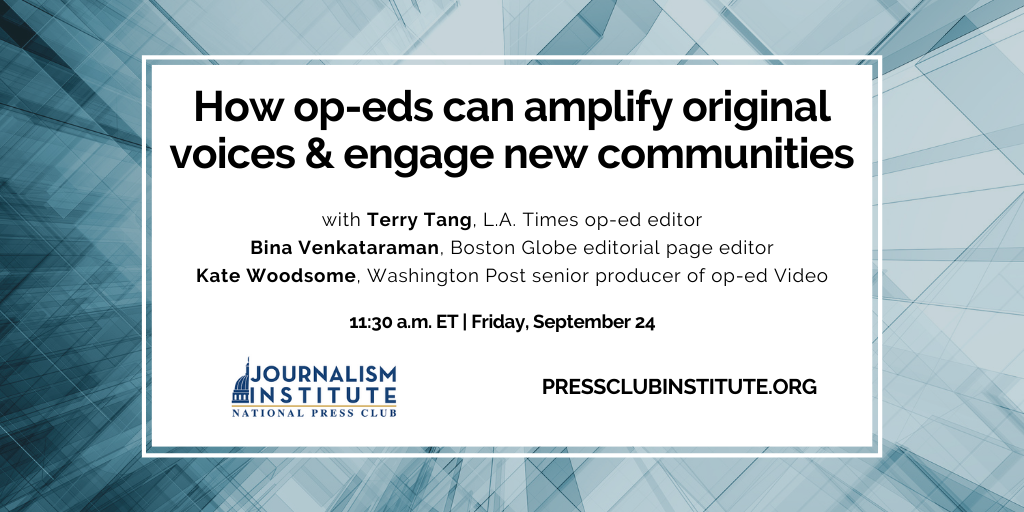
Join the National Press Club Journalism Institute and a distinguished panel to learn how to:

  • Choose voices to feature in ways that differentiate your op-eds from the noisy crowd
  • Clarify each op-ed’s purpose, and use persuasive strategies that are most effective
  • Identify specific audiences for op-eds and ways to know whether you’ve reached them

Registration is now open for this program, which will take place on September 24 at 11:30 a.m. ET.

Panelists include:


The Institute is offering this program at no cost thanks to a generous grant from the Gannett Foundation.
Resources
This newsletter is written & edited by the National Press Club Journalism Institute staff: Beth Francesco, Holly Butcher Grant and Julie Moos. Send us your questions and suggestions for topics to cover.

Get this from a friend? Subscribe, and view the archives.