The Ohio Water Resources Center Newsletter
Issue 10 | Volume 6 | October 2024
| |
|
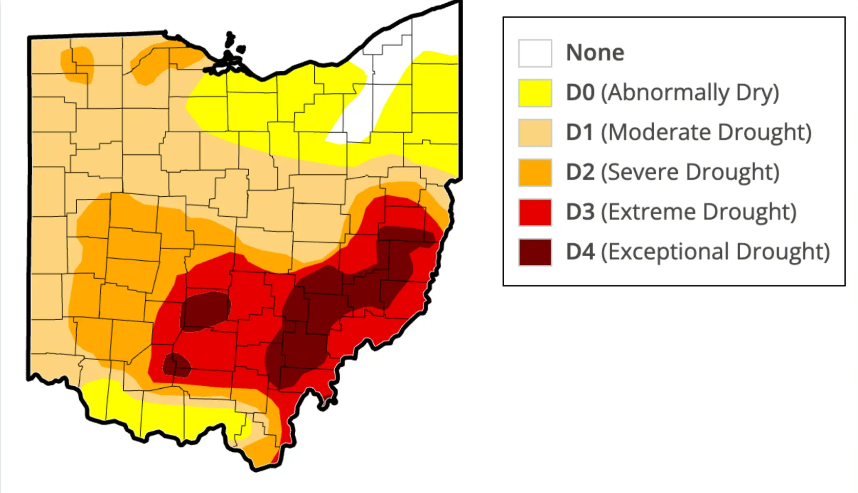
This summer has had drier conditions than usual across the state and as a result Ohio is experiencing the worst drought in over 20 years. Due to the reduced precipitation, over 95% of the state is experiencing some level of drought. Prior to the rain from Helene, 59% of the state was under severe or extreme drought conditions and 9.5% was under exceptional drought conditions. Little precipitation and high temperatures have also led to low levels in recreational and drinking water reservoirs across the state.
This drought greatly impacts farmers and agriculture across the state. Farmers are seeing reduced crop yields due to the extremely dry conditions, possibly impacting prices and availability of local produce this fall, like apples and pumpkins. On August 16th, 22 counties across Ohio were designated as natural disaster areas resulting in federal financial relief being provided to farmers during these extreme conditions. As extreme weather events like this become more common, it is important for us to be aware of our water usage and availability.
To follow current drought conditions across Ohio, click here.
Map via Cleveland.com, September 19, 2024
| |
Wireless Distributed Sensor Network for Monitoring Fixture Use in Premise Plumbing Systems | |
Dr. Tao Li, an associate professor at the University of Cincinnati, completed an Ohio Water Resources Center funded project via an Ohio Water Development Authority subaward. Instantaneous peak water demand is a vital consideration when designing buildings as it affects the scale and cost of the entire premise plumbing system. Determining peak water use can be difficult because it is not predictable and varies from day to day. Predictions are based on 100 year-old research that applies probability principles to predict peak water demand based on fixture flow and the total number of fixtures in a building. The goal of Dr. Li's work is to develop a new method to determine peak indoor water use.
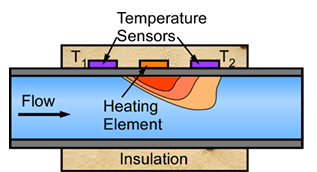
Dr. Li and his team developed and tested a low-cost, battery powered, miniature wireless sensor module for continuous, non-invasive detection of flow through pipes in plumbing systems. When deployed, the sensor network accurately monitors the incidence and patterns of water usage at various fixtures. While more work is needed before such a system is ready for wide implementation, this project identifies a path forward to determining peak flow in premise plumbing.
| | | |
A new strategy to help unleash USGS eDNA capabilities | |
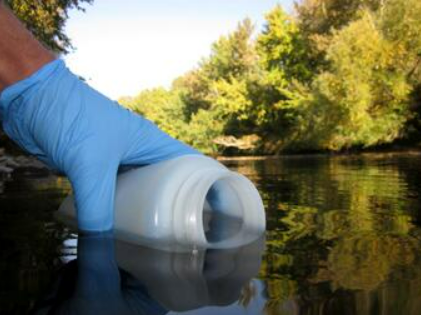
What if you could know which plants and animals lived in an area with just a little bit of water? It turns out you can. Using a small amount of water, scientists can use residual genetic material to look at its genome to figure out which species are present. They call this genetic material environmental DNA or eDNA because it is taken from the environment and contains DNA from multiple organisms. Aquatic biodiversity is important culturally, economically, and for the health of society and ecosystems. Using a non-destructive sampling method such as eDNA, measurements can be made on a scale from a single pond to a river system and even the oceans, allowing for trends in biodiversity to be observed.
Recent research and development of eDNA methods has been done by the White House Office of Science, Technology, and Policy (OSTP) and USGS. The goal was to develop a 'National Strategy for Aquatic Environmental DNA' and allow federal agencies to better use eDNA as a detection tool.
A major focus of USGS’s eDNA research has been to develop tools and methods to support the National Early Detection Rapid Response Framework. The EDRR Framework is an interagency effort that focuses on creating eDNA sampling processes and tools to improve early detection of invasive species, expanding capacity to operationalize eDNA surveillance.
Over the last decade, the USGS has published over 100 articles developing, improving, and applying eDNA tools and strategies. Work continues to further eDNA technologies and implement guidance and standards enabling it as a reliable form of biosurveillance. With the release of this national eDNA Strategy, the USGS is hoping that use of this tool will inform policy and aid in decision-making.
| | | |
Ohio EPA: Early Stakeholder Outreach- Water Quality Standards Antidegradation Rule (OAC 3745-1-05)
The Division of Surface Water (DSW) is proposing to amend rules governing Surface Water Monitoring in chapter 3745-1-05, covering antidegradation procedures, are looking to split this larger rule into two smaller rules, and update the tables of special waters based upon the results of recent water quality stream and river surveys. DSW seeks comments on a plan to file Surface Water Monitoring rules. Comments are due by October 9, 2024 and can be submitted to dsw_rulecomments@epa.ohio.gov.
Ohio EPA: Underground Injection Control
Ohio EPA Division of Drinking and Ground Waters (DDAGW) is proposing to amend rules in chapter 3745-34 of the Ohio Administrative Code. An in-person and virtual public hearing on this proposed rulemaking will be held to consider public comments on October 16, 2024, at 10:30 AM. Stakeholders will be able to comment in-person within the DDAGW Summer Conference Room at the Lazarus Government Center, 50 West Town Street, Suite 700, Columbus, Ohio 43215. During the hearing the public can submit written comments that will be read into the record by the hearing host. Citizens who want to participate virtually or in person must register in advance. All comments at the hearing or in advance are due by close of business on October 16, 2024. In advance comments can be submitted to DDAGW_Comments@epa.ohio.gov.
| |
|
Request for proposals: 2025 UCOWR/NIWR Annual Water Resources Conference
UCOWR and NIWR are requesting proposals for special sessions for the 2025 conference. Special sessions are an important component of the conference and provide an opportunity to delve into current perspectives on various water resources challenges. Sessions that cover a broad range of water-related research, management, extension, and education topics are welcomed. Proposals are due October 11, 2024.
Call for Abstracts: ASLO 2025 Aquatic Sciences Meeting
The Association for the Sciences of Limnology and Oceanography, is seeking applications for poster and oral presentations for the 2025 meeting. This year’s meeting focuses on the connectivity between all water systems and how we are connected to those systems. Poster and oral presentations can cover a broad range of water related research, management, extension and education. Abstracts are due October 21, 2024.
Call for Abstracts: 5th Annual Harmful Algal Bloom Virtual Symposium
The Algal Bloom Action Team, is seeking applications for presentations for the Fifth Annual Harmful Algal Bloom Virtual Symposium. They are looking for projects in management, forecasting, detection, prevention and treatment, human dimension, and climate change impacts that address harmful algal blooms (HABs) in the North Central Region of the United States. Abstracts are due October 22, 2024.
| |  |
|
Request for Proposals: H2Ohio Methods to Identify High Phosphorus Loss Sites Research Grant
H2Ohio's Phosphorus Removal Structures Program, is seeking proposals for projects that focus on identifying the measurable site parameters most indicative of dissolved phosphorus losses from Ohio cropland, specifically in the Western Lake Erie Basin. This investment in research will aid ODA in identifying high phosphorus losses from agricultural sites, and recommend processes to identify sites suited for removal structures. Proposals are due December 31, 2024. Proposals are due December 31, 2024.
Request for Proposals: H2Ohio Technology Development / Improvement Grant
H2Ohio's Phosphorus Removal Structures Program, is seeking proposals for projects that focus on technology development for phosphorus removal structures that address dissolved phosphorus losses from cropland. This investment in research will aid ODA in efforts to develop new or improve existing phosphorus removal structures using designs that are effective for Ohio’s WLEB watershed. Proposals are due December 31, 2024.
| | |
|
Webinar: Reap the Benefits of Ohio's Circular Economy
October 23, 2024 • Virtual
Ohio's Materials Marketplace and Rheaply, dive into how it facilitates product reuse/recycling synergies. The webinar will feature Jessica Dalzell from Ohio EPA, sponsor of the Ohio Materials Marketplace, and Daniel Kietzer from Rheaply. October 23, 2024 from 10:00-11:00. Register to receive the link
Webinar: Fish Farming, Food Systems, and Recreation Aquaculture in Ohio
October 29, 2024 • Virtual
The Freshwater Science Speaker Series, hosted by Ohio Sea Grant, has Nicole Write sharing details on what aquaculture looks like in Ohio, reasons why fish are farmed, and the challenges and opportunities associated with this agricultural sector. October 29, 2024 from 12:00-12:30. Register to receive the Zoom link
Symposium: Interdisciplinary Water Research Symposium
Nov 8, 2024 • Nationwide & Ohio Farm Bureau 4-H Center, OSU, Columbus, OH
The Second Annual Interdisciplinary Water Research Symposium is an event organized by graduate students with the aim of fostering collaboration and knowledge exchange in the field of water resources. Registration and student abstract submission is here.
Summit: Young Professionals Summit
Nov 15, 2024 • DelCo Water Company, Delaware, OH
The first ever Ohio summit for young professionals currently in or interested in the water industry. This one-day workshop will include networking opportunities, leadership development, and hands on activities such as the Water Circuit Challenge, the YP Power Hour, and a Panel discussing developing your mentor relationships. Register here.
| |
|
Get in Touch
Email: OhioWRC@osu.edu
Website: https://wrc.osu.edu
Address: 473 Hitchcock Hall
2070 Neil Avenue
Columbus, OH 43210
| | |
| | | |