News and information to help journalists serve the public and stay safe.
|
|
Thank you to all the journalists who will be working this long weekend. This newsletter will return on Tuesday, May 26.
|
|
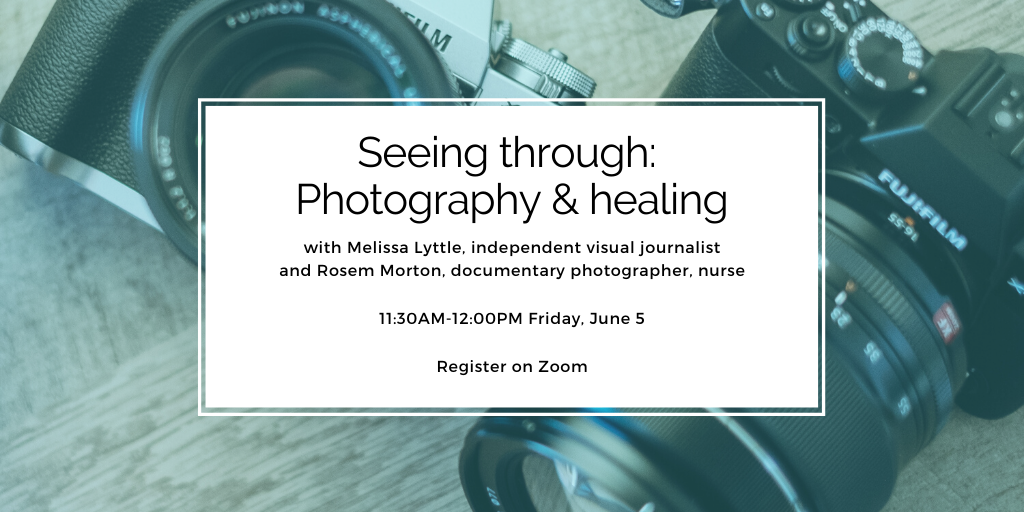
Images take us into hospitals, grocery stores, even empty spaces to show us the impact of coronavirus on the people and places affected by the pandemic. Award-winning independent photojournalist
Melissa Lyttle
and documentary photographer
Rosem Morton
,
who is also a nurse
, will talk about photography, trauma, and healing.
|
|
Imagine a writing contest that embodies key values of journalism — education, speed, creativity, diversity. Throw in a dash of TikTok-style social networking and douse it in COVID-19 isolation. That’s
The Big Scribble
, an idea conceived last month in the midst of the pandemic that in days generated more than 400 writing entries from student journalists in the U.S. and abroad.
The idea sprang from author and former Sports Illustrated writer
Jeff Pearlman
. He tested the idea with friend and fellow author
Jonathan Eig
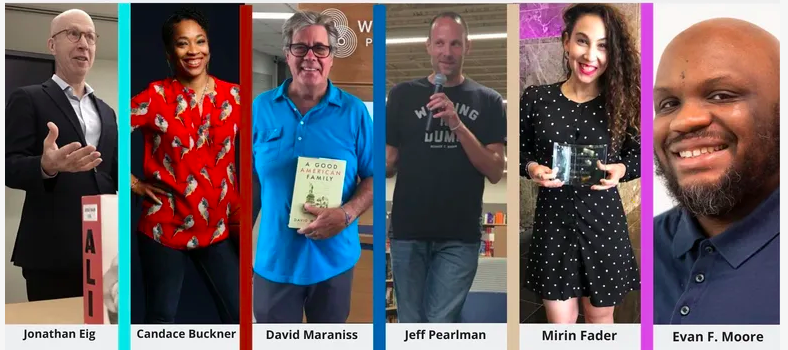
. In two weeks, the contest launched with Pearlman, Eig and four other accomplished writing colleagues as judges — David Maraniss, Candace Buckner, Mirin Fader and Evan F. Moore (pictured).
“The funny thing is how little thought/planning was put into this,” Pearlman said by email. “It went from
idea in my head
to
texting with Jon
to
OK, let's do it
to
we need a name
to
let's get guest judges
to
wow, we're at the finals.
This wasn't months in the planning. This was days in the planning. Weird.”
This week, after 409 entries, five prompts, thousands of words, and plenty of videos, the judges culled the contestants down to 10. The winner and runners-up will be announced Sunday.
The winner will receive a $200 gift certificate to the indie bookstore of their choice, a letter of recommendation from the judges, a guest appearance on Pearlman’s “Two Writers Slinging Yang” podcast, autographed books, and one-on-one consultations with a long list of journalists and writers from across the country.
To whittle the contestants down, the judges assigned one prompt a week. The first, a profile of someone you know. Then, a food review. The third, the pandemic’s impact on hair. The fourth, an obituary of [the still living]
singer
Mariah Carey
, former Soviet leader
Mikhail Gorbachev
,
child star
Jonathan Lipnicki
, or former baseball player
Bip Roberts
.
The final 10 are now wrapping up the final prompt: An essay about affection during the pandemic.
|
|
Bill Plante Chair in Leadership & Media Integrity, Loyola University Chicago
Freedom Forum Fellow in Women’s Leadership
According to the authors, onboarding does more than say hello. Done well, it expedites both social connections and information-sharing. People succeed when they know how the operation’s networks, systems, tools and processes work. They’re more likely to reach out for help and resources when they need it if they know the ropes and the folks.
They’re more likely to stick around if they feel they belong.
If organizations are still learning to do onboarding right in the traditional office, imagine the possibilities for screwing it up today, when a new hire can’t get a tour of the building, or be treated to cupcakes in the break room.
Fortunately, smart managers are trying to be as creative with remote onboarding as they are with long-distance team-building.
One reached out to me to share her plan for welcoming a new hire during social distancing - and make sure she hadn’t missed anything. She had already made a plan that emphasized lots of communication, connection and collaboration. She understood that the impressions people get right out of the blocks can color their view of the job, their colleagues and the culture. In a very smart move, she enlisted the CEO in her strategy. He reached out to the new staffer with a personal welcome, too. Bravo!
Here’s a very cool plan that was shared with me by a human resources manager in higher education:
“We just hired a new employee on the HR Team. This is her second week. The challenge to the rest [of] my team was to ensure she feels the same sense of belonging in the team as everyone else who was onboarded with face to face contact. Before she joined the team, we sent her a Powerpoint - one slide per team member with pictures and information about us - personal and professional. We have had lots of team check-ins to get to know her better, including a virtual happy hour last Friday. I feel like I know so much about her already, and she is really getting to know me and the rest of the team as well!
In these miserable budget-cutting days, you might not have the joy of adding someone to your team. All the more reason to apply the lessons of remote onboarding to your existing team members. Treat them as if you’re trying to make a great first impression.
|
|
|
The National Press Club Journalism Institute is spotlighting
the next generation of journalists
, students graduating from college or Master’s programs this spring into
a challenging job market
, in hopes they’ll meet future bosses and colleagues here who will reach out and support them in building journalism’s future together.
School
: Northwestern University, Medill School of Journalism
Location
: Washington, D.C.
Reporting from
: Iraq, Paris, Germany and Brussels
What's been your best moment in journalism?
Snell:
I pitched a story to
Al-Monitor
about a new show premiering for children in the Middle East that was designed to help them learn to understand and communicate their emotions. Before my reporting, I read a number of stories about the show that all followed the same script: talk to the show's EP, maybe one of the organizations funding the initiative, and then move on to the next story.
But I believed this new show was so critical for children in the region that it would be important to talk to one of the children that watched the premiere. So after many phone calls and email exchanges with multiple organizations and hitting a number of dead ends, I was put in touch with a contact that allowed me to access children in Syria that were gathering to watch the premiere. The comments from the children were so different and authentic from the executives and funding organizations in a way that captured the story perfectly. It was the first time these children were asked about their thoughts of the premiere, I later found out. The reaction from the children was a small bit to include in
my final story
, in total only a few grafs, but I believe it made all of the difference.
|
|
Scavenger hunts — whether you’re designing complex riddles or hunting down items in your home — can help
boost your mood and ease stress
while socializing with friends and family.
For a more personal approach, try creating a straightforward list of items or
develop riddle clues
for your searchers to solve. Set a timer, share the list with a group, and see who finds the most items in the time limit.
Themes for hunting items inside your home:
- A mix of everyday things (like a fork or a baseball cap) and some unique things (like a yellow flip-flop or potted aloe plant). Here is a list to get you started.
- A word-themed search: Participants search for items that represent the word selected, then share with the group.
- A monochromatic color item hunt. (All the blue things you can find.)
- A photo hunt. Participants hunt for items or scenarios in their phone’s photo gallery.
- Things that start with the first letter of the person’s name.
Themes for heading outdoors, safely. Use the ideas above, or try:
- Historic, cultural or iconic landmarks in your neighborhood or city. (Use Walking Milwaukee’s example as a guide.)
- Meaningful locations for your loved one(s). (Especially good for date night!)
- Buried treasure. Have each part of the hunt lead to the next clue, ending with a fun or valuable find for the first person finished.
|
|
This newsletter is written & edited by the National Press Club Journalism Institute staff: Beth Francesco, Holly Butcher Grant, Jim Kuhnhenn, and Julie Moos.
Send us your questions and suggestions
for topics to cover.
|
|
|
|
|
|
|