Breaking the Limits of Reality | | Remedios Varo interweaves art, science, surrealism, and mysticism | | Detail of Remedios Varo “Harmony" | | |
“I do not believe that in its essence it (Surrealism) can decline since it is a sentiment inherent to man…Surrealism has contributed to art in the same way psychoanalysis has contributed to the exploration of the subconscious”
| | |
A visionary lone painter, Remedios Varo, typically portrays herself sitting at a desk engaged in magical work, embarking on a journey to unlock true meaning, or dissolving completely into the environment that surrounds her. As a well-studied alchemist, seeker, and naturalist, however dreamlike her imagery may appear, it is in fact reality observed more clearly; Varo painted deep, intuitive, and multi-sensory pictures to inspire learning and promote better individual balance in an interconnected universe. Her personal hallmark: imaginary worlds where dreams and reality coexist in the same space. Women’s faces announcing something fatal and, at the same time, fascinating. A highly personal space where the most disturbing and, paradoxically, attractive nightmares have a place.
Every work completed by Varo demonstrates profound technical skill and an extraordinary insight into human nature. Fantasy and reality, magic and science, the imagined and the empirical — these seemingly opposing forces are united in Varo’s work. She was an exceptionally well-read polymath, whose scientific knowledge fed into her work and fused with its spirituality and mysticism. The experience of displacement was a frequent symbol reflected in Varo’s paintings of people — sailing in precarious boats, wandering through forests and riding bicycles.
| | |
A native Spaniard, Varo spent most of her life in transit, first due to her father’s transient job during her childhood, then in adulthood as a political refugee. It was not until the last 13 years of the artist's life, having fled war-torn Europe, that Varo found a home in Mexico (among a community of other displaced Surrealists) and finally became free of limiting financial constraints that she was able to paint prolifically.
In Mexico, Varo has been revered as a cult figure since the 1950s. She only completed about 100 paintings throughout her career, many of which are in museum collections in Mexico. Although Varo was relatively successful in her lifetime, it is only recently that she has begun getting the international recognition that she deserves. Almost 60 years after her death, Varo’s work continues to rise on the market. The scarcity of her work means that her paintings rarely surface at auctions, and she has had very few solo exhibitions.
Following her death in 1963, the art critics of Novedades called her "one of the most individual and extraordinary painters of Mexican art." Solo retrospectives of her work opened in 1964, 1971, and 1983 in Mexico. A major book, “Obras de Remedios Varo”, was published following the first retrospective and sold out all three of its subsequent printings to become a highly valued collector's item.
The value of her work has only increased following Varo’s paintings appearing in the Venice Biennale of 2022 and a major solo exhibition at the Art Institute of Chicago in 2023. Her painting “Harmony” sold in 2020 for over $6 million!
| | |
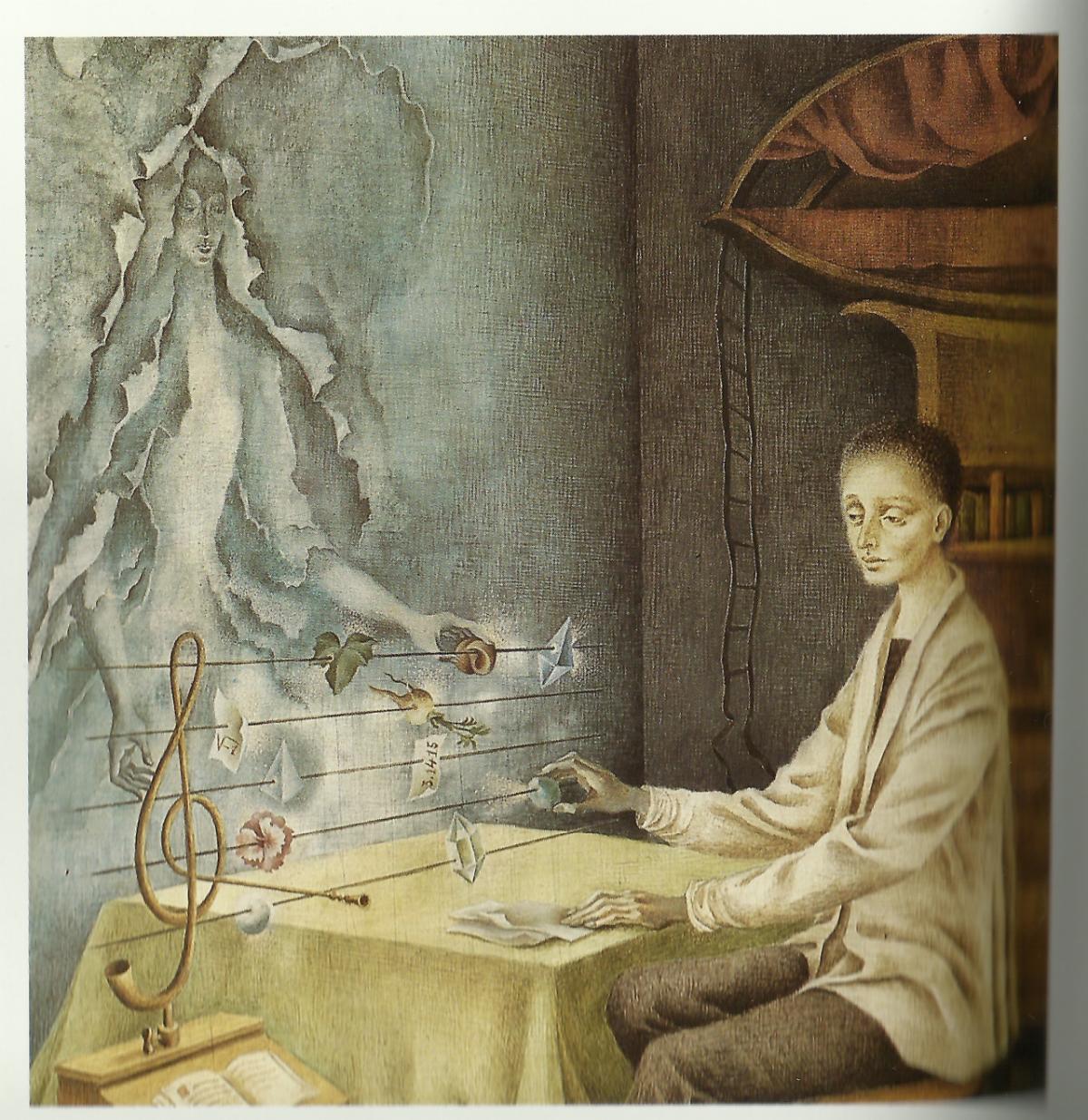
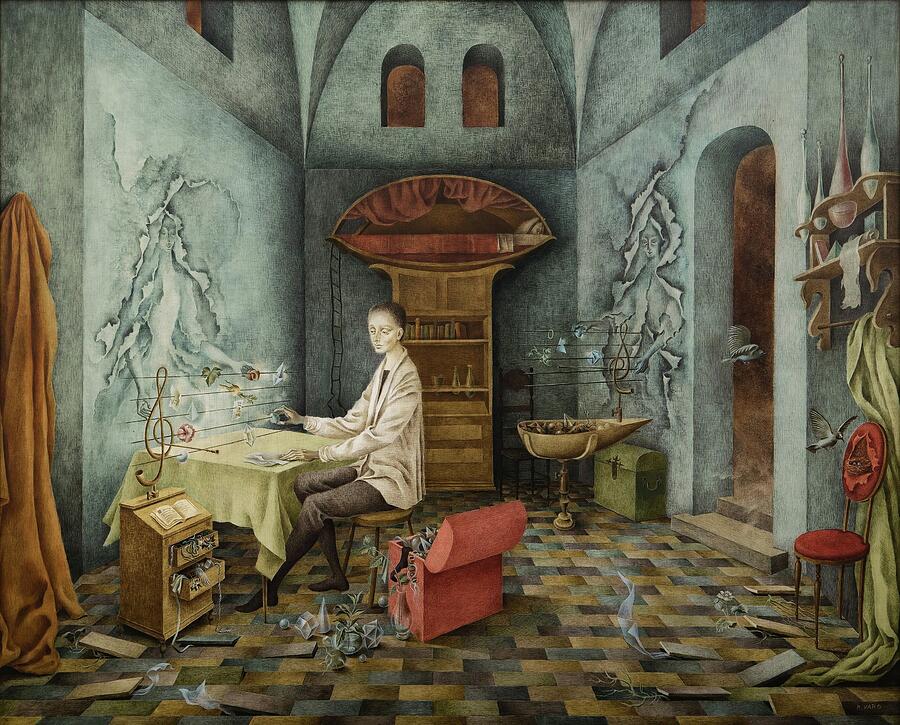
“Harmony” was conceived as a self-portrait, where the author takes on the role of the organizer of the universe, using a sheet music mill to connect with creatures from other dimensions through music. Varo repeatedly turned to music as a symbol of the wholeness she sought. In Harmony, she created the world of the composer, a quiet, dark world of diligent study. An androgynous figure whose features mirror Varo’s own sits in a medieval-looking study filled with the tools of the alchemist. Taking objects from a treasure chest—geometric solids, jewels, plants, crystals, even a scrap of paper with the mathematical constant, pi, written out to six digits. The person, Varo wrote in a note addressed to her family, “is trying to find the invisible thread that unites all things.”
They are then placed as notes onto a three-dimensional musical staff, which is being used as an arranging tool, and by doing so, creates from a chaos of possibilities, the order that is music. On the wall behind the staff, we see a female figure who also adds items to the strings of the musical staff. This is the hand of chance, a vital ingredient in attaining scientific achievement.
Like Pythagoras searching for the secret harmony between music, nature, and mathematics, the composer looks to unite the abstract and the concrete with the intangibility of sound. Varo explained, ‘When he has succeeded in putting each of the diverse objects in its place, by blowing through the clef that supports the staff, music should come out harmonious. ’ It is the breath of the musician, through the magical process of ‘inspiration,’ that sets up the vibrations of musical harmony."
| | |
Early Life:
María de los Remedios Alicia Rodriga Varo y Uranga was born on Dec. 16, 1908, in Anglès, a small town in northeastern Spain. Her father, Rodrigo Varo y Zejalvo, a hydraulic engineer, fuelled her interest in mathematics, science and perspective from an early age. As a child, he would ask her to copy the technical plans and architectural diagrams of his various projects and often had her redo them if they were not exact replicas. His work often necessitated moving his family throughout Spain and North Africa.
Her mother, Ignacia Uranga y Bergareche, a devoted Roman Catholic from the Basque region, named María for the Virgin of Remedies (the Virgin Mary), and for an older sister who died before Varo was born.
At 8, after her family had settled in Madrid, María was sent to a strict Catholic school for girls, where she escaped into adventure books by Jules Verne and Alexandre Dumas. Rigid school routines — prayer sessions, confessions, group sewing and the like — made such an impression on her that they would inform the subject matter of some of her most famous works (“Embroidering Earth’s Mantle,” the second panel of a triptych, being just one).
| |
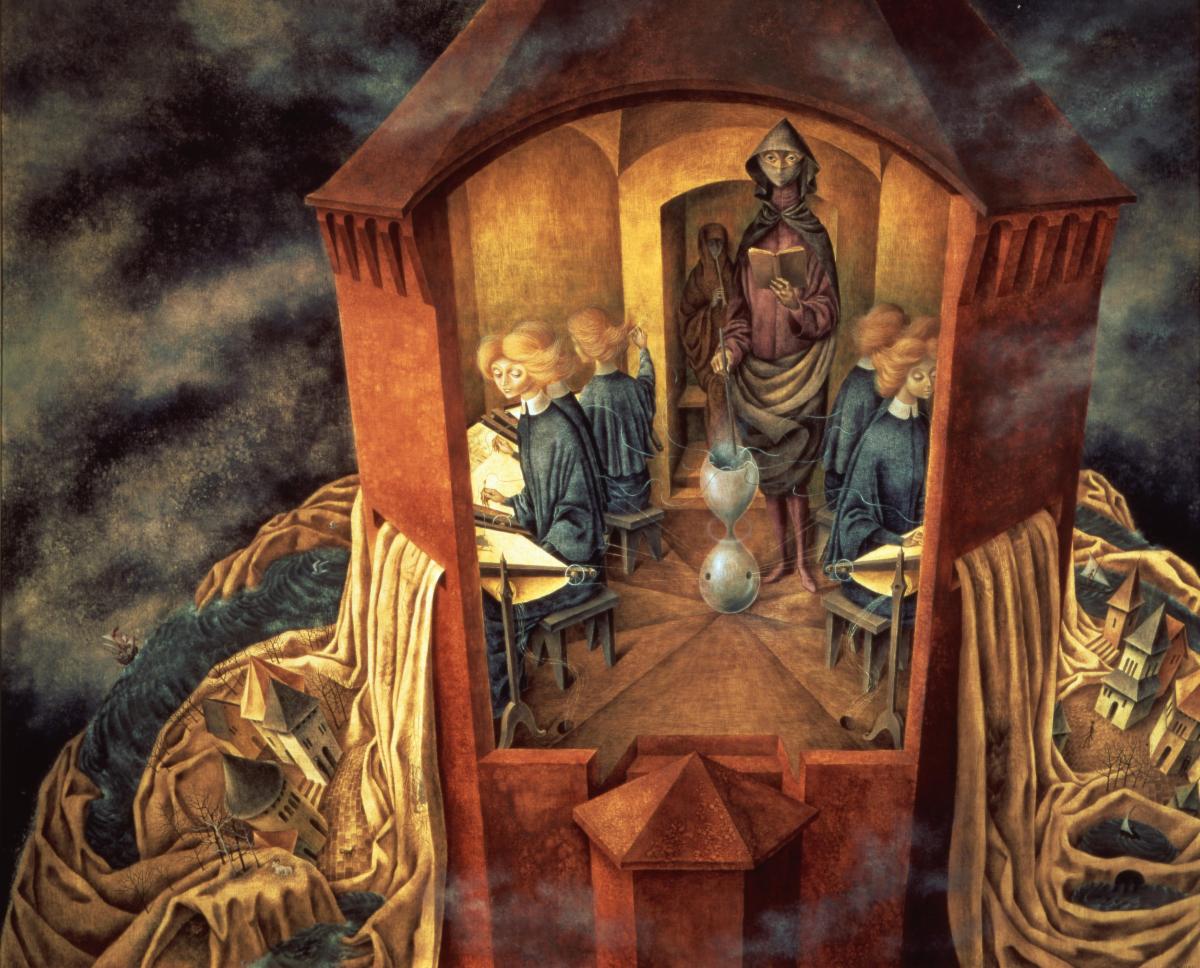
In the opening of Thomas Pynchon’s postmodern novel “The Crying of Lot 49” (1965), tears stream down the face of his protagonist, Oedipa Maas, as she takes in a Surrealist painting of “a number of frail girls with heart-shaped faces” who appear to be “prisoners in the top room of a circular tower.” The girls are embroidering a kind of tapestry that streams out of the windows.
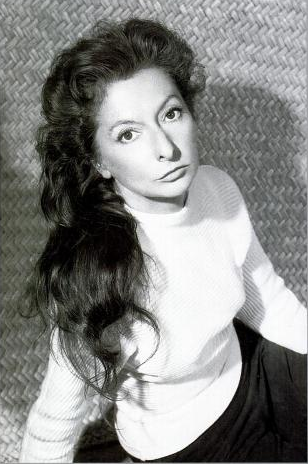
The scene is fictional but the piece is not: It is “Embroidering the Earth’s Mantle” (1961), by Remedios Varo, her elaborately detailed, often allegorical paintings, often depicted convent schoolgirls embarking on strange adventures; androgynous, ascetic figures absorbed in scientific, musical or artistic discovery; and solitary women — some of whom resembled the slender, striking Varo herself — having a transcendent experience.
At the peak of the multi-faceted medieval tower, a "Great Master," as Varo described him, stands at the center and stirs an hourglass-shaped cauldron reminiscent of part of the apparatus introduced to the viewer in The Creation of Birds. This looming master of ceremonies and the figure playing the flute in the arched alcove behind him are veiled and cloaked. The master reads from a catechism of instructions, as the alchemical device produces a web-like thread with which six almost identical girls sew. The fabric that they embroider pours out of the openings in the tower, unfolding to become the earth's mantle, replete with active towns, mountains, and lakes. Trapped in their toil, the women create the world.
This is one of three paintings that focus on Varo’s experiences in convent school and which all tell a feminist narrative of a young woman's journey to autonomy. The first painting in the series, Towards the Tower(1961) depicts a number of almost identical girls, following a nun, on bicycles and emphasizes the rigid conformity expected of women in Catholicism. The third painting, The Escape (1962), depicts one of the young women having successfully fled the convent with her lover. The second painting of the series, depicted above, shows the narrow, claustrophobic tower located in the sky, indicating confinement. Varo paints all the girls to resemble one another to show that they are interchangeable, all assigned to women's work overseen by male authority. Their golden hair has been cut to prevent a Rapunzel-esque escape.
| |
Education:
In 1924, a time when few women were allowed into art school, Varo was admitted to Real Academia de Bellas Artes de San Fernando in Madrid where both Pablo Picasso and Salvador Dalí had studied. She enrolled at the age of 15, and in 1930 received her diploma as an art teacher.
The Academia was known for its strict adherence to the technique of the Old Masters. It was an experience that she found liberating. She said of her education, "I took advantage of all that I learned, in painting the things that interested me on my own, which could be called, together with technique, the beginning of a personality." Her "personality" felt a strong affinity with Surrealism, which was simultaneously becoming a vital part of the artistic atmosphere in Madrid more generally. Varo also visited the Prado frequently to view the works of Hieronymus Bosch and also saying, "I am basically interested in the primitive painters, and besides them, El Greco and Goya."
The perspective drawing method, illusionism techniques, tonal nuances, and narrative structure of Renaissance paintings inspired Varo. The allegorical nature of much of her work and her focus on magic and alchemy especially recalls the paintings of Hieronymus Bosch, but we can also recognize the influence of Francisco Goya and El Greco. Varo developed her own meticulous painting process that was inspired by Renaissance panel painting and differentiated her from her contemporaries: she would transfer underdrawings onto gessoed fibreboard and build up luminous colours with layers of oil and varnish, adding tiny details with a single-hair brush
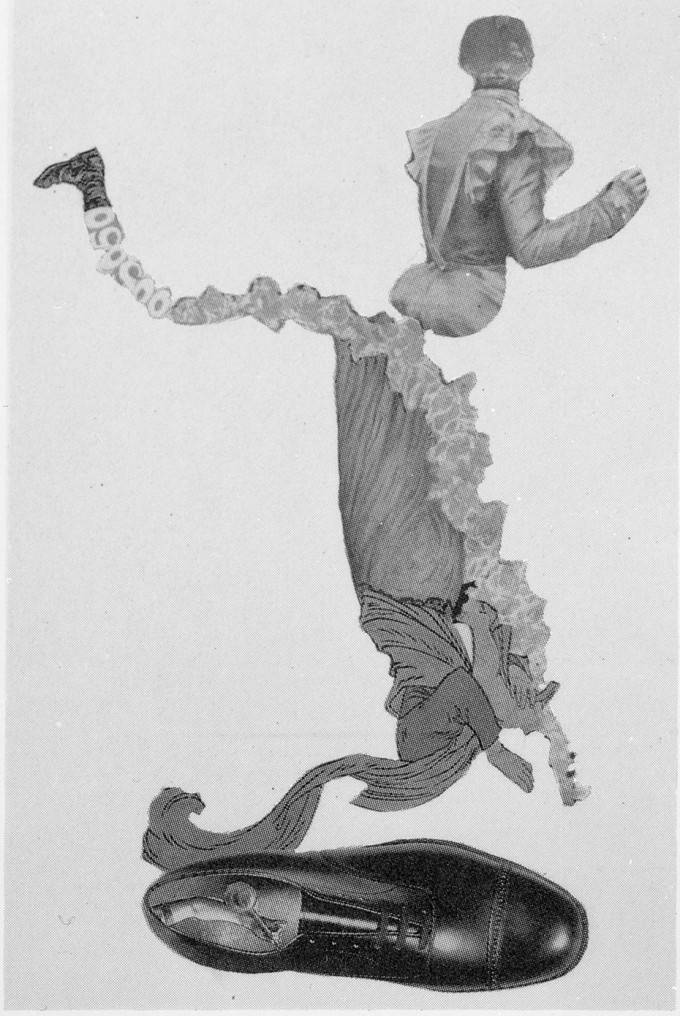
| | Remedios Varo “Exquisite Corpse" | | |
In 1930 Varo married Gerardo Lizárraga, a fellow art student and political activist, saying herself that she was drawn to the "life of poor bohemians, confident and carefree". The couple went to Paris in 1931 where Varo insightfully recorded that the many conversations held in the cafés there were at once her "hearth and trampoline." Returning to Spain, the couple settled among the avant-garde in Barcelona,
Varo began collaborating on numerous 'exquisite corpse' works with Surrealists Oscar Dominguez, Marcel Jean, and Esteban Francés. With extraordinary results, each artist would draw an image or paste a cut-out onto a sheet of paper and then fold it to hide part of the image, before passing it on to the next artist to do the same.
In 1936, she exhibited with the Logicophobists, a group of artists who sought the union of art with metaphysics. As she wrote, "we are doing everything possible to make something fully 'surrealist.’” By 1937, her work was appearing in Surrealist publications, then in international exhibitions in London, Tokyo, Paris, Amsterdam, and Mexico City. Indeed, Varo also revolted against conventional norms in her personal life. While still married to Lizárraga, she began a relationship with Esteban Francés, a Spanish Surrealist painter, yet all managed to remain on good terms.
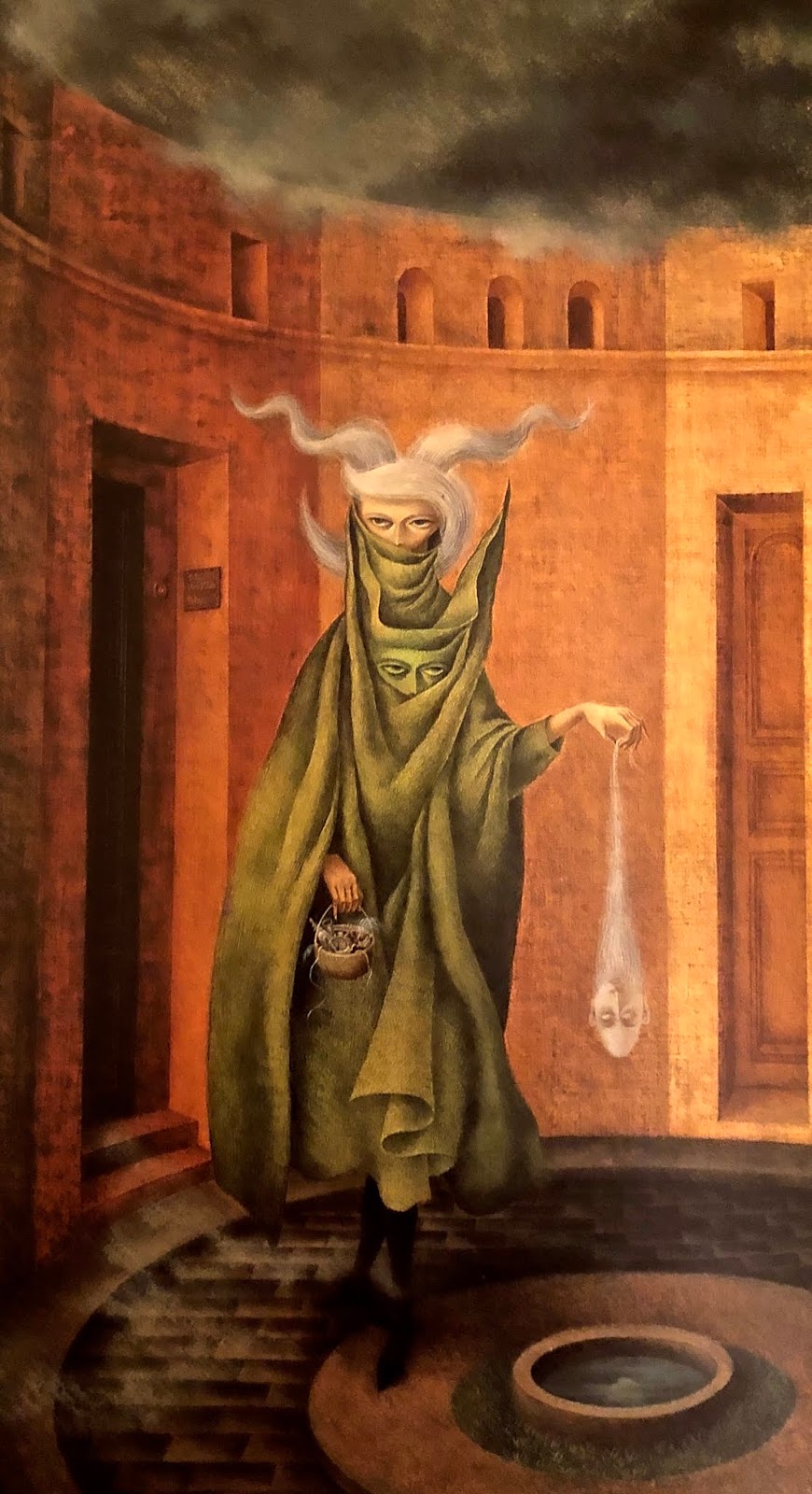
| | In “Woman Leaving the Psychoanalyst,” Varo places psychoanalysis in a medieval setting, with the initials of its three fathers inscribed on the portal behind the central figure, ‘FJA’ standing for Freud, Jung, and Adler. Varo uses the various associations of the veil to invoke seduction (Salome) and the idea of unveiling to reach psychological or metaphysical truths. This painting is a dream in itself. Each of its elements can be interpreted as a bridge between the world of dreams and the feelings of reality. The woman is shrouded in a garment that contains a mask, but her face is partly uncovered. The faces are duplicated as a way of revealing double personalities, the hair that floats and tangles like menacing snakes. Without a trace of hesitation, she drops a male disembodied head (Varo’s father’s? or, more likely, Péret’s?) down a well, which, Varo wrote, was ‘the proper thing to do when leaving the psychoanalyst’. This is one of the most important paintings of Surrealism. | | |
Surrealism/Mysticism:
Varo was not only a leading female artist of the Surrealist movement, but she also frequently used her art to assert the collective power of women and femininity. Likewise, her paintings often represent women as the central protagonists, fully in control of the environments they inhabit. She frequently incorporated motifs like ‘the cage’ and ‘the tower’ into her work, representing the urge to break free from patriarchal structures, and her use of feminine tropes like ‘the boudoir’ in her work was just as revolutionary in the male-dominated world of Surrealist painting.
Despite Surrealism’s insistence on cultural liberation, it was largely an all-male affair. The 1924 Surrealist manifesto excluded female artists, and women were often relegated to the role of 'artist's muse.' The work of Varo together with that of other artists of her generation like Leonora Carrington, Leonor Fini and Dorothea Tanning, represented a vital antidote to this male-dominated narrative. Varo differed from other Surrealists in her frequent use of religious imagery. Catholicism, Western and non-Western mysticism, magic-based faiths, witchcraft, astrology, tarot, and alchemy as she sought to find the intersection of the mystical with the scientific.
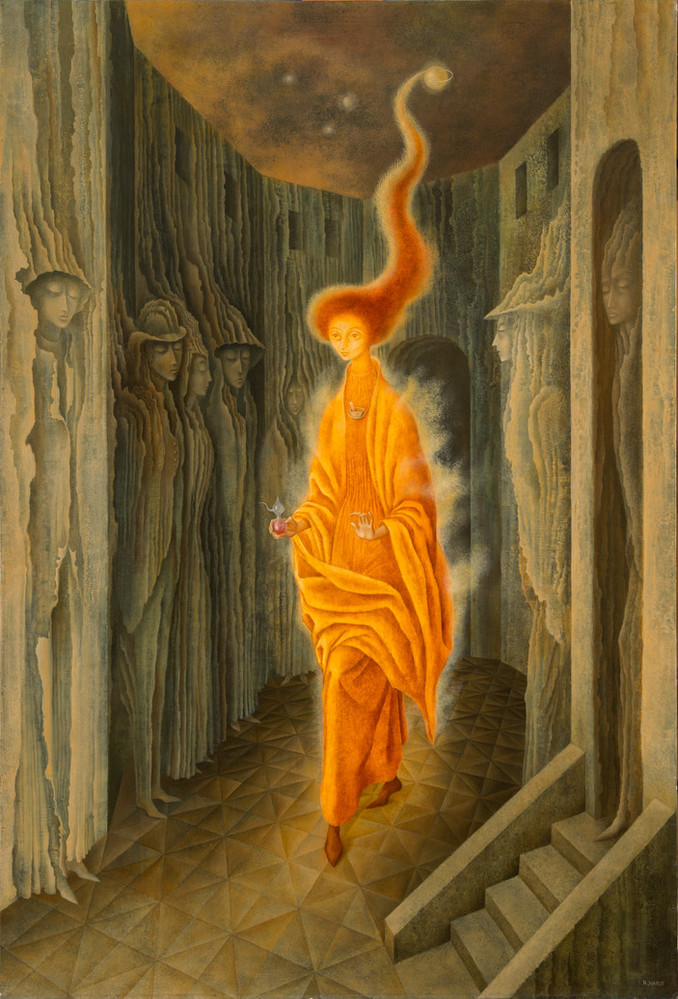
| | This painting is titled The Call (La Llamada) [1961], showing a woman dressed in a long robe walking briskly through a courtyard and carrying alchemical tools: mortar and pestle around her neck, and an alembic. She is painted in bright orange-gold, as though caught “aflame” by her desire and purpose to answer the Call. Her hair is linked to the celestial body in the sky, meaning that, in her nightly adventure, she may be “driven” by “heavenly designs”.Her style is reminiscent of Renaissance art in its exquisite precision, but her dreamlike paintings often share a common theme: a quest to reach a higher state of consciousness. | | |
The mystic George Gurdjieff particularly influenced Varo. She attended consciousness-raising workshops based on his teachings, where participants were guided to tap into their deepest imaginations. They would concentrate for hours on an inanimate object, like a chair, focusing on the life that had existed within the object. The wood in the chair, for example, had come from a tree, which had once been alive. Gurdjieff’s perspective informed her work, where natural and artificial objects and bodies often mirror and merge into one another.
However, she was also undeniably influenced by her Surrealist contemporaries like André Breton and Giorgio de Chirico, and she used Surrealist techniques like decalcomania, in which designs on paper or aluminium foil are pressed onto another surface, transferring the image.
| | |
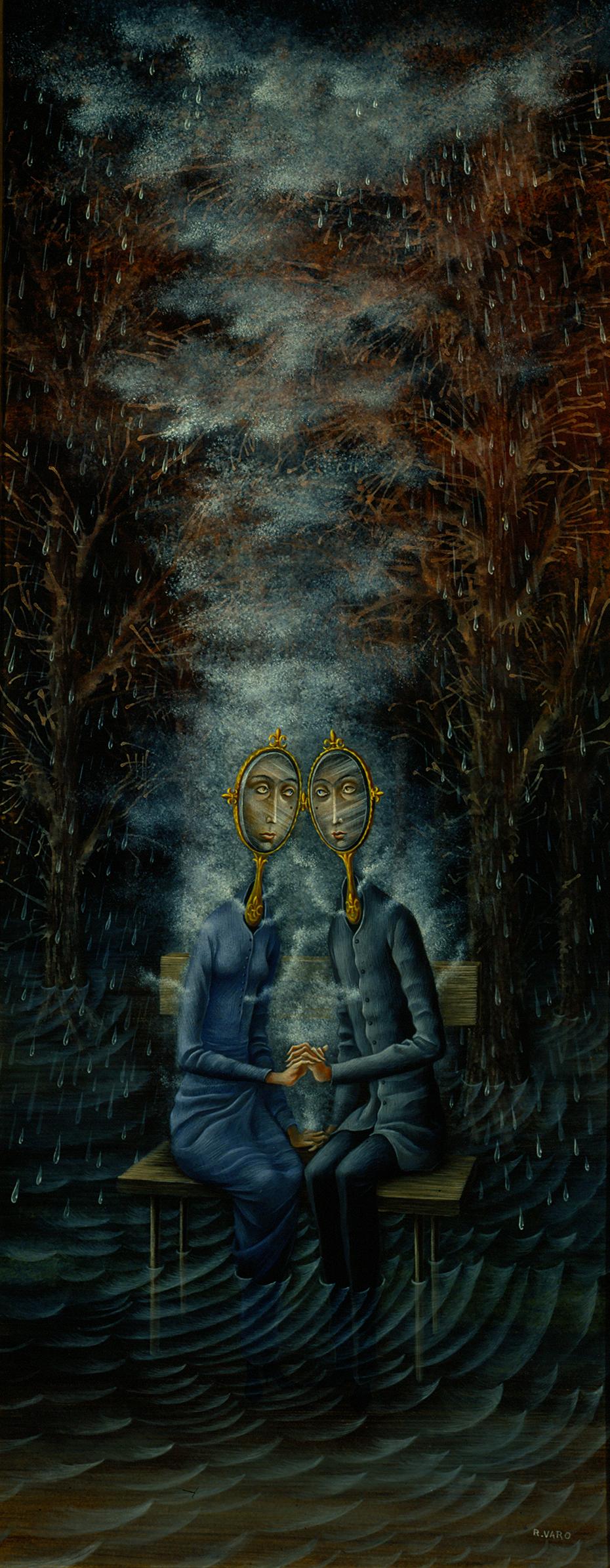
Varo also presented the bonds of love as an impediment to true autonomy. Having deferred her artistic development to the demands of several love affairs, she had reason to understand that such relationships could block personal fulfillment. In The Lovers, she depicted a couple holding hands, lost in each other’s gaze. The partners’ heads have been replaced by mirrors, so what they see is not each other but reflections of themselves. The power of this narcissistic attraction is so great that it generates steam that rises, condenses, and falls back down as rain, creating a flood that swirls around their legs. They will surely drown if they do not break out of their stuporous adoration.
| | |
Paris:
In 1936 Varo met Benjamin Péret, a Surrealist poet who was a close friend of André Breton and a political activist who had come to Spain to support the Spanish Republic. When he returned to Paris in 1937, Varo went with him. Although very much in love, the couple's life was marked by poverty, political uncertainty, and Varo's opinion of the alternative lifestyle had become more mixed when she said "It is not easy to live on painting in Paris...Sometimes I did not have more food in an entire day than a small cup of coffee with milk. I call this 'the heroic epoch'...That bohemian life that is supposed to be necessary for the artist is very bitter."
She was introduced to the inner circle of Surrealism by Péret during this period, but said that she felt somewhat intimidated, revealing that despite feeling great affinity with certain aims and beliefs, that her own, "position was the timid and humble one of a listener. I was not old enough nor did I have the aplomb to face up to them, to a Paul Eluard, a Benjamin Péret, or an André Breton. There I was with my mouth gaping open within this group of brilliant and gifted people.’".
Although her artistic output at this point was relatively small, she did partake in major Surrealist exhibitions, experimented with the same techniques as friends such as Max Ernst, René Magritte, Victor Brauner, and Wolfgang Paalen. Varo also studied science, psychology, sacred geometry, the I Ching, and the mystical works of George Gurdjieff, P.D. Ouspensky, and Meister Eckhart.
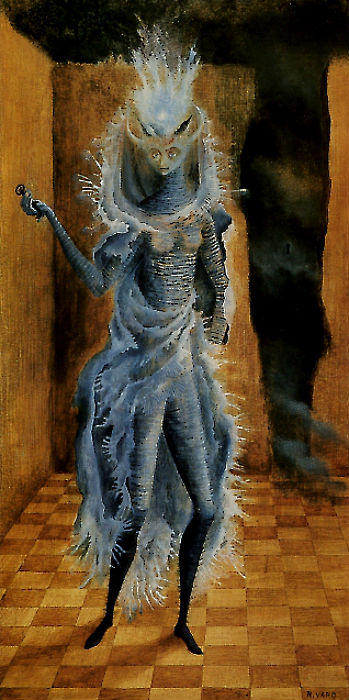
| | Varo transformed traditionally male mythic heroes into female form, creating, for example, a female Minotaur who holds a magical key before a mysterious floating keyhole. Although many of the characters in Varo’s paintings are androgynous or asexual, in these mythological transformations, she was careful to delineate the female anatomy of her heroines. The centrality of woman as a creative agent seems to be a reaction to official Surrealist doctrine, which defined woman as muse and as object of male desire. The self-referential nature of work by female Surrealists is most clearly apparent in the repeated self-portrait characters who (like those that bear Varo’s features) signal the artists’ intense quest for personal definition. Absorption with self-analysis is found throughout their work. You can see this painting here in Fort Lauderdale at the NSU Museum on Las Olas. | | |
Exile/Prison:
In February 1940, Péret was recalled to military service, and a few months later, he was arrested and imprisoned for political activity. Under suspicion as his partner, Varo was also arrested in the winter of 1940 and imprisoned for several months. While little is known of what happened to her during this time, one friend described Varo as extremely distraught following her release. Living in hiding, she joined the flight of refugees when the Nazis invaded Paris. Péret, now also released, joined her in Marseille. They found themselves in familiar company, among other Surrealist artists, and spent anxious months awaiting permission to leave. In 1941, Varo and Péret finally received the documents that enabled them to flee via Casablanca aboard a crowded Portuguese ocean liner bound for Mexico, where they were accepted as political refugees.
Once in Mexico, Varo took on a variety of jobs, hand painting furniture, restoring pre-Columbian artifacts, and working in commercial design. In 1942, she worked with Marc Chagall, designing costumes for a ballet, Aleko, and in 1947, she went to Venezuela and worked on an advertising campaign for the Bayer pharmaceutical company.
Varo would live in Mexico for the rest of her life, with the exception of a year in Venezuela.
The experience of having to flee was reflected in Varo’s paintings of people in transit — sailing in precarious boats, wandering through forests, riding bicycles through town or descending steps — all while wearing contemplative expressions and special traveling attire. In most cases, Varo's vehicles function to process that which we cannot see. Emotions and psychological lives are intangible and invisible, so it is useful to investigate them within some kind of previously encountered system.
| | |
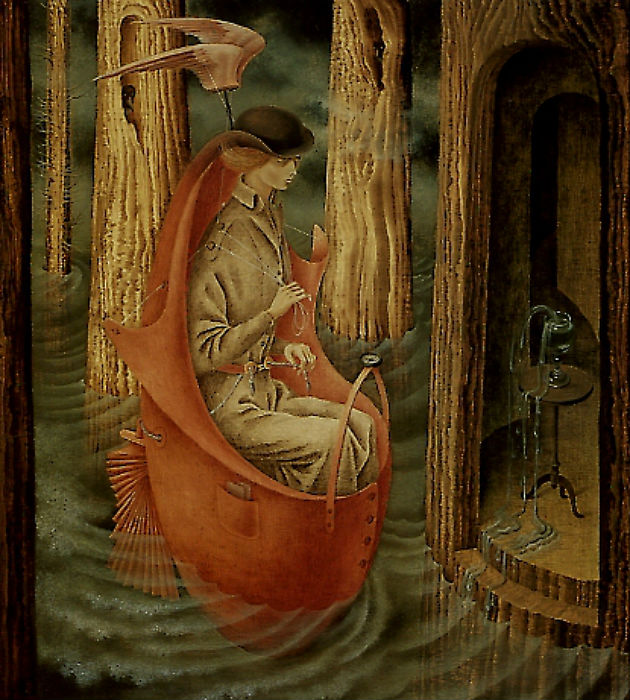
Exploration of the Sources of the Orinoco River: In a forest fully submerged in water, where large dark birds look out from the hollows of mysterious tree trunks, a most determined woman who bears particular resemblance to Varo herself, dressed androgynously in a beige trench coat and black bowler hat, embarks on a voyage for truth in her appropriately egg-shaped origin seeking flame-red boat. Humorously, the boat is also made out of a coat, with a pocket holding notes visible at the side, a compass on the belt, and a tiny pair of pink stationary wings attached at the back. The woman steers the boat by pulling on strings and directs the vessel to a hollowed-out room inside one of the trees. Within the space is a chalice that brims with water and links the depiction of the journey both to the artist's desire to live a deeper interior life, and to the medieval search for the Holy Grail.
The egg-shaped waistcoat, boat, and flooded woods are wonderfully evocative, dreamlike images of subconscious travel. They also reflect Varo’s real life travels in Venezuela to the site of forests flooded by the Orinoco River, where her friends had joined an expedition in search of gold. But the goblet (or Grail) with its inexhaustible flow of holy elixir also locates the scene within ancient mythic traditions. The water pouring inexhaustibly out of the vessel signifies the elixir of life rather than any precious and materially valuable metal. Thus, this woman’s search can be understood on a spiritual level, the gold being philosopher’s gold, the alchemical liquid of transformation. Just as alchemy is both a scientific study and a mystical search, so Varo used exploration of the river’s source as a metaphor for the spiritual quest. This painting also exemplifies the contradictions inherent in much of Varo’s work: no matter how intrepid, her travelers are rarely if ever free. Here, the traveling outfit, while a wonderfully inventive means of transport, acts also as a form of restraint, binding the woman into her boat with an elaborate network of interlaced cords.
| | |
Mexico:
In Mexico City, Varo became part of a vibrant artist community that included local writer Octavio Paz, as well as other exiled artists and writers, among them Wolfgang Paalen, Gordon Onslow Ford, and Leonora Carrington, who became Varo’s closest friend. By 1953, she had separated from Péret and was romantically involved with Walter Gruen, an exiled Austrian owner of a popular classical music record shop who became a stabilizing force in her life and provided her with the means to fund her artistic practice without distractions. He believed in Varo’s talent and supported her in devoting herself to painting wholeheartedly.
Varo had her first major solo exhibition in Mexico City in 1956. It was a hit among critics and collectors as well as the celebrated Mexican muralist Diego Rivera, who was quoted as saying that Varo was “among the most important women artists in the world.” Her second solo show, in 1962, was also successful.
| | |
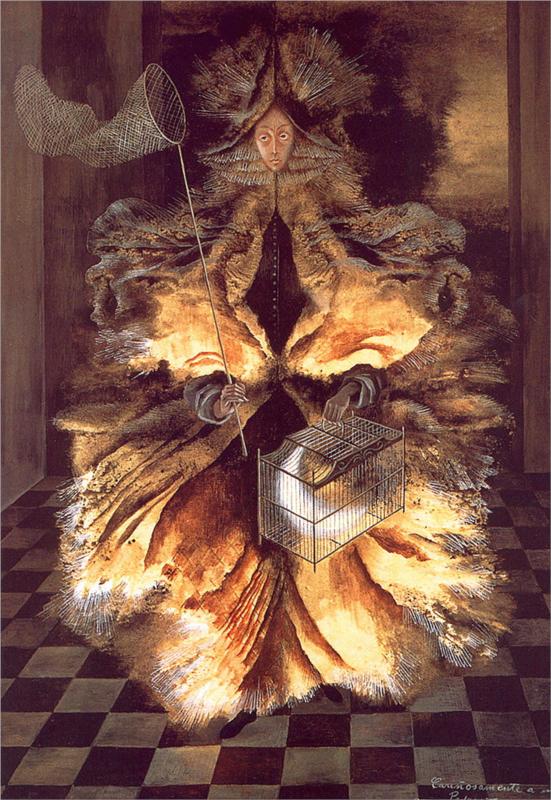
The theme of the relationship between mother and child was explored in her 1956 painting, “Star Catcher”. As is typical for Varo, a single female figure is our focus, but the setting has moved inward and has become claustrophobic. Upon leaving behind a shadowy landscape, the woman entered a room, leaving an open door behind her. With staunch regal presence, she wears an elaborate hat, an intricate lace collar, and a butterfly sleeve dress composed of symmetrical folds resembling a vulva. Varo evokes the Egyptian Isis, the goddess of the moon and of magic, or Diana the huntress—goddess of the moon and protectress of women—she has snared the moon, an archetypal symbol of feminine consciousness. The figure is at once powerful and powerless. In her right hand, the woman holds a long empty net, in her left hand, she carries a small cage that she used to capture a glowing crescent moon. Unusually here, the strong lunar force of fertility is caged, perhaps making reference to the fact that Varo did not have children or that she viewed reproduction as an imprisoning factor. Remedios never had children, although she did terminate a pregnancy when she was married to Péret, saying that motherhood was more than she could handle.
The tiled floor is another repeated motif for the artist, as it was also for her great friend Leonora Carrington; the checkered black and white pattern reinforces important notions of opposites combined. The elongation of the central figure, her arms, and the disproportion of her small head strongly evoke the work of El Greco who Varo admired. Its symmetry prefaces the insectlike figure of the Dragonfly Woman. There seems to be an overall message of suffering imposed by restriction expressed through this image. It is as though the woman feels at once defined and confined by her sex. The viewer's attention is drawn into a whirlwind by the seemingly erotic golden and grey plumage created by the process of decalcomania, but the labia-like opening in her dress greets the gaze with darkness rather than pleasure.
| | |
The Three Witches
Varo surrounded herself with a group of likeminded women (Leonora Carrington and Kati Horna in particular) also interested in alchemy and the occult. Together, these women - sometimes referred to as 'the three witches' - placed full attention on achieving a higher spiritual life, recognizing that such divine power would then in turn be transmuted more widely throughout the cosmos.
They were sensitive to a shared ancestral/evolutionary feminine consciousness and felt determined to free women from repressive patriarchal hierarchies, often illustrated in the work of Varo by repeated motifs of the cage and the tower. Imbued at once with a natural and cultivated understanding of opposites and union, Varo and her friends transformed relatively small and domestic experiences into colossal and universal ideas.
Varo and Leonora Carrington had met in Paris, but their close friendship really bloomed after they both immigrated to Mexico City. The two Surrealist artists would meet almost every evening for dinner to talk about each other’s work and share ideas about the universe, the supernatural, alchemy and astrology. The two wrote fairy tales, collaborated on a play, invented Surrealistic potions and recipes, and mutually influenced each other's work. Although the artists interpreted these topics differently, they both infused their paintings with mysticism and alternate realities.
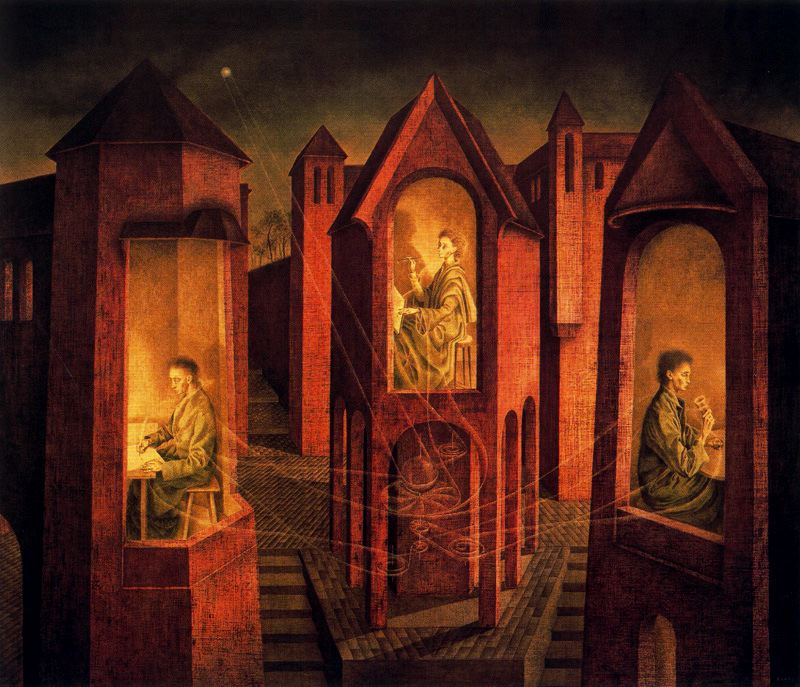
| Three Destinies: This painting brings to mind the three Fates of the Greek and Roman Worlds but even though this tradition might have been Varo’s starting point, she went further and created her own unique vision of the three destinies sharing unbreakable bonds. Each person depicted resides in his or her own house and is engaged in a task: one is seen writing, another seems to paint and yet another is talking to an object similar to a microphone. The three are connected by barely visible threads whose source emanates from the celestial body in the sky. This is what Remedios Varo says about her painting: “Each of these three characters is peacefully doing what he wants to, oblivious to the others; but there is a complicated machine from which come pulleys that wind around them and make them move (they think they move freely). In turn the machine is propelled by a pulley connected to a star in the sky which moves the whole apparatus. The star represents the destiny of these people; and although they are not aware of it, their destinies are intertwined: one day their lives will cross”. | |
Similarities abound in the work of Varo and Carrington, her better-known peer. They both delighted at notions of the occult, mystical realms, and anthropomorphization. Both espoused flat and highly-detailed scenes, which often evoke illuminated manuscripts from the medieval era. (Their works have even been misattributed as the other’s.) Yet the pair immersed themselves in different philosophical texts. Varo’s palette, too, distinguishes her work from her friend’s: Burnt oranges, scarlets, and browns infuse Varo’s paintings, often exuding fire and warmth
“Varo and Carrington would see each other almost every day, either in the middle of the day to go to the market or later in the evening for dinner, and they would discuss what they were working on,” said Wendi Norris, who organized “Indelible Fables,” a solo exhibition of Varo’s work, at her San Francisco gallery in 2012. “I believe that a lot of their narratives were born out of these conversations that they had.”
Norris said that the two had often worked through similar ideas — parsing the theories of the psychoanalyst Carl Jung and the mystic philosophers George Gurdjieff and P.D. Ouspensky — but that they would manifest them in different ways. While Carrington was free in her painting, Varo was exacting.
“Her precision — the single hair brushstrokes and the way that she was thinning the paint to get a lustrous layered effect — is beyond masterful,” Norris said by phone. Varo was interested in proportion and scale, as her father had been, and she would draft preliminary sketches carefully. It sometimes took her months to complete a single small painting.“She was very deliberate,” Norris said, “and, in a way, patient.”“It has a magical effect,” Norris said. “There is a radiance and a light to her work, much like you see in a great Renaissance painting.”
Homo Rodans (1959), the only sculpture that Varo ever produced, is made with chicken and fish bones believed to have been discarded from one of their famous dinner parties: a relic of one of the most significant female friendships in the history of art.
| | |
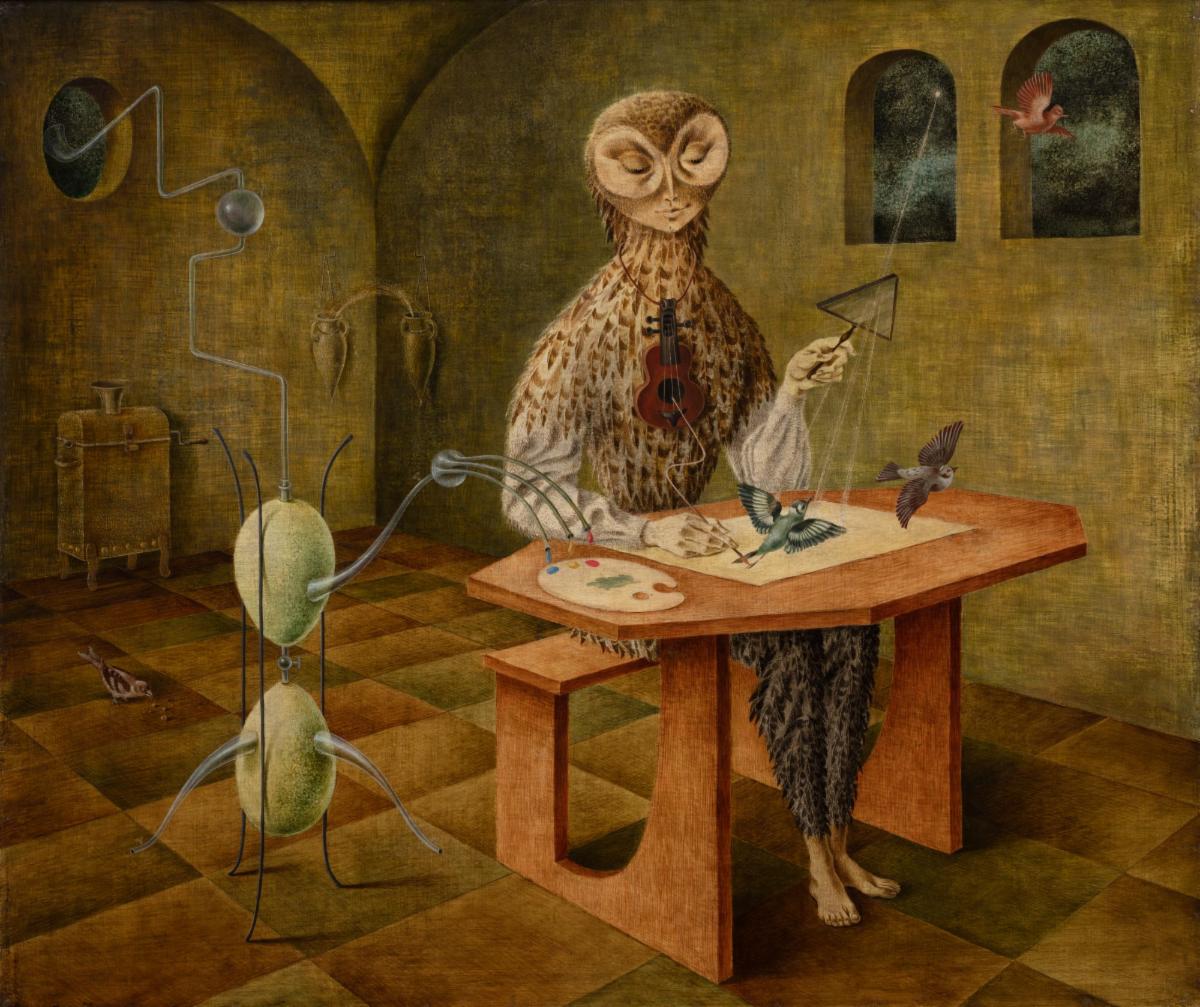
The Creation of the Birds: In an austere setting suggestive of a monk's cell as well as countless images of St. Jerome in his study, an equally academic hybrid owl-woman is seated at her desk painting a bird. Using primary colors distilled from the atmosphere, she draws with a pen that is connected through a violin to her heart. Moonlight (the domain of both owl and woman), captured and magnified through a triangular lens, illuminates the drawing, stimulating the drawn birds to come to life and take flight out of a window. In this reversal of the Annunciation, the bird does not announce new life; it embodies new life. Here is the true interconnection of art, science, alchemy, and nature, each nurturing the other in a cycle symbolically represented by the two vases in the corner, which feed their golden contents back and forth to each other. Varo’s choice of symbols is significant. She used an egg-shaped alchemical vessel as the receptacle of transformation, in which the palette of primaries is created, the trinity that is the foundation of all color in art. She chose a triangular magnifier, like the triangular prism that Newton, the master scientist, had used to separate light into the colors of the spectrum. By creating birds that fly off the page, Varo placed herself within the tradition of mythological artists such as Pygmalion, whose creation was said to have come to life, and Daedalus, who sculpted wings that offered flight.
In aligning herself with these traditions, Varo made a claim for the artist as one who goes beyond mere imitation of nature to actual creation itself. This painting of the owl-woman-artist-alchemist creating beauty and life through the conjunction of color, light, sound, science, art, and magic is the very image of creativity to which Varo aspired in her life. As creativity and harmony are at the center of this painting, they were at the very core of Varo’s being. Thus, Creation of the Birds can be seen as the paradigmatic image of the fulfillment of her quest.
| | |
Legacy:
Varo died of a heart attack on Oct. 8, 1963. She was 54. Walter Gruen became a tireless champion of her work and legacy, and a 1971 posthumous retrospective at the Museum of Modern Art in Mexico drew crowds.
Margarita Nelken, a close friend and a journalist for the Mexico city newspaper Excelsior wrote “…Remedios Varo, one of the greatest artists of modern Mexico, and – without exaggeration – of contemporary painting, on Tuesday evening left us forever. Unexpectedly. So discreetly, quietly, just as she had lived among us…”
Alfonso de Neuvillate, the art critic for the Novedades newspaper wrote:
“…Unjust, inexplicable…..on Tuesday, the eighth of October at 7pm, death ended the life of one of the most individual and extraordinary painters of Mexican art, Remedios Varo. A heart attack. One asks the questions like, why her? Why not someone mediocre?…”
The last 13 years of Remedios Varo’s life were her most productive. She died at the height of her success—her posthumous retrospective at the Museum of Modern Art in Mexico City in 1971 surpassed attendance records at the institution for shows by Diego Rivera and David Alfaro Siqueiros.
In the decades that followed it became clear that Varo's 'Surrealist' work would have an enduring influence on subsequent generations of artists, and in particular on female practitioners. Post-WWII female artists resolutely shifted their role from that of passive muse to active maker.
At the forefront of this change and as pioneers of a new artistic language centered on interior reality, Varo and her contemporaries provided younger female artists necessary role models to look towards, emulate and surpass. Kiki Smith is a perfect example of an artist working today who quotes Frida Kahlo and the other Surrealist women artists as "the beginning of contemporary art because they use the self and their own image to make art". Louise Bourgeois, Mona Hatoum, and Tracey Emin are all notable examples of artists whose work, like that of Varo's is breaking through the boundaries between fantasy and reality, and on making the interior invisible emotions visible.
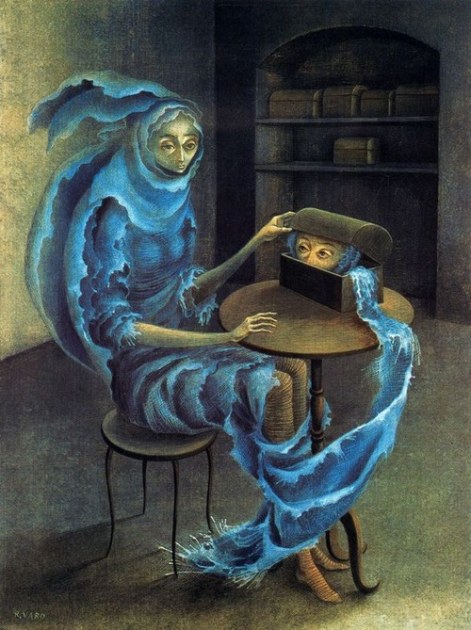
| | Encounter was painted in 1959, at the height of Varo’s career. It embraces the Surrealist fascination with the idea of the ‘chance encounter’, both in subject and practice. At the centre of this striking composition, a seated figure is draped in a fluid cloak of what appear to be tiny, blue waves. Carefully lifting the lid on a small box, she finds her own eyes staring back at her. Several similar boxes sit on the shelves in the background, suggesting many more ‘selves’ to be discovered. | | |
Art Techniques
When creating her paintings, Varo was “thinking about her own practice as a type of alchemy,” says the Art Institute’s Caitlin Haskell, “You see that on the surface of her work, with story and material coming together into one unified composition.” In several paintings, she inlaid mother-of-pearl—“a material significant in shamanic rituals”—to “burnish the faces of the otherworldly figures,” writes The Art Newspaper. She also made tiny scratches in her works “possibly using quartz crystals that she ‘charged’ by moonlight” and stored talismans in her studio.
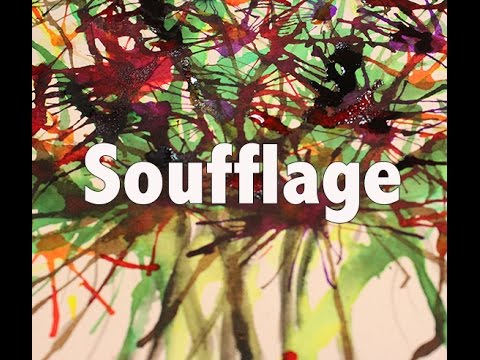
Soufflage:
To produce this magic cloak, Varo has used the technique of soufflage (an automatic process where wet paint or ink is blown to create patterns and shapes – souffler means ‘to blow’), evoking the fluid qualities of both water and fabric. In soufflage, paint is thinned to an extremely fluid consistency, applied to the support, and then moved with blown air (often through a straw).
Decalcomania:
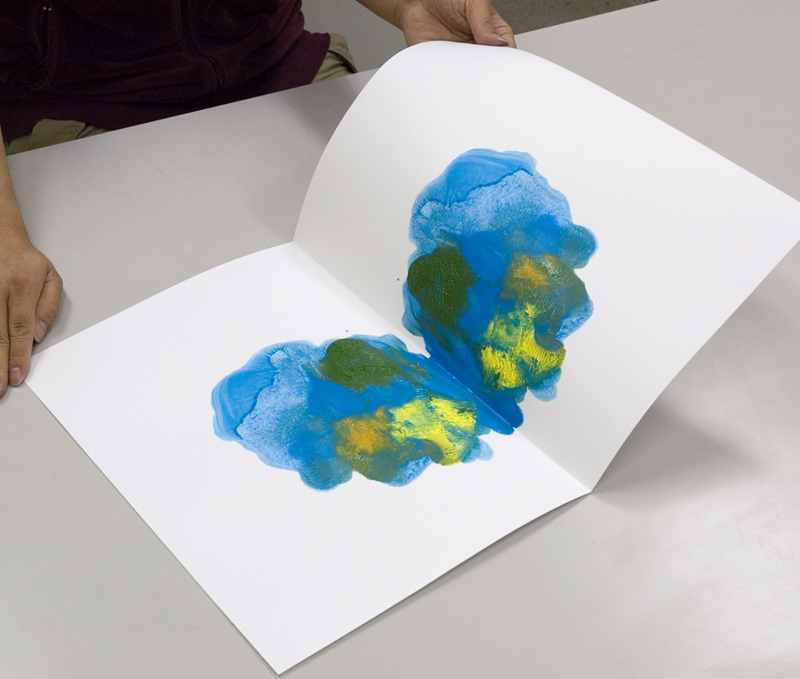
A chance-driven technique in which one material (such as paper, tracing paper, aluminum foil, or glass) is pressed against a freshly painted or inked surface and then removed to form a pattern or texture. European Surrealists often used decalcomania as a tool to inspire their paintings. Evidence shows that Varo, on the other hand, used it in a very deliberate and planned manner. Decalcomania also refers to the process of applying paint to paper, then folding and unfolding the paper to reveal a mirrored biomorphic pattern such as the one that underlies Cazadora de astros (Star Catcher).
| | |
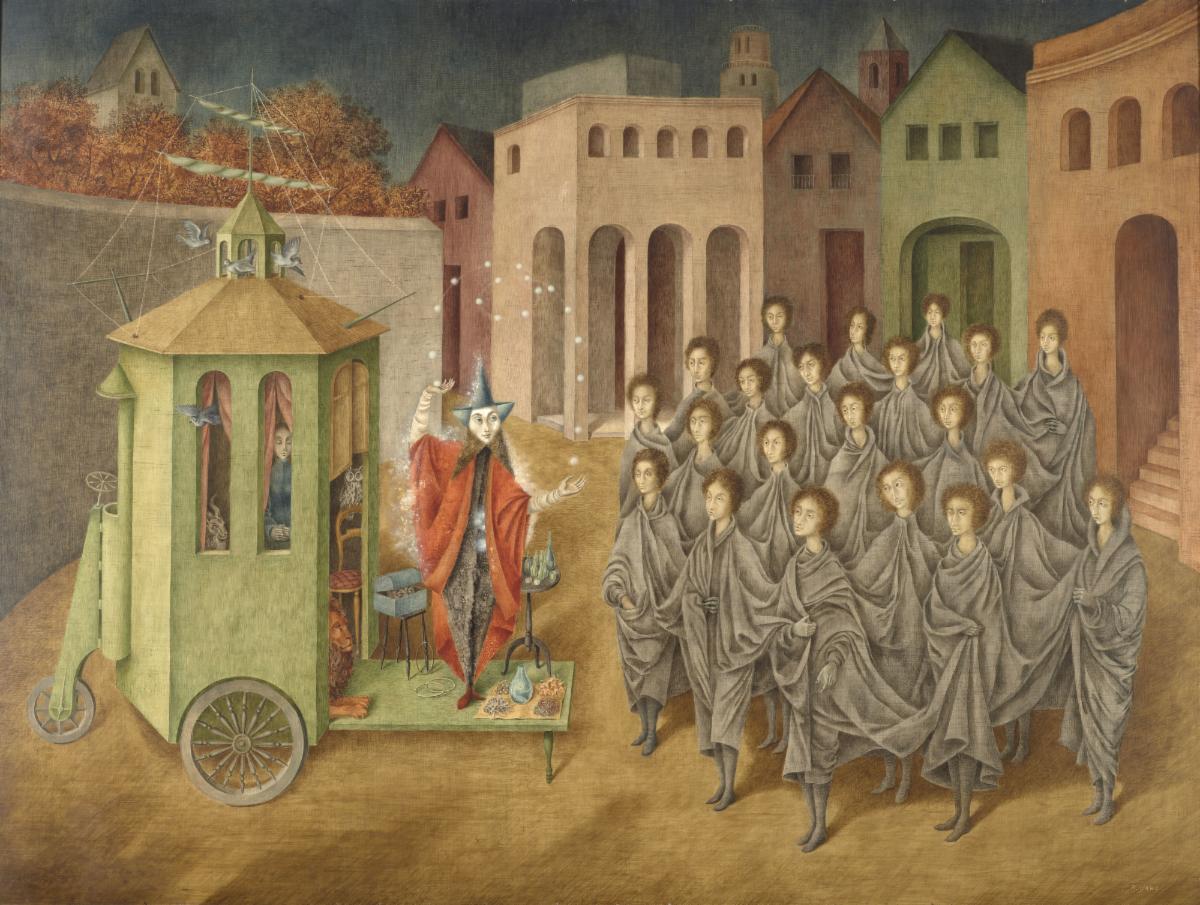
The Juggler: At the centre of this painting, we see the magician/juggler standing on a table in front of a crowd of onlookers. The table actually forms part of his bizarre-looking vehicle. The Juggler is dressed in a red robe, which covers his brown-patterned outfit, and atop his head he wears a witch-like conical hat. The face of the juggler is painted on a five-sided piece of inlaid mother of pearl. Mother of pearl was often associated with works by Remedios Varo. For her, it was the idea of enlightenment and of understanding, a sort of hyper-awareness. The figure is in the act of juggling, but instead of using his juggler’s rings, which lay at his feet, he is juggling balls of light, adding to the impression that this is not just an ordinary juggler but one with mystic powers. Look carefully at his audience. All look the same with similar hairstyles, and yet on closer inspection, they all have individual expressions. However, what is more bizarre are their clothes. Again, on closer inspection, their clothes are made from just one single cloak, which is worn by them all. It is all about unity. Varo, in a letter, described the audience as “… a kind of unenlightened individuals who were awaiting a transference of enlightenment from the magician so that they can wake up…”
The painting does not just depict the juggler and his audience. Look closely at the others in the “cast” that add to the depiction. Varo includes an owl who we see in the part-open chest, a lion that lies obediently at the juggler’s feet, and the ever-present birds. Inside the vehicle is the juggler’s wife and a goat. It is this type of painting that I find fascinating. No matter how many times you look at it, there is something new to see, and it taxes your brain trying to work out what Remedios was thinking when she put the brush to the masonite. This painting is housed in the Museum of Modern Art in New York.
| | |
Grattage:
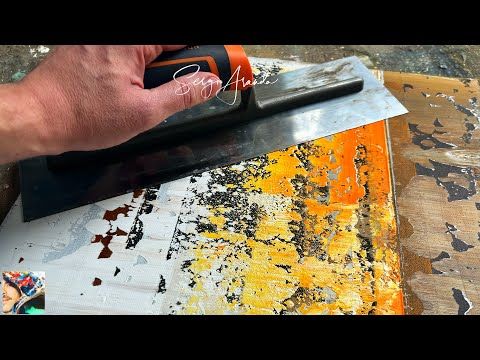
Often credited as being invented by Surrealist artist Max Ernst, grattage consists of abrading or scraping away paint (usually wet) with a sharp or flat-edged object, like a palette knife, to reveal an image, pattern, or texture. Typically, a flexible painted support such as canvas is laid over a textured object and then scraped, the paint revealing the texture of the object through the canvas.
Inlay:
Used in a range of applications from decorative arts to sculpture, inlay involves inserting a piece of rigid material—usually a thin piece of shell, bone, or wood veneer—so that it is flush with the surface of another material in order to create a seamless design. Varo added mother-of-pearl, or nacre, inlays to five of her paintings—invariably reserving this unique technique for spiritual works or to distinguish individuals who have achieved an enlightened state.
Sgraffito:
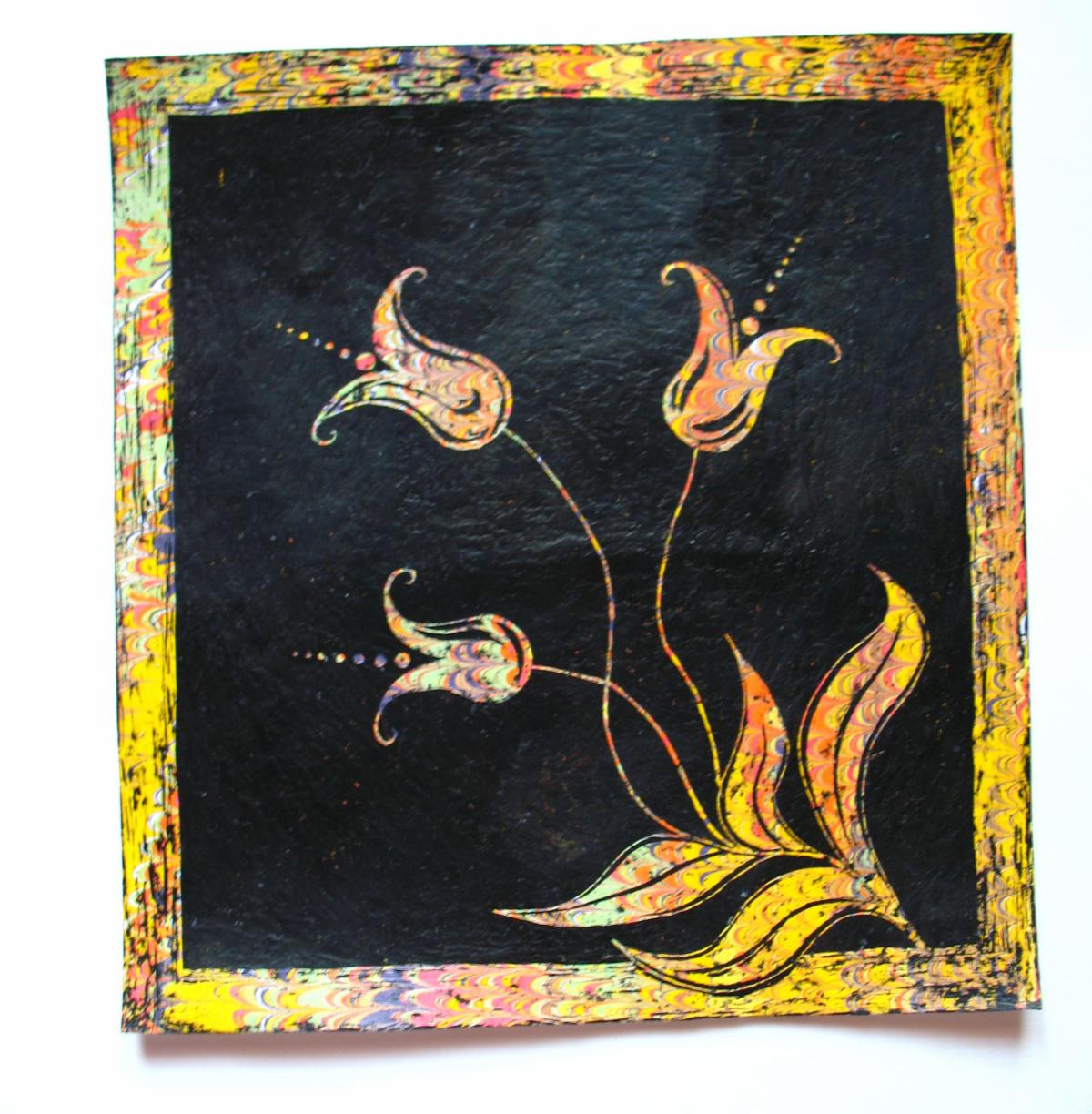
Sgraffito is a technique of scratching through a coating on a hard surface to reveal another colour.
Textured Gesso:
Similar to the Italian Renaissance technique of pastiglia (paste work), textured gesso involves modeling gesso, a thick glue-based preparatory material, with a brush or other material to create a low-relief image or pattern. It seems Varo created sections of textured gesso in her paintings by applying the gesso with a stiff broad or round brush and then pressing the surface with another material, such as glass or foil, in a manner similar to decalcomania, before pulling it away. Varo used this technique in some of her works to create low-relief textured patterns that she also painted, allowing white peaks of the gesso to remain visible.
| | |
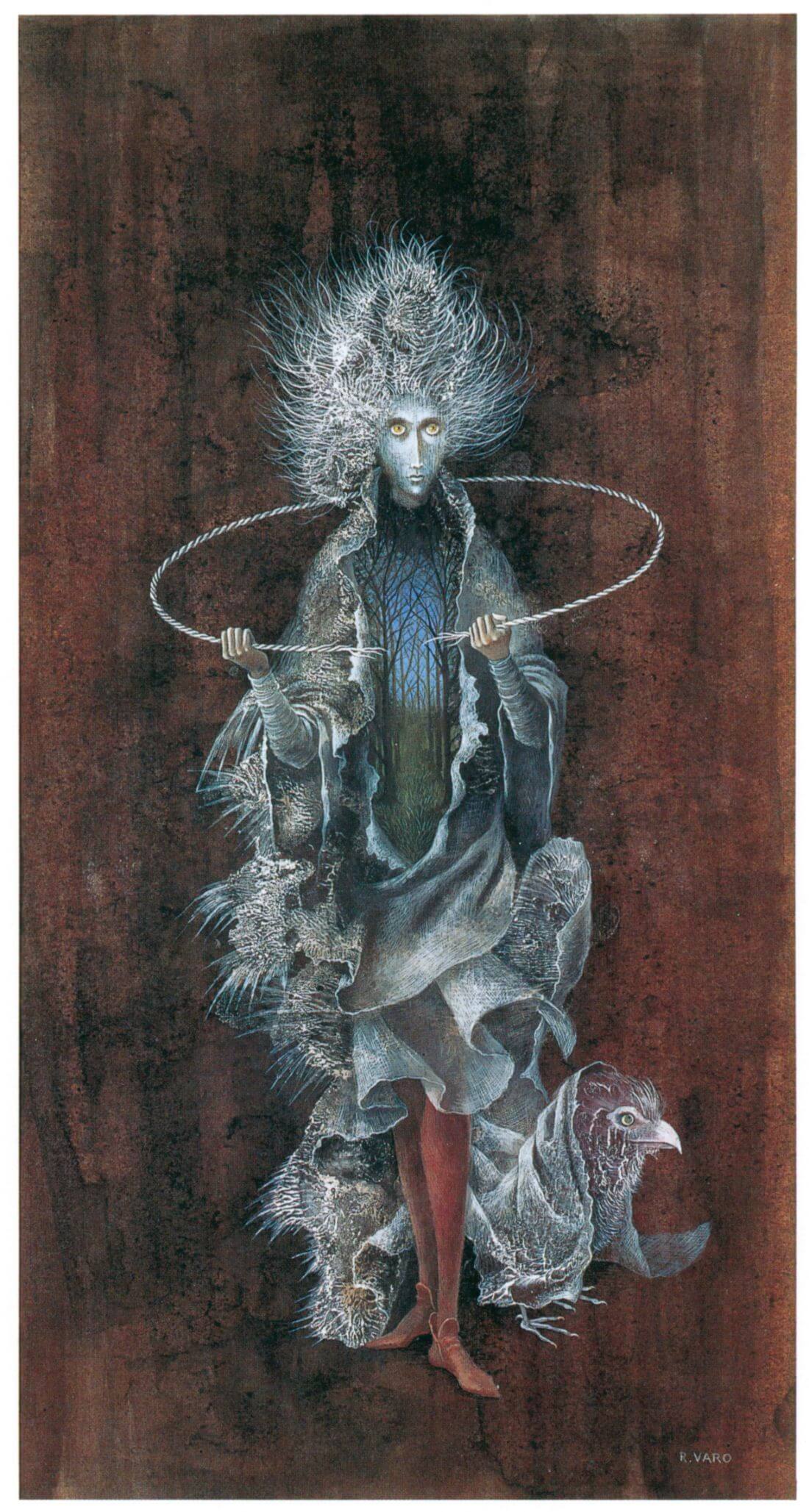
In Breaking the Vicious Circle, the heroine seizes control and frees herself from her limiting beliefs. With wide staring eyes, as in a trance, she summons her strength to pull apart the rope that encircles her body. Electrified, her hair stands on end, charged by the energy of her act. As the ‘vicious circle’ is broken, a dense, green forest is revealed within her chest, the deep dwelling place of her unconscious, now made accessible. Accompanied by a bird, a Jungian symbol of transcendence, which nestles in the folds of the cloak at her feet, she has made a spiritual breakthrough.
| | |
Whether you’re an established artist seeking new horizons or a budding creative looking to elevate your work, I hope I have inspired you on how you can break through your own limiting beliefs to bring more depth into your art. What you perceive with your physical eyes is only a glimpse of “reality” When you paint with passion, you ignite your flames and inspire others to do the same.
Perhaps I can invite you to join my artistic “family,” where I can support your creative development. Don't hesitate to contact me if you want my mentorship, guidance, and advice in exploring your artistic path. It makes me happy to share my insights and my knowledge with you.
| |
If someone shared this newsletter with you and you'd like to subscribe, please reach out to me below with your email address. I promise, no spam, no overloading your inbox, just the good stuff.
I welcome the opportunity for connection, conversation, cooperation, collaboration, and commissions.
With Light and Delight
| |
P.S. If you didn't get the chance to download your free gift from me: Here is my "Inner Artist Inspiration Package" - a series of illustrated quotes in watercolor based on flower photos taken by family and friends.
| | |
| |
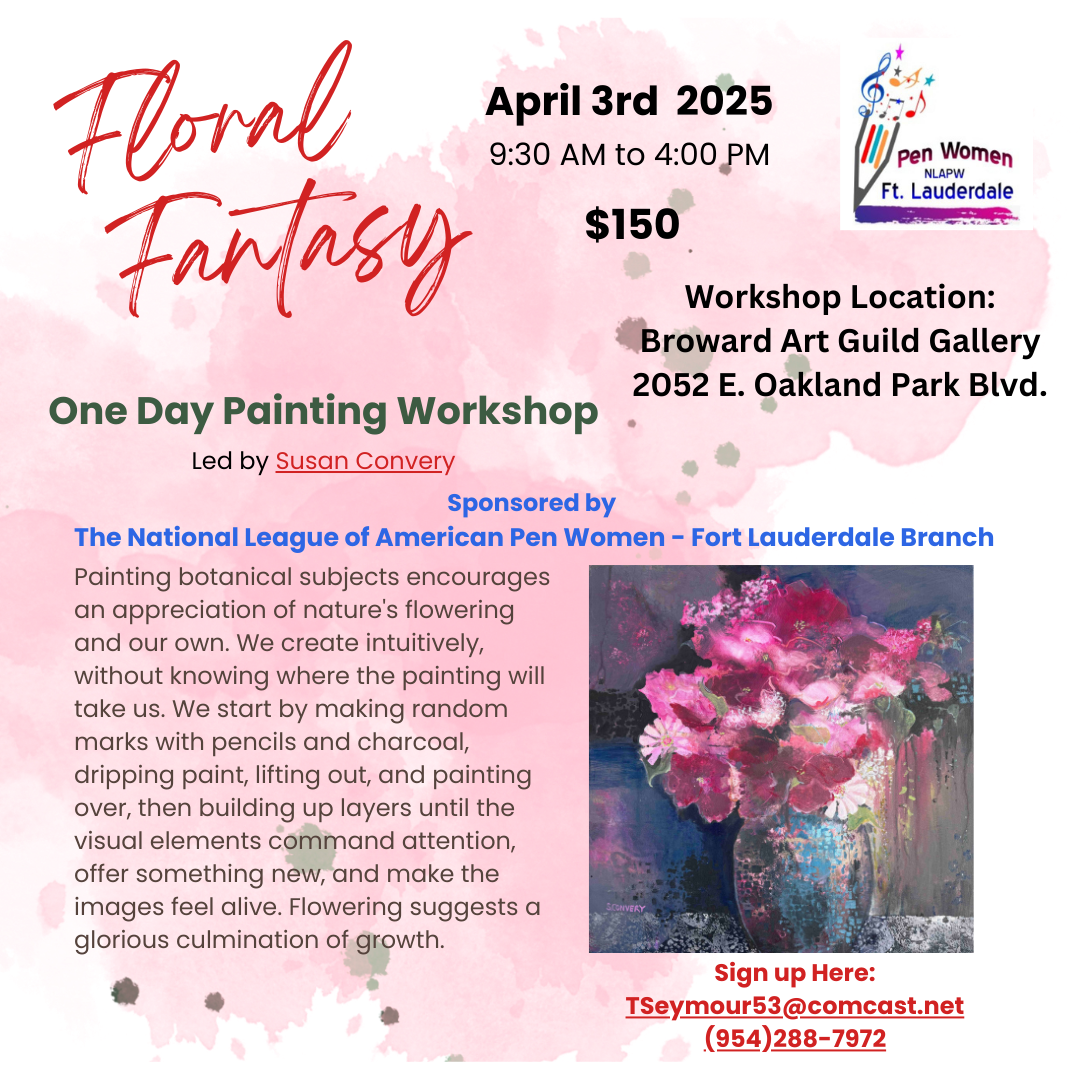
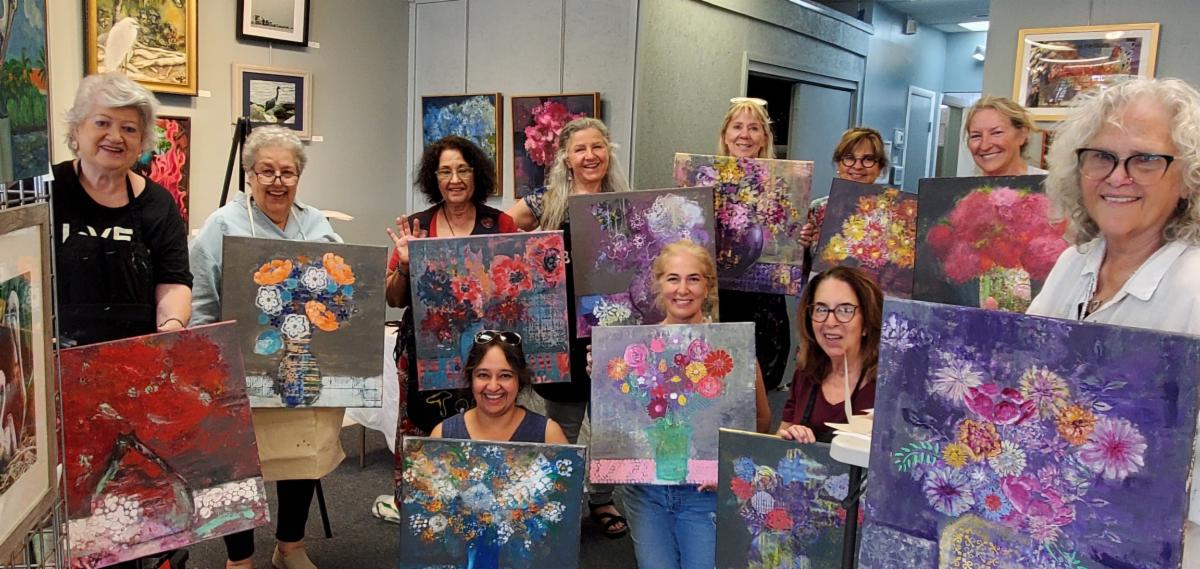
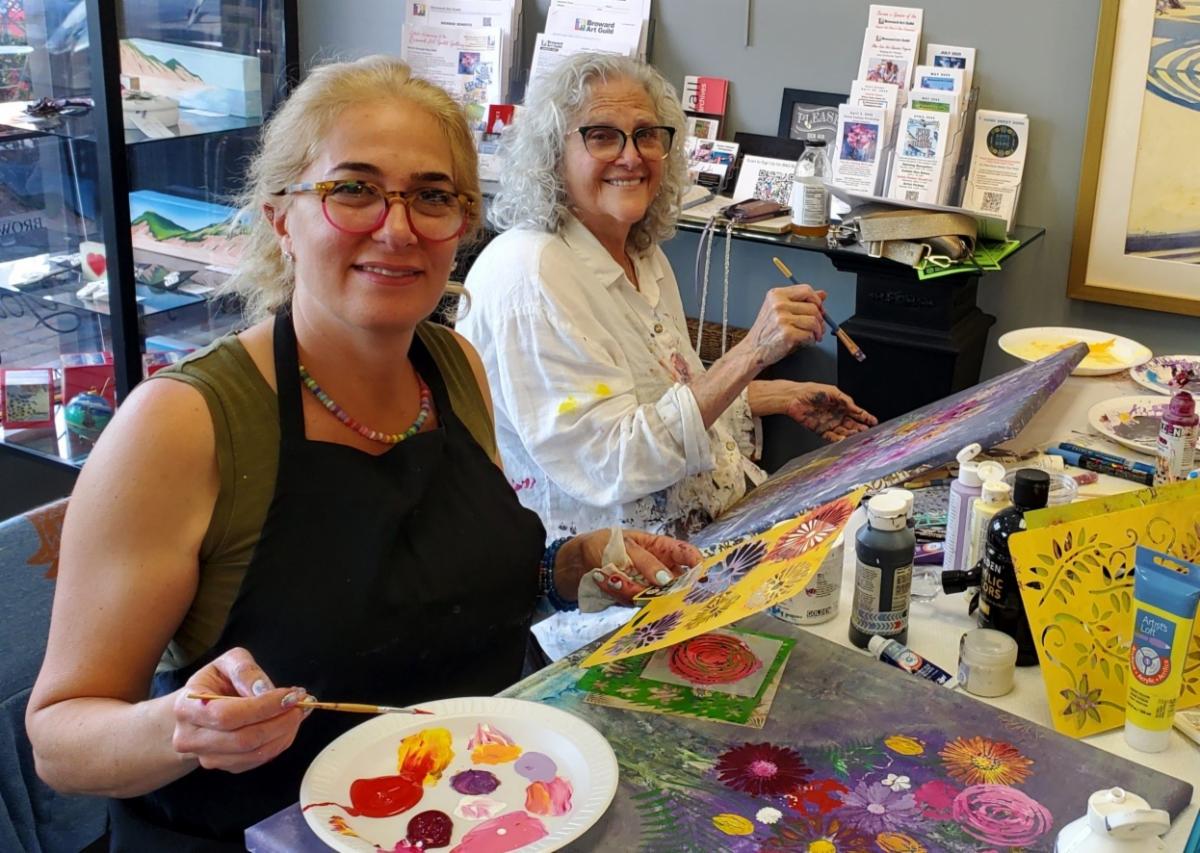
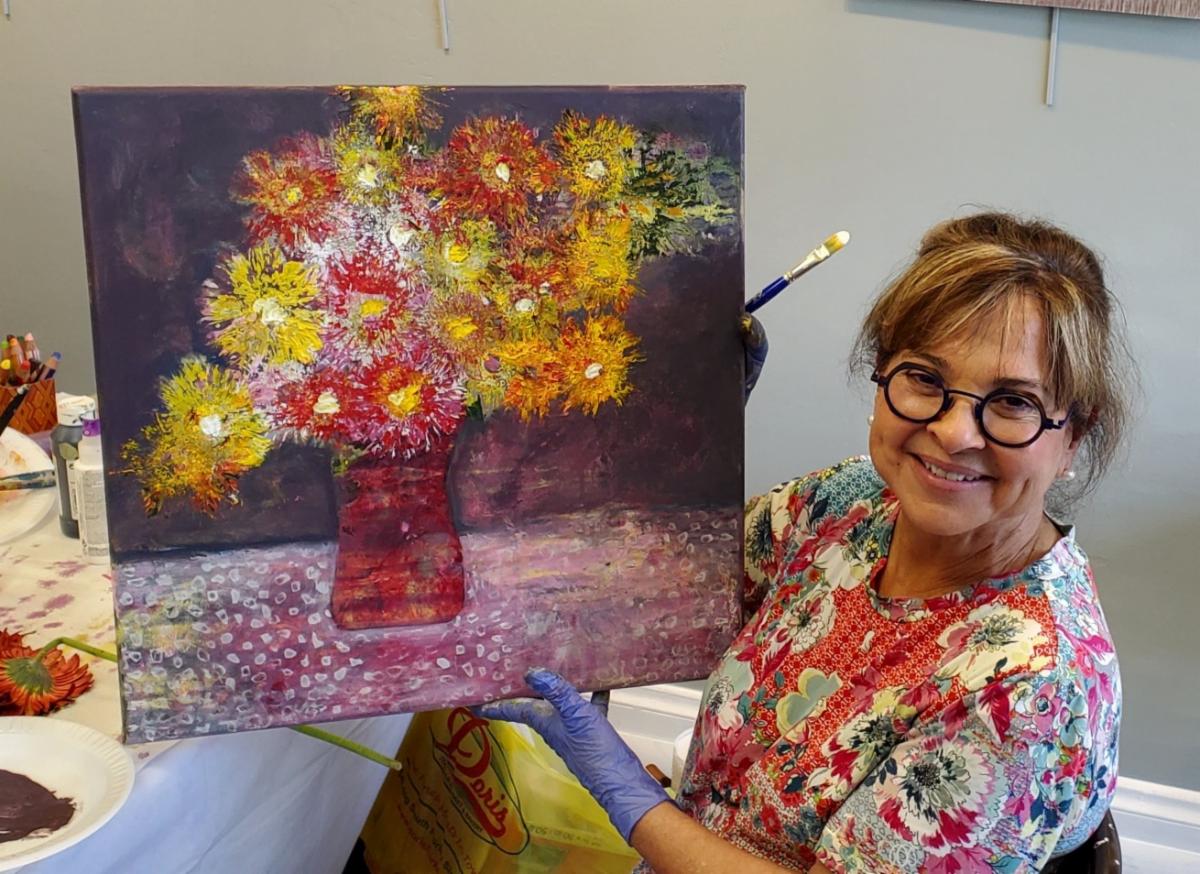
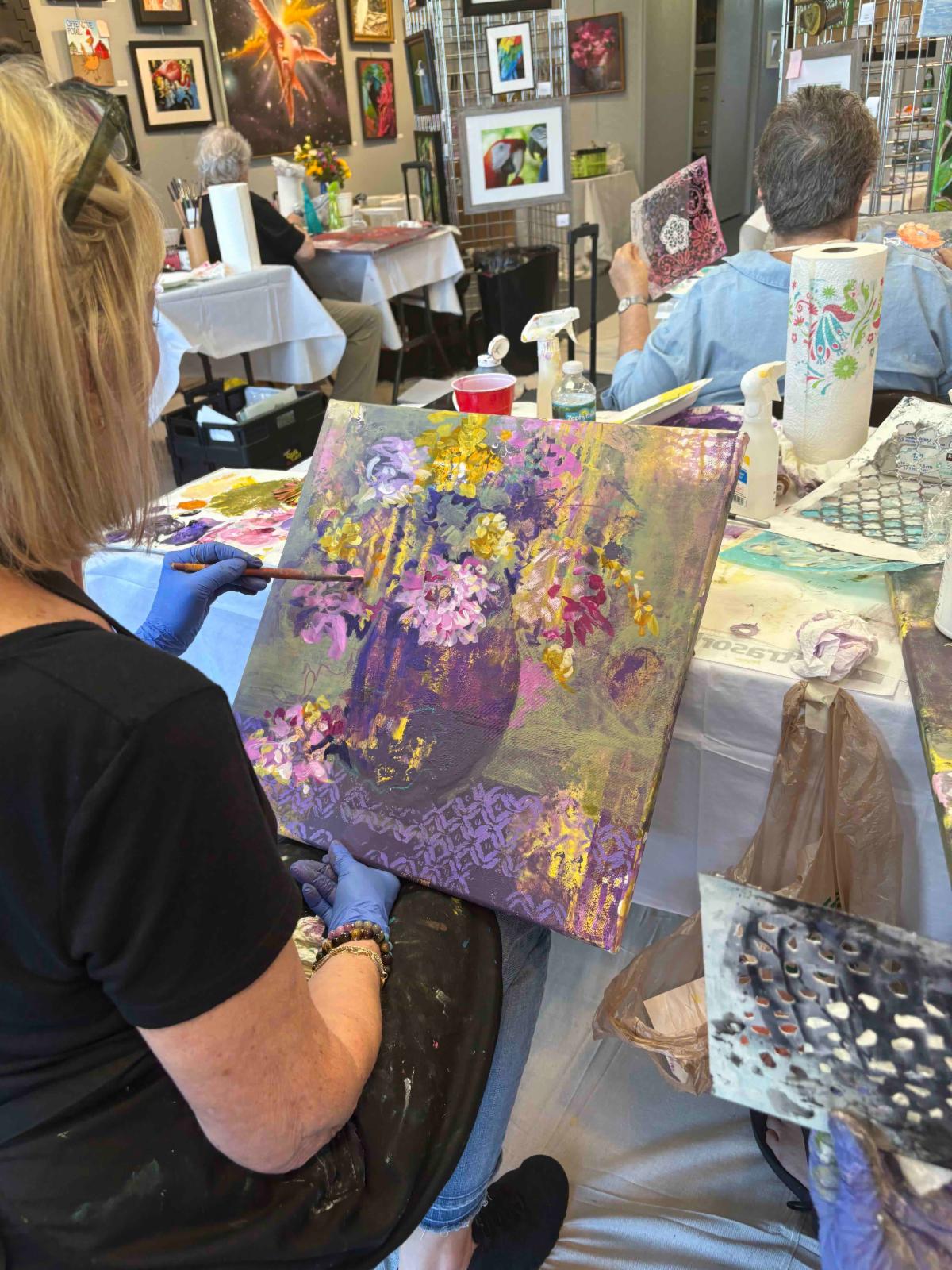
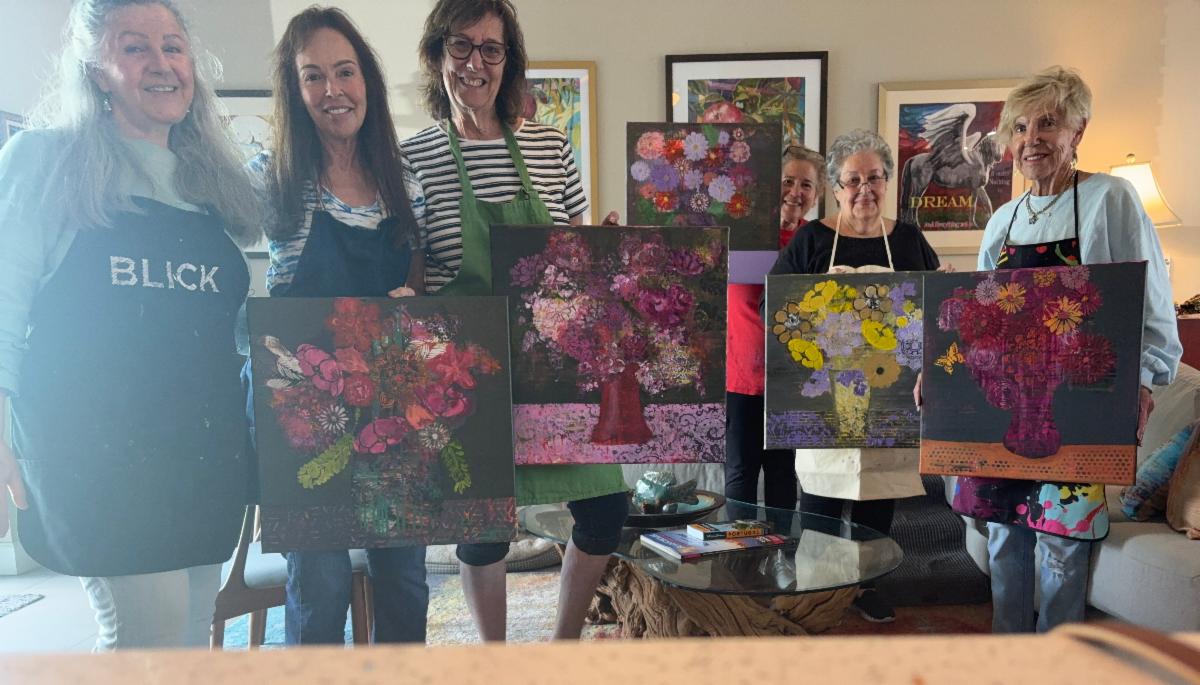
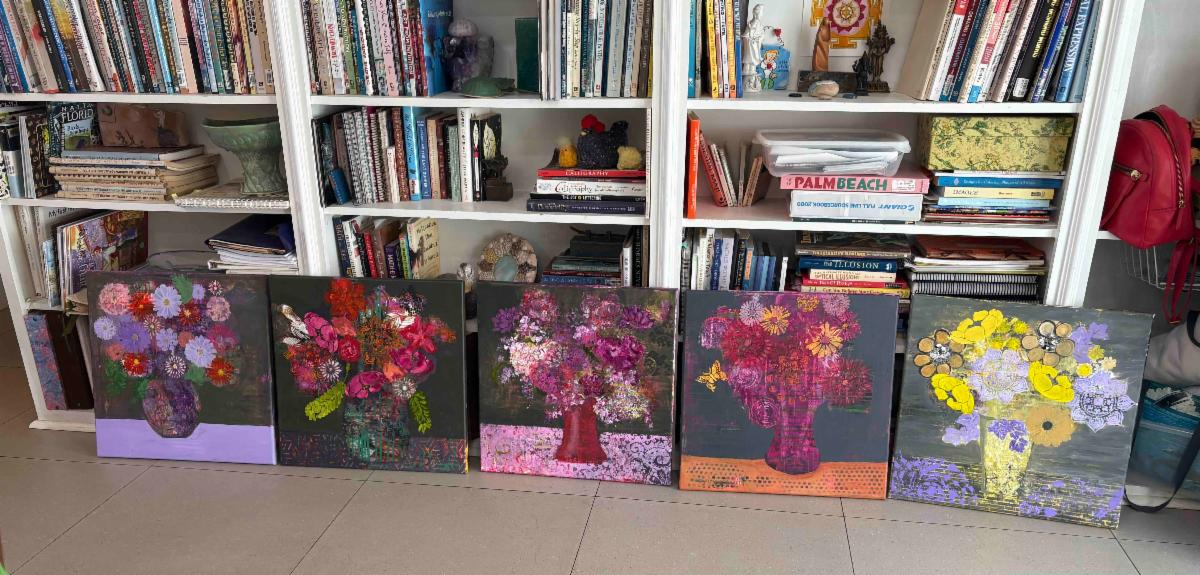
Floral Fantasy 2 Workshop
A few friends who were unable to make the first workshop convinced me to offer it a second time.
Friday, April 18, 2025
9:30 am to 4:00 pm
My Home Studio
I am happy to offer this workshop as a private retreat for groups of two to four in my home studio.
| | | |
| |
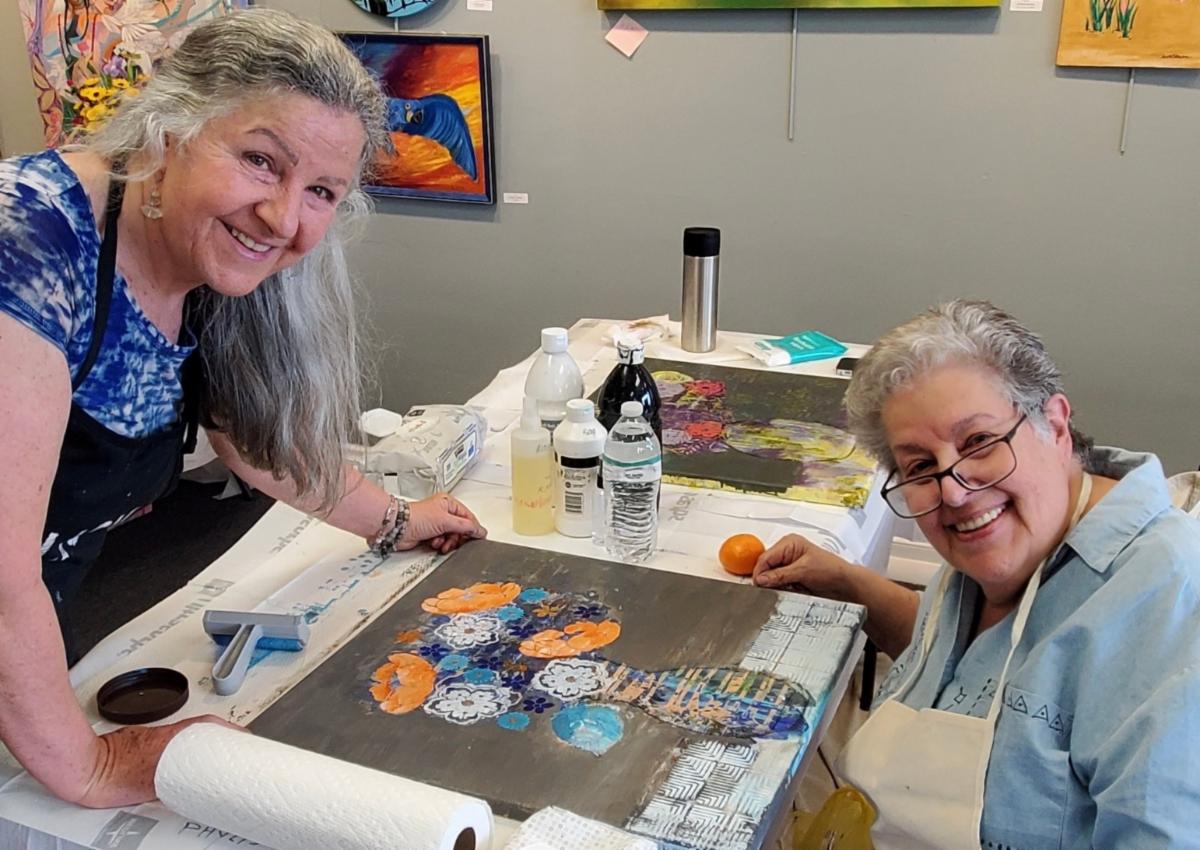
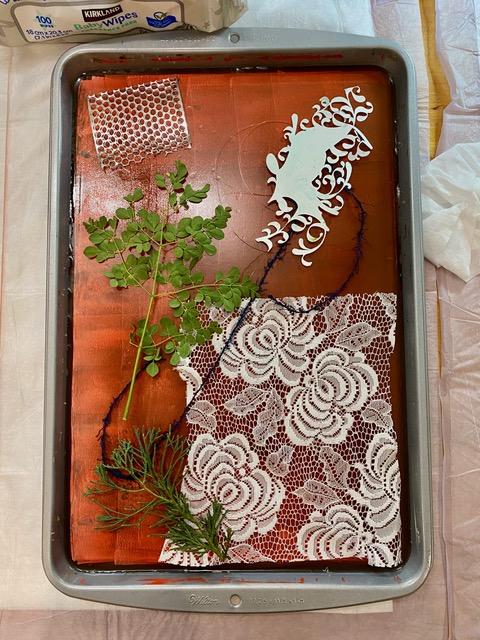
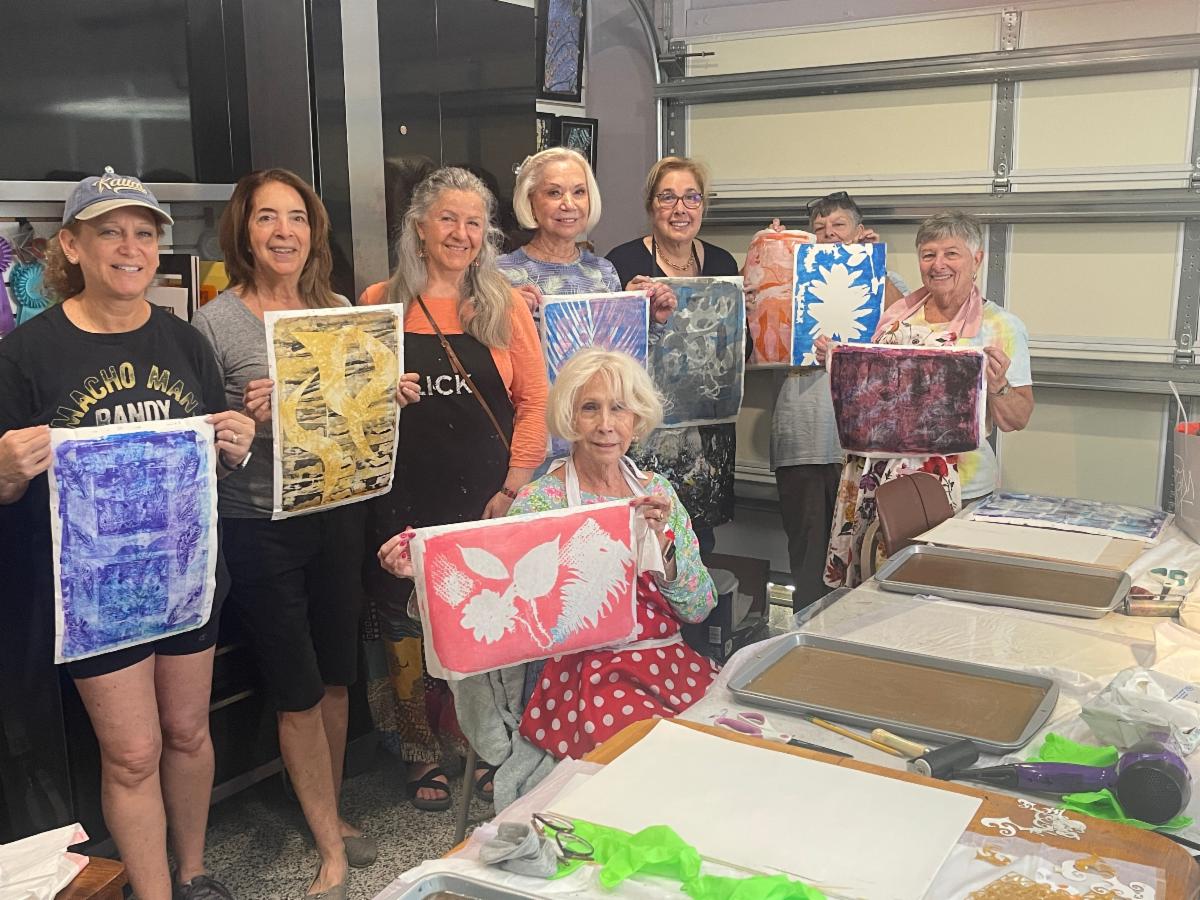
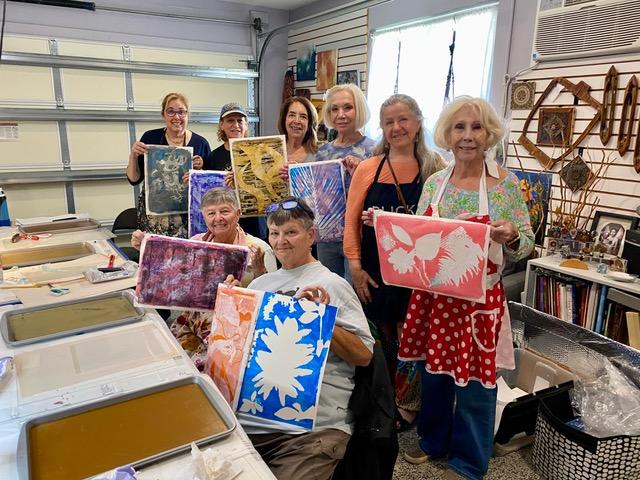
Gelatin Plate Printing
This was a private retreat designed for a group of friends interested in exploring gelatin plate printing in their garage home studio.
I can create a special experience for you and your friends too.
| | | | | |
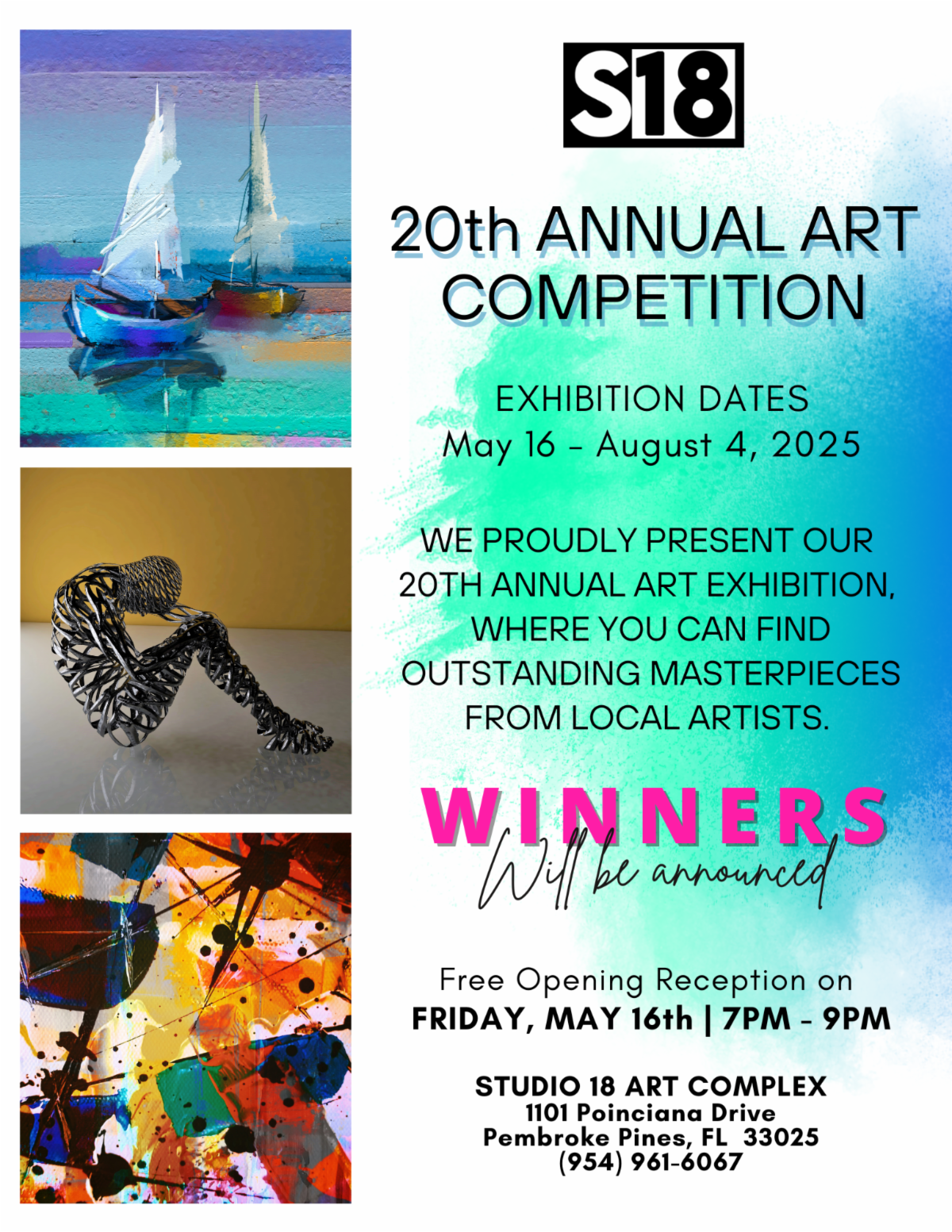
20th Annual Art Competition
Studio 18 Art Complex
1101 Poinciana Drive, Pembroke Pines, FL 33025
Friday, May 16 to Monday, August 4, 2025
Opening Reception on Friday, May 16, 2025, at 7 pm
Free parking, hors d’oeuvres & refreshments
www.ppines.com/studio18
| | |
| |
Artserve Library Exhibition
1350 East Sunrise Boulevard Fort Lauderdale, FL 33304
May 1 through June 30, 2025
A selection of my work will be on display in the library of the ArtServe building. Thank you to the Broward Art Guild for arranging this for me.
| | | | | |
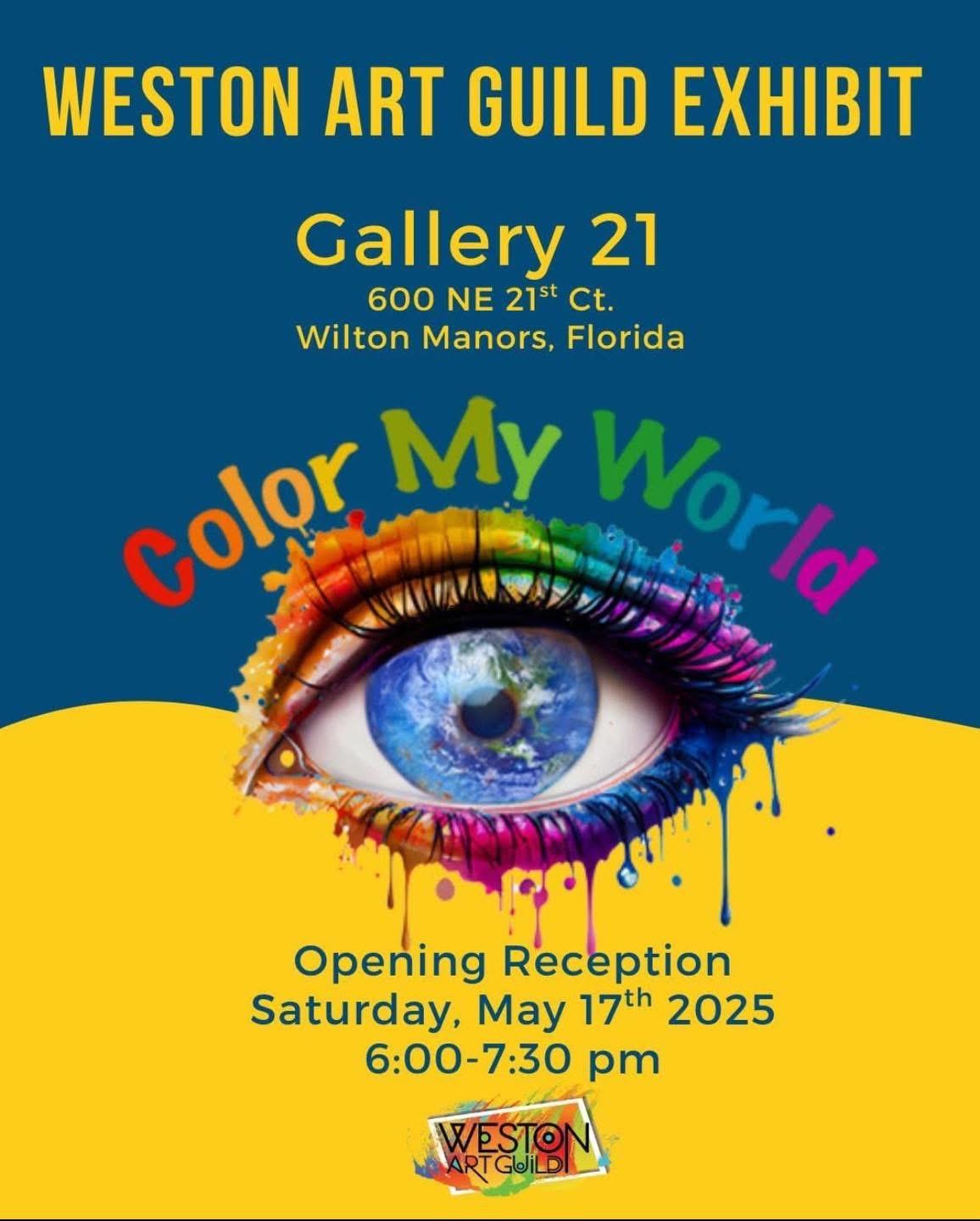
Weston Art Guild - Color My World
Art Exhibition
Island City Cultural Center,
600 NE 21 Court, Wilton Manors, FL 33305
Sat. May 10 to Sat. May 31
Reception: Sat, May 17, 6-7:30PM
| | |
Private Art Retreats
A personalized experience, full of art and discovery, for those who….
- are traveling alone, or with a couple of friends
- would like a much more flexible, and free experience, and lots of fun, too, tailored exactly to your needs, interests, and experience level
- may want to combine painting with organized discovery trips and tours and really get to know the ‘real’ South Florida
- would like to book in for a shorter or longer time than most workshops
- don’t want to have to bring a mountain of supplies in their luggage
| |
Painting Joy
Created especially for artistic women in the third stage of life who are dissatisfied with their artwork and want to have more fun connecting with themselves and others. In this three-day watercolor workshop, we experiment with visual cues that inspire joy, discover personal symbols that resonate, and provide ways to bring more effervescence into our lives and art.
Please recommend any venues you know that might be interested in hosting this workshop in 2025.
I am also happy to teach this as a private retreat or for a small group in my studio.
I would very much appreciate your help in getting the next booking.
| | | | Private Lessons and Events | | | | Master Classes for High School Students |
Private, highly personalized classes in mastery for artistically-minded US & international students virtually on Zoom or in person at my home.
If you have a student who is a visual thinker, willing to push the boundaries of their own work, and serious about improving their options for college, I want to hear from you! Schedule a time to discuss how I can collaborate with you to build a portfolio that will give your student the greatest chance for success.
| | | | Art Workshops, Critiques & Presentations |
Invite me to present or lead a workshop for your school, club, or guild.
I can customize a program for your event or present my skills programs on composition, color theory, drawing faces, coordinating light/shadow or understanding the cues for depth. I am available for judging, confidence-building critiques and recorded tutorials.
| | | | Improve Your Artist Statement | |
If you would like to delve more deeply into your own inner questions and clarify your thoughts as you create an artist statement for your website, a gallery show, a sponsor, or another project, please reach out, and let’s talk. I have helped many students write compelling statements for AP Art, college applications, and competitions.
Find out More:
| | |
Sketchbook Prompt:
Try out one of Remedios Varo’s special techniques - soufflage, grattage, sgraffito or decalomania. Can you create some inspiring textures with them?
| |
Please contact me if you are interested in adding any of the paintings below to your collection.
I will deliver if you live within a 2-hour drive and if you live further away, I will give you a reasonable price for shipping.
Venmo, CashApp, PayPal and Zelle are welcomed.
| | |
Title: Sweet as Kisses
Media: Watercolor
Size: 36”x28"
Price: $1212
Frame: Gold
| | | |
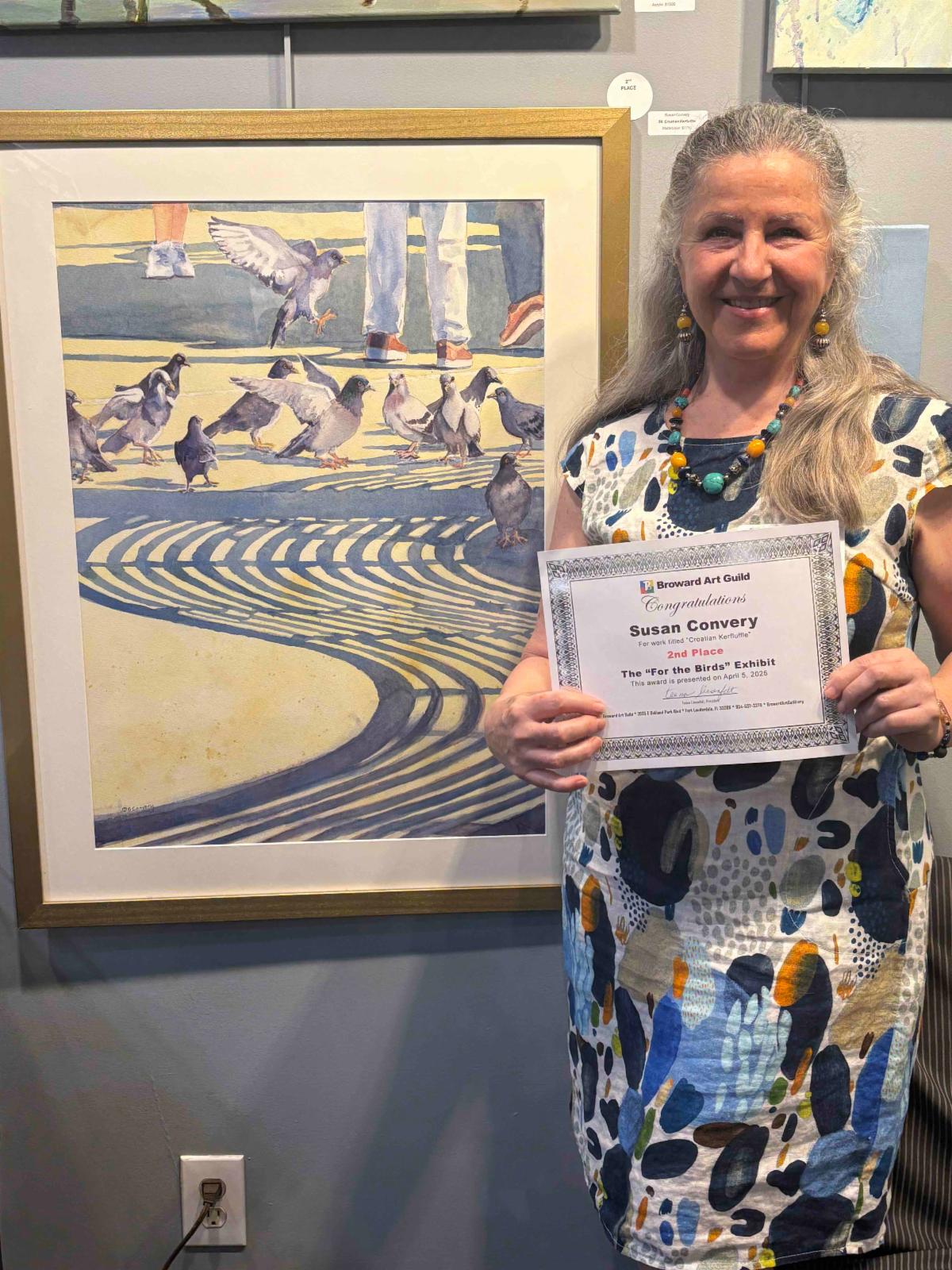
Title: Croatian Kerfluffle
Media: Watercolor
Size: 36"x 28"
Frame: Gold
Price:$1111
.
| | | |
Title: Little Blue
Media: Acrylic Mixed Media
Size: 16" x 20"
Price: $444
Frame: Gold
| | | |
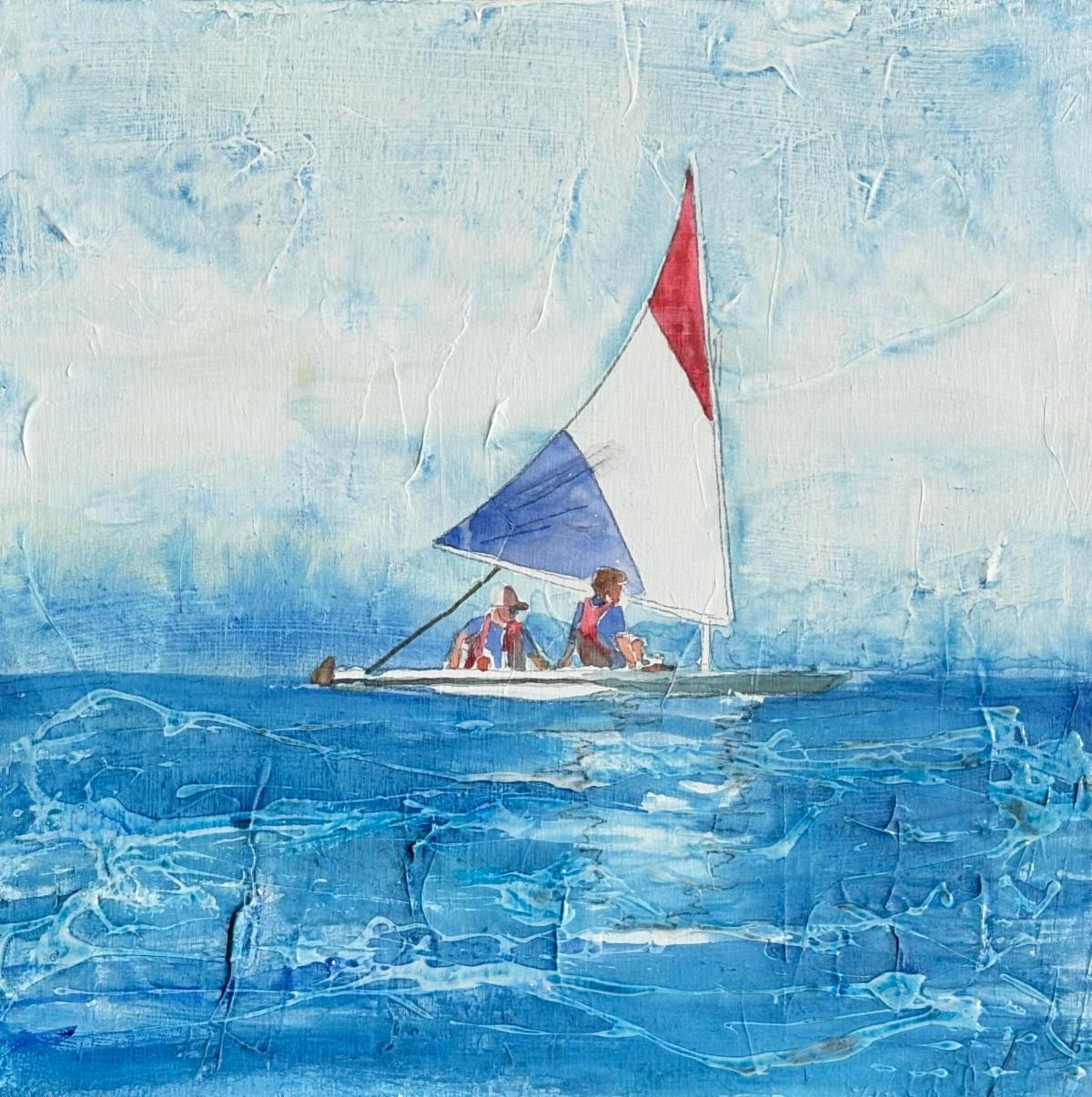
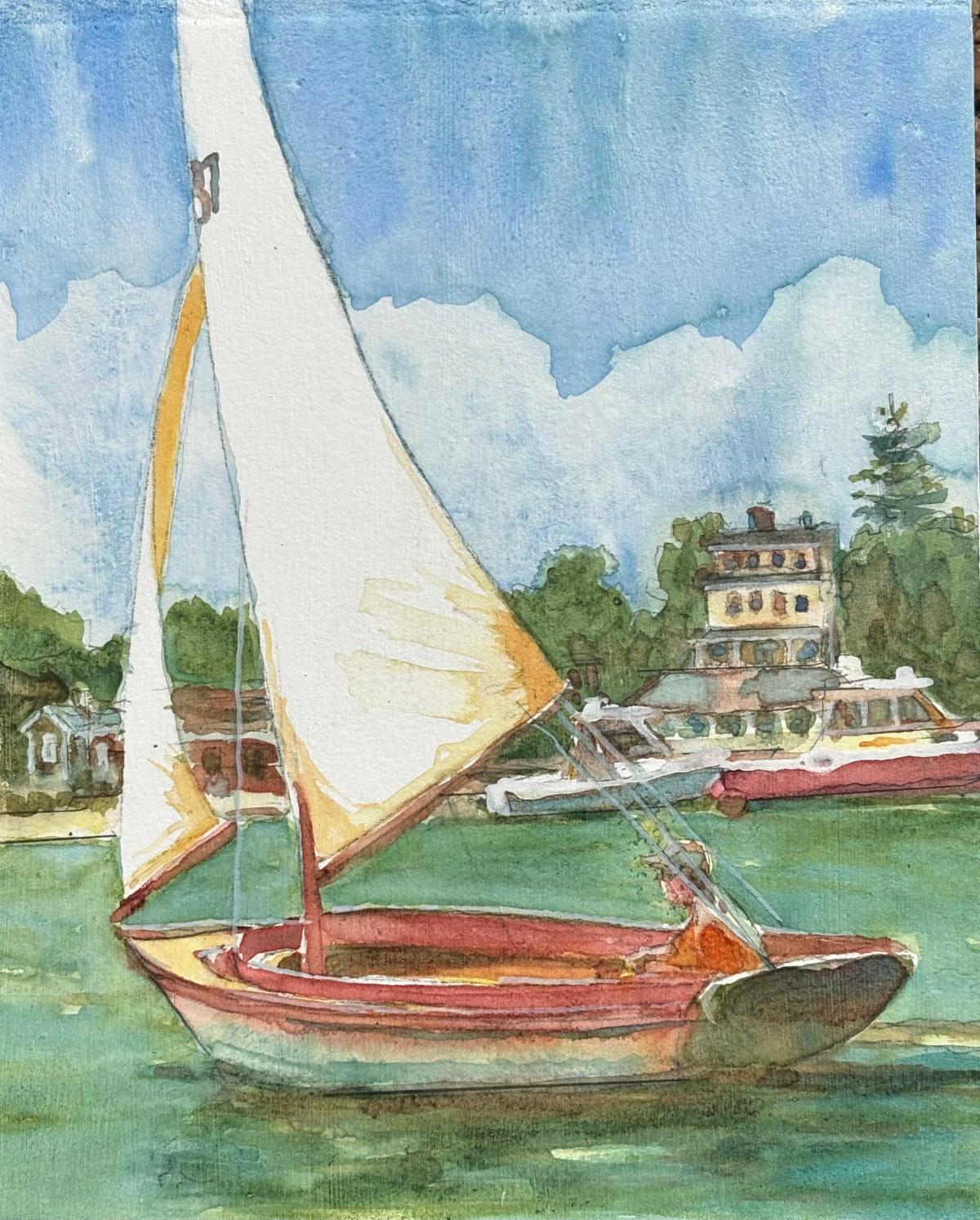
Title: Sunfish Sail
Media: Mixed Media
Size: 10" x 10"
Price: $444
Frame: White Wood Panel
| | | |
Title: Vineyard Life
Media: Watercolor on panel
Size: 10" x 8"
Price: $222
Frame: White Wood Panel
| | | |
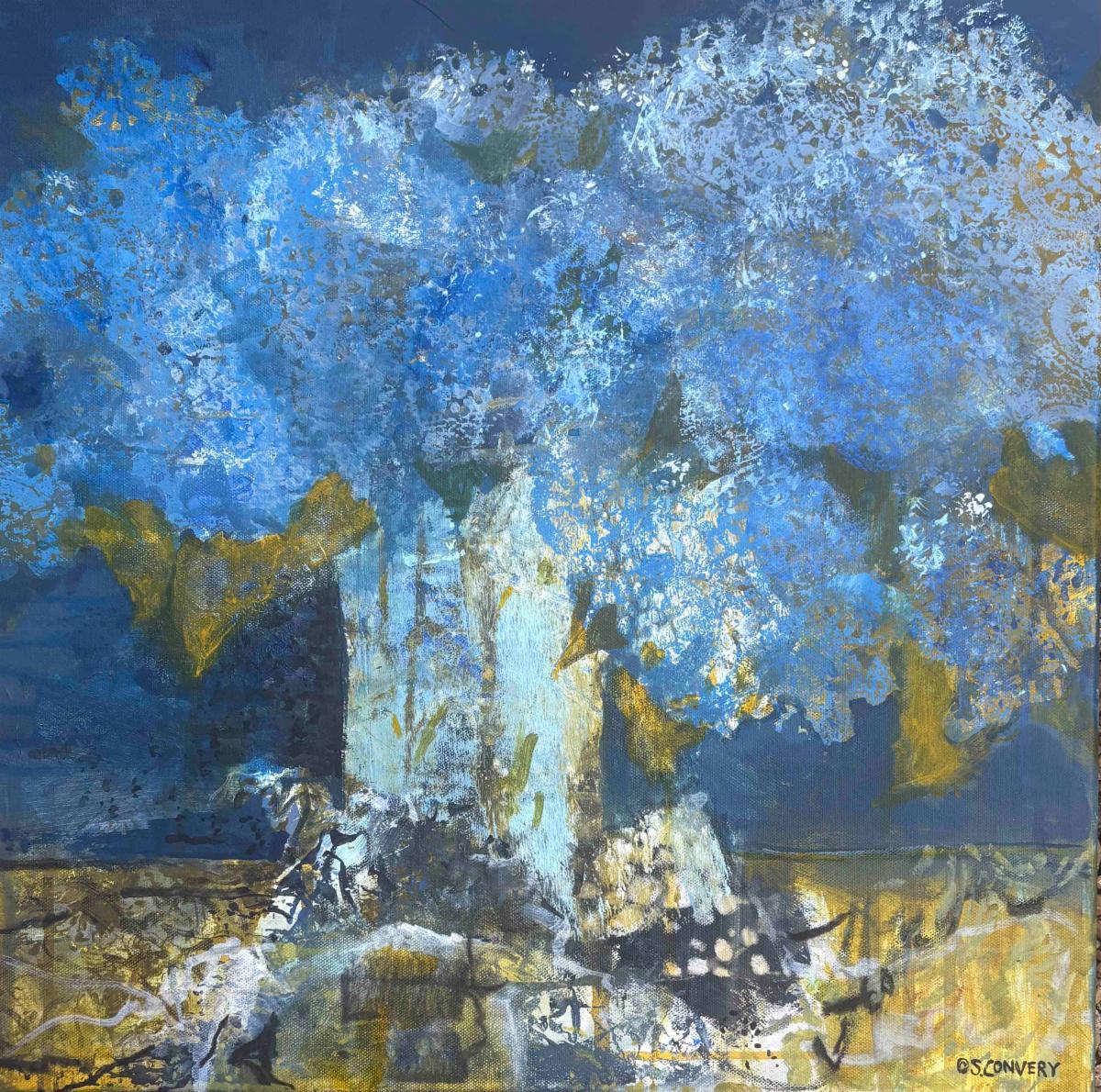
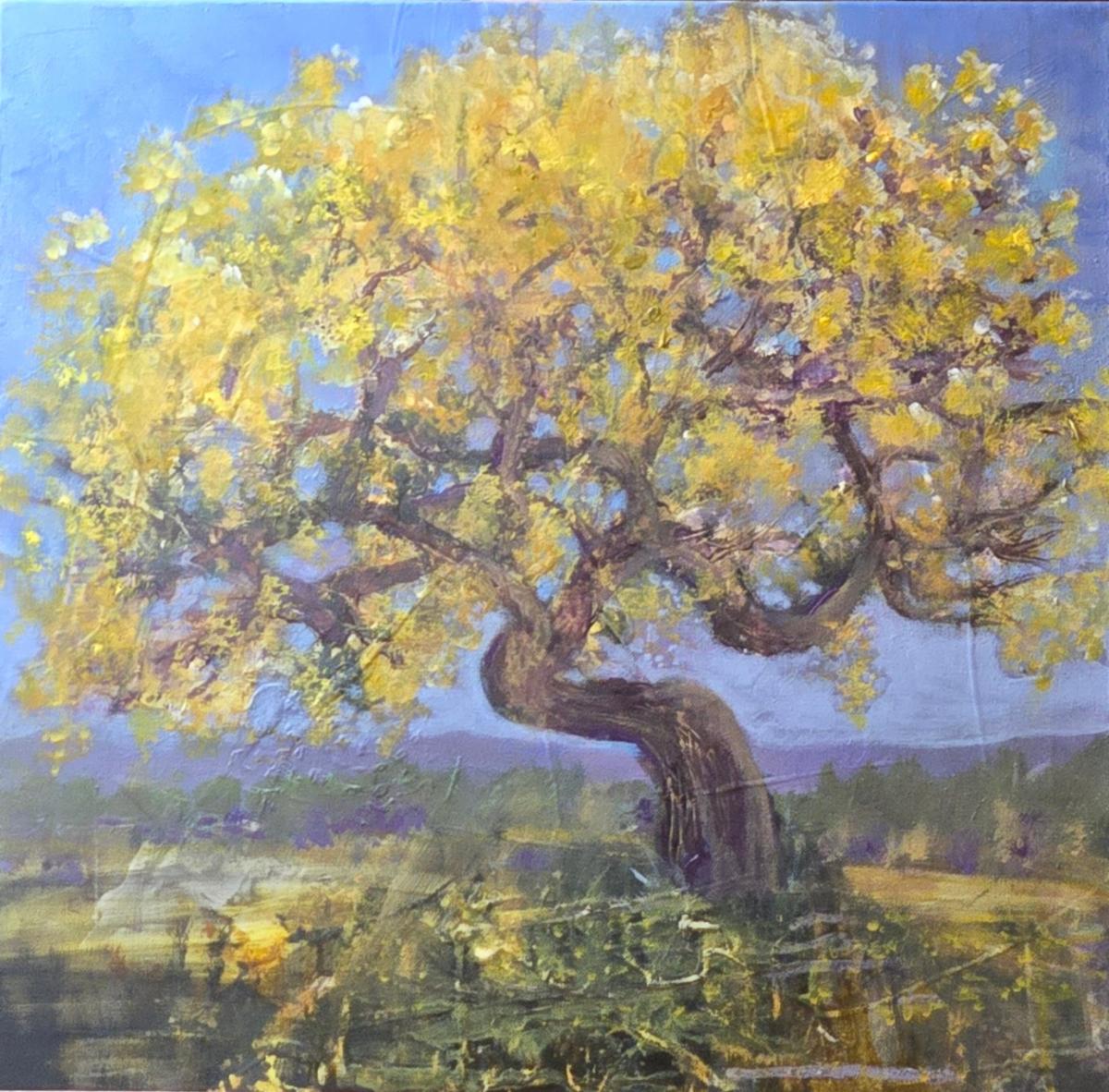
Title: Nothing Gold Can Stay
Media: Acrylic Mixed M
Size: 20" x 20"
Price: $555
Frame: Gallery Wrap
| | | |
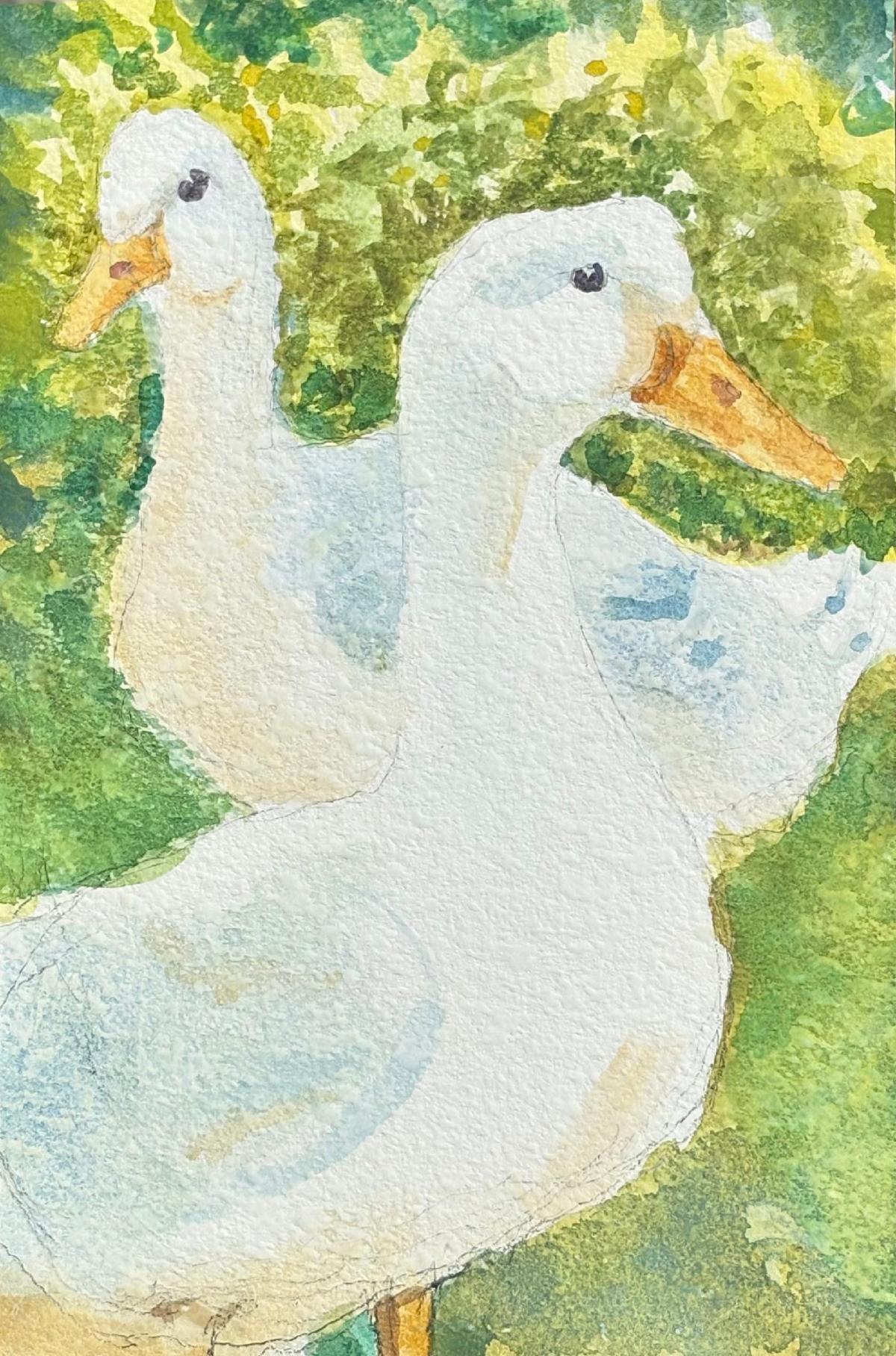
Title: Puddle Ducks
Media: Watercolor on panel
Size: 6" x 4"
Price: $125
Frame: White Wood Panel
| | | Want to see past issues of my newsletters? Visit this link on my website. | |
Subscription Information: You are receiving this email because you subscribed to my mailing list, downloaded a resource, purchased one of my products/programs, or opt-ed in some other way.
Thank you for being part of the Cr8V Soul Arts Tribe!
NOTE: Unsubscribing means you won't receive any more emails from me including information about your paid products and programs.
| | | | |