|
The Georgia House of Representatives began the seventh week of the 2025 legislative session on Monday, February 24. By the end of the week, we reached Legislative Day 25. This week, we convened for four legislative days and a committee day, passing several measures crucial to Georgians. The workload will only increase with Crossover Day looming this Thursday, March 6.
Placing into Georgia Law the Right to Use In Vitro Feralization (IVF)
With the unanimous passage of House Bill 428, the House took a significant step in supporting Georgians and their growing families. This legislation would codify the right to in vitro fertilization (IVF) in our state’s law, reinforcing our commitment to making Georgia the best place to live, work and raise a family. Many couples face the heartbreaking challenge of infertility, with the Centers for Disease Control reporting that 19 percent of women experience this struggle. IVF has provided a safe and effective path to parenthood for many, and in 2021 alone, more than 2,300 children were born in Georgia through this medical intervention, and members of the House shared stories of their personal connections to this life-changing medical procedure. These testimonies underscored just how vital IVF is for families struggling with infertility, making our vote to protect this right even more meaningful. I am proud to stand with my colleagues in ensuring that those who rely on IVF have the legal protection and support they need to grow their families through this procedure.
Continuing Work to Improve Literacy In Georgia
and Including Dyslexia to Assist More Georgians
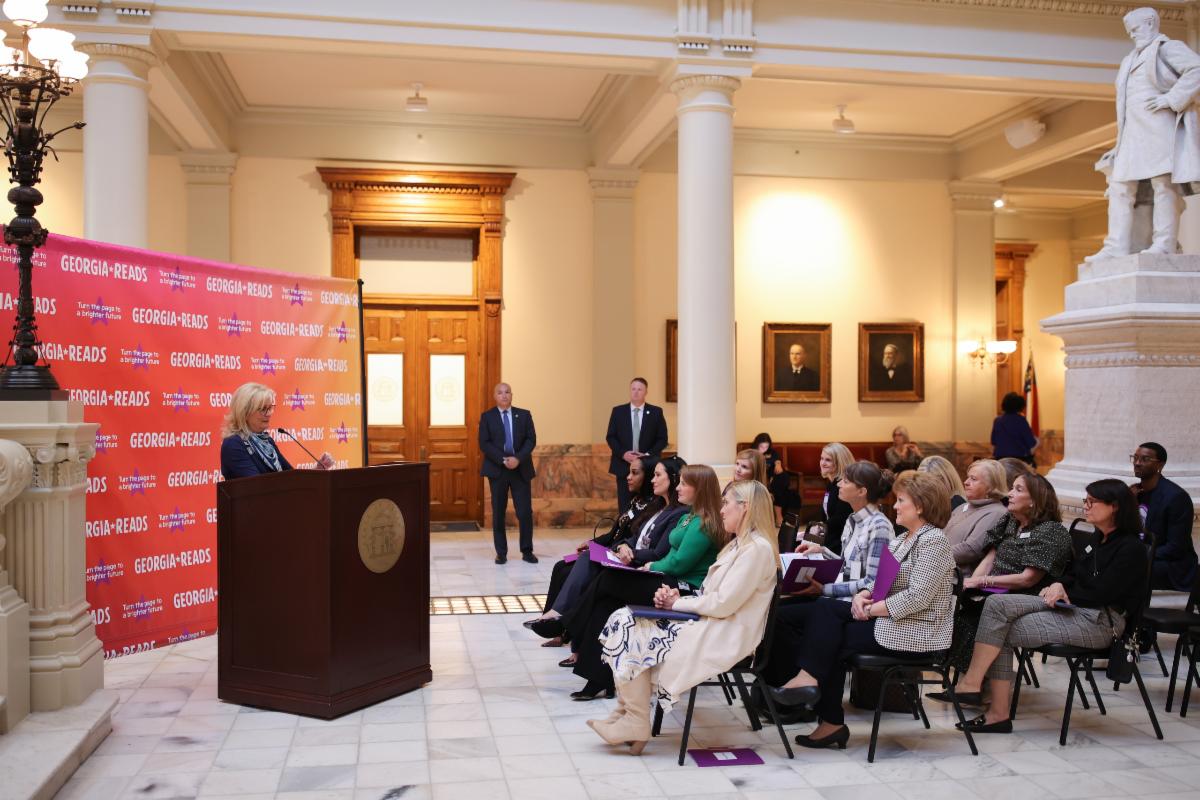
House Bill 307 demonstrates the House’s dedication to improving literacy in Georgia. Passed with bipartisan support this week, HB 307 would amend the Georgia Early Literacy Act to include dyslexia, renaming it the Georgia Early Literacy and Dyslexia Act. During the 2023 legislative session, the House passed House Bill 538, and HB 307 builds on that legislation to further support students at risk of not achieving grade-level reading proficiency or who exhibit characteristics of dyslexia. The bill aims to align instruction with the science of reading principles. HB 307 would also remove outdated language related to programs that do not align with these science-based standards and would prevent the three-cueing method from being used in Georgia. The bill would make it clear that any three-cueing curriculum, defined as any model for teaching students to read based on meaning, structure and syntax and visual cues (also referred to as MSV), would not be considered high-quality instructional material, ensuring that only effective, research-based approaches are used. Importantly, HB 307 would not ban the use of picture books, pictures or the practice of calling attention to pictures or using flash cards in instruction. These methods could still be used as supplemental tools but not as a primary means of literacy instruction. Additionally, HB 307 would create the Georgia Literacy Coach Coordination Council to ensure that Georgia’s literacy coaches receive quality instruction that is standardized. This legislative measure would further strengthen Georgia’s efforts to improve literacy outcomes and ensure all students receive evidence-based, high-quality reading instruction. By focusing on early literacy, especially for students at risk of falling behind, we ensure that every child has the tools needed to succeed academically and beyond.
Covering PANS and PANDAS in the State Health Plan
Another significant bill that passed out of the House this week was House Bill 124, which would mandate that the State Health Benefit Plan (SHBP) provide health insurance coverage for children diagnosed with Pediatric Acute Onset Neuropsychiatric Syndrome (PANS) and Pediatric Autoimmune Neuropsychiatric Disorders Associated with Streptococcal Infection (PANDAS). Under this bill, all SHBP policies renewed or issued on or after July 1, 2025, would be required to include coverage for the purposes of diagnosis, treatment, appropriate management or ongoing monitoring of a covered person’s disorder. Both PANS and PANDAS are rare diseases that have previously not been recognized under the SHBP as covered conditions, and this legislation would help ensure that affected families and patients have answers and receive the care they need. Moreover, this legislation would align Georgia with 29 other states that have adopted similar coverage mandates. In 2019, the House established the House Study Committee on PANS and PANDAS through the adoption of House Resolution 590. The study committee's mission was to examine and identify the barriers to diagnosing and treating PANS and PANDAS, while also raising awareness and improving access to testing, diagnosis and timely medication and care. Advocates and patients have long pushed for awareness and health coverage for these rare diseases, and I am proud of the House’s leadership in addressing this issue and delivering on our promise to Georgia’s families by supporting those affected by these rare diseases.
Protecting Georgia's Children
We also took an important step to protect Georgia’s children by passing House Bill 171, a measure aimed at addressing the growing concern surrounding computer-generated obscene material involving children. As technology evolves, so do the ways in which individuals may exploit and potentially harm children, with artificial intelligence (AI) playing an increasingly prominent role. HB 171, also known as the Illegal AI Activities Act, would create a new criminal offense for the distribution, solicitation or possession with the intent to distribute obscene computer-generated material that depict a child. This would include any AI-generated images, videos, drawings, sculptures or paintings that are obscene and feature realistic depictions of what appears to be a child. Individuals convicted of this crime would face a prison sentence between one and 15 years. In addition, HB 171 would give judges the discretion to impose specific probation rules, including special protections for minors. These specific probation rules could include being monitored remotely and imposing restrictions on using drones or prohibiting the individual from running for a local school board position. Additionally, HB 171 would enhance sentences for certain crimes when they involve the use of AI. For example, crimes such as stalking, aggravated stalking, exploitation of a disabled adult, child exploitation and theft, among others, would carry increased penalties if AI is used in the crime. If AI is determined to be the proximate cause of the crime—meaning it played a direct role in facilitating the offense—those convicted could face up to 12 additional months in prison or a fine of up to $5,000 for misdemeanor offenses. For felony crimes, this penalty enhancement could result in a minimum of two extra years in prison. By passing HB 171, the House took a strong stand to guarantee that emerging technology is used responsibly, closing a loophole to ensure that those who attempt to use AI technology for criminal purposes are held accountable.
Ethan's Law to Keep Families Together
The House also passed House Bill 253, or Ethan’s Law, with bipartisan support, to protect Georgia families during the reunification process. Under current law, superior court judges could order children to attend reunification camps outside of Georgia, which would not only remove the child from the state’s jurisdiction but also violate certain parental rights. Parents with sole custody could be directed, under court order, to send their children across state lines for reunification with a parent who was previously deemed unfit for custody. Ethan’s Law would prevent such practices by prohibiting juvenile courts from ordering family reunification or unification treatments, programs or services, including camps, workshops, therapeutic vacations or educational programs. The bill would define these treatments as educational or experiential workshops that may involve youth transporters or private transportation agents. Additionally, the legislation would ensure that such programs cannot be ordered if they would result in a violation of court orders, involve the use of force or threat of force by private youth transporters, put the child’s safety at risk, require no-contact periods between the child and their parent or guardian or involve out-of-state stays. With the passage of HB 253, the House took crucial action to protect parental rights, as well as the safety and well-being of Georgia’s children.
Covering Prostrate Cancer Preventative Care
We also turned our attention this week to passing legislation that seeks to improve health outcomes for Georgians. The House passed House Bill 373, which would mandate insurance coverage for annual prostate cancer screenings for high-risk men, including digital rectal examinations and prostate-specific antigen tests. Given that early detection significantly improves outcomes for prostate cancer, this bill would prioritize preventive care over late-stage, often costly treatments. The bill would define high-risk men as men who have a first-degree relative who has been diagnosed with prostate cancer, who developed prostate cancer, whose death was a result of prostate cancer, who has been diagnosed with a cancer known to be associated with an increased risk of prostate cancer or who has a genetic alteration known to be associated with an increased risk of prostate cancer. It would further define high-risk men as men with a family history of prostate cancer between 40 and 49 years old, men who are 50 years and older and other men, as determined by a physician. By defining risk categories and ensuring coverage for these essential screenings, HB 373 would allow for greater chances of early detection and would ultimately save lives as a result.
We also passed the following bills this week:
Additional Bills from Week 7 of 2025 Session
The Georgia House of Representatives will resume its work on Monday, March 3rd, for the eighth week of the session. Wednesday will be dedicated to a committee workday, which will be followed by Legislative Day 28 on Thursday, Crossover Day.
Committee Schedules
House Committees continue to meet; we are working hard across all committees. Full committee schedules are available online by clicking here.
|