February 21, 2025

Newsletter for February 21, 2025

Visit our Website

This Issue:

  • Nevada Department of Agriculture Issues Order On Eggs Sold In Nevada
  • Nevada Farm Bureau Testifies In Support Of Soil Health Bill
  • Work Continues On SB 172
  • New Bills In The Legislative Mix
  • Attention To Those Who Transport Intra-State Freight – SB 18Assembly Natural Resources Committee Hearings On Water Bills – Monday, Feb. 24
  • A Reminder Of Where Agricultural Trade Fits In


Nevada Department of Agriculture Issues Order On Eggs Sold In Nevada

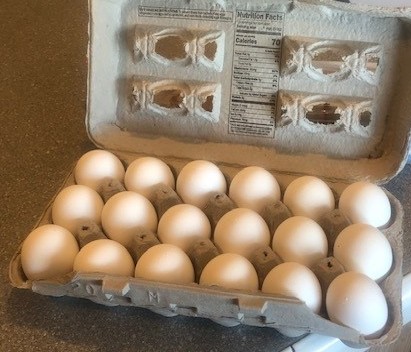
The Nevada Department of Agriculture (NDA) State Quarantine Officer, Director J.J. Goicoechea, DVM, has temporarily suspended Nevada’s cage-free egg law. Beginning February 20, 2025, eggs for retail sale can be sourced from any egg producer meeting food-safety guidelines, regardless of whether the eggs originated from hens in a cage-free housing system. This order was issued to address the strain on egg supplies and high egg prices in Nevada. 


“Eggs are typically the most cost-effective protein source for food insecure populations,” said NDA Director Goicoechea. “When families can’t find eggs on the shelf, and when they do the prices are not attainable, this can leave them without an essential food they depend on.”


In 2021, Nevada passed cage-free egg regulations requiring all eggs sold in Nevada to be sourced from cage-free hens. “Cage-free” is defined as eggs from hens in an enclosure in which they are unrestricted and free to roam, with a total space of at least one square foot per hen in the enclosure. As Highly Pathogenic Avian Influenza (HPAI) continues to impact the poultry industry, particularly cage-free egg producers, the supply of cage-free eggs has been significantly reduced. 


During the current 83rd Legislative Session, Assembly Bill 171 was passed and signed into law, allowing for the temporary suspension of cage-free regulations for up to 120 days in emergencies. Director Goicoechea issued the order, beginning the 120-day period, on Feb. 20, 2025. This order also allows for the sale of “Grade B” quality standard eggs. These eggs must meet all of the food safety requirements of “Grade A” eggs, but may have different colors, shapes and sizes. 


“This egg shortage didn’t happen overnight, and we cannot resolve it overnight,” said Director Goicoechea. “We anticipate roughly 30 days before we can secure new contracts and start to see increased egg supplies on the shelf, and hopefully lower prices as availability increases.”

Nevada Farm Bureau Testifies In Support Of Soil Health Bill

On February 19th, Nevada Farm Bureau and a large group of other supporters for AB 80 shared their approval for passage of the legislation to establish and implement the “Healthy Soils Initiative” when the Assembly Natural Resources Committee heard the bill.


“Our voting delegates – Nevada farmer and rancher Farm Bureau members – have adopted a policy position which includes our support for educational sessions and workshops for the purpose of helping in understanding regenerative agricultural practices and principles,” Doug Busselman stated, adding, “We have supported, promoted and even hosted these types of training sessions.”


Another favorable approach from the bill that Busselman drew attention to was that the bill explicitly protects voluntary participation and prohibits mandates of implementation of soil health practices by agricultural producers.


As part of the presentation from Assembly member LaRue Hatch, an amendment was provided which basically removes funding from the bill.  This is a move that is intended to avoid the bill from going to the Assembly Ways and Means Committee where last session the proposed bill then was sent and where it died in committee.

Work Continues On SB 172

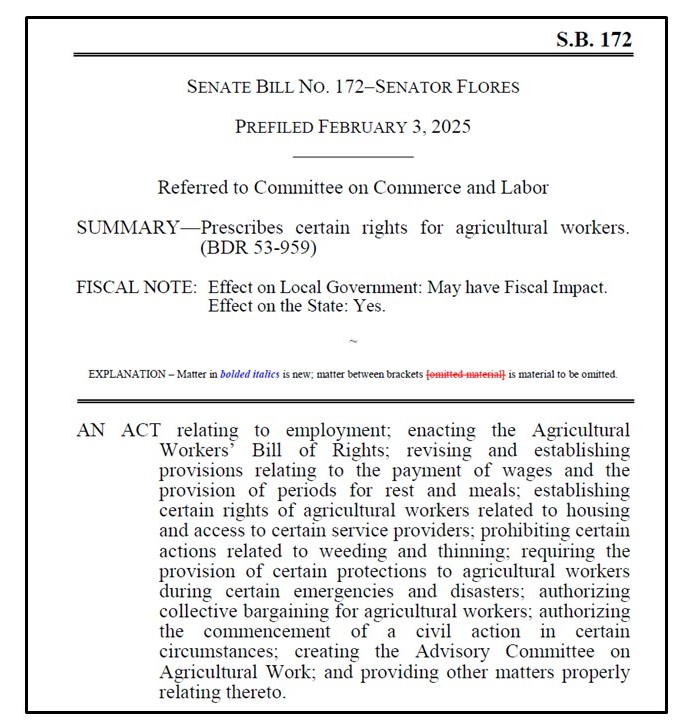
We greatly appreciate hearing from Farm Bureau members who have concerns and have been offering input on SB 172 The information that we’ve been gathering from farmers and ranchers who will be affected if the legislation would be passed, has been very helpful.  This contact has also provided us with the opportunity to stress with members on the importance in their contacts with members of the Senate Commerce and Labor Committee and communicating the consequences if SB 172 removes the exemption that agriculture presently has as part of state law.  


The Senate Commerce and Labor Committee Members:


Senator Julie Pazina, Chair – email: Julie.Pazina@sen.state.nv.us

Senator Skip Daly, Vice Chair – email: Skip.Daly@sen.state.nv.us

Senator Melanie Scheible – email: Melanie.Scheible@sen.state.nv.us

Senator Roberta Lange – email: Roberta.Lange@sen.state.nv.us

Senator Edgar Flores – email: Edgar.Flores@sen.state.nv.us

Senator John Ellison – email: John.Ellison@sen.state.nv.us

Senator Lori Rogich – email: Lori.Rogich@sen.state.nv.us


As an information tool for you to review in providing an understanding of the legislation and to be used in basing your communications with committee members, we have prepared this background paper.

New Bills In The Legislative Mix

Since our last newsletter, these bills which Nevada Farm Bureau is following have been introduced:


AB 242 is a proposal from Assemblyman Rich DeLong of Reno that seeks to install the requirements for regulations to be adopted for the current program to mitigate damage for the sagebrush ecosystem.  The assignment for the adoption of the regulations will fall to the Nevada Sagebrush Ecosystem Council, if the bill is adopted and signed into law.


AB 251 this bill is co-sponsored by Assemblymembers Greg Koenig of Fallon and Bert Gurr of Elko.  Under the bill, mobile harvesting units, which meet the necessary inspection requirements to be qualified as official establishments in Nevada’s State Meat Inspection program.  Prior to this bill being proposed, mobile facilities have not been authorized to be classified as “official establishments.”

Attention To Those Who Transport Intra-State Freight – SB 180

The language in SB 180 indicates that anyone transporting intra-state freight with a vehicle that has a rating of 26,000 pounds or more is going to need to file with the Department of Transportation as well as with the Department of Motor Vehicles a completed form which demonstrates that they have liability insurance or a bond with a surety company in an amount of $1.5 million.  Not only does the language specify this requirement on common and contract carriers, but also “every private carrier” who is transporting intra-state (within the State of Nevada) freight.  In other words, even farmers or ranchers hauling their own “freight” within the state would be required to have liability insurance of $1.5 million.


Do you have such a vehicle that transports freight (including your own products) within the state?  Do you currently have $1.5 million in liability insurance?  If you have concerns regarding this legislative proposal, please reach out to the assigned committee (see below the members and their contact information) and share your concerns…


Members of the Senate Committee on Growth and Infrastructure:


Chair, Senator Rochelle Nguyen – Email – Rochelle.Nguyen@sen.state.nv.us

Vice Chair, Senator Julie Pazina – Email – Julie.Pazina@sen.state.nv.us

Senator Fabian Donate – Email – Fabian.Donate@sen.state.nv.us

Senator Ira Hansen – Email – Ira.Hansen@sen.state.nv.us

Senator Carrie Ann Buck – Email – Carrie.Buck@sen.state.nv.us

Assembly Natural Resources Committee Hearings On Water Bills – Monday, Feb. 24

The advanced notification that we’ve received indicates that the Assembly Natural Resources Committee is planning to hold hearings on two key water bills during their Monday, February 24th committee meeting.  AB 104 is nicknamed the “Omnibus Bill” because it covers a number of different areas dealing with water.  The primary portion of the proposed legislation involves the creation of a voluntary water purchase and retirement program.  Nevada Farm Bureau and other water stakeholders have been meeting and developing the language for the legislation for over a year-and-a-half.  It was officially brought forward by the Joint Interim Standing Committee on Natural Resources.  Since the bill was pre-filed there have been continuing discussions with a wider range of water interests on SB 104 and substantial amendments are expected to be introduced when the Assembly Natural Resources Committee hold their hearing.


AB 9 is another bill which has been brought forward from the Joint Interim Standing Committee.  There is also the possibility of this bill having an amendment brought forward when the Natural Resources Committee holds the hearing that is expected to happen on February 24th.  Under current law there are ways for agricultural water rights to be temporarily transferred for wildlife or to improve the quality or flow of water for three years.  AB 9 seeks to allow for longer term “temporary” transfers.

Nevada Group Make Washington, D.C. Trip

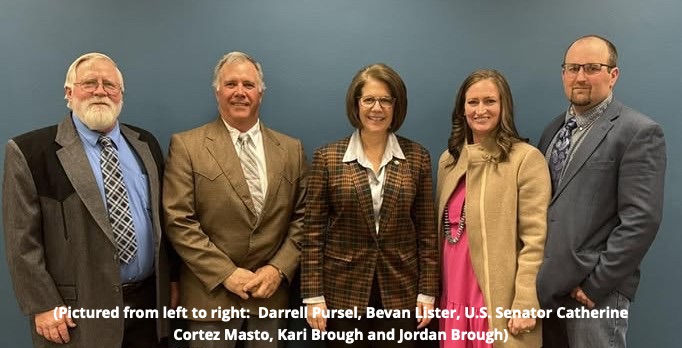
A group of Nevada Farm Bureau leaders have wrapped up a successful trip to Washington, D.C. where they met with Senator Cortez Masto, Senator Jacky Rosen and staff members of Nevada’s representatives in the U.S. House.  The trip involving President Bevan Lister, Vice President Darrell Pursel, Kari and Jordan Brough of Elko County was also for the purpose of participating in two of the American Farm Bureau Federation’s (AFBF) Issues Advisory Committee meetings.  Pursel is a representative on the Environmental Regulations and Water Issues Advisory Committee and Kari Brough represents Nevada Farm Bureau on the Federal Lands Issues Advisory Committee.

A Reminder Of Where Agricultural Trade Fits In

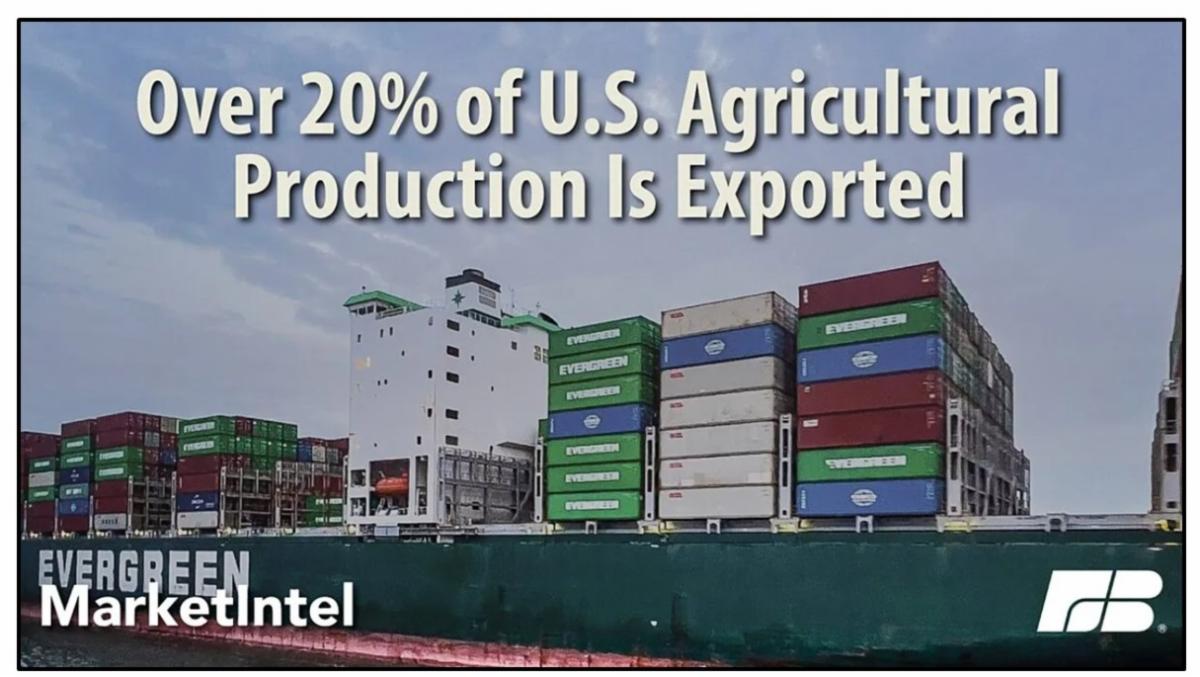
Given the timely and lively topic of U.S. trade and debate over trade policy decisions flowing throughout Washington, D.C., the American Farm Bureau Federation (AFBF) Economic Team has announced that they are planning to present a series of articles on different agricultural trade matters.   The first of this series is from AFBF economist, Betty Resnick.


In addition to the important role that agricultural trade has for U.S. farmers and ranchers who produce the commodities which enter the international marketplace, Resnick writes, “Agricultural exports are also important in the broader U.S. economy.”


“On average, $2.09 of domestic economic activity is created for every $1 of U.S. agricultural exports.” she continues, adding, “This translates to jobs as well, with USDA estimating that over 6,000 jobs are created for each $1 billion in agricultural exports – equaling approximately 1.25 million jobs in 2022.”

Have a great weekend!