GI Societies Issue Updated Colorectal Cancer Screening Recommendations
|
|
The
U.S. Multisociety Task Force (MSTF) on Colorectal Cancer has released two new recommendation documents providing you with a timeline for follow-up colonoscopy based on a patient’s initial exam as well as recommendations to ensure high-quality polypectomy.
The publications from the U.S. Multisociety Task Force — which is comprised of representatives of the American College of Gastroenterology, the American Gastroenterological Association and the American Society for Gastrointestinal Endoscopy — aim to improve colorectal cancer prevention and early detection.
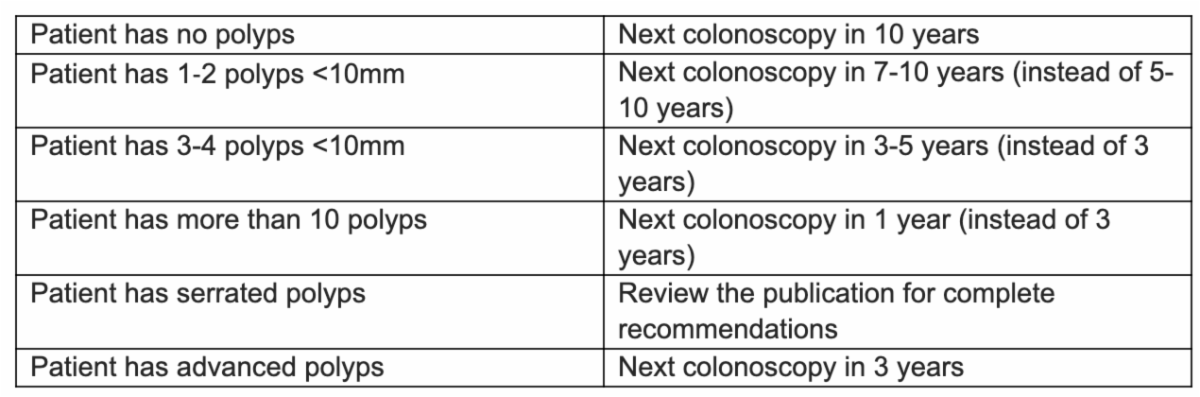
Recommendations for Follow-Up After Colonoscopy and Polypectomy
1
For this publication, the U.S. MSTF reviewed their 2012 recommendations
2
and provide an updated schedule for follow-up colonoscopy following a patient’s initial high-quality exam:
|
|
To review all MSTF recommendations for patient follow-up, review the
full publication
.
Recommendations for Endoscopic Removal of Colorectal Lesions
3
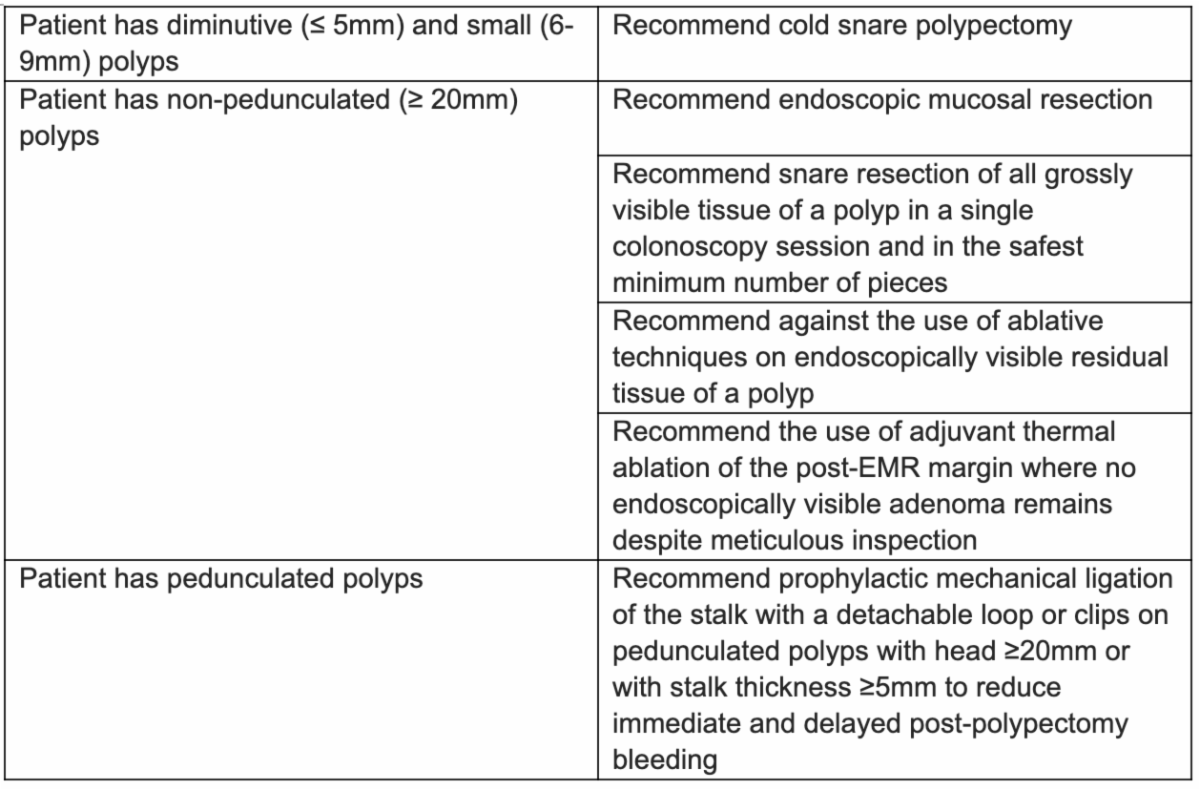
This publication provides best practices for the endoscopic removal of precancerous colorectal polyps
during colonoscopy.
Best practices for polyp assessment and description
MSTF recommends macroscopic characterization of a polyp, which provides information to facilitate the polyp’s histologic prediction, and optimal removal strategy.
Best practices for polyp removal
The primary aim of polypectomy is complete removal of the colorectal lesion, and the subsequent prevention of colorectal cancer. If you encounter a suspected benign colorectal polyp that you are not confident to completely remove, MSTF recommends referral to an endoscopist experienced in advanced polypectomy for subsequent evaluation and management in lieu of referral for surgery.
|
|
Best practices for surveillance
MSTF recommends intensive follow-up schedule in patients following piecemeal endoscopic mucosal resection (lesions ≥ 20 mm) with the first surveillance colonoscopy at 6 months, and the intervals to the next colonoscopy at 1 year, and then 3 years.
To review all MSTF recommendations on polyp removal, review the
full publication
.
|
|
Task force members:
- Joseph C. Anderson, MD, MHCDS, Dartmouth Geisel School of Medicine, Hanover, New Hampshire
- Carol A. Burke, MD, Cleveland Clinic, Ohio
- Jason A. Dominitz, MD, MHS, University of Washington Medicine, Seattle
- Samir Gupta, MD, MSc, University of California San Diego
- Tonya R. Kaltenbach, MD, MS, University of California San Francisco
- David A. Lieberman, MD, Oregon Health and Science University, Portland
- Douglas K. Rex, MD, Indiana University School of Medicine, Indianapolis
- Douglas J. Robertson, MD, MPH, Dartmouth Geisel School of Medicine, Hanover, New Hampshire
- Aasma Shaukat, MD, MPH, Minneapolis VA Health Care System, Minnesota
- Sapna Syngal, MD, MPH, Dana-Farber Cancer Institute, Boston, Massachusetts
The U.S. MSTF recommendations are published jointly in
Gastroenterology
,
The American Journal of Gastroenterology
, and
Gastrointestinal Endoscopy
|
|
- Gupta S., Lieberman, D.A., Anderson, J.C. et al. Recommendations for Follow-Up After Colonoscopy and Polypectomy: A Consensus Update by the US Multi-Society Task Force on Colorectal Cancer. Gastroenterology 2020. Epub ahead of print.
- Lieberman, D.A., Rex, D.K., Winawer, S.J. et al. Guidelines for colonoscopy surveillance after screening and polypectomy: a consensus update by the US Multi-Society Task Force on Colorectal Cancer. Gastroenterology. 2012; 143: 844–857
- Kaltenbach, T., Anderson, J.C., Burke, C.A. et al. Endoscopic Removal of Colorectal Lesions—Recommendations by the US Multi-Society Task Force on Colorectal Cancer. Gastroenterology 2020. Epub ahead of print.
|
|
Thank you for your time. Please contact your GI Society with any questions:
|
|
American College of Gastroenterology
(301) 263-9000
|
American Gastroenterological Association
(301) 654-2055
|
|
American Society for Gastrointestinal Endoscopy
(630) 570-5635
|
|
ACG, AGA and ASGE are committed to collaborate on issues of common interest to all members of the GI community, including public policy and regulatory challenges facing gastroenterologists. This message is being sent as a joint communication from the three societies and has been reviewed by each organization.
|
|
|
|
|
|
|