October 16, 2020
The Out-of-Pocket Health News Digest
|
|
Below you will find briefs about recent health policy news stories. Our hope is for students to have an information outlet at their fingertips to keep up-to-date with the most pressing news stories in health policy.
This compilation is produced by the HPSA Education Committee: Matthew Dunn, Magdalena Mihaylova, Atticus Raasch, and Brynna Thigpen
|
|
American southeast recovering from Hurricane Delta - the latest storm in a historic season
by Matthew Dunn
|
|
On Friday, October 9, Hurricane Delta made landfall in Louisiana as a category 3 storm. The impact of this hurricane was felt throughout the southeast, including Louisiana, Mississippi, Florida, Alabama, and parts of Texas. So far there have been 4 reported deaths and many more injuries and hospitalizations. While the storm has since passed through the area, environmental hazards remain in the form of flooding, broken power and gas lines, and damaged homes. By Monday there were still approximately 140,000 residents without power.
Louisiana Governor John Bel Edwards has requested a Major Disaster Declaration from the federal government. This would provide aid to the state to help with debris removal and emergency protective measures, and also provide assistance to individuals affected by the hurricane.
Delta was the latest addition to a historic hurricane season. This was the 5th hurricane to make landfall in the U.S. in 2020 - the most since 2005 when there were 7. In fact, Hurricane Delta made landfall in Creole, Louisiana, which is just 13 miles from where Hurricane Laura hit less than 2 months ago. The cleanup effort from Laura is actually still ongoing in some places, and there are communities who have experienced the devastation of 2 strong hurricanes in such a short period of time.
Prior to reaching the U.S., Hurricane Delta made landfall in Mexico on the Yucatan peninsula. Although 266,000 lost power, there were no reported deaths or fatalities.
|
|
Employer-based health insurance premiums see 4% increase, 55% over the past decade
by Atticus Raasch
|
|
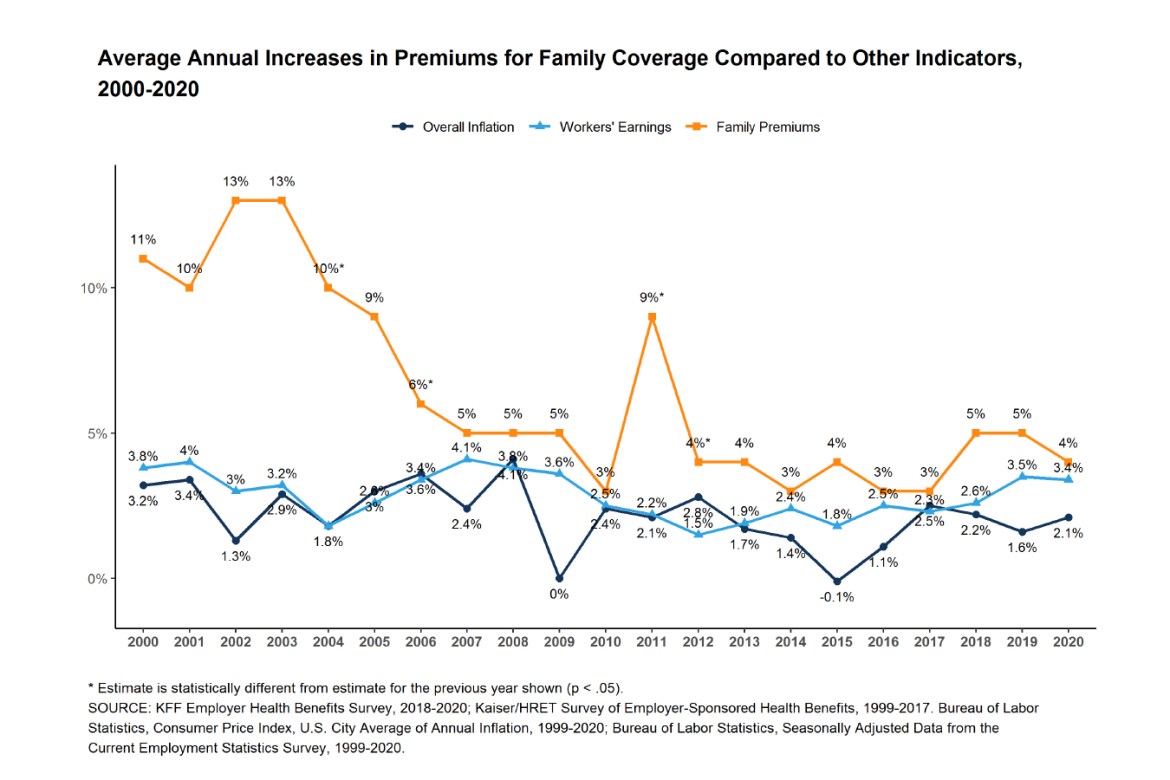
According to a new study by Kaiser Family Foundation, Americans with employer-based health insurance found that their average family premiums rose 4% to $21,342 this year. Of this number, workers pay approximately $5,588 while the employer foots the rest of the bill. This increase has been consistent with the rising trend of health insurance premium increases in the past decade. Though a small increase in 2020, prices have gone up by 55% in the last 10 years alone.
Currently, around 157 million Americans rely on employer-based coverage for their care, far more than any other source of coverage in the country. While the increase year to year has not hit double digits for quite some time, the compounded modest increases have been extreme. Over the last year, some employers and insurance companies have decided to waive cost-sharing in light of the COVID-19 pandemic. However, many companies are reinstating deductibles and copayments for illnesses and treatments unrelated to COVID-19, which poses concerns for Americans experiencing the plights of the economic slowdown.
In addition, the average annual deductible for coverage has seen immense increases over the past few years. The average deductible for single coverage has increased 25% over the last 5 years and 79% over the last decade.
|
|
For Indigenous women, community midwifery may help narrow health disparities
by Magdalena Mihaylova
|
|
Indigenous people face stark health disparities all around the world. In the U.S., American Indians and Alaska Natives have a life expectancy that is 5 and a half years less than that of all other races. They also die at much higher rates than other Americans from causes such as cirrhosis, diabetes, suicide, and chronic lower respiratory diseases. Indigenous women face additional prejudices; they are two to three more times likely to die from pregnancy-related causes than white women, even when living in urban areas with access to healthcare. This occurs for a variety of reasons, including implicit bias in healthcare, due to a lack of resources, or unstandardized care for disadvantaged communities.
Indigenous midwifery is experiencing a resurgence, with calls to close such gaps in reproductive health. The World Health Organization named 2020 as the Year of the Nurse and the Midwife, acknowledging the immense impact and importance of midwifery on maternal and familial outcomes. Indeed, with quality midwife care, 83% of maternal deaths could be avoided; even further, a well-trained midwife can provide 87% of all essential sexual, reproductive, maternal, and newborn health services. For Indigenous women, midwifery can serve as a central and impactful measure in improving reproductive health outcomes.
Many Indigenous women face obstacles under the Western biomedical model of birth. Giving birth outside of their communities, wherein they might not speak the language, can pose great risk. Not only can indigenous midwives provide the crucial care that many Native communities lack, but they can improve health outcomes through appropriate cultural understanding.
|
|
One-Liners
by Brynna Thigpen
|
|
-
Drug pricing: Following approval from HHS secretary Alex Azar, President Trump announced in late September that states can set up programs to import a limited number of pharmaceutical drugs from Canada, potentially lowering prices for US consumers, although Canada and pharmaceutical companies oppose the move. (Kaiser Health News)
-
Immigrant health: Non-citizen immigrants in Illinois will be eligible to receive state-funded health insurance coverage similar to Medicaid beginning in December. (Chicago Tribune, US News)
-
Health data and privacy: Michigan is one of eight states in the US not releasing details of children’s coronavirus deaths, citing privacy concerns; doctors and epidemiologists worry these gaps in the data prevent robust nationwide data and make it harder for scientists to learn about COVID-19’s impact on children. (Detroit Free Press)
-
Public health law: After ruling that Governor Whitmer’s COVID-19 emergency executive orders were unconstitutional, the Michigan Supreme Court also ruled that they were invalidated immediately, rather than at the end of October. (The Detroit News)
-
Vaccine development: A COVID-19 vaccine may be available for distribution by the end of 2020, according to the Director-General of the World Health Organization (WHO), with a goal of 2 billion doses delivered by the end of 2021. (Reuters)
|
|
|
|
|
|
|