|
|
|
POLICY & ADVOCACY UPDATE
Issue #34, 5 December 2024
| | | |
- New appointments to the AA Board
- Migration Core Skills List announced
- International airline capacity increases
- Apprenticeship numbers continue to fall
- AA Supporting South Australian Members
- Treasury consultation addresses pricing practices
- Stronger hotel performance in October
- Horwath annual hotel performance report released
- Tourism GDP close to $80 billion in 2023-24
| |
New appointments to the AA Board
Last week’s board meeting in Brisbane saw the appointment to the Board of EVT Area General Manager Joanna Carruthers, Marriott Area Vice-President Australia, New Zealand & Pacific – Jason Nuell, Ovolo Group Chief Operating Officer Wayne Taranto and Crown Hotels & Resorts Executive General Manager Perth Andrew Cairns (see media release). AA Chair David Mansfield said all were welcome additions, bringing decades of experience and expertise to the board at a pivotal time for the industry – just in time for a federal election year. Issues and advocacy plans related to the election were a key discussion point at the meeting. Migration, skills and airline capacity and pricing were all major issues on the AA election agenda. The Board also discussed plans for the first election of the AA Board since the amalgamation as the transitional arrangements come to a conclusion in July 2025.
Pictured below are the new board members with AA chair. From the left: Jason Nuell, Joanna Carruthers, AA chair David Mansfield, Andrew Cairns and Wayne Taranto.
| | |
Migration core skills list announced
On Tuesday the Minister for Home Affairs and the Minister for Training & Skills released the Consolidated Skills Occupation List (CSOL) that will enable employer sponsorship of temporary migrants paid between the TSMIT (salary threshold) of $73,150 and $135,000 pa. The list, which will apply from 7 December 2024, will also relate to the sponsorship of permanent migrants under the Employer Nomination Scheme. The announcement is mostly good news for our industry, but with a couple of standout misses. On the plus side, Hotel Managers, Hotel Service Managers (Exec Housekeepers), Cooks, Chefs, Pastrycooks and Finance Managers remain accessible for sponsorship. Of the occupations we advocated for, the two that are missing are restaurant managers and security managers. For those with whom I have discussed this issue in the past, I had consistently identified restaurant managers at highest risk of not being on the list. Security managers were also challenging, as their occupation falls within a code that is a catch-all occupational code of Specialist Managers not elsewhere classified.
In total the list includes 456 occupations, which is about two-thirds of the total number of skilled occupations identified by the ABS in ANZSCO. A key thing to remember about the current system is that all temporary skilled occupations have a pathway to permanency, so it is a significant improvement on the old split system of short-term and medium to long-term which was introduced in 2017 by the Coalition Government, where there was no pathway to permanency for those occupations on the short-term list. We are scheduled to meet with Minister Burke tomorrow where we hope to clarify if there will be any transitional arrangements and ensure that restaurant managers in country now will still retain their pathway to permanency. It will be very challenging if access to occupations such as restaurant manager are just switched off. We understand there will be further announcements on migration in the coming days, and the meeting will be a good opportunity to understand any future directions particularly with regional migration, working holiday makers and students.
| |
International airline capacity increases
There have been a number of announcements in the last few weeks that bring welcome increases in international airline capacity. The biggest news was that last week, the ACCC granted conditional approval for more Qatar Airways flights to and from Australia by issuing an interim authorisation for Virgin Australia and Qatar Airways to commence marketing 28 additional flights to commence in June 2025 to Brisbane, Melbourne, Perth and Sydney. These flights, to operate under what is called a "wet lease" arrangement, are the same number that the government rejected last year. The undertaking accepted by the ACCC ensures that if final regulatory approval is not granted, then customers who have booked these proposed new services would be protected by being given the option of a refund or re-accommodation on a suitable alternative flight at no additional charge. Turkish airlines have also commenced their four flights a week into Sydney, which are additional to flights already well established into Melbourne. Also, Emirates have launched their second daily flight into Perth, adding an additional 129,000 inbound seats.
In related news, last week parliament passed the Sydney Airport Demand Management Amendment Bill 2024, which implements reforms to the Sydney Airport slot regime following the Harris Review and the Aviation White Paper process, including:
- Creating a ‘recovery period’ where up to 85 aircraft movements per hour will be allowed, up from 80. This does not change the existing curfew arrangements or the daily movement cap.
- Responsibility for making the Slot Management Scheme will sit with the Minister for Transport, rather than the Slot Manager, which currently sits under Airport Coordination Australia.
- New civil penalties will be introduced for failures to use a slot movement, flight operations not in accordance with slot requirements, applying for slots with no reasonable prospects of use, and failing to return or transfer unused slots.
- Ministerial powers will be introduced to require the production of information or documents which can be shared with relevant parties.
- Introduction of the ability for the regulations to provide for the publication of information about the allocation or use of slots and gate movements
| |
Apprenticeship numbers continue to fall
The latest figures for apprenticeships in our industry released by NCVER for the March 2024 quarter continue to show a decline in both food trade apprenticeships and hospitality traineeships. Food trade commencements for the March quarter were 1,500, down 4.4% on March quarter 2023. Of even greater concern, the food trade is the only one of seven trade categories published by the NCVER that have lower commencements than the quarter at the beginning of the COVID pandemic, where there were 1,570. Demonstrating the effectiveness of the higher subsidies for apprentices during COVID, the 2024 March quarter figures compare to the peak of 2890 food trade commencements in March quarter 2022. Across all industries trade apprenticeships were up 0.8% compared with March quarter 2023, but traineeships were down 7.6% due to the reduction in traineeship employer incentives. Female apprenticeships fared the worst, falling 6.2%, as industries such as ours where opportunities for women are strong, lost their traineeship incentives. the only piece of good news in otherwise sobering data was that due to the high COVID subsidies completions in the food trade were significantly higher, with 1,005 apprentice chefs completing their trade in the March quarter 2024 compared to 650 in 2023 and 700 in the pre-COVID March quarter 2020.
| |
|
AA Supporting South Australian members
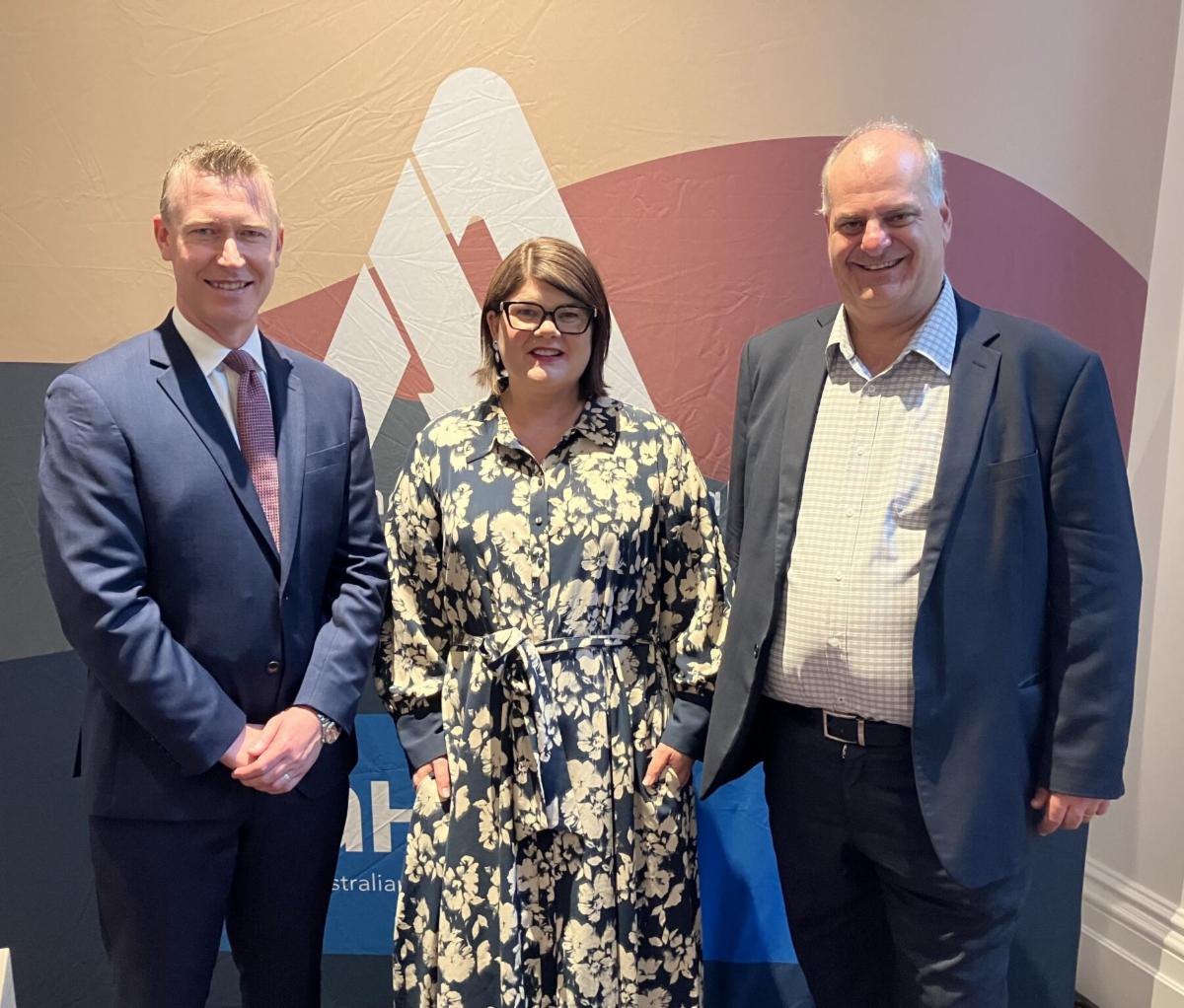
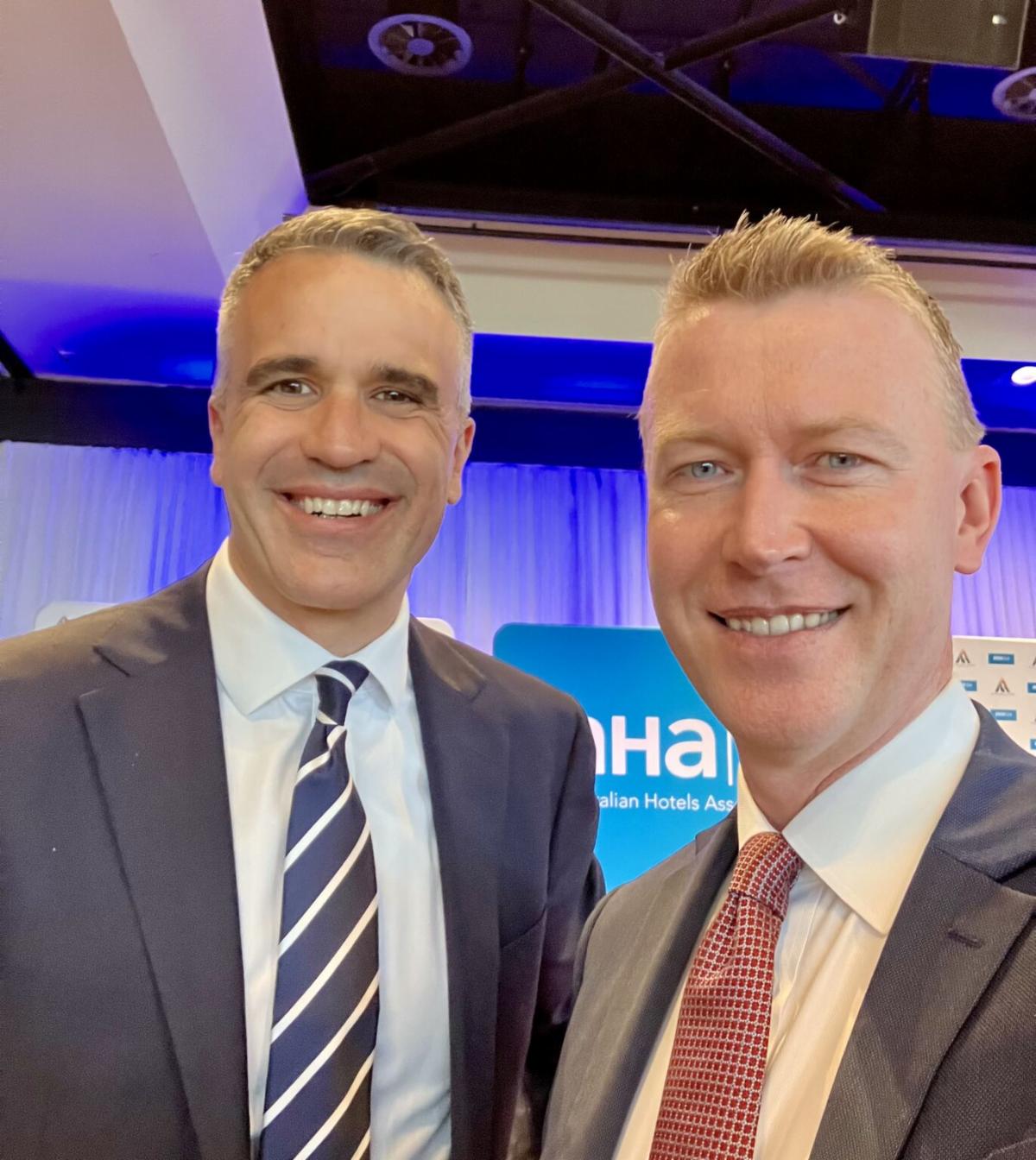
AA were involved this week in high level and important discussions with political leaders in South Australia when the South Australian Tourism Minister Zoe Bettison joined National CEO James Goodwin to address accommodation operators at the end of year function at the new Marriott Bonvoy in Adelaide. Minister Bettison championed the recent sporting and cultural events that boosted hotel occupancy in October, but Goodwin noted the need to increase business events and conferences to ease the peaks and troughs between large events. Minister Bettison also highlighted the need to work together to facilitate more international tourism and drew attention to the work to get Emirates landing into Adelaide. James was also able to speak with Premier Peter Malinauskas who expressed an understanding of regulatory burdens, a willingness to work with tourism and hospitality operators and also announced at the event reforms to some key liquor and gaming rules.
| |
James Goodwin AA CEO with Tourism Minister Zoe Bettison and SA AHA President David Basheer | |
James Goodwin with the Premier, Peter Malinauskas. | |
|
Treasury consultation addresses pricing practices
Last month a consultation paper was issued by Treasury and a media release by the Assistant Treasurer to address some unfair selling practices to consumers. The Treasury paper makes specific reference to our industry, where drip pricing is defined as occurring where a headline price is advertised, but the application of fees increases that price as the customer moves through the purchasing process. “Concerns have been raised about drip pricing practices, particularly in the context of accommodation bookings, airline and event ticketing, with stakeholders advocating for greater transparency regarding additional fees charged when making bookings or purchasing tickets”. Importantly, the paper also seeks to target dynamic pricing, which on the face of it could relate to changes in pricing according to market demand. However, the paper specifically differentiates this practice from surge pricing (a common industry practice), with plans only to legislate against the former. ‘Dynamic pricing’ is defined as when the price of a product or service that was presented upfront to the consumer increases during the purchasing process (for example, when in a queue to purchase concert tickets.
We plan to put together a brief submission for AA by end of next week and would be keen to hear any views on the prevalence of these practices in your experience, both in terms of any direct bookings made via hotel websites, or more frequently, the problems with OTA. Our key position would be that we are not supportive of either practice (ie. drip pricing and dynamic pricing), and it is not something that is done directly by our members. Any comments would be welcome.
| |
|
Stronger hotel performance in October
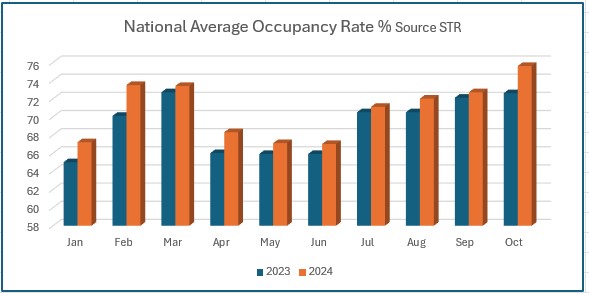
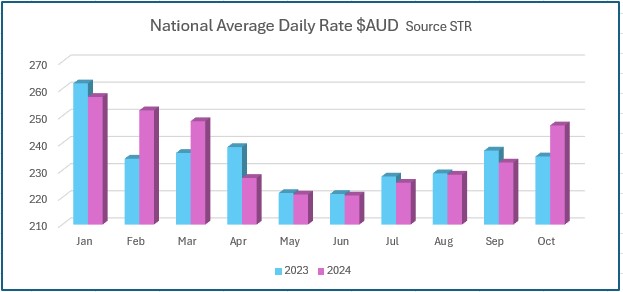
According to the latest STR data, for the first time since March both the occupancy rate and the average daily rate across Australia rose in October. The average occupancy in October across Australia was 75.6% compared with 72.6% in October 2023, and the Average Daily Rate was almost 5% higher at $246.52 compared with $235.09 in October 2023. Revenue per available room in October 2024 was $186.47, a strong and welcome increase from $170.73 in October 2023. For the year to October 2024, the average Australian occupancy rate was 70.9% compared with 69.1% in 2023. The rise in the ADR over this period was $1.87 to $235.92, which remains below the inflation rate. Growth in revenue per available room increased from $167.19 in the year to October 2024 to $161.71 in 2023. Occupancy rates for October 2024 were up in most of the capital cities except for Adelaide, with particularly strong performance in Queensland. In contrast to the rise in occupancy rates in Australia, New Zealand continues to struggle, with an occupancy rate for October 2024 at 65.2% compared with 67.8% in October 2023.
The graphs below derived from the STR data show the strength of the October performance compared with other strong months such as February and March. In all other months this year, the occupancy rates have held up, but ADR has been below 2023
| |
|
Horwath annual hotel performance report released
Horwath HTL recently released their hotel industry performance report for 2023. The Survey report provides a useful summary of the overall trends in tourism and visitor nights, together with specific information on hotel performance and financial fundamentals. The financial summary showed that consistently across 2022 and 2023 revenue from rooms accounted for 70% of total revenue, with F&B revenue rising marginally from 25% to 26% in 2023. For a copy of the summary report, click here.
| |
|
Tourism GDP close to $80 billion in 2023-24
According to the latest Tourism Satellite accounts released by the ABS yesterday, the contribution of tourism to GDP in 2023-24 was $78.1 billion, compared to $71.6 billion in 2022-23. $12.2 billion of this was net taxes on tourism products. The share of the Australian economy attributed to tourism rose from 2.8% in 2022-23 to 2.9% in 2023-24. Of the $78 billion, 63% was contributed by domestic "household" tourists, 15.7% by domestic business and government, and 21.5% by international tourists. Accommodation accounts for $10.1 billion of total tourism gross value add, (ie. not including taxes) which compares with $9.7 billion in 2022-23. This is the highest of all tourism related sectors, with cafes and restaurants second at $8.3 billion.
| |
|
Drop me an email at policy@accommodationaustralia.org or give me a call on 0418 277 919 if you have any national policy issue that you think AA should be following up. If you know an AA member who is not receiving this advocacy report but wants to, then encourage them to email me and we can add them to the distribution list.
Kind Regards
Jenny Lambert OAM
National Policy Director
Accommodation Australia
| | | | |