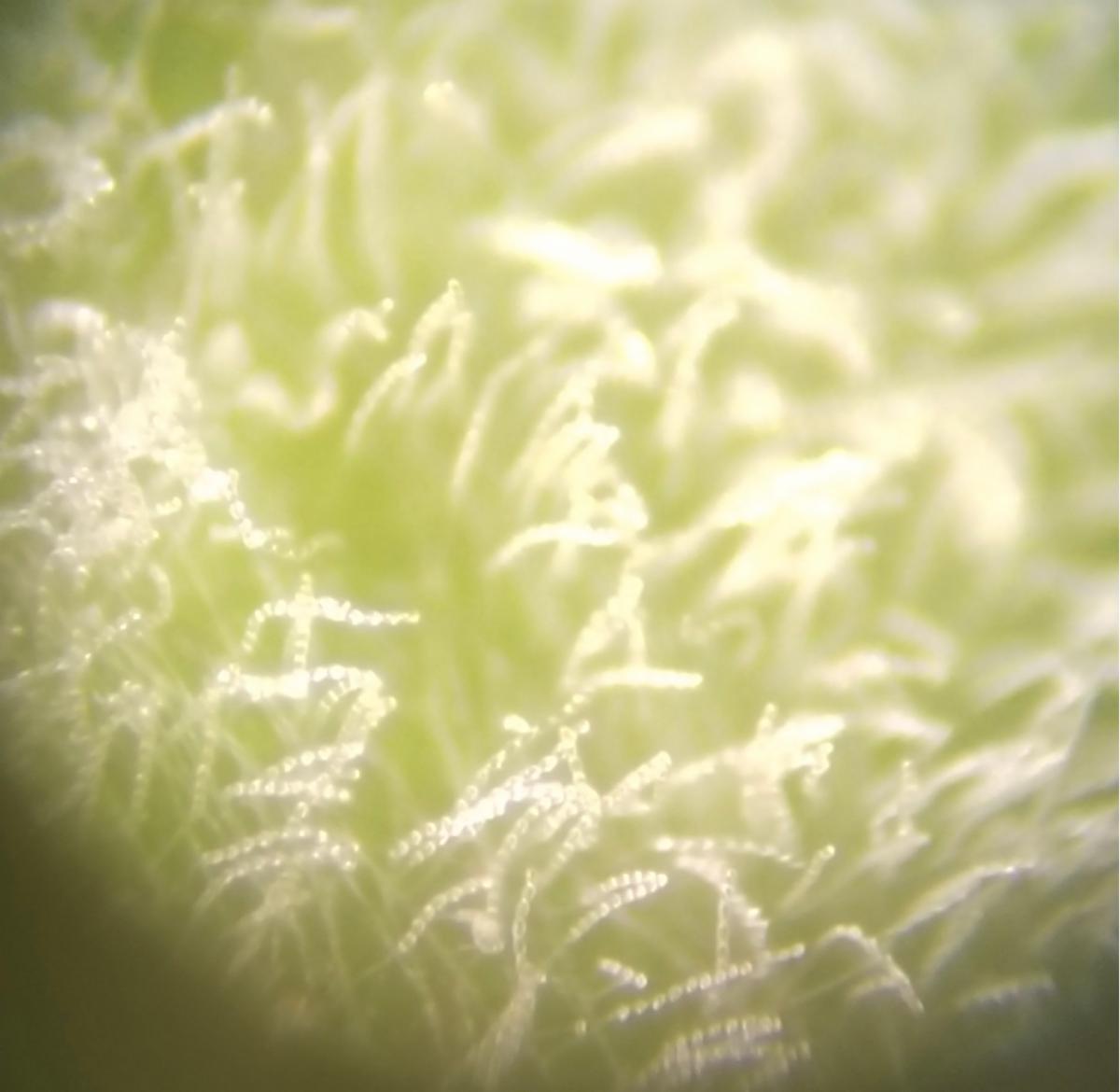
Microscopic view of powdery mildew* |
|
BUILDING UP THE PV EVIDENCE BASE |
|
In June 2021, with our colleagues at the American Society for Enology and Viticulture, we hosted the ASEV-NGRA Precision Viticulture (PV) Symposium. Kicking off the full day of Zoom-based conference proceedings, Rob Bramley, Senior Principal Research Scientist at CSIRO (Commonwealth Scientific and Industrial Research Organisation) in Australia, teed up the value proposition for precision farming. The basic promise of precision ag, he said, stems from the premise that land is variable; understanding that variability and its limitations to production has worth. That is, by applying knowledge of vineyard variability (gleaned from sensors, decision support systems and other tech), you can reduce inputs and/or direct them more effectively, create product streams or enable other product differentiation, improve your sustainability efforts, and ensure that a shrinking labor pool can work smarter and more efficiently.
But as Rob and other speakers observed, the focus of precision viticulture has been on the development of technology (“solutions looking for problems,” as he described), and growers are rightfully reluctant to invest in or adopt things they don’t fully understand. As NASA Harvest’s Alyssa Whitcraft said in her talk, “We need to build up our evidence base” for what works.
As I write this, we’re confirming the list of demos we’ll do, but these are the broad brushstrokes of this day-long, in-person tour:
-
Scheid Family Wines: Tony Stephen and Craig Winn will focus on how they collect and leverage data in their “Tech-Enabled Vineyard” (the title of Tony’s talk). Parabug, HeavyConnect and Tule Technologies are some of the tech they’ll share.
-
Monterey Pacific: Steve McIntyre will talk about “Balancing Crop Size, Labor and Technology” in the vineyard’s high-wire (and high wind) system. Doug Beck will show how the WeedIt weeder and GUSS (Global Unmanned Spray System) help them deal, precisely, with weeds and other unwanteds.
-
Valley Farm Management: Over lunch, Jason Smith will apply the concepts of precision management to the continuum “From Field to Workforce,” including labor management apps, and payroll and supply systems. Three to four in-field demos of precision equipment will take place in this premium chardonnay vineyard.
-
Tanimura & Antle: As one of the country’s largest row-crop operations, T&A is all about precision. Brian Antle and Brent Shedd will show a PlantTape seeding machine and Stout Smart Cultivator—enviable technologies that point to what’s possible for grape. Share your thoughts with your tour guides and fellow attendees at the closing reception here.
|
|
Check your calendar to see if you’re free on April 13, then scroll down for ticket info. We hope you’ll be there to help “build up the evidence base” for what works in precision viticulture! |
|
*About the photo
UC Berkeley's Dr. Jyoti Taneja provided this view through the lens of her microscope of the hyphae and conidia (spore) of powdery mildew (Erysiphe necator) on a grape leaf. See the related Research Focus article below.
|
|
Register Now! ASEV-NGRA Precision Viticulture Demo Day |
|
Following last summer’s Precision Viticulture Symposium, with funding from USDA’s National Institute of Food and Agriculture, we bring you the ASEV-NGRA Precision Viticulture Demo Day. Join us on Wednesday, April 13, 2022, in California’s Salinas Valley to see advances in precision viticulture technology come to life! Visit three early-adopting grape growers and one of the country’s top row crop operations where cutting-edge technology and service providers will demonstrate precision techniques in action. Demos will feature mechanized, autonomous and robotic tools, as well as sensors, decision support systems and more. Tickets start at just $50 for NGRA and ASEV members. Register and reserve your hotel room now!
|
|
Coming Soon: NVEELC 2022 Registration |
|
The next National Viticulture and Enology Extension Leadership Conference (NVEELC) is taking place this summer, August 14-17, 2022, in California's San Joaquin Valley—the largest, most diverse viticulture production area in the U.S. Organized and hosted by UC Cooperative Extension, NVEELC 2022 is timed later in the year to offer an extraordinary opportunity to tour raisin, table grape and wine vineyards and postharvest and production facilities at the height of the growing season. Join with other extension and outreach specialists for professional development, best-practice sharing, research and regional reports, collaboration and dialogue on the unique challenges in V&E extension in America. See the draft agenda and stay tuned for registration, coming soon! |
|
Homer Wilkes Is USDA's Under Secretary for Natural Resources and Environment |
|
This month, Dr. Homer Wilkes was sworn in as Under Secretary for Natural Resources and Environment at USDA. He has worked with USDA for more than 41 years, heavily contributing to engineering, natural resource and watershed projects, as well as forestry and working lands. Dr. Wilkes is the first African American to hold this position. Among other natural resources-related federal priorities, Dr. Wilkes will work with Forest Service Chief Randy Moore to confront the nation’s wildfire crisis.
|
|
New York Releases Version 2 of VineBalance 2022 |
|
The New York Wine and Grape Foundation, an NGRA member-organization, has released version 2 of VineBalance 2022, its statewide code of sustainable winegrowing. The new version was reviewed and revised through a six-month stakeholder engagement process. The resulting workbook is designed to broadly apply to all winegrowing regions and grape varieties of New York State and will serve as the foundation of the Sustainability Pilot Program, registration for which closes today. Future iterations will be the basis for New York’s first statewide sustainable winegrowing certification.
|
|
Julie Suarez Is a Friend of Extension |
|
As the Associate Dean for Land Grant Affairs in the College of Agriculture and Life Sciences (CALS) at Cornell University, Julie Suarez already was recognized across New York as an advocate for the state's agriculture and a trusted partner in furthering the outreach efforts of Cornell CALS and Cornell Cooperative Extension (CCE). But on January 31, 2022, she was formally named CCE's 2021 Friend of Extension. In her time with CALS, Julie has helped spearhead successful efforts to increase state funding streams for CCE, including re-invigorating organizational visits to Albany to share CCE impact stories with state legislators. Benjamin Houlton, Ronald P. Lynch Dean, Cornell CALS, says Julie is "a powerful voice for applying science-based solutions...to boost our food and farming sectors." |
|
Renee Threlfall Is a Distinguished Researcher |
|
Dr. Renee Threlfall, a research scientist in enology and viticulture at the University of Arkansas, this month won the Julian Miller Sr. Distinguished Researcher Award, presented by the Southern Region of the American Society for Horticultural Sciences. It recognizes outstanding research on one or more horticultural crops in one or more areas of horticultural research for a period of 10 or more years. A member of NGRA's Extension and Outreach Committee, Renee is on faculty in U of A's Department of Food Science in the Dale Bumpers College of Agricultural, Food and Life Sciences and is a researcher and scientist with the Arkansas Agricultural Experiment Station. In her more than 30 years there, Renee has focused her research, teaching and extension efforts on processing and postharvest storage of wine grapes, muscadine grapes, table grapes, blackberries, strawberries, peaches, hops and other specialty crops, and value-added processing of horticultural crops.
|
|
WSU Seeks Founding V&E Department Chair |
|
The College of Agricultural, Human, and Natural Resource Sciences at Washington State University (WSU) seeks a visionary and distinguished leader to be Founding Chair of the newly established Department of Viticulture and Enology. This 12-month, permanent full-time position at the rank of Associate Professor or Professor is eligible for tenure. The position begins on August 15, 2022, at the university’s Tri-Cities campus in Richland, WA. Screening of applicant materials will begin on April 15, 2022, and continue until the position is filled. Learn more and apply.
|
|
Washington Wine Industry Pros: Win a Sabbatical |
|
The Washington Wine Industry Foundation is accepting applications for the 2022 Bill Powers Sabbatical. Employees of Badger Mountain Vineyard and Powers Winery developed the sabbatical in 2017 to honor their late owner, Bill Powers. The award of up to $5,000 goes to a Washington wine professional with at least five years' experience to take a study leave to learn about an aspect of winegrape growing and/or winemaking to further their professional career and benefit the industry. Applications are due by July 30, 2022. Learn more and apply.
|
|
THE SOUND (SCIENCE) OF SILENCE:
SPRAY-INDUCED SILENCING OF POWDERY MILDEW GENES
|
|
Spray-induced gene silencing (SIGS) is a new weapon in the fight against powdery mildew. Already shown to control the growth of fusarium in barley and botrytis in other plants, SIGS is being researched as a tool to “turn off” powdery mildew’s mode of infection in grape.
A team of researchers led by Dr. Mary Wildermuth, Associate Professor of Plant and Microbial Biology at the University of California, Berkeley, has successfully developed the methodology “to identify novel powdery mildew targets that, when silenced, reduce (the incidence of) powdery mildew disease of grapevine.” Now, with funding from the American Vineyard Foundation (an NGRA member-organization) and the National Science Foundation, they are translating and testing this approach in the vineyard.
The research is ongoing, but so far Mary and her team have had “an 80% success rate in identifying efficacious novel targets, with reductions in powdery mildew proliferation ranging from two- to more than five-fold compared to controls.” Last growing season, Assistant Project Scientist Dr. Jyoti Taneja led field tests at two vineyard sites. They saw a dramatic reduction in powdery mildew disease incidence and severity on berries from plants treated with their spray compared to untreated plants. Furthermore, when their treatment replaced multiple gold standard chemical fungicide treatments, it performed similar to the gold standard treatments. The team is further optimizing the technology for field use and estimate it could become available to grape growers in three to five years.
How Does It Work?
Also known as RNA interference (RNAi), the technology controls powdery mildew disease by shutting down the production of certain proteins that allow the mildew to grow on plants. Although applied topically, as a spray, it works at the genetic level, interfering with the messenger ribonucleic acid, or mRNA, the mildew uses to translate its DNA into specific proteins. To enable the process, Mary and her team used specially designed molecules known as double-stranded RNA, or dsRNA, that enter the mildew’s cells and convert into smaller molecules called small interfering RNAs, or siRNA. These siRNA bind to the targeted mildew mRNA—and only the targeted mRNA—and chop it into bits, which shuts down the protein-making pathway. In other words, “it takes advantage of a process that already exists in the powdery mildew,” Mary said.
“The mildew is less likely to develop resistance against this technology compared to traditional fungicides, and it reduces the need for chemical fungicide applications,” Mary explained. “The designed dsRNA is specific to the powdery mildew target, RNA is a naturally occurring compound, and it is degraded through natural processes,” she added.
Mary and her research group have been studying powdery mildew and host plant interaction for more than 17 years. In recent years, Mary, Jyoti and former graduate student Dr. Amanda McRae developed the spray-applied or topical RNAi technology for use against grape powdery mildew, which, Mary said, accounts for 90% of the pesticide use for grapevines in California.
Eventually, the researchers hope to expand their work to other species of powdery mildew, such as those that target roses, melons, squash, cherry and apple trees, Mary said. For now, however, they are keeping their primary focus on grape powdery mildew.
See also this research update, posted in 2021 on the American Vineyard Foundation website.
|
|
Funding Opportunities
Sharpen your pencils! These research funding programs have upcoming deadlines.
|
|
The Foundation for Food & Agriculture Research (FFAR) Seeding Solutions program supports research to solve urgent issues in FFAR’s Challenge Areas. This year, it also encompasses FFAR's AgMission initiative, mobilizing farmers, ranchers, scientists, data providers, stakeholders and funders to develop and implement scalable climate-smart solutions. Matching funds are required. The deadline for pre-proposals is March 9, 2022.
The California Department of Food and Agriculture (CDFA) California Fruit Tree, Nut Tree, and Grapevine Improvement Advisory Board (IAB) funds research to promote the production of fruit and nut trees and grapevines resulting in improved nursery stock. Projects funded through IAB commonly include elements such as research of diseases and genetic disorders, variety identification, education and outreach, alternative treatment methods, and rootstock advancements. Deadline for proposals is April 1, 2022.
The USDA's National Institute of Food and Agriculture’s (NIFA) Food and Agricultural Sciences National Needs Graduate and Postgraduate Fellowship (NNF) program supports outstanding, diverse students in completing graduate degrees and relevant international experiential learning in food, agricultural and natural resource disciplines relevant to USDA's mission. Application deadline is April 26, 2022.
|
|
February 23, 2022 │ Texas Monthly
The herbicide Dicamba used in Texas cotton fields is devastating vineyards in the state’s largest viticultural area, the High Plains, endangering the $13 billion wine business there. Grape growers have banded together to fight back.
February 15, 2022 │ California PD/GWSS Board Bulletin – Winter Edition
The California PD/GWSS Board helped fund development of the five PD-resistant varieties by UC Davis’ Andy Walker. In this update, it reports that Novavine Grapevine Nursery sells out of the vines every year, with 90% going to growers in Texas and 10% to growers in California. Jeff Wheeler, the nursery’s agronomist, says, “I tell all the growers (that) these PD-resistant vines look like, act like and taste like Vitis vinifera. For growers looking to keep land super productive in the of PD pressures, planting these (varieties) is the most sustainable option for how they’re going to do it.”
February 10, 2022 │ Croptastic (podcast)
In this podcast interview, Virginia Tech weed scientist James Westwood, lead author of “Weed Management in 2050: Perspectives on the Future of Weed Science,” talks about what’s next for weeds. “We may never completely get away from herbicides,” he says, “But I do think they’ll become a minor component (of agricultural practices and) a very different type of system from running across a field with a big rig spraying a layer of chemicals.”
February 9, 2022 │ Good Fruit Grower
Michigan State University’s Paolo Sabbatini has influenced the Michigan wine industry to remove leaves early in the growing season, during bloom, to improve light penetration and airflow, reduce fruit set and produce looser clusters, all leading to lower incidence of cluster rot. But the practice can also improve quality. In new research, he’s exploring why.
February 8, 2022 │ Good Fruit Grower
Washington Winegrowers’ WineVit conference opened with a tasting of four white wines made from disease-resistant varieties developed by Cornell and the University of Minnesota. As moderator WSU’s Michelle Moyer explained, cultivar choice should be considered “part of the sustainability toolbox.”
February 7, 2022 │ Growing Produce
Want to get the word out about new varieties developed for your region? University of Arkansas plant breeder John Clark says make a video. His own YouTube efforts (complete with original guitar riffs) for blackberries his lab has developed have garnered 300K views! Check out this one for the new U of A winegrape, Indulgence: https://bit.ly/3gFAldy.
February 3, 2022 │ Vitisphere
A French startup hopes to commercialize its Wine Protect anti-frost lamps in early 2023. Designed to attach to the trellis wire above the cane, the device is triggered when the temperature drops below the threshold defined by the grower, maintaining a temperature of at least 0°C during a frost event of up to eight hours on one battery charge. A dozen units will be trialed in vineyards across France this winter.
February 2, 2022 │ Wine Business Monthly
At the Unified Wine & Grape Symposium, UC Davis scientist Anita Oberholster joined with a grower, an insurer and an attorney to offer their hard-won perspectives on dealing with smoke-exposed fruit. Each shared some silver linings, but also cautioned there aren’t yet any silver bullets.
February 1, 2022 │ Good Fruit Grower
The long-term nematode research underway in Washington aims to find a sustainable approach to managing nematodes. In the scientists’ search for nonchemical tools to help reduce the root-feeding pests before vineyards are planted and keep them suppressed after, two promising trials study the use of pre- and post-plant cover crops to trap or trick them into feeding on inhospitable plots.
February 1, 2022 │ Good Fruit Grower
The Washington wine industry collaborated to create the first statewide sustainability certification for wine grapes. This think piece by Washington Winegrowers’ Vicky Scharlau (an NGRA Board member) is as much about the insight and instinct to create the program as it is about “the Standard” (and the standards within it) that supports “Sustainable WA.”
February 1, 2022 │ Good Fruit Grower
With a strong rebound in the price of juice grapes and the cost efficiencies possible with mechanization, Concord growers are planting new vines. And that raises the question: What does a modern Concord vineyard look like? WSU’s Markus Keller recommends low-density, 12-foot plant spacing, drip and deficit irrigation, cover crops and clean plants.
February 1, 2022 │ Wine Business Monthly
Water conservation is not only about resource-efficiency in winemaking, but a growing regulatory concern and critical component of climate-smart farming. At the 2022 Unified Wine & Grape Symposium, three producers—Jackson Family Wines, Silver Oak Cellars and Rombauer Vineyards—shared their strategies.
January 31, 2022 │ Lodi Winegrape Commission
UC Davis has released two 2021 vineyard cost studies for Lodi Cabernet Sauvignon—one for a quadrilateral system and one for a high wire system. Sections include everything from labor and equipment to cash overhead and costs/returns per acre. It is noted that some costs may have already risen in 2022.
January 26, 2022 │ Sonoma County Winegrowers
Ford Pro and Sonoma County Winegrowers are launching a pilot program that will add electric vehicles and fleet management tools to three pilot Sonoma County vineyards to improve sustainability and lower fleet costs 10% to 20%.
January 24, 2022 │ Wine Industry Network
At a Washington State Wine Commission WAVEx webinar, Tom Collins (WSU) gave a preliminary update on his research on the effectiveness of kaolin and bentonite clay barrier sprays in preventing the uptake of smoke compounds from wildfire. His most recent treatments, where barriers were applied with backpack sprayers and rinsed with water, showed pronounced reduction in guaiacol, a chemical found in wood smoke suspected of causing smoke taint in wine.
January 22, 2022 │ Daily Mail
According to new research from China, people who drink more than five glasses of red wine a week had a 17% lower risk of Covid infection, presumably due to its polyphenol content. Drinking up to four glasses of white wine per week reduced risk 8%. Beer and cider drinkers had nearly 28% higher chance of contracting the virus.
January 5, 2022 │ Come Rain or Shine (podcast)
When climate expert Katharine Hayhoe is asked what gives her hope, she muses, "How is hope different than our optimism bias as humans, where we think, 'Everything will be okay if we just give it enough time'? With climate change, it's the opposite: the more time we give it, the worse it gets! Hope comes from acting…and from seeing how we can make a difference. (It's) the small chance of a better future, however faint it might be. And knowing that what's going to get us to that better future is us doing something about it."
September 21, 2021 │ PV Magazine
French agrivoltaics company Sun-Agri installed a pilot photovoltaics (PV) system at a vineyard in southern France in 2018. Said to be the first agrivoltaic wine-growing operation, its 7,800 PV modules installed five meters above the vines are intended to prevent sunburn and shield grapes from excessive sugar concentration. Following the first harvest in September 2021, the company reported a half-degree lower alcohol than an adjacent plot.
Find these stories and more, published daily, on NGRA's Facebook and Twitter feeds.
|
|
March 1-3, 2022
Virtual event
March 3, 2022
Geneva, OH
March 8-9, 2022
Portland, OR
March 16, 2022
Davis, CA
March 22-24, 2022
Syracuse, NY
March 24, 2022
Washington State Wine Commission:
Virtual event
March 27-29, 2022
Washington, DC
March 29-31, 2022
Virtual event
March 30, 2022
Paso Robles, CA
March 30-31, 2022
Newberg, OR
April 7, 2022
Stockton, CA
April 11, 2022
Geneva, OH
April 13, 2022
Salinas Valley, CA
April 20, 2022
Washington State Wine Commission:
Format TBD
|
|
The monthly NGRA Update is provided as a service to the U.S. grape and wine industry.
|
|
|
|
|
|
|