Rail & Labor News from RWU
| |
Weekly Digest Number 6 - February 4, 2025 | |
Welcome to the RWU Rail & Labor News! This news bulletin is produced and emailed out each Tuesday morning. We hope you find each week's news and information useful. If so, please share with co-workers, friends, and colleagues. If you like, you can sign them up to get all the news from RWU HERE. Or forward them the link. Got a hot tip? Please forward the article and a link to raillabornews@gmail.com. Note: If you read over this news bulletin each week, you will be sure to never miss the important news of what is going on in the railroad world from a worker's perspective! | |
THIS WEEK'S RAIL AND LABOR NEWS | |
Editor's Note: Another rail union signs on, but let’s put this in perspective—an 18.77% wage increase over five years sounds decent, but it’s a far cry from the last contract’s 24% bump. The improvements to sick leave and vacation accrual are welcome, but the real question remains: what did the carriers get in return? Rail labor has seen this playbook before—marginal gains dressed up as big wins. A contract is only as strong as the workers enforcing it, and time will tell if this deal holds up under the daily grind of railroad life. | |
Progressive Railroading / January 31
The International Brotherhood of Electrical Workers (IBEW) has reached a new five-year tentative collective bargaining agreement with the National Carriers' Conference Committee (NCCC), the union announced yesterday.
The agreement has terms similar to ones ratified with BNSF Railway Co. and CSX last month, IBEW officials said in a press release.
Benefits include an 18.77% compound wage increase over the next five years, changes to vacation benefits allowing workers to accrue vacation time earlier, and the option to carry-over up to four unused paid sick days per year, to a maximum of 20 days. Employees will also be able to cash out unused sick days 100% when they leave service.
| |
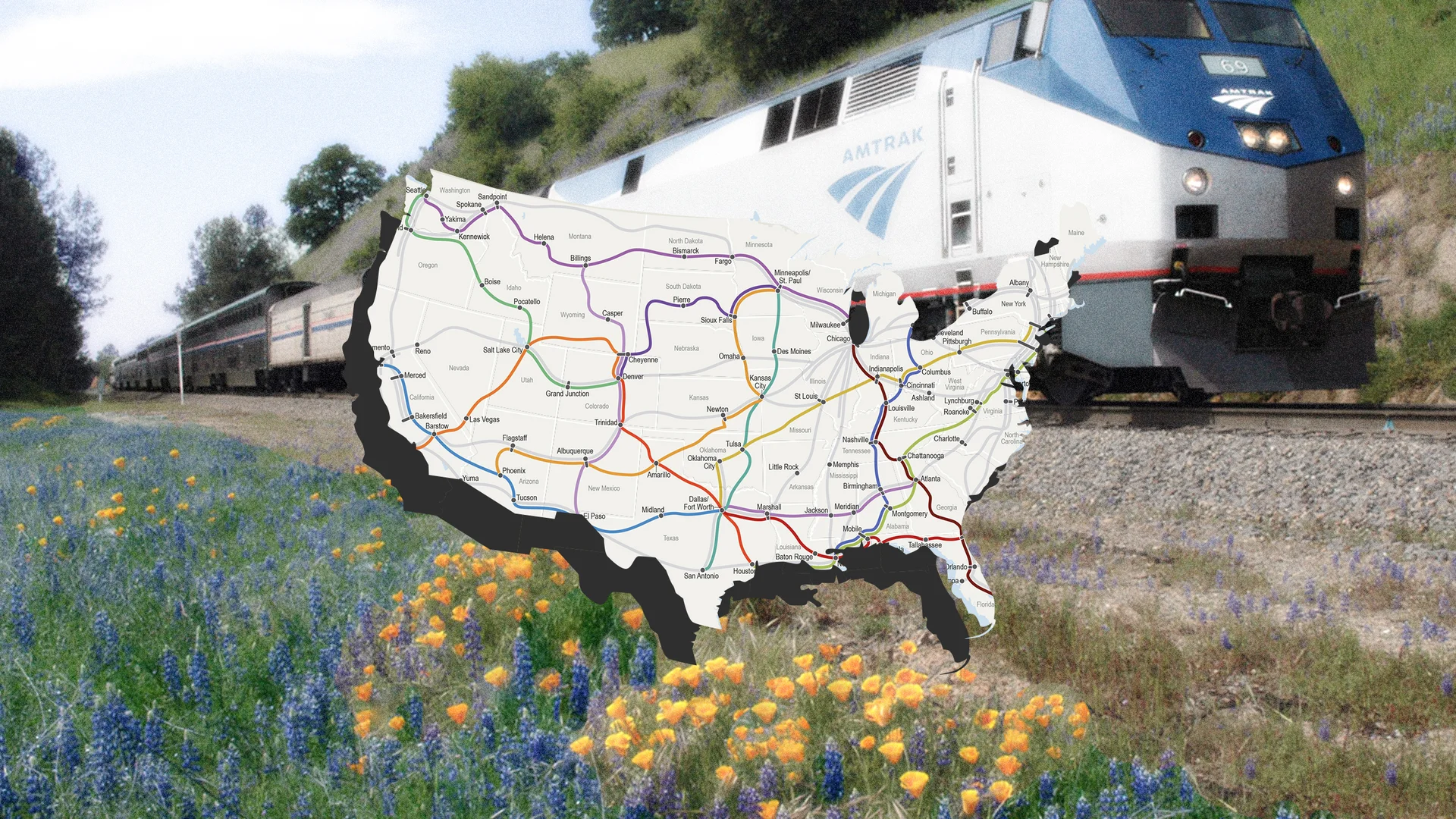
Editor's Note: A vision of expanded long-distance passenger rail in the U.S. is always worth celebrating, but let’s be real—maps don’t move trains, funding and labor do. The FRA’s latest study paints a compelling picture, but without a serious commitment to infrastructure investment, workforce expansion, and operational funding, it’s just another blueprint collecting dust. Rail workers know too well that passenger service can’t thrive on promises alone. Until policymakers match their enthusiasm with action, this is little more than a brightly colored fantasy map for a system that still runs on outdated tracks and corporate disinterest. | |
Fast Company / January 24
Passenger rail service in the United States is woefully lacking compared to other countries, particularly long-distance service that connects far-reaching cities. Amtrak currently operates 15 long-distance routes, which range from 750 to 2,500 miles. But they stretch over just 39 states and the District of Columbia, and a map of those routes reveals that large swaths of the country don’t have any rail options.
A new map, as part of a recent Federal Railroad Administration study, shows what the country could look like if 15 additional long-distance routes were added. With those rail lines, previously stranded regions of the country are suddenly connected with bright lines representing passenger rail. They would make the country’s rail network considerably fuller and would bring rail service to all of the lower 48 states.
| |
|
Editor's Note: A $22 million settlement? That’s a rounding error for Norfolk Southern, a company that raked in billions while cutting safety to the bone. East Palestine didn’t just suffer a derailment—it suffered from a corporate cost-cutting disaster that put profits over people. Let’s be clear: NS didn’t “replace” fire and police vehicles out of generosity—it was cleaning up its own mess. And as for that $25 million in park improvements? That’s PR money meant to distract from the fact that the railroad turned an entire town into a chemical experiment.
The real crime here isn’t just a faulty wheel bearing—it’s the systemic gutting of rail safety through job cuts, deferred maintenance, and a reckless obsession with shareholder returns. Norfolk Southern and its Wall Street backers will keep handing out settlements as long as it’s cheaper than running a safe railroad. Rail labor has been shouting about this for years: cutting crews, cutting inspections, and cutting corners leads to exactly this. The only real solution is holding these carriers criminally accountable—because without that, East Palestine is just another cost of doing business.
| |
Freight Waves / January 29
Norfolk Southern and the village of East Palestine have reached a $22 million settlement to resolve all claims by the village resulting from the Feb. 3, 2023, derailment and hazardous-materials release, the two parties have announced.
A joint statement on the East Palestine website Monday says the village recognizes the approximately $13.5 million NS has already spent in the village — including replacement of fire and police vehicles, improvements to the water treatment plant, and exterior renovation of the East Palestine railroad station. NS also remains committed to spending $25 million on improvements to East Palestine City Park.
A defective wheel bearing led to the derailment of 38 cars of an NS train in East Palestine at about 9 p.m. on Feb. 3, while 12 more became involved in a subsequent fire. Eleven of the cars were carrying hazardous materials. Fearing an explosion, NS eventually conducted a vent and burn of the five cars carrying highly toxic vinyl chloride — a move the National Transportation Safety Board would eventually determine was unnecessary, and one that spread the material throughout the area.
|
|
Editor's Note: For those who follow these carload patterns, last week showed a shocking increase in rail freight shipments in the U.S. No explanation has been given. But as we predicted, it was simply a one-off - whatever the reason - and now freight traffic has resumed its lackluster weekly stats. | |
Progressive Railroading / January 30
U.S. freight railroads hauled 454,797 carloads and intermodal units in the week ending Jan. 25, a 2.5% decrease compared with volume in the same week in 2024, according to Association of American Railroads data.
Carloads for the week totaled 189,125, down 8.8%, while intermodal units reached 265,672 containers and trailers, up 2.5%. One of the 10 carload commodity groups tracked weekly by the AAR posted an increase for the week: Farm products excluding grain, and food, increased 2.3% to 16,180 carloads.
| |
Editor's Note: The AAR was in the room, so you already know what happened—more corporate spin, more excuses, and zero accountability. They’ll back a grade-crossing safety program if it keeps regulators off their backs, but when it comes to crew cuts, blocked crossings, and Wall Street bleeding railroads dry? Silence. Meanwhile, Congress wrings its hands over cargo theft while the real thieves—the carriers and their shareholders—strip the industry for parts. Rail labor has seen this show before: the AAR talks, lawmakers nod, and nothing changes. Safety won’t come from hearings—it’ll come when workers take the fight directly to the profiteers gutting this industry. | |
Freight Waves / January 24
Widespread support for a federal grade-crossing safety program emerged during a lengthy House subcommittee hearing, a session which also saw representatives of the railroad industry and rail labor lay down markers for their priorities in the upcoming surface transportation reauthorization bill.
The two-hour, 45-minute session on Jan. 23rd of the Transportation and Infrastructure Committee’s Subcommittee on Railroads, Pipelines, and Hazardous Materials was billed as “examining America’s freight and passenger rail network.” It was overwhelmingly focused on freight issues, addressing topics ranging from cargo theft to blocked crossings.
| |
Editor's Note: California High-Speed Rail keeps proving what rail labor already knows—investing in rail means investing in workers, communities, and the economy. While the freight carriers cry poor and cut jobs, this project is putting people to work and building for the future. The only question now is whether lawmakers will stay the course or cave to the usual anti-rail lobbyists. | |
Rail Track & Structures / January 24
California High Speed Rail Authority released the 2024 Economic Impact Analysis Report that highlights the benefits of its work on the high-speed rail system.
The Economic Impact Analysis Report highlights the project’s role in stimulating economic growth, according to the report. 99% of the project’s FY2023-2024 expenditures have gone to California businesses, “with two out of every three dollars going to disadvantaged communities.”
Authority Chief Financial Officer Jamey Matalka said, “The benefits of investing in a high-speed rail system continue to ripple through the California economy. This project is creating meaningful partnerships and jobs, lifting up disadvantaged communities and supporting greenhouse gas reduction goals.”
| |
Editor's Note: NS whining that enforcing Amtrak's statutory preference would create traffic jams on the rails is rich. Too-long trains and running equipment to failure creates jams. The Class Ones' collective screwing of Amtrak trains has earned an absolutist application of the law. | |
|
Norfolk Southern today asked a federal court to dismiss the Justice Department’s lawsuit over the railroad’s handling of Amtrak’s Crescent, arguing that the government’s “extreme” interpretation of passenger train right of preference doesn’t hold water.
NS says the Justice Department “complaint depends on the idea that freight railroads must totally clear their tracks for approaching Amtrak trains, the same way D.C.-area commuters must clear the road for the President’s motorcade—even if the result is a massive traffic jam.
“But ‘preference’ for passenger trains has never worked that way. Not in the decades before Congress codified it, and not in the half-century since,” NS told the U.S. District Court for the District of Columbia. “And with good reason: If adopted, the Government’s absolutist theory would produce gridlock, with a series of cascading delays grinding the rail network to a halt. Congress thus recognized that dispatchers must have flexibility to ensure the smooth flow of all traffic, not just individual passenger trains.”
| |
NEWS FROM AROUND THE LABOR MOVEMENT | |
Each week, RWU includes a few articles about advances and developments in the larger labor movement that are of interest to railroad workers. Got an artcile to submit for possible inclusion next week? Email it along to raillabornews@gmail.com. Thank you! | |
Jacobin / January 29
Donald Trump is trying to shock and awe the workers’ movement (and everyone else) into submission. On the labor rights front, this took the form of a late Monday night firing of pro-union National Labor Relations Board (NLRB) officials, including General Counsel Jennifer Abruzzo and board member Gwynne Wilcox. The latter move is illegal, since Wilcox’s congressionally mandated term does not end until August 2028. And it leaves the five-person national board without a quorum and therefore unable to do its work nationally. (Local NLRB work, however, can still continue in the meantime, which means that workers should not yet throw in the towel on filing for board-sanctioned union elections — more on this below).
It’s unclear what Trump’s next steps will be. Perhaps he intends to leave a seat vacant in order to hobble the board for the next four years. But for employers, such an approach would have the downside of leaving all of the Biden board’s pro-union decisions on the books.
| |
Labor Notes / January 29
The Trump administration has swept into office with a volley of attacks: Gutting programs that acknowledge race and gender inequality. Freezing funding for a wide swath of programs (though that order has already been rescinded). New work rules. Immigration raids. Replacing career civil servants with political lackeys. A mass email inviting federal employees to resign.
The firehose of bad ideas over the past week is alarming and overwhelming. It’s never been more important for organizers to remember: workers do have power.
| |
|
In These Times / January 30
More than two months after a monumental defeat to the Trump-led GOP, the Democratic Party is still picking up the pieces as a new era of trifecta Republican rule emerges in Washington.
Tech billionaires are licking their lips, now with the full ear of President Donald Trump, preparing to tear apart the last vestiges of the regulatory state. The GOP plans to eviscerate social programs, carry out mass deportations, kneecap labor unions, massively cut taxes for the ultra-wealthy, cease environmental protections and usher in a far-right political future. Trump’s early actions — from illegally firing inspectors general and those tasked with protecting workers’ rights, to cutting off federal dollars for vital programs providing aid and healthcare to low-income Americans — suggests the second Trump term will ravage the U.S. working class.
Immediately after November’s loss, some Democratic Party leaders claimed there was nothing more they could have done — instead, the voting public just made a different choice. Others on the establishment wing argued Democrats had moved too far to the Left and spent too much time listening to The Groups (NGOs and other advocacy organizations) when instead they should have stuck to moderating and throwing the communities most threatened by Trumpism under the bus.
| |
WEEKLY DERAILMENT DEPARTMENT | |
Each Tuesday in this news bulletin, RWU does our best to present a picture of what has been happening over the course of the previous week in terms of derailments in North America, and investigation determinations of previous accidents. NOTE: This list is by no means comprehensive. Smaller and less consequential mishaps are generally not reported here. If the wreck results in injury or fatality, or is especially damaging/extreme, a full article will appear as a feature in the dozen or so rail articles above. Know of a train wreck? Please feel free to forward a link to raillabornews@gmail.com for possible inclusion next week. Thanks! |
| | | |