|
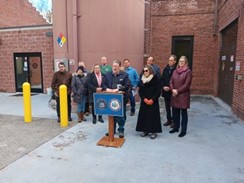
Thank you to Senator Harckham for holding a press conference this weekend at the Indian Brook Water Treatment Plant to support Clean Water Infrastructure Funding in the NYS budget.
This gathering supported the continued investment in clean water infrastructure and the restoration of $250M in the Water Infrastructure Improvement Act (WIIA) and Intermunicipal Water Infrastructure Grant (IMG) programs included in the Senate and Assembly one-house budgets.
We are grateful to Senator Harckham for organizing this event and for his and Assemblyperson Dana Levenberg’s support of this invaluable infrastructure funding.
Ossining well understands its fundamental obligation to provide clean drinking water that complies with all provisions of the Safe Water Drinking Act and other regulations created for the benefit and the safety of the public.
With the understanding that our current water treatment facility was reaching the end of its useful life, The Village and Town of Ossining planning for the new Indian Brook Water Treatment Plant (IBWTP) began in 2015. As water is increasingly recognized as a scarce and precious resource in our changing global environment, the construction of this new plant is essential for Ossining to ensure the health and safety of its residents and to plan sustainably for the future.
The primary objective of the new IBWTP project is to construct and implement the most efficient treatment processes that will meet all applicable regulatory requirements for the foreseeable future. The new plant will enable us to meet the current and future needs for housing, education, and economic development in the Village and Town of Ossining. But this investment will go so much farther than that.
Not only will the new IBWTP yield significant benefits for the Village and Town of Ossining, but the project’s impact on affordable housing, economic development, placemaking, and local tourism will extend significant benefits to Westchester County and New York State as well, making this investment a particularly valuable one.
The cost for this project is approximately $100 million. It represents the largest public infrastructure investment ever made by the Village of Ossining, a community where the majority of our hard-working residents struggle to make ends meet. While we have planned for this project to minimize its financial impact on Ossining’s water ratepayers, the cost to build this plant has nearly tripled since its early planning stages. Increased costs were driven by project delays due to COVID-19, new design requirements to meet changing water quality standards, and construction cost increases, combined with rising interest rates – all having a significant impact on the financing of this project.
The Village has applied for every source of grant funding possible; however, despite the fact that the provision of clean drinking water is an essential and fundamental service, the majority of state funding sources for water infrastructure prioritize projects that are failing and have significant violations and regulatory compliance issues.
Ossining has planned carefully and has taken many proactive measures to make sure that our plant does not fail – a fact that we are very proud of. We believe that if we are to ensure access to clean drinking water, we cannot afford to wait for systems to fail. The new plant will dramatically improve the Village’s ability to treat for harmful contaminants, including perfluorooctanoic acid (PFOA) associated with perfluorinated alkylated substances (PFAS), 2-Methylisoborneol (MIB), and trihalomethanes (THMs), as well as meet, and likely exceed, the new compliance requirements for copper and lead that the current IBWTP cannot accommodate. We cannot risk the health and well-being of our residents who are relying on us to ensure their water is clean and drinkable.
We believe that this responsibility extends to the state as well, which must invest in maintaining and improving water treatment systems before they fail. For the sake of all New Yorkers, funding must be available for new technology and infrastructure to meet the everchanging and evolving regulatory requirements for decontamination and to address issues associated with climate change.
Increasing access to this funding, particularly at a time when the need for housing and economic development is growing, requirements to address water contamination are increasing, and climate change poses a significant threat to water sources, is by far the most cost-effective, sustainable and responsible way to ensure the provision of clean water now and for the future.
|