Weekly update from the National Housing Conference | | News from Washington | By Brittany Webb | | |
ROAD to Housing Act unanimously passes Senate Banking Committee
The Senate Banking, Housing, and Urban Affairs Committee unanimously voted to advance the ROAD to Housing Act, a sweeping bipartisan housing package championed by Committee Chairman Tim Scott (R-S.C.) and Ranking Member Elizabeth Warren (D-Mass.). The legislation marks the Committee’s first bipartisan housing package to advance in over a decade and represents a significant step toward addressing the nation’s housing affordability crisis.
The ROAD to Housing Act aims to expand and preserve the housing supply, improve affordability and access, advance accountability and fiscal responsibility, and enhance oversight and program integrity. The bill also incorporates widely supported proposals, including the PRICE Act, the Housing Supply Frameworks Act, the Whole Home Repairs Act, the HOME Investment Partnerships Reauthorization and Improvement Act, the Choice in Affordable Housing Act, and the Build More Housing Near Transit Act.
“Today marks a very important first step toward jumpstarting our housing development and making a real difference in the lives of Americans across the country. I want to thank my colleagues to the left for your hard work. There’s so many, every piece of legislation I’ve mentioned, almost every single one is a bipartisan bill. Working together as a committee proves to the American people that we can get things done, and it requires, frankly, bipartisanship, to get to the president’s desk,” said Chairman Scott in the press release.
“For years, the American people have called on their elected officials to act to reduce housing costs. The Scott-Warren legislation represents what is possible when both parties put families ahead of politics. It’s a significant step in the right direction,” said Ranking Member Warren. “We should all be proud of this package and the solutions it delivers to the American people. I urge my colleagues on both sides of the aisle in the House and in the Senate to move quickly to pass the bipartisan ROAD to Housing Act of 2025.”
David M. Dworkin, President and CEO of NHC, praised the legislation and the bipartisan effort that led to its advancement. In a press release from the Senate Banking, Housing, and Urban Affairs Committee, Dworkin stated:
“The housing affordability crisis has impacted every community in America, regardless of politics or geography. It requires urgent, bipartisan, comprehensive action. I am grateful to Senate Banking, Housing, and Urban Affairs Committee Chairman Tim Scott (R-S.C.) and Ranking Member Elizabeth Warren (D-Mass.) for their leadership in crafting and advancing the ROAD to Housing Act, which seeks to expand and preserve housing supply, improve housing affordability and access, advance accountability and fiscal responsibility, and improve oversight and program integrity. The National Housing Conference is proud to support this legislation and looks forward to working with members of the Senate and House of Representatives to enact this bipartisan legislation.”
| | | |
HUD ordered to release fair housing funds
A federal judge has ordered the U.S. Department of Housing and Urban Development (HUD) to move forward with distributing tens of millions of dollars in fair housing grants after the agency paused activity for the first time in the program’s 30-year history. U.S. District Court Judge Sparkle Sooknanan granted a temporary restraining order in response to a lawsuit brought by the National Fair Housing Alliance (NFHA) and the Tennessee Fair Housing Council. The suit centers around the Fair Housing Initiatives Program (FHIP) that distributes federal fair housing funding for community organizations assisting seniors, disabled veterans, survivors of sexual assault and domestic violence, families with children, and people with disabilities. Two organizations have reported closing since the funding stopped. Judge Sooknanan ordered HUD to establish a timeline of how it will distribute grants before September 30.
The ruling partially satisfies a request from NFHA by requiring HUD to set deadlines for processing new grants, though it stops short of mandating that the agency immediately release appropriated funds while litigation continues. HUD acknowledged that processing FHIP grants took longer than usual and confirmed the temporary pause, but said it plans to meet the statutory deadline to ensure the fiscal year 2024 funds remain available.
“Today’s decision is a crucial step in restoring the fair housing infrastructure that millions of people across the country rely on to challenge illegal housing and lending policies and practices and access justice,” said Lisa Rice, President and CEO of NFHA. “The court recognized the real and immediate harm that HUD’s actions are causing to fair housing organizations and the communities that depend on them as the nation continues to grapple with a fair and affordable housing crisis.”
| | | |
FHFA proposes ending Enterprise Equitable Housing Finance plans
The Federal Housing Finance Agency (FHFA) issued a notice of proposed rulemaking to repeal its Fair Lending, Fair Housing, and Equitable Housing Finance Plans (EHFPs) regulation that required Fannie Mae and Freddie Mac (the Enterprises) to outline and report on steps to address barriers to sustainable housing opportunities for underserved communities. EHFPs were introduced in 2022 under previous Director Sandra Thompson and finalized in May 2024 with enthusiasm from the housing industry. The rule also included provisions related to fair lending and oversight responsibilities for directors serving on the boards of regulated entities. FHFA now argues that the rule is “duplicative” and that repealing it would streamline operations and reduce costs for the Enterprises.
“This rule represents a milestone in the agency’s ongoing efforts to promote a robust and inclusive housing market,” NHC stated at the time. “Through the introduction of new initiatives like Special Purpose Credit Programs, which provide new homebuyers with downpayment and closing cost assistance, and rent payment reporting programs to help renters use on-time rent payments to improve their credit scores, FHFA is taking proactive measures to address critical housing issues facing underserved communities. This rule promises to foster greater confidence and resilience within the housing finance ecosystem.”
In its repeal notice, FHFA emphasized that the statutory obligations underlying the rule, specifically compliance with the Fair Housing Act, the Equal Credit Opportunity Act, and prohibitions on unfair or deceptive practices, are unnecessary. The Agency notes the Enterprises are already administered by other federal agencies, such as HUD, the Consumer Financial Protection Bureau, and the Federal Trade Commission. The Agency adds that the change will reduce administrative burdens for Enterprises, particularly the costs associated with staffing.
The proposed repeal reflects how FHFA is shifting to align its policy framework with a series of executive orders directing federal agencies to eliminate regulatory burdens and refocus on core statutory mandates. The FHFA states that it will continue to utilize its statutory authority to ensure the Enterprises fulfill their obligations to support affordable housing through existing tools, such as housing goals and Duty to Serve requirements. Comments are due by September 26.
| | | |
VA mortgage relief bill becomes law
The VA Home Loan Program Reform Act was signed into law by President Trump, concluding months of advocacy efforts from the housing industry who sought to align the Department of Veterans Affairs (VA) mortgage relief options with those of other government programs. The bill restores VA’s authority to offer partial claims, a key foreclosure prevention tool that helps borrowers catch up on missed payments without changing their loan terms that expired in 2022.
“Our veterans and their families should have every tool at their disposal to keep their homes and reduce the risk of foreclosure if they fall into financial hardship or endure a national disaster,” said Rep. Mike Bost (R-Ill.), chairman of the House Veterans Committee.
“Those who have served our country deserve access to the same protections available to other homeowners,” Rocket Mortgage said in a statement. Mortgage Bankers Association President and CEO Bob Broeksmit called it “a critical step forward” in ensuring that veteran homeowners have access to a proven and sustainable loss mitigation solution.
With the President’s signature, the VA can now immediately develop the new partial claim program, providing vital relief to thousands of veteran homeowners.
| | | |
President Trump meets with major banks on Fannie Mae and Freddie Mac stock offering
President Trump has invited the CEOs of major banks, including Jamie Dimon of JPMorganChase, David Solomon of Goldman Sachs, and Brian Moynihan of Bank of America, to private meetings to discuss a secondary offering stock sale for Fannie Mae and Freddie Mac (the Enterprises) and how their banks might participate in the process. NHC warned in its recent report “Moving Forward Administrative: recapitalization and release from conservatorship for Fannie Mae and Freddie Mac” that exercising the Treasury warrants and selling the stock without returning the Enterprise boards to independent leadership would severely depreciate the value of the stock. Further, without repealing 12 USC 1739(g)(2) in the Dodd Frank Act, proceeds from the sale could only be used for deficit reduction and not recapitalization or any other purpose.
These discussions follow several months of the administration privately and publicly discussing recapitalization and release for Fannie Mae and Freddie Mac. FHFA Director Bill Pulte recently stated that he wants to keep the Enterprises in conservatorship while also taking them “public,” a proposal which presents many challenges. The White House has not yet commented on the bank meetings, but the outreach signals a renewed push from Trump to advance one of the most complex and politically sensitive issues in housing finance.
| | | |
Housing cost burdens persist in the 2025 State of Equitable Homeownership Report
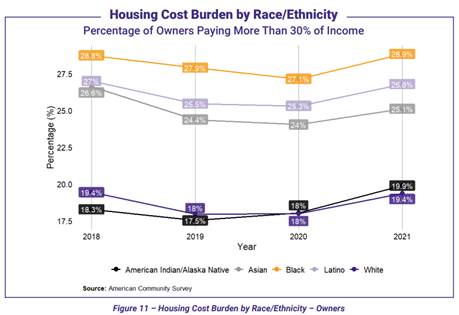
The 2025 State of Equitable Homeownership Report, released by the National Fair Housing Alliance (NFHA), explores recent trends and ongoing inequities that continue to shape racial gaps in housing access and affordability. In the chart below, housing cost burden refers to households spending more than 30% of their income on housing expenses, a threshold that can strain financial stability and limit long term wealth building. It illustrates that Black and Latino homeowners are disproportionately affected, with Black homeowners facing the highest cost burdens in 2021. Rising home prices, limited inventory, rising property insurance, stagnant wages, and high interest rates contribute to this growing burden.
| | |
In a recent Washington Post op-ed, former HUD Secretaries Ben Carson and Henry Cisneros call on Congress to pass the bipartisan Neighborhood Homes Investment Act (NHIA), which would provide federal tax credits for developers to build and rehabilitate homes in communities across the nation. They highlight NHIA as a practical solution to lower barriers to entry and strengthen communities through targeted investment. The former secretaries emphasize that this approach would revitalize struggling neighborhoods and expand homeownership opportunities nationwide.
Ann Oliva, CEO of the National Alliance to End Homelessness, discussed recent developments in Washington impacting homelessness policy. The note warns that the recently released Executive Order could undermine evidence-based practices like Housing First by pushing more punitive measures. Additionally, while the Senate’s FY 2026 HUD Funding bill rejects the President’s proposed cuts, Oliva stresses the need for continued advocacy to protect critical programs and housing resources. The article underscores that commitment and monitoring of these changes is most necessary under the current threats.
A recent publication by Barry Wides on Artisan Advisors offers a breakdown of bipartisan legislation introduced in Congress to enhance investment in Community Development Financial Institutions (CDFIs). Provisions like the Low-Income Housing Tax Credits (LIHTC) and New Market Tax Credits (NMTC) expand flexibility for banks and CDFIs to support local projects and enable continued investment into distressed areas. Under the evolving legislative landscape, the additional provisions outlined highlight the opportunities for effective community revitalization and further investment.
| | Here's what's happening at our member organizations: | | |
Across the country, the shortage of affordable housing continues to place growing pressure on renters, homebuyers, and local communities. Addressing this crisis requires deep, sustained collaboration among public and private stakeholders—and the Federal Home Loan Banks (FHLBanks) are rising to that challenge.
The primary mission of the FHLBank System is to provide reliable liquidity to its member institutions—banks, credit unions, insurance companies, and CDFIs—liquidity that in turn helps finance housing opportunities and community development. The FHLBanks have successfully fulfilled this mission for 93 years. An additional part of the FHLBank System mission is the Affordable Housing Program (AHP), through which each FHLBank is statutorily required to contribute at least 10% of its net income annually.
As their 2024 Impact Report demonstrates, the FHLBanks didn’t just meet that obligation—they far surpassed it, committing a record $1.2 billion, or 19.6% of their net income, to housing and community development. This includes $528 million in voluntary contributions beyond what’s required by statute.
These voluntary contributions are a clear signal of the FHLBanks’ deep, enduring commitment—not only to fulfilling their public mission, but to going above and beyond in service of their members and the communities they serve. Voluntary funding supports regionally tailored initiatives such as down payment assistance, disaster recovery, and local capacity-building—developed in partnership with members and aligned to local needs.
As housing advocates know well, scalable solutions must also be locally informed. The FHLBank System is committed to both—and to working with partners nationwide to close the housing gap for good.
| | | The National Housing Conference is a diverse continuum of affordable housing stakeholders that convene and collaborate through dialogue, advocacy, research, and education, to develop equitable solutions that serve our common interest. | | Defending Our American Home since 1931 | | Copyright © 2024. All Rights Reserved. | | | | |