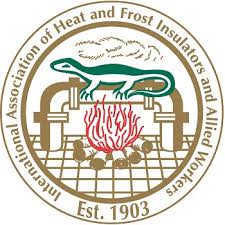
Take a look at the centerpiece of the logo of the Heat and Frost Insulators union whose members were, for most of the 20th century, called "asbestos workers." Featured is a salamander perched on a pipe above a crackling fire. What is this small green amphibian doing in the logo of this building trades union and how did it get there?
Tom Lemmon, currently a retired member of the union's Local 5 in Los Angeles, researched the history of this logo as part of his senior project while attending classes at the National Labor College in Silver Spring, Md. His research resulted in the publication of a paper, "The Historical Significance of the Salamander and Its Relationship with Asbestos and the Asbestos Workers" which he published in 2003.
And in 2004 Michael Merrill, the editor of Labor's Heritage, a journal of the George Meany Memorial Archives expanded on Lemmon's research in an essay with the provocative title, "Why Are You Barbecuing that Lizard?" (Spring/Summer, vol. 11, no. 2)
The answer to the salamander riddle requires a journey into labor history.
- Asbestos is a fibrous silicate mineral which is found in nature. The mineral's physical properties and its power to resist flames has been recorded in ancient history, beginning with some of the Egyptian pharaohs who were buried in its magical cloth.
-
Stories about asbestos have included mention of the salamander which, according to legend, has a skin that is impervious to fire. Some people believed the salamander was incredibly cold and was able to withstand and extinguish fire. The word - salamander - comes from the Greek word for fireplace. According to Aristotle, the salamander "not only walks through the fire but puts it out in doing so."
-
In 1298 Marco Polo in The Travels of Marco Polo reported seeing a tablecloth in China that was cleaned by throwing it in a fireplace. He was told the tablecloth was made of "salamander's wool."
- Salamanders - thought to be fire resistant and poisonous - were also mentioned in the Bible and in books on alchemy and natural philosophy. Francis Bacon (1561-1626) reported on the supernatural traits of salamanders.
- The salamander secretes a milky juice from the pores of its body when it is irritated. They often hibernate in hollow trees or wood piles in the winter where they coil up until the spring. Lemmon says "they would often be found hiding within the firewood and when the wood was added to the fire the hidden salamander would wake up with only enough time to put forth all its faculties for its defense."
- In the United States the asbestos workers' union grew with the widespread use of steam power. Skilled insulation mechanics were needed to insulate steam boilers in an effort to conserve the precious heat being piped from these boilers into residential and industrial buildings.
- In 1900 asbestos workers organized into the Salamander Association of New York City. They soon joined with workers in other cities to form a national labor union-- the National Association of Pipe and Boiler Coverers which affiliated with the National Building Trades Council of America. In 1904, American Federation of Labor President Samuel Gompers issued the union its first charter and, in 1910, several Canadian locals affiliated.
- Today, heat and frost insulators work on equipment and systems with temperatures ranging from well below zero to over 2000 degrees. Green energy construction requires skilled workers who are in high demand. These unionized workers complete joint apprenticeship and training programs designed to enhance their knowledge, skills and abilities.
- The International Association of Heat and Frost Insulators and Allied Workers prides itself on being "a testament to our founders’ commitment to the dignity, skills and well-being of our membership. Our union has endured, through good times and bad, in peacetime and at war, through economic depression and prosperity, in favor and out of favor with governments and politicians. Through it all we not only have survived; we have flourished."
A tip of the hat to Tom Lemmon and all of the union men and women
of America's building trades. They are a symbol of pride and accomplishment and, like the salamander, possess "an enduring faith, or courage, that cannot be destroyed."