Women's History Month Newsletter Series | | | | |
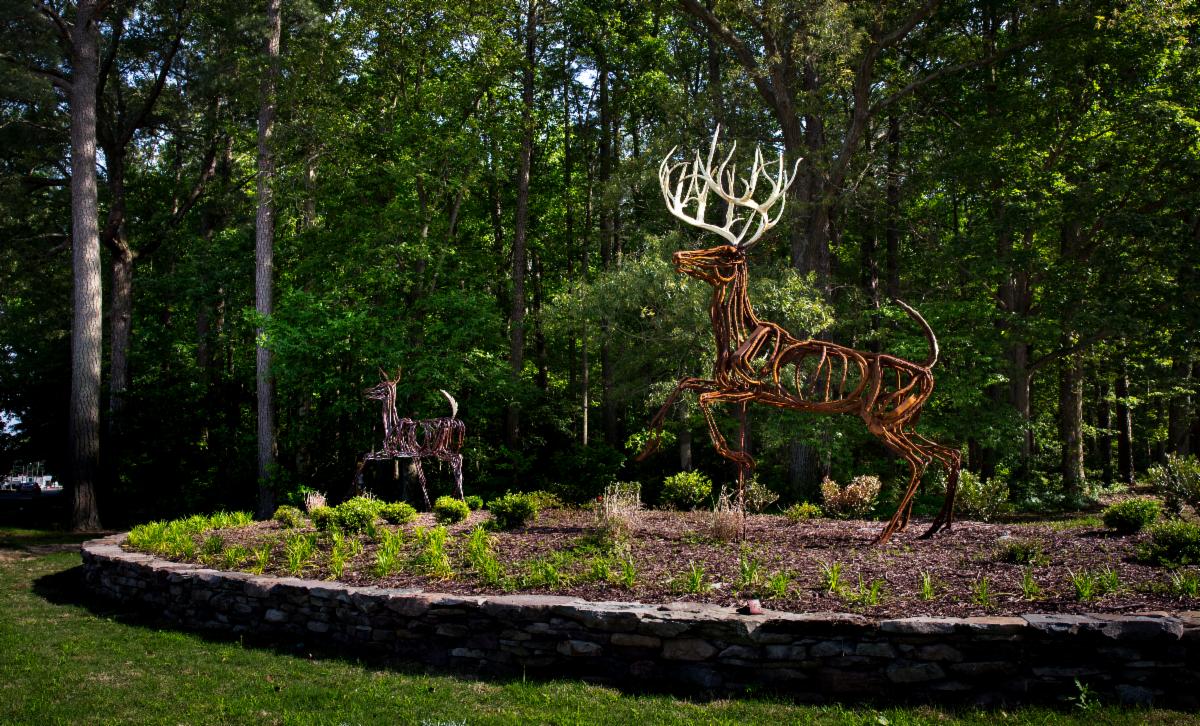
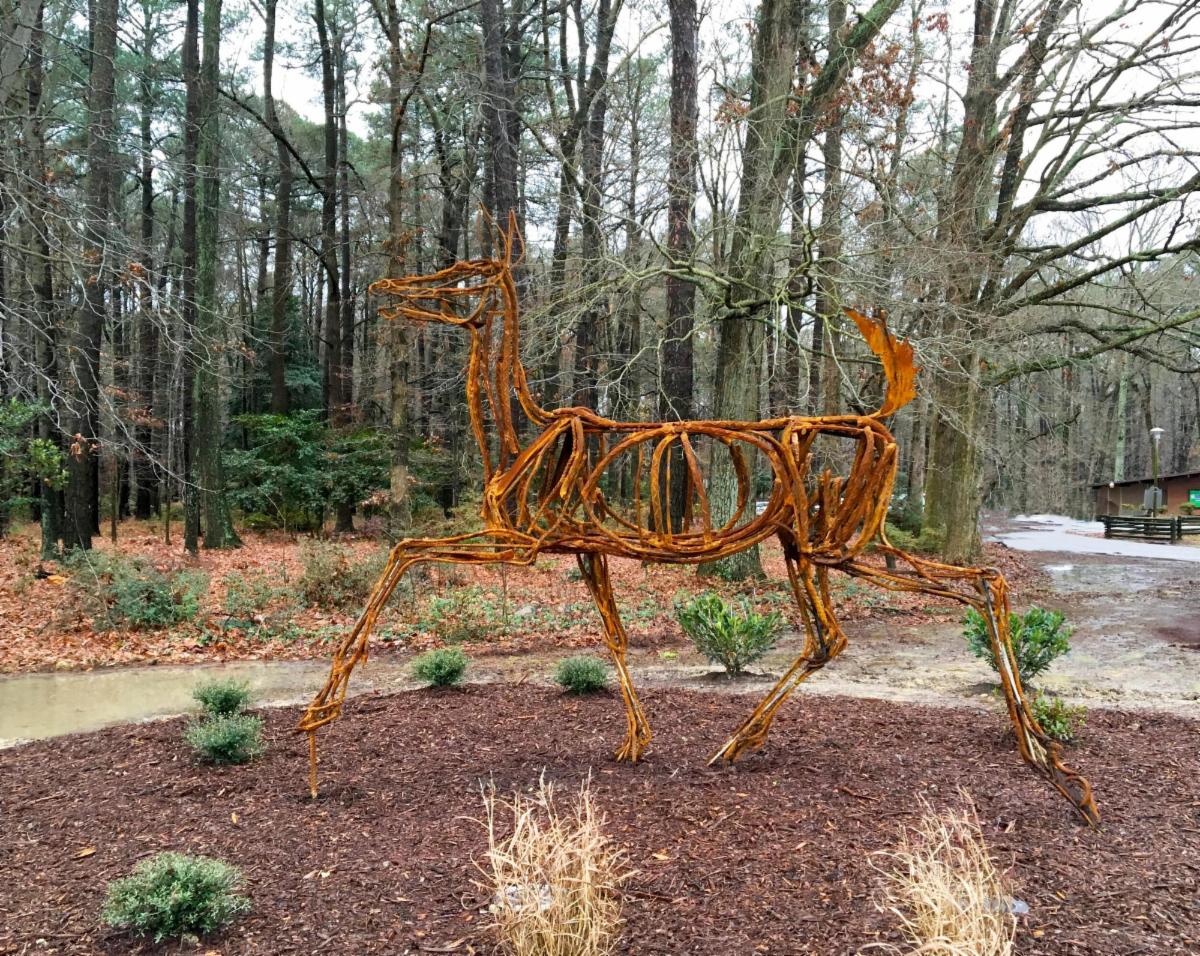
Wendy Klemperer's salvaged industrial materials sculpture Whitetail Crossing (2015), as visible from the entrance to Deer Park.
Photo Courtesy of NNPAF © Alexander Kravets.
| |
WENDY KLEMPERER
Wendy Klemperer (b. 1958) is an American sculptor known for large-scale animal forms built from salvaged industrial materials. Her educational background spans science and the arts. She studied biochemistry at Harvard and later sculpture at Pratt Institute, a combination that informs her depiction of anatomy, structure, and movement. Klemperer has developed a distinctive sculptural language in which welded lines function like gestural drawing strokes, the expressive and rapid mapping of movement, so that presence is created through both solid forms and the open air between them.
Klemperer's career has received significant professional recognition within the sculpture community. In 2022, she received the National Sculpture Society's Marilyn Newmark Memorial Grant, awarded to animal sculptors who demonstrate outstanding ability and sustained commitment to their practice. Her work is grounded in the question of how we recognize and reward sentience and dignity.
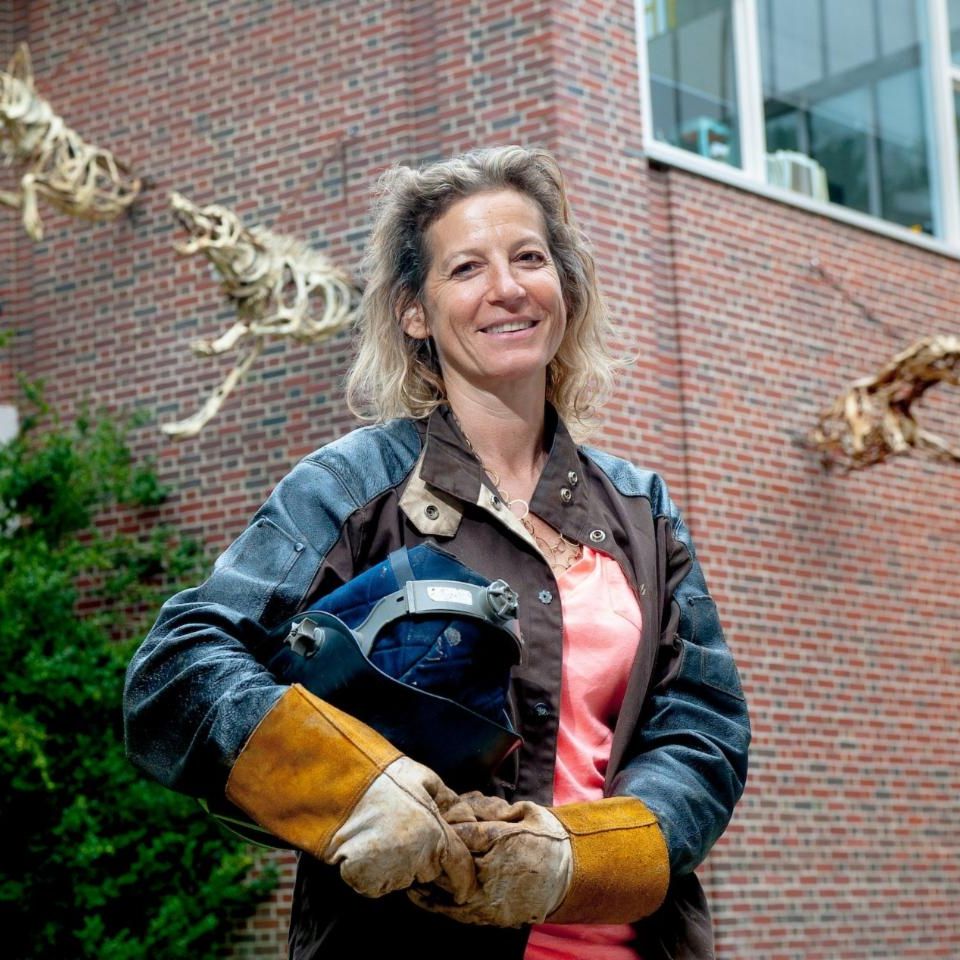
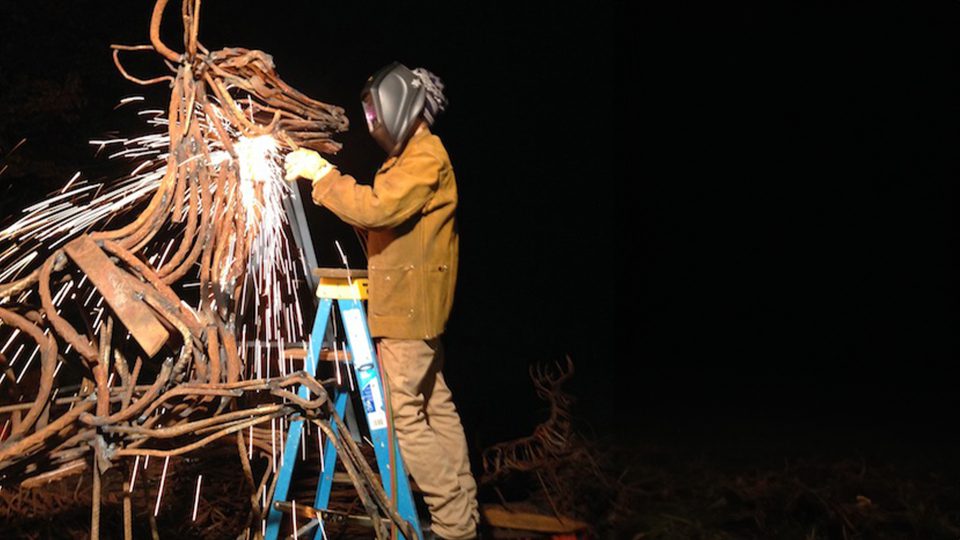
Wendy Klemperer posing in her welding gear with her steel-and-epoxy piece, Chain-Hound VI (2000).
Photo © Lisa Nugent.
| |  | |
MARTA MAGDALENA ABAKANOWICZ
Magdalena Abakanowicz (1930–2017) was a Polish sculptor and fiber artist internationally recognized for installations that explore the collective body, crowd behavior, and the psychology of social life. She studied at art schools in Sopot and later at the Warsaw Academy of Fine Arts. Training within a postwar institutional context, Abakanowicz's works are shaped by her early exposure to Socialist Realism and lifelong interest in how ideology, power, and conformity materialize within the body.
Abakanowicz's global influence is reflected in major awards, including the Grand Prix at the São Paulo Biennale (1965) and the Herder Prize (1979). She is known for her post-minimalist style, which expands on minimalism’s clean neutrality toward materials into forms that register vulnerability and irregularity. Her fragmented bodily surrogates make viewers physically experience the tension between individuality and the collective.
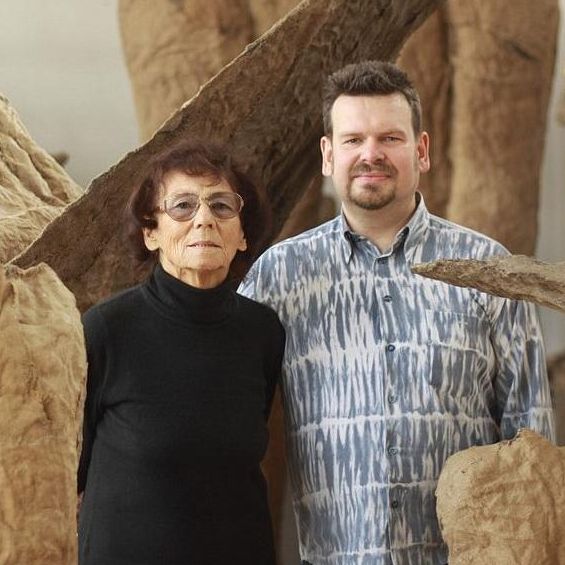
Magdalena Abakanowicz and Jarosław Pijarowski during a photo session in her studio, October 27, 2010. Photo © Kontrola / CC-BY-SA-4.0.
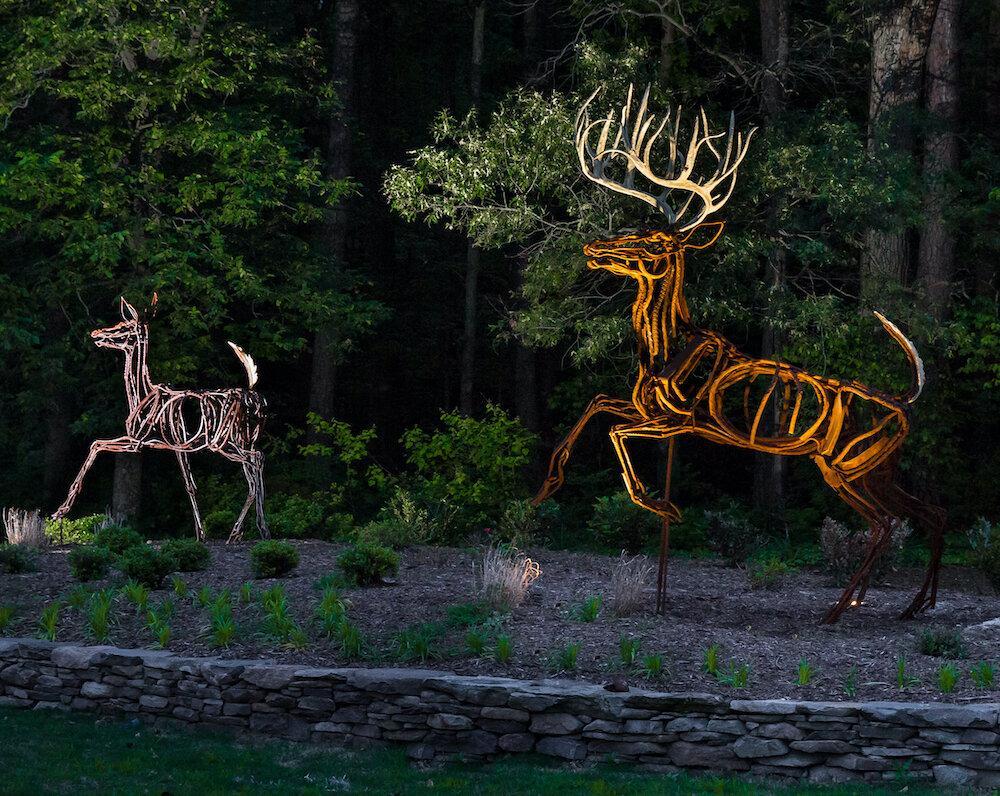
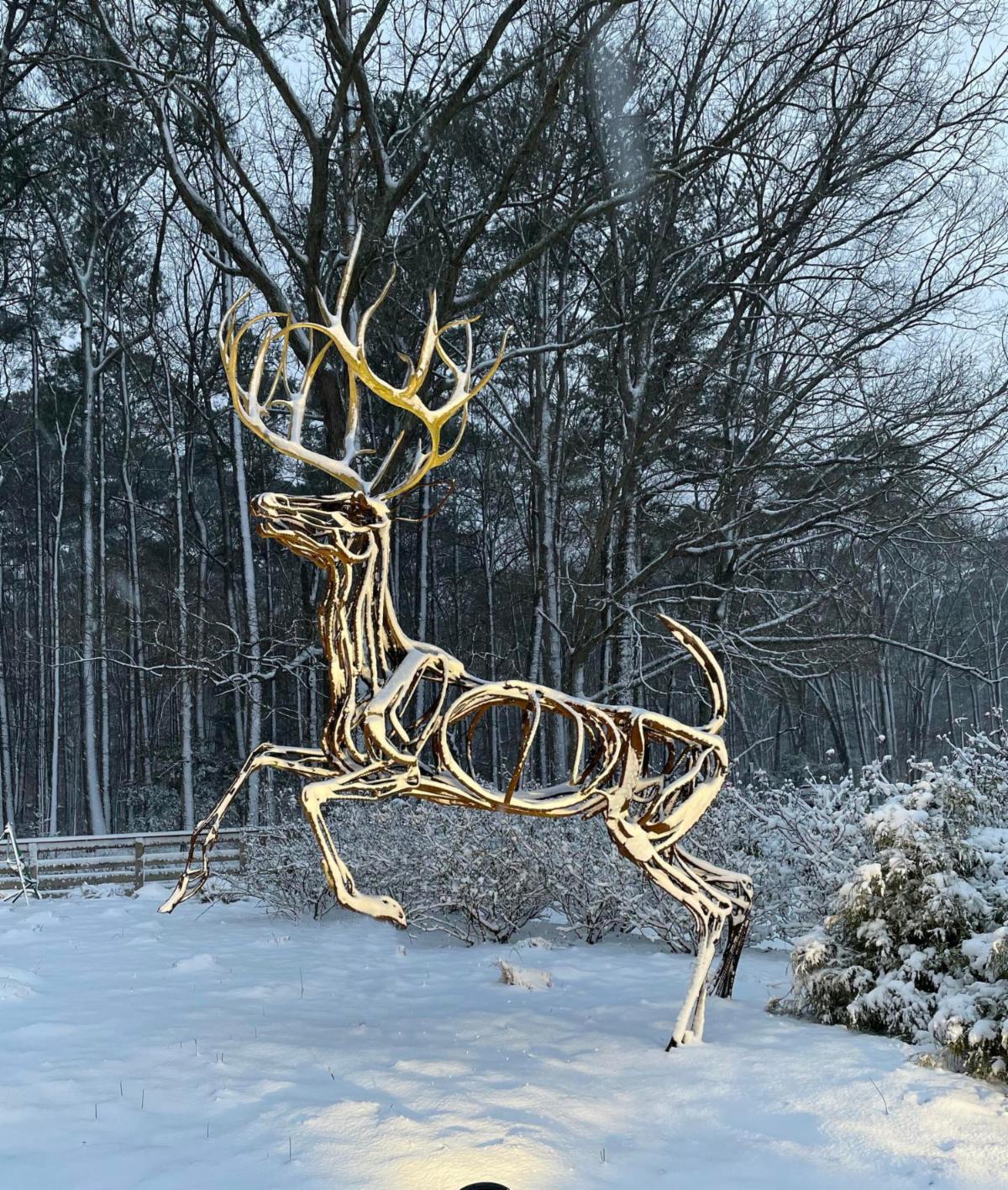
| | | Evening view of Wendy Klemperer's Whitetail Crossing (2015). Photo Courtesy of NNPAF © Alexander Kravets. | | |
Detail of the trotting doe, 2015. Photo Courtesy of NNPAF.
C
| | Detail of the stag, 2015. Photo Courtesy of NNPAF. | |
WHITETAIL CROSSING
Whitetail Crossing (2015) is installed at the entrance to Deer Park, where it serves as both a welcome and a warning. This threshold encounter frames the park as a space shared between the local wildlife and human visitors. Within this setting, the deer evoke a tense balance between elegance and the sheer force of nature.
The deer occupy space through structural line, a built skeleton of welded elements that can be read as sculptural or drawn. The bodies are present, but remain open, making negative space part of the form, so movement feels imminent. Klemperer's deer also carry an ethical proposition. By rendering the animals as alert, individuated presences, Klemperer asks viewers to reconsider how public space is organized around human priorities and how sculpture can redirect attention toward ecological issues.
| |
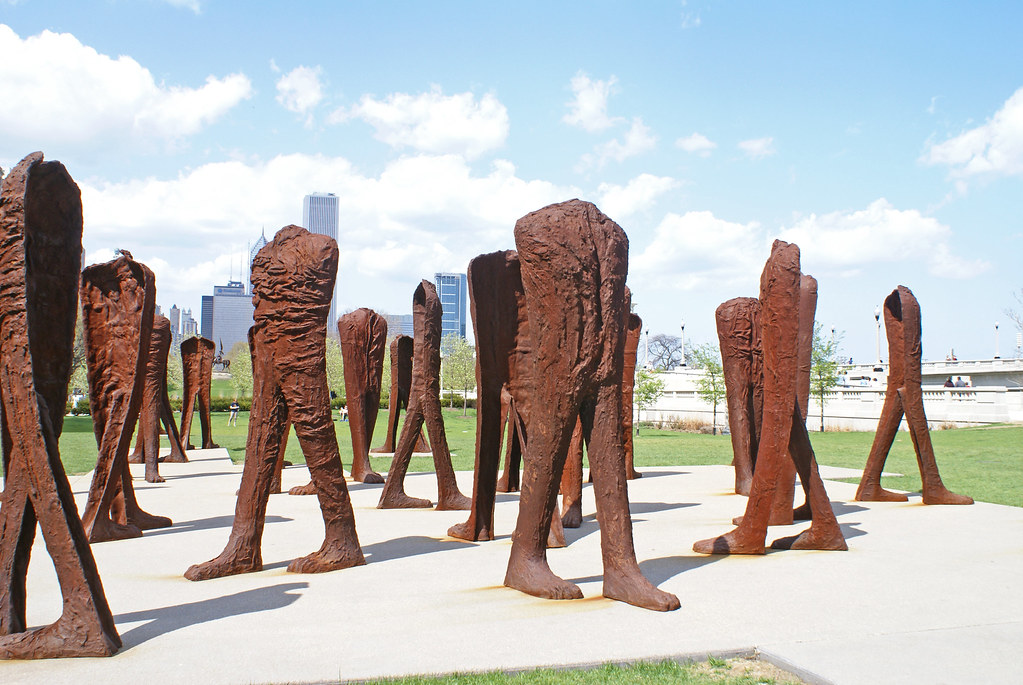
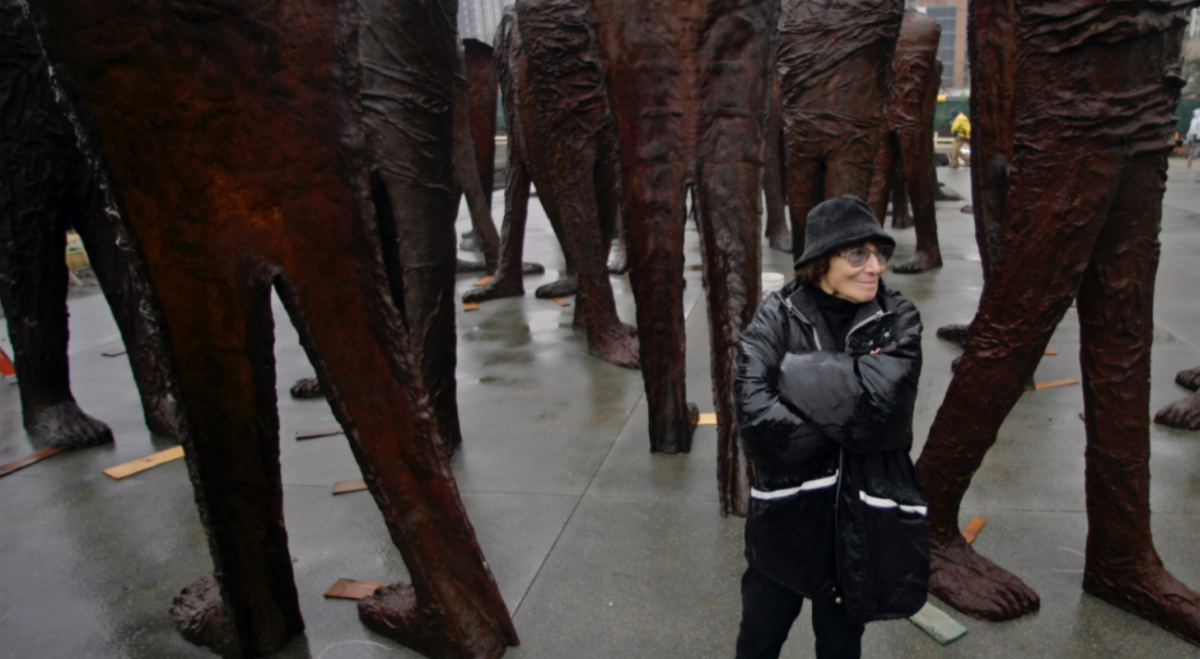
Marta Magdalena Abakanowicz's cast iron piece Agora (2006), a permanent installation in Grant Park, Chicago, Illinois.
Photo Courtesy of Public Art Archive © Atelier Teee.
|
AGORA
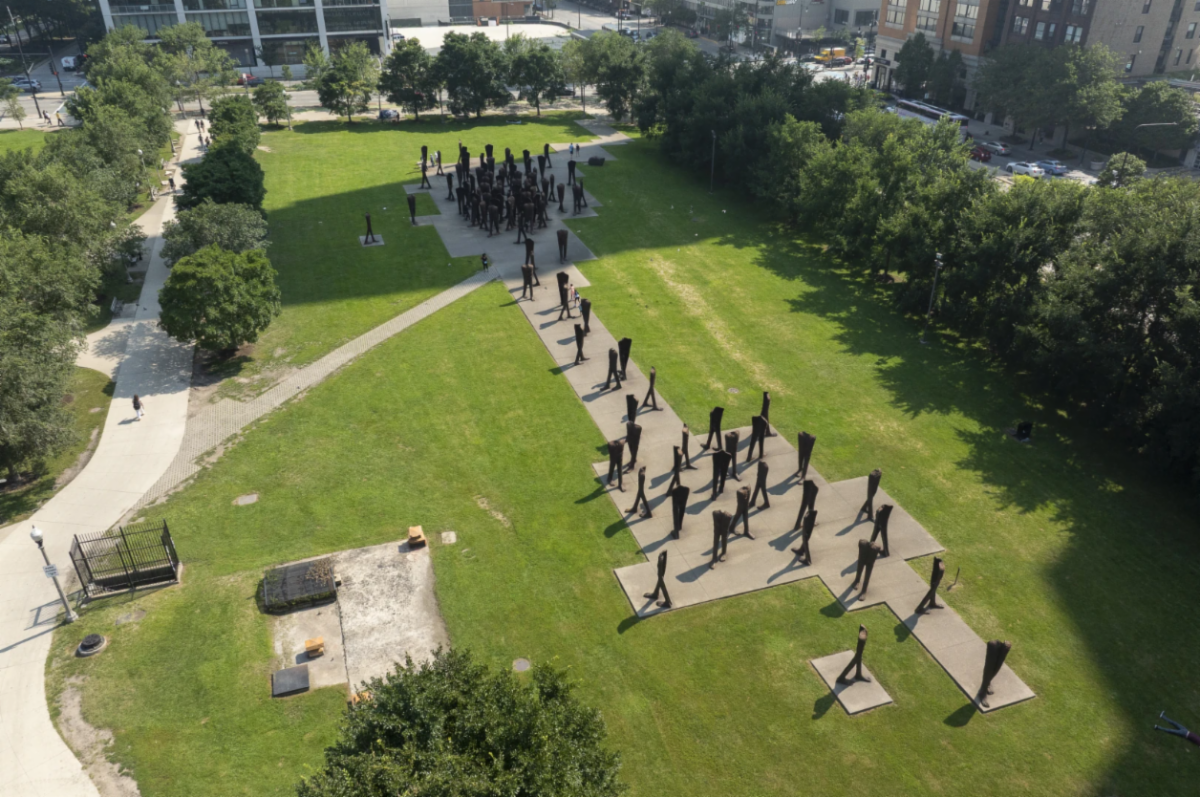
Agora (2006) is an installation of 106 depersonalized cast iron figures in Chicago's Grant Park. The title references the ancient Greek agora, the social heart of city-states that served as meeting places and markets, positioning the work within a larger civic history of assembly and debate within collective life. The figures are approximately nine feet tall and are arranged in groupings that suggest both movement and stillness. An aerial view shows some figures who appear to be migrating away from the larger mass of bodies.
In Agora, the body is not individualized. The removal of arms and heads from the figures deprives them of the features that usually create personhood. The sculpture produces a sensation of anonymity and vulnerability by withholding identity cues. Walking among the figures, the viewer becomes acutely aware of scale and proximity. You are surrounded by bodies that are present but unknowable, a crowd that feels simultaneously familiar and estranged.
| | |
Aerial view of Agora in Hutchinson Field at Grant Park.
Photo Courtesy of Chicago Sun-Times © Tyler Pasciak LaRiviere.
| | |
Abakanowicz posing with Agora in 2006.
Photo Courtesy of Chicago Sun-Times.
| | Bodies, Repetition, and the Ethics of the Crowd | |
Klemperer's Whitetail Crossing and Abakanowicz's Agora both use repetition to produce sculptural presence, despite their different approaches towards recognition. For Klemperer, repetition generates a rhythm of living movement. By including multiple deer bodies, she establishes a sense of migration, alertness, and shared direction. For Abakanowicz, repetition creates the opposite effect. The crowd becomes a dense social fact in which the viewer's body is made to be aware of proximity and surveillance.
Klemperer's salvaged metal carries visible histories of use and reuse, so the animal body emerges out of industrial residue. This creates a productive tension between nature and industry, in which the deer's vitality is built on the material traces of human infrastructure. Abakanowicz's iron bodies, by contrast, operate through uniformity. The material does not individualize, but consolidates. The repeated torsos are a reminder that modern life often reduces individuals to units.
Both works are about posture, mass, and viewer relation. Klemperer shifts the subject away from heroic humans by insisting that animal presences can carry dignity and intelligence. Abakanowicz refuses the heroic individual altogether, insisting that the crowd is one of modernity’s defining traits and that it is both frightening and unavoidable.
| The Role of the Site in Meaning-Making | | |
Klemperer's Whitetail Crossing gains meaning through its placement between the built environment and the landscape, simultaneously commemorating the previously endangered whitetail deer while maintaining the surprise one feels when unexpectedly encountering an animal in the wild. Because it is installed at the park entrance, the deer greet visitors on a personal scale, but they also ask how everyday experiences can coexist in shared habitats. Similarly, they assert their presence over their human visitors from their elevated position, signaling a subtle triumph of nature over humanity associated with the sublime. The salvaged material visualizes the tension among industry, urbanization, and ecology, aspects inseparable from the city's relationship to green space.
Abakanowicz's Agora invites visitors to walk within the crowd. Grant Park is a civic commons already defined by public gathering, tourism, and movement, and whose association with shared space is only reinforced through the piece's Greek name. This installation intensifies social choreography, the patterned movement of bodies through a space, by converting an otherwise open field into a chamber of proximity and creating a paradoxical open-air crowd that feels psychologically dense. Because the viewer encounters collective bodies inside a space meant for the collective, the sculpture feels less like an isolated artwork and more like a model of public life itself.
Despite vastly different methodologies and subjects, Klemperer and Abakanowicz both manage to encapsulate the human condition through oppositional forces. Klemperer creates animal bodies that signal ethical presence through a surprise redirection of attention. Whitetail Crossing represents the reckoning between humanity and nature that is unavoidable in the face of modern industry, creating an uncanny sense of isolation amid the hope of ecological preservation. Abakanowicz creates a similarly isolating effect by using repetition to make viewers experience the vulnerability and anonymity we are subject to within the ever-present crowd, as previously open regions continue to urbanize and collective spaces become suffocating. Together, these works depict public sculpture's ability to render both shared life and estrangement visible, asking not only how bodies occupy space, but how space itself shapes the terms of coexistence.
| | |
Learn More About the Artist and Artwork Here | This expressive installation, created from salvaged industrial materials, evokes elegance, agility, and the sheer force of nature - remarkable qualities of deer. There is no better setting for these deer sculptures than welcoming the 400,000 visitors a year to Deer Park on Jefferson Avenue in Newport News, Virginia. | | | | |
Explore the Work of NNPAF's Female Sculptors
Public art is an ever-evolving experience. Each sculpture reveals something new depending on the time of day, the season, and the viewer's perspective. In honor of Women's History Month, we invite you to explore the work of four remarkable sculptors whose creations enrich our shared spaces.
Take a self-guided tour and discover these inspiring works in Newport News:
📍Whitetail Crossing – Deer Park
📍Elements – Christopher Newport University
📍Selene – Kettle Pond, near the Lions Bridge
📍Spirit of Life – Riverside Regional Medical Center
| |
Learn More About Magdalena Abakanowicz and Her Work Here | Polish artist Magdalena Abakanowicz was a pioneer of fiber-based sculpture and installation in the 1960s. She began making abstract fiber works in the 1950s, when her government was advocating socialist realism. Her earliest works were monumental hanging textiles, which she named "Abakans." They function as both objects and spaces. | | | |
📸 Engage with Us!
What speaks to you about these works? Let us know! Your perspective adds to the dialogue. Together, let's celebrate the women shaping our world, one sculpture at a time.
If you visit one of these pieces or have engaged with Abakanowicz's work, we’d love to see your experience! Share your visit on social media by tagging @nnpublicartfoundation or using #NNPAF.
Tune in Next Week to Learn About...
Our final week will bring us to Inger Sannes and her work, Elements (2008), alongside Linda Howard and her modular sculptural structures, a pairing that asks us how abstraction can behave like a body without depicting one. Together, these sculptors depict how abstract form carries embodied meaning and how women artists have used abstraction as a rigorous formal language to claim space, build authority, and shape what the public is conditioned to notice.
| | | | |
|
Contact Us
Email: info@nnpaf.org
Phone: (757) 369-3014
Newport News Public Art Foundation
733 Thimble Shoals Blvd., Suite 170
Newport News, VA 23606
| | |
| |
Follow Along
Stay tuned to our website and social media for updates, sneak peeks, and upcoming events.
We can't wait to share this journey with you!
| Thank you for the continued support from the following sponsors: | | |
Copyright © 2026 Newport News Public Art Foundation, All rights reserved.
You are receiving this email because you opted in at our website, social media, or during one of our events.
| | | | |