February 12, 2021
The Out-of-Pocket Health News Digest
|
|
Below you will find briefs about recent health policy news stories. Our hope is for students to have an information outlet at their fingertips to keep up-to-date with the most pressing news stories in health policy.
This compilation is produced by the HPSA Education Committee: Matthew Dunn, Magdalena Mihaylova, Atticus Raasch, and Brynna Thigpen
|
|
Spread the Word, Not Disease: Public Messaging to Increase Vaccine Uptake
by Brynna Thigpen
|
|
Since the beginning of the COVID-19 pandemic, public messaging has been crucial to controlling disease spread. Everyone can recall when they saw an ad on the bus encouraging them to wash their hands more frequently, or when they first heard the words “social distancing” on the news. As of mid-January 2021, the pandemic has been in the U.S. for over a year, and public awareness campaigns have begun to turn to a topic that was controversial even before the pandemic: vaccines.
Pre-pandemic, American public health departments had struggled for several decades to combat a growing trend of vaccine hesitancy and outright anti-vaccine sentiment. Stemming in large part from a debunked study from a former British physician that fraudulently linked the measles, mumps, and rubella vaccine to autism incidence, hesitancy and resistance to vaccines has been on the rise. Ironically, vaccines have been so successful at protecting most patients from infectious diseases that most people have never seen a case of polio or measles. This can cause patients to minimize their perceived risk of disease, while disproportionately magnifying minor risks of adverse events. Compounding this hesitancy, in the U.S. the federal government repeatedly failed to protect the health of Black Americans and Americans of color. This breach of trust has resulted in understandable hesitancy among these populations to accept national promotion of medical treatment, a particularly important factor to consider as populations of color have been disproportionately harmed by this pandemic.
Amidst this controversy, medical organizations, advertising groups, and governments are trying to devise strategies to effectively reassure Americans of COVID-19 vaccines’ safety and efficacy, and motivate them to get vaccinated. In November, the U.S. Department of Health and Human Services launched a $250M campaign to promote COVID-19 vaccines. The Ad Council, acting independently of the federal government, launched a campaign in January to convince vaccine skeptics to reconsider, tailoring strategies by target population. Newly inaugurated, President Biden and his team have developed their own massive advertising and public awareness campaign, but have delayed rollout, seeking to balance an increase in demand for vaccines with severely limited supply.
Successful messaging about the vaccine’s safety and significant personal and public health benefits will generate demand among patients, who may then be disappointed and frustrated by a months-long wait for appointments. But if the United States is to reach herd immunity in an equitable manner, getting this message right may be the most important move of all.
Politico, Becker’s Hospital Review, CNN Politics, New York Times, Association of Health Care Journalists, Time, US News, Time, New England Journal of Medicine, CDC, Los Angeles Times
|
|
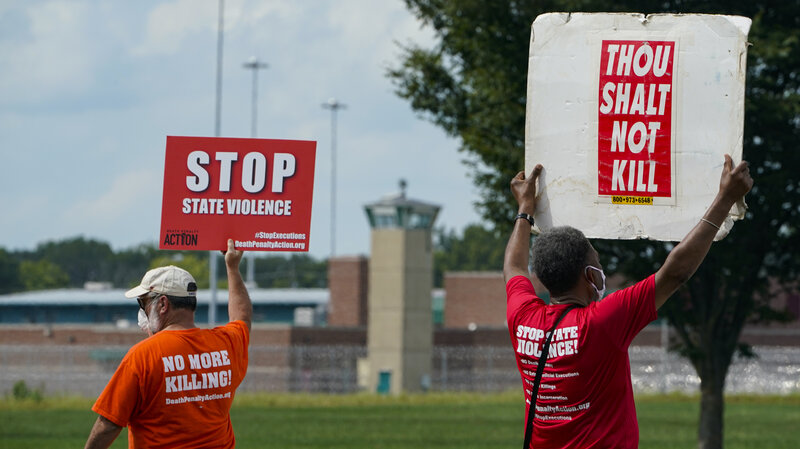
New administration brings renewed hope of stopping federal executions
by Matthew Dunn
|
|
A coalition of 82 advocacy groups, led by the American Civil Liberties Union (ACLU) and Amnesty International, published an open letter to president Biden on Tuesday. These organizations urged the president to 1) commute the sentences of individuals currently under federal punishment of death, and 2) reinstate the federal moratorium on the use of the death penalty going forward. This letter comes a month after Sen. Dick Durbin (D-IL) and Rep. Ayanna Pressley (D-MA) introduced a bill that aims to permanently end capital punishment on the federal level.
In 1976 the death penalty was reinstated, but this practice has been criticized as an unjust means of criminal sentencing. First, there is the argument that state-sponsored executions are morally wrong and should not be conducted in a democratic society. Second, the legal determination of who receives the death penalty is subject to racial prejudice. Year after year, Black-Americans are overrepresented on death row. According to a 2019 report, since 1977 there have been 295 black defendants executed for killing a white victim, compared to 21 white defendants executed for the killing of a black victim.
The push to abolish the federal death penalty was intensified following a series of executions in the closing days of the Trump Administration. Five people were executed during the presidential transition, bringing the 2020 total to 13 deaths by federal capital punishment - the most in a single year since 1896. The scheduling was also curious: all of the death row prisoners killed in the summer were white, while 4 of the 5 most recent executions were black. Former Attorney General William Barr may have intended to avoid public criticism of scheduling the executions of black men during the George Floyd protests and increased awareness of racial discrimination in the criminal justice system.
|
|
Study finds Black Americans may have to travel farther for COVID-19 vaccine, again highlighting disparities during the pandemic
by Magdalena Mihaylova
|
|
Health equity is a topic of major concern for many diseases and illnesses, but the COVID-19 pandemic has brought new attention to the disparate health impacts on minority communities, such as those of Black Americans, Latinos, and American Indian/Alaska Native people. Hospitalization rates among American Indian and Alaska Native people are 5.3 times the rates of non-Hispanic white people; among Black Americans and Latinos, their hospitalization rate is 4.7 times that of non-Hispanic white people. While there are many reasons for these alarmingly distinct rates, a few compelling ones include healthcare access, discrimination, housing, and work occupation.
As various vaccines are administered throughout the country, many Americans are hopeful about lower infection and hospitalization rates. And yet, even within vaccine rollout there is a sizable gap in coverage among racial and ethnic minorities. In a study conducted by researchers from the University of Pittsburgh and the West Health Policy Center, they found that Black Americans are more likely to live farther from—and thus have a harder time getting to—COVID-19 vaccination sites, which can lead to even larger disparities in COVID-19 health outcomes.
|
|
One-Liners
by Atticus Raasch
|
|
-
Contact tracing: President Biden has proposed the hiring of 100,000 people that would help with contact tracing and facilitate vaccination as part of a new healthcare job corps.. Experts said it’s not clear that the new employees would be enough to keep up with another surge in COVID-19 cases, even if the vaccination rate increases at the same time. (Kaiser Health News)
-
COVID-19 variants: According to Dr. Rochelle Walensky, director of the Centers for Disease Control and Prevention, the U.S. is ramping up it’s gene sequencing efforts to identify new variants of COVID-19 (CNN).
-
Food safety: A congressional investigation found high levels of heavy metals in certain baby foods. A staff report from the House Oversight and Reform Subcommittee on Economic and Consumer Policy released Thursday found that certain company standards permit dangerously high levels of toxic heavy metals. (The Hill)
-
Healthcare: Part of the Covid-19 relief package House Democrats released Monday night include an expansion of Affordable Care Act subsidies, a key plank of President Joe Biden’s health care agenda that they hope to pass in the coming weeks. (Politico)
-
HIV Injectable drug regimen: Cabenuva, the first ever injectable HIV treatment, has been approved by the FDA. Those living with HIV can opt into Cabenuva instead of having to take a pill every day of the year. (Healthline)
-
Vaccination centers: According to a new study out of the University of Pittsburgh and the West Health Policy Center, black Americans will likely have to travel further to get a COVID-19 vaccine. The study also found that rural states like Montana, South Dakota, and Wyoming had the longest average driving distance to a potential facility. (The Philadelphia Inquirer)
|
|
|
|
|
|
|