October 2, 2020
The Out-of-Pocket Health News Digest
|
|
Below you will find briefs about recent health policy news stories. Our hope is for students to have an information outlet at their fingertips to keep up-to-date with the most pressing news stories in health policy.
This compilation is produced by the HPSA Education Committee: Matthew Dunn, Magdalena Mihaylova, Atticus Raasch, and Brynna Thigpen
|
|
Vacant Supreme Court Seat Increases Uncertainty on the Future of American Health Care
by Brynna Thigpen
|
|
Raising the stakes of this replacement fight is the potential for a new Supreme Court justice to have an immense and immediate impact on American healthcare, most notably Roe v. Wade and the Affordable Care Act (aka “Obamacare”).
Roe v. Wade
President Trump has nominated Amy Coney Barrett, who, at 48, has only a short judicial record to consider as Americans and policymakers weigh her potential impact on the court. Her strict constitutional interpretation and religious faith, however, suggest that she may be open to overturning previous judicial precedent on cases like Roe v. Wade, although she’s pledged to separate her personal opinions from her rulings. This being said, she’s also written previously in a court opinion that abortion is “always immoral,” and signed a 2006 newspaper ad with her husband calling for Roe v. Wade to be overturned, labeling the decision “barbaric.” Current challenges to the 1973 decision that protected a woman’s right to choose are winding their way through the courts and will likely appear before the Supreme in the next several years; certainly during Coney Barrett’s potential tenure.
The Affordable Care Act
In California v. Texas, a case slated to appear before the Supreme Court in mid-November, 20 Republican-led states and Trump’s Justice Department allege that the entire Affordable Care Act should be invalidated because the individual mandate penalty (which applied to people who chose not to buy health insurance) fell to $0 under 2017’s tax cuts. The 2010 law is being defended by 20 Democratic-led states, helmed by California’s Attorney General Xavier Becerra. Although many legal scholars see the current challenge as legally weak, Judge Barrett has previously expressed support for other arguments to strike down the law. While this doesn’t mean she will likewise rule in this manner were the case to come before her, it does provide some indication of her views on previous challenges.
Regardless of who the new Supreme Court justice is - Judge Coney Barrett or otherwise - the shift in the court will have profound impacts on the future of healthcare in the United States.
Sources: Vox, New York Times, Becker’s Hospital Review, Advisory Board, Chicago Tribune, CNN, White House, NPR, Kaiser Family Foundation, The Guardian, CBN
|
|
Food insecurity during the COVID-19 pandemic
by Matthew Dunn
|
|
The COVID-19 pandemic has exacerbated the burden of unmet social needs in the United States and worldwide, including the prevalence and burden of food insecurity. The state of being food insecure can mean insufficient food intake, but also lack of nutrition, desirability, and quality.
This was a problem even before the pandemic, with an estimated 10.5% of U.S. households experiencing food insecurity in 2019. However, this figure has doubled during COVID-19: a study from Northwestern University estimated food insecurity may have reached 23% during the peak of economic hardship. In addition, food insecurity in the U.S. is tied to existing inequalities. Multiple studies have shown that households with children are far more likely to not have enough to eat compared to households without children. White households are less likely to face food insecurity compared to Black and Hispanic families.
Yet, the prevalence of food insecurity could be significantly reduced through appropriate policy measures at the federal level. One such policy is to boost the maximum food stamp benefit, which has long been supported by anti-hunger advocates. As of October 1, 2020, the updated coronavirus relief bill known as the HEROES Act contains a provision to increase the maximum food stamp benefit by 15%. This stimulus bill, $2.2 trillion dollars in total, was passed Thursday night by House Democrats in advance of negotiations with Treasury Secretary Steven Mnuchin. The future of this bill is uncertain; however, given that Senate Republicans have already stated opposition to this rescue package, instead arguing for a smaller bill.
|
|
President Trump signs vague order protecting pre-existing conditions
by Atticus Raasch
|
|
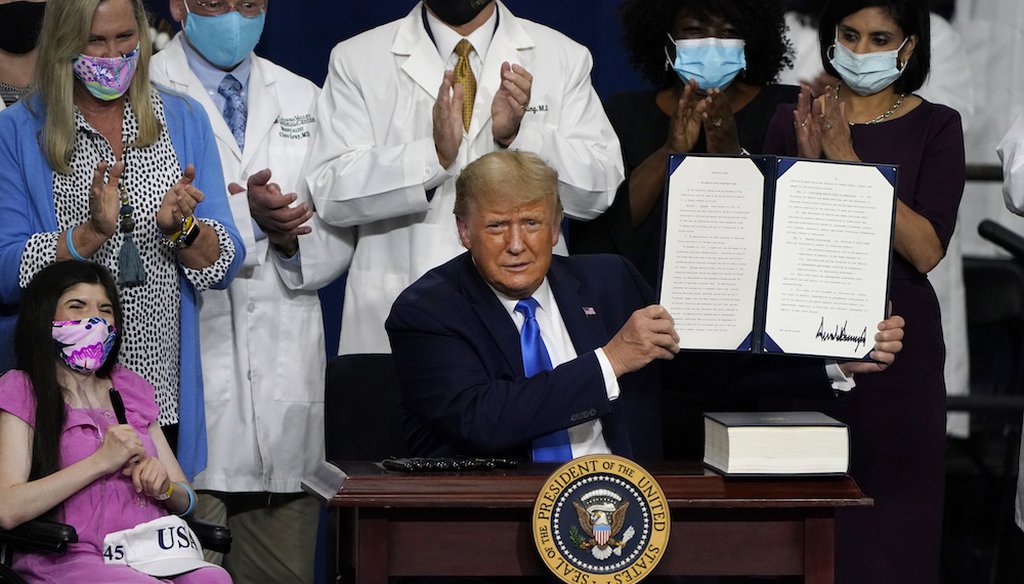
President Trump signed an executive order last week mandating that preexisting conditions must be protected under any model of healthcare reform posed in Congress. While the order seems to reaffirm protections for pre-existing conditions, many experts say the order lacks substance.
According to Joe Antos with the American Enterprise Institute, the order has “no technical context.” Antos argues that the Executive Order implies that the Administration wants one of his departments to come up with a plan, but doesn’t give “any guidance or the vaguest outline of what that plan should be."
This order comes in light of the Administration’s efforts to overturn the Affordable Care Act, which already works to protect Americans with pre-existing conditions. However, experts believe that a law is needed to guarantee these protections, not just an executive order. What the order really says, explains Tara Sklar, JD, MPH, a professor of health law at University of Arizona’s James E. Rogers College of Law, is that Trump is looking to assure the American people that he will work to protect pre-existing conditions, even in the absence of the ACA.
|
|
One-Liners
by Magdalena Mihaylova
|
|
-
COVID-19: As flu season approaches, hospitals and pharmacies prepare for increased demand for flu vaccines, despite some hesitation from parents (STAT, CNN).
-
Global Health: A study of over 85,000 people with COVID-19 in India found that children of all ages can become infected with and spread the coronavirus, demonstrating compelling evidence for what has been an important and controversial question in pandemic discourse (The New York Times).
-
Immigration: Following a whistleblower complaint earlier last month, continued information surfaces about women detainees undergoing unnecessary gynecological surgeries while under ICE detention (The New York Times).
-
Mental Health: In the wake of the Oregon wildfires, attention is called to the necessity of emotional support, whether through parenting or schools, for children facing post-traumatic stress after a disaster (The New York Times).
-
Women’s Health: A population-wide study became the first to show that the HPV vaccine significantly lowers a woman’s risk of developing cervical cancer, especially when vaccinated at a younger age (NBC News).
|
|
|
|
|
|
|