April 2026

TREE Fund Webinar Q&A:

Increasing Biological Control of Soft Scale Insects by Excluding Ants from Trees

Caleb Wilson, PhD

University of Kentucky


During a TREE Fund Webinar on March 3, Caleb Wilson presented research funded by the Jack Z. Duling Memorial Research Grant Program to over 1,000 viewers from around the world. There were many questions in the chat and not enough time to answer them all. We took those extra questions and sent them to Caleb so he could follow up with answers. Some of those answers are below. The full webinar can be viewed by visiting our Webinar Archives page or clicking here.


Questions and Answers:


Q: Can eliminating the ants and reducing their harvesting of the honeydew increase the susceptivity to black sooty mold?


A: Removing ants should reduce the amount of sooty mold eventually. This is because fewer ants means fewer scales and ultimately less honeydew forming on tree trunks. However removing ants will not do anything with the sooty mold that is already there. That should degrade over time very slowly if no more honeydew is being deposited, but I suppose you could get it off with a pressure washer, provided the tree can handle it.


Q: Last year, I got question about European Elm Scales and impact of soot and black mold on Human Health--- Anybody did any research on it ?


A: Very little research on this topic. Seems that inhaling the mold can cause allergic reactions and asthma. Handling fruits with the mold can cause contact dermatitis. Here is a paper on the topic: Guarneri, F., Guarneri, C., Cannavo, S.P. and Guarneri, B., 2008. Dyschromia of hands and bronchial asthma caused by sooty molds. American journal of clinical dermatology, 9(5), pp.341-343. https://link.springer.com/article/10.2165/00128071-200809050-00010


Q: Is dormant oil and 'sunspray' type treatments still effective and a good control?


A: Yes, oils can work well. In general, it seems that horticultural oils work better on armored scales and that insecticidal soaps work better on soft scales. You can get good knockdown effects but it's very hard to get complete eradication of scales within trees. They are a good option in comparison to broad spectrum insecticides because there is no residual and thus limited risk to pollinators and natural enemies, especially if applied in winter. This paper explains in greater detail: Quesada, C.R. and Sadof, C.S., 2017. Efficacy of horticultural oil and insecticidal soap against selected armored and soft scales. HortTechnology, 27(5), pp.618-624. https://journals.ashs.org/view/journals/horttech/27/5/article-p618.xml


Q: Is felt scale a relatively recent classification? I have been in arboriculture for almost 50 years and I haven’t heard of this classification until this year.


A: No, they have been recognized as a family of scale insects since at least the early 1900's. Most arborists encounter them infrequently because few of them become pests. Here's the wikipedia page on the family for reference: https://en.wikipedia.org/wiki/Eriococcidae


Q: How do scale insects move from tree to tree?


A: Crawlers are blown from tree to tree by the wind and they also climb up on birds or squirrels and get moved from trees that way. They can also move to neighboring trees if the canopies touch each other.


To view the full list of questions and answers, click here.

Lead Donors


We are deeply grateful to the following people and organizations whose accumulated contributions to TREE Fund in 2026 recently surpassed $2,500:


ArborMetrics Solutions, LLC

Bandit Industries, Inc.

Jeffrey Birdwell

David Gorden

International Society of Arboriculture

Prinoth/ Jarraff

Steve Reynolds

Vermeer Corporation


We'd like to thank all of our individual and corporate donors that have made a gift this year. Your donations are vital to our work in identifying and funding programs that support the discovery and dissemination of new knowledge in arboriculture and urban forestry.

Fall 2025 Grant Application Cycle Awardees Announcement


After a record number of applications received, TREE Fund is proud to announce five recipients of research grants from the Fall 2025 Grant Application Cycle.


Altogether, 130 applications were submitted for the five available grants and over $79,700 in research grant money is being awarded for research projects. Full information can be found HERE. 


Environmental Indicators and Intervention Treatment for Horned Oak Gall Outbreaks on the Common Street Tree Quercus palustris.

Awarded to: Brett Fredericksen Jr. of Southern Illinois University- Edwardsville

Grant: John Z. Duling Grant


Traitbased Assessment of Urban Tree Health and Climate Resilience.

Awarded to: Mohammad A. Rahman of University of Melbourne, Australia

Grant: Jack Kimmel International Grant


Tree Risk During Rigging Operations: Identifying Biomechanical Risk Factors for Arborist Safety – TRIAS.

Awarded to: Leonardo Bianchini of University of Tuscia, Department of Agriculture and Forestry Services (Italy)

Grant: Safe Arborist Techniques Fund Grant


Mitigating Roadsalt Impacts on Urban Trees: Strategic Companion Planting with Native Halophytes.

Awarded to: Andrew Milward of Toronto Metropolitan University (Canada)

Grant: Tree and Soil Research Fund Grant


Beyond the Canopy: Cocreating a Healthier City with Urban Trees.

Awarded to: Luz Piedad Romero Duque of Fundación Jardín Botánico “Joaquín Antonio Uribe” de Medellín (Colombia)

Grant: Bob Skiera Memorial Fund Building Bridges Initiative and John P. White Grant Program

TREE Fund's 2026 Free Webinar Series


Save the dates for our 2026 TREE Fund Webinar series. Free webinars available to the public based on research funded by TREE Fund grants. Thanks to the Alabama Cooperative Extension System for helping us again with these videos.


Stay tuned for these 2026 webinars.

Additional dates for this year will continue to be added.


April 21, 2026. Noon CST.

Tree Health Implications of Long-term Strategies to Treat Emerald Ash Borer: Long-term Effects on Tree Injections and Tree Tissue

Presenter: Dr. Richard Hauer, Dr. Andrew Koeser, and Dr. Jake Miesbauer

Registration here


July 21, 2026. Noon CST.

Efficacy of Aphidoletes aphidimyza predator releases to control aphid populations on linden street trees

Presenter: Thomas Whitney, PhD

Save the date. Registration link available soon.


See our Webinar page for more information. https://treefund.org/webinars


TREE Fund’s 1-hour webinars are free and offer 1.0 CEU credit for live broadcasts from the International Society of Arboriculture and the Society of American Foresters. Our website is updated regularly as we add on new webinar dates, so check the webinar page for details.


Missed a webinar? Watch it anytime on our website. You can also subscribe to our YouTube page.

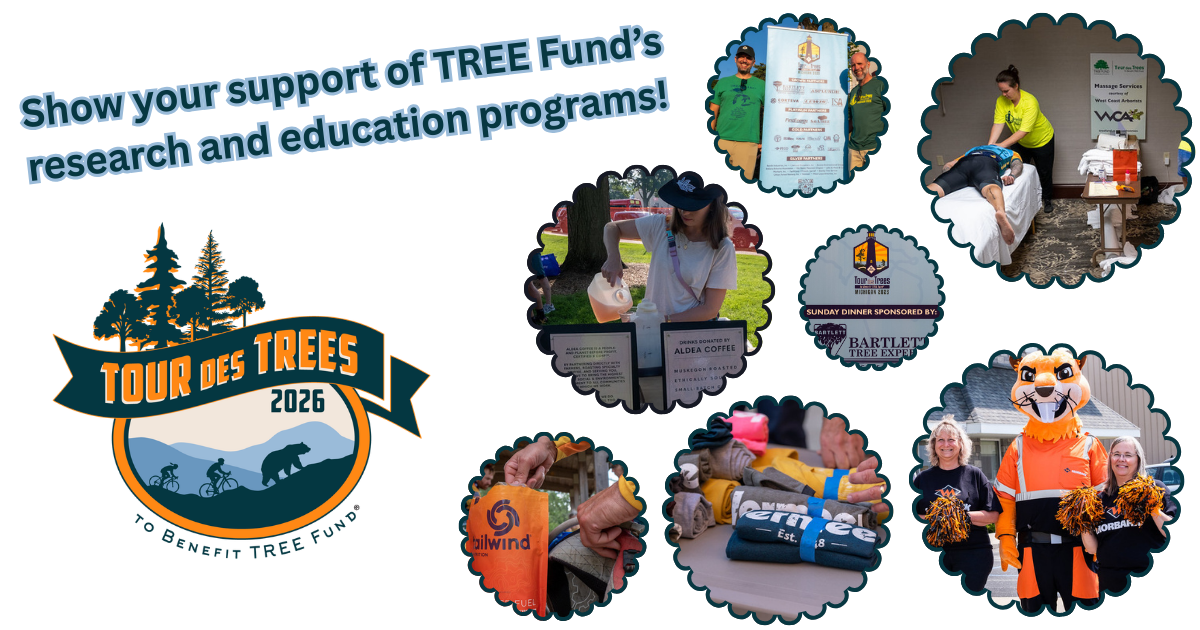
Tour des Trees 2026: The Carolinas Are Calling You!


Have you been on the fence, waiting to sign up for the 2026 Tour des Trees? Wait no longer and make that commitment to sign up today!


Show that TREE Fund's grant and scholarship programs are vital to the needs of the industry and arborists all over the world. Ride with us as we share our knowledge along the route and learn a few things about how the region is recovering after Hurricane Helene two years ago.


Ride dates are September 12-18 riding from Greenville, SC to Asheville, NC.


See information on this year's ride and register today on our website, treefund.org/tourdestrees.


The Tour des Trees is a multi-day bike ride that not only raises funds for TREE Fund but also hosts multiple outreach events throughout the week, getting people together to learn more about the importance of tree research, proper tree care, and why our industry is so vital to maintaining our urban forests.


Can't ride all five days? Ride 1-4 days as your schedule allows.


Tour Alumni: If you haven't ridden in a while but would like to join us for Paul Wood's retirement dinner on September 17, join us!


The 2026 Tour des Trees will be an epic ride that you won't soon forget, so make this the year that you sign up and ride with us to support tree research.

Virtual Tour des Trees Registration Now Open!


Can't make it to the Carolinas this September? Never fear! You can still show your support for TREE Fund by participating in the Virtual Tour des Trees.


Set a fitness goal for yourself for this August and bike, swim, run, or walk your way to supporting tree research and education.


Sign up for the Virtual Tour des Trees today and be a part of this year's ride on your own time. Help spread the word about TREE Fund's programs by crushing your fitness goals and showing why TREE Fund's grants and scholarships are so important to the tree care industry.


See more information and register here.


Companies: Get your co-workers together a set a team goal, competing against other companies. See website for details.

National Urban and Community Forestry Ten Year Action Plan Survey


From time to time, TREE Fund will share requests for proposals from other organizations for projects that align with our mission. Below is a request for input on the National Urban and Community Forestry Ten Year Action Plan.


The congressionally-mandated National Urban and Community Forestry (UCF) Ten Year Action Plan creates a guiding framework that optimizes innovations, resources, and collaborations for the field of urban and community forestry. Input gathered through this voluntary form is part of the stakeholder engagement process and will help update the NUCF Ten Year Action Plan.


Click here for information and to submit your ideas.

Sponsor the Tour des Trees to Show Your Commitment to Tree Research


There are many ways that your company can be a part of the 2026 Tour des Trees and show off your commitment to TREE Fund's research and education programs, not just to our riders, but to all of our followers and local contacts along the route.


We have several, unique sponsorship opportunities available to help you show your company's dedication to tree research. Reach out to Paul, Jonathan, or Heath for details. https://treefund.org/contact

Surveys on Green Waste Management and Fresh Arborist Mulch


From time to time, TREE Fund will share requests for proposals from other organizations for projects that align with our mission. Below are two surveys being shared by Western Chapter ISA for researchers in their region.


You are invited to participate in a research study conducted by Dr. Beatriz Nobua-Behrmann (University of California Cooperative Extension), titled “Green Waste Management Practices and Barriers for Invasive Pest Prevention.”


The goal of this study is to better understand how green waste is managed, how invasive pest risks are considered, and what challenges professionals face when applying best management practices in California.


Participation is voluntary and involves completing a one-time, anonymous online survey that takes about 10 minutes.


This survey is intended for professionals who work with trees and/or green waste, including arborists/tree care professionals, landscape maintenance contractors, pest control advisers, land or natural resource managers, urban foresters, public agency staff, and green waste or recycling facility operators. Participants must be 18 years or older.


I would greatly appreciate you taking the time to share your experience and perspectives.


Click Here to complete the survey


Questions about the study? Contact:

Dr. Beatriz Nobua-Behrmann

University of California Cooperative Extension (UC ANR)

Email: benobua@ucanr.edu


----------------------------------------------------------------------------------------


Pre-Presentation Survey: Fresh Arborist Mulch (FAM): Operations, Economics, and Regulations


Danny Mahoney and I are excited to be presenting at the 92nd Annual Conference next month on Fresh Arborist Mulch (FAM): Operations, Economics, and Regulations.


We’ve put together a short survey to help us better understand how arboriculture companies are currently handling fresh arborist mulch—how it’s produced, how it’s used, the regulatory hurdles you face, and the market opportunities you’re seeing.


Our session, “FAM: The Science and Regulatory Issues of Fresh Arborist Mulch,” will take place at 4:15 p.m. on Wednesday, April 29th in the Practice Breakout. I’ll be speaking alongside Daniel Mahoney, and we look forward to digging into the latest research, field practices, and policy considerations shaping the future of FAM.


Click Here to complete the survey.


Hope to see you there.

– Dr. Jim Downer, UCCE Emeritus

THANK YOU
TREE Fund Crown Partners! 
Facebook  Instagram  Linkedin

TREE Fund

Tree Research and Education Endowment Fund

1755 Park St. Suite #200, Naperville, IL 60563

(630) 369-8300

treefund@treefund.org

www.treefund.org

TREE Fund is a 501(c)3 nonprofit whose mission is to support scientific discovery and dissemination of new knowledge in the fields of arboriculture and urban forestry.

TREE Fund earned our 2024 Candid Platinum Seal of Transparency. Check out our nonprofit profile to keep up to date with our impact. https://www.guidestar.org/profile/shared/17bf1c65-c913-4096-8695-11f0dc3fa73f.

Keep this link handy, we want to make sure you always have the information you need to support our work with trust and confidence.


TREE Fund is proud to announce that its strong financial health and ongoing accountability and transparency has earned a Three-Star Rating from Charity Navigator. This rating designates TREE Fund as an official “Give with Confidence” charity, indicating that our organization is using its donations effectively based on Charity Navigator’s criteria.