|
Welcome
The JITI Journal is a bimonthly publication of the Japan International Transport Institute, USA (JITI), in which JITI shares information on transportation developments in Japan and elsewhere, as well as recent JITI programs. As a supplement to our regular events, we hope that the Journal likewise serves as a resource for the transportation community.
JITI would like to take a moment to thank you for your support during 2017 and to welcome 2018. We hope that the new year holds many opportunities and successes for you. Thank you for your continued support of JITI USA.
We hope this issue finds you well despite the cold weather.
In this issue, JITI staff member Ryoki Toku writes a feature on capacity building support by the Japan Coast Guard. In addition, staff member Shinichi Yamada writes an article on the provincial city of Niihama in Ehime Prefecture.
|
|
JITI Events
UPCOMING:
T
he Trump administration's 1 trillion-dollar infrastructure plan has brought much attention to how infrastructure projects will be carried out in the coming years. As anticipation for updating and fixing the outdated transportation infrastructure - including the nation's airports - grows, many think that Public Private Partnerships (P3) could be the solution. Often capital improvement projects are challenging, given that most projects are costly, and the financial situation of the public sector tends to be constrained in capital to use in these projects.
For this workshop, JITI has invited experts of airport management from Japan and the U.S. to discuss the challenges and benefits of P3 in airport redevelopment, lessons learned, and important takeaways for applications on future airport infrastructure projects.
Please click
here for complete information and to register.
Automated driving has caught the attention of Congress. The House of Representatives passed the "SELF DRIVE Act" in September 2017, and the Senate Commerce Committee advanced the "AV START Act" in October. Both of these would significantly increase the number of vehicles that can be exempted from the Federal Motor Vehicle Safety Standards and encourage developers of highly automated vehicles to provide specific information on the safety of their vehicles.
Anticipation for highly automated vehicles has also been high in Japan. In view of the expected arrival of the automated & connected driving society in 2025, the Japanese government set a goal to commercialize highly automated and connected vehicles (Level 3 and above) and include them in the services market by 2020. Public-Private ITS Initiative/Roadmaps 2017 was released last year, laying out scenarios up to the year 2025 for realizing highly automated and connected driving and focusing on preparing the regulatory system with a view to strengthening and commercializing the technologies.
With this rapidly changing and highly focused legal and regulatory background in relation to automated vehicles, JITI USA plans to invite experts on the subject, from both Japan and the U.S., to discuss the progress so far (especially milestones accomplished), as well as the future path toward automated vehicles.
Please click here for complete information and to register.
PAST:
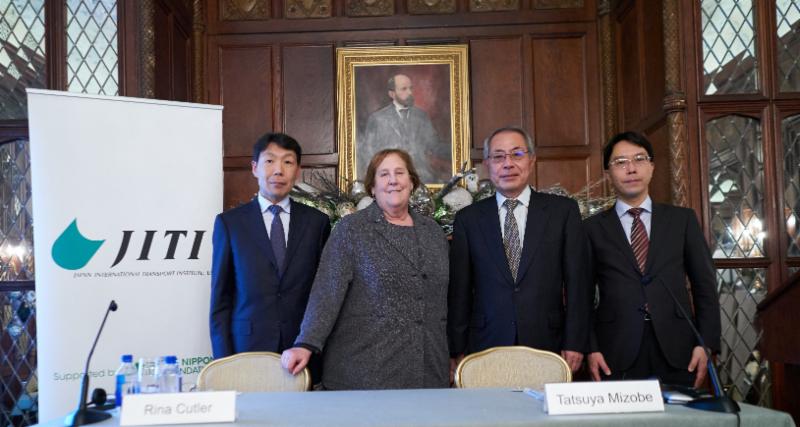
On December 5th, JITI hosted a seminar on railway redevelopment using public-private partnerships (PPP or P3) at the Hay Adams Hotel in Washington D.C. Considering the paradigm shift in use of public transportation, as well as the utilization of under-developed space, and recent infrastructure funding changes on national levels JITI invited experts of PPP in use in transit oriented development. Speakers from Japan and the U.S.A discussed challenges and benefits of PPP, lessons learned, and important takeaways for application and future projects. C
lick here
for overview, presentation materials, and bios of the keynote speakers.
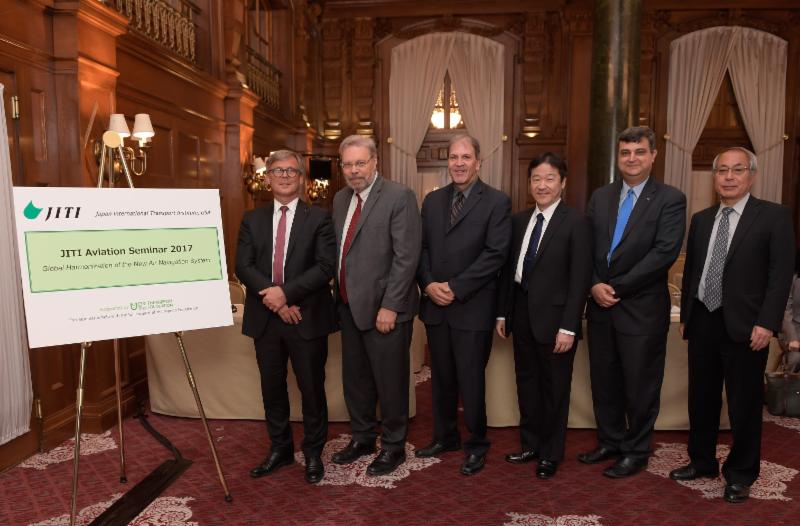
On May 18th, JITI hosted a seminar at the Willard Hotel. Considering the dramatically increasing air traffic volume and the expectation that air traffic will steadily increase in the future, JITI invited officials from Japan, the U.S., and Europe who had been involved in the development of future air traffic systems, as well as academic experts, and airline industry specialists. The speakers discussed the current situation of each program, mutual cooperation between the programs, and the challenges inherent in future development and deployment of the systems. Click here
for overview, presentation materials, and bios of the keynote speakers.
|
|
Capacity Building Support by the Japan Coast Guard
to Developing Countries
Mobile Cooperation Team
|
|
b
y Ryoki Toku
Prologue
Sea routes in the Southeast Asian area can be said to be the life lines of Japan. The security and safety of the area is extremely important for Japanese ships as they pass through.
Each coastal
country's maritime law enforcements
are required to have the appropriate capabilities to be able to secure the area.
It is also important there are the good relationships and cooperation between the maritime law enforcements
of these coastal
countries and Japan.
Inauguration of JCG Mobile Cooperation Team
In October of 2017, the Japan Coast Guard (JCG) established a brand-new unit in the JCG Headquarters called the "Mobile Cooperation Team (MCT)", which focuses on capacity building support for developing country's maritime law enforcements.
The MCT consists of 7 people. There are 6 members, under the direction of the seventh member who is the Director for Coast Guard International Cooperation.
They engage in training for foreign maritime law enforcement and their goal is to create effective, consistent, and sustainable capacity building support, as well as build trusting relationships with other countries through consultations about country needs in advance, and provision of detailed curriculums
following the outcomes of these discussions.
(Access: 11th Dec,2017))
The first mission of MCT
One month from the inauguration of the MCT, they were dispatched to the Philippines for their first mission: to train the Philippine Coast Guard.
The MCT engaged in exercises regarding the maneuvering of
high speed small boats.
Thee high speed small boats that were used in the exercises were transferred from the Japan government to the Philippine government.
The MCT members instructed in several maneuvering skills that related to maritime law enforcement, such as guarding measures, like pinch maneuvering, as well as basic techniques like turning, chasing, or approaching the port.
This exercise became an opportunity to teach JCG's maneuvering techniques to other nation's maritime law enforcements as well, given that coast guards from Vietnam, Malaysia, and Indonesia also participated in the exercises.
The opportunity for cooperation between the USCG and the JCG in the field of capacity building support
The MCT's first mission was also an opportunity for cooperation between the U.S. Coast Guard (USCG) and the JCG.
During the same period, the USCG was also in the Philippines to train the coast guard. The USCG and the JCG coordinated on site, and the USCG then gave a lecture about the maintenance of small boat engines.
As a result, in this case, we can say that the USCG and the JCG provided joint training for high speed small boats through their cooperation.
Conclusion
The JCG says that through these activities it would like to deepen its trust relationships with other national maritime law enforcements, and contribute to maintaining and developing open and stable oceans under the rules of law.
The JCG has engaged in several capacity building efforts regarding maritime law enforcement, especially in Southeast Asian countries, not only recently through the activities of the MCT.
It is hoped that these engagements help in establishing an international network in the field of maritime law enforcement amongst those who share the same values. In addition, these engagements promote regional cooperation that should help lead to an avoidance of risks in any unpreventable accidents in the future.
|
Provincial city - Niihama
(Ehime prefecture, Shikoku)
|
|
by Shinichi Yamada
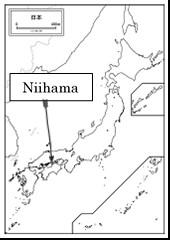
Niihama city, located on Shikoku Island, is surrounded by mountains on its east, west and north sides, and faces the Inland Sea on its north. The population of the city is about 120,000 and the city is the sixth largest city on Shikoku.
This article will introduce Niihama and the traditional culture of Niihama. It takes about 6 hours to travel to Niihama from Tokyo, and it is not easy to travel there from overseas. However, I would be very glad if through this short article you gain interest in Niihama and its regional culture.
History
of Niihama (Sumitomo Group and Besshi copper mine)
In Japan, Niihama is known as the town where Sumitomo Zaibatsu (the predecessor of the current Sumitomo Group) established their foundation after they discovered the Besshi copper mine at the end of the 17th century. At that time, the Besshi copper mine was said to turn out the world's largest output of copper. Therefore, despite the fact that Niihama is inconvenient to get to, Niihama developed as an industrial city, and there are many main factories of the Sumitomo Group located in Niihama even now.
The mine itself is now closed, but there is a sightseeing spot built to commemorate it. We can learn about the mining history of the Besshi copper mine, and also enjoy the hot spring and local foods.
Traditional Festival (Taiko-dai Carnival)
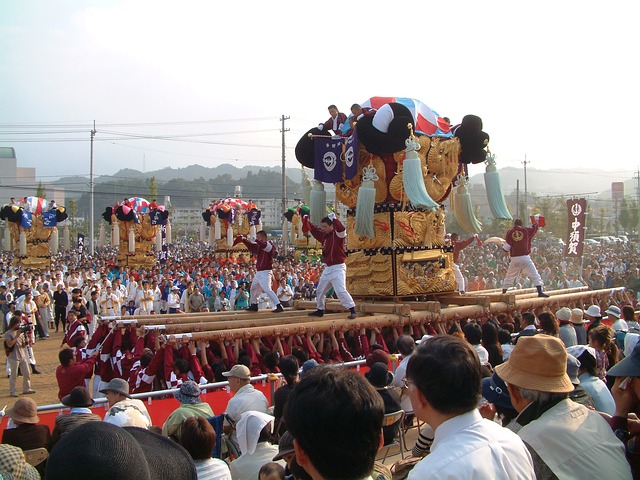
The Taiko-dai Carnival, one of the three biggest festivals in Shikoku, is held every October and more than 100,000 tourists visit. "Taiko" means drum and "dai" means cart in English. The origin of Taiko-dai is unclear, but it is said that the cart that carries offerings in order to thank God for the blessings of nature. The carts are about 6600 lbs, 16 ft tall, and 40 ft in length. During the festival, 150 people carry it throughout the town while beating the drum placed inside of the taiko-dai structure, which is hollow. Each area of Niihama has its own Taiko-dai, and there are 53 Taiko-dai total in Niihama.
(Taiko-dai)
One of the highlights of the festival is called "Kaki-kurabe". Multiple Taiko-dai are gathered together and lifted with human power only. Each area competes for the strength and harmony of the bearers.
Sweets originated in Niihama (Hatada Marron Taruto)
Hatada Marron Taruto is like a roll cake covered in a citrus-flavored bean paste with chestnuts, wrapped in a sponge cake. It is said that the origin of this sweet is a torta (a roll cake wrapped in jam in Castella) which came from Portugal to Japan about 350 year ago. The jam was changed to bean paste, and current roll cake was developed.
This roll cake is a Japanese-style confectionery and has an elegant and rich taste. It is slightly sweet because of citrus flavor in the paste. It has been awarded the High International Quality Trophy in the Food products Selection every year since 2006.
Like various countries, each town in Japan has an individual history and culture. Niihama is not a famous city even in Japan, but I think my hometown is a wonderful city with its own culture. Did you get interested?
|
|
Stay in Touch with JITI
|
Please follow the Japan International Transport Institute Twitter feed at @JITIUSA or check back with our website to get the latest information on workshops and seminars.
|
| Thank you for reading the JITI Journal. Until the next issue, whatever your mode, travel safely! We wish you a happy and healthy holiday season and look forward to next year. The JITI Team |
|
|
|