Strong Families. Strong Futures. | | |
Greetings to our VFN Family and Friends,
As Election Day approaches, it's a great time for families to learn about the candidates and issues that may impact our lives. Taking the time to gather information from trusted sources can help us make informed decisions at the ballot box. For families of children with disabilities, it's especially important to consider how proposed policies and changes in government priorities could affect services, supports, and civil rights protections.
Two important protections for individuals with disabilities are the Individuals with Disabilities Education Act (IDEA) and the Olmstead Decision. IDEA is a federal law that ensures children with disabilities receive a Free Appropriate Public Education (FAPE) in the least restrictive environment. Through an Individualized Education Program (IEP), students can receive the specialized instruction and supports they need to learn, grow, and succeed in school.
The Olmstead Decision is often called the disability community's "Brown v. Board of Education" because of its impact on inclusion and equal opportunity. This landmark ruling affirms that people with disabilities of all ages have the right to receive services and supports in the most integrated setting appropriate to their needs. Rather than being unnecessarily placed in institutions or nursing facilities, individuals with disabilities should have the opportunity to live, work, attend school, and participate fully in their communities while receiving the supports they need.
While neither IDEA nor the Olmstead Decision has been repealed, many families are paying close attention to how states and the federal government fund, implement, and enforce these protections. Understanding these issues can help families stay informed, speak up for themselves, and make voting decisions that reflect their own priorities for their children and loved ones with disabilities.
If you'd like to learn more, there are several nonpartisan resources to explore. The Vermont Secretary of State's Elections Division has information on registering, voting early or by mail, and what to expect on the ballot. VOTE411.org shares candidates' answers to the same questions side by side so you can compare them independently. If you or a family member has questions about accessible voting or needs accommodations at the polls, Disability Rights Vermont can help. For more background on the laws themselves, visit the U.S. Department of Education's IDEA website and the Olmstead page on ADA.gov.
We see all you do for your loved ones. We are right here alongside you, doing the same for our families and community. Your voice matters in the voting booth and every day in your loved one’s care and education. If you have questions, our Family Support team is here. Call our free helpline at 802-876-5315 or email us at info@vtfn.org.
From the Heart,
Karen Price, Emmy Hilliard, Michelle Kessler
The VFN Leadership Team
| | |
October is National
Bullying Prevention Month
| | |
Throughout the month of October, we can all raise awareness to prevent bullying and promote kindness, acceptance, and inclusion. No one should ever be bullied, and all students deserve to be safe in school, online, and in the community. Download the National Bullying Prevention Center Student Activity Kit (grades K-12) to help youth reflect on how to prevent bullying in their schools and communities. Schools can access the All IN! year-long toolkit to keep students engaged in bullying prevention throughout the year. Read this plain-language guide for Vermont students, families and caregivers: What Happens when Hazing, Harassment and Bullying is Reported?
If your child with a disability is facing bullying or harassment at school or at school-sponsored activities and you have questions about the process or how to help your child, please contact the VFN helpline at 802-876-5315 or info@vtfn.org.
| | |
Family Support Fund
Respite is a planned break for parents or caregivers, which allows them to do things like spend time with their other children, schedule needed appointments, or have an opportunity to rest and recharge. Does your child under the age of 21 have a chronic physical, medical, or developmental condition? If the answer is yes, do you receive respite funding from another organization? If not, you may be eligible for respite funding through the Vermont Family Network.
Respite funding is part of our Family Support Fund, which also includes Medically Necessary Supplemental Funding (MNSF). Our Family Support Fund is made possible through a grant from the Vermont Department of Health Children with Special Health Needs program.
Please see our flyer and/or contact Diane at diane.bugbee@vtfn.org to learn more.
| | |
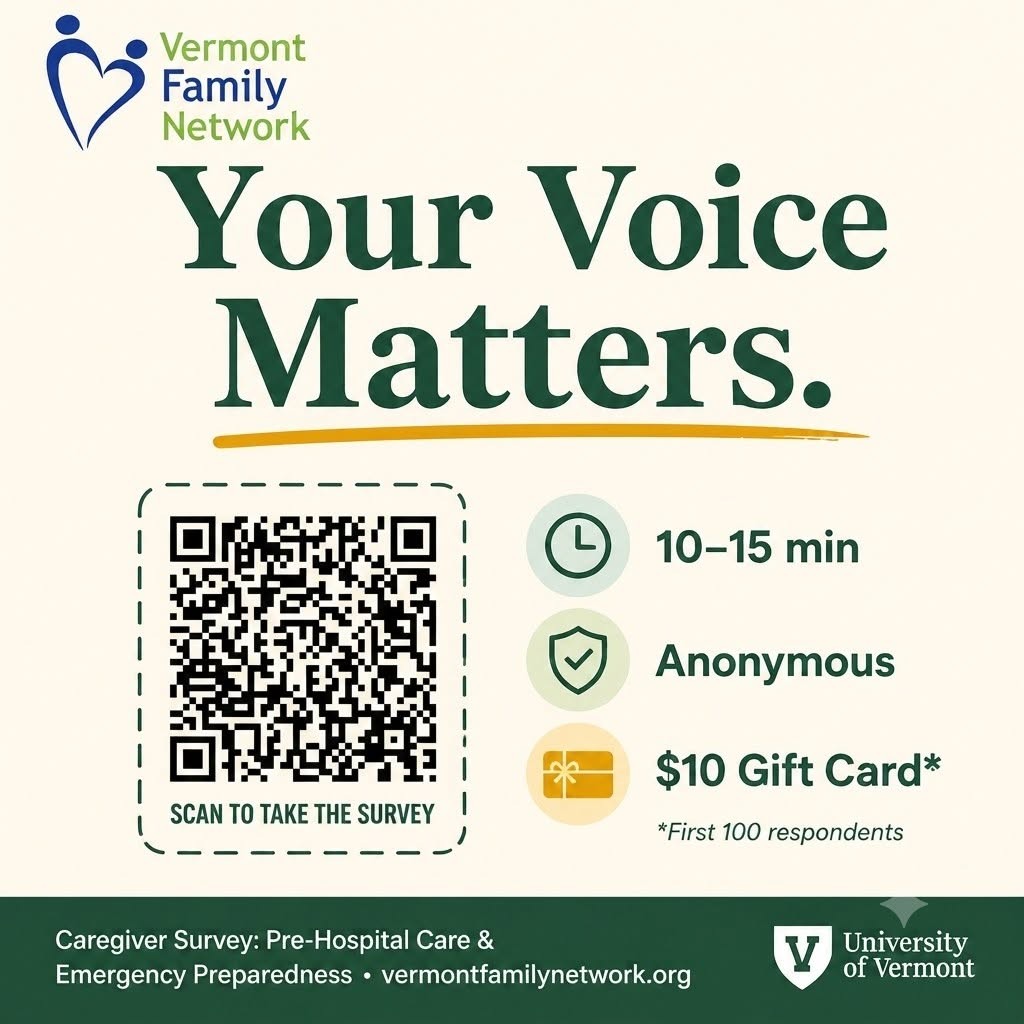
Your Voice Matters!
If you're caring for a child with a disability or special health need, our partners at the University of Vermont want to hear from you. They're looking at what happens before a child gets to the hospital, such as calling 911, ambulance rides, and how you prepare your family for an emergency. The survey aims to learn more about what that looks like for Vermont families.
The survey takes minutes, and your answers stay anonymous. The first 100 respondents can get a $10 gift card as a special thank you. To take the survey, please scan the QR code or click here to get started. Thank you!
| | Disability Disclosure for Young Adults | | |
For a young person with a disability, it is a personal choice when and how to tell others about a condition that may not be visible, or to explain the impacts of a more visible condition. The first time they decide for themselves who to tell can mark a real shift toward ownership of their own story. It can also mean explaining something they are still trying to understand, especially if they were diagnosed recently or are still working out what the diagnosis means for their identity and abilities.
Youth often weigh whether disclosing will bring helpful support, negative attention, or different treatment from others. They might choose to tell a trusted friend or a supportive teacher, or only share what is necessary to get a specific need met. Some young people will choose to say nothing to protect their privacy and sense of normalcy, but this may leave them without the help they need.
The adults in a youth's life play an important role: they can let young people decide how and when to share, avoid disclosing on their behalf without asking, and help them practice what they might say. Over time, these experiences shape whether a young person grows into an adult who can advocate for their needs, which is why disclosure for youth is about more than sharing information. It is a step in developing identity, self-advocacy, and trust.
The National Collaborative on Workforce and Disability for Youth (NCWD/Youth) produced The 411 on Disability Disclosure workbook for youth with disabilities to help them think about and plan for the ways they might want to disclose their disability to others.
For more information and support on the transition to adulthood for families of youth with disabilities, reach out to us via our helpline (802) 876-5315 or email info@vtfn.org and check out our Transition Toolkit.
| | |
We are Growing:
Join Our Family Support Team!
| | |
VFN is growing, and we have several openings right now. We're hiring Family Support Consultants in education, health, and mental health, along with a Program Outreach Consultant for our health team. Our staff are parents and caregivers of children with disabilities and special health needs, and that experience shapes everything we do for families.
If you’re looking for rewarding work, a supportive and caring team, and the opportunity to make a meaningful difference every day, we’d love to hear from you. Or please pass this opportunity along to someone who might be a great fit!
Job descriptions and how to apply can be found on our Join Our team page.
Apply for our two part-time Family Support Consultant – Education positions
Apply for our part-time Family Support Consultant – Health position
Apply for our part-time Program Outreach Consultant - Health position
Apply for our part-time Family Support - Mental Health Consultant position
Apply for our full-time Family Support - Mental Health Consultant position
| |
A Fall Adventure with Sibshops
Sibshops participants—brothers and sisters of children with special health needs or disabilities—kicked off the season with a beautiful fall day at Chapin Orchards in Essex, Vermont, on September 26.
The sibs rode a tractor to the orchard, where they picked Macoun, Honeycrisp, and McIntosh apples. They decorated apple-collecting bags, enjoyed apples, cider doughnuts, cider, and played catch and UNO. They also shared a little about their siblings, laughed together, soaked up the sun, and enjoyed the unexpected delight of live music from a folk group performing at the orchard.
If your child is 8 or older and has a sibling with a special health need or disability, we invite them to connect for fun and community with other sibs who understand.
A few spots are still available for our upcoming monthly fall season gatherings at the Whitcomb Corn Maze and Murmurations Aerial, as well as for our Day of Service at Williston Place.
Sibshops meet one Saturday each month during the school year, usually from 1 to 3 p.m. Registration for the winter and spring sessions will open after the new year.
To ask questions or register your child, please email us at info@vtfn.org or call 802-876-5315.
| | |
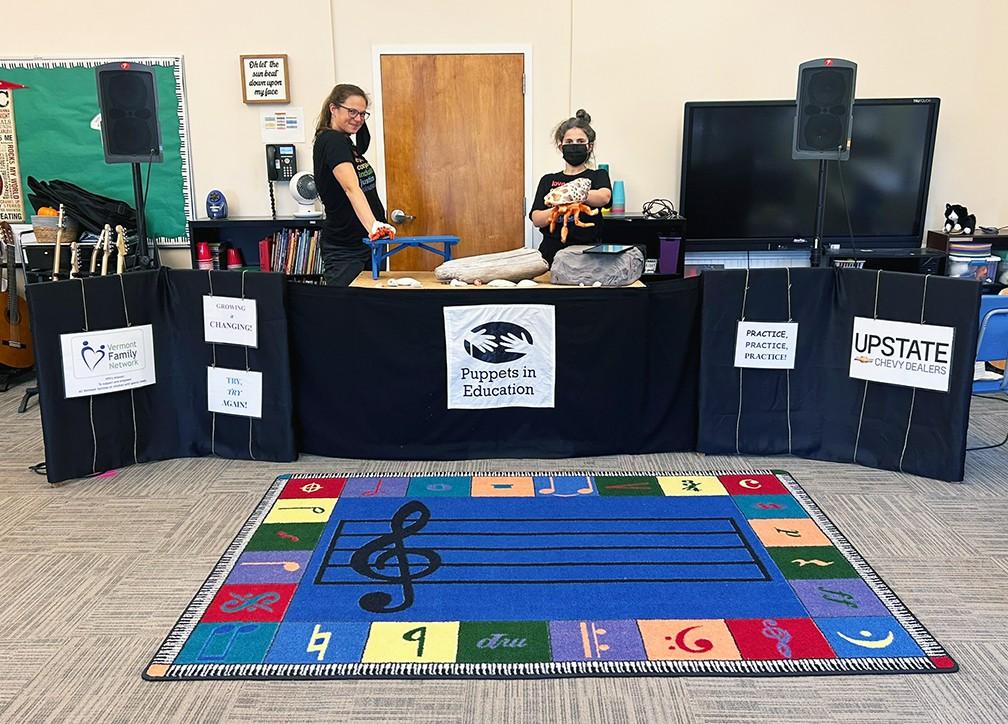
Behind the Scenes: Rebuilding Our Side Wings
There’s a lot that goes into making the magic happen at Puppets in Education, and sometimes that magic looks a little less like puppets and a little more like sawdust, paint, and power tools!
After years of traveling to schools across Vermont, our side wings, the panels that help transform a school gym, cafeteria, or classroom into the world of a Puppets in Education performance, were ready for some serious TLC. These hardworking pieces have been packed, transported, set up, taken down, and packed again countless times over the years. It was time to rebuild them!
We were lucky to have the help of our friend Natalie Kendrach, who jumped in to help us tackle this behind-the-scenes project. Her time, creativity, and willingness to get to work made a huge difference as we gave these well-loved pieces of our set a whole new life.
Rebuilding the side wings is more than a scenery repair, it’s an investment in the future of Puppets in Education. Our sets and puppets are essential tools for creating an engaging, imaginative space where children feel comfortable exploring big ideas and emotions. As part of the rebuild, we’re continuing a tradition we value displaying the logos of the generous funders and sponsors who make this work possible. Their support is literally part of the scenery, and every performance we bring to children across Vermont.
And, of course, there’s something wonderfully satisfying about taking something well-loved and giving it new life!
We’re excited to share a little behind-the-scenes look at the rebuild. Take a peek at the video and see what happens before the puppets ever take the stage.
Because while children see the magic, there is a whole team of people behind the scenes, and wonderful friends like Natalie, helping to make sure that magic can keep traveling from school to school, year after year.
| | |
Parent to Parent Support
is Just a Phone Call Away!
| | |
Feeling alone in parenting a child with a disability or special health needs? Like no one really understands?
Maybe connecting with another parent or caregiver who has a child or children with a similar special health need or disability could help?
A volunteer Parent Match Support Parent has firsthand parenting experience and specialized training to support other parents.
Email VFN at info@vtfn.org to inquire about being matched with a trained volunteer support parent.
| | |
Making Room for Quiet
Before November
Election Day is November 3, and for many families, the weeks before it give us all a daily countdown through the phone or tablet. Alerts show up first thing in the morning, the same story appears on three different apps in multiple formats, and ads keep running between whatever else is on. Families who are already juggling specialist appointments and insurance calls don't have much more bandwidth for that kind of noise, so it may be healthy and helpful to pull back a bit this month.
Screens are part of how many of our kids communicate, learn, and see their doctors, and that stays the same. What tends to drain parents is the late-night scrolling through headlines after a long day, when sleep would do us all better.
Some families have found it easier to pick a set time for the news, like once after breakfast or after bedtime, and turn off breaking news notifications until the election is over. Others keep phones away from the dinner table or out of reach for certain times of the day. Even one of those can make the house feel calmer.
Vermont mails ballots to registered voters before the general election. If yours has come, filling it out early means it's done and off the counter.
And if the weather holds, try to get outside while the leaves are still up, and enjoy it fully, even for a few minutes, with a cup of coffee or tea.
Take good care this month.
| | Upcoming Events - Register today! | | |
Free Online Workshops
October 13 at 2:00 - 3:00 p.m. "Inclusive Post-Secondary Education Programs for Students with Disabilities: A Panel Presentation"
There are many options for students with developmental and intellectual disabilities to continue their education after high school. In this panel, we will hear from participants and staff at four programs that serve Vermont students: Think College, College Steps, Mansfield Hall and the SUCCEED program. Panelists will share the different components of each program, including admissions, academic and social inclusion, and employment outcomes. Whether you're a student, family member, educator, or simply curious about the future of inclusive education, this session will offer practical information and personal reflection.
Presenters: Brya L. Emery - College Steps, Bryan Dague - UVM Think College, Mark Prior - Howard Center SUCCEED Program, and Tanner Hilbish - Mansfield Hall
October 29 at 1:00 - 2:00 p.m. "Vermont's Education Transformation: What families of children with disabilities need to know."
Act 73 (2025) and Act 170 (2026) are Vermont's two major education reform laws. Among the initiatives proposed are establishing larger school districts, a new student funding model, a single statewide education tax rate, and setting up Cooperative Educational Service Areas (CESAs). These changes are scheduled to roll out over the next few years. Join us as Meagan Roy demystifies the Education Transformation process, what changes may mean for students with disabilities and how families can contribute input into the process.
Presenter: Meagan Roy - Coordinator of School Leadership Programs at Saint Michael’s College
November 5 at 10:00 - 11:00 a.m. "From Homework to Healthcare: What Families Need to Know about AI"
This is a beginner-friendly workshop that will explain what generative AI is, how it works, where youth may already encounter it, and how families can help each other talk about and use AI safely and responsibly. Participants will also learn about AI's growing role in healthcare and explore important topics including privacy, bias, misleading information, accessibility, and ethical use. No prior AI experience needed.
Presenter: Maria Avery - Community Outreach Manager for UVM Libraries
November 19 at 10:00 - 11:00 a.m. "Being an Active Member of Your Child’s Special Education Team"
Families are essential members of their child’s educational team. Knowing how and when to raise concerns, make a request, or respond to a school decision can be confusing. This session will focus on effective ways families can communicate with school personnel while understanding the rights that support their participation in the special education process. We’ll discuss how to make requests in writing, prepare for various meeting types, document concerns, ask for clarification when something doesn’t make sense, and respond when you disagree with a decision. The goal is to help families feel prepared to participate meaningfully and know what steps they can take when questions or concerns arise.
Presenter: Cassie Santo - former VT State Director of Special Education
December 10 at 1:00 - 2:00 p.m. "Stronger Together: Expanding Adaptive Recreation Through Community Connections"
This workshop explores how recreation can become more inclusive by looking beyond traditional programming and focusing on participation, belonging, and removing barriers. The presentation will share South Burlington’s journey in developing adaptive recreation, from understanding community needs and training staff to building meaningful partnerships and creating opportunities for people of all abilities.
Presenters: Adam Matth - Director of Recreation, and Kate Likhite at the South Burlington Recreation Department
Our workshops are online using the Zoom meeting platform.
If you are unable to attend the live presentation, you can still register and we’ll send you a link to the recording of the workshop which you can watch on your own time, unless otherwise noted. We appreciate when you register for our workshops as we need that data for our grant reporting.
Registrations are also posted under Upcoming Events on the landing page of our website. In case you missed our last series of workshops, you can find a full list on our VFN website. Check in regularly as we add more workshops to our schedule!
We save workshops on our website and YouTube channel.
| |
VFN Workshop Topics/Speakers Survey
We want to hear your ideas for our upcoming online workshops. What topics interest you? Are there presenters you would recommend?
Let us know your thoughts.
| | Contact Us. We Will Listen! | | Helping Vermont Families thrive for more than 30 years | | | |  |
Office
600 Blair Park Rd, Ste 240,
Williston, VT 05495
| | | | |