|
|
This Week in Farm to School from NC
April 28, 2022
|
|
Farm to school connects local agriculture, schools, and partners to benefit students, educators, farmers, families, and communities.
|
|
Culturally Responsive Garden-based Learning
May 10, 2022 // 4 pm EDT
Edible school gardens are ideal spaces to talk about and celebrate diversity and cultural traditions around food and agriculture. Join KidsGardening for a lively discussion with renowned garden educators and authors Dr. Dilafruz Williams, Amoreena Guerrero, and Lori Koenick to discuss what culturally inclusive garden-based learning looks like and how we can make it the norm across our edible school garden programs.
Deadline to apply for scholarships: April 29
The American Horticulture Society is looking forward to hosting an in-person conference from July 13 to July 15 where attendees can learn from one another in face-to-face interactive and hands-on ways, visit and tour gardens and greenspaces, and network in both the facilitated and unfacilitated ways that conferences provide. There is also a limited number of scholarships for discounted or complimentary registration available. Scholarships will be awarded based on three factors: a demonstrated commitment to children's and youth gardening initiatives, work with an underserved and/or Title I population, and financial need.
Recording: Drip Irrigation Training
Drip Irrigation Systems can save time, conserve water, and enhance ease and health of your school garden plants. This webinar from the University of Arizona Community and School Garden Program shows how to set up and manage a simple drip irrigation system, as well as the components needed to create a system, steps to calculate/order materials, demonstrates basic skills to build/repair your system, and tips for year-round management within a school garden context. It includes a mixed presentation of lecture, sharing of video clips, and ample time for Q and A.
|
|
United States Department of Agriculture (USDA) - Reducing Food Waste at K - 12 Schools
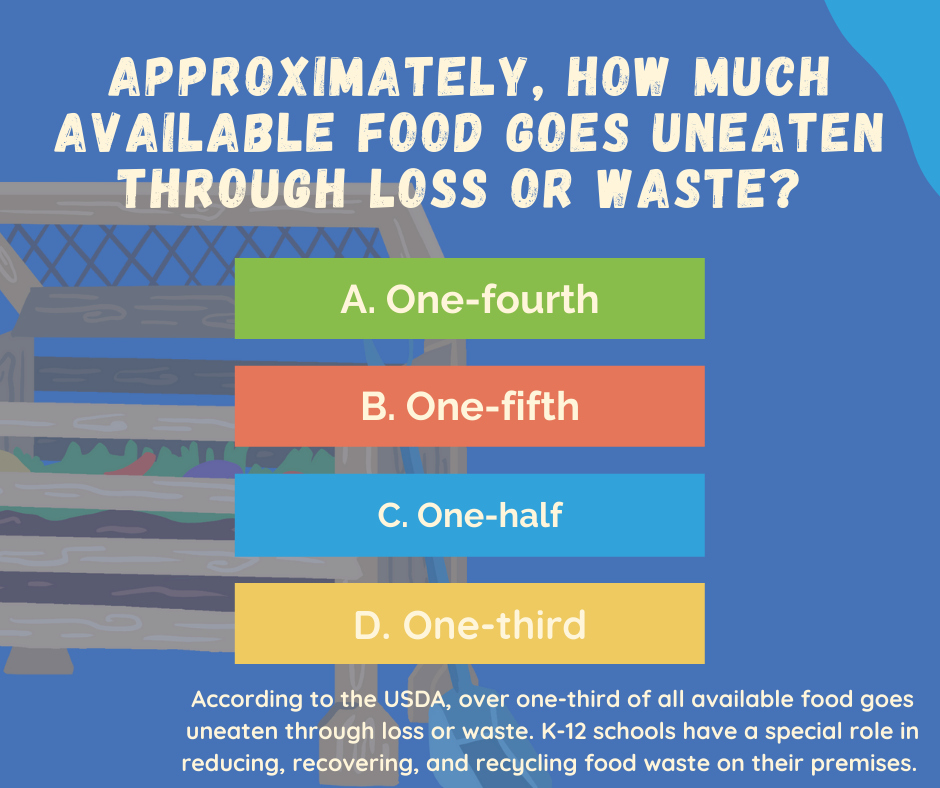
K-12 schools have a special role in not only reducing, recovering, and recycling food waste on their premises but also in educating the next generation about the importance of food conservation and recovering wholesome excess food for donation to those less fortunate. Most importantly, increasing consumption and reducing wasted food means children get the nutritional benefits from the National School Lunch Program (NSLP) and School Breakfast Program (SBP).
|
|
Public Libraries Are Making It Easy to Check Out Seeds—and Plant a Garden
Across the country, libraries are giving away seeds to encourage neighbors to plant food, spend more time outside, and build a relationship with nature.
|
|
Food Waste Reduction - School Food Project
Boulder Valley School District has an ambitious sustainability plan, outlining a “green” mission and long-term goals including zero waste goals and sustainable purchasing practices. In order to align with this vision, Food Services has made significant improvements to its daily operations. Their program is using reusable trays, cups and silverware in all school cafeterias; purchasing organic milk in bulk containers; introducing reusable plastic containers (RPCs) for the delivery of local produce, chicken and beef products; and supporting comprehensive recycling and composting programs in all school cafeterias.
|
|
Emerson Collective: Community & School Garden Special Initiative
Deadline: April 30
Emerson Collective is excited to launch a special initiative focused on funding hundreds of community gardens and school gardens around the United States, driven by their belief in and appreciation for the importance of nature for healthy individuals and the well-being of communities. This opportunity is open to 501c3 organizations, including those that are not currently Emerson Collective grantees, that are interested in creating, improving, or expanding a community garden in the United States.
we are Student Grant Opportunity
Deadline: May 2, 2022
we are Student Grants support 6th - 8th grade and 9th - 11th grade students seeking to apply anti-racism efforts in their classrooms and school communities. The focus of these microgrants, ranging from $250-$750, is to support student-led projects that disrupt current school rules and policies and to support the creation of racial equity student groups. The funds can be used for an initiative, student group, or policy/rule that will create an environment of anti-racism. The grants would also support book discussion groups, increase social belonging, and include funds for research projects.
Local Agriculture Market Program (LAMP)
Deadline: May 16
The United States Department of Agriculture (USDA) has opened grant applications under the Local Agriculture Market Program (LAMP). This funding is available through three channels, with the USDA including a focus on Farm to Institution (FTI) projects for two of the funding streams: The Local Food Promotion Program (LFPP) grants will develop food businesses that connect local food to institutions, and the Regional Food System Partnerships (RFSP) grant supports public-private partnerships that build and strengthen the viability of local or regional food economies. The third stream, the Farmers Market Promotion Program (FMPP), supports direct-to-consumer markets such as farmers' markets and CSAs. The Wallace Center has created this set of resources on applying.
Gus Schumacher Nutrition Incentive Program - Produce Prescription Program
Deadline: June 30
The National Institute for Food and Agriculture's (NIFA) Gus Schumacher Nutrition Incentive Program - Produce Prescription Program focuses on projects that improve dietary health through increased consumption of fruits and vegetables; reduce individual and household food insecurity; and reduce healthcare use and associated costs. Submissions for grants have now opened. Applications may only be submitted by government agencies and non-profit organizations; however, award recipients may sub-award to organizations not eligible to apply provided such organizations are necessary for the conduct of the project.
National Institute of Food and Agriculture Grant
Deadline: July 28, 2022
The Agriculture and Food Research Initiative Sustainable Agricultural Systems supports approaches that promote transformational changes in the U.S. food and agriculture system. NIFA seeks creative and visionary applications that take a systems approach for projects that are expected to significantly improve the supply of affordable, safe, nutritious, and accessible agricultural products while fostering economic development and rural prosperity in America.
|
|
Support Kids Not Red Tape
Senator Stabenow and Senator Murkowski introduced a bipartisan bill to extend the USDA waiver authority for Child Nutrition programs (read more about why that's important). Follow this link to urge our Senators to support this bill.
National Farm to School Network State (NFSN) Policy Map
NFSN recently launched an exciting new State Policy Map resource. State legislative sessions are in full swing, and they would love to learn about state policies that should be highlighted and shared through this interactive tool.
Let Your Voice Be Heard: Help Shape the Next Dietary Guidelines
Deadline: May 16, 2022
Every five years, USDA and the U.S. Department of Health and Human Services partner to provide the latest, science-based nutrition guidance to empower Americans to make dietary choices that will improve their health and lifestyles. Starting last week, the USDA and HHS began the process of developing the next edition of the Dietary Guidelines for Americans by posting proposed scientific questions for public comment.
|
|
A Community of Seed Savers Has a Recipe to Revive Rare Varieties of Collard Greens
There was once a kaleidoscope of diversity in collards, as people diligently collected and replanted seeds, passing them from one generation to the next to preserve the qualities they found most important. Collards — an inexpensive, nutrient-rich vegetable — became a staple for many Southern families, especially African Americans trying to feed their families healthy food year-round. Many of the heirloom varieties Wallace and the Heirloom Collard Project grow are rare, some once teetering on extinction. Other types can likely be found in backroad gardens of aging stewards, but countless varieties have vanished in the U.S.
Earth Day Special: Nurturing Soil Health and Seeding Justice across Generations with Karen Washington of Rise and Root Farm
Mary Sketch Bryant, Eric Bendfeldt, and Jeff Ishee share a deeply meaningful and inspiring conversation with Karen Washington of Rise and Root Farm about soil health, intergenerational knowledge, and heeding nature's wisdom. Karen recalls how planting a tomato seed changed her life and introduced her to nature, land, and soil. She emphasizes the importance of having hard conversations about eating healthy so people and communities are all part of the solution and meet people where they are with soil health and environmental justice. There is room for everyone to grow food.
Timeline: Black farmers and the USDA, 1920 to present
This resource provides a history of exclusion related to participation in farming and land access experienced by Black farmers.
|
|
|
|
|
|
|