- Casino Update
- Ranked Choice Voting Town Hall Feb. 23
- Lake Anne Logo Redesign Meeting Feb. 17
- Community Groups Can Apply for Free Trees
- Affordable Housing Crisis: By the Numbers
- Panhandling Study: What the Data Says
- Upcoming Land Use Meetings
- What's News in Vienna
- Events and Activities
| | Casino Update: Richmond Deals Tysons Out | | |
Yesterday, a Virginia Senate committee dealt out a surprise change to the proposed legislation to bring a casino to Fairfax County.
The Senate Finance and Appropriations Resources Subcommittee removed the requirement that a casino be located in Tysons, and the full committee voted to send the revised bill to the full Senate for a vote. The move seemed to stun Senate Majority Leader Scott Surrovell who has championed this bill (SB 756), according to news reports.
By stripping the stipulation that it be built in Tysons, the bill would allow a casino to be located anywhere in Fairfax County. The bill continues to require voters to approve a casino by referendum. While it remains to be seen what ultimately will happen with this bill, the drama continues in Richmond.
Regardless, the Fairfax County Board of Supervisors’ position remains unchanged: we oppose any legislation to authorize a casino unless requested by Fairfax County. As you’ll remember, I introduced this change to the county’s state legislative package that the Board approved at our Dec. 9 meeting.
| |
Town Hall Meeting: Learn About
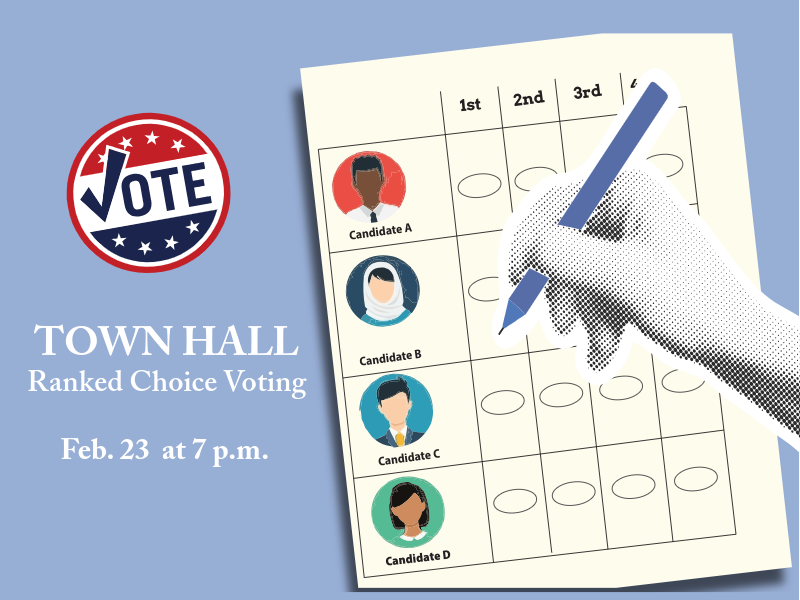
Ranked Choice Voting Feb. 23
| | |
Ranked choice voting is becoming more popular nationwide with 62 cities, counties and states using this voting method, including New York City, Minneapolis and more locally Arlington County. And political parties have intermittently used ranked choice voting to determine their party’s nominee in various Virginia and Fairfax County races.
What could ranked choice voting look like in a publicly-administered election in Fairfax County?
Come to my town hall meeting on Monday, Feb. 23 at 7 p.m. at the North County Governmental Center to learn more. I’ve invited two experts to share their insights:
- Gretchen Reinemeyer, Arlington County Director of Elections: Arlington was the first jurisdiction in Virginia to pilot ranked choice voting, and she’ll share how it works, what the voter feedback has been, and the lessons they’ve learned.
- Liz White, Executive Director for Up Vote Virginia: a nonpartisan organization focused on improving election systems, including ranked choice voting, campaign finance reform and fully independent redistricting.
Background: In 2020, Virginia passed legislation to allow localities to use ranked choice voting for city and county governing body elections until July 1, 2031. Two jurisdictions in Virginia are using it in government-administered elections: Arlington County and the city of Charlottesville. In Arlington, ranked choice voting is used in primaries for county board members and it was used for the first time in a general election in 2024. Charlottesville used RCV in its city-administered council primary election last year.
| | Lake Anne Logo Redesign Community Meeting Feb. 17 | |
What’s happening: Join a virtual meeting on Tuesday, Feb. 17 at 7 p.m. to learn more about refined concepts for a new logo and wayfinding signage for Lake Anne:
-
Zoom meeting link (Meeting ID: 868 7977 4975 and Passcode: 271728)
- Join by phone at (301) 715-8592 (Meeting ID: 868 7977 4975)
Tell me more: At the meeting, county staff and the county’s place-making consultant Streetsense will:
-
Review the results and key takeaways from the logo survey
- Present revised logo designs based on community feedback
- Share preliminary wayfinding signage concepts
- Answer questions and hear your thoughts as the project continues to move forward
Background: This project originated as a follow-on from the Lake Anne Economic Visioning Study that was completed in 2024. Since then, the county and Streetsense have been devising a strategy to improve the wayfinding signage in Lake Anne. This includes reviewing how the current logo — which was created a decade ago — reflects the Lake Anne community’s identity, values and spirit. To help assess the logo and brand, the county conducted a survey last year that more than 350 residents and business owners answered. Following the survey, the project team has been refining the logo and signage concepts based on this feedback.
| | Fairfax County Offers Free Trees to Community Organizations. Apply Now | | Building the Future: Housing Production Must Double to Address Supply/Demand Imbalance | | |
What’s happening: Fairfax County must double its housing production by 2035 to meet future demand, as limited supply and rising costs are creating a crisis for low- to moderate-income families. This was the key take-away that housing staff presented to the Board of Supervisors at a committee meeting yesterday.
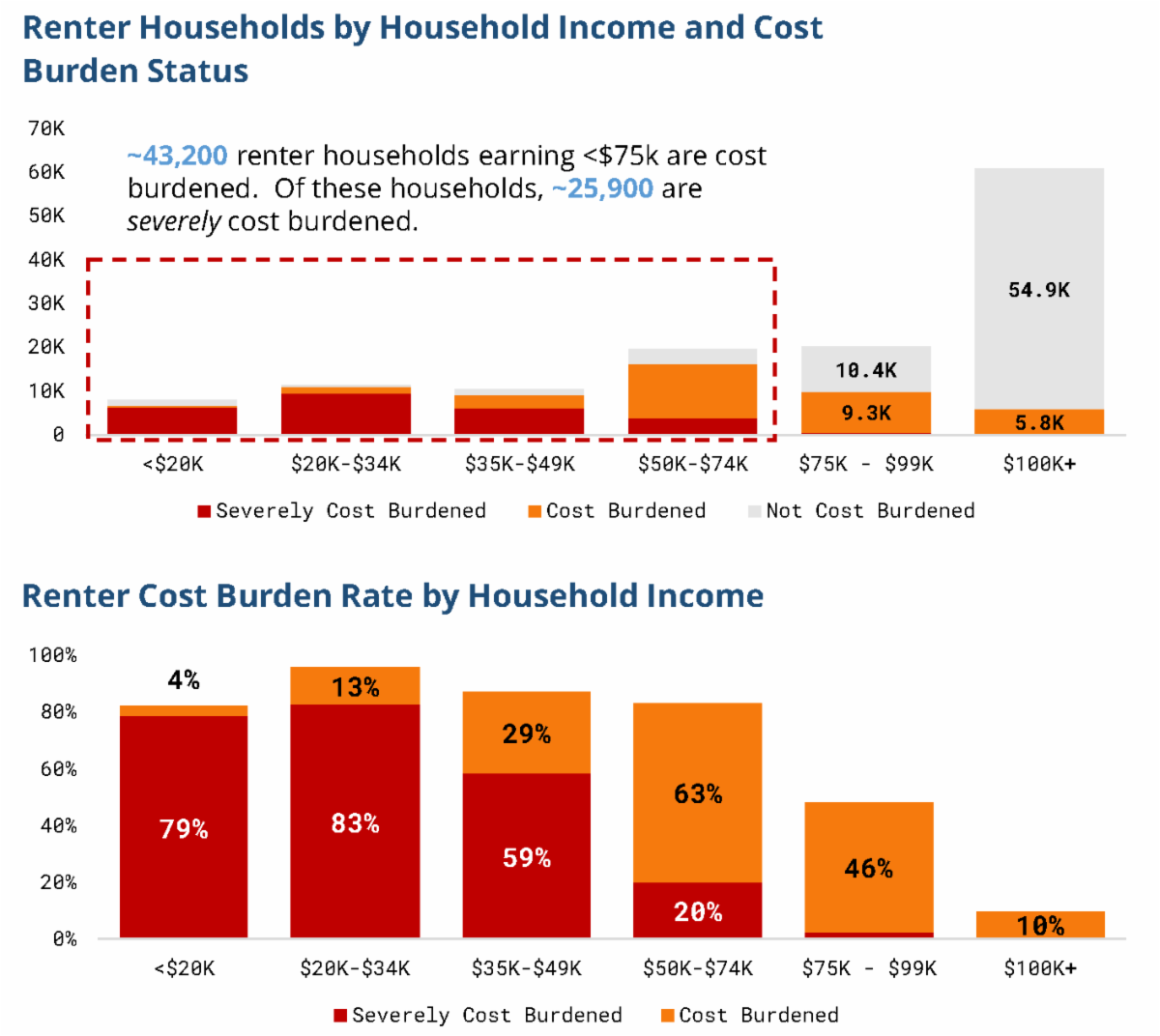
Homeownership is out of reach for moderate income households —including young professionals — and there’s a critical shortage of rental homes for residents who make 60% of the area median income or less.
Yesterday’s sobering presentation provides important context for Chairman McKay's board matter to increase affordable housing that I supported last September. County staff will be presenting a proposed action plan in March on how to address this housing crisis.
| | |
Why it matters: Fairfax County isn’t alone as we face a statewide and nationwide housing shortage, and this lack of affordable housing presents a challenge for everyone regardless of income. Abundant and affordable housing is necessary to sustain our economic competitiveness. Without it, Fairfax County may face a:
- Decline in job creation and retention as companies and workers leave for places with more affordable housing.
- Loss in county tax revenues, such as real estate, business, sales and other taxes, if residents move elsewhere.
- Decrease in economic mobility for low- and moderate-income residents as they spend more and more of their income on housing.
- Rising rents and home prices that continue to climb faster than what people can afford.
| | |
Key Findings: There aren’t enough homes produced, and housing costs make homeownership and rent unaffordable:
- Our housing supply isn’t keeping pace with job creation. In Fairfax County, there 2.13 jobs created per every new home — making us the only jurisdiction in the D.C. region with this great of an imbalance between jobs and homes. In some ways this is a good problem to have, but not for housing affordability.
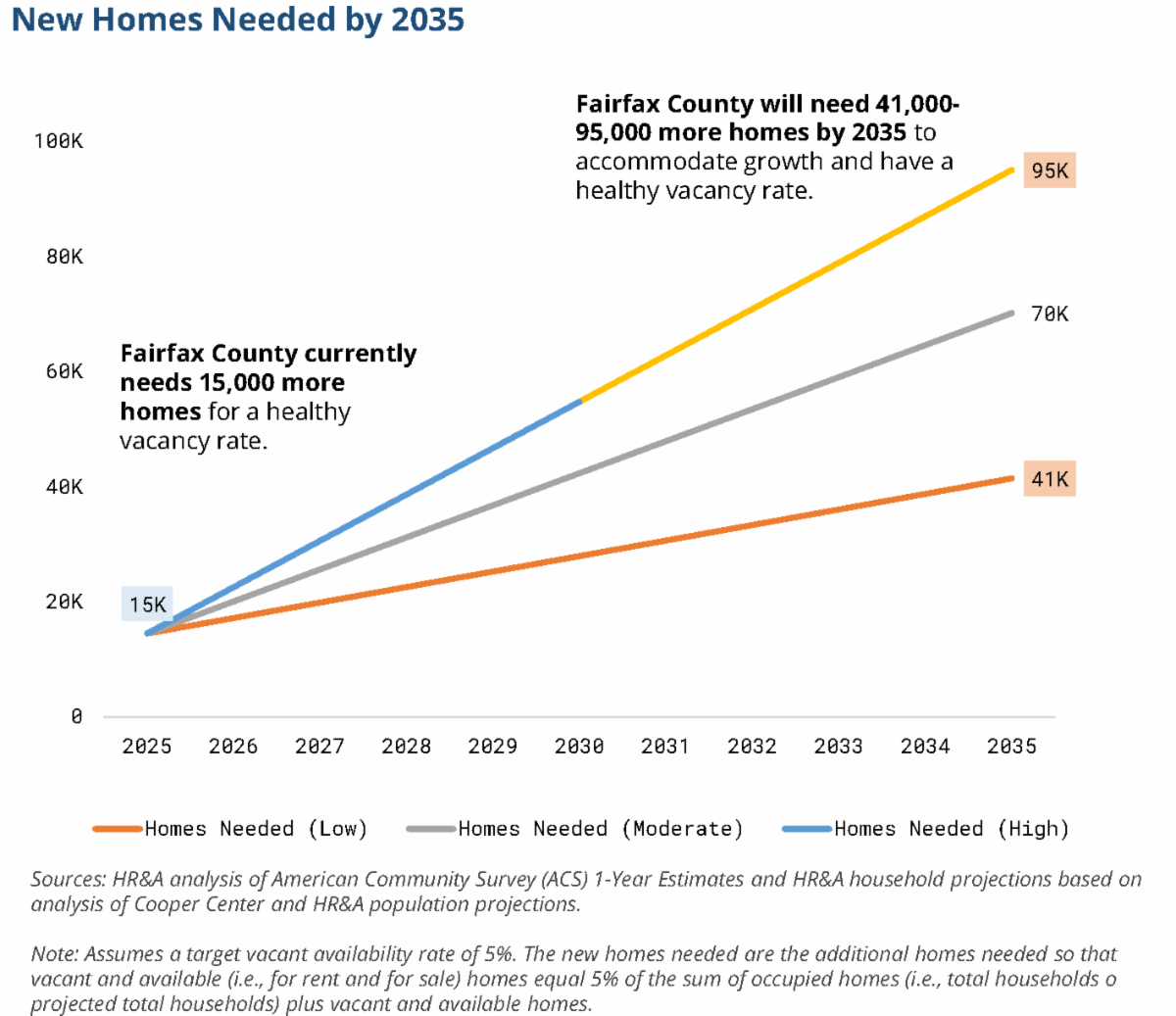
- Healthy housing markets require 5% of its homes be available for sale or rent so people can move for work or start families. To meet this desired vacancy rate, Fairfax County needs 15,000 more homes now, and a total of 41,000 to 95,000 by 2035.
- At yesterday’s hearing staff noted that more than 90,000 new homes have been approved by the Board of Supervisors through rezonings between 2014-2023. Yet for whatever reason — and anecdotally developers tell me all the time the reason is the lack of financing — only about 20,000 new homes were permitted and built in Fairfax County during that period.
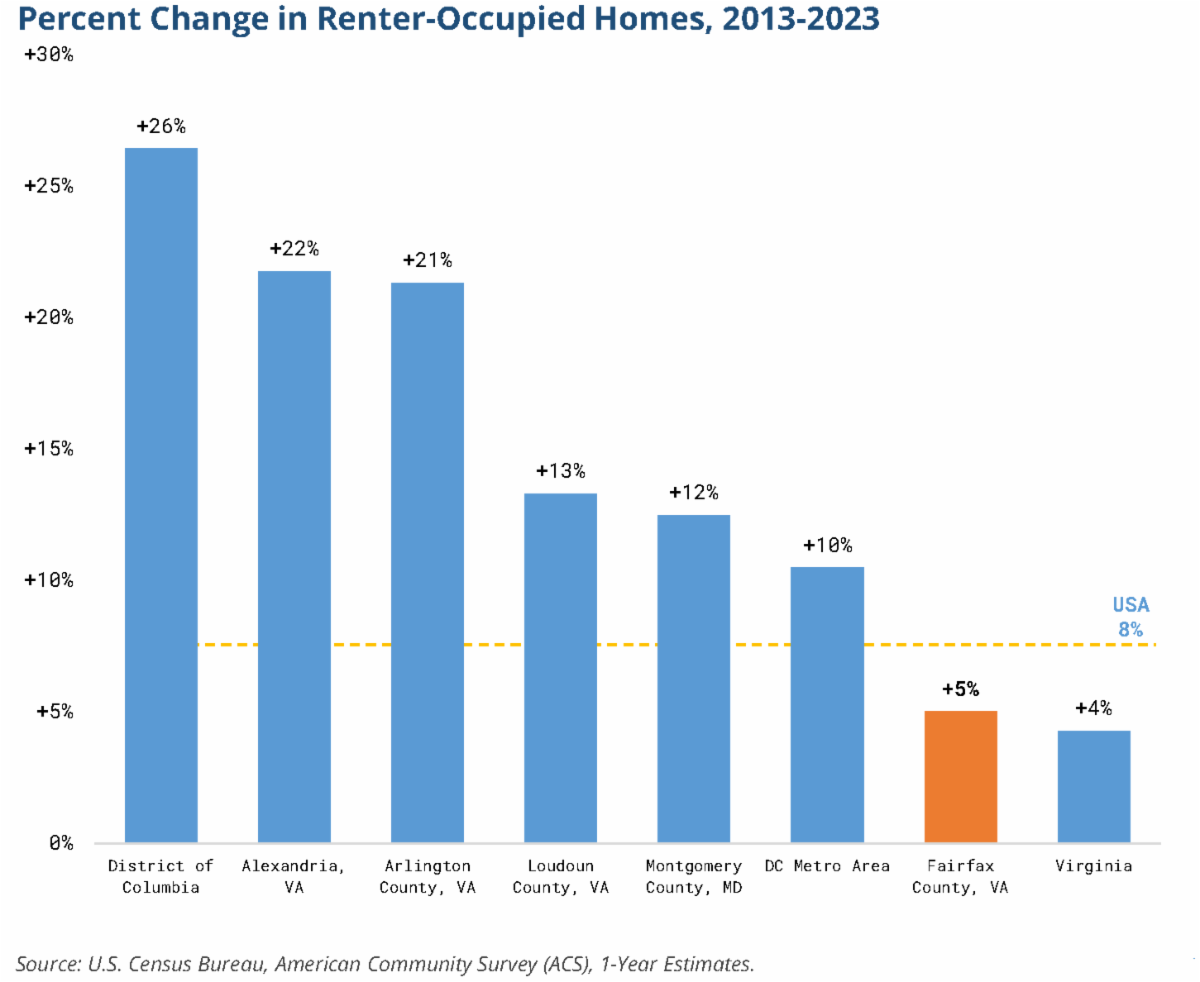
- Fairfax County’s rental housing supply only grew by 5% between 2013 to 2022. In comparison, Arlington County’s supply of rental homes grew by 21% and D.C.’s grew by 26%.
- Currently, another 13,800 affordable rental units are needed for households that make 60% of area median income or less — that’s $98,350 for a four-person family or $78,700 for two-person family.
- Only 13% of the new homes for sale built during the past five years are affordable for families making less than 100% of the area median income — or $164,000 for a family of four.
- More than one-third of all new homes sold for over $1.1 million during the past five years — and last year, every single family detached home built sold for more than $1.1 million.
- In 2024, the median home sales price in Fairfax County was $770,000. A family of four would need at least $230,000 in income to afford a median-priced house.
| | |
Affordable Housing Progress: On Track for 10,000 Units
Despite these headwinds, the Board of Supervisors remains committed to our goal to produce 10,000 net new affordable units by 2034. We are making steady progress, and so far we are roughly at 35% of our goal.
Since 2020, Fairfax County has successfully delivered 1,562 new affordable rental and for-sale units, and there are approximately another 2,050 units in the development pipeline.
| | Understanding Panhandling in Fairfax County: What the Data Tell Us — and What You Can Do | | |
What’s happening: Fairfax County released a new panhandling study that finds economic hardship, housing instability and limited access to services drive people to this activity — not personal choice. Funded by the county, the Urban Institute conducted research that offers a clearer picture of who is panhandling, why they do it, and what services they need most.
The Board requested this study to better understand the problem, as well as try to address it. While asking for money is a protected activity under the First Amendment, panhandling can be a nuisance. It can also be public safety hazard for both panhandlers and drivers even though it’s not against the law for people to stand in a road’s median (or other public places) to ask for money.
Why It matters: Addressing panhandling effectively requires focusing on the root causes — housing, income, health, and access to services. By investing in outreach and long-term stability, the county can reduce the need for panhandling while improving safety, dignity, and well-being for everyone in the community.
Key Findings: Researchers surveyed 40 people and conducted six in-depth interviews at panhandling “hotspots” across the county. Due to the study’s limited size, the findings aren’t statistically valid or representative of everyone who panhandles. However, the study provides important insights:
Why:
- Despite the common perception that panhandling is a choice, people surveyed said it was due to economic necessity. Nearly 83 percent reported that limited or no income from employment was a major reason for panhandling. (Many said health conditions prevented them from working.) Other frequently cited reasons included lack of stable housing (78%), and need for food and basic necessities (75%).
- For 65% of people, panhandling was their primary source of income while only 15% say they received money from government assistance programs like Social Security or disability payments. Another 15% reported that full or part-time jobs were their main source of income.
- Most respondents (70%) reported an annual income of under $10,000 in the past year, and no respondents reported earning more than $50,000 annually.
- Earnings from panhandling varied widely — but about 50% said they earned less than $51 per day while one‑third earned between $51 and $100.
- For the vast majority — 85% — of people said money received from panhandling was “very important” for paying for food and basic necessities.
Who:
- Most people were unhoused with 60% saying they lived outdoors, in a vehicle, a tent, or an abandoned building. However, 23% said they lived in market-rate rental housing.
- Many people also described living with chronic health conditions or a disability, including diabetes, hypertension, high cholesterol, muscular pain, and mental health disorders including depression, anxiety, post-traumatic stress disorder, and bipolar disorder.
- For those who were employed previously, they said they lost their jobs due to disabling conditions, health problems or aging. and these circumstances limited their ability to find new jobs.
What the county can do: Based on these findings, the report points out opportunities for action:
- Expand street outreach to build trust and connect people directly to housing, health, and benefit services. The county’s Office to Prevent and End Homelessness is hiring a new “Outreach & Overflow Specialist” position.
- Increase awareness of existing programs, especially housing assistance, which many respondents did not know how to access. The Office to Prevent and End Homelessness has also made significant investments recently in local nonprofit organizations that do street outreach to increase awareness of programs and services.
- Improve language access and communication, ensuring information is available in multiple languages.
- Strengthen partnerships among county agencies, nonprofits, businesses, and faith-based organizations to create more coordinated support.
What you can do: Despite the study’s findings, county staff recommends that you don’t give to panhandlers. It’s much more effective to direct people in need to county-provided resources instead. As the study indicates, many people who panhandle don't appear to aware of them.
Hand out this resource information flyer that’s available in many different languages including:
| | Upcoming Land Use Meetings | | |
Canceled: Hunter Mill Land Use Committee Meeting Feb. 17
The committee meeting previously scheduled for Feb. 17 was canceled because there are no applications to review. The next regularly scheduled meeting will be Tuesday, March 17.
Reston Planning & Zoning Feb. 23
Attend the virtual meeting on Monday, Feb. 23 at 7 p.m. Click here to join. To attend by phone, dial 571-429-5982 and enter meeting ID 693 626 456#
Agenda:
| | |
Registration for Spring Recreation Programs Begins
Start planning your spring festivities. Registration is now open for town recreation programs and events. Flip through the 2026 Parks and Recreation Spring Program and Events Guide to find your next activity. Events and activities include the Vienna Photo Show, Walk on the Hill, gymnastics, acrylic painting and more.
Vienna Youth Players: 2026 Interest Meeting
Find out what the Vienna Youth Players are all about on Feb. 16. Come meet the director and learn about opportunities to join the summer show as an actor or techie. Students age 10-18 can audition to perform or apply to be a techie.
| | Stay Informed and In Touch | |
Hunter Mill District Supervisor Walter Alcorn
703-478-0283, TTY 711
| | | | |