|
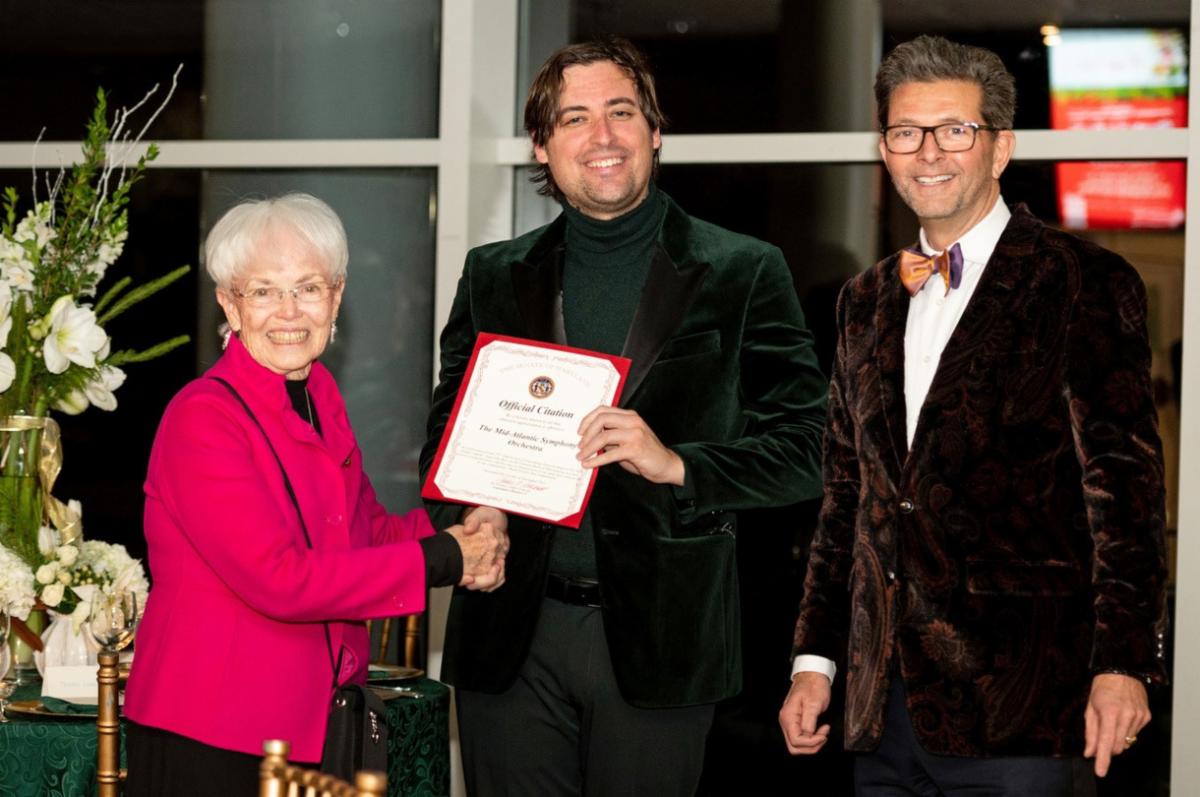
Senator Addie Eckardt presenting an Official Citation of the Senate of Maryland to the Mid-Atlantic Symphony Orchestra (MSO) honoring the Orchestra’s 25 years of “presenting classical music to the Mid-Atlantic Region”.
Senator Eckhardt made the presentation to Music Director Michael Repper and MSO Board President Jeffrey Parker on December 1st at the Gala Dinner following the Orchestra’s annual “Holiday Joy” concert held at the Todd Performing Arts Hall at Chesapeake College.
| |
Dec. 17th is Wreaths Across America Day
Remember our Deceased Veterans
| |
|
Governor Hogan Announces 114 Economic Development Projects For Rural Communities
Rural Maryland Economic Development Fund Allocates $50 Million to 15 Counties for Key Economic Development Projects
| |
|
Governor Larry Hogan today announced that 114 economic development projects in Maryland’s rural counties will be funded through the $50 million Rural Maryland Economic Development Fund. The grant fund, which is overseen by the Maryland Department of Commerce and administered by the five rural regional councils, was announced by Governor Hogan earlier this year to boost economic development activity, stimulate private sector investment, and create jobs in the state’s rural regions.
Under the program, the five rural regional councils—representing the Upper, Mid, and Lower Eastern Shore, Southern Maryland, and Western Maryland—each received $10 million to fund key projects in their respective counties. In September, each council submitted applications for review by Maryland Commerce, with 114 projects receiving approval.
The list of approved projects include:
- Development of an agricultural biotechnology manufacturing center in Talbot County
-
A comprehensive plan to enhance airline service and improve economic development through the Salisbury‐Ocean City Wicomico Regional Airport (SBY)
- A Data Center Shell Building in Caroline County
- Cambridge Harbor streetscape design and partial construction.
Some projects will enhance broadband access and workforce training across multiple counties; others will support tourism projects, including visitor centers, walking/biking trails, and event facilities; and feasibility studies and economic development strategies. The counties benefiting from the grant funds include Allegany, Calvert, Caroline, Cecil, Charles, Dorchester, Garrett, Kent, Queen Anne’s, Somerset, St. Mary’s, Talbot, Washington, Wicomico, and Worcester.
| |
|
Governor Hogan Announces Preliminary FY24 Budget Plan, Transformative Health Care Investments For Rural and Vulnerable Communities
Blueprint Maintains Fiscal Responsibility, Urges Caution on Surplus and Rainy Day Fund
Includes Scholarships for Low-Income Students, Support for Non-Public Schools to Address Learning Loss
Advances Successful Initiatives to Support Small Businesses, Revitalize Communities, Downtowns, and Main Streets
Health Care Investments Support New UMMS Regional Medical Center in Easton
| |
|
Governor Larry Hogan announced on Dec 15 preliminary recommendations for the state’s Fiscal Year 2024 (FY24) budget, a plan that supports continued economic growth and community revitalization, strong fiscal responsibility and budget sustainability, and key investments in critical areas—including expanding access to health care for rural and vulnerable communities.
Under the state’s budget process, the outgoing administration has prepared a preliminary budget to be submitted to the incoming administration, which will ultimately be tasked with submitting the final budget to the General Assembly no later than Friday, January 20.
Maintaining Fiscal Responsibility and Budget Sustainability
The recommended FY24 budget plan calls for preserving the state’s strong fiscal position by maintaining a substantial budget surplus and keeping the Rainy Day Fund at a record 12% of general fund revenues—all while continuing to fully fund core priorities.
Record-Funding Education and Supporting Low-Income, High-Need Students
The recommended FY24 budget plan includes:
- Continuing to fund K-12 education at record levels;
- $10 million in support for non-public schools to address learning loss caused by the COVID-19 pandemic, and
-
$10 million for the highly successful BOOST program, which provides scholarships for low-income, high-need students to attend the school of their choice. (To date, the program has provided over 15,000 scholarships—the vast majority of which have gone to students in the state’s four largest jurisdictions.)
Expanding Access to Health Care Services For Rural and Vulnerable Communities
The recommended FY24 budget plan calls for $220 million in transformative health care investments to expand access to health care services for rural and vulnerable communities, including:
-
$100 million to advance the University of Maryland Medical System’s plan to construct a new Regional Medical Center in Easton, to ensure advanced clinical care is available in the Mid-Shore region. Learn more.
- $100 million to advance Sheppard Pratt’s plan to expand behavioral health services in Maryland—including expanded capacity at its new Elkridge campus, a new dedicated children’s hospital in Towson, a neuroimaging center to advance cutting-edge research, and a global training center for workforce development.
-
$10 million to advance Meritus Health’s plan to construct a new School of Osteopathic Medicine in Hagerstown. The governor attended the groundbreaking ceremony for the new medical school earlier this fall. Learn more.
-
$10 million in initial funding to advance the Kennedy Krieger Institute’s plan to build a new Innovative Care Center on its East Baltimore campus. Learn more.
Reinvesting In Police, Public Safety, and Victim Services
The recommended FY24 budget plan includes:
-
Continuing the state’s $500 million Re-Fund The Police Initiative to increase support for state and local police;
- An additional $30 million to Victims of Crime Assistance (VOCA) grant recipients;
- $2.1 million for a ZeroEyes gun detection pilot program;
- $400,000 for an automated ballistics imaging system for the Maryland State Police crime lab.
Leading on Environmental Stewardship and Land Conservation
The recommended FY24 budget plan includes:
- Continuing to fully fund Chesapeake Bay Restoration; and
- $102 million to fully replenish Program Open Space eight years ahead of schedule to accelerate land conservation projects.
Supporting Economic Growth and Statewide Revitalization
The recommended FY24 budget plan includes:
- $70 million for rental housing and homeownership programs;
-
$25 million each for the successful Project Restore and Neighborhood BusinessWorks initiatives;
-
$25 million for Project CORE to clear blighted units in Baltimore City; and
- $10 million for the National Capital Strategic Economic Development Fund. (To date, more than 5,000 units have been cleared through Project CORE, leveraging more than $2 billion in investment to support revitalization in Baltimore City.)
-
$15 million for the Jobs That Build initiative to hire and retain skilled construction workers; and
-
$1 million for the Global Gateway Initiative to attract foreign companies to the state.
Addressing The Rise in Hate Crimes and Anti-Semitism
The recommended FY24 budget plan includes:
- $5 million to support local efforts to address the rise in hate crimes and acts of anti-Semitism; and
-
$800,000 for an initiative at the University of Maryland’s Merrill College of Journalism to launch a training program focused on Asian American issues and communities. This program builds on the work of the state’s Asian-American Hate Crimes Workgroup.
Combating Cyber Threats With Historic Investments
The recommended FY24 budget plan includes additional investments to build on last year’s historic cybersecurity investments of over $200 million:
- $152 million for continued improvements and modernization of the state's cyber defenses, as well as additional personnel to keep state data and IT systems secure.
- A $7 million grant fund to assist local governments with bolstering their own defenses against ransomware attacks.
Additional Budget Priorities
In addition, the Hogan administration has made a series of operating and capital grant recommendations—which can be accessed here.
| |
Project Restore: Governor Hogan Announces Awards For 376 Businesses to Revitalize Downtowns and Main Streets
80% of Awards For Minority-Owned Businesses, More Than 2,500 Jobs Created Overall
| |
|
Governor Larry Hogan announced on Dec 7 awards for 376 businesses through Project Restore, an economic recovery initiative that provides financial incentives for small businesses to revitalize vacant retail and commercial spaces. A total of 376 businesses in all 23 counties and Baltimore City will receive $24.5 million through the initiative—including $8.8 million in property assistance grants and $15.7 million in business operations grants.
View the full list of recipients.
Project Restore was launched by the governor last year, and is administered by the Maryland Department of Housing and Community Development (DHCD). Through Project Restore, the department offers property assistance and operational grants to support startup and expansion costs and incentivize private investment in vacant spaces. In total, more than 725 businesses have now been awarded grants through Project Restore.
The latest application round received almost 800 applications. Approximately 2,520 jobs will be created by the businesses awarded funding. Of those awarded grants this round, 301 are minority-owned businesses and 206 of those are women-owned businesses. An additional 20 businesses are veteran-owned businesses.
The previously vacant properties will return to active use as:
- 119 office spaces
- 110 retail spaces
- 61 restaurants
- 41 manufacturing/industrial spaces
- 44 other uses, such as event space, breweries, salons and indoor recreation.
More than 120 of the vacant properties are located in Maryland’s Opportunity Zones and 48 are in the state’s designated Main Street Maryland districts.
| |
|
Swinging Into the Holidays: Gates Begin Operating Tuesday, Dec. 20 as Part of Bay Bridge Automated Lane Closure System Phased Implementation
REQUESTING DRIVERS PAY ATTENTION AND OBEY NEW TRAFFIC CONTROL DEVICES
New system includes full-color dynamic message signs, larger overhead lane-use control
signals, horizontal swing gates and illuminated pavement markers
| |
Motorists using the Bay Bridge this holiday season will experience the latest phase of an innovative project designed to improve safety and accelerate the process of opening and closing lanes on the bridge. Starting December 20, drivers on westbound US 50/301 approaching the Bay Bridge from the Eastern Shore will be among the first to witness use of the new gates as part of the Automated Lane Closure System (ALCS) that will replace the existing, time consuming use of barrels to close off lanes.
ALCS uses horizontal swing gates, illuminated pavement markers, full-color dynamic message signs and overhead lane-use control signals to alert and guide motorists when lanes are opening and closing to accommodate two-way traffic operations on the westbound span.
The new gates and the entire ALCS helps protect Maryland Transportation Authority (MDTA) employees by replacing a manual process with automation, and improves safety for drivers as well by giving them more time to move into the correct lanes, allowing for safer lane changes and helping prevent secondary crashes during incidents. The ALCS also enhances incident response, enabling crews to switch between lane closure scenarios more rapidly during incidents. For a video simulation of the new system, visit mdta.maryland.gov/Capital_Projects/BayBridgeALCS.
In addition, during this transition period barrels still will be used – along with the new gates. Throughout the course of winter 2022/2023, the MDTA will complete phasing the system to include the Western Shore.
| |
Lt. Governor Rutherford and Federal Officials Announce $5.97 Million in Grants to State Of Maryland to Support High-Speed Internet Expansion
Grants Advance State’s Plan to Close Digital Divide Under $400 Million Connect Maryland Initiative
| |
|
Lieutenant Governor Boyd K. Rutherford on Dec. 12 joined federal officials at City View at McCulloh Apartments in Baltimore to announce the awarding of $5.97 million in grants to support Connect Maryland initiative—the state’s transformative $400 million initiative to ensure every Marylander has access to high-speed internet.
The Office of Statewide Broadband, part of the Maryland Department of Housing and Community Development, will utilize the additional funding to develop a framework for identifying unserved and underserved broadband regions throughout the state, and provide resources to increase access to technology and education.
The Office of Statewide Broadband will receive $5 million from a Broadband Equity, Access, and Deployment (BEAD) program grant to identify the remaining households that don’t have a reliable internet connection, and to inform and guide the state’s plan for broadband infrastructure deployment. The office will also receive $966,659 through a Digital Equity Planning grant that funds the resources to compile a complementary plan to increase access to technology and education. The two five-year plans will be developed concurrently and inform future NTIA funding for broadband infrastructure and access initiatives.
| |
In case you haven't seen: A TikTok and Cybersecurity Update Message (12/9) From Governor Hogan | |
|
Dear Marylanders,
Earlier this week, I announced an emergency cybersecurity directive to prohibit the use of TikTok—and other Chinese and Russian-influenced platforms—in Maryland state government.
This directive applies only to government devices and platforms, but it deals with some very serious and grave cyber threats we all face. The director of the FBI has stated that “the Chinese government has shown a willingness to steal Americans’ data on a scale that dwarfs any other.” The information collected on these apps through cyber espionage could be used to target families with misinformation campaigns, or to gain access to critical systems.
I talked about this TikTok directive on CNBC and Fox News:
Other states are already following our lead to curtail the use of TikTok, and I expect more to do so in the coming weeks. There are also always things you and your family can do to prevent unauthorized access to your devices.
We will continue to keep Marylanders updated with important information about our cybersecurity actions.
Governor Larry Hogan
| |
Maryland Board of Public Works: Approved Projects | |
|
· $250,000 grant for an improved Andean bear exhibit at the Salisbury Zoological Park.
· $75,000 grant for the Christian Shelter Inc. Thrift Store property.
· $156,693 grant for the Christian Shelter Inc. facilities, including a refrigerator/freezer cooler unit replacement.
· $100,000 allocated to Caroline County to construct a new full-size basketball court at Jonestown Community Park.
· $25,000 to Talbot County to complete the County's 2022 Land Preservation, Parks. and Recreation Plan, consistent with State planning requirements.
· $40,000 for the acquisition in fee simple of 5.25+/- acres Merriken property in Caroline County. This forested property, which is composed entirely of palustrine wetland and upland forest, is in the Marshyhope Creek Watershed, and surrounded by the Idylwild Wildlife Management Area (WMA).
| |
|
Governor Larry Hogan Declares State Holiday and Maryland State Government Closure
State Offices Will Be Closed Friday, December 23
| |
|
Governor Larry Hogan has declared that Maryland state government agencies and offices will be closed on Friday, December 23, 2022, in addition to previously planned Monday, December 26.
| |
Assistive telecommunications equipment | |
|
The Maryland Accessible Telecommunications (MAT) Program provides assistive telecommunications equipment to Maryland residents, ages 3 or older, who have difficulty using a standard telephone.
The MAT program offers a wide variety of solutions and tools for participants to make and receive phone calls—from amplified phones to Captioned Telephones to tablets, all to support day-to-day communications.
Learn more and apply here.
| |
Messages from Maryland Insurance Administration | | |
|
Older Driver Safety Awareness
Please take a moment to read Maryland's Resource Guide to Aging Drivers. The guide provides resources and safety tips specific to older adults. The guide emphasizes the importance of recognizing changes in driving skills and understanding risk factors.
Resource Guide
| |
|
Packages
Are your packages protected? Make sure to read this Consumer Advisory on "Porch Pirate" theft.
Read our Consumer Advisory
| |
With each newsletter, we are providing a link that gives our constituents access to "tutorials" located on the Maryland General Assembly Website. These tutorials will aid you as a citizen to navigate bill tracking, finding a legislator, understanding a bill page, as well as instructions for witness sign up for a specific piece of legislation. We hope this will give you a better understanding of how our legislative process works. | | | | |