|
Welcome to our June newsletter!
Wisconsin CONNECT is a collaborative. We seek to provide technical assistance and training opportunities for substance use prevention and treatment grantees, providers, clinicians, social workers, and support staff.
We draw on local and national academic and community resources to reduce and prevent substance use and improve overall health and wellness in Wisconsin.
To that end, we want to help you connect the dots with this newsletter. It is a tool to support our efforts to promote new research, share tools and trainings that aim to help you engage in different communities, enhance practice and improve the health of your clients and program participants.
| | |
Young Adults are Using Cannabis to Sleep at Alarming Rates
Article from Science Daily
New data from the University of Michigan's annual Monitoring the Future Panel Study shows that using substances to help with sleep is common among young adults. The study, funded by the National Institute on Drug Abuse, found that 22% of Americans ages 19 to 30 said they used cannabis, alcohol, or both to help themselves sleep, with cannabis being the most popular substance.
Researchers warn this strategy can backfire, disrupting sleep quality and increasing the risk of long-term sleep and substance use problems. The findings highlight the importance of screening for both issues and offering coordinated support when needed.
Read the article here.
| |
Canned Cocktails Will Smash You to the Ground
An Atlantic Article by Nicholas Florko
"American may be drinking less. But a lot of them are getting drunk faster."
Read the article here.
| |
2026 Motivational Interviewing Conference
Motivational Interviewing : Elevate Your Conversations:
A conference for Newcomers, Beginners, and Lifelong Learners
Have you ever found yourself trying to help someone in a high-stakes situation, only to meet a wall of defensiveness, anger, or total shut-down?
Whether you are trying to de-escalate a crisis on the street, guide a patient toward better health choices, or support a client through recovery, pushing too hard usually backfires. That’s where Motivational Interviewing (MI) comes in.
MI isn't about giving advice or convincing people to change. It is an evidence-based, collaborative communication style that lowers tension and helps individuals discover their own reasons for cooperation and positive change. And the best part? It's a highly practical skill you can learn.
Why This Conference is Different
If you’ve never taken an MI course before, it’s easy to feel intimidated by the jargon. This conference is designed from the ground up to be a zero-judgment, high-support environment. We trade dense academic lectures for interactive, skill-building workshops tailored to real-world scenarios.
You won't just sit and listen — you will practice, laugh, and walk away with communication tools you can deploy on your very next shift.
What You’ll Walk Away With
- The "OARS" Framework: Master the four core communication skills (Open questions, Affirmations, Reflections, and Summaries) that instantly de-escalate tension and build rapid rapport.
- Rapid De-escalation & Defensiveness Control: Learn how to handle pushback, hostility, or "yes, but..." responses without getting locked into a power struggle.
- How to Spot "Change Talk": Train your ears to pick up on the subtle verbal clues that mean someone is ready to cooperate or move forward, and learn exactly how to guide them there.
- Reducing Professional Burnout: Shift your mindset from a stressful "fixing/forcing" approach to a "partnering" approach, protecting your own mental longevity on the job.
Who Should Attend?
This conference is tailor-made for professionals new to MI, including:
- First Responders: Law Enforcement, Paramedics, EMTs, Firefighters, and Crisis Intervention Teams (CIT).
- Healthcare Professionals: Nurses, Physicians, Dietitians, and Public Health Workers.
- Behavioral Health: Mental Health Counselors, Social Workers, and Addiction & Recovery Specialists.
- Community Support: Life Coaches, Educators, and Academic Advisors.
No Prior Experience Required. Whether you've only heard the term "Motivational Interviewing" once or you're looking for new, effective tools to add to your de-escalation toolkit, you belong here.
Secure your spot today and transform the way you navigate critical conversations.
Learn more and register here.
| |
Technical Assistance and Training Directory
from SAMHSA
SAMHSA-funded training and technical assistance centers offer free support to those working in the field on topics across the behavioral health spectrum. This includes assistance for states, tribes, non-profits, communities, health care professionals, and behavioral health specialties including licensed clinicians and peer support specialists.
Training and technical assistance serves:
- National audiences through webinars, online learning modules, and written resources
- Specific groups through topic-based virtual learning collaboratives, communities of practice, or short-term training
- Communities, states, tribes, and systems through intensive individualized technical assistance
Access resources here.
| | |
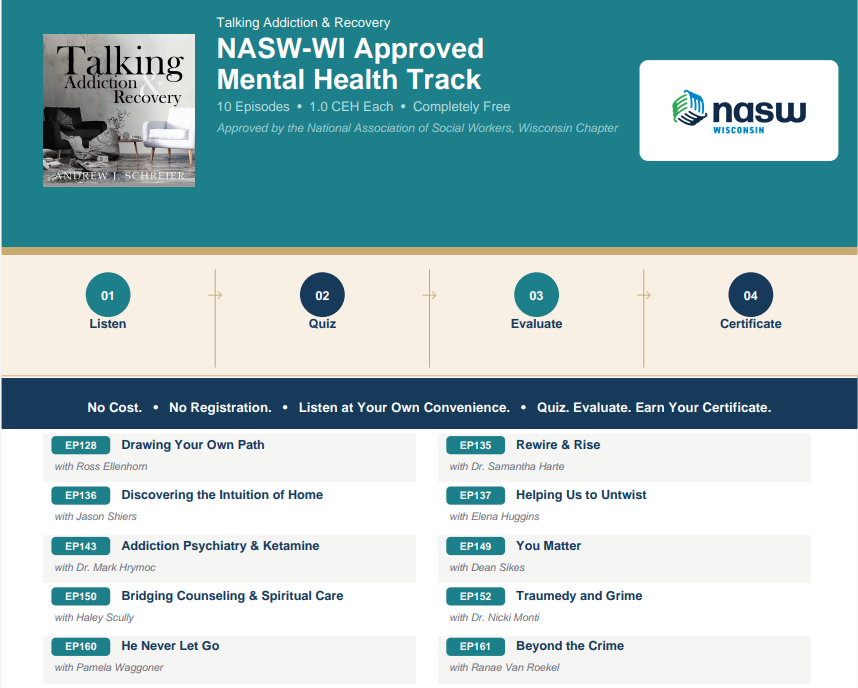
Talking Addiction & Recovery
A Podcast from Andrew J. Schreier
Select episodes of Talking Addiction & Recovery are now approved for continuing education credit through the International Problem Gambling and Gaming Certification Organization (IPGGC) and the National Association of Social Workers, Wisconsin Chapter.
Free for all listeners.
| | |
Matrix Model Training
from Wisconsin CONNECT
Matrix Recovery Program™ for Adults
Wednesday, June 10 and Thursday, June 11
9:00am-4:00pm CT both days
Virtual
This 2-day training has been updated to provide implementation of the new Matrix Recovery Program for Integrated Care- Adults™. The training will utilize some lecture, discussions, videos and experiential exercises. A special emphasis will be placed on familiarizing attendees will all the evidence-based components of the original Matrix public domain program but a new 2026 adapted version which incorporates new evolving recovery language and terminology, recent advances in behavioral health and substance disorder treatment.
Attendees will learn to:
- Describe the core components of Matrix Recovery Program™ for Adults
- Begin implementing these components into their organizations
- Provide clients new skills they need to move forward in their recovery journey
- Integration of the components and recovery process to improve both individual outcomes and overall program effectiveness
- Understand the neurochemical changes integrated into the sessions to assist clients in understanding where they are in the recovery process.
register here
Peer Recovery
Monday, June 22 and Tuesday, June 23
9:00am-4:00pm CT both days
Virtual
Since its beginnings the Matrix Model has always incorporated the use of Peers in programming. Specifically, the use of Peers as co-leaders in the Matrix group process. This training will provide the basics of the Matrix Model and how peers can use their own recovery successes to help others. The Matrix Model wants to further that support with individuals who have completed the Matrix Program and share their lived experience with others in Matrix. A person with lived experience can pull from those successes while sharing their own recovery journey. Matrix Peers/Co-Leaders also can provide additional support as a new individual moves through the Matrix program.
Goals:
- Assist program participants in the development of skills, confidence, and relationships as they begin their recovery journey.
- Learn skills to Co-Facilitate Matrix groups in an open and welcoming environment.
- Provide direct peer support based on their own lived experiences.
Objectives:
- Learn how to engage new individuals in the Matrix Program
- Display skills of when and how to share recovery stories
- Identify ways to help peers efforts for health, wellbeing and recovery
- Learn Matrix core components and how to assist peers with new skills and strategies learned in Matrix programming.
register here
Learn more about Matrix offerings here.
| |
|
Upcoming Trainings and Events with ORN Partners
from the Opioid Response Network
Mark your calendars for these June trainings and events sponsored by ORN partners:
🗓️ Monday, 6/1 at 2:00 PM EDT: “Mindfulness for Moving Forward: Release What You’re Carrying” from the Western Interstate Commission for Higher Education (WICHE)
🗓️ Wednesday, 6/3 at 5:00 PM EDT: “The Culture of Addiction Medicine” from the American Osteopathic Academy of Addiction Medicine (AOAAM)
🗓️ Thursday, 6/4 at 1:00 PM EDT: “Overamping” from the Grayken Center for Addiction TTA at Boston Medical Center
🗓️ Friday, 6/5 at 12:00 PM EDT: “Substance Use, Sex Work and HIV: Intersecting Vulnerabilities for People Experiencing Opioid or Stimulant Use Disorder” from the National Alliance for HIV Education and Workforce Development (NAHEWD)
🗓️ Friday, 6/5 at 1:00 PM EDT: “Buprenorphine 101” from the Grayken Center for Addiction TTA at Boston Medical Center
🗓️ Wednesday, 6/10 at 2:00 PM EDT: “Addressing Behavioral Health Crises in Indian Country: Lessons, Adaptations, and Community Empowerment” from the Western Interstate Commission for Higher Education (WICHE). Please note: This webinar is for Tribal Opioid (TOR) grantees, Tribal organizations and communities.
🗓️ Thursday, 6/18 at 1:00 PM EDT: “Essentials of Treating Stimulant Use Disorder” from the Grayken Center for Addiction TTA at Boston Medical Center
🗓️ Monday, 6/22 at 2:00 PM EDT: “Grounded Earth & Sky Breathing Exercise” from the Western Interstate Commission for Higher Education (WICHE)
🗓️ Friday, 6/26 at 12:30 PM EDT: “Coordinating Care for Adolescents: Integrating MOUD and Mental Health Treatment in Pediatric Practice” from the American Academy of Pediatrics (AAP)
Learn more and register here.
| | |
Respectful Care at the Intersection of Mental Health and Substance Use
from Wisconsin Association for Perinatal Care
June 30
12:00 - 1:00 PM CT
Nearly half of individuals with a psychiatric illness have co-occurring substance use disorders. This presentation will explore how providers can navigate individuals through the dangerous intersection of mental health issues and substance use. Presented by Halie Ecker, LPC, CSAC, PMH-C; Beth Abramson, MD; Allie Wayman, APNP; Hannah Demmon, LCSW.
Register here.
| | |
Solving the Wrong Problem: When Recovery Models Ignore Neurodivergence
A Video and Podcast from Living with FASD
This episode of Living with FASD features “Jon Baer to explore the critical intersection of neurodivergence and substance use recovery. Jon emphasizes the need for recovery models that are neurodiversity-aware and discusses why traditional recovery systems often fail neurodivergent individuals.”
Watch and listen here.
| | |
Check out our video archive to find a session you might have missed.
You can also go back to the training session webpage to find other resources, slides and handouts.
| | | |
Click here below to see all the upcoming trainings and events across topics. | |  |
Have a training interest? Looking for technical assistance? Simply fill out this online form with what you are seeking, and we will follow up to further explore your needs. | | Wisconsin CONNECT Social Media | | Go follow the new Wisconsin CONNECT social media pages for regular updates on training opportunities as well as to connect and network with other professionals. | | |
|
We do this in partnership with the Bureau of Prevention, Treatment and Recovery within the Wisconsin Department of Health Service's Division of Care and Treatment Services, UW-Milwaukee, and our network of training providers. |
| | | |