FCI Names New Student Climate Fellows |
|
Please join us in congratulating our 6 new FCI Student Climate Fellows!
Each submitted outstanding original ideas for exploring climate-related research projects AND plans to communicate their findings. This program will not only help prepare our next generation of climate leaders, but it will also help inform communities in Florida about these urgent issues.
|
|
Transforming Suburban Florida Through Resiliency + Recovery |
|
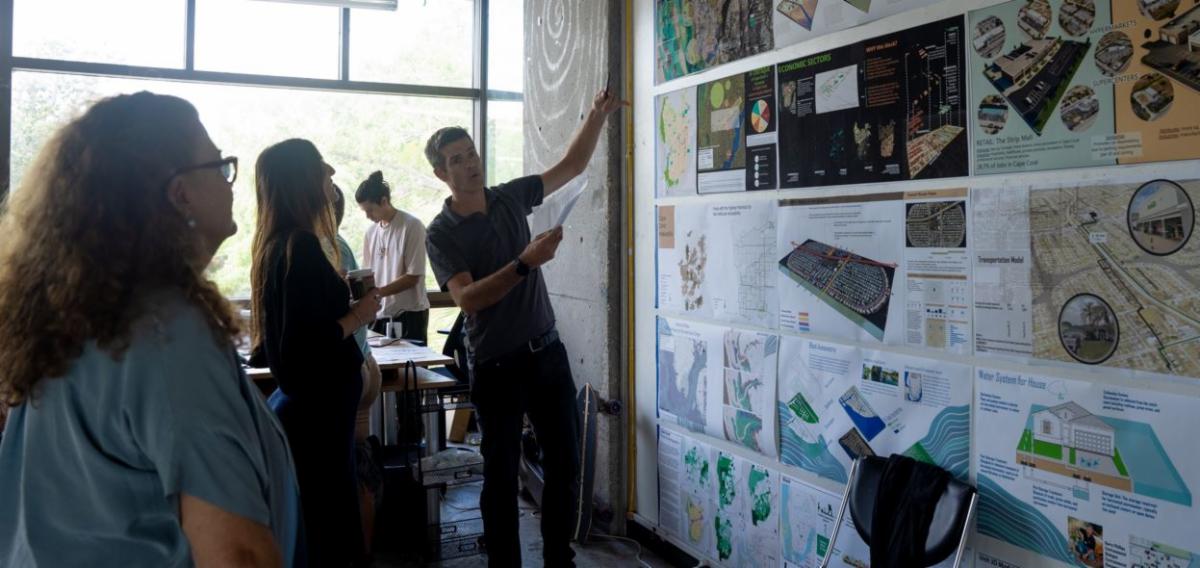
This interdisciplinary studio, led by the University of Florida, proposes a series of “suburban retrofits” to envision greater resilience, equity, and sustainability in Southwest Florida, which was recently devastated by Hurricane Ian. Multi-disciplinary teams focus on the city of Cape Coral, a poster child for Florida’s rampant post World War II suburban development, to explore design interventions systems at the scale of city and neighborhood.
|
|
Coastal Flood Resilience Project Advocates for Increased NSF Funding |
|
The Coastal Flood Resilience Project recently provided Congress with a letter advocating increased funding for the National Science Foundation to expand research of glacier and ice sheet loss as needed to improve projections of sea level rise and support communities developing coastal flood resilience plans.
|
|
At this year’s institute, we’ll explore the connection between public interest communications and activism, work collectively to bridge the researcher-practitioner divide, dive into community engaged scholarship and more.
The event is pay-what-you-can, with a suggested registration fee of $60 for students, $100 for non-students and $50 for those joining us online.
|
|
If you have any climate-related research, news items, or events that you would like to submit for consideration in the next newsletter, please email them to info@floridaclimateinstitute.org
|
|
Other Upcoming Events & Webinars |
|
Job, Internship, and Fellowship Opportunities |
|
National, International, and Remote
|
|
Aguiar, A. C. F., Scarano, F. R., Bozelli, R. L., Branco, P. D., Ceotto, P., Farjalla, V. F., et al. (2023). Business, biodiversity, and innovation in Brazil. Perspectives in Ecology and Conservation, 21(1).
Best, K. B., Jouzi, Z., Islam, M. S., Kirby, T., Nixon, R., Hossan, A., et al. (2023). Typologies of multiple vulnerabilities and climate gentrification across the East Coast of the United States. Urban Climate, 48.
Dickey, S. L., Ai, A. L., Hawkins, C., Clark, I., Wedenoja, M., Boone, K., et al. (2023). Psychosocial and Physical Challenges from a Natural Hazard: Implications for Resilience in the Black Community. Nat. Hazards Rev., 24(2).
Guo, Y., Zhang, Y., Wu, J., Richards, C. L., Bossdorf, O., Li, B., et al. (2023). Geographic variation of litter chemistry and palatability in an invasive plant versus its native competitor. Journal of Biogeography.
Hauser, D., Abdalla, S., Ardhuin, F., & Bidlot, J. R., et al. (2023). Satellite Remote Sensing of Surface Winds, Waves, and Currents: Where are we Now? Surveys in Geophysics.
Hermans, T. H. J., Malagón-Santos, V., Katsman, C. A., Jane, R. A., Rasmussen,, Haasnoot, M., et al. (2023). The timing of decreasing coastal flood protection due to sea-level rise. Nat. Clim. Chang., 14(4).
Herrero, H. V., Southworth, J., Khatami, R., Insalaco, S., & Muir, C. (2023). Examining the relationship between vegetation decline and precipitation in the national parks of the Greater Limpopo Transfrontier Conservation Area during the 21st century. Front. Environ. Sci., 11.
Keppeler, F. W., Junker, J. R., Shaw, M. J., Alford, S. B., Engel, A. S., HooperBùi, L. M., et al. (2023). Can biodiversity of preexisting and created salt marshes match across scales? An assessment from microbes to predators. Ecosphere, 14(3).
Manzoor, M., Hussain, S. B., Anjum, M. A., Naseer, M., Ahmad, R., & Ziogas, V. (2023). Effects of Harvest Time on the Fruit Quality of Kinnow and Feutrells Early Mandarins (Citrus reticulata Blanco). Agronomy.
Martin, J., Richardson, M., Passeri, D., Enwright, N., Yurek, S., Flocks, J., et al. (2023). Decision science as a framework for combining geomorphological and ecological modeling for the management of coastal systems. Ecology and Society, 28(1).
Petro, C., Carrell, AA., Wilson, R. M., Duchesneau, K., & Noble-Kuchera, S., et al. (2023). Climate drivers alter nitrogen availability in surface peat and decouple N-2 fixation from CH4 oxidation in the Sphagnum moss microbiome. Global Change Biology.
Ravikumar, A., Chairez Uriarte, E., Lizano, D., Muñoz Ledo Farré, A., & Montero, M. (2023). How payments for ecosystem services can undermine Indigenous institutions: The case of Peru's Ampiyacu-Apayacu watershed. Ecological Economics, 205.
Ross, A., Mack, E. A., Marcantonio, R., & Miller-Graff, L., et al. (2023). A mediation analysis of the linkages between climate variability, water insecurity, and interpersonal violence. Climate and Development.
Secchi, M. A., Fernandez, J. A., Stamm, M. J., Durrett, T., Prasad, P. V. V., Messina, C. D., et al. (2023). Effects of heat and drought on canola (Brassica napus L.) yield, oil, and protein: A meta-analysis. Field Crops Research.
Yue, Z., Li, Z., Yu, G., Chen, Z., Shi, P., Qiao, Y., et al. (2023). Climate controls over phenology and amplitude of net ecosystem productivity in a wheat-maize rotation system in the North China plain. Agricultural and Forest Meteorology, 333.
|
|
About Us
The Florida Climate Institute (FCI) is a multi-disciplinary network of national and international research and public organizations, scientists, and individuals concerned with achieving a better understanding of climate variability and change.
|
|
|
|
|
|
|