|
The American Society of
Le Souvenir Français Inc.
Monthly Bulletin - Vol. VI, No. 2
February 2026
| | |
The Best of
French-American stories
5 Years of Monthly Chronicles
60 Bulletins Celebrating Our Shared History
| | |
Editorial
This month is special for us, as it marks the 5th anniversary of our monthly bulletins chronicling the many diverse facets of the long shared history between the French and American peoples. We thought it would be fitting to revisit them and survey the vast corpus of memories that bind our two nations across five centuries.
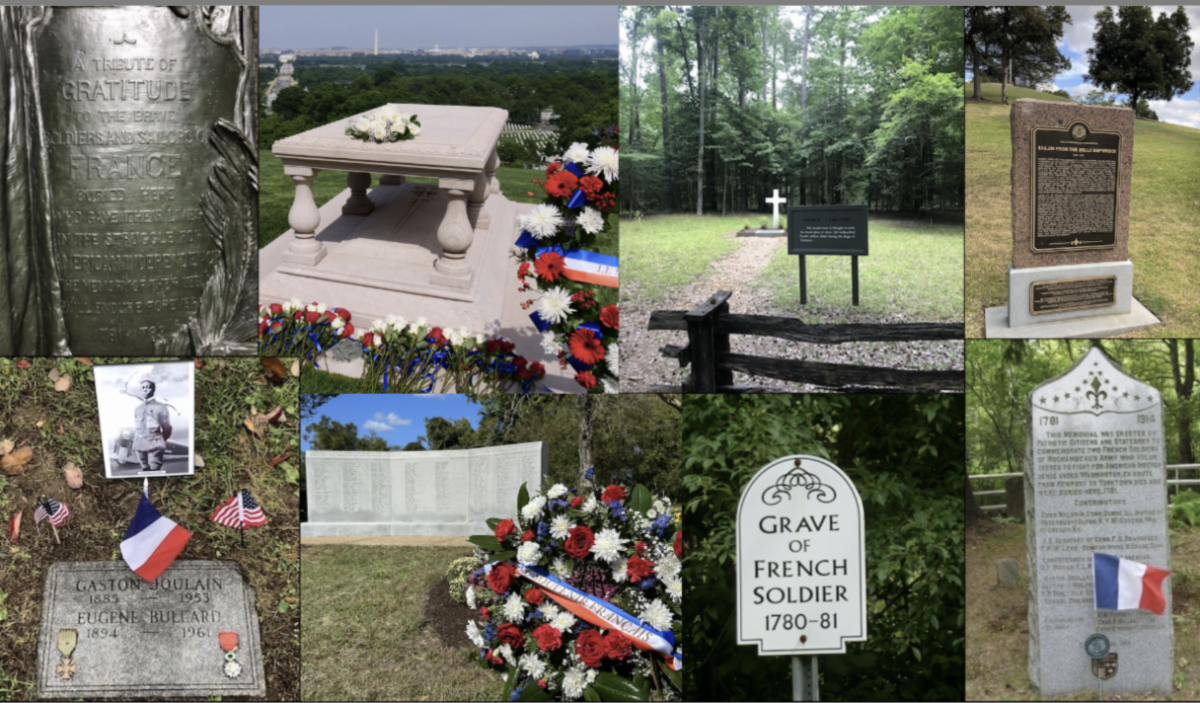
We like to focus on anecdotes and illustrations, often beginning with statues, monuments, memorials, bronze plaques, and markers erected over the years, faithfully transcribing the inscriptions left by our forebears. In this "Bulletin of Bulletins," clicking on each illustration gives you direct access to the entire original bulletin to delve deeper into the subject.
Do you have a favorite? Would you like to read more about a specific period, character, area, or topic? Please let us know. As you'll see, over the years we've presented the main chapters of this long shared history—a total of over 3,600 pages and more than 1,800 illustrations. In itself, it constitutes an encyclopedia of French stories, but we prefer the French term "Dictionnaire Amoureux" (akin to a collection of love letters), all dedicated, in the end, to the United States and to the French who contributed to its glorious history.
We look forward to hearing back from you!
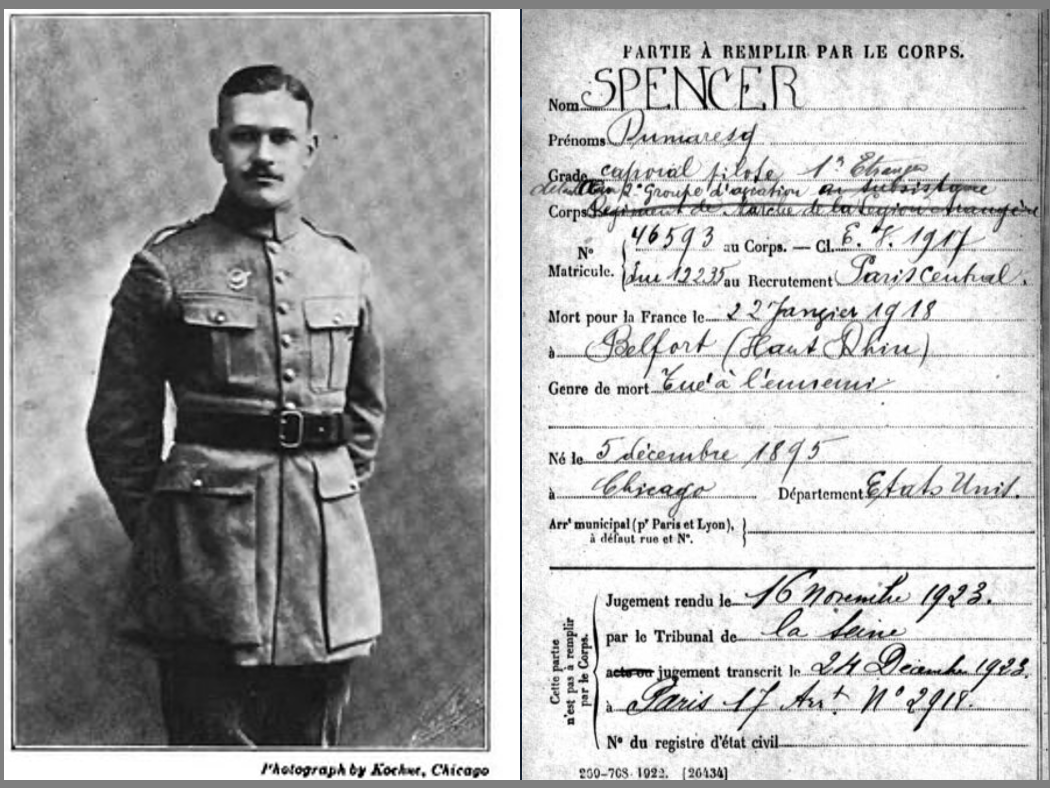
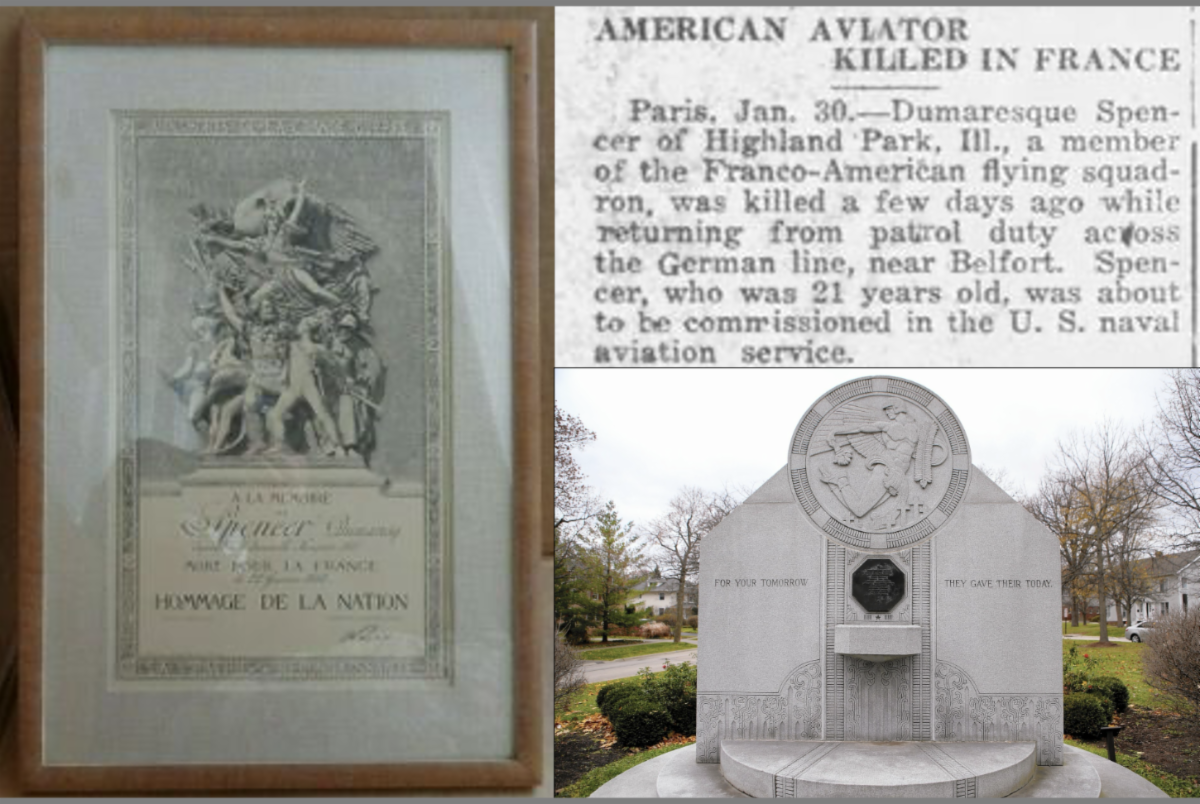
Part Two of this Bulletin continues our tradition of honoring a particular American volunteer who fought and died for France. This month we will honor 2nd Lieutenant Demaresq Spencer, who "Died for France" on January 22, 1918, near Belfort in the region of Franche-Comté. Like many of these daring pilots, he was a Yale graduate, and received the Croix de Guerre and the Médaille Militaire.
Part Three of this Bulletin, as always, is devoted to News and Save the Dates.
Please scroll down and find out what is happening!
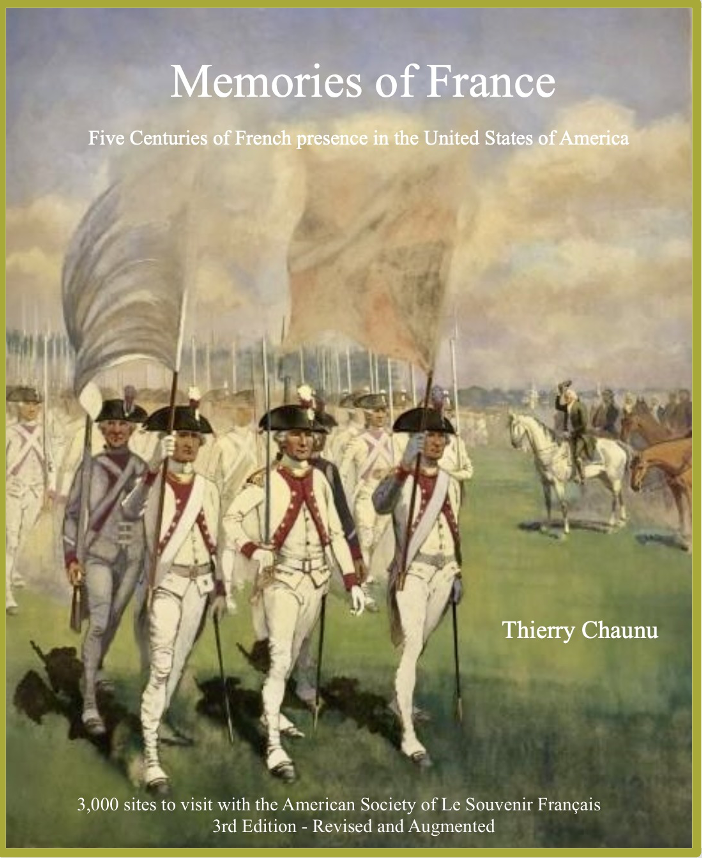
We would like to express our thanks to all those who joined or renewed their membership for 2026 following our January appeal. If you haven't done so, we invite you to consider joining us. While our monthly bulletins are free (please don't hesitate to share them widely!), members receive more than just a 2026 membership card—you'll also receive a special private link to access "Memories of France," a compilation of more than 3,000 sites of French presence throughout the 50 United States in PDF format. A great traveling companion for your smartphone! It is never too late to join or help support our activities.
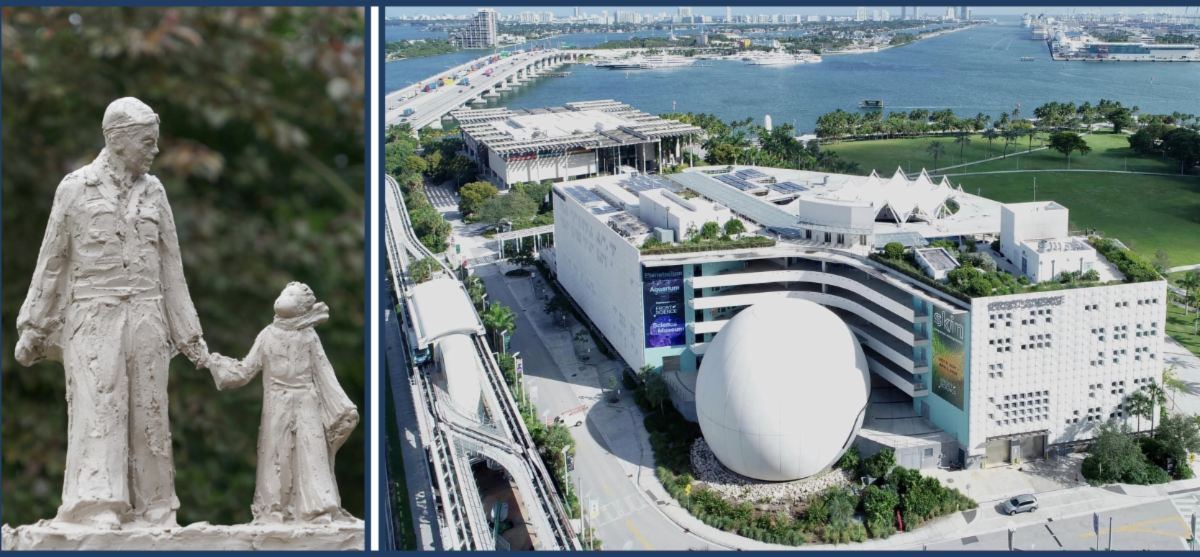
We have several plaques and memorials planned for the next twelve months, including the sculpture of Antoine de Saint Exupéry and his Little Prince in Miami, and we thank you for your kind and generous support.
On behalf of the Board of Directors,
Thierry Chaunu
President, The American Society of Le Souvenir Français, Inc.
| | |
Our very first Bulletin...
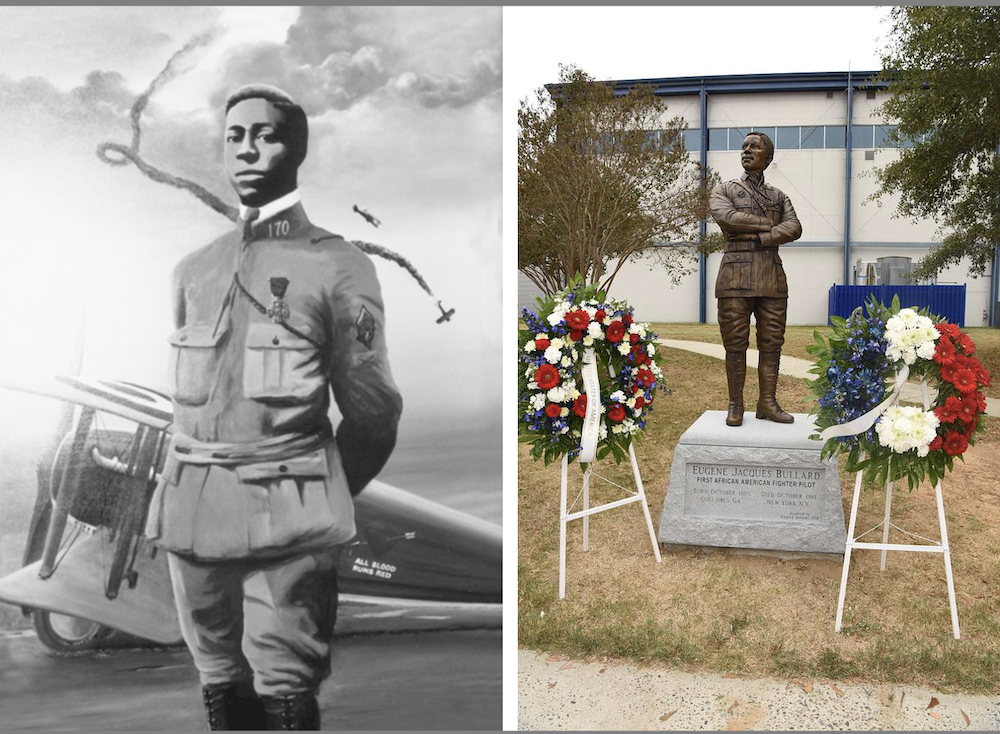
Tribute to Eugene Bullard
Black History Month, February 2021
| | |
Our very first Bulletin started more as a postcard. There is so much to write about this great unsung American hero of WWI — it should actually be made into a movie.
“Eugene Jacques Bullard, you lived a life that defied every limitation placed upon you [...] You would become a legend—a man who fought for freedom in the skies above France.
When World War I erupted, you joined the French Foreign Legion, fighting in the brutal trenches of Verdun where you were twice wounded. In 1916, you trained as a pilot and earned your wings, becoming the first African American military pilot in history. Flying with the Lafayette Flying Corps, you completed twenty combat missions, earning the nickname "The Black Swallow of Death."
France recognized your valor with the Croix de Guerre and fifteen other medals [...] After WWI, you stayed in Paris and became a famous night club owner, frequented by the likes of Hemingway, Josephine Baker, and American expats, members of the “Lost Generation”.
When World War II began, you enlisted again in French uniform and fought valiantly, and were wounded in combat. After the fall of France, you managed to flee to the safety of the United States in 1940. After WWII, you spent your final years working as an elevator operator in New York City, your heroism largely forgotten.
In 1959, France invited you to help relight the flame at the Tomb of the Unknown Soldier. General Charles de Gaulle, President of the French Republic, embraced you and awarded you the Legion of Honor. You passed away in 1961 at age 66.
Finally, long overdue recognition arrived — posthumously [...] In 2008, the U.S. Air Force officially recognized you as the "First Black American fighter pilot in history". Rest in peace along your French Brothers in arms under the loving protection of the 50 stars of the Star-Spangled Banner and the stars in the North American skies"
(excerpts from the tribute we pay every year at his grave at the French War Veterans Lot, Flushing Cemetery, NY)
| | |
Honoring two French Navy officers
of the frigate Hermione, 240 years later
March 2021 Bulletin
| | |
Above:
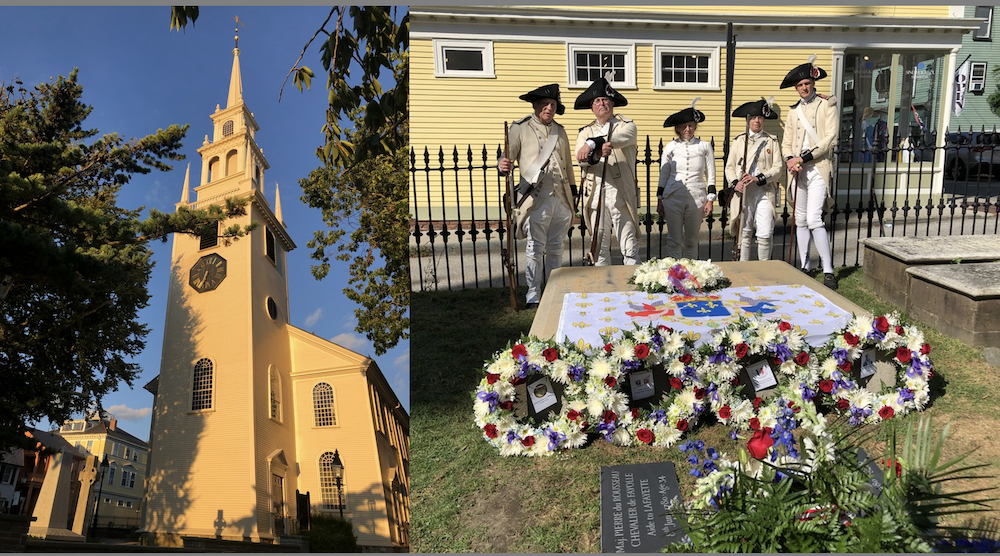
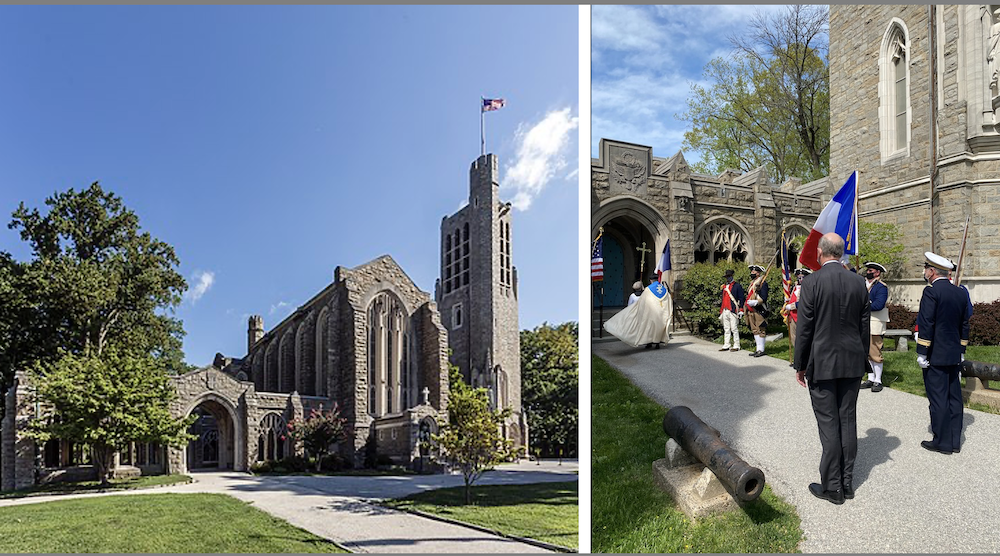
Left: Historic Trinity Church, Newport, R.I., where Admiral de Ternay (who commanded the French fleet transporting Rochambeau and his Expeditionary forces) is buried and where we placed the two markers next to his grave (foreground)
Right: Color guard in period uniforms during the ceremony, Prof. Norman Desmarais at left.
Photos: Daniel Falgerho, Federation of French War Veterans, Inc.
| | |
Historic Grave Markers inaugurated
September 11-12, 2021
Our Association was proud to participate in the inauguration of two grave markers to pay tribute to two French officers of the French Navy frigate Hermione who are interred in the Trinity Church historic cemetery of Newport, Rhode Island.
The ceremony took place on Saturday September 11, 2021 during the City of Newport's "Tribute to France" weekend.
We contributed to this endeavor, along with the National Park Service, the Newport Historical Society, the American Friends of Lafayette, the Washington-Rochambeau Revolutionary Route association, among other civic and patriotic organizations.
The history of these two young officers is poignant, as they gave their lives for America's freedom. You can read more about Major Pierre du Rousseau, Chevalier de Fayolle, and Second Lieutenant Augustin Benjamin de la Villemarais in this September 2021 Bulletin.
| | |
Annual "French Alliance Day"
1st Sunday of May
George Washington Memorial Chapel
Valley Forge, PA.
April 2021 Bulletin
| | |
French Alliance Day
The Treaty of Alliance between France and the United States was concluded at Paris, February 6, 1778. The treaty was ratified by Congress on May 4, 1778.
When word of the Alliance and its ratification by the Continental Congress reached Valley Forge, General George Washington issued this famous General Order:
“It having pleased the Almighty Ruler of the universe to defend the course of the United States, and finally raise up a powerful friend among the princes of the earth *, to establish our Liberty and Independence upon a lasting foundation, it becomes us to set apart a day for gratefully acknowledging the Divine goodness, and celebrating the important event which we owe to His Divine interposition."
* King Louis XVI
Fast forward to our contemporary times: every year, on the first Sunday of May, our friends at the Washington Memorial Heritage celebrate this event with a very moving service at the George Washington Memorial Chapel, attended by representatives of many patriotic associations. The French Embassy is represented with diplomatic or military personnel delivering remarks. We are honored to be invited and lay the wreath of Le Souvenir Français in front of the Lafayette door.
| | |
French Airmen who died in the USA
1943-1945
May 2021 Bulletin
| | |
Above:
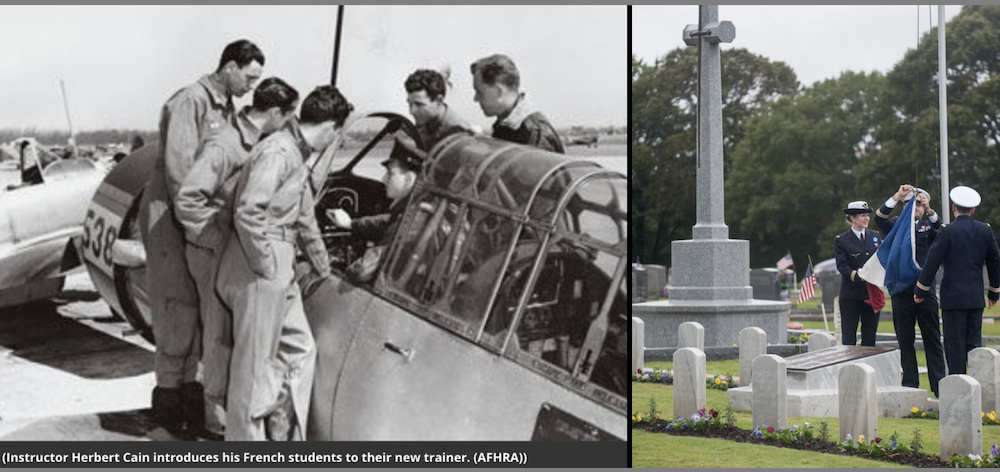
Left: “The French Pilot Training Experience at Oscoda Army Air Field During World War II.” Air Power History, vol. 64, no. 3, 2017, pp. 37–46. JSTOR, Photo credit: Vaughan, David K.
www.jstor.org/stable/26571039
Right: 20 French Air Force airmen who lost their lives flying training accidents in the Southeast U.S. during World War II are buried at the Oakwood Cemetery Annex in Montgomery, Alabama, along with 78 R.A.F. Cadets.
| | |
During World War II, approximately 4,100 French Air Force aviators and ground personnel came to train in the United States between 1943 and 1945. After the British, it was the largest contingent to receive combat training in several US AIr Forces bases, principally in Maxwell Air Force Base and Gunter Field, both in Montgomery, Alabama and Selfridge and Oscoda-Wurtsmith,, Michigan, where 700 officers and 2,300 enlisted airmen were trained as bombers.
Sadly, more than 60 of them died in crashes while training. 20 are buried in Alabama, alongside 78 Royal Air Force student pilots.
This is the story of a lesser-known chapter of a longstanding, historic collaboration between the French and American Armed Forces, fighting for democracy and freedom side by side.
We would like to acknowledge the tremendous research work carried out by Mr. Patrice Laverdet, member of our Society, and invite you to visit his website: Les Centres de Formation du Personnel Navigant en Amérique
| | |
The Washington-Rochambeau
Revolutionary Route (W3R)
A series of 5 Bulletins
June - October 2021
| | |
Above:
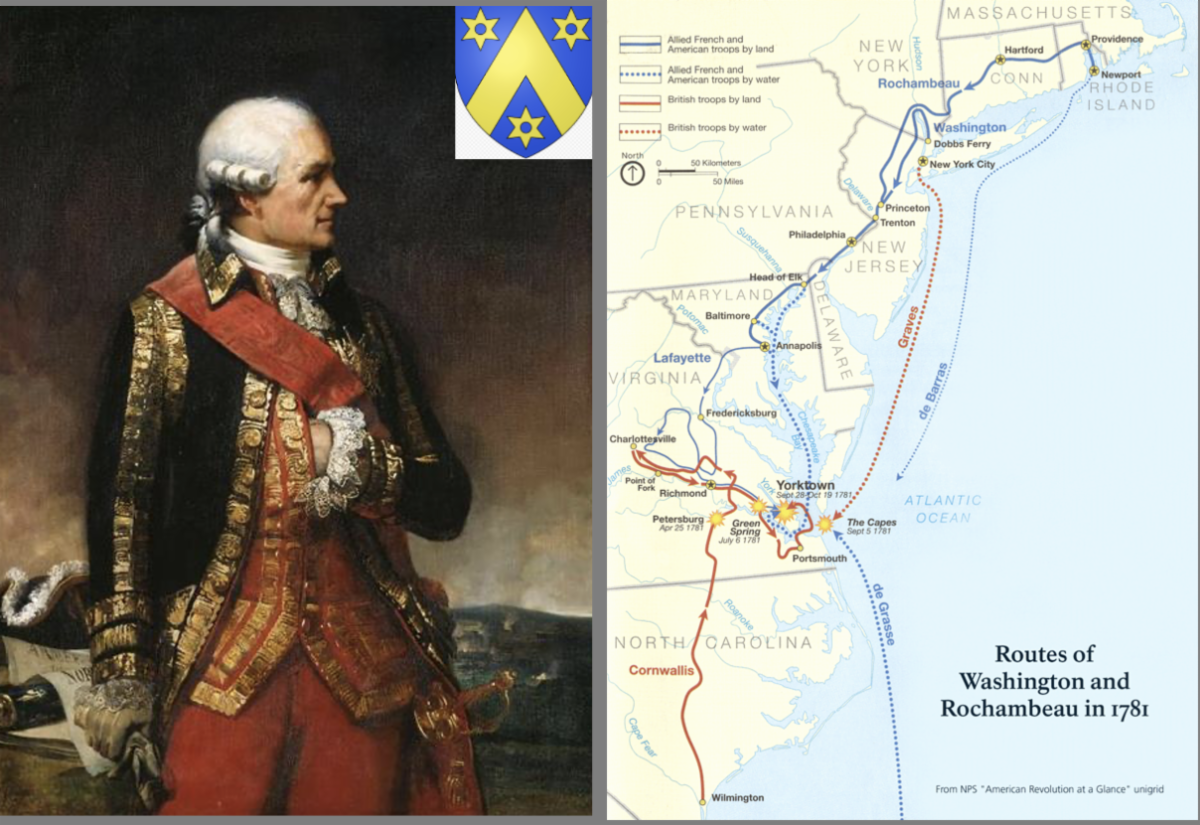
Left: Jean-Baptiste-Donatien de Vimeur, comte de Rochambeau (1725-1807), oil on canvas painting by Charles-Philippe Larivière (1798-1876), c. 1834, on display at the Corps central, Grands Appartements, salle de 1792, Château de Versailles, Public Domain,
https://collections.chateauversailles.fr/#/query/769d3cfb-4aab-4c1d-a6a4-f3ce308fdb37
Right: Park Service map of the Washington–Rochambeau Revolutionary Route, By National Park Service - Public Domain, https://commons.wikimedia.org/w/index.php?curid=3877939
| |
A "Long March" to the victory
That cemented American independence
The Washington-Rochambeau Revolutionary Route National Historic Trail (WARO) is a 680-mile, multi-state land and water trail (9 states + D.C.) commemorating the 1781-1782 march of General Washington’s Continental Army and French forces under Rochambeau to victory at Yorktown. Managed by the National Park Service, this route features numerous historical, cultural, and recreational sites.
In June 1781, General Rochambeau led the French armed forces on a 14-week, 691-mile epic march from Rhode Island to Virginia to aid General Washington and ultimately deliver a resounding victory over the British at Yorktown on October 19 of that same year.
• In the June bulletin (Part 1 – Connecticut) we documented the march throughout Northern Connecticut from the 3rd to 6th camp.
• In July, (Part 2 – Connecticut & New York) we narrated stories from the 7th to the 11th camp, culminating in the month-long stay at Hartsdale, in the town of Greenburgh, north of New York City, where Rochambeau had his headquarters. It was there that he and General Washington made the fateful decision to swiftly march to Yorktown, entrap General Cornwallis with the incoming French Navy fleet under Admiral de Grasse, and leave British General Clinton in New York—until it was too late for him to realize what was happening and catch up.
• In August (Part 3– New York/New Jersey to Philadelphia), we told stories from the 14th to the 27th camp, culminating in the military parade in front of George Washington and the Continental Congress in Philadelphia at the beginning of September, 1781.
• In the September bulletin, (Part 4–Philadelphia to Yorktown, Battle of the Capes), we recount with several fascinating anecdotes the race to entrap General Cornwallis in Yorktown before he could escape. For this to happen, the French Marine Royale had to acquire naval supremacy in the area to prevent any rescue by the British Royal Navy.
If successful, after six years of an epic struggle, the final act of the War of Independence would be at hand!
• In October, (Part 5 – Final episode: Victory in Yorktown!) we narrated the Yorktown victory: although not technically the end of the war (which continued in India until the French naval victory at Cuddalore in June 1783), the resounding Allied victory at Yorktown prompted the British Cabinet to seek peace negotiations and eventually grant formal recognition of American independence through the Treaty of Paris, signed September 3, 1783.
The National Washington-Rochambeau Revolutionary Route Association Inc. (W3R-US) is the private sector 501c3 partner to the Washington Rochambeau National Historic Trail. W3R-US’ mission is educating the public both about the Washington Rochambeau National Historic Trail, and the Trail’s context within the American Revolution
| |
The Two Unknown Soldiers from WW1
Side by side across the Atlantic
November 2021 Bulletin
| | |
Above:
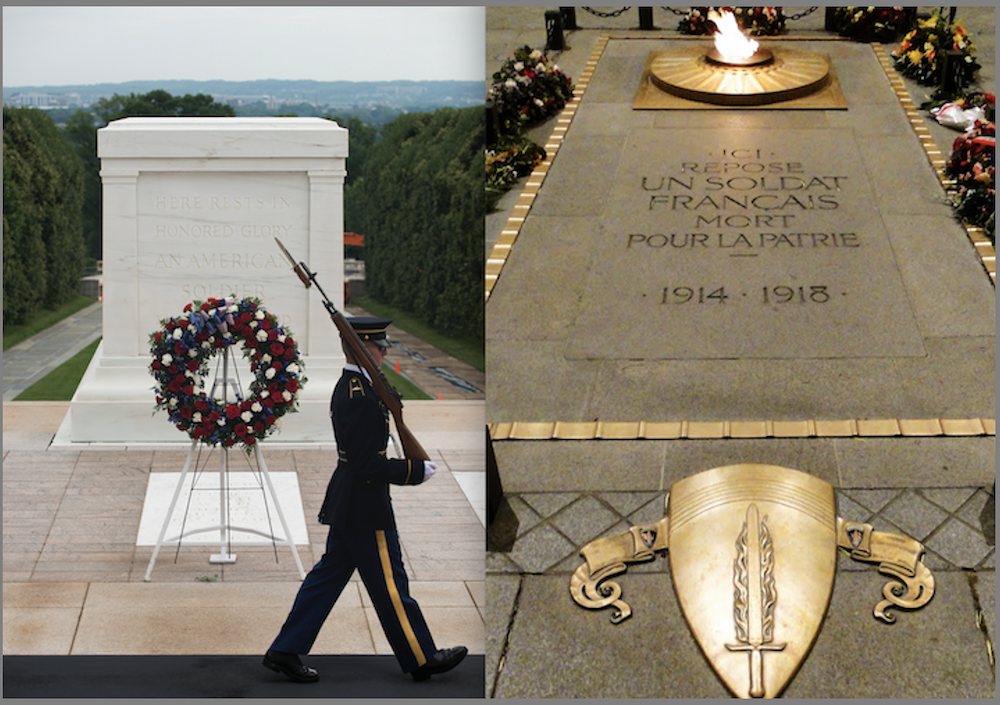
Left: A Tomb Guard from the 3d U.S. Infantry Regiment (The Old Guard), Tomb Guard Platoon, goes past the Tomb of the Unknown Soldier sarcophagus in Arlington, Va., June 30, 2017. (U.S. Army photo by Elizabeth Fraser / Arlington National Cemetery / released) -
Right: Tombe du Soldat Inconnu, Arc de Triomphe, Paris, photo by Mike Peel CC BY-SA 4.0, Public Domain, https://commons.wikimedia.org/w/index.php?curid=32818348
| | |
In honor of Armistice Day/Veterans Day on November 11th—the anniversary of the end of World War I—we dedicate every November bulletin to a French-American episode of the 'Great War.' This first bulletin started with the highest symbol of a shared patriotism: The Unknown Soldier.
• On November 20, 1916, while the battle of Verdun was still raging, Francis Simon, president of the local chapter of Le Souvenir Français in Rennes, Brittany, suggested that France honor a soldier who had died for the Motherland, as a homage to all soldiers who fought for the ideals of freedom. On November 8, 1920, the French Chamber of Deputies unanimously passed a law so that the remains of an Unknown Soldier be buried under the Arc de Triomphe.
• Similarly, on October 29, 1919, Brigadier General William D. Connor, Commander of the United States Forces in France, proposed to the Chief of Staff of the United States Army, General Peyton C. March, to honor an unidentified American soldier killed in action on French soil, following the model of French ceremonies. On March 4, 1921, Congress approved the project, and on November 11, 1921, the Unknown Soldier was interred at Arlington National Cemetery.
We gratefully acknowledge J.R. Neubeiser, Historian of the Society of the Honor Guard, Tomb of the Unknown Soldier, and salute his impressively detailed and moving narration, from the selection of the Unknown Soldier to the epic journey home on board the USS Olympia during a hurricane, to his final resting place in Arlington: "With the Hand of God He Will Be Delivered Home”.
https://tombguard.org/news/article/with-the-hand-of-god-he-will-be-delivered-home
| |
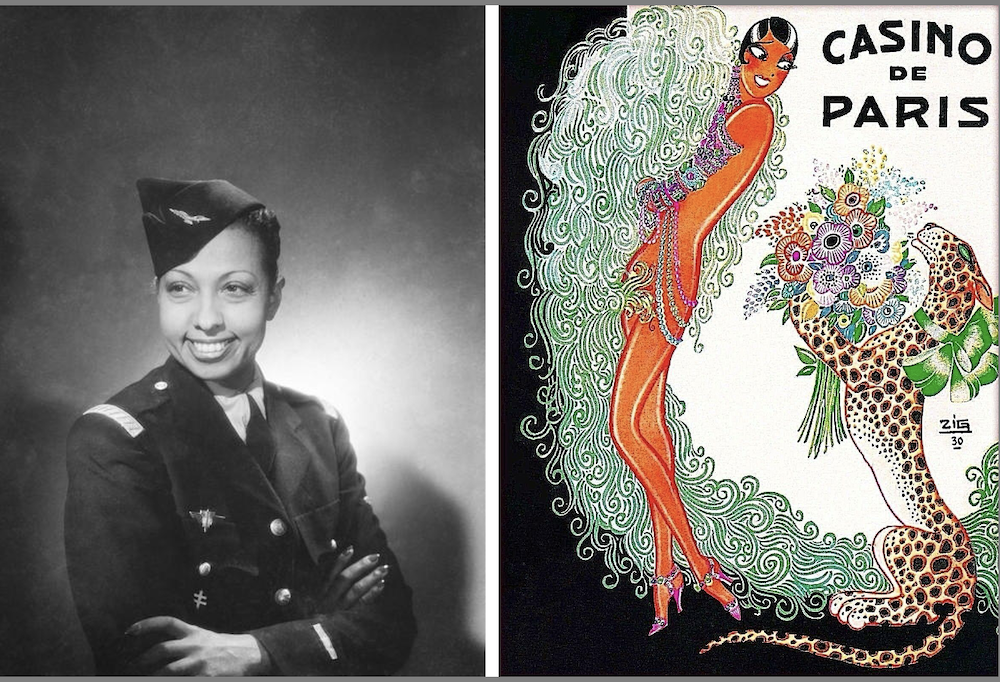
Tribute to Josephine Baker
at the Panthéon, Paris
Black History Month Bulletin, February 2022
| | |
"J'ai deux amours, mon pays et Paris"
(“I have two loves, my country and Paris”)
• Josephine Baker (born Freda Josephine McDonald; June 3, 1906 – April 12, 1975) became a French and American icon through her extraordinary journey from poverty to stardom and her unwavering commitment to justice. Born in St. Louis, Missouri, to a desperately poor family, she escaped domestic work and a teenage marriage to pursue performance in New York before moving to Paris in the 1920s. There, she became an instant sensation and one of the most celebrated artists of the interwar period. Choosing France as her home, she became a naturalized French citizen (taking the name Joséphine Baker), and during World War II, she risked her life serving in the French Resistance—earning the Resistance Medal, the Croix de Guerre, and the Légion d'Honneur from Charles de Gaulle himself.
Beyond her artistic brilliance, Baker embodied values that transcended borders. She adopted twelve children from different countries and continents. As a tireless civil rights activist, she refused to perform for segregated audiences and spoke alongside Dr. Martin Luther King Jr. at the 1963 March on Washington. Her death in 1975, just days after a triumphant return to the Paris stage, sparked an immense outpouring of grief in France, cementing her legacy as a symbol of courage, creativity, and the fight for human dignity on both sides of the Atlantic.
• On November 30, 2021, during a particularly moving ceremony, she entered the Panthéon in Paris, the first Black woman to receive one of the highest honors in France. As her resting place remains in Monaco, a cenotaph was installed in vault #13 of the crypt in the Panthéon.
You can view the entire ceremony in English by clicking: HERE
President Emmanuel Macron said at the end of his speech:
"You enter our Pantheon because, born American,
there is no one more French than you."
| | |
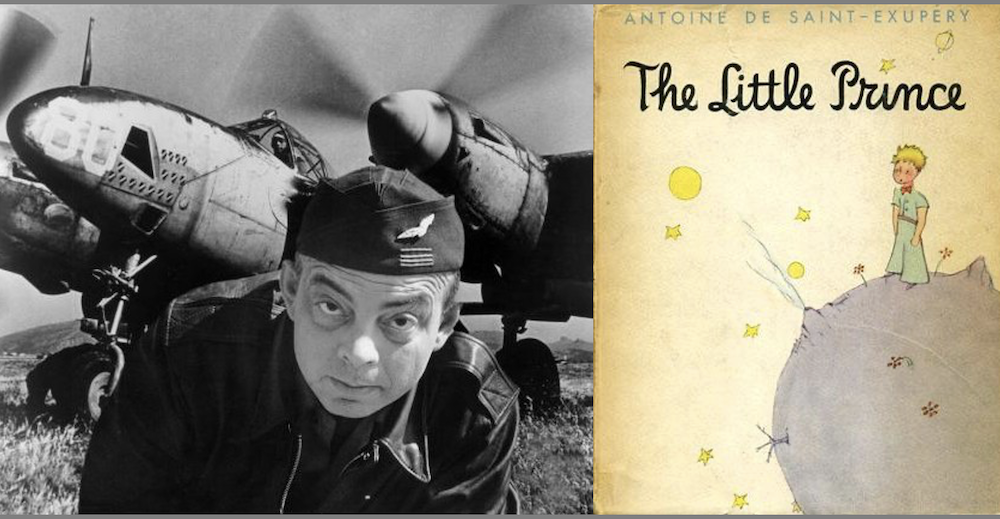
Tribute to Antoine de Saint Exupéry
Pioneer Aviator, Author, Patriot, WWII Hero
March 2022 Bulletin
| | |
Above:
Top Left: Antoine de Saint Exupéry in front of his Lightning-P38, Photo by John Phillips, ©The John and Annamaria Phillips Foundation.
Top Right: first edition cover of The Little Prince, by Antoine de Saint-Exupéry (1900–1944) - Fair use, https://en.wikipedia.org/w/index.php?curid=7777341
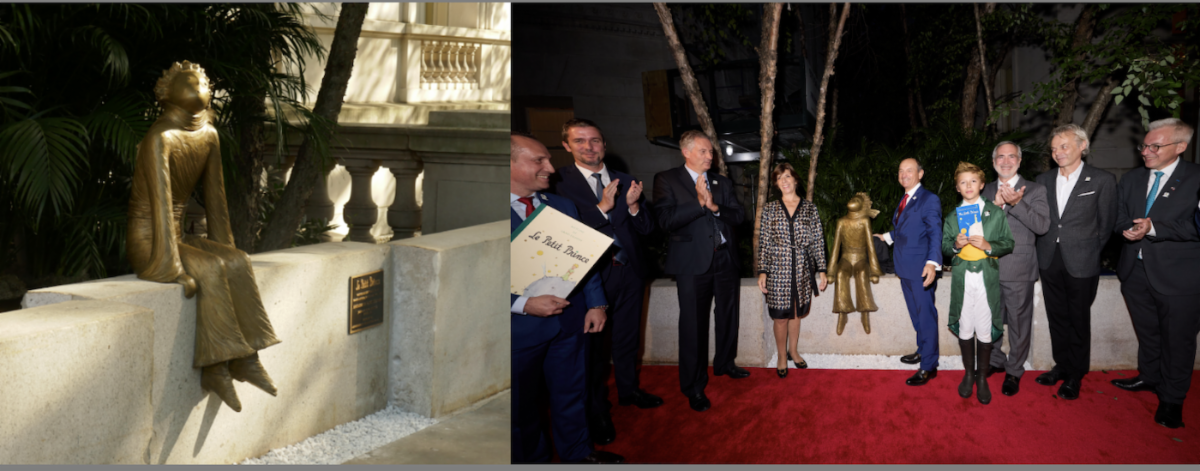
Below: Official inauguration of our sculpture at Villa Albertine, 972 Fifth Avenue, NY on September 20, 2023 by Mme Catherine Colonna, Minister for Europe and Foreign Affairs of France. Click on the photo above to see the entire special edition bulletin dedicated to the sculpture.
| | |
The motto of our association is: 'À nous le Souvenir, à eux l'Immortalité'... (Remembrance is ours, Immortality is theirs). This, of course, applies to all those who died for France while defending the cause of freedom.
At the church of Notre-Dame, located at 405 West 114th Street in upper Manhattan, there are several marble and bronze plaques affixed to the wall, with the names of 463 French conscripts and American volunteers who 'Died for France' during World War One and World War Two.
Among them is Commandant Antoine de Saint-Exupéry who achieved 'immortality' for dying in the line of duty on July 31, 1944, at the controls of an American P-38 Lightning reconnaissance plane, with French Air Force colors on its fuselage.
While very few New Yorkers or tourists know about these rosters of names, hundreds of millions of readers around the world have heard of Antoine de Saint-Exupéry's immortal masterpiece, The Little Prince, which is both an illustrated children's book and a philosophical novella. And this is not hyperbole: The Little Prince is the most translated book after the Holy Bible, translated into more than 600 languages and dialects!
And yet, how many know that Le Petit Prince was written entirely in New York in 1942, and was first published in English in the United States in 1943?
We are proud to have installed a bronze statue of The Little Prince in front of Villa Albertine on Fifth Avenue in 2023. It has been a hit with tourists and New Yorkers alike ever since, with thousands of selfies taken every month.
And we will inaugurate in a few months a bronze statue of Antoine de Saint-Exupéry and his companion Le Petit Prince at the entrance of the Frost Museum of Science and Planetarium in the heart of Miami, Florida.
See more details on how you can be part of this worthy endeavor at the end of this Bulletin, and have your name engraved on a plaque!
| | |
Major Pierre Charles L'Enfant
Our marker at Arlington National Cemetery
April 2022 Bulletin
| | |
Above:
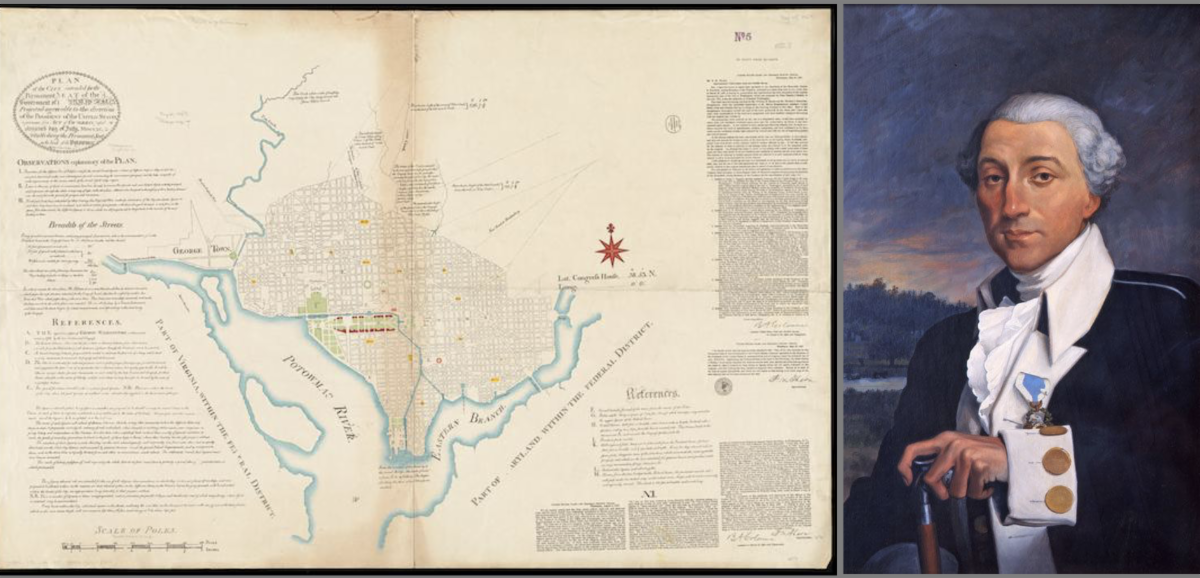
Top Left: "Plan of the city intended for the permanent seat of the government of (the) United States ..."; Facsimile of manuscript of L'Enfant plan, by Peter Charles L'Enfant - Library of Congress: Created and published by the United States Coast and Geodetic Survey, Washington, D.C. (1887), Public Domain, https://commons.wikimedia.org/w/index.php?curid=50638693
Top Right: Pierre Charles L'Enfant - Painting by artist Bryan Leister, based on a silhouette of L'Enfant and a pastel of the Major's father. It currently hangs in the District of Columbia Historical Society in Washington, DC. https://alchetron.com/Pierre-Charles-L'Enfant
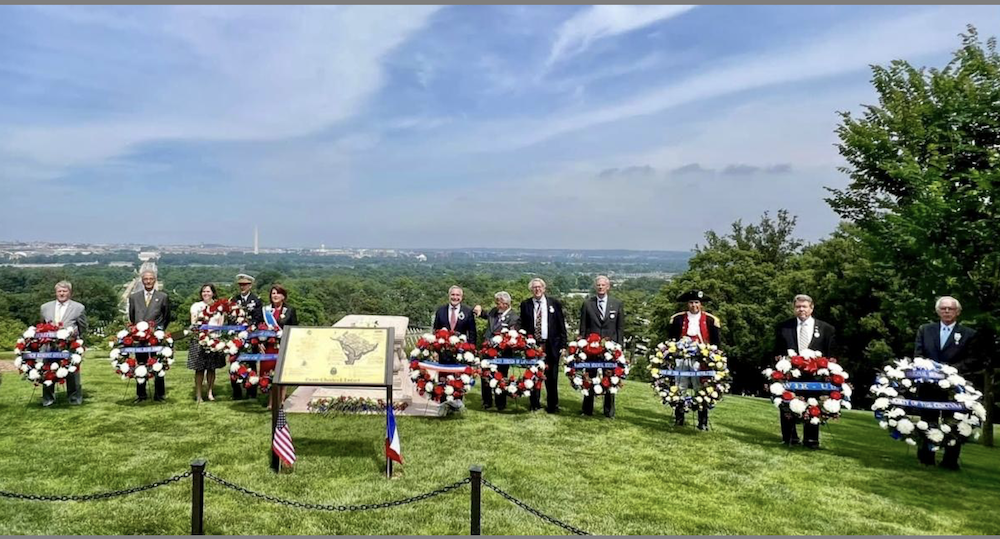
Below: Presidents of major American and French patriotic organizations gather for a "family photo" at the inauguration of the L'Enfant marker, Arlington National Cemetery, June 14, 2022
| | |
L'Enfant Plan - Washington D.C.
Long forgotten, Major Pierre Charles L'Enfant's legacy was restored, thanks to Ambassador Jusserand, who pushed for L'Enfant's posthumous recognition in 1909 after more than 80 years of obscurity, and who devoted a chapter to the close relationship between George Washington and this French military engineer in his Pulitzer Prize-winning book "With Americans of Past and Present Days".
L'Enfant volunteered to fight for the "Insurgents" early in the Revolutionary War and was commissioned as a Major by the Continental Congress. He became a protégé of General George Washington. Yet, despite his many accomplishments—including developing the visionary design for the brand new capital of the young Republic—L'Enfant died in total poverty and had faded from public memory.
Like so many others, this French aristocrat fell in love with the United States and its values. He came to defend the cause of freedom and fervently believed in the revolutionary concept of equality that he found embodied in his new nation. We wrote this bulletin as a tribute to a Frenchman who designed the United States capital, with a vision that remains resplendent today.
Site of the US Capitol:
L'Enfant selected the place for the Capitol, a place called "Jenkin's Hill", which he described as a "pedestal awaiting a monument", at the highest point overlooking the Potomac.
Site of The White House:
He also selected the place for the White House (so named in 1817, but originally called the Federal House), which, he wrote, will be "adding to the sumptuousness of a palace the convenience of a house and the agreeableness of a country seat".
Streets, Avenues, Circles, Squares:
He sketched wide avenues and streets: "Attention has been paid to the passing of those leading avenues over the most favorable ground for prospect and convenience."
Above all, L'Enfant was guided by his vision of grandeur for the new nation and its capital city: "we must leave to posterity a grand idea of the patriotic interest which promoted it." (L'Enfant's Observations Explanatory of the Plan, inscribed on it)
The Mall:
The centerpiece of L'Enfant's plan was a great "public walk". Today's National Mall is a wide, straight strip of grass and trees that stretches for two miles, from Capitol Hill to the Potomac River. Smithsonian museums flank both sides and war memorials are embedded among the famous monuments to Lincoln, Washington and Jefferson.'
On June 14, 2022, we inaugurated a new interpretive marker at the tomb of Major L'Enfant, which we co-signed with the Daughters of the American Revolution.
On average, ten thousand tourists visit Arlington National Cemetery each summer day and can now learn more about the accomplishments of this Patriot.
| |
Tribute to the Four Americans
“Compagnons de la Libération"
May 2022 Bulletin
| |
Above:
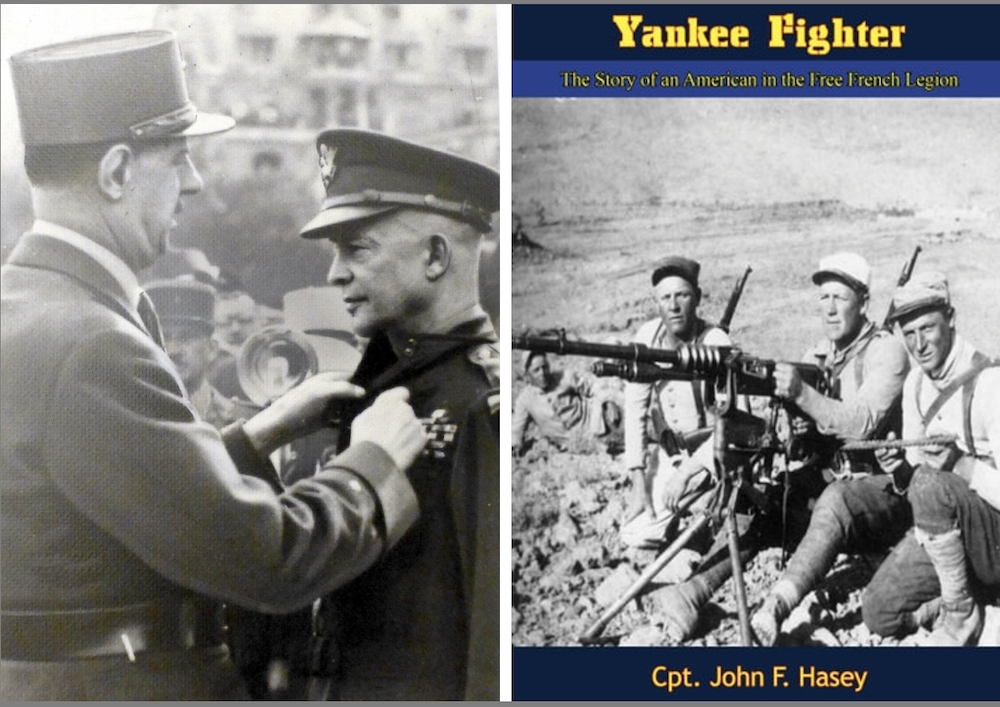
Left: Général Charles de Gaulle inducts General Dwight D. Eisenhower into the "l'Ordre de la Libération", June 14, 1945, Arc de Triomphe, Paris. https://youtu.be/NubLLENd7I4
Right: Another one of these heroes is John Hasey. His book of memoirs "Yankee Fighter, the story of an American in the French Foreign Legion" dictated from his hospital bed in 1942 gives a first-hand account of the sudden collapse of France, the very first days of the Free French, and their incredible odyssey throughout the vastness of Africa and the Sahara desert.
| |
We paid homage in this bulletin to the only four Americans awarded the title of 'Compagnon de la Libération,' out of a total of 1,038 individuals ever inducted into this Order.
This little-known fact in the long history of the French-American alliance deserves to be better known. The most illustrious of the four is General Dwight D. Eisenhower, no less, but the other three also deserve public recognition here in America: John Hasey, Jacques Terrane (Tartière), and James Worden. This bulletin tells their stories.
We plan to honor John Hasey with an insignia at his tomb in the presence of his descendants, at Columbia Memorial Park, Arlington, VA.
| |
The crucial role of the French Navy
in the War of Independence
June 2022 Bulletin
| |
Above:
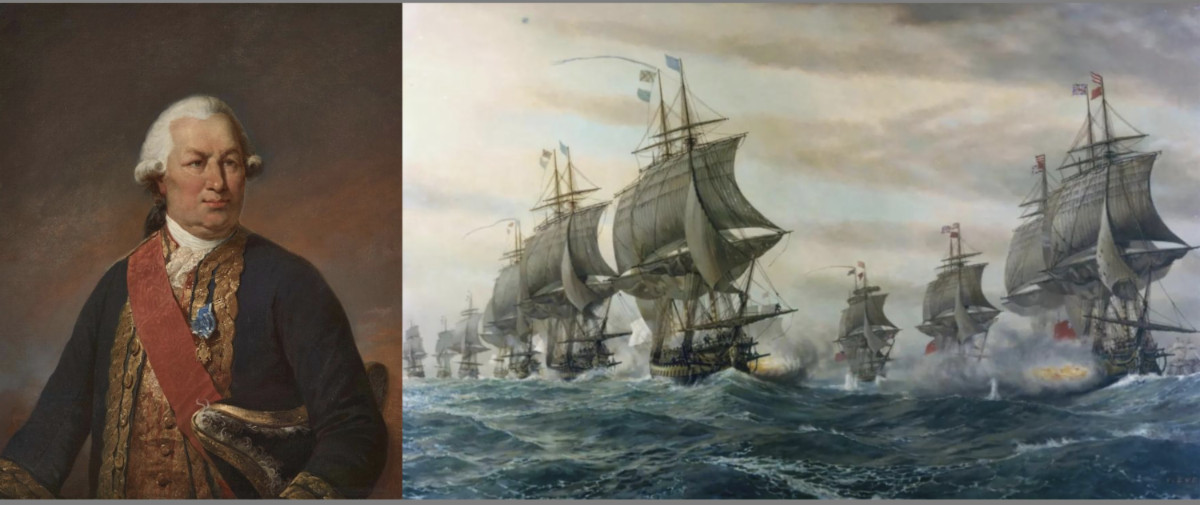
Top Left: Portrait of Admiral de Grasse by Jean-Baptiste Mauzaisse - Joconde, Public Domain, https://commons.wikimedia.org/w/index.php?curid=10628855/
Top Right: Battle of The Capes, September 5, 1781, oil on canvas by v. Zveg, 1962, depicting the French fleet (at left), commanded by Vice Admiral the Comte de Grasse, engaging the British fleet (at right) under Rear Admiral Sir Thomas Graves. Hampton Roads Naval Museum, Courtesy of the U.S. Navy Art Collection, Washington, Public domain, https://commons.wikimedia.org/w/index.php?curid=1177171
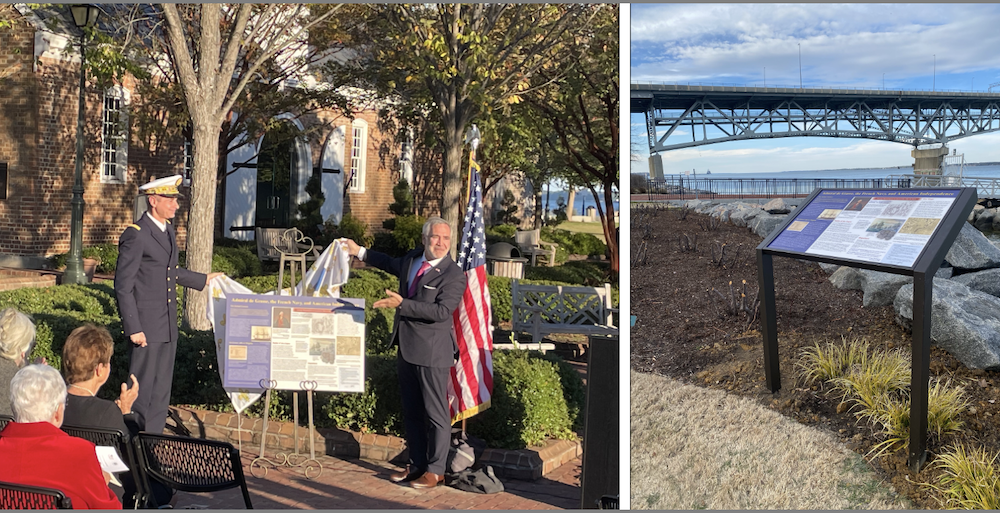
Bottom: inauguration at Riverwalk, Yorktown, with Rear Admiral Frédéric de Rupilly, French Navy, Deputy Chief of Staff (Plans), Joint Force Command, NATO - Norfolk, Oct. 18, 2022
| |
In this Bulletin, we gave an overview of the crucial role played by the French Navy during the American Revolutionary War.
The "Marine Royale" not only carried French troops across the Atlantic Ocean, they fought the British Navy on all oceans from the eastern seabord of North America to the Caribbean, in the Indian Ocean and India.
By prevailing at the "Battle of the Capes" on September 5, 1781, the French Navy under admiral de Grasse successfully sealed the fate of the British in Yorktown, the resounding victory which led to the independence of the United States.
On October 18, 2022, we inaugurated an interpretive marker telling the story of admiral de Grasse and the French Navy at Riverwalk, Yorktown, visited by thousands of tourists.
| |
Two National Holidays in July:
celebrating the same ideal of Liberty
July 2022 Bulletin
| |
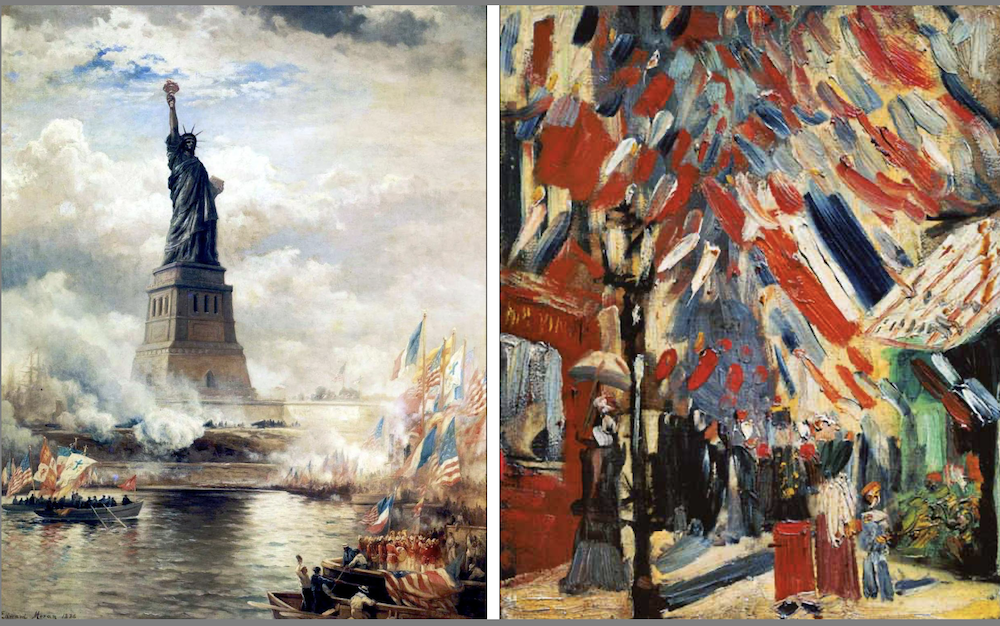
Above:
Left: Unveiling of the Statue of Liberty Enlightening the World (1886) by Edward Moran. Oil on canvas.
By Edward Moran - Museum of the City of New York, Public Domain, https://commons.wikimedia.org/w/index.php?curid=229787
Dedicated in 1886, the statue holds a torch above her head with her right hand, and in her left hand carries a tabula ansata inscribed JULY IV MDCCLXXVI (July 4, 1776 in Roman numerals), the date of the U.S. Declaration of Independence. A broken shackle and chain lie at her feet as she walks forward, commemorating the recent national abolition of slavery.
Right: 14-Juillet à Paris, by Vincent van Gogh, painted the same year, in the summer of 1886 - Public Domain, https://commons.wikimedia.org/w/index.php?curid=9402914
| |
The July 2022 bulletin started with this editorial:
"Summer has started, and the month of July is synonymous with patriotic festivities in both the United States and France.
...Two National Holidays in July, same shared values...
In the history of the world, there have been few examples, if any, of such a long and deep amity between two nations. Despite different evolutions in the geopolitical sphere over the past 250 years, the basic fundamental bonds of friendship remain strong. It seems important in view of current world events to remind ourselves of the special meaning of this historical friendship.
We thought it appropriate to ponder the significance of our national holidays, which in spite of different historical contexts, fourteen years apart, both celebrate the same values of liberty and democracy. Both peoples fought for their freedom, one from a distant king and overtaxing government, the other from an absolute monarch also overtaxing its subjects. Both were inspired by the same philosophers of the age of Enlightenment: Voltaire, Montesquieu, Rousseau, Locke, Thomas Paine, Benjamin Franklin, Diderot, Hume, to name a few.
...Lady Liberty, and other gifts...
What better shining example of this friendship and symbol of our shared values than our Lady Liberty?
As always with our bulletins, we endeavor to turn the spotlight on a few basic facts and anecdotes, well known or more obscure, and highlight other gifts from the French government, municipalities, or French private citizens to the United States and its peoples, in places in America where the French presence can still be felt."
| |
Jean Ribaut's and his Colony's tragic fate
September 2022 Bulletin
| | |
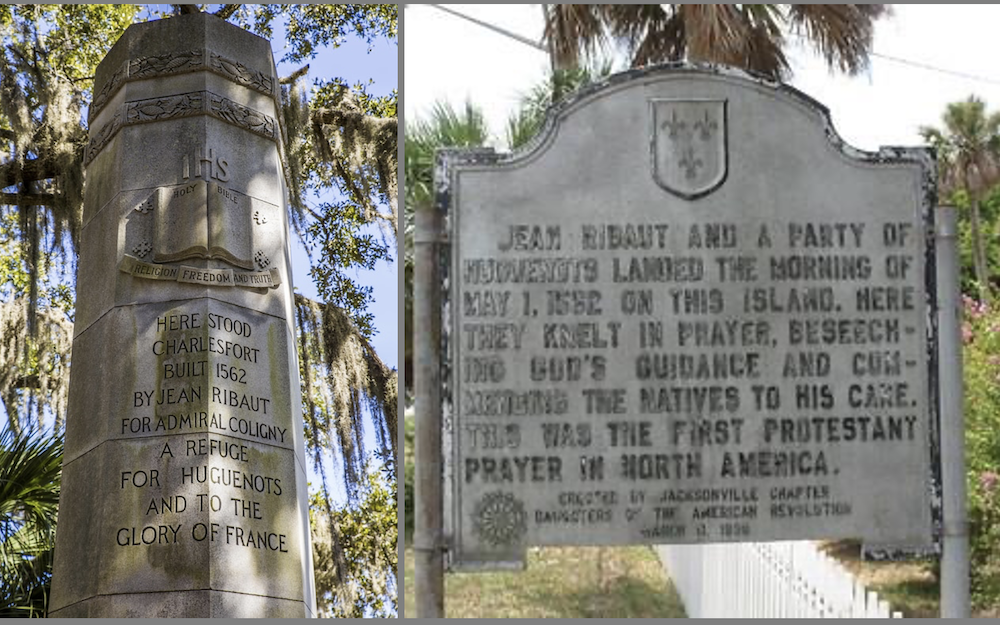
Above:
Left: "The Ribaut Monument”, U.S. Marines Corps Air Station Beaufort
Parris Island, Belleau Wood Road Circle, Beaufort, SC 29902, GPS: 32.306217, -80.675550
Photo by Sgt. Dengrier M. Baez, US Marines Corps Air Station Beaufort
A replica of the French Memorial is also part of the Marine Corps Depot entrance wall
Right: Marker, "The First Protestant Prayer In America" 9953 Heckscher Dr, Jacksonville, FL 32226
GPS: 30.402467, -81.432450
| |
The Tragic Fate Of Jean Ribault
And French Huguenots In Florida
September 29, 1565
Everyone knows the story of the pilgrims on the Mayflower. Yet hardly anyone knows that some 55 years before their arrival in Portsmouth, a colony of French protestants came to seek refuge from persecution in today's Jacksonville, Florida, and Beaufort, (north of Savannah), in South Carolina.
Unfortunately, their fate was tragic. They were not massacred by Indians, with whom they had established very friendly relations, but they were massacred by Spaniards who were determined to claim the area and expel non catholics, whom they viewed as heretics.
Today, a few markers and monuments remain. They attest to a remarkable story, largely forgotten, yet rich in accomplishments.
The enumeration of all the "firsts" accomplished by Jean Ribault and his companions is quite extraordinary. Yet who, among the general public, knows these facts? History taught in school textbooks only retains clichés, which are self-perpetuating....
Thus, this fairly recent marker (2016) deserves to be better known....
Judge for yourself!
Marker “French Huguenots in North America”
4830 Ocean St, Jacksonville, FL 32233
GPS: 30.395467, -81.429083
• Inscription (excerpts - highlights are ours):
“This marker commemorates the French Huguenot landing near this site on May 1, 1562, and their lives as colonists on the land until 1565. Hoping to escape religious persecution in Western Europe, the Huguenots set sail to this un-colonized portion of the New World, establishing La Caroline in June of 1564. Between May 1562 and September 1565, the Huguenots shaped history by establishing many "firsts":
The first Protestant prayer on American soil, offered by Jean Ribault;
the first settlement of men and women seeking religious freedom;
the first Colonial Thanksgiving, celebrated June 30, 1564;
the first known commercial artist of North America, Jacques le Moyne, who documented native Timucua life;
the first recorded birth of a European child in the continental United States;
the first international port of trade when Englishman John Hawkins exchanged goods with La Caroline's leader, René de Laudonnière;
and with the 1565 Spanish attack on the colony, the first battle between European forces on soil that later became the United States.”
| | |
The Canyon of Heroes
Broadway ticker tapes parades
October 2022 Bulletin
| | |
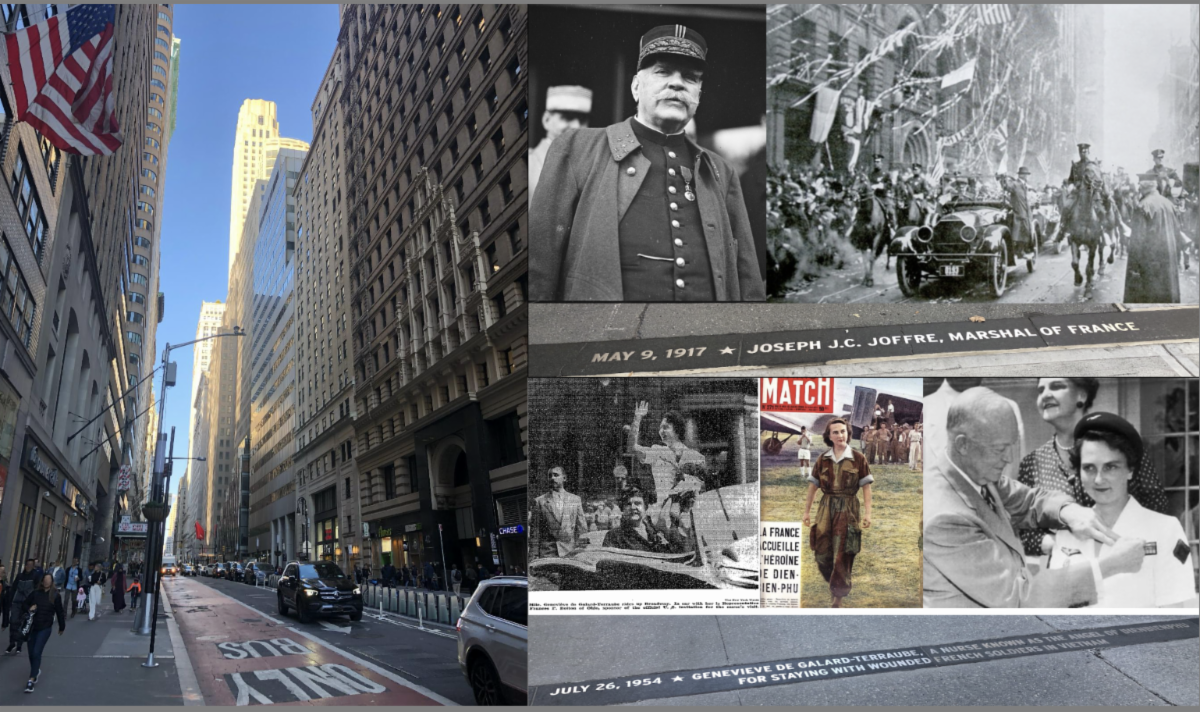
Above:
Left: "The Canyon of Heroes" on Broadway, starting at Battery Park and ending at City Hall, New York NY 10004 GPS: 40.705759, -74.013468 - Photo TC © ASSFI 2022
Top Right: Library of Congress Prints and Photographs Division Washington, D.C. 20540 http://hdl.loc.gov/loc.pnp/hec.42122 Public Domain - Marshal Joffre and Viviani arrive in New York, First World War, 9 May 1917. Joffre, Commander-in-Chief of the French army, and Rene Viviani, Prime Minister of France when war broke out in 1914.
New York Public Library, https://twitter.com/nypl/status/1148960671637352448/photo/1
Bottom Right: Geneviève de Galard-Terraube, The New York Times - Middle: front cover of Paris Match magazine, May 24 1954 - Right: Gen. Eisenhower decorating "the angel of Dien Bien Phu"
https://www.presidency.ucsb.edu/documents/citation-accompanying-the-medal-freedom-presented-genevieve-de-galard-terraube
| | |
In the previous month's bulletin, we narrated several events, some well known, some almost forgotten, which all took place in the month of September throughout several states.
In this October 2022 bulletin, we focused instead on one specific, narrowly defined geographic area: 'The Canyon of Heroes' on Broadway, New York City.
Out of a total of 206 ticker-tape parades since 1886, 14 honored visiting French figures (if we include Lafayette in 1824, who, as we will see below, can be considered the precursor of this New York tradition, then the total is 15).
Some of these illustrious French visitors need little introduction. General de Gaulle was one of a grand total of eleven luminaries who had the privilege of being honored twice (in his case, 1947 and 1960).
A few, alas, fell into relative or total oblivion: who remembers, for instance, Geneviève de Galard-Terraube? (She passed away on May 30, 2024 at the age of 99.)
Two of them fell into dishonor. Read our bulletin and find out who they were! True to our mission, we stick to historical facts, the faithful transcription of markers, and contemporary press reports.
| | |
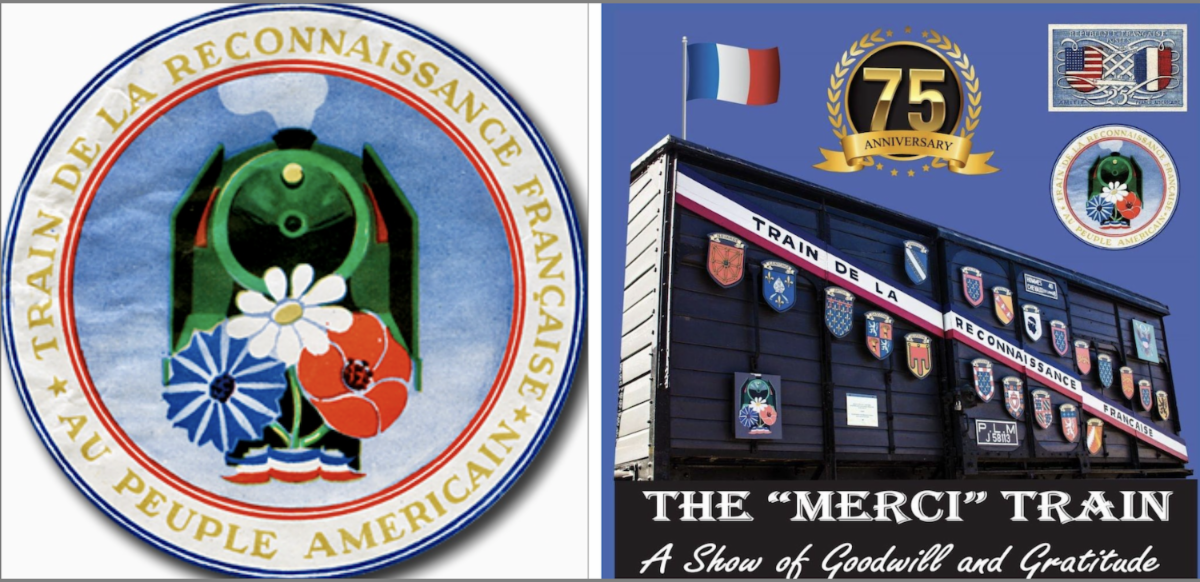
The Merci Train, 49 boxcars of French gifts
November 2022 Bulletin
| | |
Prof. Norman Desmarais, Professor Emeritus at Providence College, Regional Delegate of Le Souvenir Français for New England, who published his 51st book on the American Revolution this past December (see below in the "News & Announcements" section) wrote an entire section of the November 2022 Bulletin, as he is also a Docent of the Museum of Work & Culture, in Woonsocket, RI, where the Rhode Island Merci Train boxcar is exhibited.
Few remember a unique gesture of gratitude from ordinary French people towards the American people, which took place right after World War II in 1949—and whose legacy is kept alive in almost every state by the '40 & 8' Societies, the American Legion, or state museums.
In 1949, a French railroad worker and WWII veteran, André Picard, launched the idea of a 'Train de la Reconnaissance Française,' affectionately nicknamed the 'Merci Train' in the United States. This initiative was quickly endorsed by several associations of French railroad Resistance veterans and French President Vincent Auriol. Composed of 49 boxcars and filled with 'gifts of gratitude,' the Merci Train arrived in New York City on February 3, 1949 with over 25,000 onlookers in attendance, and was divided among the 48 states with the remaining car to be shared by the District of Columbia and Hawaii.
The boxcars' contents (more than a million gifts weighing a total of 250 tons, ranging from dolls, statues, clothes, ornamental objects, furniture, etc.) were opened and turned into exhibits before being distributed as each state saw fit.
Most states continued to exhibit the boxcars to the public after their gifts were distributed. Most, but not all, are preserved today and can be visited.
As André Picard declared, 'We found ourselves unable to reply in the same manner as you aided us,' explaining the plight of a devastated France following the war. 'We did wish to send you remembrances which would last forever."
Every month since, we report on news from our friends from the 40&8 National Boxcar Association and MerciTrain.org, as these historical relics are restored, preserved and serve as backdrops to many patriotic ceremonies.
| | |
George Washington's French engineers
January 2023 Bulletin
| | |
Above:
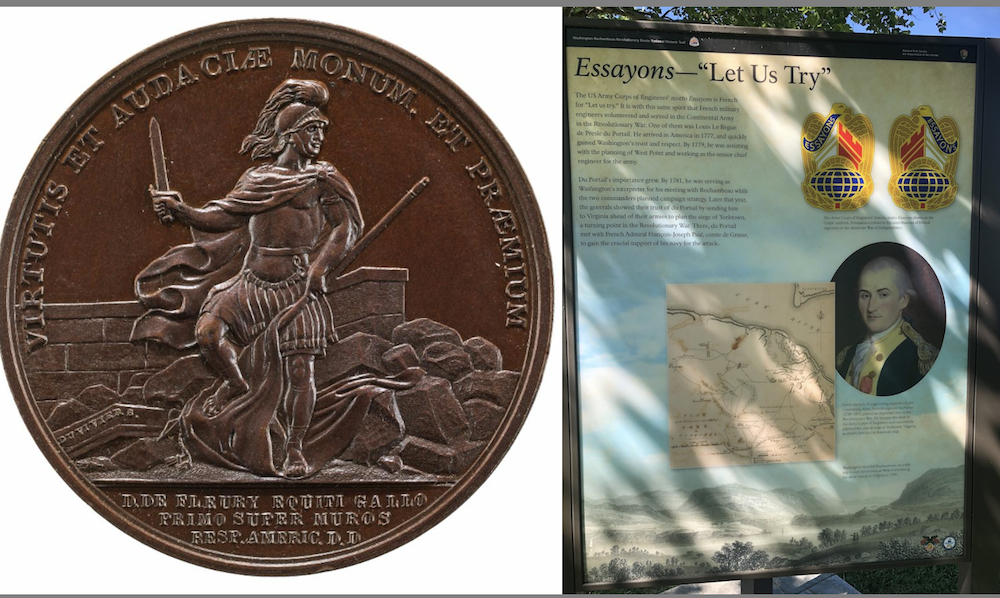
Left: Medal, Francois Louis Teissedre de Fleury at Stony Point 1779, Congress of the United States, (issuing authority), by Benjamin Duvivier, National Museum of American History, Smithsonian, Public Domain, U.S. Mint
VIRTUTIS / ET / AUDACIAE / MONUM. / ET / PRAEMIUM / D. / DE / FLEURY / EQUITI / GALLO / PRIMO / SUPER / MURES / RESP. / AMERIC. / D. / D. / DU / VIVIER / S.,
‘A memorial and reward of valor and daring. The American Republic has bestowed (this medal) on Colonel D. de Fleury, a native of France, the first over the walls (of the enemy)."
Right: Marker “Essayons – Let Us Try” at West Point Military Academy, Visitors Center
Photo: TC © ASSFI (2022)
| | |
The spotlight in this bulletin is turned on the French engineers who worked under George Washington's command in the Continental Army, and whose contributions to American Independence are often overlooked.
Their technical expertise was unmatched, and proved crucial not just during the Revolutionary War but during the decades that followed as well. Alongside heavy artillery—another area of expertise of the French Army (and the topic of another future Bulletin)—these engineers laid the foundations for two centuries of US military engineering excellence, which endures today. Few people know that the De Fleury Medal, the top award of the US Army Engineer Association, was named in honor of François-Louis Teissèdre de Fleury, a French military engineer who served in the Continental Army.
Prof. Desmarais, Professor Emeritus at Providence College, Rhode Island, our Regional Delegate in New England, contributed to this Bulletin with a captivating article: 'Valley Forge: Lieutenant Colonel Antoine-Jean-Louis Le Bègue de Presle Duportail,' narrating the story of one of the most prominent French engineers. Duportail was the founder of the Corps of Sappers and Miners which became the US Army Corps of Engineers.
| | |
French Forts throughout America
A series of Bulletins
February/March/June/November 2023
| | |
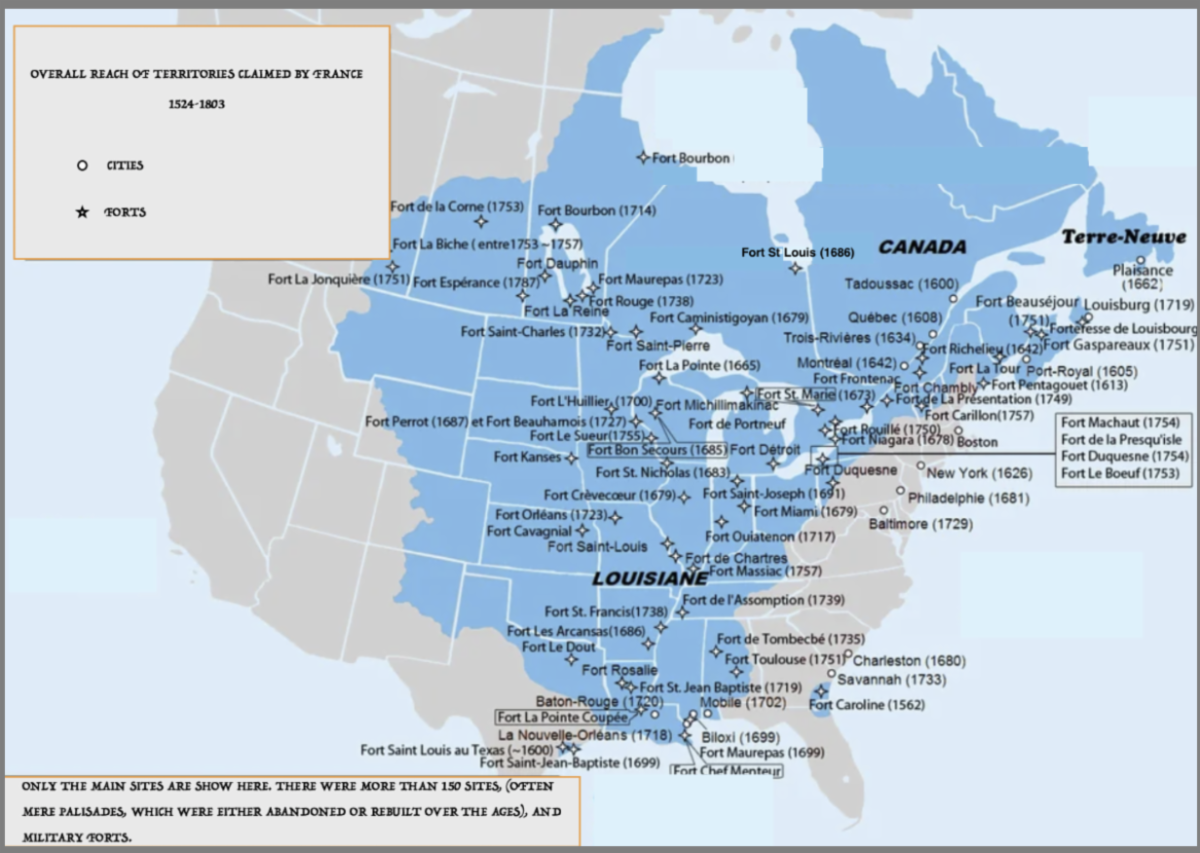
In these four bulletins, we explored several French forts, from the State of New York (French Forts of New York) to the far reaches of Wisconsin (French Forts of the MidWest) all the way south to Louisiana (French Forts of Mississippi and Lower Louisiana), to conclude with French Forts of Ohio & Pennsylvania)
all over a vast empire that stretched from Canada to the Gulf of Mexico until 1763.
In so doing, we paid tribute to soldiers, explorers and missionaries who left an imprint throughout vast portions of the continent. Many of them have been restored or reconstituted and are worth a visit, as several regional historical associations organize events throughout the year.
No doubt there are hundreds of unmarked graves of French soldiers nearby these sites, however we do not have precise historical records to properly honor them.
| | |
Tribute to Jean de Verrazane
First discovery of the Eastern seaboard
April 2023 Bulletin
| | |
Above:
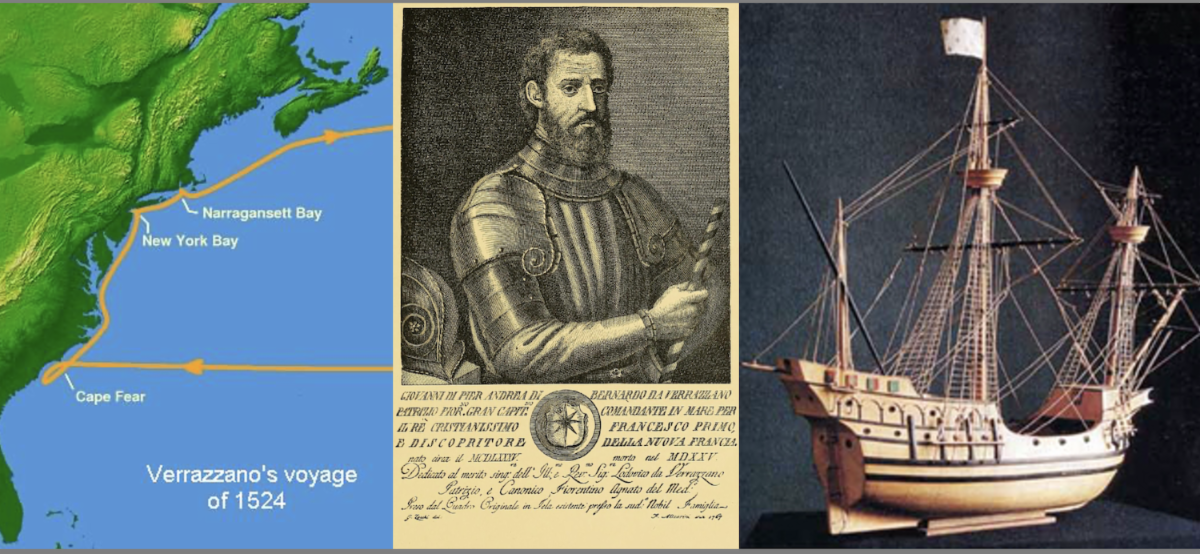
Left: Voyage map http://it.wikipedia.org/wiki/Immagine:Viaggioverrazzano.jpg
Middle: Giovanni di Pier Andrea di Bernardo da Verrazzano, "Captain Commandant at Sea for the Most Christian King François Ier, and Discoverer of New France"m By Allegrini, Francesco (1729-17..). Graveur ; Zocchi, Giuseppe (1711-1767). Peintre, Public domain
https://commons.wikimedia.org/w/index.php?curid=71010215
Right: "La Dauphine", replica 1/5 model of the Musée Maritime de Rouen "Nearly five centuries later, a group of enthusiasts wants to give back all its historic place to this extraordinary adventure. The model was done by the volunteers of the association, supervised by the Master Carpenter Patrice Mabire, and by the participation of the students of the Colleges of Haute-Normandie. The 1/5th replica of “la Dauphine” is 7 meters long." 13, Quai Emile Duchemin, 76000 Rouen, France
Photo: https://www1.musee-maritime-rouen.asso.fr/atelier/la-dauphine/
| | |
• In April 1524, aboard the Dauphine, Jean de Verrazane, sent by François Ier in search of a passage to Asia, discovers the site where New York stands today and names it "land of Angoulême," after the name the king held before ascending the throne.
• He was the first to explore the Atlantic coast of what is now the United States, naming it after prominent figures of the Court: Marguerite, the king's sister, Louise, his mother, Bonnivet, the admiral of France, Vendôme, Lorraine, Alençon... The lands he discovered were collectively named "Nova Gallia" - New France - on the map created by his brother Jérôme.
• He undertook other voyages, previously unknown until the discovery of several ancient manuscripts: in 1526, he followed in Magellan's footsteps; in 1527, he opened Brazil to French trade; in 1528, he traveled to the Antilles where he met a terrible fate.
• Although the Florentine navigator is referred to as Verrazane in France rather than Verrazano (the name of the giant bridge in New York), it is because throughout his public life, which was entirely in France, he was always referred to by a French version of his name, which he never used otherwise. He signed his last will accordingly. This humanist sailor, a true European, remained loyal to his adopted country and served it well.
A bronze plaque in the vestibule of the French General Consulate in New York recalls the Jean de Verrazane was the first European to discover New York, which he named Nouvelle Angoulême in honor of King Francis I, 85 years before Henry Hudson.
| | |
Joan of Arc in America
A compilation of many statues
across the nation
May 2023 Bulletin
| | |
Above, clockwise:
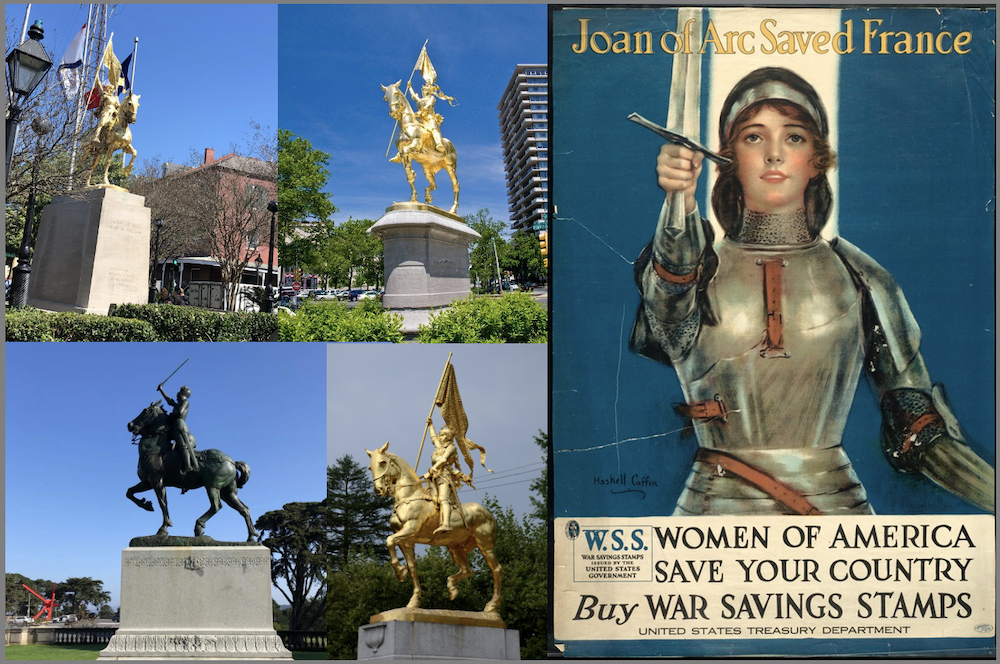
Statue of Joan of Arc, Maid of Orleans, New Orleans, LA
photo TC © 2020 ASSFI - Statue of Joan of Arc, Maid of Orleans, Philadelphia, PA - Photo https://www.pinterest.com/pin/323344448216557488/ - Poster, "Joan of Arc saved France--Women of America, save your country--Buy War Savings Stamps" / Haskell Coffin by The United States Printing & Lithograph Co., [1918], Library of Congress Prints and Photographs Division, Public Domain - Statue of Joan of Arc, Portland, OR, photo by Steve Morgan - Own work, CC BY-SA 3.0,
https://commons.wikimedia.org/w/index.php?curid=42102142
Statue of Joan of Arc, Maid of Orleans, San Francisco, CA Legion of Honor museum
https://www.famsf.org/stories/conserving-anna-vaughn-hyatt-huntington-s-joan-of-arc-at-the-legion-of-honor
| | |
How and why would a French medieval hero be a popular figure in the United States? With majestic equestrian statues coast-to-coast in large cities such as Portland, San Francisco, New Orleans, Washington DC, Philadelphia, New York, and even more modest ones such as Gloucester, MA, or Farmville, VA, one can say that Joan of Arc has left quite an imprint. Furthermore, with hundreds, if not thousands, of sculptures in numerous churches named Joan of Arc (more than in France!) as well as in universities and schools, this symbol of France has been adopted in many ways in the United States.
And this is not just a faint echo of a distant past... Witness the recent inauguration (2018) of a statue of Joan of Arc at Longwood University, Virginia, by Alexander Stoddart, the renowned Scottish sculptor who was until recently the Queen's Sculptor in Ordinary.
If you search online, there are many questions such as: 'Why is St. Joan of Arc famous?' 'How does Joan of Arc inspire us today?' 'What impact did Joan of Arc have on the world?' or... 'Was Joan of Arc a feminist?'
This Bulletin does not aim at writing a thesis about this heroic saint. We simply wished to highlight several sites in our vast nation where you can experience the radiant power of this historical figure, and hopefully get inspired, like generations of Americans before us.
| | |
The adventure of La Belle
and the sailor of Louis XIV
at the Texas State Cemetery
July 2023 Bulletin
| | |
Above:
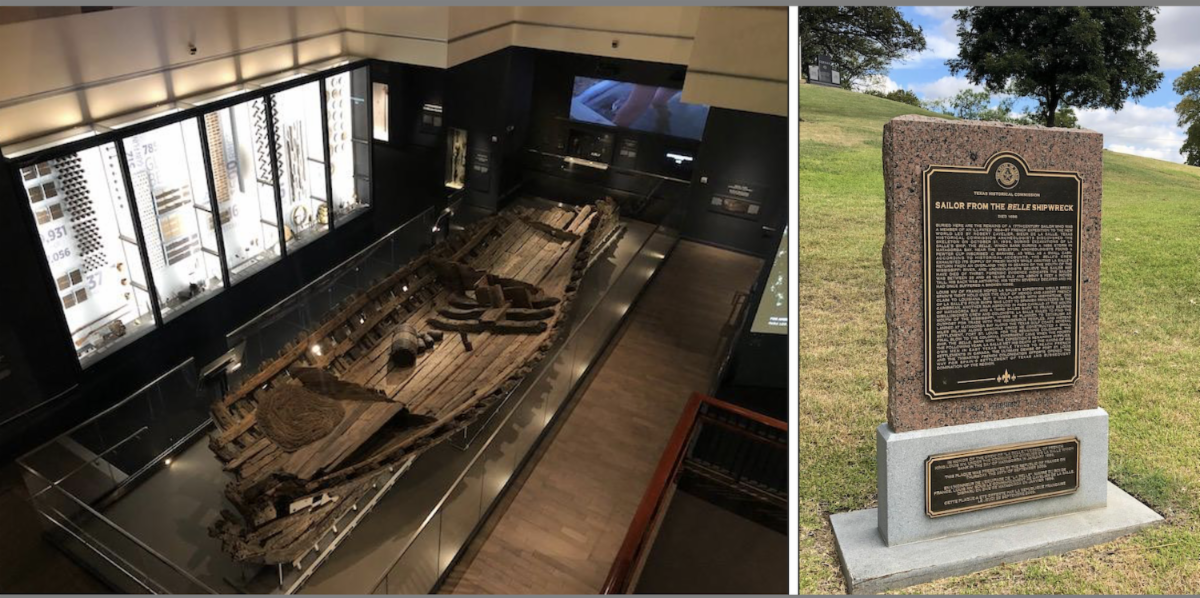
Left: The preserved hull of La Belle is the centerpiece in the Bullock Museum's first floor Texas History Gallery. The hull was treated by long-term soaking in polyethylene glycol and freeze-drying, a process which took over ten years. The cannons were ornately decorated, and bore the crest of King Louis and the Count of Vermandois, the Admiral of France. An illegitimate son of Louis XIV, Vermandois served as Admiral of the French fleet until his death in 1683, meaning the cannon would have been cast no later than 1683, the time when La Salle was preparing for his voyage. The Bullock Texas State History Museum, 1800 Congress Ave.Austin, TX 78701 GPS: 30.280115, -97.739033
Right: Grave Marker, Sailor from the ”La Belle” Shipwreck, Texas State Cemetery, Monument Hill, Section 2 (H2), Row D, Number 1, 909 Navasota Street, Austin TX 78702 GPS: 30.266814, -97.725677
Photos: TC © ASSFI 2021
| | |
After exploring many land forts throughout the Mississippi basin in our past Bulletins, Robert Cavelier de La Salle's name was never far. Indeed, this legendary explorer left his mark everywhere, from Chicago to New Orleans, and is lovingly honored and remembered in many states, counties, and cities.
In this July 2023 Bulletin, we recount his ill-fated expedition to Texas, which left La Rochelle, France, on July 24, 1684, and in doing so celebrate the historical ties that exist between France and Texas.
In 2003, an agreement was signed between the governments of the United States and France to manage the shipwreck of La Salle's ship La Belle, considered one of the most important shipwrecks ever found in North America.
Today, one can marvel at the ship's remarkable state of preservation in a special wing of the Bullock Texas State History Museum, with an astounding 1,000,000 artifacts on display. As one of America's fastest-growing cities, Austin proudly hosts such a world-class museum.
While in the capital of Texas, one can also visit the gravesite of an unknown sailor of King Louis XIV, buried in Texas State Cemetery. While not the first French soldier buried in America, this is the oldest known official gravesite.
Read our Bulletin to learn more about this tragic expedition, and how this sailor was identified in the wreck of La Belle.
| | |
The exploits of Costes & Bellonte
August 2023 Bulletin
| | |
Above:
Times Wide World Photos, Sept 5, 1930
New York, New York: September, 1930 - French aviators Dieudonné Costes and Maurice Bellonte in the parade given them up Broadway after being the first to fly nonstop from Paris to New York.
Public domain - Photo by unknown author published in 1930. — Personal collection, CC0, https://commons.wikimedia.org/w/index.php?curid=74638052
| | |
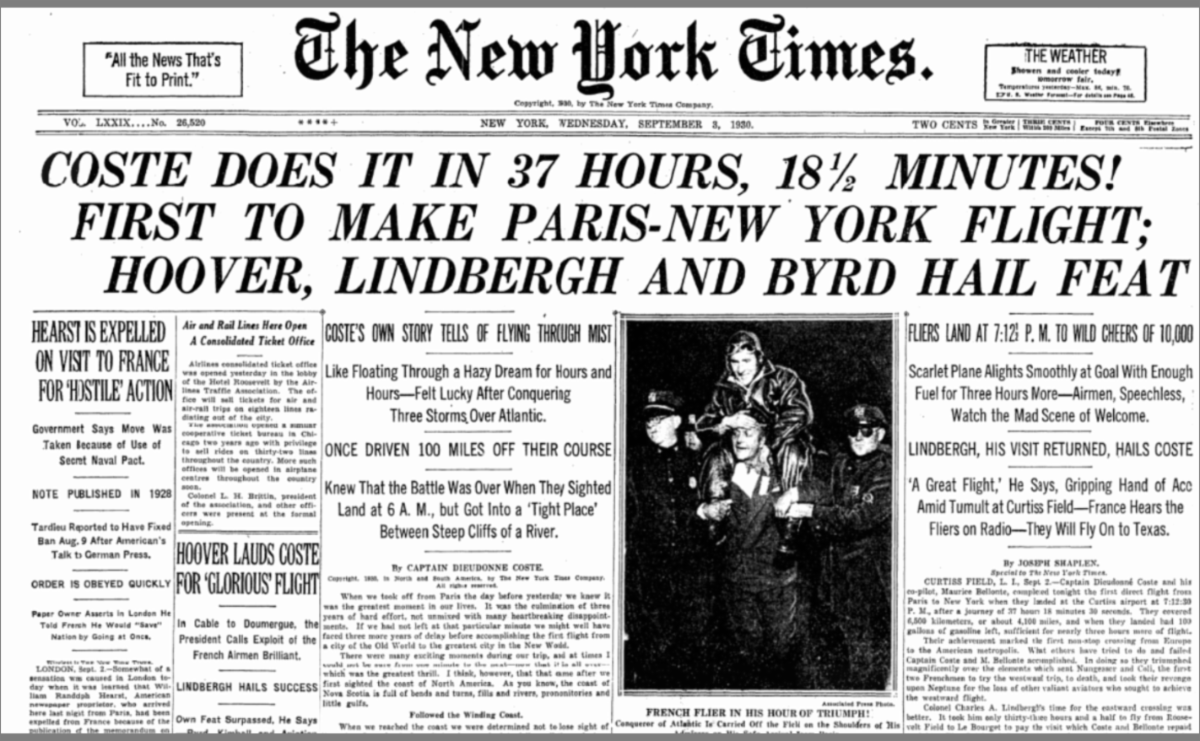
This Bulletin honored two French aviation pioneers, Dieudonné Costes and Maurice Bellonte, who were the first to fly across the Atlantic from east to west. They took off from Paris on September 1st, 1930, and landed 37 hours later at Curtiss Airfield on Long Island.
On September 2, they were greeted by an excited crowd, with Charles Lindbergh present at the airfield. They enjoyed a ticker-tape parade on Broadway, met President Hoover at the White House, and embarked on a triumphant tour across 37 cities in America... yet today, they are largely forgotten.
If you are reading this while flying, think about the incredible progress in aviation over less than a century! What was a remarkable achievement in 1930 is now routine, and we often overlook the amazing accomplishments of many brave pioneers. For example, very few people know that there is a unique site to visit just a few blocks south on the same famous avenue, at the "Maison Française" in Rockefeller Center. Inside a lobby that few would consider entering, there is a beautiful replica in sterling silver of their airplane, called Le Point d'Interrogation, ("Question Mark").
| |
The Duc de Lauzun
and his Legion of Hussars
September 2023 Bulletin
| | |
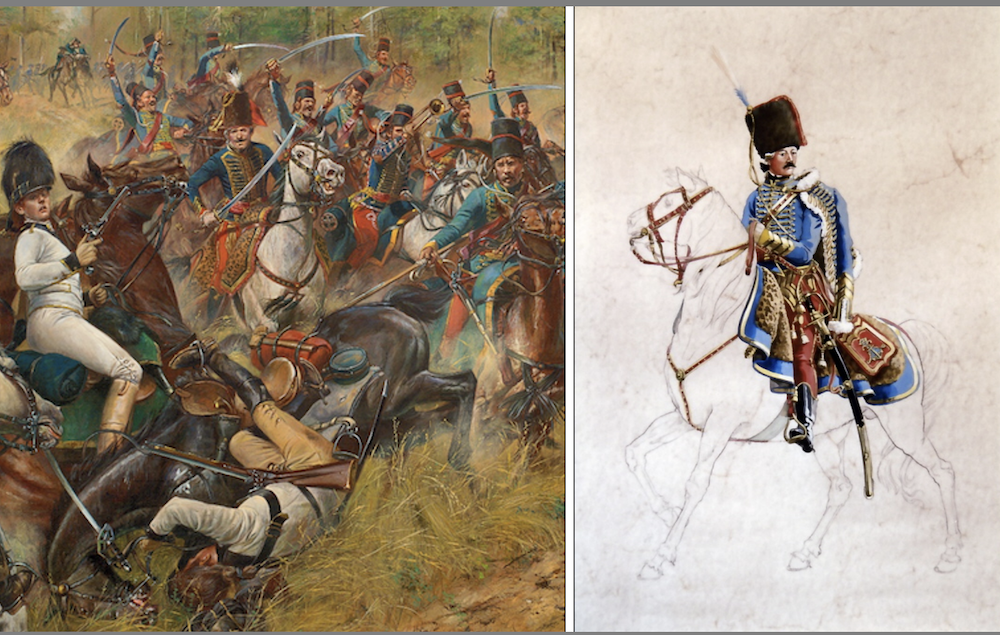
In this Bulletin, we paid tribute to Armand-Louis de Gontaut Biron, Duc de Lauzun and his Legion of hussars who played such a critical role in the War for American Independence. You will discover that being a gallant and flamboyant aristocrat is not antithetical to bravery and panache on the battlefield.
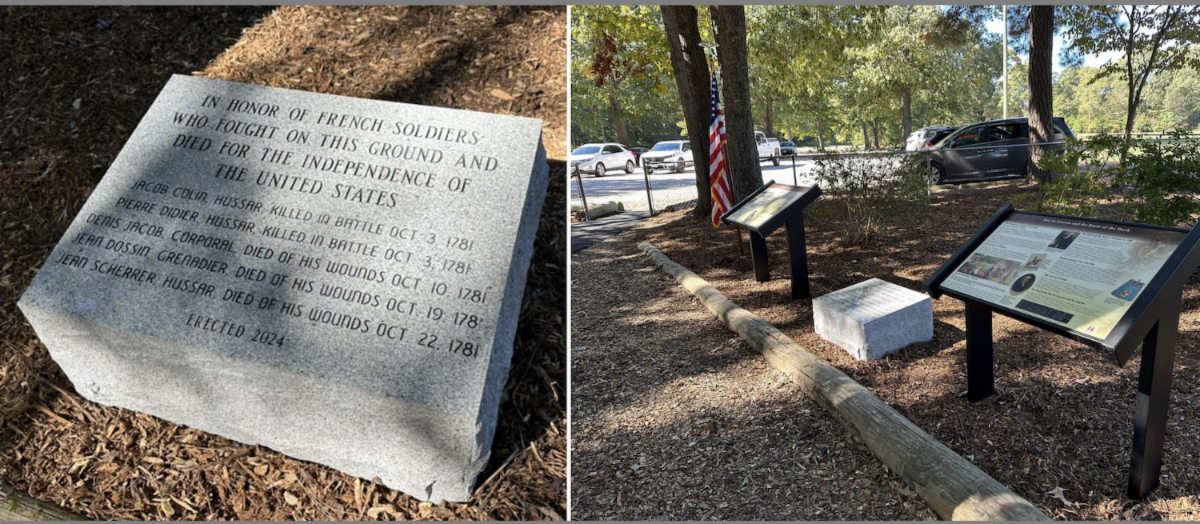
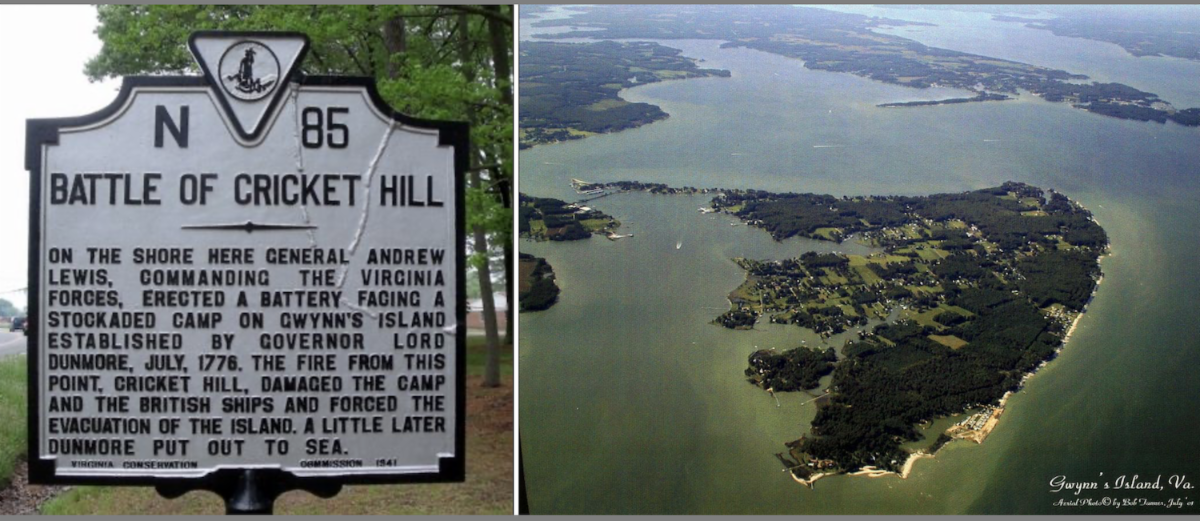
On October 18, 2023, we proudly unveiled two markers dedicated to the relatively unknown Battle of the Hook and the Siege of Gloucester, Virginia, which prevented the escape of Lord Cornwallis from Yorktown, and the site of the 2nd surrender of the British Army to the Marquis de Choisy, exactly one hour after the first surrender to George Washington and Count de Rochambeau.
One of these markers tells the significant action of the Duc de Lauzun and his Legion of hussars—a major cavalry action of the Revolutionary War.
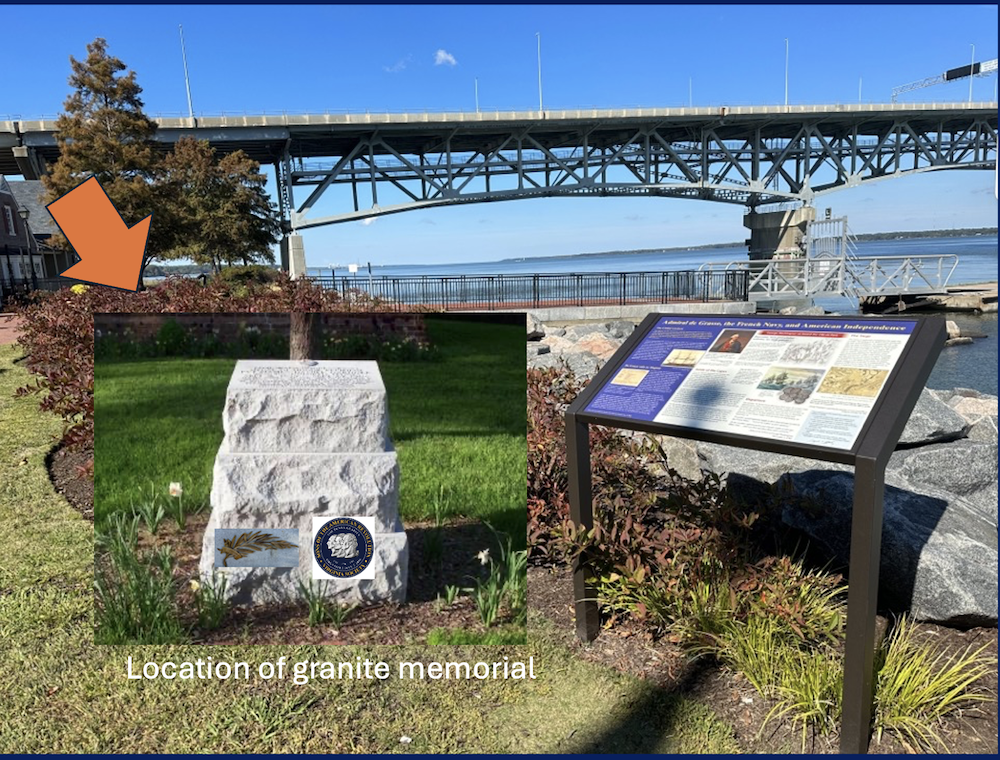
And, on October 18, 2024, we inaugurated a granite memorial honoring the names of five of his soldiers who died at the Battle of the Hook for the independence of the United States.
Since then, thanks to Robert W. Kelly Jr., Vice President of the American Friends of Lafayette, the local elementary schoolchildren and their teachers regularly celebrate their memory, which is the most genuine gratification we can feel, since 'passing the torch of Memory' to the younger generations is the reason for everything we do.
| | |
The Escadrille Lafayette
and the Lafayette Flying Corps
October 2023 Bulletin
| | |
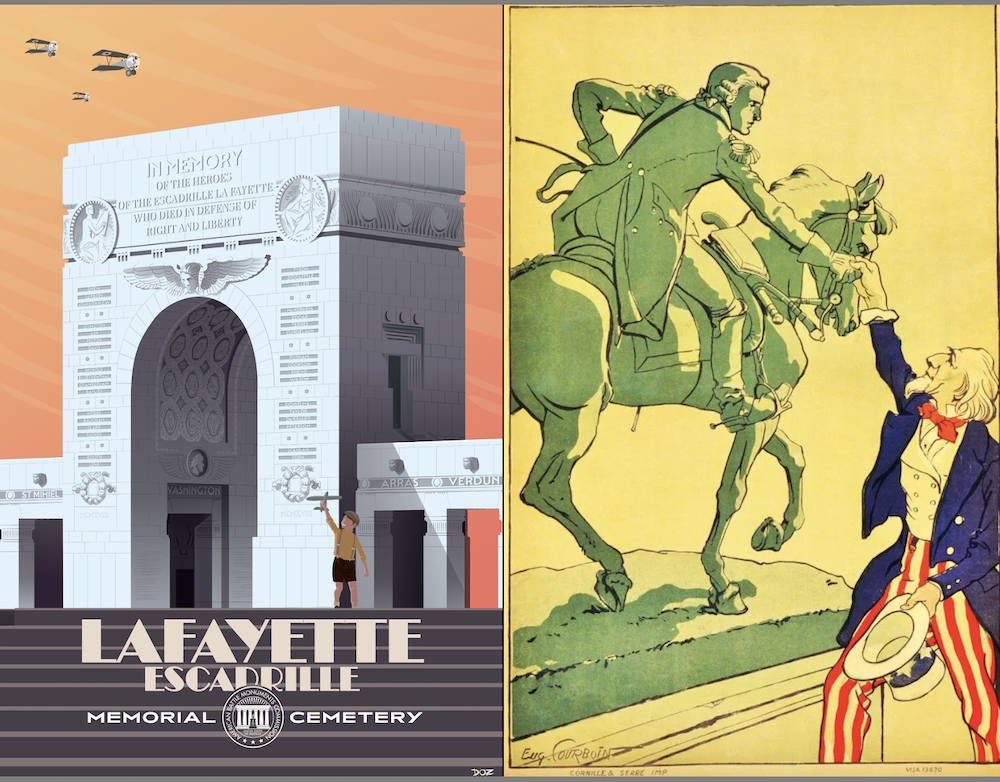
On the wall of Notre-Dame church in Manhattan, 463 names of conscripts and volunteers who 'Died for France' during the two world wars are engraved on several marble plaques. One of these plaques, under the heading 'Escadrille Lafayette,' lists all these valiant American aviators who died during World War One in French skies in the defense of Freedom, whether they served in the original Escadrille Lafayette unit or in the Lafayette Flying Corps in general.
While Hollywood has made a couple of movies on the legendary Lafayette Escadrille, we submit that each and every one of them is deserving of a full movie. Their bravery was legendary, and we owe it to them—and their descendants—to narrate their exploits. Therefore, starting with this Bulletin, we are paying a special homage to each and every one of them on a monthly basis.
What a story they all wrote, individually, with their blood!
| | |
French Missionaries in the United States
A series of monthly Bulletins
January / September / November 2024
| | |
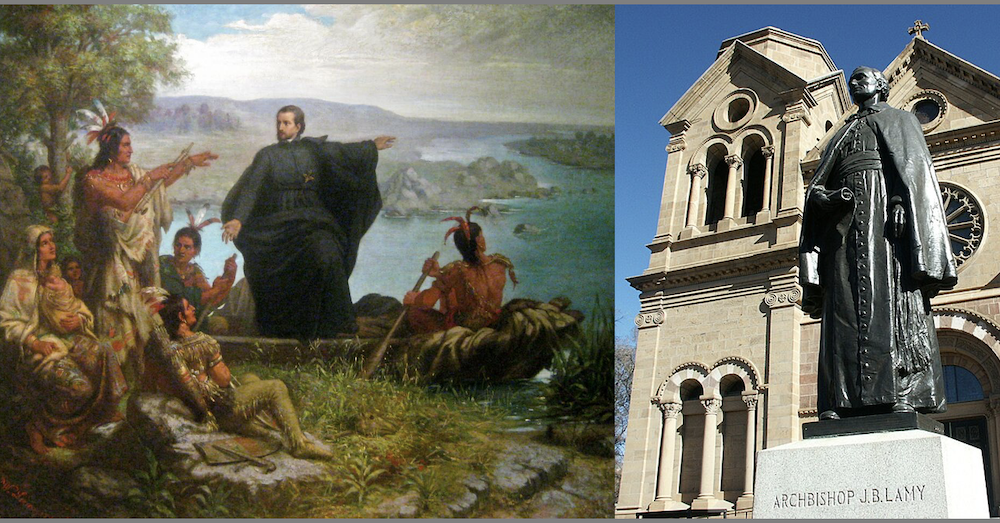
They were many, and their work spanned more than three centuries! This is why it took no less than three bulletins to give just an overview of a few of these men of faith.
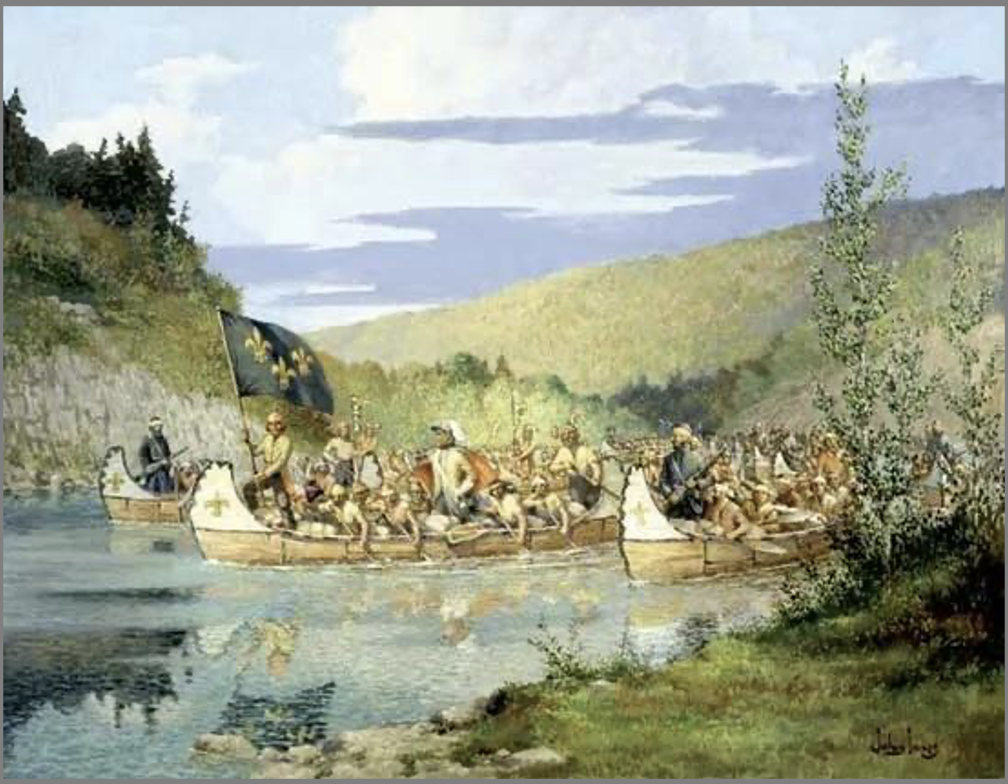
The first missionaries to arrive in Quebec were French Franciscans (Récollets) in 1615, who ministered to the Montagnais, Wyandot Hurons, and the Micmacs. Jesuits arrived shortly after. These missionaries in their black robes worked tirelessly with unwavering courage and patience among the native tribes for many years to come. They traveled across the entire country, from the Atlantic coast to the western prairies, and from Hudson Bay to the Gulf of Mexico. The Jesuit priests were always there with the explorers and fur traders. The tale of the Jesuit missions in America serves as a testament to extraordinary bravery and unwavering dedication.
We followed their steps in several bulletins:
January 2024: Part 1 - New York, Maine, Vermont
September 2024: Part 2 - From 1600 to 1800
November 2024: Part 3 - From 1800 to 1900
Missionaries, priests, nuns, and prelates from France helped shape the spiritual identity of the fast-growing United States and its millions of new Catholic immigrants well into the 1900s (and founded many universities, orphanages, and convents). From Michigan, Minnesota, Illinois, Wisconsin, Missouri, and Louisiana, as far as New Mexico or Hawaii, their work is vividly remembered and honored to this day.
| | |
Tribute to the Harlem Hellfighters
Black History month February 2024 Bulletin
| | |
Above:
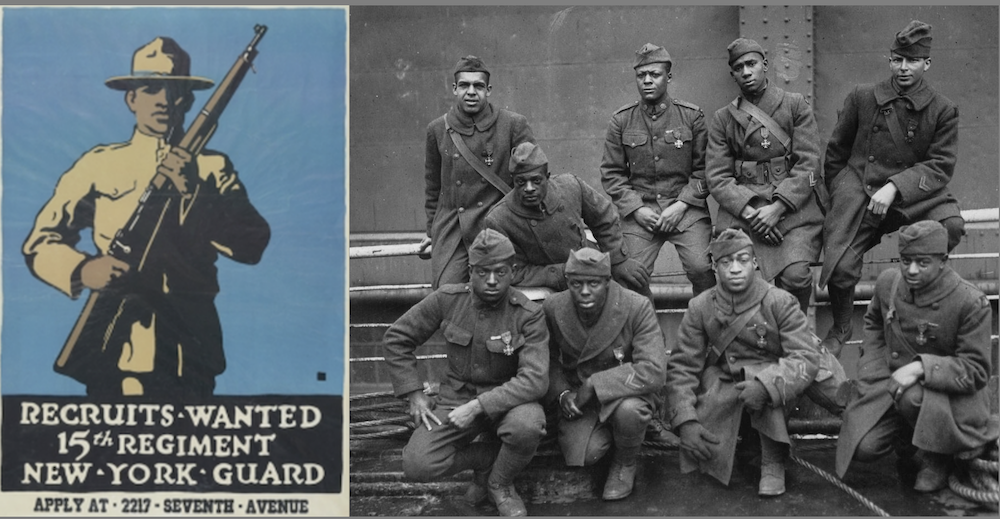
Left: Recruits Wanted, 15th Regiment New York Guard, Artist: Unknown, Printer: Unknown, Publisher: New York National Guard, New York State Museum Collection, H-1975.185.4
Right: Soldiers of the 369th (15th N.Y.), awarded the Croix de Guerre for gallantry in action, 1919, US National Archives website, Public Domain,
https://commons.wikimedia.org/w/index.php?curid=3908981
| | |
After paying homage to Eugene Bullard in 2021 and Josephine Baker in 2022, we narrated in 2024 the incredible story and achievements of this legendary US Army military unit, the most decorated of WWI, consisting of African-American soldiers from Harlem who fought and died under French uniform for the cause of freedom and democracy: the Harlem Hellfighters.
Theirs is a story of unbelievable bravery in combat, unflinching patriotism in spite of the prejudices prevalent at the time, and an often overlooked contribution to the history of music: the introduction of jazz in France, and ultimately Europe and the rest of the world - - no less.
The French Army and the French people at large welcomed them with open arms, and they returned to America proudly wearing their Croix de Guerre on their chests - - 171 decorations plus the coveted "Fourragère" worn by each officer and soldier of the Regiment!
| | |
La Pérouse in America
April 2024 Bulletin
| | |
Above:
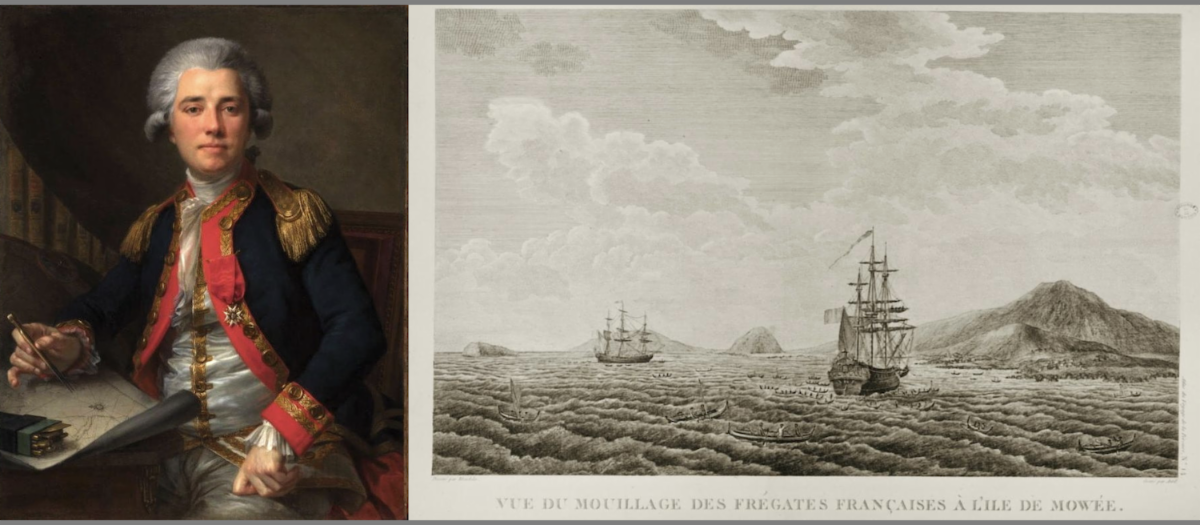
Top Left: 1778 portrait of Count Jean-François de Galaup de La Pérouse (1741-1788), portrayed on his return from the Indies, dressed as a lieutenant and wearing the Order of Saint-Louis issued the previous year. Location: Fine Arts Museums of San Francisco. By Geneviève Brossard de Beaulieu - tumblr.com, Public Domain,
https://commons.wikimedia.org/w/index.php?curid=62779249
Top Right: "Vue du mouillage des frégates françaises à l'île de Mowée" (French frigates anchored near Mowee island), Engraving by Louis-Antoine Destouff Milet-Mureau (1797), based on the original drawing by Francois-Michel Blondela (1761-1788), Polynesia, 18th century, Service Historique de la Marine, VincennesGallica Digital Library, Public Domain.
https://commons.wikimedia.org/w/index.php?curid=23176560
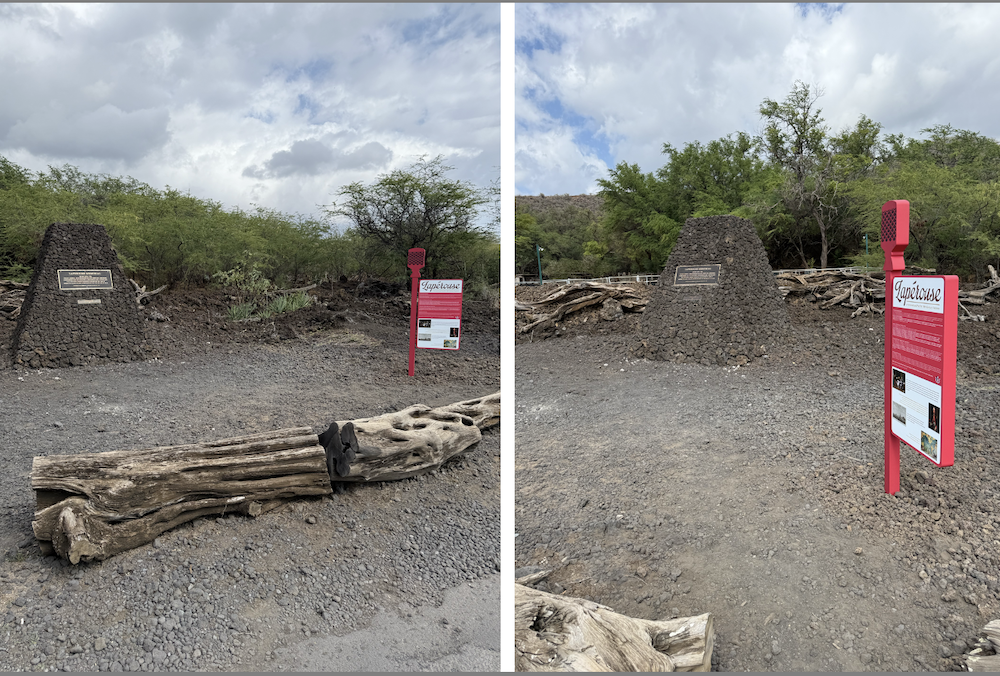
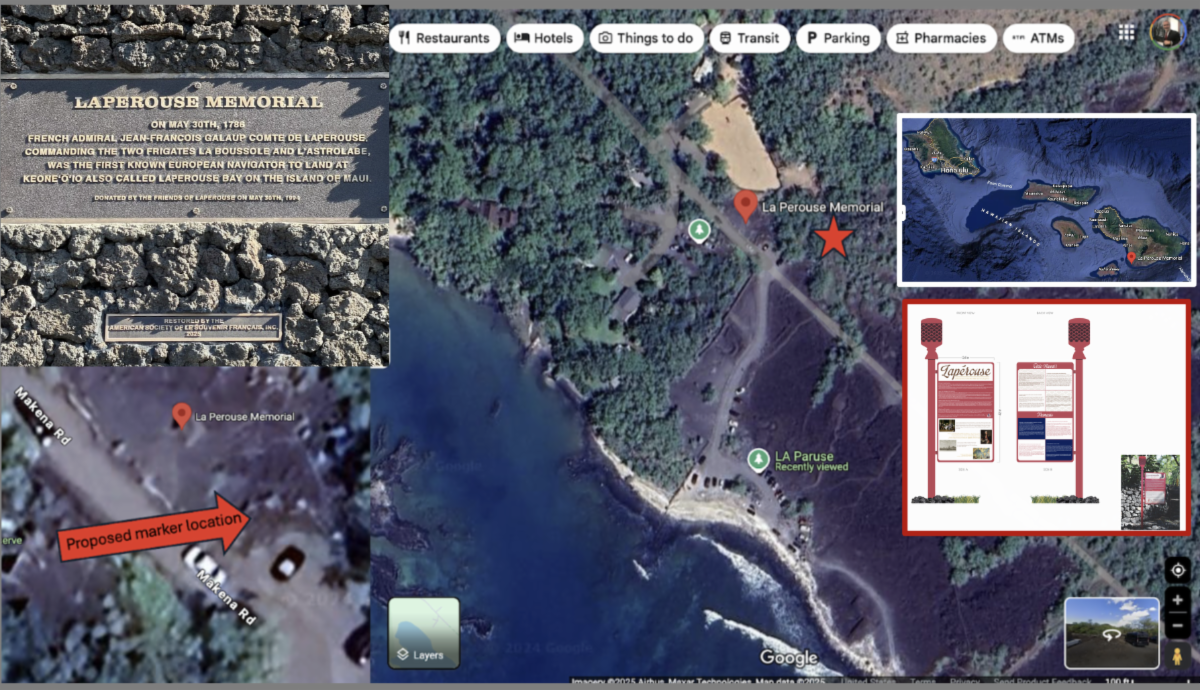
Bottom: The renovated Lapérouse lava-rock Memorial and new interpretive signage, in Maui, Hawaii - Off Makena Road, Kihei, HI 96753 GPS: 20.600745, -156.419877 - Photos © ASSFI 2025
| | |
There are several sites in the Pacific Ocean which were discovered by—and later named in memory of—the great navigator and explorer Jean-François de Galaup, comte de La Pérouse, captain of La Boussole.
He and his trusted companion Paul Antoine Fleuriot de Langle, captain of L'Astrolabe, both had fought valiantly for American Independence all along the Eastern seaboard of the United States.
In this April 2024 Bulletin, we paid tribute to their memories and to their crews, sailors and scientists, and focused on the part of their circumnavigation that touched Hawaii, Alaska, and California in today's United States.
We are grateful to Marc Onetto, Regional Delegate for the West Coast, who is himself a keen admirer of La Pérouse, for his generous support for the restoration of the Lapérouse memorial in Maui, Hawaii.
We are also honored to work with the Native Hawai'ians on this project, as well as the Hawai'i chapters of the Daughters of the American Revolution for the upcoming official re-dedication this spring (see the announcement section at the end of this bulletin).
| | |
French pioneers of the American West
March / May / June / July 2024 Bulletins
| | |
America the Beautiful... "O beautiful for spacious skies, For amber waves of grain, For purple mountain majesties, Above the fruited plain!..."
(Beloved American patriotic song with lyrics written by Katharine Lee Bates in 1893 and first published in 1895. Inspired by the scenery from Pikes Peak, Colorado, the poem celebrates America's landscapes and was set to music by Samuel Ward.)
Join us on an exciting journey this series of four bulletins, as we travel from the Mississippi River to the Pacific Ocean, commemorating more than two hundred years of historical events and the intrepid explorers who unveiled vast portions of the American West.
We delved into the adventures of French (and French Canadians) explorers and pioneers who braved the unknown, encountered indigenous tribes, and conquered towering mountains initially in search of direct routes to the Indies or, as the reality of geography became clear, the golden shores of California.
March 2024: Part 1 - 1634-1804
May 2024: Part 2 - the Frontier - 1750-1850
June 2024: Part 3 - the Rockies, the Far West & Texas - 1840-1880
July 2024: Part 4 - California & the West Coast - 1830-1920
| |
Tribute to the American Field Service
October 2024 Bulletin
| | |
Above:
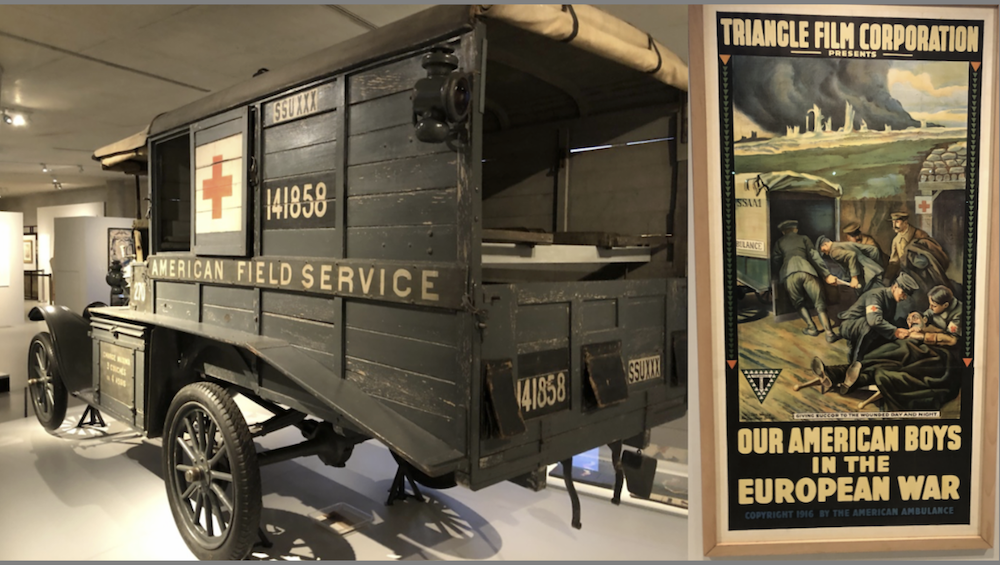
Ford Model T of the American Field Service, "La Section n°1 de l'American Field Service à Cappy-sur-Somme", oil on canvas by White Victor Gerald (1891-1954) and a different version of the poster shown above, all on display at the Musée Franco-Américain, Château de Blérancourt, 33 Pl. du Général Leclerc, 02300 Blérancourt, France - Photos: TC © ASSFI 2019
| | |
Our monthly Bulletins are generally based on the inscriptions found on monuments, statues, markers, tablets, steles, and memorials of all sorts. Instead of long tedious academic studies, they give us a generally accurate story of what happened here and there, often with touching anecdotes.
This time, we relied instead on quotes and excerpts of books to tell the relatively unknown story of all the brave volunteers who left the comfort of the United States to help France during World War One.
We paid tribute to the American Field Service, this remarkable organization which revolutionized the way wounded soldiers on the battlefield were rescued. It was composed of young volunteers who chose to go to the front lines while eschewing the strict neutrality dictated by the official policy of the United States. And they did so in the most unique way: serving as ambulance drivers, taking all the risks under a rain of artillery and machine-gun fire, to save lives.
It is a story not unlike the Escadrille Lafayette, which we narrated exactly a year before. Like their comrades in aviation, many of these volunteers came from very well-heeled families and studied in Ivy League schools. They knew about driving cars, an uncommon skill at the time. Some of them became aviators towards the end of the war. They shared a profound affection for France. In fact, many preferred to stay fighting within the French armed forces even after the United States entered the fray.
Surprisingly, a great number who served as ambulance drivers in the American Field Service or related units such as the Norton-Harjes ambulances, Red Cross ambulances, or the US Corps became famous writers: Ernest Hemingway, John Dos Passos, Julien Green.
The American Field Service lives on today, as it left a very unique legacy. After two world wars, it promoted the concept of international scholarships to help build a better world.
| | |
A chronicle of French
Envoys in the United States
(1778-1938)
January 2025 Bulletin
| |
|
Above:
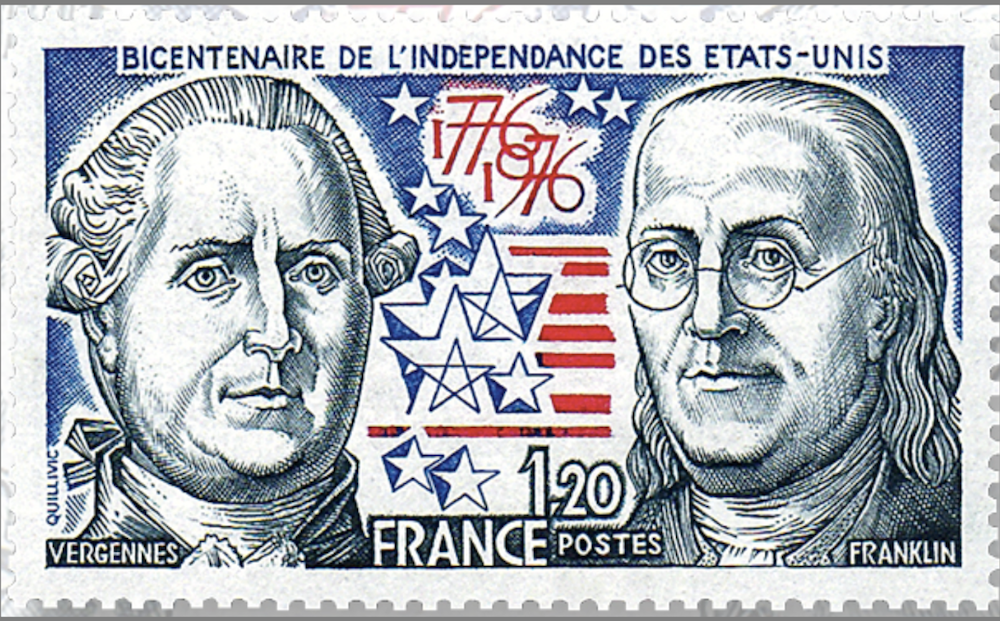
French Post office stamp of 1976, depicting French Foreign Affairs Vergennes and Benjamin Franklin founders of French-American diplomatic relations (Benjamin Franklin was the very first Ambassador of the United States)
https://philatelie-lmi77.com/35135-timbre-de-france-n-1879-oblitere.html
| |
In this bulletin, we tell the diverse stories of a few French ambassadors and consuls who left a tangible mark in this country, other than mere diplomatic dispatches.
Does anyone today remember the crucial roles that Conrad Alexandre Gérard or the Marquis de la Luzerne played in the birth of the United States? Or Jacques-Antoine Moerenhout in California, or Alphonse Dubois de Saligny in Texas? Or Jean-Jules Jusserand, a close friend of Theodore Roosevelt and member of his 'tennis cabinet,' later an influential actor behind America's entry into World War One?
As we do with all our activities, we do not concern ourselves with the contemporary period (any event less than 80 years old) and will leave this task to our descendants in the 22nd century! We made one exception, however, by including Romain Gary, French Consul in Los Angeles from 1956 to 1960, and the reasons for this are explained at the end of this chronicle.
| |
The Battle of Savannah (1779) and
the "Chasseurs Volontaires de Saint Domingue
Black History month - February 2025 Bulletin
| |
Above:
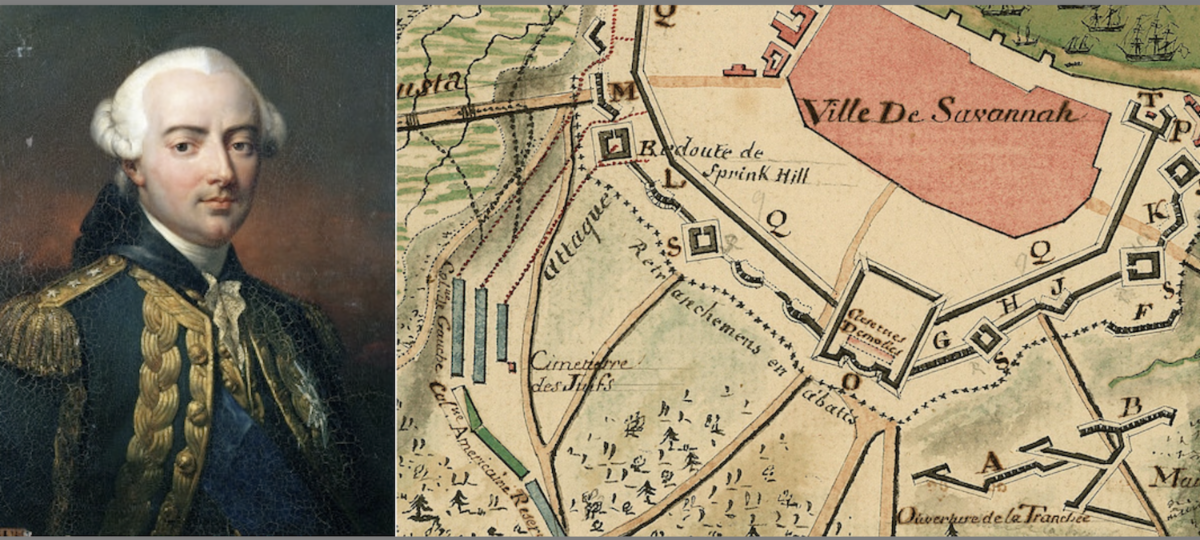
Left: Charles Henri Jean-Baptiste, Comte d'Estaing (1729-94) by Jean-Pierre Franque, Public Domain, https://commons.wikimedia.org/w/index.php?curid=140487
Right: Close-up showing Redoubt Spring Hill. This detailed manuscript map, probably copied by Antoine O’Connor, the chief engineer for Admiral d’Estaing, from the original map drawn by Pierre Ozanne, the naval artist formally attached to d’Estaing’s fleet. The French set up siege works (shown at the lower right) to bombard the town but later changed their strategy to a direct attack on the Spring Hill Redoubt (located at the upper left) on October 9. During this assault, d’Estaing was injured, and Casimir Pulaski, who led the American cavalry, lost his life. Almost one thousand soldiers from both the French and American sides were either killed, injured, or captured. The allies eventually withdrew, allowing the British to maintain control over Savannah.
https://jcb.lunaimaging.com/luna/servlet/detail/JCBMAPS~1~1~4453~102547:-Plan-of-the-Seige-of-Savannah,-177
| |
Savannah was the site of the second bloodiest battle of the Revolutionary War, the first occasion for American and French forces to fight side by side in a major military operation.
In this bulletin we narrate the ill-fated attempt to capture Savannah from the British, and focus on the role played by the forces commanded by Admiral Count d'Estaing.
Among the many regiments and ships of the line engaged to assist America in 1779, the role of Black regiments of the French Army, including the 'Régiment des Chasseurs Volontaires de Saint Domingue,' is often overlooked. And yet, they played an important role, which we narrate in this bulletin.
Among those volunteers, several became important figures after the war in Saint Domingue, which became known as Haiti, as well as in France: Henri Christophe, future president and later King of Haiti; André Rigaud, future president of the short-lived Republic of the South. Four of them would have notable military careers, becoming Black generals of the First French Republic, while others played a role in the French Revolution in Paris, as you will discover in this bulletin.
| |
French generals of the U.S. Army
March 2025 Bulletin
| |
Above:
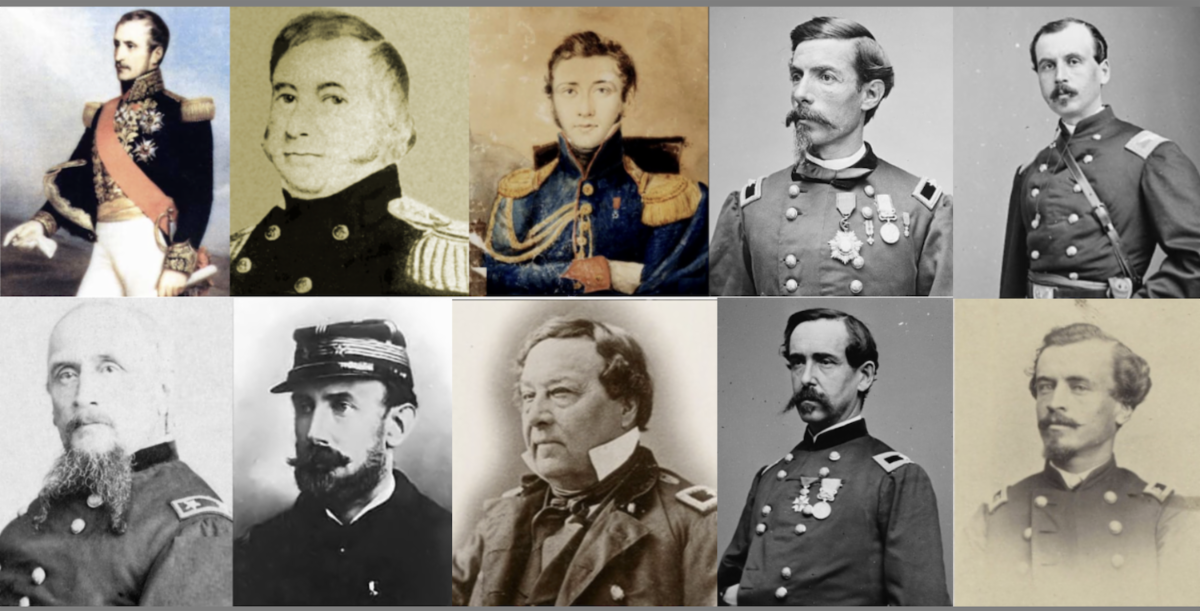
Partial view of the bulletin cover. All these generals served in various American uniforms. Out of a total of twenty presented, seventeen were born in France, three were of immediate French ancestry. All portraits credits are in the bulletin.
| |
Much has been written about the long fraternity and cooperation between the French and American military forces since 1778. As our Society is uniquely focused on memorializing the past, it is appropriate that we would narrate the diverse stories of these French general officers who fought here, from the birth of the Nation and throughout the tragedy of the Civil War.
Some of them are still remembered, some fell into obscurity, and yet their tales could be the subject of Hollywood movies.
Of course, to be historically accurate, we started with General Lafayette. He casts such a long shadow that many of his contemporaries as well as successors are often forgotten.
You will discover the likes of Armand Tuffin de la Rouërie, whose contributions to American Independence deserve more than a couple of interpretative markers. Louis Le Bègue Duportail fares better with his own statue on Lafayette Square in Washington D.C., but chances are tourists do not know who he was and what he did for the United States. Same with General Simon Bernard, who designed and oversaw the long chains of military forts on the U.S. eastern seaboard to protect the new Republic. A few decades later, Brigadier General Bonneville opened much of the American northwest territories, but who knows this today? As for the Civil War, the likes of Generals de Polignac, de Trobriand (and his 55th New York Infantry regiment made up primarily of French volunteers), Duffié, Agnus, LeGendre—they are forgotten (for good or bad reasons), yet they left lasting memories among their soldiers. We also included a couple of very famous generals such as P.G.T. Beauregard and Mouton, as their French ancestry was quite recent (in fact, the former only spoke French until the age of twelve).
| |
Statues of Liberty in the United States
More than 200 replicas
April 2025 Bulletin
| | |
Above:
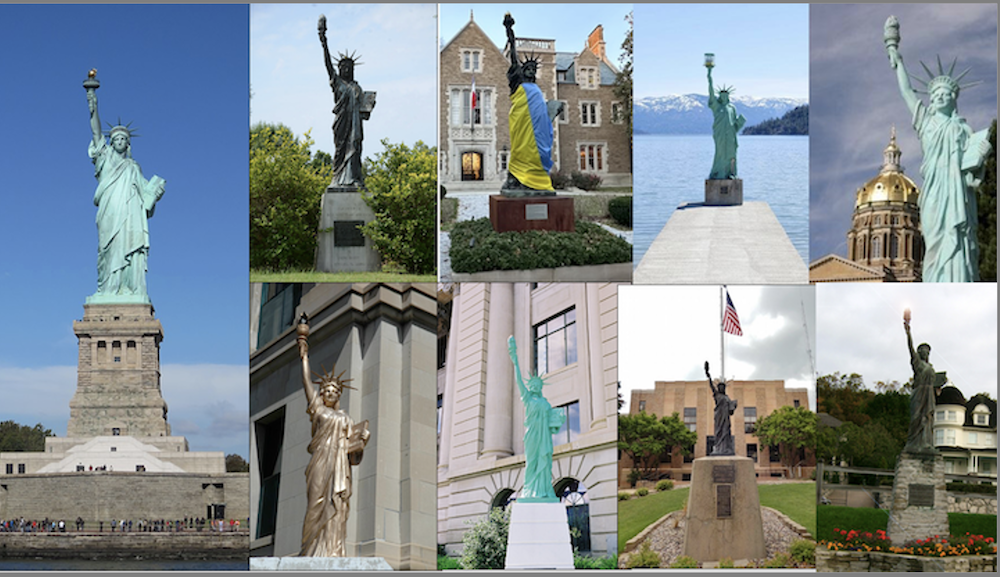
Cover illustration, "Liberty Enlightening the World" in New York harbor, a gift of the French people to the United States, became a national symbol. There are hundreds of replicas throughout the United States, as well as thousands others of all stripes and colors, each carrying a little trace of French DNA.
See the Bulletin for photo credits and click on illustrations to access interpretive links.
| | |
The Statue of Liberty (full name: Liberty Enlightening the World) is a powerful symbol of American identity, representing the nation's ideals of freedom, democracy, and economic opportunity.
To celebrate the statue's 140th anniversary in 2026, during the 250th anniversary of the United States, this monthly Bulletin explores this significant symbol of French-American friendship.
Many outstanding books have explored this topic. With that in mind, we aimed to engage you, our readers, by using our typical approach: showcasing existing markers and plaques that you can visit either in person or online. We had much fun writing it and discovering so many replicas all over the 50 states. These markers and plaques are filled with fascinating stories and historical insights. This collection of information serves as a bridge between our present and the past: what were the thoughts and beliefs of those who came before us? How can we draw inspiration from their testimonials to guide us in today's world?
To find out, we traveled throughout America and present just a few of the hundreds of replicas which dot the country. While more than 200 replicas were installed in the 1950s by the Boy Scouts of America, there are many more, some more faithful to the original than others, erected in different materials by different sculptors, and they each tell a story of profound patriotism and attachment to the values of Freedom and Democracy.
And we do not count the hundreds that have been installed next to businesses, from car dealerships to tax services, nail salons and pizza parlors—they all symbolize the American dream pursued by generations of immigrants.
We invite you to join the Statue of Liberty Club which publishes newsletters dedicated to our Lady Liberty three times a year.
| | |
222 years ago:
The Louisiana Purchase
May 2025 Bulletin
| | |
Above:
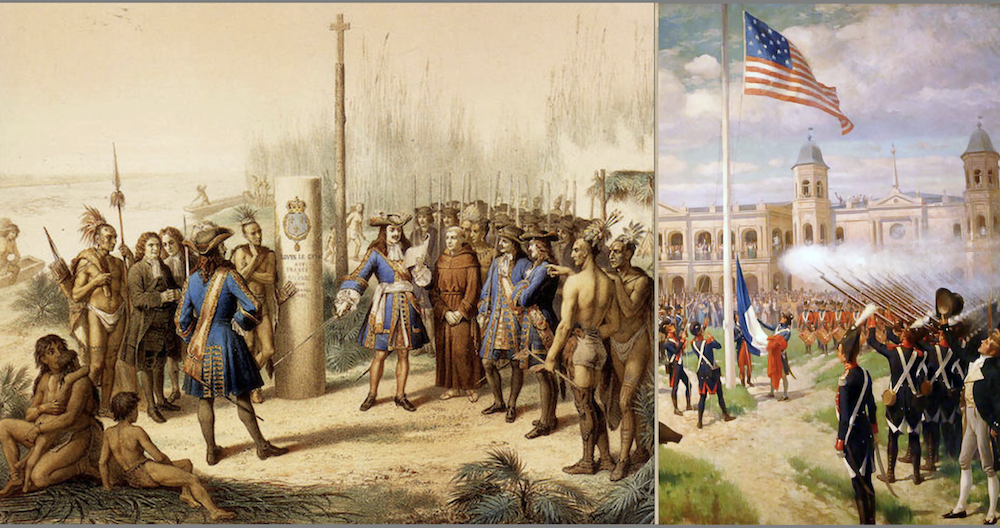
Left: René-Robert Cavelier, Sieur de La Salle claiming Louisiana for the King of France Louis XIV, by Charles André Waltner (1846-1925) - Sulte - Histoires des Canadiens-français, 1608-1880, tome II, 1882 (page 3), Public Domain, https://commons.wikimedia.org/w/index.php?curid=25673
Right: Hoisting American colors, Louisiana Cession, December 20, 1803, oil on canvas, by Thure de Thulstrup (Swedish-American illustrator, circa 1903) - Louisiana State Museum, Public Domain,
https://commons.wikimedia.org/w/index.php?curid=19310406
Thure de Thulstrup (1848-1930) served in the French Foreign Legion in the Franco-Prussian War. He also served in North Africa as a member of the First Zouave Regiment. The dramatic moment on December 20, 1803 when the American flag was raised in place of the French flag in front of St. Louis Cathedral, modern day Jackson Square in New Orleans, marking the transfer of the Louisiana Territory from France to the United States.
| | |
The acquisition of the territory of Louisiana by the United States from the French First Republic in 1803—the largest land deal in modern history agreed upon between two sovereign nations—effectively doubled the size of the United States at the time. It added sizeable territories that would become the states of Louisiana, Arkansas, Missouri, Iowa, Oklahoma, Kansas, Nebraska, North Dakota, South Dakota, and parts of Minnesota, New Mexico, Montana, Wyoming, and Colorado (as well as portions of Alberta and Saskatchewan in today's Canada).
We recounted how French explorers claimed this vast land for France a hundred and fifty years before: Robert Cavelier de La Salle, Pierre Le Moyne d'Iberville, Jean-Baptiste Le Moyne de Bienville, Henry Tonti, Pierre de la Vérendrye, who are memorialized with statues and markers in several states.
We discussed the motives of the main protagonists: First Consul Napoléon Bonaparte, Talleyrand, and Barbé-Marbois on the French side; President Thomas Jefferson, Robert R. Livingston, and James Monroe on the American side. And, to complete the story, we visited several places that memorialize this historic event, with a few anecdotes about Frenchmen established in Louisiana who embraced their new nation.
This summer, if you happen to travel down South or out West, make sure you visit these sites and detect the pervasive traces of French cultural influences throughout many communities!
| | |
French Ships in American History
June 2025 Bulletin
| | |
Above:
Left: Portrait of Latouche-Tréville as a vice-admiral, in 1803. King Louis-Philippe commissioned the painting for the History Museum of Versailles in 1835; Georges Rouget painted it in 1840. Public Domain, https://commons.wikimedia.org/w/index.php?curid=17859712
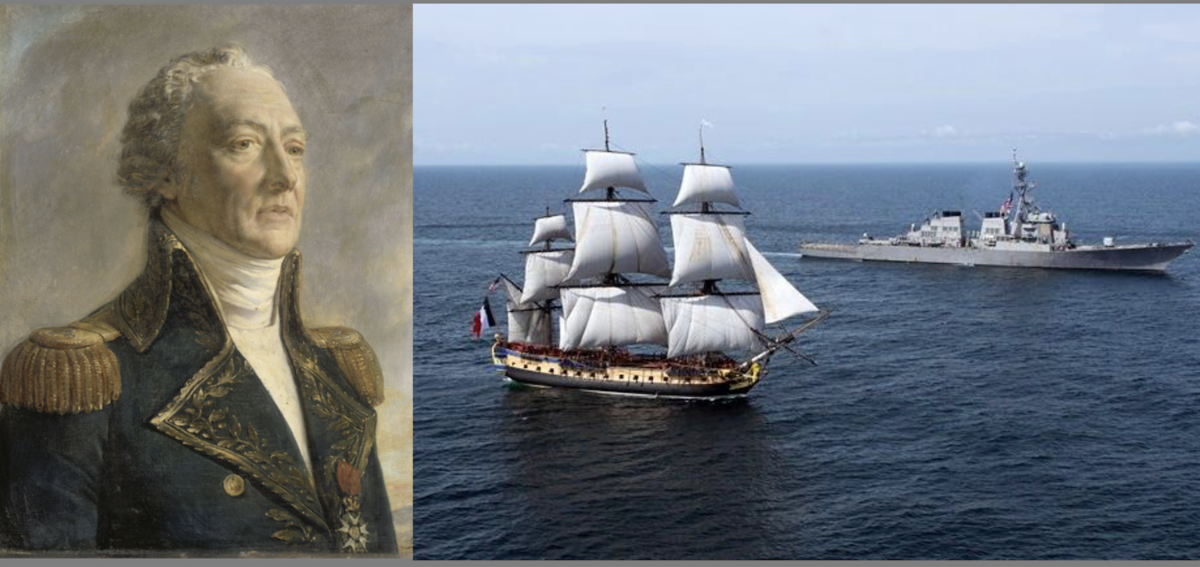
Right: The Hermione at Virginia Capes (June 2, 2015) The Arleigh Burke-class guided-missile destroyer USS Mitscher (DDG 57), right, provides a warm welcome to the French replica the Hermione, a.k.a The Freedom frigate in the vicinity of the Battle of Virginia Capes off the east coast of Virginia. The original Hermione brought French Gen. Marquis de Lafayette to America in 1780 to inform General Washington that a French army was headed for the United States to assist in the war effort. Navy photo by Mass Communication Specialist 1st Class Michael Sandberg/Released, Public Domain, https://nara.getarchive.net/media/150602-n-oa702-001-virginia-capes-june-2-2015-the-40e551
| | |
Anyone who sets eyes on a tall ship cannot help but feel the awe they inspire. In particular, one of them—the frigate Hermione, a.k.a. the 'Freedom Frigate,' beloved on both sides of the Atlantic—is currently in dire straits, so to speak, as she rests in dry dock undergoing critical (and expensive) repairs.
A fundraising campaign has been going on for several months now, and much remains to be collected in order to save her and allow her to return to America.
This made us ponder: why not narrate and celebrate her extraordinary story, as well as several other French ships, some well known such as the Normandie, and other lesser-known vessels such as the Griffon, all intertwined with American and U.S. history?
We invite you to embark with us on this journey: our bulletin will take you from the Atlantic shores to the Great Lakes, and all the way to Texas, California, Alaska, Hawaii, and American Samoa!
Unfortunately, the Hermione replica which sailed triumphantly to the U.S. in 2015 has been in dry dock for the past three years, and may not be able to sail again. We urge companies and individuals to help Save the Hermione in any amount possible!
| | |
Tribute to Rochambeau
300th anniversary, July 1, 1725
July 2025 Bulletin
| | |
Above:
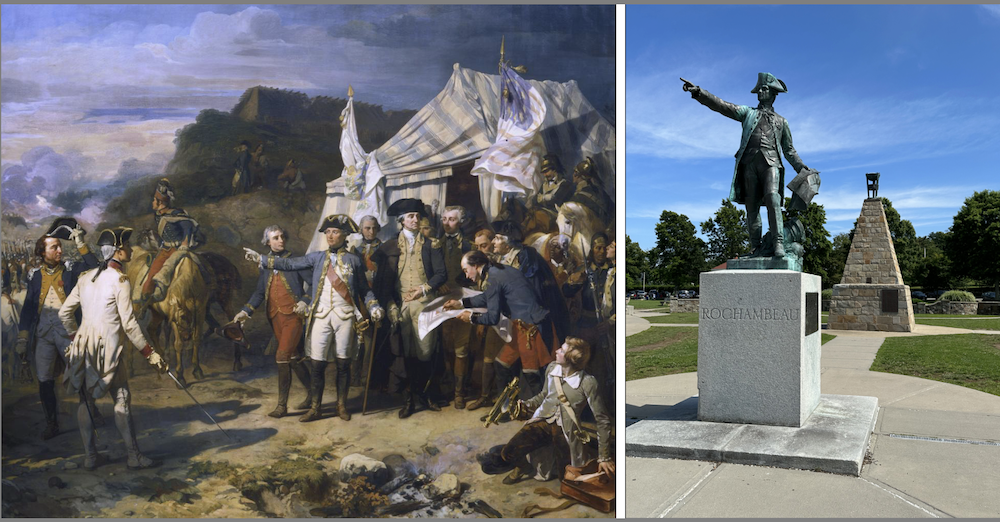
Left: Bataille de Yorktown by Auguste Couder (1789-1873), oil on canvas painted c. 1836, most likely influenced by the 1784 Blarenberghe initial version for King Louis XVI. Rochambeau wears the 'field dress': lighter blue coat and off white waistcoat and breeches. Rochambeau is seen giving orders, flanked by general Washington to his left. Galerie des Batailles, Palais de Versailles, (a copy exists at the French Embassy in Washington DC). Behind the two men, we recognize the Marquis de La Fayette, and to Washington's right is the Marquis de Saint Simon. On the left, on horseback and with his back turned, is the Duke of Lauzun. Public Domain, https://commons.wikimedia.org/w/index.php?curid=7029460
Right: Rochambeau Statue and Memorial to the French Fleet (in the background), Newport, R.I.
Rochambeau Plaza, King Park, waterfront, Newport R.I. GPS: 41.476733, -71.321555
Photo: TC © ASSFI 2021. In the background stands the Memorial to the French Fleet.
| |
Jean-Baptiste-Donatien de Vimeur, comte de Rochambeau, is often overlooked in favor of Lafayette, and this is a form of historical injustice, as he arguably played a different but equally decisive role, especially in military terms.
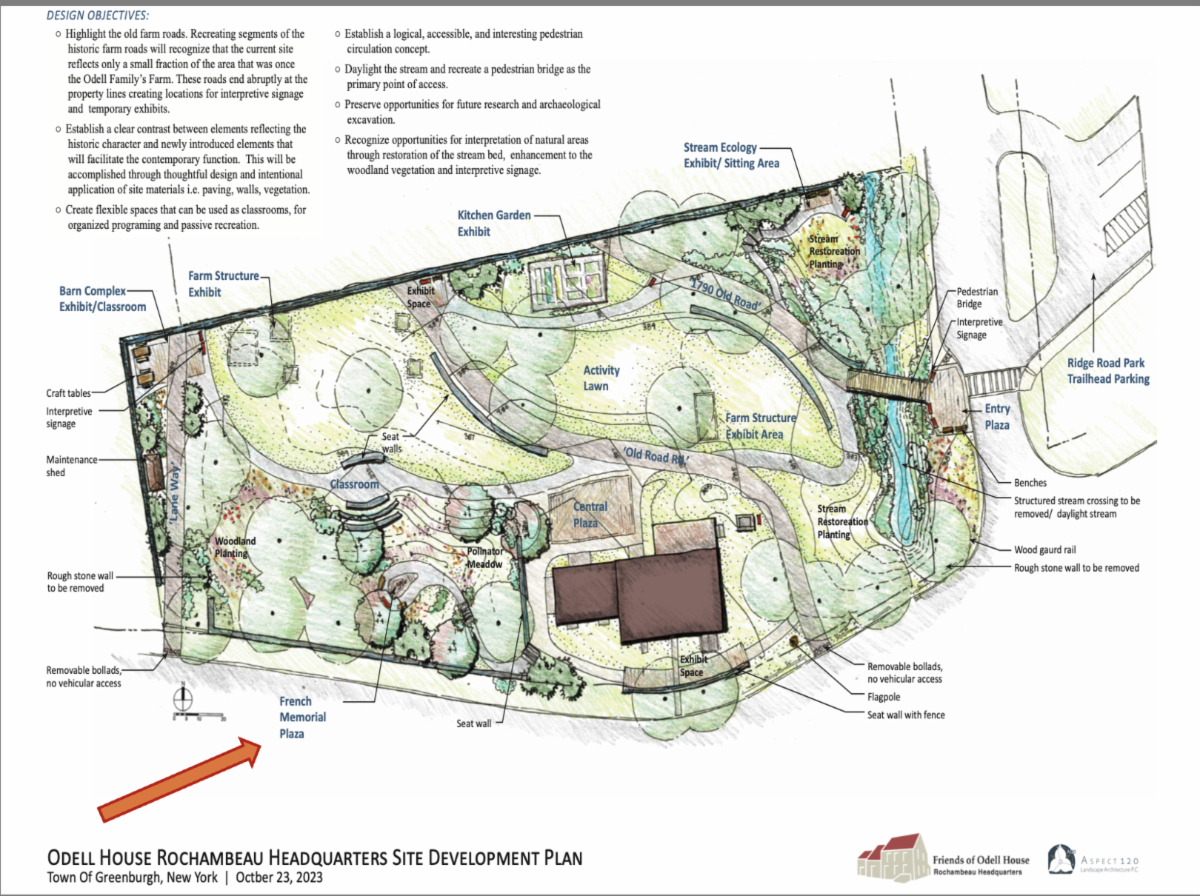
In 2021, we published a five-part series called 'In the footsteps of Rochambeau,' which followed the important encampments of the French Army from Newport, R.I. to Yorktown, VA, and back to Boston, MA. This was a significant military accomplishment over the roughly 1,500 miles they traveled along the Congress-designated Washington-Rochambeau Revolutionary Route—a unique part of the National Park system in an urban area. Some chapters from that series will be included in this current Bulletin.
We hope that in the coming years, especially by 2031, the 250th anniversary of the joint French-American victory at Yorktown that led to the independence of the United States, Rochambeau will finally receive the recognition he truly deserves.
| | |
Tribute to Samuel de Champlain
August 2025 Bulletin
| | |
Above:
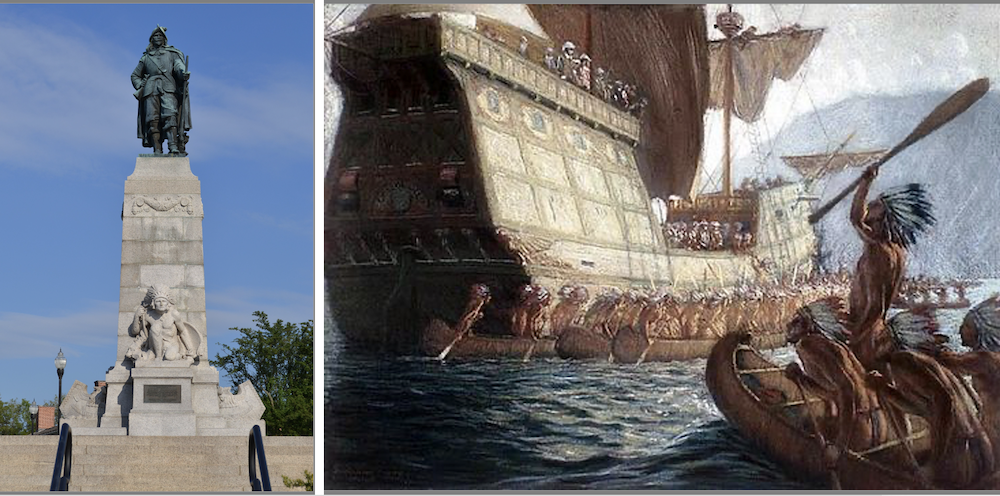
Left: Statue of Samuel de Champlain in Plattsburgh, NY. The presence of an Indian at his foot has stirred controversy. It was also noted that the Indian pictured had an inaccurate headdress (Indian from the Plains). It was resolved to install a panel explaining the historic circumstances.
Photos: by Joe Harness, July 17, 2011, https://www.hmdb.org/m.asp?m=46525
Right: Painting by George Agnew Reid, done for the third centennial (1908), showing the arrival of Samuel de Champlain on the site of Quebec City., By George Agnew Reid, Public Domain, https://commons.wikimedia.org/w/index.php?curid=1091272
| | |
Famed founder of Québec and founder of New France, Samuel de Champlain was an extraordinary cartographer, explorer, and administrator. He sailed across the Atlantic no less than twenty-one times in the 1600s, and his detailed maps served as a guide to navigators for decades.
In Canada, he is indeed a father figure still very much present. In the United States, he is remembered and honored with multiple statues and markers throughout Maine, Massachusetts, Vermont, and New York.
| | |
Acadians & Cajuns, from Maine to Louisiana
September 2025 Bulletin
| | |
Above:
Cover illustration:
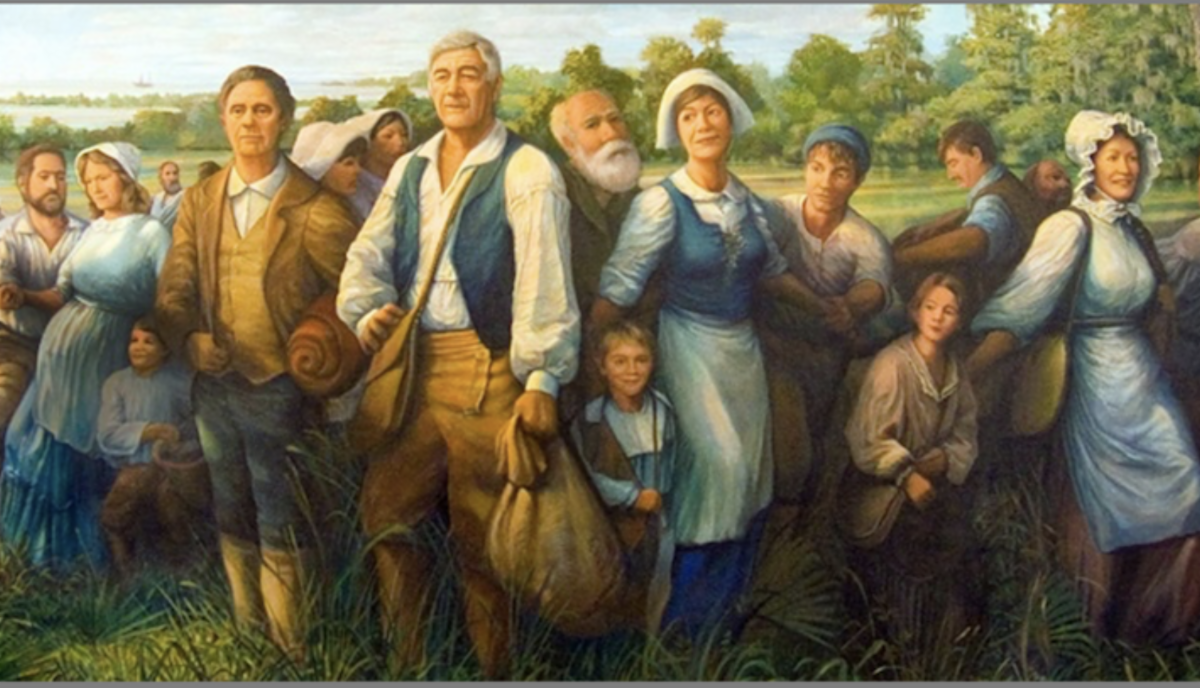
Part of a large mural of the arrival of first Acadian settlers in Louisiana, on display at the Acadian Memorial Foundation, St. Martinville, Louisiana.
https://acadianmemorial.org/
| | |
The prior month's Bulletin was dedicated to Samuel de Champlain, the founder of New France. It had been sent out on August 15, precisely the National Day of the Acadians. It was therefore logical to dedicate the following Bulletin to these early French settlers on the American continent: the Acadians in the north and the Cajuns in Louisiana. While our Society only concerns itself with today's United States, it is important to remember that, not so long ago, they and their families straddled the border between present-day Canada and the United States.
The Deportation of French settlers in Acadia started on September 10, 1755. On that tragic day, 315 British soldiers and militiamen gathered Acadian families to transport them using 16 requisitioned boats, mainly to New England territories (mostly Massachusetts). Out of an estimated population of about 13,500 Acadians, over 12,600 were deported. The others managed to reach Quebec and the remaining French Acadia (which included Gaspésie, Cape Breton Island, and Prince Edward Island). Thus started a long and tragic odyssey. However, their story is a remarkable tale of resilience and fighting spirit, in spite of suffering what would be called 'ethnic cleansing' today. Two hundred and seventy years later, they still share a strong cultural unity with Quebecers, their French Canadian brethren.
From Maine to Louisiana, you will find dozens of memorials, plaques, and markers celebrating their common roots and, we dare say, the 'joie de vivre' that is typically part of French culture. Come travel with us in this Bulletin, listen to their upbeat music, taste their wonderful cuisine, and remember with us that history repeats itself in various latitudes, and that the determination to survive vanquishes all odds...
| | |
Alsatian Legacy in the United States
October 2025 Bulletin
| | |
Above:
Left: Steinbach Hüs, originally built in Wahlbach (today Département du Haut-Rhin), France in 1648 and reassembled in Castroville in 2002, is now the town's Visitors Center. It is the oldest standing building in Texas! Photo: The Lyda Hill Texas Collection of Photographs in Carol M. Highsmith's America Project, Library of Congress, Prints and Photographs Division. Public Domain
Right: Marker, “Along the Zimmerman Trail”, U.S. Highway 3 and Zimmerman Trail, Billings MT 59102 GPS: 45.805600, -108.604833, photo by by Rich Pfingsten, March 22, 2009 https://www.hmdb.org/m.asp?m=169996
| | |
The relationship between Alsace and the United States is a very important one.
Let us remember Miss Liberty, this wonderful Alsatian lady, who has welcomed millions of immigrants arriving in this land of opportunities in the harbor of New York.
Let us not forget that the very name of America was proposed at the beginning of the sixteenth century in Saint-Dié, Lorraine, by two scholars, one being Matthias Ringmann, whose Alsatian roots traced to the small village of Eichhoffen.
And through the years, the contribution of Alsatians in the New World has been extraordinary: the Marx Brothers, William Wyler in the movie industry, Jean-Georges or Gabriel Kreuther in the restaurant business to name a few. Their role at the United Nations from its inception has been crucial.
The Union Alsacienne of New York is one of the oldest francophone clubs in the city: for 155 years, their mission to promote Alsatian identity has been very much alive, and they do so in harmony and friendship. Our Society's Honorary President, Françoise Cestac, former United Nations Assistant Secretary-General for Conference Services (in charge of the 6 official languages), is a long-time active member and Vice President of the Union Alsacienne.
| | |
French Soldiers in the United States (a selection)
November 2025 Bulletin
| | |
Above:
Cover illustration (detail):
There are many sites of individual tombs and mass graves from the 1600's until 1960's with French soldiers, sailors and aviators. Scroll down the pages of this bulletin to discover some of their stories and accomplishments.
| |
November is a special month, as we celebrate the memory of our departed.
At Le Souvenir Français in the United States, our primary mission is to honor all the French soldiers, sailors, and aviators who fell and are buried throughout the nation. While a high number (3,520 sailors and soldiers on board vessels) do not have tombs, as they were lost at sea all along the Eastern seaboard. Others are resting in mass graves, since it was a common practice at the time. Several are resting in cemeteries, some alone, some in small groups, and some alongside their American brothers-in-arms. All their individual tombs are very well kept by local communities, for which we are extremely grateful.
Over the years, we have identified several sites with their precise GPS coordinates. In the case of mass graves, the overall location is known, but not precisely. In at least one instance, they are probably under commercial or residential developments, and we are working to install a marker nearby, at long last. Overall, we have their names, their villages and provinces of birth, the dates of enrollment, the dates of death. Due to the inconsistent nature of their handwritten military records, details are at times sketchy. Revolutionary War-era soldiers from France can be found in Massachusetts, Rhode Island, Connecticut, New York, New Jersey, Delaware, and Virginia.
For those who died in modern times during the two World Wars—yes, there were sailors and aviators who died while on duty in the United States in the 20th century—we even have photos of several of them. They are in New York, D.C., Virginia, and Alabama for the most part.
Another unknown number, most likely in the thousands, rests everywhere that French forts were built during the colonial period, from Upstate New York and Massachusetts, to the Great Lakes, the Mississippi basin, and Louisiana. Thus, there are French graves in Upstate New York, North Carolina, South Carolina, Georgia, Louisiana, Florida, Illinois, Arkansas, Missouri, Mississippi, and Texas.
We are meticulously listing all those who have become known to us, and this task will probably never be totally completed. We will update the lists posted on our website with the records fastidiously kept by our Society, not only to honor them with virtual plaques, but also to identify the many locations where markers should be considered. While this process will take months and years, it is our sacred duty to remember them, and to tell, whenever possible, their stories.
Laying a wreath is a meaningful gesture, but telling their stories is just as important.
We are starting this annual endeavor in this November bulletin with a few selections spanning centuries and several states, to highlight the scope and variety of our Society's work.
We will continue to do so every November. Please join us in reflecting on their sacrifice and the legacy they left behind.
'Si nous les oublions, ils meurent deux fois.'
(If we forget them, they die twice)
| |
America250:
From Covert Aid to Official Alliance 1776-1778
January 2026 Bulletin
| |
Above:
La France offrant la Liberté à l’Amérique (“France offering Liberty to America”) Oil on canvas, 135cm (4’42”) x 186cm (6’10”) by Jean Suau (1755-1841), Musée franco-américain (Blérancourt)
In 1784, the painter won the Royal Academy of Toulouse competition with this painting (1784).
| |
2026 is a special year, as the United States of America celebrates its 250th Anniversary. We didn't want to wait for July 4th to celebrate the role of France in the birth of the new republic, which started covertly as early as 1775.
Unfortunately, several of the key players in this seminal event of world history are not particularly well honored or memorialized. The covert maneuvers that took place during the crucial months leading to the Declaration of Independence all deserve to be remembered.
As our readers are well aware, we always base our monthly bulletins on existing monuments, statues, plaques, and markers, and faithfully transcribe the engraved texts. Since there are not too many linked to this period of history in the United States, we went straight to the source: the incredible diplomatic correspondence of the French foreign ministry at Versailles.
We recounted the crucial roles of King Louis XVI, his minister of Foreign Affairs Vergennes, special envoys Benjamin Franklin and Silas Deane, the activism of Pierre Caron de Beaumarchais, the early interventions of the Marquis de Lafayette and Baron de Kalb. We also remembered the roles of other key players, largely ignored in history textbooks, such as Jacques-Donatien Leray de Chaumont, Charles-François de Broglie, Marquis de Ruffec, Julien Achard de Bonvouloir, Jean-Baptiste de Gribeauval, and Jacques Barbeu du Bourg...
They deserve to be remembered during this semiquincentennial.
| |
EPILOGUE
George Washington and Lafayette
A permanent presence at the U.S. Congress
Our August 2024 Bulletin
| | |
Above:
Left: United States House of Representatives, White House photo by Susan Sterner - President Delivers "State of the Union", Public Domain, https://commons.wikimedia.org/w/index.php?curid=18164
Both portraits are embedded on the wall, on each side of the Speaker of the House.
Right : Portrait of Lafayette, gift of artist, oil painting by Dutch-French artist Ary Scheffer (1795-1858),
1824 portrait housed in the U.S. House of Representatives, to the left of the Speaker of the House - United States Capitol, Washington D.C. (More on this portrait and its political significance inside the bulletin), Public Domain, https://commons.wikimedia.org/w/index.php?curid=9646036
| | |
Full circle, we choose to end this 'Bulletin of Bulletins' with the cover of this August 2024 Bulletin, showing both George Washington and the Marquis de Lafayette side by side as symbols of the French-American alliance (they are also on the landing page of our website). The reason for this is that these illustrious historical figures still serve as a powerful reminder of what democracy means, in this temple of democracy that is the U.S. Congress.
Our intention then was not to write another full biography, as professional historians and biographers have written dozens of excellent books on this illustrious Frenchman, which we heartily recommend for a complete understanding of this historical figure.
In this Bulletin, we instead feature several noteworthy sites in America where he is duly honored. Reading the inscriptions on the many statues, pedestals, memorials, and plaques is quite instructive, and serves as a vibrant reminder of his contributions to the birth of our great nation.
We also endeavored to publicize all the upcoming festivities that were organized by our friends and partners The American Friends of Lafayette, as well as other civic and patriotic organizations, throughout the 24 states he visited in 1824-1825 during his triumphal Farewell Tour.
Certainly, the salient facts of his lifelong devotion to the United States are generally (but not always) known by the public at large. But there is more to it than the dashing, courageous, and flamboyant general we all know. All the symposiums which took place in 2024 and 2025 helped present other important aspects of his political philosophy, such as his steadfast abolitionist stance, or his proto-feminist views. The political turmoil that the United States experienced at the time of his triumphal tour is not without parallels in our present times. Lafayette's advice was eagerly sought and welcomed.
His boundless optimism and faith in America's future are an inspiration to all of us.
We also choose to end this Bulletin on a very inspiring quote that our friend and partner Richard Azzaro, Co-founder and President, Tomb of the Unknown Soldier Foundation, Co-founder and Past President, Society of the Honor Guard, Tomb of the Unknown Soldier, always uses in his correspondence:
'Poor is the nation that has no heroes, but poorer still is the nation that, having heroes, fails to remember and honor them.'
—Marcus Tullius Cicero, 106–43 BC
This serves as a powerful reminder and guide for all the actions we pursue.
| | |
As an independent, nonpolitical, nonprofit memorial association, we will be commemorating many important French-American historical dates and solicit your generous continued donations, in any amount, to help us erect markers and plaques throughout the next five years!
We published in last month's Bulletin the calendar of all the important dates relating to Franco-American history from 1776 to 1783.
Throughout 2026, we will devote Bulletins to specific aspects of the French American alliance throughout the American Revolution and other periods of history in the 19th & 20th Centuries.
Both the American Embassy in France and the French Embassy in the United States (and their respective Consulates) will host a multitude of events and celebrations throughout the year. We invite you to follow their posts on social networks!
| | |
PART TWO
Tribute to the American Volunteers
who joined the Lafayette Flying Corps:
Every month, we are paying tribute to an American volunteer who fought for France, freedom and democracy. This month, we honor:
2LT Dumaresq Spencer
"Mort Pour la France"
22 January 1918 (aged 22)
Belfort, Territoire de Belfort
Franche-Comté, France
Note*: "Mort pour la France" meaning "Died for France," is a legal term in France. It is an honor given to men or wome who lost their lives in conflicts while serving the country. This phrase appears on their death certificates. Both French citizens and foreign volunteers can receive this recognition.
| | |
• Demaresq Spencer was born on December 4, 1895, in Chicago, Illinois.
• He graduated from Phillips Academy in 1913, where he was part of the Phi Lambda Delta society.
• At Yale, he took on leadership roles. He participated in the Dramatic Club and the Junior Promenade Committee; he managed the basketball team, served as President of Minor Sports, and was a member of Alpha Delta Phi and Wolf's Head.
• While attending college, Spencer gained aviation experience with the 1st Battery of the New York State Militia.
• He departed for France on June 20, 1917, joined the LaFayette Escadrille, and earned his pilot's brevet at Tours on October 20, 1917, later being commissioned as a Second Lieutenant.
• On January 22, 1918, in the afternoon, he took off to practice aerobatics. After performing various stunts, he executed a renversement, which ended in a vrille, but he did not recover as quickly as he anticipated.
• His aircraft crashed, with the hood striking him just below the eyebrows, resulting in his instant death.
• Decoration:
Croix de Guerre with star and Médaille Militaire, officially designated as "Mort Pour la France"
| | |
"Spencer's keenness to fly and constant anxiety to get to the Front were noticeable all through his period of training. At Tours, at Avord, and at Pau, he was impatient of every delay which retarded, even for a few hours, his progress toward active duty. On December 27, 1917, he arrived at Belfort, assigned to the N. 150, a squadron which was at that time equipped with the Type 27 Nieuports. On his first patrol over the lines, he found occasion to show his daring and aggressive spirit, for he became lost from the formation and flew alone into the enemy lines on the lookout for trouble. At Mulhouse, ten miles into German territory, he found a lone Albatross practicing acrobacy over the city. Spencer plunged headlong to the attack and a point-blank combat ensued, watched, no doubt, by hundreds of Germans in the town below. Several times both pilots went into vrilles with full motor, pulled out and renewed the combat, until at last Spencer lost his opponent and returned to his aerodrome, the Nieuport bearing many scars of battle.
During his short life at the Front, Spencer became known as the keenest man in his squadron, flying whenever possible, no matter how cold or windy the day. He was possessed of but one idea; to shoot down German machines. His one complaint was the difficulty of getting a combat on the quiet Alsatian Front.
On January 22, 1918, Spencer made his last patrol. Returning from the lines, he left his formation and flew to a target near the aerodrome, where the pilots were encouraged to try their skill in shooting. While making a sharp turn over the target, his machine lost speed and fell in a spin, crashing to the ground and killing Spencer instantly. His loss was a bitter one, for he had endeared himself to many friends, and would have gone far had he been spared."
The Lafayette Flying Corps, Edited by James Norman Hall and Charles Bernard Nordhoff
| | |
PART THREE
NEWS, ANNOUNCEMENTS & SAVE THE DATES
| | |
Prof. Norman Desmarais
Honored for his work (again!)
| | |
Professor Norman Desmarais, Regional Delegate of Le Souvenir Français for New England, was the guest speaker at a joint meeting of the DAR and SAR on Cape Cod on Saturday, January 24th. After his talk about the French in Boston, Kathryn Winterle Illo, regent of the Capt Joshua Gray - Jonathan Hatch Chapter of the Daughters of the American Revolution awarded him the DAR America 250! medal and a certificate of commendation. The medal is awarded to non-DAR individuals or groups who have demonstrated extraordinary effort in raising awareness of Revolutionary Patriots and America's 250th anniversary.
In our Bulletin this past December we were proud to announce the publication of his 51st book, George Washington's Dilemma, co-authored with Arthur S. Lefkowitz. This is first ever account of the 200 French volunteers who joined the Continental Army. They volunteered to serve prior to the entry of France into the war as America's ally. The Continental Congress commissioned them as officers and told them to report to General Washington for assignments. Washington had to decide which of the volunteers had valuable military experience while others were frauds who bluffed their way into the Patriot Army". The book is available at: Amazon.com
| | |
Announcement from
The American Friends of Lafayette
| | |
Washington and Lafayette letters digitized!
For more than 80 years, Lafayette College has held and preserved the largest single repository of letters written and sent by Lafayette to Washington, from the earliest ones written as a young officer from Valley Forge in 1777 and other military encampments during the American Revolution, to the 1790 letter from his restive homeland that included the key to the Bastille.
The canon of correspondence reveals how Lafayette’s life unfolded, starting in November 1777, the year he turned 20 and just a few months after his arrival in North America, to the 1790s, when he entered the most heated years of the French Revolution.
His improving command of English is also shown over the course of the 20-year correspondence, as the content of his letters evolves from brief dispatches written with expediency from battlefield bivouacs to richer, more philosophical tomes to Washington later in life. Regardless of the message or where it was written, all are penned in iron gall ink on high-quality linen paper, a reflection of Lafayette’s personal wealth.
“One could say that Lafayette grows up over the course of this correspondence from being a hot shot, idealistic young nobleman, eager to earn his laurels, as he repeatedly writes in his letters during the American Revolution, to a 34-year-old man entering early midlife and facing a turbulent revolution at home in France,” Nora Zimmerman, digital archivist & head of repository strategies, observes.
“I would describe it as one of fierce loyalty and deep affection, growing out of their shared experiences together navigating not only the Revolutionary War battlefields, but also the political minefields and intrigues of the Continental Congress and Continental Army and events in France and Europe,” Zimmerman says.
Explore the letters now! Click: HERE
| |
The Washington-Rochambeau
Revolutionary Route Association
(W3R)
| | |
Join W3R for the
Nation’s 250th Anniversary
A message from our friends at W3R-Virginia:
"Education remains central to our mission. We collaborate with partners to share the true history of the American Revolution through educational films and initiatives, such as our featured videos:
• https://www.youtube.com/watch?v=wzgW9oMhVUw
• https://www.youtube.com/watch?v=mcqT6PUDwe4\
We have identified key sites for signage, developed a driving app, and are eager to explore collaborative opportunities with your organization.
As we approach the 250th anniversary of the Declaration of Independence in 2026, we are working with the Virginia Department of Transportation to re-mark the original Virginia tourist route as a National Historic Trail, with completion and recognition scheduled for July 1.
We are currently seeking financial support for the following initiatives:
• The Atlantic Region Conference of the American Volkssport Association (AVA) in Williamsburg, VA, March 20–22, 2026, offering walks along the original trail.
• A commemorative event in Yorktown on July 1, 2026, marking the 301st anniversary of Jean-Baptiste Donatien de Vimeur, Comte de Rochambeau’s birth.
• The launch of a five-year program honoring Generals Washington, Rochambeau, and de Grasse, culminating in the 250th anniversary of the Battle of Yorktown in 2031.
• Additional educational programs, lecture series, historical markers, and other 250th anniversary activities.
If you are, or your organization is interested in partnering with us, please contact David Meredith or Carol “Sam” Meredith, Fundraising Coordinator, email: w3r.virginia@gmail.com. Your tax-deductible donation of $100, $500, $1,000, or any amount will help advance our mission. As an individual, should you wish to become a
member of our organization, you may do so online. https://www.w3r-us.org/membership
| | |
An Atlantic crossing
from Brest to New York by sailboat
to celebrate 400 years of the French Navy
| | |
The École navale, which trains tomorrow's French Navy sailors at its Lanvéoc-Poulmic site in Finistère, Brittany, and its American counterpart, the United States Naval Academy (USNA), will effect a crossing of the Atlantic in May 2026. A challenge organized as part of the 400th anniversary of the French Navy and the 250th anniversary of American independence.
Click above to help make this crossing a reality!
| | Announcement from
Texas Military Forces Museum | | |
From the Fondation
Josée & René de Chambrun
Paris
International Symposium
April 20-21, 2026
| | |
Save the Date
From Washington-Rochambeau Revolutionary Route - New York
| | |
Upcoming inaugurations
2026
| |
|
Re-dedication of the
Lapérouse Memorial
and inauguration of our Society's marker
Maui, Hawaii
May 2026 (date to be announced)
| | This restoration of the lava rock monument and installation of the marker would not have been possible without the constant support of Marc Onetto, West Coast Regional Delegate. We will announce the exact day of the ceremony (most likely in May 2026) in a future bulletin! | | |
Inauguration
The Rochambeau Monument Project
Meadowview Park, Middlebury, CT
June 27, 2026
| | |
Middlebury’s Role in the American Revolution
The Rochambeau Monument Project is a major initiative of the Middlebury Historical Society, commemorating a pivotal moment in our town’s Revolutionary War history.
Timed to coincide with the 250th anniversary of the Declaration of Independence and the start of the Revolutionary War, the monument honors the French troops who marched through Middlebury in 1781 under the leadership of General Jean-Baptiste de Rochambeau. Their presence was part of the critical French-American alliance that helped turn the tide of the war. More than 2,000 of these soldiers died in the fight for American Independence.
It is now confirmed that the Memorial Park and statue will be inaugurated on Saturday, June 27, 2026. More details to follow.
As Ms. Alice DeMartino, Board Secretary of the Middlebury Historical Society wrote:
"What makes this monument especially distinctive is that it does not portray a general or statesman— instead, it honors the French foot soldiers themselves: the men who marched, suffered, and in many cases died for American independence. Their courage and sacrifice are too often overlooked. Our project includes a major fundraising effort, a commissioned sculpture by Tony Falcone, and educational materials for the public".
The groundbreaking ceremony took place on Saturday, October 7, which was attended by our 1st Vice President, Col. (H) Patrick du Tertre. He paid tribute to both nations’ shared struggle for liberty, declaring, “Our duty today is to protect this heritage, to cherish and defend all that unites us—for the good of the world and of the next generations.”
The Middlebury Historical Society need your help!
We invite you to visit our dedicated website to learn more:
https://www.middleburyhistoricalsociety.org/
| | |
Inauguration of marker honoring
Capt. Louis d'Ohicky Arunder
First French officer Volunteer killed
of the American Revolutionary War
Gwynn Island, VA.
July 9, 1776 - 2026
| | |
It is confirmed!
On Thursday July 9, 2026, at 10:00AM, at Morningstar Marinas, 249 Mill Point Rd, Hudgins, VA 23076 we will inaugurate a bronze marker funded by our Society honoring Capt. Louis d'Ohicky Arundel at a ceremony organized by the Virginia Society of the Sons of the American Revolution, exactly 250 years later after the tragic death of the first French casualty of the War of Independence. Virginia and French Embassy officials are being invited. More details will be forthcoming.
In our March 2025 Bulletin, we publicized an article written by Mr. Patrick Hannum published in the Journal of the American Revolution of February 26, 2025.
https://allthingsliberty.com/2025/02/cricket-hill-and-gwynns-island-captain-arundels-only-fight/
| | |
Inauguration of our
Memorial to French Navy Sailors
Riverwalk, Yorktown, VA
October 18, 2026
| |
In 2022, we installed an interpretive marker dedicated to Admiral de Grasse explaining the crucial role
of the French Navy 1778-1783. It has been seen by thousands of tourists on the Riverwalk, a few steps from the 4 sculptures of General Washington, Rochambeau, Lafayette and admiral de Grasse.
We have received the authorization from Yorktown authorities to install a granite memorial "to the Memory of 3,520 French Navy sailors who lost their lives for American independence", who do not have tombs as there are resting at the bottom of the ocean. We have received the support from the Virginia Society, Sons of the American Revolution. The inauguration is planned for October 18, 2025, on the eve of the 245th anniversary of the joint French-American victory.
| |
Inauguration of a Memorial
honoring 4 soldiers of the
Royal Deux-Ponts
Odell Rochambeau Museum
Greenburgh, NY
Fall 2026
| |
Our granite memorial honoring 4 Soldiers of the French Army who died in the vicinity while American and French troops camped side-by-side will be inaugurated this Fall. This was the site of Rochambeau's headquarters from July 6 to August 19, 1781, and the site where Rochambeau and George Washington met to adopt the winning strategy to march to Yorktown.
The names of the 4 Soldiers of the Royal Deux-Ponts Regiments engraved on the memorial are:
David Petter, ✝︎ July 18, 1781
Antoine Houllier, ✝︎ July 31, 1781
Adam Steel, ✝︎ July 14, 1781
Johannes Anneury, ✝︎ August 9, 1781
A date will be announced by Friends of Odell House Rochambeau Headquarters and their president Susan Seal.
Click on the photos above to watch the video produced by the Odell Rochambeau Museum, "Dear France, thank you"
| |
Our sculpture of
Antoine de Saint Exupéry and The Little Prince
Miami, Florida
Last mile for our fund raising!
| | |
If the Petit Prince sculpture in New York is any gauge, this life-size sculpture in front of Miami's Frost Science Museum and Planetarium is sure to become a big hit with locals and tourists alike—and one of the most 'Instagrammable' sites in Miami.
Thanks to the generosity of small and large donors, we're very close to being able to order the sculpture. Like a baby, it will take about 9 months to complete—including molding at the foundry, shipping across the Atlantic, and installation on site. We still need additional funding tuntil the inauguration, and donations are actively sought!
Please contribute any amount you can—and let us know if you're aware of any organizations or individuals who might be able to make significant donations. Thank you!
Please send your donation (specify: Petit Prince)
by ACH wire to:
The American Society of Le Souvenir Français Inc.
TD BANK - 1031 1st Avenue, New York, NY 10022
Routing # 026013673 - Account# 4326011741
Or by check, made payable to:
The American Society of Le Souvenir Français Inc.
500 East 77th Street #2017, New York, NY 10162
or via PayPal:
https://www.paypal.com/donate/?hosted_button_id=WP5E5SCTBTFMN
| | |
If you have not done so already....
This is the time to renew your support!
Please renew your Membership for the year 2026!
Whether you are renewing, joining us for the first time, or after an absence, we send you our warm greetings of welcome.
Your contribution is essential to our activities!
- $ 25 for Veterans and Students
- $ 50 for a membership ($80 for a couple)
- $100 for a Supporting Level membership
- $150 for a Benefactor Level membership
- $250 donation for the 'America250 special fund' (installation of a bronze plaque at Gwynn Island, VA)
- $500 donation for our granite memorial at Riverwalk, Yorktown, VA to honor the 3,250 French sailors who died at sea for the independence of the United States (1778-1783)
-
Any amount for the sculpture of Le Petit Prince and Antoine de Saint Exupéry in Miami (with $1,000, your name will be on the Donors plaque inside the Museum)
- We are an IRS-qualified 501(c)3 non-profit organization. Dues and/or donations are tax deductible. Donations of $250 or more automatically include membership for 2026
Note: We heartily thank those who responded to our recent email. If you joined in the final quarter of 2025, your membership is automatically extended through the entirety of the calendar year 2026.
The list of our activities, achievements, projects, is extensive and can be discovered on our site: www.SouvenirFrancaisUSA.org as well as our monthly Bulletins.
Please help us promote the historical ties between France and the United States. We thank you for your membership and any donations you may make to help us promote our missions and values!
| | |
You can send your Membership or donation
via PayPal:
https://souvenirfrancaisusa.org/donate/
(100% secure - no need to have an account with PayPal - major credit cards accepted)
or
By check, payable to "American Society of Le Souvenir Français, Inc"
Mailing address:
Yves de Ternay, General Secretary
5650 Netherland Avenue #4G Bronx NY 10471
You will receive a Membership e-card, a donation receipt,
and
a unique link to access our compilation of French sites in the U.S.A.
(a $19.5 value)
| | |
The 3rd edition of Memories of France (Revised & Augmented) is now available on Amazon documents 3,000 sites of French presence across all 50 states and five centuries of American history, up from 2,000 from the previous edition.
Join us and receive a special link to access a free PDF special version !
| |
OUR MISSIONS:
• To preserve the memory of the French soldiers, sailors and airmen who gave their lives for freedom, and who are buried in the United States.
• To honor French Citizens who did great deeds in the United States, or with a strong connection with the United States,
• To promote the appreciation for French culture and heritage in the United States, and the ideals that unite our two nations, in order to pass the torch of memory to younger generations.
• To strengthen the long-standing traditional bonds of friendship between the American and French peoples, and to this end: erect or maintain memorials and monuments and encourage historical research, public presentations and publications in the media.
The American Society of Le Souvenir Français, Inc. is an independent American corporation, apolitical, established in 1993 in NY, with 501 (c) 3 non-profit status.
| | |
Board of Directors
2025 - 2028
Directors:
Françoise Cestac, Honorary President • Gabriel Chalom • Thierry Chaunu, President • Yves de Ternay, General Secretary • Patrick du Tertre, 1st Vice President • Francis Dubois • Alain Dupuis, 2nd Vice President • Daniel Falgerho • Dr. Patti Maclay, M.D. • Domitille Marchal-Lemoine • Mathias Maisonnier, Treasurer • Clément Mbom, 3rd Vice President • Jean-Hugues Monier, Auditor • Patrick Pagni • Harriet Saxon • Nicole Yancey
Regional Delegates:
Jacques Besnainou, Great Lakes and Midwest • Bruno Cateni, South
Prof. Norman Desmarais, New England • Alain Leca, Washington D.C. •
Marc Onetto, West Coast • Brigitte Van den Hove – Smith, Southeast • Nicole Yancey, Yorktown & Virginia, former Honorary Consul of France in Virginia
| | |
ERRATUM
We do our best to proofread and verify the contents of our Bulletins, but errors can slip through. In our last Bulletin, we mistakenly wrote, 'There are no statues of him (King Louis XVI) in France.' In addition to marble statues at the Basilica of Saint Denis and the Chapelle Expiatoire in Paris, we didn't mention a statue of him atop a column in the city of Nantes (Loire-Atlantique). We apologize for the error.
MONTHLY BULLETINS
OUR AIM: To turn the spotlight on a famous, or less famous, episode or historical figure during the long shared history between France and the United States, with illustrations and anecdotes.
You can have access to our past monthly Bulletins
(in English and French) at: www.SouvenirFrancaisUSA.org
Click on the illustrations for further access to sources and references
| | |
The American Society of Le Souvenir Français, Inc. is a registered NY State non-profit corporation and has full IRS tax exempt 501(c)3 status. All donations are tax deductible.
Copyright © 2026 The American Society of Le Souvenir Français, Inc.
All Rights Reserved
Merci de nous contacter si vous souhaitez recevoir ce bulletin dans sa version traduite en français.
Contact: Thierry Chaunu, President
Email: tchaunu@SouvenirFrancaisUSA.org
| | | | |