The American Society of Le Souvenir Français Inc.
Monthly Bulletin - Vol. II. No 8 - August 2022
|
|
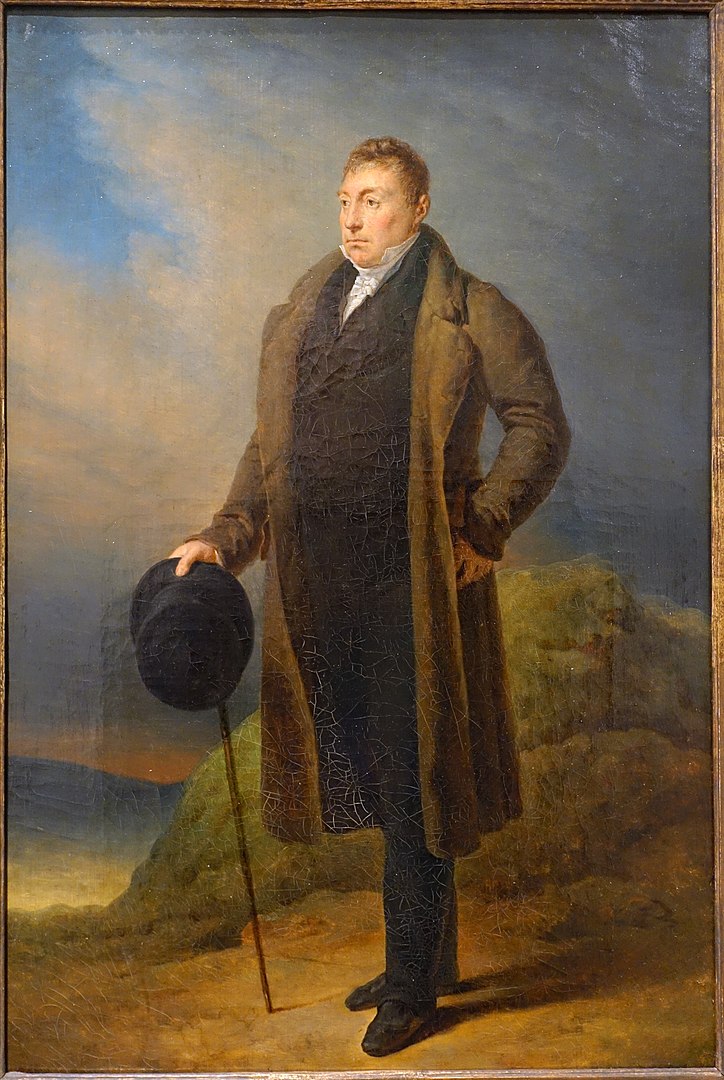
Marie-Joseph-Paul-Yves-Roch-Gilbert du Motier, Marquis de Lafayette (1757-1834) c. 1822, oil on canvas by French-Dutch artist Ary Scheffer (1795-1858) - Public Domain – US Congress, House of Representatives. It is part of the wall to the left of the Speaker of the House (George Washington portrait is to the Speaker’s right). The 1950 renovation included frames built into the new wood paneling, making the two paintings of Washington and Lafayette permanent Chamber fixtures, physically as well as symbolically.
|
|
EDITORIAL
When Lafayette returned to America at the age of 68, as "Guest of the Nation" at the invitation of Congress and President James Monroe, the new Republic was not 50 years old and was facing intense political tensions. It was thought that Lafayette, the last surviving general of the American Revolution, who had demonstrated so many times his profound love and devotion for this country, would maybe teach to a new generation the importance of the values for which his own generation sacrificed so much, and rekindle the "Spirit of '76".
We have not, so far, dedicated a bulletin to this illustrious son of both nations, the "hero of the two worlds", the flag-bearer of democracy and Rights of Man.
As the bicentennial of his triumphal tour of 1824-1825 is looming on the horizon, it is high time that we start repairing this glaring omission.
Clearly, the General Marquis de Lafayette plays a central role in the narrative of the formation of this great Nation, and it is almost impossible to turn the spotlight on the most illustrious actors of the shared history of France and the United States without mentioning his name.
Indeed, our dear friend and colleague Chuck Schwam, COO of the American Friends of Lafayette, remarked to me that the name Lafayette had been mentioned 22 times in our last monthly bulletin.
Also, in just the past 6 months, we have received several invitations from Julien Icher, Founder & president of the LafayetteTrail.org to attend the dedication of the new markers commemorating each stop of the "dear Marquis" in States such as New York, Connecticut, Massachusetts, New Hampshire, Kentucky, Pennsylvania, Tennessee...and we were privileged to attend a new marker dedication in West Point on June 6th.
Several patriotic and like-minded organizations are gearing up to map out the triumphal tour of the Marquis throughout 24 States from 1824 to 1825. We at the American Society of Le Souvenir Français are proud to take part in the preparation of several of these upcoming festivities. They are still many months away, but planning them require a lot of meetings, permits of all sorts, and as we all know, time flies.
Dear reader, do not worry: we will not attempt to write a lengthy biography, or a thick thesis on the John Quincy Adams vs. Andrew Jackson rivalry.
These last few days of summer and the long Labor Day weekend ahead of us are more propitious for light and entertaining reading, which has always been our aim.
Just like pictures are worth a thousand words, there are so many anecdotes worth telling, that are both illuminating and thought-provoking. Among the hundreds of noteworthy sites visited by the Marquis, a few that are perhaps less known will be privileged, as we like to go off the beaten path.
And if, in the process, we bring a smile or two, we will consider ourselves happy as well. Thank you as always for all your kind words or encouragements and valuable suggestions.
As always, you will also find the activities in which your association participated in since last month's bulletin, as well as other upcoming worthy patriotic events and historical commemorations uniting French and Americans.
We wish you "Bonne Lecture", or "Happy reading", with best wishes for a nice end of summer and relaxing Labor Day weekend.
On behalf of the Board of Directors.
Thierry Chaunu, President,
American Society of Le Souvenir Français, Inc.
Poor is the nation that has no heroes, but poorer still is the nation that having heroes, fails to remember and honor them. Marcus Tullius Cicero 106-43 BC
|
|
IF AN INTRODUCTION IS NECESSARY...
We aim to include younger readers in our audience, and before narrating the visit of the Marquis in the United States almost 200 years ago, maybe it is proper to re-introduce him (and maybe facilitate some history homework as we are in a back-to-school mode...)
The Souvenir Français' prime mission anywhere is to honor the memory and care for the tombs of soldiers who died for France. While this is very much our mission here in the USA, the American Society of Le Souvenir Français' other mission is also to pay tribute to Frenchmen who did great deeds in America, whether they are illustrious or less known, and to pass the "torch of remembrance" to younger generations.
Today, Lafayette is remembered with literally hundreds of places coast to coast: counties, cities, schools, parks, streets, monuments, statues, markers, plaques, tablets, even a mountain, are all bearing his name.
Still, in our modern age, how many of the younger generations simply know who Lafayette was? What he accomplished? And how many of us know that Lafayette was very much against slavery, and very much in favor of the emancipation of women? And a friend of the Native Americans, who had a lot of respect and affection for him?
How many of us, really did know about all the places that Lafayette visited during his tour?
|
|
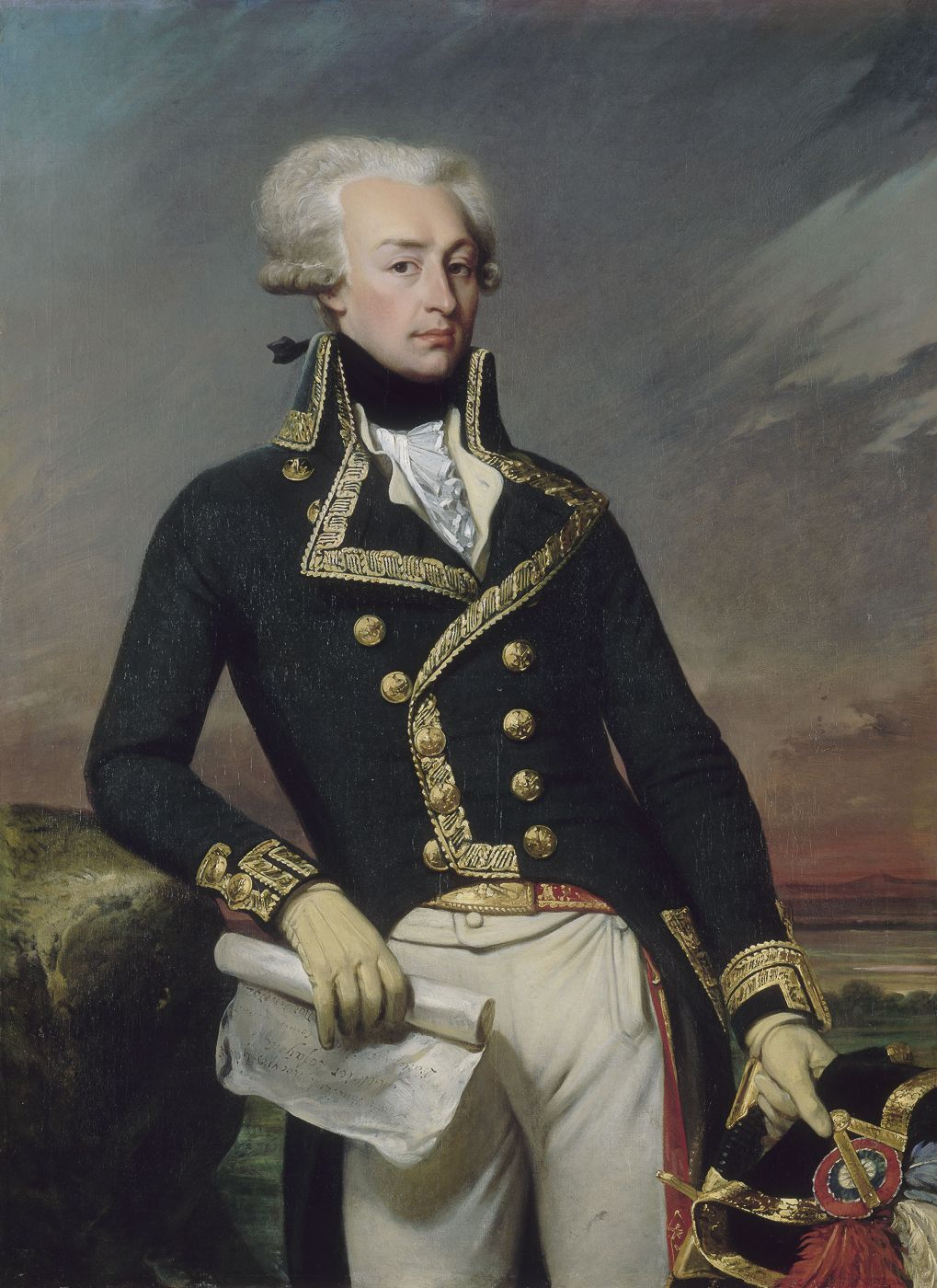
Portrait of Marie-Joseph-Paul-Yves-Roch-Gilbert Mottier, Marquis de LaFayette, Lieutenant General (1757-1834) - (Note, he was a Major General in the Continental Army, and a Lieutenant General in the French Army)
By Joseph-Désiré Court, Public Domain, 1834 (commissioned by the Historical Museum of Versailles)https://commons.wikimedia.org/w/index.php?curid=12059524
|
|
“The moment I heard of America, I loved her; the moment I knew she was fighting for freedom, I burnt with a desire of bleeding for her; and the moment I shall be able to serve her at any time, or in any part of the world, will be the happiest one of my life.”
- Marquis de Lafayette, to Henry Laurens, President of the Continental Congress, September 23, 1778.
• Marie-Joseph Paul Yves Roch Gilbert du Motier, Marquis de La Fayette (6 September 1757 – 20 May 1834), known in the United States as Lafayette is a national hero in both France and America.
First, as with any resume or CV, and before we go any further, let us start with the spelling of his name... is it La Fayette or Lafayette? Certainly, most Frenchmen write La Fayette, as this was the official spelling of the aristocratic name at his birth. On this side of the Atlantic, the spelling "Lafayette" is universally used, as befits the principle of equality. Even this spelling is not universally used. Witness the town of "LaFayette" in Georgia.
But, the Marquis himself was happily signing "Lafayette" - - and we are therefore adopting this spelling!
• Born out of one of the most distinguished and wealthiest noble lineage in France, young Lafayette embraced the ideal of Liberty and went to America to offer his service and his fortune to help the insurgent early on in 1777. Thanks to his military education(1), the Continental Congress commissioned him a Major General in the Continental Army at the age of 19.
• His brilliant military skills and valor in combat were immediately evident, and he shed blood at the battle of Brandywine. Throughout the War of Independence, he played an essential military role, and was one of the main protagonist in the allied victory in Yorktown.
• He did return to the United States in 1784 to see George Washington. That was the last time he would see him. The French Revolution started in 1789, and his important role falls outside the scope of this Bulletin. Suffice it to say that throughout the numerous trials and incredible hardships he endured during these tumultuous times, as well as during the reign of Emperor Napoleon, when he wisely stayed out of politics and devoted his time to the agricultural production in his estate of La Grange, he always upheld a constant and admirable loyalty to his democratic principles, and never for one moment forgot his beloved United States.
• In 1824, he was invited by President James Madison as “Guest of the Nation” to tour the United States.
During this triumphal tour which lasted 13 months, he toured 24 States and received a historic welcome. In every city he visited, throngs came from miles away in order to have a chance to see him, shake his hands, touch his clothes, listen to him. Just in the city of New York, it is estimated that 50,000, a third of the population at the time, lined up around the harbor to see his arrival.
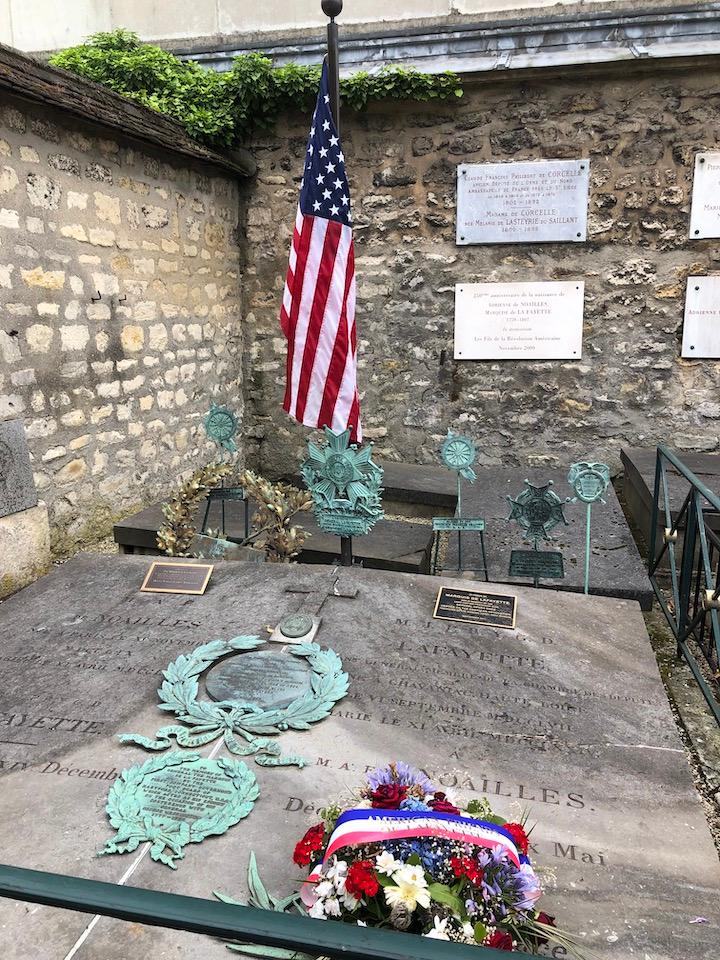
• He is buried at the Picpus Cemetery in Paris, in a casket resting on US soil he brought back from Bunker Hill near Boston. The Star-Spangled Banner has been flying continuously over his grave, without interruption ever, and is changed every year on July 4th.
Had he been born here, he would certainly be considered as one of the Founding Fathers. In the United States, he is most definitely the most beloved Frenchman, the one single figure who from the very start to the very end professed and demonstrated again and again his profound love for the United States, and the ideals of democracy and the Rights of Man.
He was uniquely close to George Washington, with whom he had a father-son relationship, and throughout his life had immense political influence in the New World.
Perhaps never before in the history of nations has someone been unanimously seen as a disinterested friend, revered as a father figure, listened to as a objective, open-minded, unprejudiced adviser, equally admired by people from all origins, beliefs or social status. A staunch lifelong abolitionist, and a protofeminist, he advised politicians of both sides at a time when the young republic was going through turbulent times.
(1) At age 13 he was commissioned an officer in the corps of Musketeers, with the rank of sous-lieutenant, quickly advancing to the rank of lieutenant, then captain after his wedding, and serving in the garrison in Metz in the regiment of the Prince de Poix, under the command of Marshall de Broglie. It is in Metz that the famous dinner with the Duke of Gloucester took place, when he first heard of the Insurgents struggles...
|
|
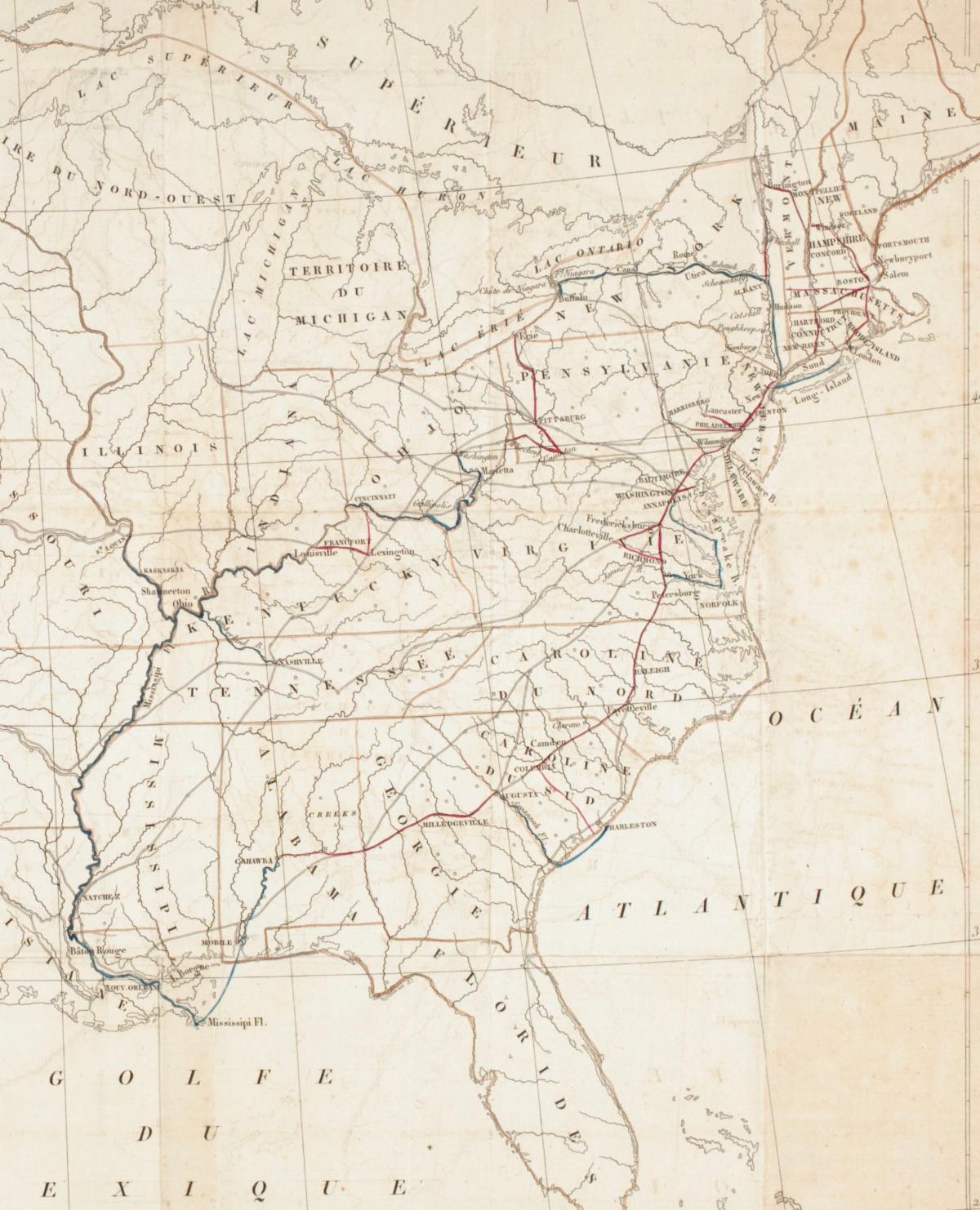
Map showing the itinerary of General Lafayette in America. The red line represents the land route, and the blue line the water route. Map published in Paris, 1829. Special Collections & College Archives, Skillman Library, Lafayette College, Public Domain.
|
|
"GUEST OF THE NATION"
• President James Monroe invited Lafayette, the last surviving major general of the American Revolutionary War, to tour the United States, officially to celebrate the nation's 50th anniversary but also to instill the "spirit of 1776" in the next generation of Americans at a time of great political divide. His tour drew large crowds and sparked a renewal of patriotism.
• From July 1824 to September 1825, Lafayette made a tour of all 24 States in the United States. He was received with a hero's welcome everywhere he stopped. Immense crowds, children, old veterans would come from miles away and wait hours to have a chance to see him, approach him, touch him. Many honors and monuments were presented to commemorate and memorialize the visit.
• The 24 states visited were: Alabama, Connecticut, Delaware, Georgia, Illinois, Indiana, Kentucky, Louisiana, Maine (ex-Massachusetts / North part), Maryland, Massachusetts, Mississippi, Missouri, New Hampshire, New Jersey, New York, North Carolina, Ohio, Pennsylvania, Rhode Island, South Carolina, Tennessee, Vermont, Virginia, Washington D.C.
• The main means of transportation were stagecoach, horseback, canal barge, and steamboat.
• Throughout the years 2024 and 2025 each city will celebrate this most illustrious Frenchman, ranked alongside the Founding Fathers, practically on a par with George Washington. If anyone harbors any doubt about it, one only needs to read the some of the hundreds of local newspapers articles and the accounts or memoirs of contemporary witnesses accounts.
|
|
The American Friends of Lafayette is a nonprofit organization dedicated to honoring the memory of the Marquis de Lafayette, and is the driving force behind the preparation of the Bicentennial visit to the US. Click on the logo above to learn more. |
|
The Lafayette Trail, Inc. is a nonprofit organization with the mission to document, map, and mark General Lafayette's footsteps during his Farewell Tour of the United States in 1824 and 1825. Click on the logo above to learn more.
|
|
• Several of his stops are memorialized with markers and plaques, some decades-old, and an increasing number of brand new ones, thanks to the energy and enthusiasm deployed by Julien Icher, president of the LafayetteTrail.org, whose goal is to dedicate all 175 markers by 2024.
• These new markers from the LafayetteTrail.org are all made in the same distinctive blue and red cast metal and signed by the William C. Pomeroy Foundation which is generously funding this gigantic project.
• The American Society of Le Souvenir Français Inc. is honored to partner with these two like-minded organizations, all well as all other American patriotic associations and volunteers who are participating in these celebrations.
|
|
Starting with this Bulletin, every month we will narrate some of the most salient episodes of this remarkable journey of the corresponding month 198 years ago, while keeping you abreast of the many celebrations planned by the local committees of the American Friends of Lafayette in 2024 and in 2025.
We will also borrow from the testimonies of a privileged close witness, Auguste Levasseur, Lafayette’s personal secretary, who traveled along with the Marquis and his son, George Washington Lafayette, and who published his extensive daily journal: “Lafayette en Amérique 1824-1825, ou Journal d'un voyage au Etats-Unis" (Published by the Librairie Baudoin, Paris, in 1829), as well as other well-documented sources, such as Samuel Lorenzo Knapp. “Memoirs of General Lafayette : with an Account of His Visit to America and His Reception By the People of the United States; From His Arrival, August 15th, to the Celebration at Yorktown, October 19th, 1824”(Published in November, 1824)
|
|
July 13 – Lafayette leaves France on board the merchant ship Cadmus
August 15 – Arrives at Staten Island, New York
August 16 – Arrives in New York City, landing at Castle Garden and Welcoming Parade to City Hall.
August 20 – Leaves New York City and travels to Bridgeport, Connecticut, stopping along the way in Harlem and New Rochelle, New York, Byram
Bridge and Putnam Hill in Greenwich, Connecticut, Stamford, Norwalk, Saugatuck (Westport), and Fairfield, staying at the Washington Hotel in Bridgeport
August 21–24 – Makes stops in New Haven and Old Saybrook, Connecticut, Providence, Rhode Island, Stoughton, Massachusetts, and Boston
August 24-30: series of celebrations (including the monument to Bunker Hill) in Boston.
|
|
ARRIVAL IN NEW YORK HARBOR
AUGUST 16, 1824
|
|
Landing of Gen. Lafayette at Castle Garden, New York, 16th August 1824, From the New York Public Library, Public Domain
|
|
A FERRY RIDE FROM STATEN ISLAND TO LOWER MANHATTAN
• Lafayette spent the first night in Staten Island on August 15th at the home of the Vice President of the United States, Daniel D. Tomkins.
• ..."General Lafayette embarked at Staten Island, for the city. This was announced by a salute from the largest steam ship, manned by the national troops, and from fort Lafayette. The procession then moved for the city, and presented to its inhabitants, a most beautiful and magnificent scene. About two o'clock the General landed at the battery, where he was received by a salute from the troops, and the hearty and reiterated cheers of the immense throng which had assembled to welcome him to our shores..." (Knapp, op. cit.)
• “...It is impossible to describe the majesty of this procession towards the city. The sea was covered with boats of every sort, elegantly decorated with flags and filled with people; these boats which were moved with a swiftness and lightness almost inconceivable, appeared to fly around us...” (Levasseur, op. cit.)
|
|
ARRIVAL AT CLINTON CASTLE |
|
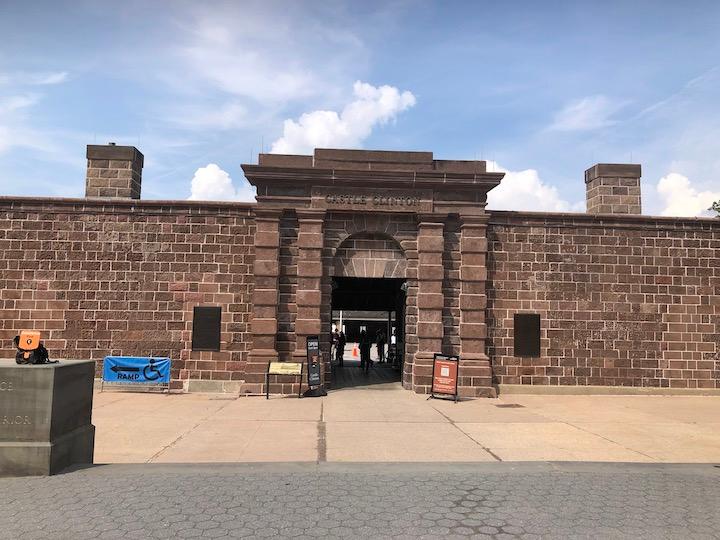
Clinton Castle, 10 Battery Pl, New York, NY 10004
Two similar markers are located at the entrance and exit sides.
Photos: Thierry Chaunu
|
|
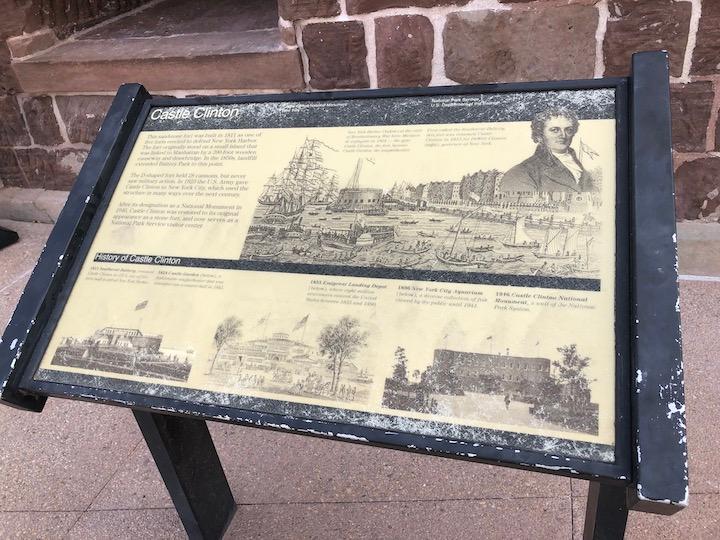
• Today throngs of tourists line up to purchase tickets to visit the Statue of Liberty. In their hurry to go through the airport-style security and embark on the ferry, how many take the time to stop and read the "interpretive marker"?
It describes the history of Castle Clinton (see inscription below), with an illustration of the "Landing of Lafayette" and the caption: "New York Harbor (below) at the visit of Revolutionary War hero Marquis de Lafayette in 1824 - the year Castle Clinton, the fort, became Castle Garden, the amphitheater. First called the Southwest Battery, this fort was renamed Castle Clinton in 1815 for DeWitt Clinton (right), governor of New York.”
• Alas, there is no account of the memorable reception of August 16, 1824.
And yet, more than 50,000 New Yorkers (more than one third of the population) lined up to watch his arrival in New York on August 16, 1824!
• ...“At an early hour, the whole city was in motion; almost every man, woman and child was preparing to witness the landing of their much respected guest. The shops and stores were closed, and all business was suspended for the day. The ringing of bells, the roar of cannon, and the display of the national flag, at all public places and on board the shipping, proclaimed that it was a day of joy, in which all were anxious to partake. Before 12 o'clock, the battery, the adjoining wharves and every place commanding a view of the passage from Staten Island, were crowded to excess. It was supposed there were nearly 50,000 persons upon the battery, including the troops. This elegant promenade, since its enlargement, is said to be capable of holding nearly the whole population of the city, (130,000) but a large portion of the front was occupied by the brigade of artillery and other troops. The castle garden, almost contiguous to the battery, and its gallery, were also crowded by the citizens" (Knapp, op. cit.)
• Inscription of the marker:
“This sandstone fort was built in 1811 as one of five forts erected to defend New York Harbor. The fort originally stood on a small island that was linked to Manhattan by a 200-foot wooden causeway and drawbridge. In the 1850s, landfill extended Battery Park to this point.
The D-shaped fort held 28 cannons, but never saw military action. In 1823 the U.S. Army gave Castle Clinton to New York City, which used the structure in many ways over the next century.
After is designation as a National Monument in 1946, Castle Clinton was restored to its original appearance as a stone fort, and now serves as a National Park Service visitor center."
|
|
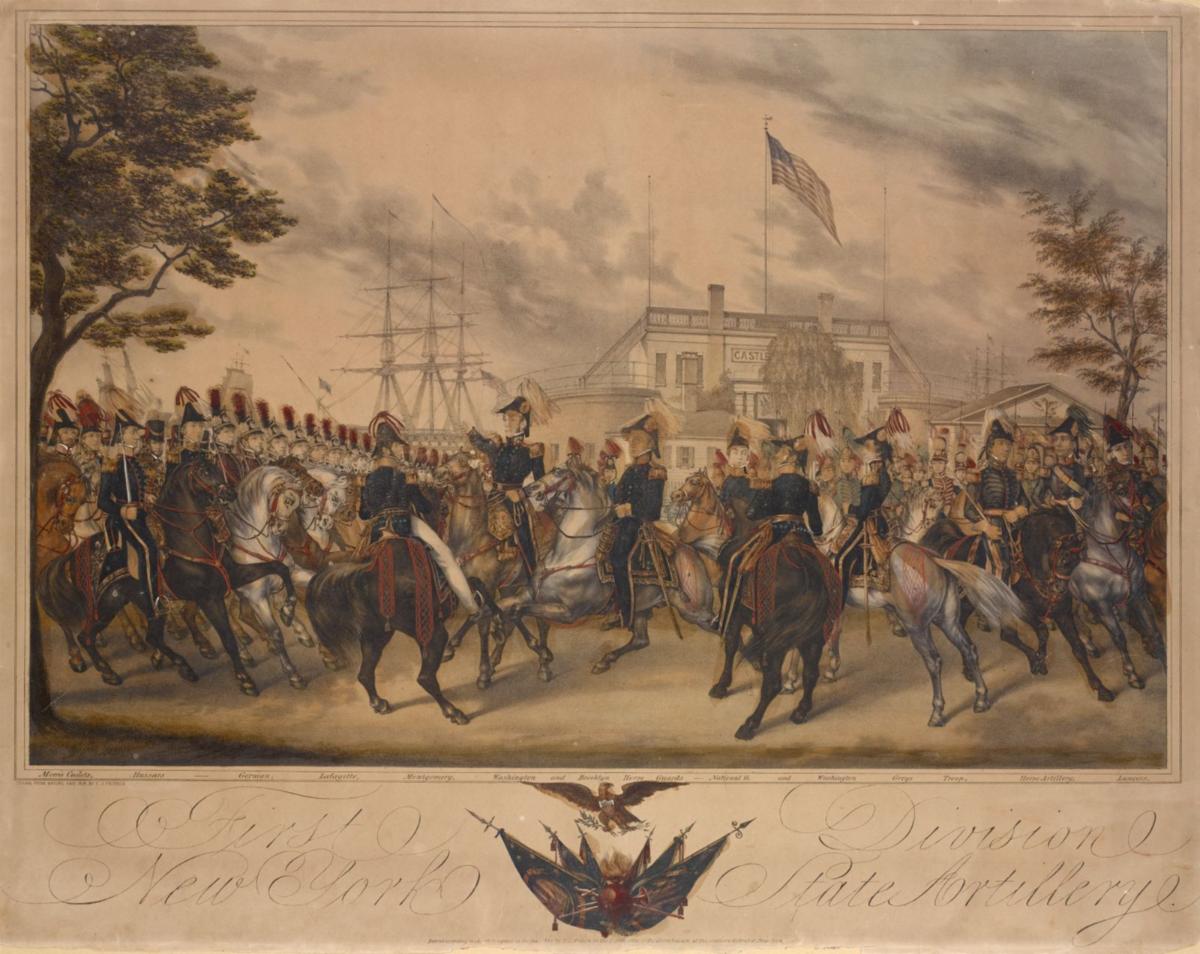
Arrival of Lafayette in New York Harbour and the first parade to City Hall, August 16, 1824
|
|
THE PRECURSOR OF THE TICKER TAPE PARADES
• After reviewing the "Lafayette Guards", the procession to City Hall can be considered as the forerunner of future "ticker tape" parades.
• ..."The Lafayette Guards dressed in an elegant and neat uniform, bearing on their breast the portrait of the general, escorted him in front of the long line of militia drawn up to receive him. The general, attended by a numerous and brilliant staff, marched along the front; as he advanced, each corps presented arms and saluted him with its colours; all were decorated with a ribband bearing his portrait, and the legend “Welcome Lafayette”..." (Levasseur, op.cit.)
• “...At the extremity of the line of troops, elegant carriages were in waiting. General Lafayette was seated in a car drawn by four white horses, and in the midst of an immense crowd, we went to the City Hall. On our way, all the streets were decorated with flags and drapery, and from all the windows flowers and wreaths were showered upon the general..." (Levasseur, op. cit.)
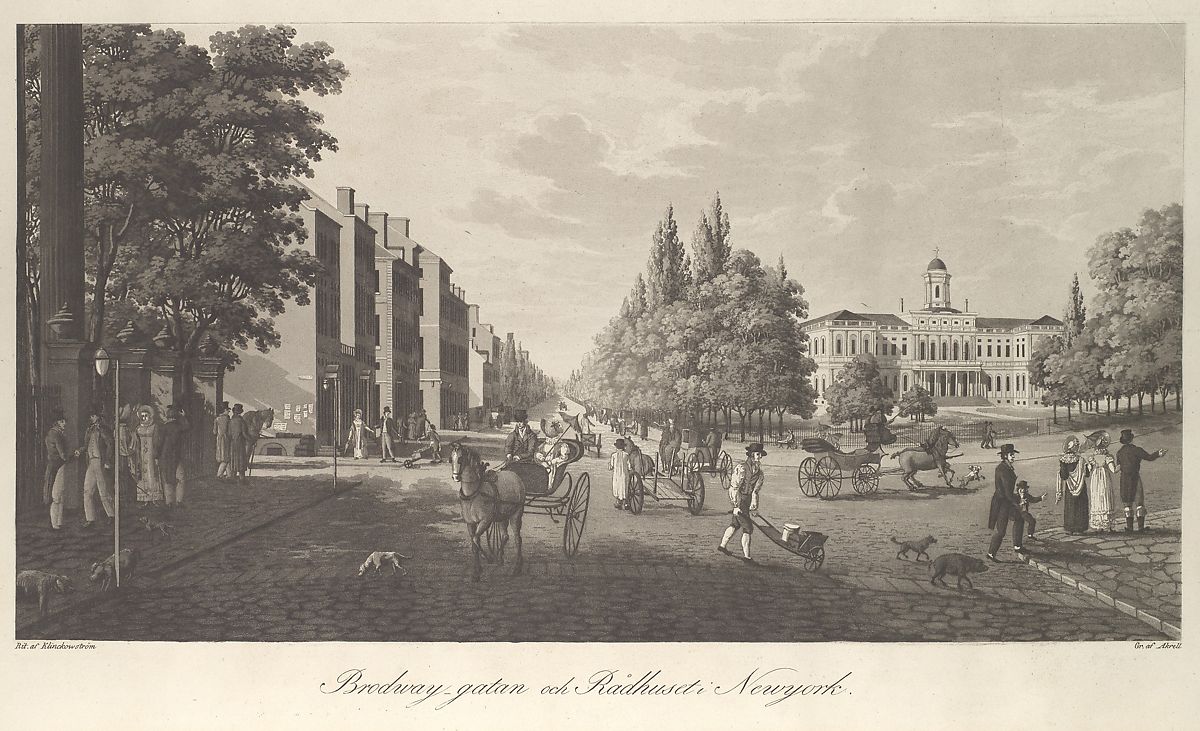
• "It is impossible fully to describe the enthusiasm of joy which pervaded and was expressed by the whole multitude. Here the General had a fair specimen of the affection and respect, which is felt for him by every individual of this extended country. He seemed much moved by these expressions of attachment, and bowed continually to the people who pressed about him. After resting a few moments at the castle garden, he proceeded in an elegant barouche drawn by four horses, escorted by the dragoons and troops, through Broadway to the City Hall. The windows, balconies, and even the roofs of the houses were filled with ladies, all welcoming the General as he passed, by their smiles and waving of handkerchiefs” (Knapp, op. cit.)
|
|
4 DAYS OF RECEPTIONS AT A FRENETIC PACE |
|
Broadway and City Hall in New York (Brodway-Gatan Och Rådhuset i New York), 1824, by Etcher Carl Fredrik Akrell (Swedish, 1779–1868)
Artist: After Axel Klinckowström (Swedish, 1775–1837)
The Met, Public Domain
|
|
• The frenzy of the crowds and outpouring of emotions are only a harbinger of what was going to occur again and again throughout the country:
• ...“Mothers surrounded him, presenting their children and asking his blessing, which having obtained, they embraced their offspring with renewed tenderness; feeble old men appeared to become re-animated in talking to him of the numerous battles in which they had been engaged with him for the sake of liberty. Men of colour reminded him with tenderness of his philanthropical efforts at various periods, to replace them in the rank, which horrid prejudices still deny them in some countries; young men whose hard and blackened hands announced their laborious occupations, stopped before him and said with energy, “We also belong to the ten millions who are indebted to you for liberty and happiness!” Many others wished to speak to him, but were prevented by their tears;” (Levasseur, op. cit.)
• “During the four following days, the general found it difficult to divide his time in such a manner as to satisfy the wishes of all his friends. He devoted, daily, two hours to the public in the City Hall, into which the crowd pressed as on the first day, and he there received numerous deputations from neighboring cities, and different states, which expressed their desire and hope of receiving him. The rest of the time was employed in attending the meetings of the learned societies of the city. (Levasseur, op. cit.)
• “During the four days he remained in New-York, all gentlemen and ladies of the most respectable families were individually introduced to him; and he manifested great pleasure at the cordial welcome, with which he was universally greeted. Splendid evening parties were given in honor of the "nation's guest," at which he met many individuals whom he had known more than forty years before. His interviews with "the war-worn veterans," with whom he had been associated in times of danger, for the liberties of the country, were peculiarly interesting and affecting. He embraced them; but his feelings were so powerful, that he could not give utterance to his sentiments for many minutes." (Knapp, op. cit.)
• ..."The members of the bar, the society of the Cincinnati, and the French residents of New York came to compliment him. The latter, under their president Mr. Monneron, expressed with animation the sentiments which the triumph of their compatriot inspired..." (Levasseur, op. cit.)
|
|
ON THE ROAD THROUGH CONNECTICUT & RHODE ISLAND
August 24 - 27, 1824
|
|
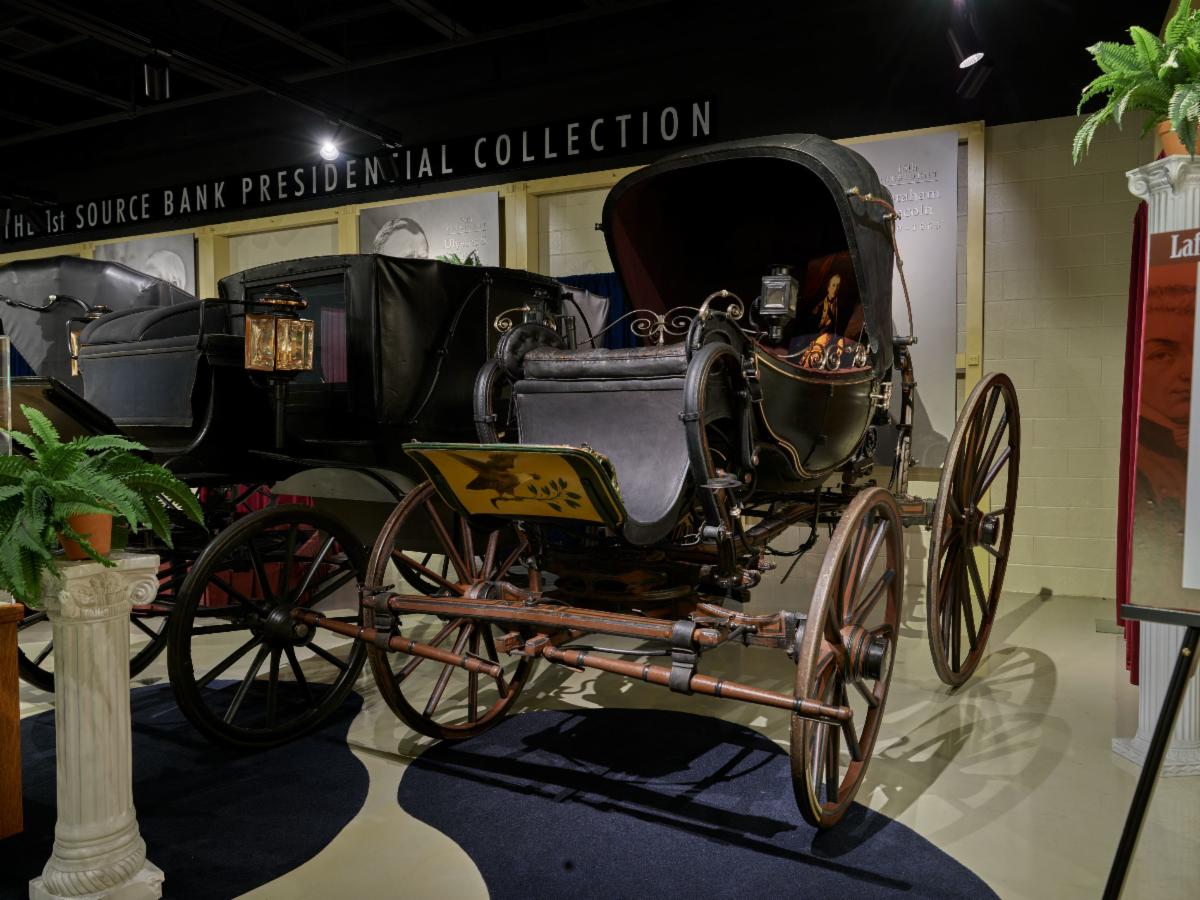
The U.S. Government commissioned this carriage for use by Revolutionary War hero Marquis de Lafayette for his tour of America in 1824.
"Lafayette's Barouche," on display at the Studebaker Museum in South Bend, Indiana
Carol M. Highsmith Archive, Library of Congress, Prints and Photographs Division
|
|
• Lafayette had promised in earlier correspondances that he would hasten to the City of Boston. And so, he was intent on fulfilling his promise, even though, as we will see later, he regretted having to rush though Connecticut and Rhode Island on this portion of his journey.
• ...“We left New York on the morning of the twentieth of August, for Boston, in the state of Massachusetts. At day light several military corps were drawn up in front of the hotel, for the purpose of escorting the general out of the city, where a parting salute was fired from a battery of six pieces of cannon, two of which had been taken from the English at the siege of York-town, in 1781. A great number of citizens on horseback, and in carriages, accompanied us as far as New-Rochelle, where we halted some time, to give the general an opportunity of receiving some of his old companions in arms, who being unable to come to New York, had collected together on his passage, in order once more to see him and take him by the hand.” (Levassseur, op. cit.)
•..."They reached New Haven about midnight, on his approach to which he was met by the governor's guard, and escorted into that city. Most of the buildings on the principal streets were illuminated, and a national salute was fired. "The night was almost turned into day, and the scene was very brilliant and impressive." He was detained at all the villages on the road from New-York to New Haven, through the eagerness of the citizens, to see and be introduced to this distinguished hero […] At New London, and at most other places on his journey, he met some of his old revolutionary companions, who were delighted to see again in their own free and happy country, a man who had devoted his earliest days and zealous efforts to secure its independence..." (Knapp, op. cit.)
•..."Notwithstanding this necessary precaution, our march was very slow, as we could not pass a hamlet without being detained some moments by collections of people from more than 20 miles around. Every village had its triumphal arch, upon which was almost always inscribed the names of Washington and Lafayette or the dates of the battles of Brandywine and Yorktown. Every where announced by the sound of cannon, every where received and complimented by the magistrates of the people, and every where obliged to alight to receive the testimonials of the love of the entire population, it was not until after five days and almost five nights that the general arrived at Boston, which is but two hundred miles from New York; I say almost five nights, because we constantly travelled until near midnight, and set out again at five o’clock in the morning..."(Levassseur, op. cit.)
•...“these moving and sublime displays of the gratefulness of a whole people, we did not dream of fatigue; even our night marches had a charm which caused us to be forgetful of it. The long file of carriages escorted by horsemen bearing torches; the fires lighted from place to place upon the tops of the hills, and around which were grouped families whom the desire of beholding their guest had kept watching; the somewhat wild sound of the trumpet of our escort, repeated several times by the woodland echoes, the sight of the sea which occasionally came into view on our right, and the distant and decreasing peal of the bells which had announced our passage, all formed around us a picturesque and enchanting scene, worthy of the pen of Cooper. In this manner we passed through Fairfield, New Haven and New London in Connecticut; Providence in Rhode Island, and finally the route from Rhode Island to Boston.” (Levassseur, op. cit.)
|
|
BOSTON, AUGUST 24-30, 1824 |
|
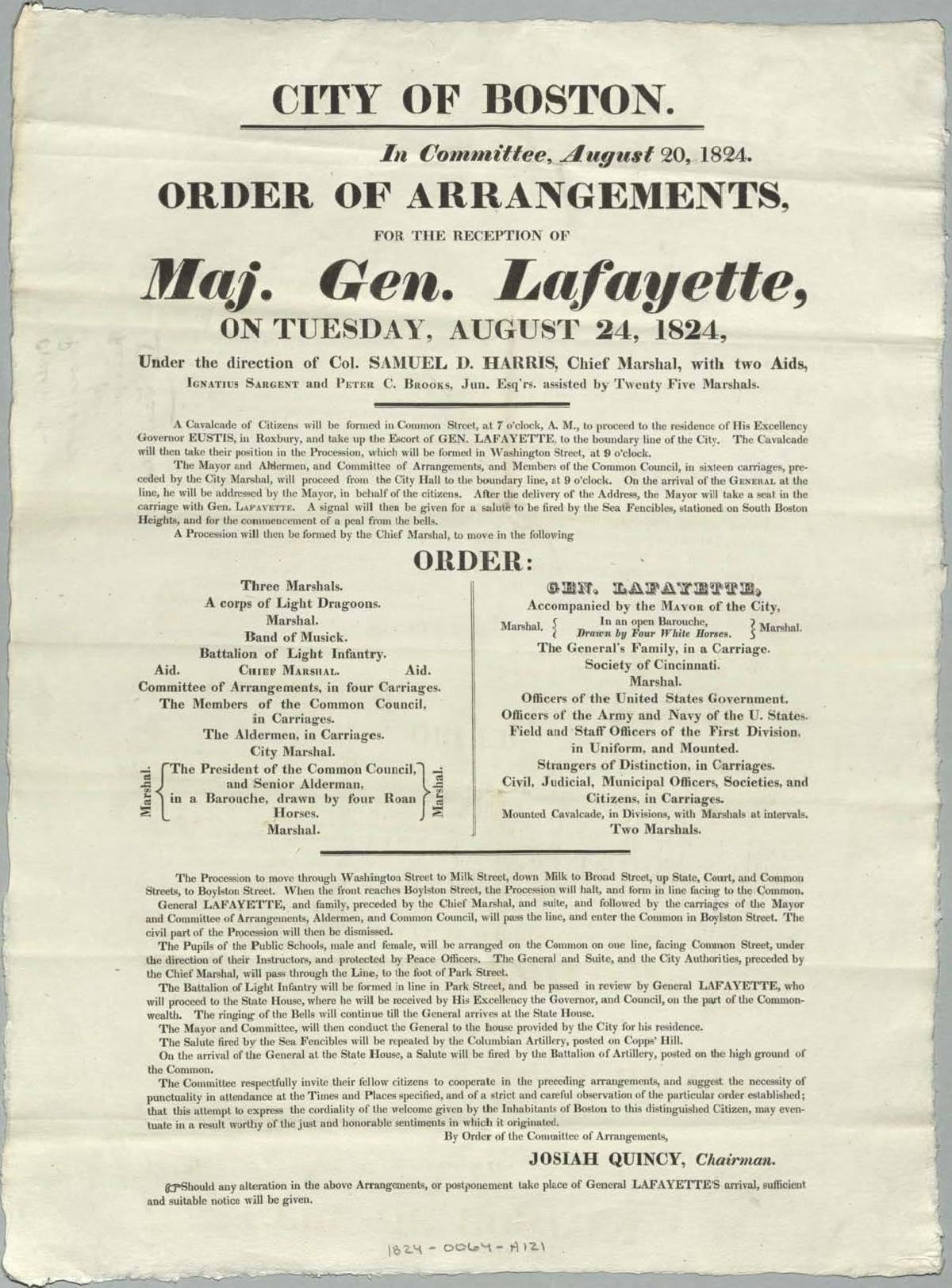
Massachusetts traditionally celebrates Lafayette Day on May 20.
Boston City Archives
|
|
• ..."The concourse of people coming out of the city was so great, and so much obstructed the road, that we were two hours in riding the distance of only two miles. All the road was lined with troops on foot, and on horseback.” […]“At noon we reached the suburbs of Boston. At the entrance of the city, under a triumphal arch we were met by the corporation; the mayor alone in an open carriage, stopped by the side of the open carriage of the general. Both rose to salute each other, when the mayor addressed him on behalf of the city...” (Levasseur, op. cit)
•...“Arches were thrown across several of the principal streets, through which Lafayette was conducted, covered with evergreens and flowers, and containing appropriate mottos. There were two in Washington-street, the largest, and part of the distance, the widest street in the City.—
On one of these was very legibly written:
—1776—
WASHINGTON and LAFAYETTE.
Welcome Lafayette—A Republic not ungrateful.
On the other: "WELCOME LAFAYETTE."
"The Fathers in glory shall sleep,
Who gather'd with thee to the fight;
But the sons will eternally keep
The tablet of gratitude bright.
We bow not the neck
And we bend not the knee,
But our hearts, LAFAYETTE,
We surrender to thee.”
The lines were from the pen of a citizen of Boston...”
(Knapp. op. cit.)
• ..."In front of the state house, upon an immense terrace, whence the sea might be discovered at a distance covered with small vessels, was a long double row of girls and boys, from the public schools, all decorated with Lafayette badges; raising their little hands towards heaven, and uttering cries of joy. One of the youngest girls advanced towards the general; she was lifted up to his carriage, placed a wreath of evergreens on his head, embraced him tenderly, and called him Father...” (Levasseur, op. cit)
• ..."In the evening we dined at the Exchange Coffee-house with the governor and staff, the corporation, and all the other public authorities. The hall was decorated with devices which referred both to the actions of Lafayette, and the gratitude felt by the Americans for the assistance of France, when Fortune, still wavering, held her scales equally balanced between liberty and oppression. The French and American flags waved united over the head of the president of the banquet, and Chief Justice Parker gave a toast to the memory of Louis XVI. adding, that none of the friends of liberty should be forgotten, although they might have worn a crown...” (Levasseur, op. cit)
|
|
UNINTERRUPTED APPLAUSE IN CAMBRIDGE |
|
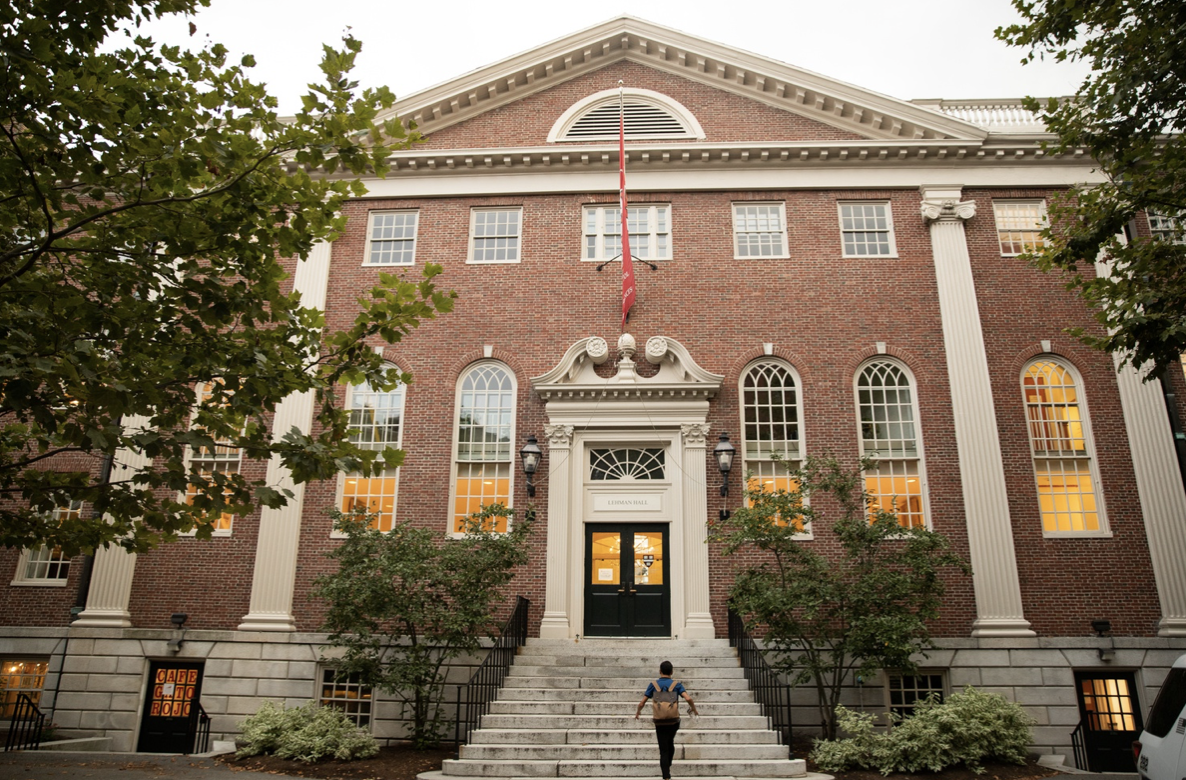
Harvard square, facing Lehman Hall, Cambridge, MA 02138
Lehman Dudley House, Harvard
Photo: Wikimedia, By KH1776 - Own work, CC BY-SA 4.0,
|
|
• On August 25, 1824, Boston Mayor Josiah Quincy III escorted Lafayette to Cambridge to attend the Mayor’s son’s commencement at Harvard College. The younger Josiah Quincy IV, another future Boston Mayor, was a new acquaintance of Lafayette. He was graduating from the Law School and gave the commencement address in Latin. With the distinguished guest present, Quincy spoke with eloquence about Lafayette’s military service in American Revolution.
• ...“When the general entered the hall, the acclamations and transports of the crowd, and especially of the ladies were so great, that the business of the meeting was for a long time delayed. It certainly was an enchanting spectacle to behold the vast galleries filled with young ladies wreathed with flowers, waving their handkerchiefs in salutation of him, whom they called their father, friend, defender, and companion of the Great Washington. In vain the president frequently called for silence, without which it was impossible to be understood; every voice was drowned with the cries and plaudits for Lafayette. At length after half an hour had elapsed, quiet was established, and the exercises began, but were often interrupted by the eagerness, with which the audience seized upon all the allusions to Lafayette, that occurred in the discourses...” (Levasseur, op.cit.)
• Inscription:
“Site of the Fourth Meeting House built in 1756. Here Washington worshipped in 1775. Constitutional Convention of Massachusetts held here in 1779.
Lafayette welcomed here in 1824.”
|
|
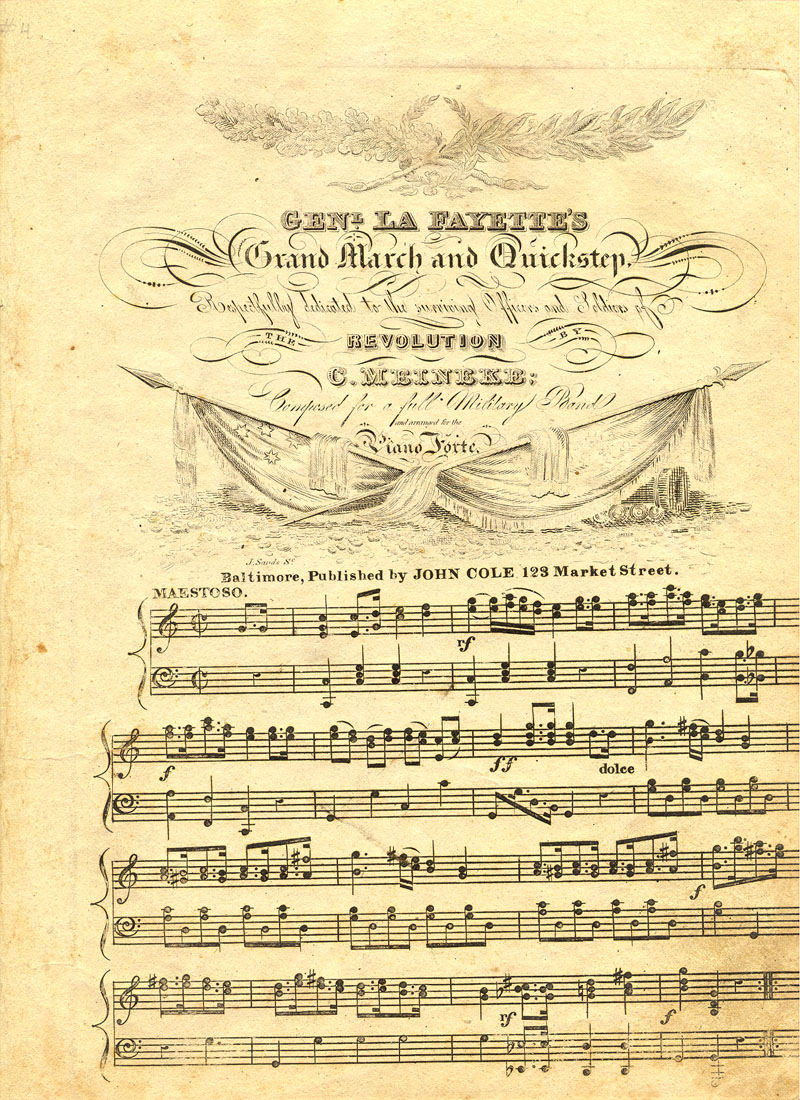
TIME TO SING!...
MUSIC SHEETS FROM AUGUST 1824
SPECIALLY COMPOSED FOR LAFAYETTE
|
|
1824 (August 17). "Gen'l La Fayette's Grand March and Quickstep," Composed by C. Meineke for a full Military Band and arranged for a Piano Forte. Published by John Cole 123 Market Street. Philadelphia.
|
|
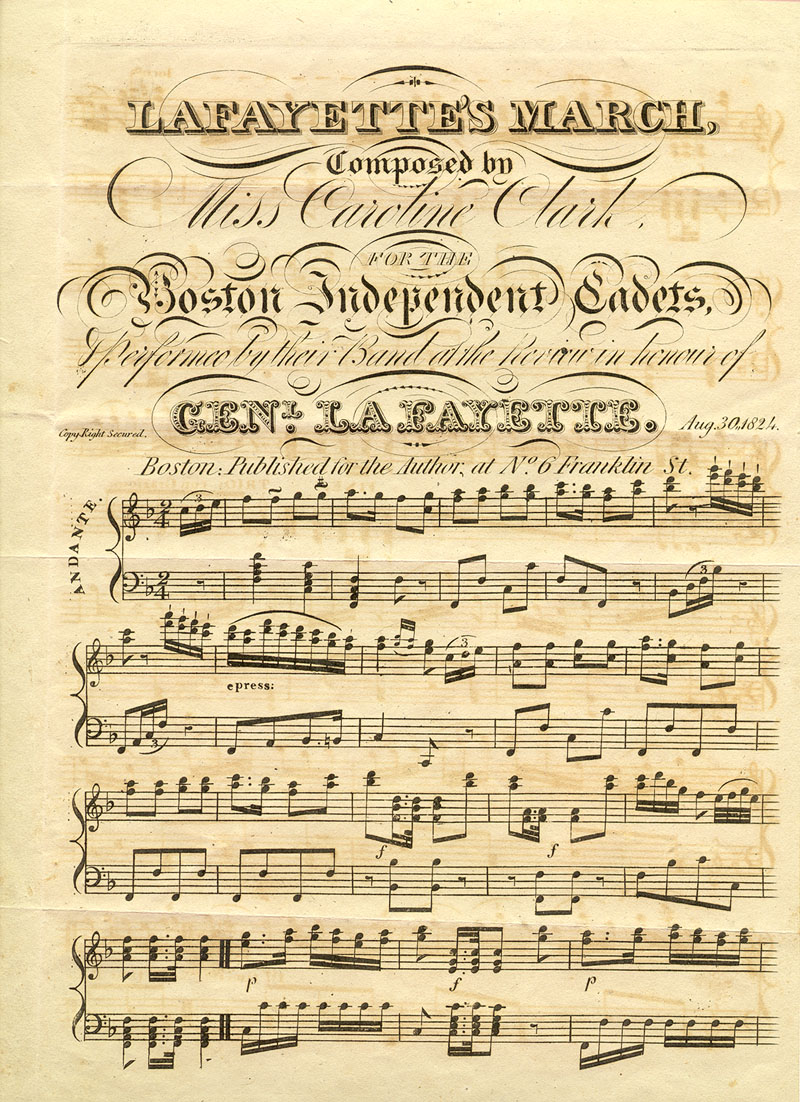
1824 (August 30). "Lafayette's March," composed by Miss Caroline Clark for the Boston Independent Cadets. Boston.
https://academicmuseum.lafayette.edu/special/marquis/CelebratingLafayette/lafmarch1.htm
|
|
A FEW OTHER MARKERS ALONG THE WAY... |
|
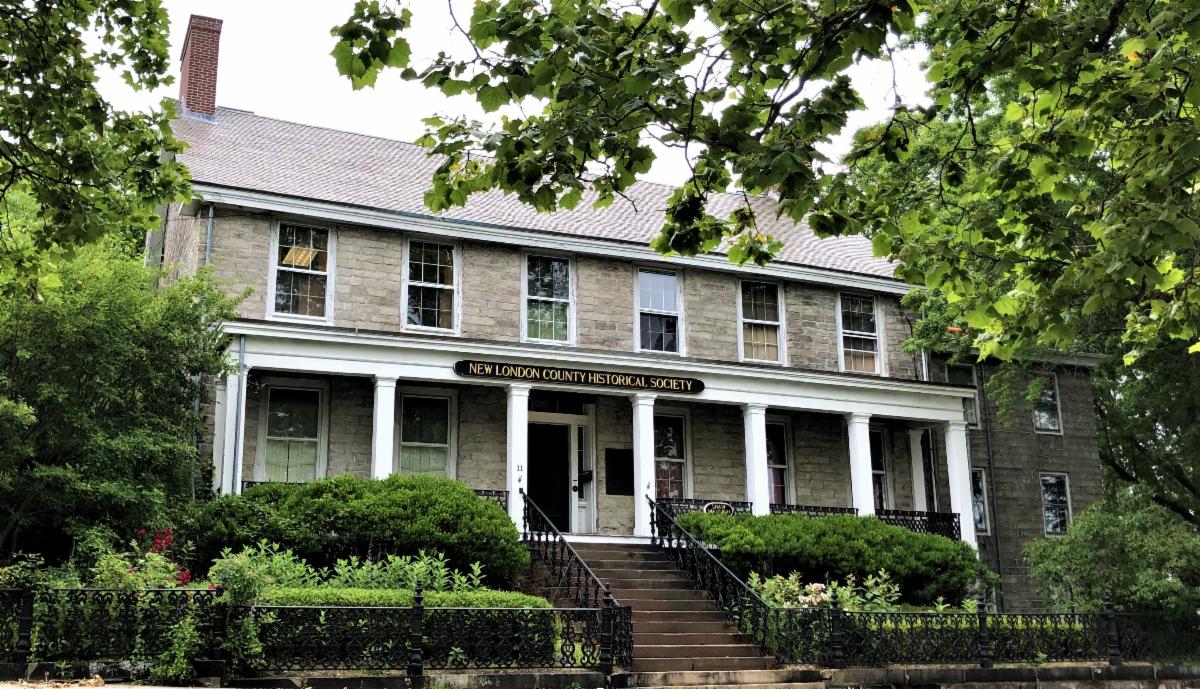
MARKER, "SHAW MANSION"
August 22, 1824
|
|
Marker located in front of the mansion, 11 Blinman St, New London, CT 06320
|
|
• The Shaw Mansion, also known as the Shaw-Perkins Mansion and as the Shaw Mansion Museum, is a historic mansion and house museum. It was built in 1756 for Nathaniel Shaw Sr., it is a well-preserved example of a wealthy merchant's house, made further notable as the location of the state's naval offices during the American Revolutionary War. The headquarters and museum of the New London County Historical Society have been located in the Shaw Mansion since 1907. The house was added to the National Register of Historic Places in 1970.
• Inscription (excerpts):
Among guests were
General George Washington, Apr. 9 & 10, 1776
Marquis de Lafayette, August 22, 1824
Governor Jonathan Trumbull
(Brother Jonathan)
Major General Nathanael Greene
Commodore Esek Hopkins
Captain Nathan Hale
• • •
Purchased by the
New London County Historical Society
for its permanent home in 1907
|
|
MEMORIAL "LAFAYETTE MALL", BOSTON |
|
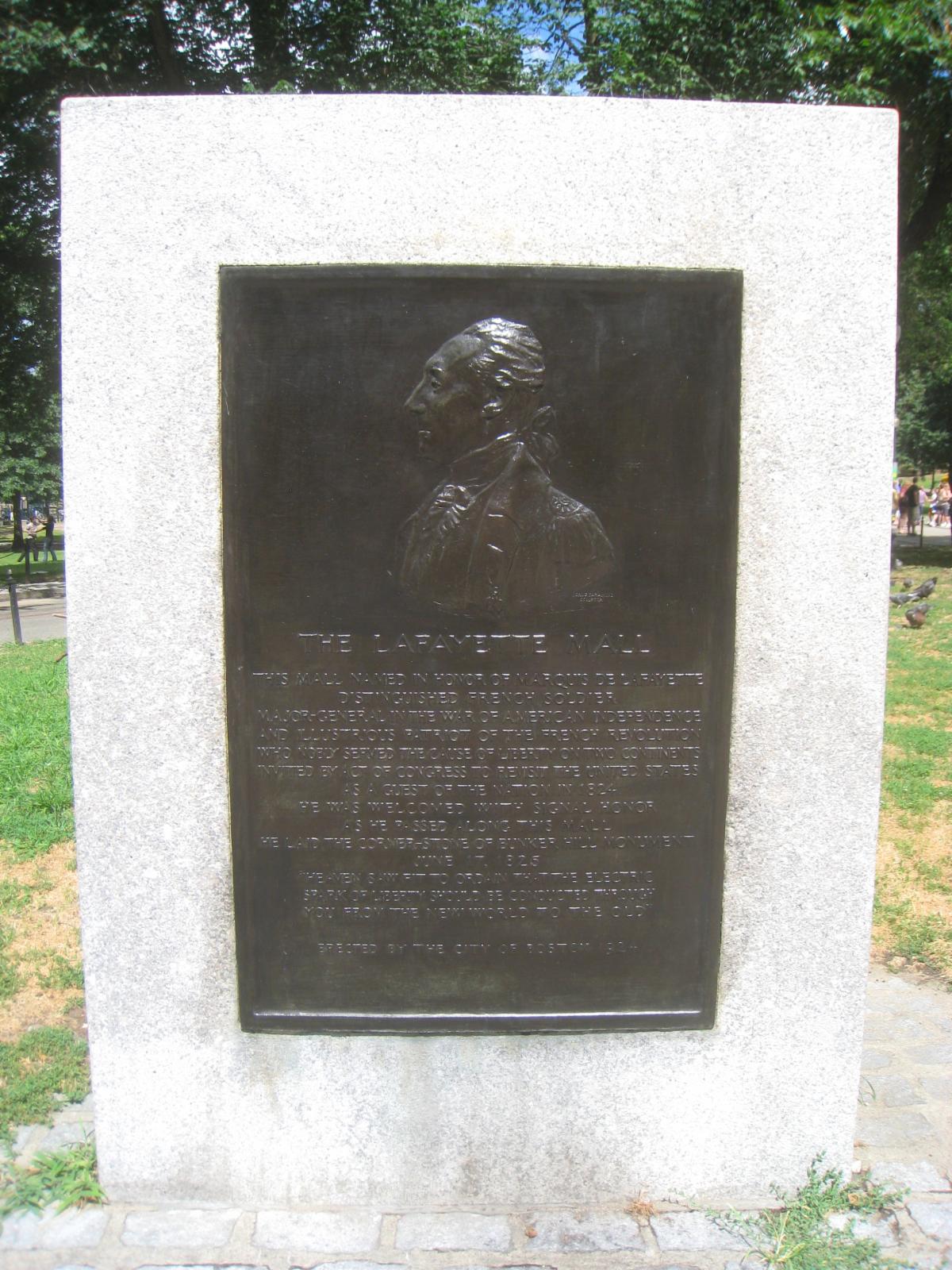
Lafayette Mall plaque, Boston Common, Boston, Massachusetts, USA.
Parkman Plaza, part of the Boston Common, Tremont St, Boston, MA 02110
By Daderot - Own work, Public Domain, https://commons.wikimedia.org/w/index.php?curid=10940076
|
|
• This bronze plaque was designed in 1924 by John Francis Paramino, (1888/89-1956), sculptor and created by the Gorham Manufacturing Company foundry. The monument commemorates the 100th anniversary of Lafayette's march to Bunker Hill on the 50th anniversary of that battle. The Tremont Street Mall was renamed Lafayette Mall in his honor.
• Inscription:
“This mall is named in honor of Marquis de Lafayette, distinguished French soldier, Major-General in the War of American Independence
and illustrious patriot of the French Revolution who nobly served the cause of liberty on two continents, invited by act of Congress to revisit the United States as a guest of the nation in 1824. He was welcomed with signal honor
as he passed along this mall. He laid the corner-stone of Bunker Hill Monument, June 17, 1825.
"Heaven saw fit to ordain that the electric
spark of liberty should be conducted through
you from the New World to the Old"
Erected by the city of Boston 1924
|
|
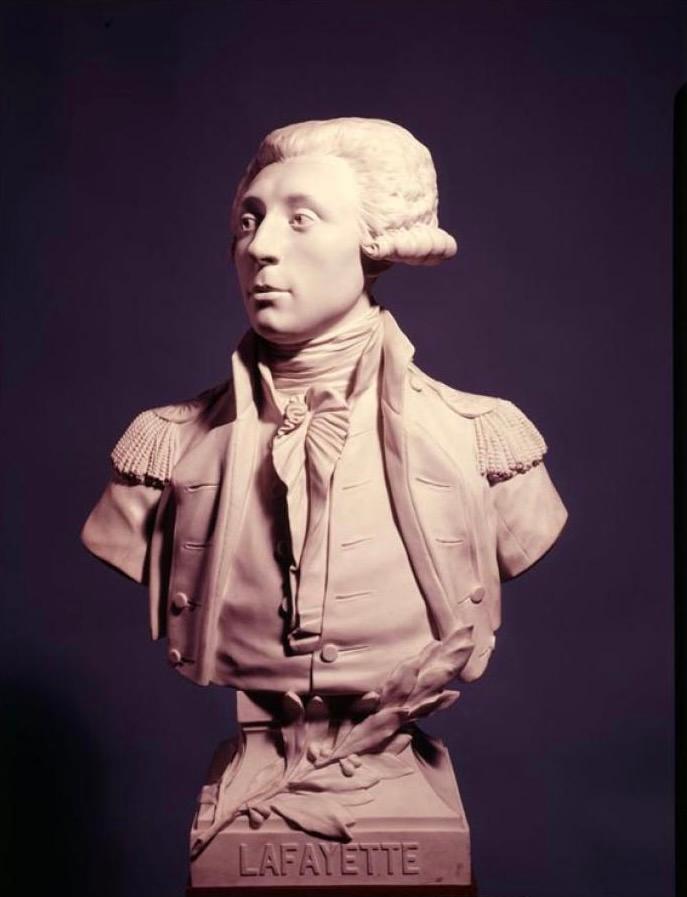
Gilbert du Motier, marquis de La Fayette (1757-1834) en uniforme de la Garde nationale
Bust by Jean-Antoine Houdon, hard-paste biscuit porcelain, edited by Sèvres starting from 1903,
Photo credit: 2009 President and Fellows of Harvard College
Harvard Art Museums/Fogg Museum, Bequest of Grenville L. Winthrop, 1943.1267
|
|
TO BE CONTINUED NEXT MONTH!... |
|
SEASON 2, EPISODE 1, AUGUST 1782:
THE FRENCH ARMY FROM WILLIAMSBURG TO BOSTON
|
|
MISSION ACCOMPLISHED
Last year we narrated in 5 episodes, from June to October, the long march of the French Army under general comte de Rochambeau from Newport, R.I. to Yorktown, VA, through the States of CT, NJ, NY, PA, DE, MD
We are resuming the series, which will extend from this month until December: "Season 2, Episode 1: August 1782, Maryland"
After the victory in Yorktown, the war was not officially over. It would take several more months before England would recognize the independence of the United States and sign the Treaty of Paris on September 3, 1783.
During that time, British forces were still in control of cities such as New York.
The French army spent the most part of the winter of 1781-1782 stationed in Williamsburg, VA, and starting marching north in July 1st, 1782 to reach Boston in December and sail home.
Some units stayed behind, such as the famous Lauzun Legion of hussards, who kept watch during the winter of 1782-1783.
The return march route was in a much lighter mood, understandably so. It is not as well documented than the south-bound march we narrated last year. Still, there are several markers along the way which we will select, as well as a few nice anecdotes which we will tell in future bulletins until December.
Below are a few markers pertaining to the month of August, shortly after the regiments started their 690-mile long trek.
|
|
A FEW SELECTED MARKERS ALONG THE WAY... |
|
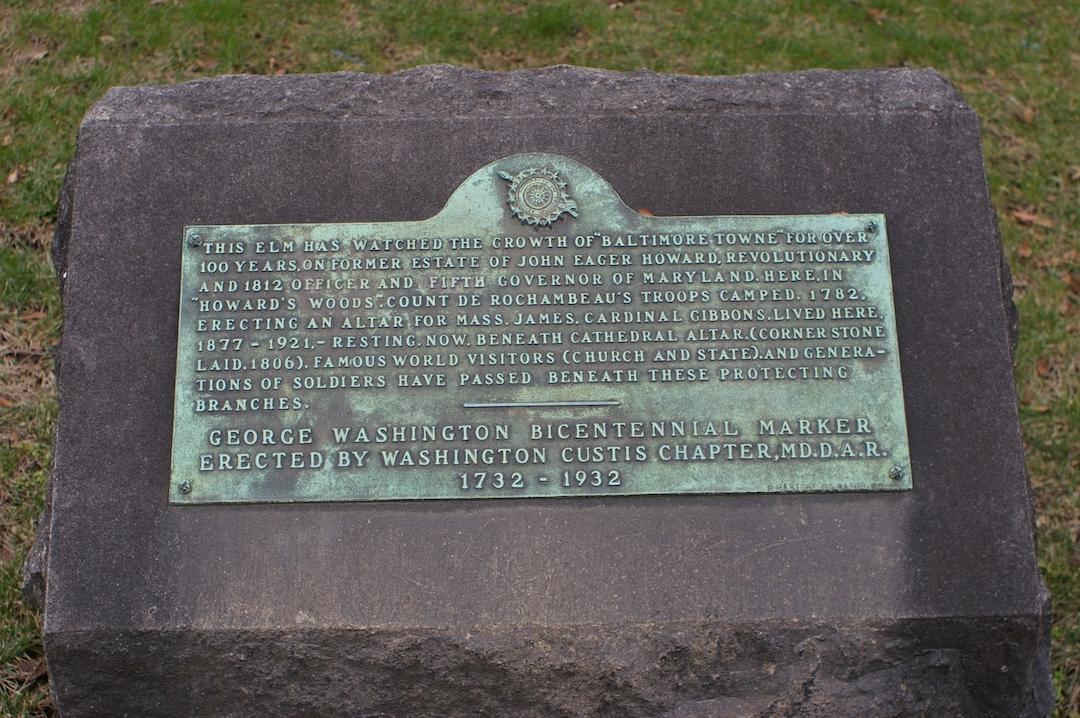
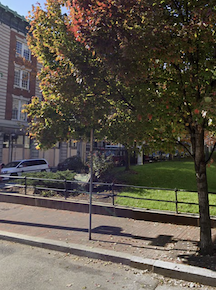
Marker, 34th(South) & 20th (North) Camp of the French Army
At Howard’s Woods, Baltimore, MD.
September 12-15, 1781 (on the way to Yorktown)
24 July – 24 August 1782 (on the way back to Boston)
Corner of Baltimore Basilica & Mulberry Street, 400 N Charles St, Baltimore, MD 21201
|
|
• Inscription:
This elm has watched the growth of "Baltimore Towne" for over 100 years, on former estate of John Eager Howard, Revolutionary and 1812 Officer and fifth governor of Maryland. Here, in "Howard's Woods", Count De Rochambeau's troops camped, 1782, erecting an altar for mass. James Cardinal Gibbons lived here, 1877-1921, resting now beneath Cathedral altar. (Corner stone laid 1806). Famous world visitors (church and state) and generations of soldiers have passed beneath these protecting branches.
Erected 1932 by Washington Curtis Chapter,
Maryland Daughters of the American Revolution.
|
|
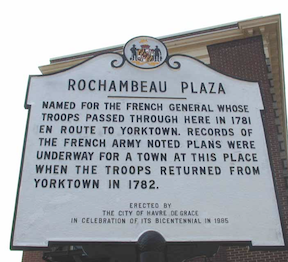
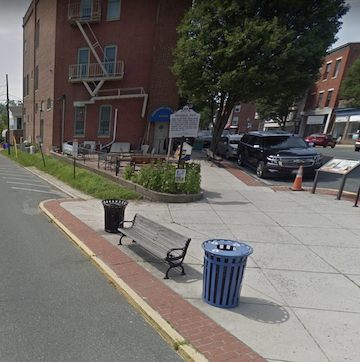
At the intersection of Washington Street and St. John’s Street, Havre de Grace, MD 21078
|
|
About the origin of the name Havre de Grace, Maryland:
• "Lafayette played a major role in re-naming the city. Prior to 1781 it was known as Lower Susquehanna. It was not a municipality at the time. Then, a French army traveled through and camped here on their way to the future battle at Yorktown, Va. While it was here, local residents suggested that the place be renamed to Havre de Grace since many people had told them that it looked like Le Havre, France. The French officers agreed and presented the idea to Lafayette and he agreed and was given the credit for the official suggestion. When the place was charted in 1785, becoming the second official municipality in Maryland with continuous existence, it was named 'Havre de Grace." (David Craig, 34th Mayor of Havre de Grace, Member of Maryland Senate)
|
|
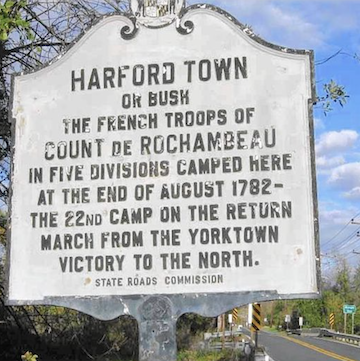
Marker, 32nd (South) & 22nd (North) Camp of the French Army
Hartford Town (Bushtown, Aberdeen, MD)
September 10/11, 1781 7 August 25-28, 1782
On Maryland Route 7, .8 miles south of 136 Cavalry Road, Abingdon, MD 21009
|
|
• On the return trip on August 25/26, 1782, they established a regular camp, Camp 22 since departure from Williamsburg, Virginia, on July 1, 1782.
• Inscription (excerpts):
The French Troops of
Count de Rochambeau
in five divisions camped here at the end of August 1782
the 22nd camp on the return march from the Yorktown victory to the north.
Erected by State Roads Commission.
|
|
PAST MONTHLY BULLETINS
OUR GOAL: turn the spotlight on a famous, or less famous, episode or historical figure during the long shared history between France and the United States, with illustrations and anecdotes.
You can have access to all our past Monthly Bulletin
since February 2021 by visiting our website:
You can click on the photos in our bulletins and on the links indicated in blue for more information and direct access to the references.
|
|
In our next Bulletin in September we will continue to follow the steps of the Marquis during his tour in September 1824 through New Hampshire, Massachusetts, Connecticut, New York, Pennsylvania, as well as the long march of the French Army back to Boston after the victorious siege at Yorktown, Virginia. |
|
• We are honored to announce that Alain Dupuis, 2nd Vice President of the American Society of Le Souvenir Français Inc. and President of the Federation of French War Veterans, has been appointed Deputy General Delegate of Le Souvenir Français in the United States by Le Souvenir Français in Paris.
More information in our next September Bulletin on the expansion of our national coverage with a more detailed presentation of our Board of Directors and Regional Delegates.
• We started a fund raising campaign for the purpose of providing volunteers from the French military contingent stationed at NATO headquarters in Virginia with period uniforms, to participate alongside American volunteers in joint patriotic ceremonies. These sets of period military uniforms are made in the USA by very skilled specialized tailors and will be exact reproductions, to the last button. More detailed information will be sent soon.
• We also started a fund raising campaign to install the long-awaited a statue of The Little Prince and its author Antoine de Saint-Exupéry in Manhattan.
Ms. Stacy Schiff, 2000 Pulitzer Prize, Author, "Saint-Exupéry: A Biography" and Mr. Olivier d’Agay, Vice President of the Fondation Saint-Exupéry Pour la Jeunesse, and grand-nephew of Antoine de Saint-Exupéry, are co-presiding our Honorary Committee.
More detailed information will be sent soon, stay tuned!
|
|
THE ROCHAMBEAU ASTEROID
96178 Rochambeau (1987 SA4)
|
|
FROM DR. ROBERT A. SELIG, Ph.D.
HISTORIAN
" In December 2014 I gave a talk about W3R in the Longfellow House National Historic Site in Boston at the invitation of Alan Hoffman of W3R-MA. Dr. Richard Binzel from the Massachusetts Institute of Technology, one of the world’s leading scientists in the study of asteroids, was there and somehow or other the question came up whether there was a star or planet named after General Rochambeau.
I did not know but, to make a long story short, Dr. Binzel had a minor planet available and asked me to write a sentence or two about Rochambeau
to explain why the planet was named after him. So I did. And that is how Minor Planet 96178 came to be named for the French commander. "
" 96178 Rochambeau:
Discovered 1987 Sept. 29 by E. Bowell at the Anderson Mesa Station of the Lowell Observatory. Jean-Baptiste Donatien de Vimeur, comte de Rochambeau (1725-1807), was commander of the French Expeditionary Force supporting the American revolution. French and American troops marched from Newport, Rhode Island to Yorktown, Virginia for the decisive battle, a route now designated as a National Historic Trail."
– Dr. Robert A. Selig, W3R-US Historian
Since star gazing is a favorite activity shared by many during the summer months, we challenge you to find another asteroid, and start the administrative process to name it after your favorite Frenchman.
To learn more about the asteroid, please visit:
https://ssd.jpl.nasa.gov/tools/sbdb_lookup.html#/?sstr=96178&view=VOP
|
|
ONGOING RENOVATION WORK AT ODELL HOUSE
ROCHAMBEAU'S HEADQUARTERS IN NEW YORK
|
|
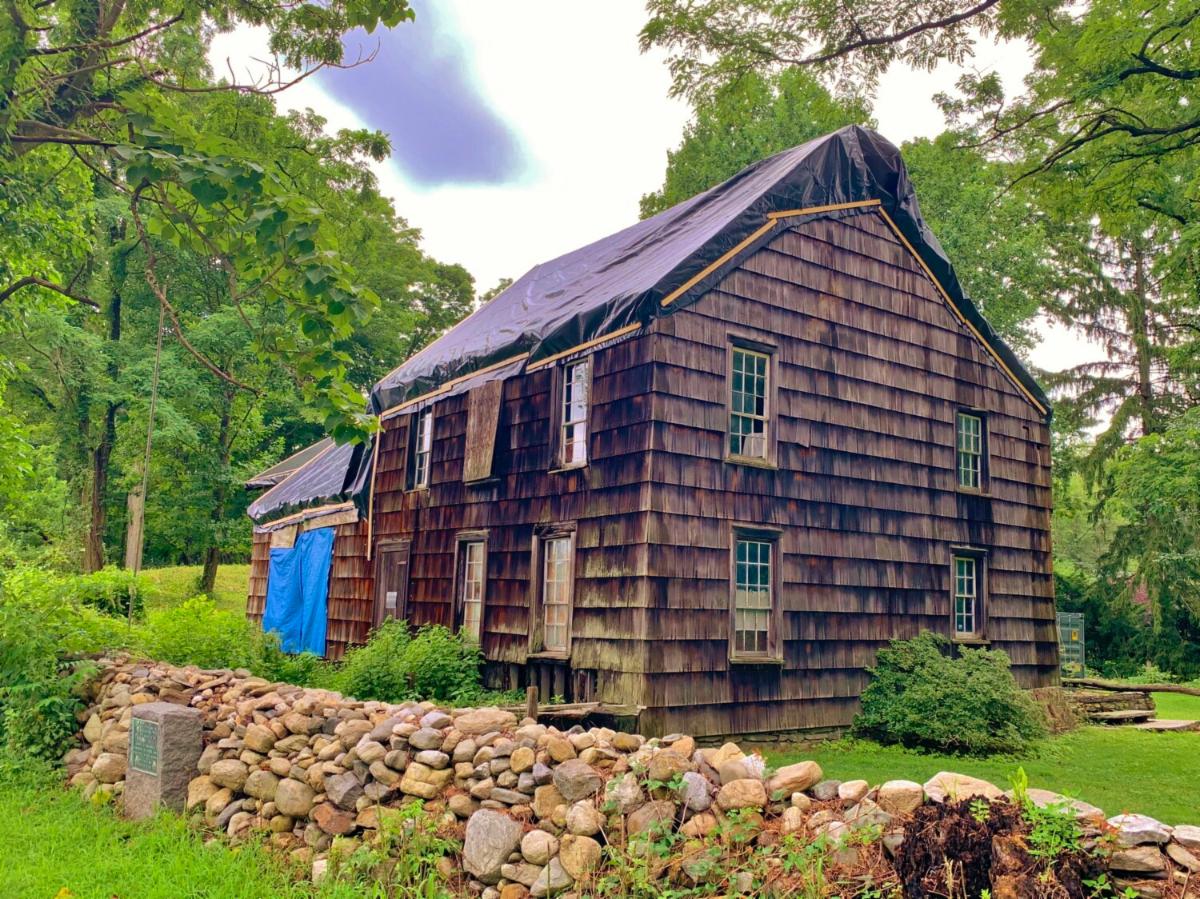
Odell House - Rochambeau Headquarters, 425 Ridge Rd, Hartsdale, NY 10530
Photo: The Friends of Odell House Rochambeau Headquarters (OHRH)
|
|
A FUTURE MUSEUM and FRENCH SOLDIERS MEMORIAL
• Located 21 miles north of New York, off I-87 and just south of White Plains, this old farm which remained intact throughout two centuries is undergoing renovations led by Susan and David Seal, following the recent acquisition by the City of Greenburgh (Westchester County) for conversion into a museum.
• This site is historically particularly important. This is where General Rochambeau established his headquarters on this farm in July-August 1781 and met with George Washington to develop the strategy which was successful at Yorktown. The French Army and the Continental Army camped all around the area for more than a month.
• The American Society of Le Souvenir Français, Inc. has pledged to help erect a memorial in honor of at least four soldiers of the Royal Deux-Ponts Regiment who are buried in the vicinity. The memorial will likely consist of a boulder and a plaque and be located in the gardens, nearby the entrance of the future museum, depending on the proposal of the architect and landscapist, once the necessary archeological study is completed and permits obtained.
• A wonderful video "Dear France, Thank You!" was unveiled to the guests. You can view above or by clicking on the following link:
|
|
THE AMERICAN FRIENDS OF LAFAYETTE
APPEAL TO VOLUNTEERS
|
|
Tomb of Marquis de Lafayette, cimetière de Picpus, 35 Rue de Picpus, 75012 Paris, France. Note, it is a private cemetery and is only open to the public Mo-Fr, 2PM to 5PM.
Photo: Thierry Chaunu (2021)
|
|
THE BICENTENNIAL OF LAFAYETTE'S TOUR IS COMING SOON...
The New York Committee is working on that big day and ALL 32 days Lafayette was in New York. We currently have an additional twenty geographical committees (175 individuals in all !!!) working on commemorations in the 24 states Lafayette visited (along with West Virginia and Washington, DC)....with more to come. We will need at least twenty more committees to cover all thirteen months, so....
- If you are currently working on a committee...thank you !!!
- If you indicated that you would like to be bicentennial volunteer in the past...I promise to be in touch as we form more committees in the coming weeks.
- If you are interested in being part of the fun, please reply to this email.
Here's some updates on our progress...
- We won our first grant !!! With many more in the hopper, we are actively raising money for many bicentennial initiatives.
- We have confirmed event dates at places you know like Mount Vernon and Independence Hall. We also have confirmed events at places you don't, but Lafayette was there (and so will we). In many small towns Lafayette visited, his farewell tour is STILL the most important thing that ever happened there and we will be there.
- We are in touch with the White House for a presidential event and the possibility of recreating Lafayette's historic address to a joint session of congress.
- We are working with a travel company that will offer mini tours in 2024 and 2025. The idea is that someone will be able to get on a motor-coach and follow Lafayette's footsteps, attend all the commemorations (with hotel accommodations) for a week at a time. No hassle, heritage travel.
- We are working on the development of a travel app. This will be GPS activated so that if the user is near a spot Lafayette was (in 1824 or 1825) a narration of what happened there will automatically start (with images and sound effects !!). This can be used on your computer as well as you can manually follow Lafayette's footsteps from the privacy of your own home.
- Our partnership with America250 is strengthening. Lafayette's abolitionist views and human rights efforts are certainly catching their attention. This relationship is important to the AFL as we work on 2024 and 2025...and then on to our country's 250th birthday. America250 will help with our national exposure.
- We are interacting with the leadership at both with the SAR and DAR. These are incredibly important relationships as these organizations lead the way with bringing history to general public. We have much to learn from these organizations and they both have been enthusiastic colleagues.
- We have access to the original music that was played during Lafayette's farewell tour. Nearly every city composed music for him. We will certainly tap into this resource for our celebrations.
- Our committees understand the importance of teaching children about Lafayette and the Franco-American alliance. Consequently many plans are being made for events at schools and libraries.
- We are working on a bicentennial website (or web page). This will be launched later in the year.
- We are forming a Social Media and Public Relations committee. Our goal is to engage with local and national news organizations as we commemorate Lafayette's bicentennial. We also hope to expand our social media presence on all platforms so as to generate a Lafayette frenzy leading leading up to the bicentennial.
- Parades and parties are being planned. Concerts and dramatic plays are in the works. Balls and dinner parties are being organized. We will recreate Lafayette on boats, in carriages and in buildings that still exist 202 years ago today.
Thank you and vive Lafayette!!!
Chuck Schwam
AMERICAN FRIENDS OF LAFAYETTE
Chief Operating Officer
Bicentennial Chair
|
|
UPCOMING EVENTS
AMERICAN FRIENDS OF LAFAYETTE
|
|
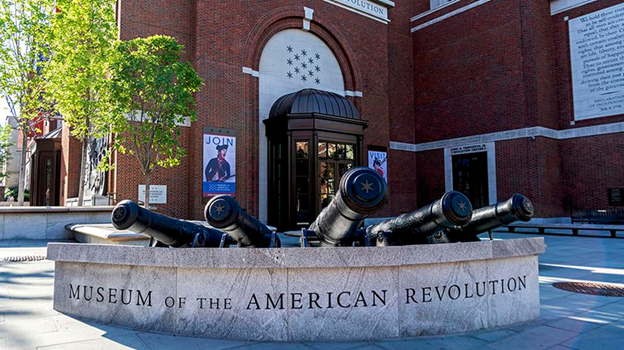
• Labor Day Weekend (September 3rd to 5th - 10:00am to 5:00pm EDT all three days) the Museum of the American Revolution in Philadelphia will be highlighting the Continental Army's alliance with France and comte de Rochambeau's march through Philadelphia on Sept. 2, 1781 en route to Yorktown (where Lafayette was anxiously waiting). This will be three days filled with living history interpreters, hands-on crafts, a bilingual gallery guide, and a new French language audio tour AND.....
• The AFL has been invited to have a presence all three days. We will have several tables set up at the main entrance where we will have an opportunity to discuss Lafayette and the alliance with the general public. We will be handing out Lafayette-related reading material and other fun giveaways. If you would like to volunteer to be there, please reply to this email and let me know. It will be GREAT fun !!! More details to come.
• On September 9, at 6:00pm EDT, AFL President Alan Hoffman will join Richard Ingram, (AFL member & Lafayette Alliance Chair) to, discuss Lafayette in America in 1824 and 1825: Journal of a Voyage in the United States. This is going to be a very interesting Zoom event and you can register: HERE
There will be a two-day event on September 24th and September 25th (10AM – 4PM) commemorating the 245th anniversary of the Battle of Brandywine. This will feature a two-day re-enactment at Sandy Hollow Heritage Park, with over 1,000 re-enactor soldiers and camp followers. In addition to battle re-enactments, camps of both armies will be open for inspection by the public. Historical interpreters portraying George Washington, General Lafayette (AFL's very own Ben Goldman), and Alexander Hamilton, (AFL's very own Gene Pisasle) will be conversing with visitors. AFL member Bruce Mowday will be there as well to discuss his recently released book ‘Lafayette at Brandywine: The Making of an American Hero’. Please find more details: HERE
|
|
NEWS FROM THE LAFAYETTETRAIL.ORG |
|
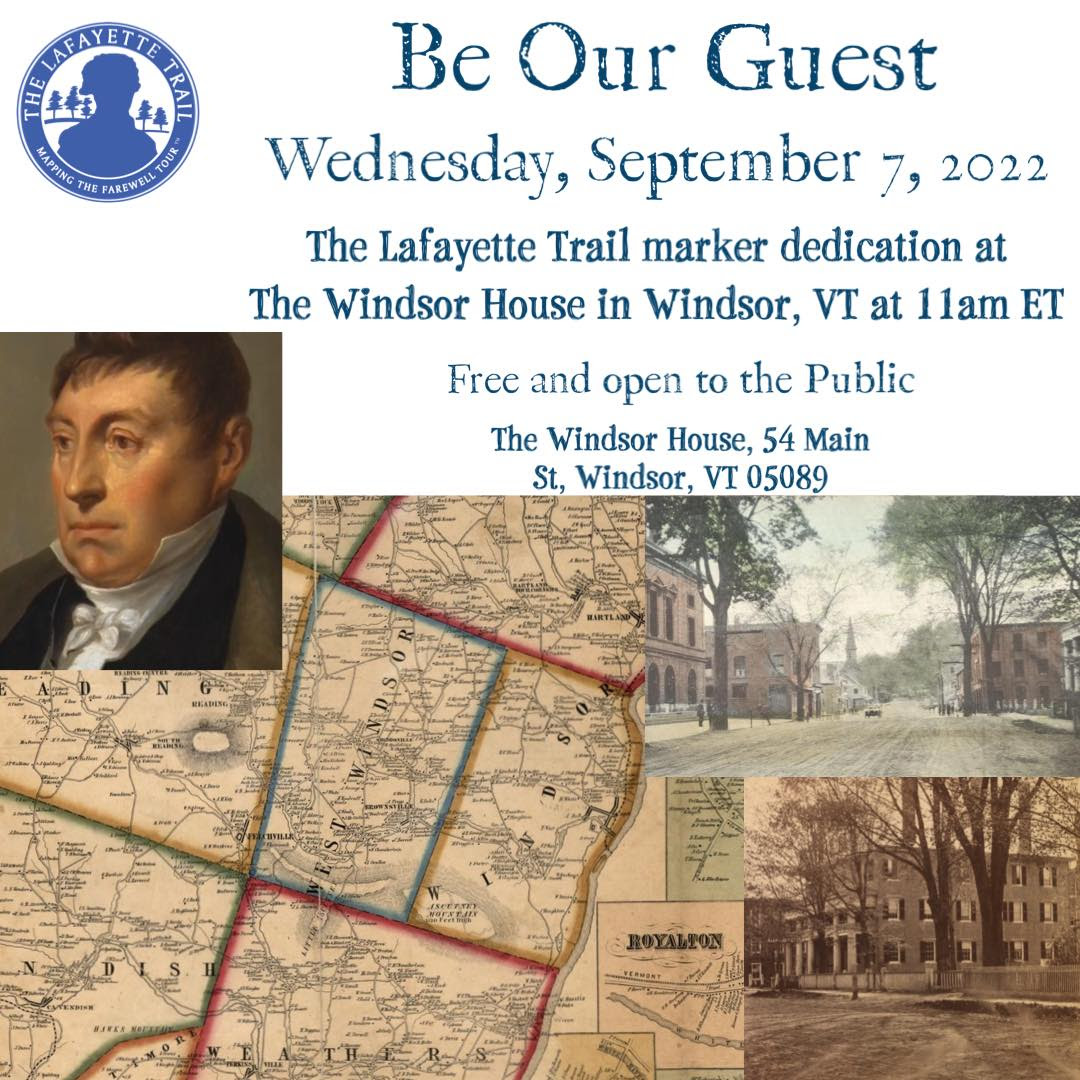
The Lafayette Trail, Inc. is pleased to announce the upcoming dedication of a new Lafayette Trail historic marker in Windsor, VT on Wednesday, September 7 at 11 am ET.
The Windsor marker dedication ceremony will take place at the Windsor House, located at 54 Main St, Windsor, VT 05089.
|
|
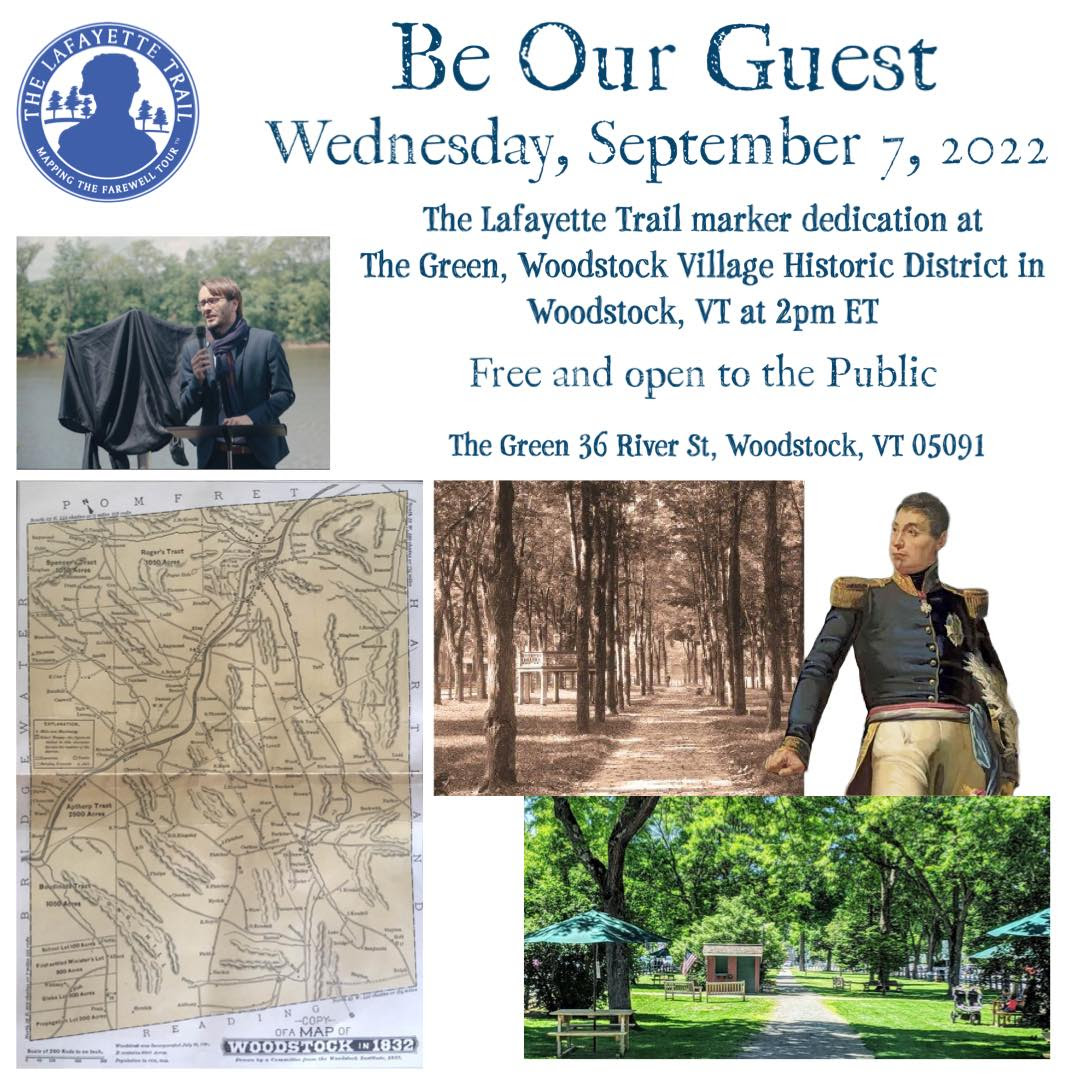
The Woodstock marker dedication ceremony will take place on the Green, located at 36 River St, Woodstock, VT 05091, in the Woodstock Village Historic District.
The event will coincide with the local Weekly Farmers Market! Come join us if you can, look around, and explore Woodstock!
|
|
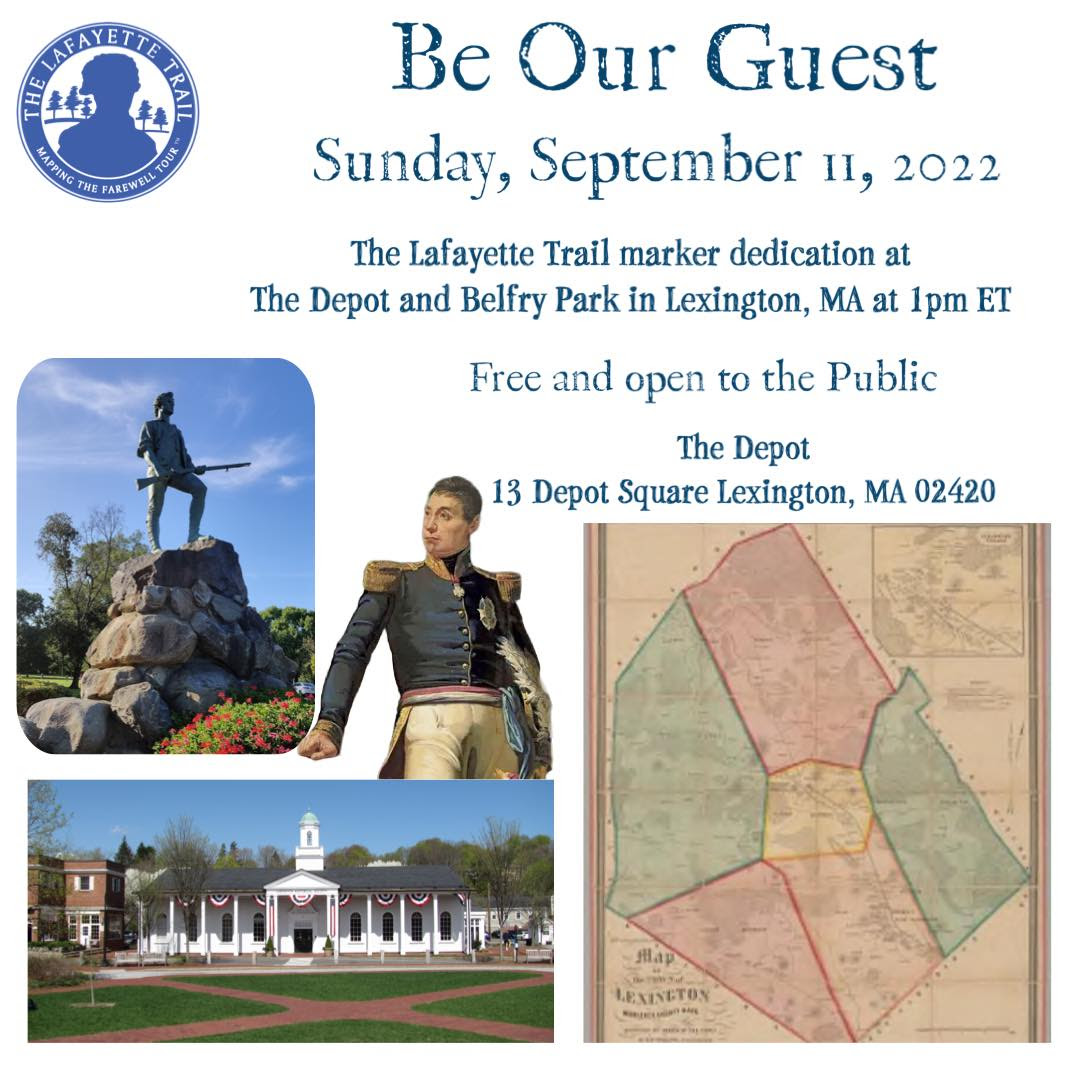
The Lafayette Trail, Inc. is pleased to announce the upcoming dedication of a new Lafayette Trail historic marker in Lexington, MA on Sunday, September 11.
The program will begin with remarks and refreshments at the Depot (13 Depot Square) at 1 pm ET. Attendees will then walk to the adjacent Belfry Hill Park, where the marker unveiling will take place around 2:30 pm ET.
Please, enter Belfry Hill Park from the Massachusetts Avenue entrance located near the corner of Clarke Street. The entrance to the park is located directly across from the Minuteman Statue.
|
|
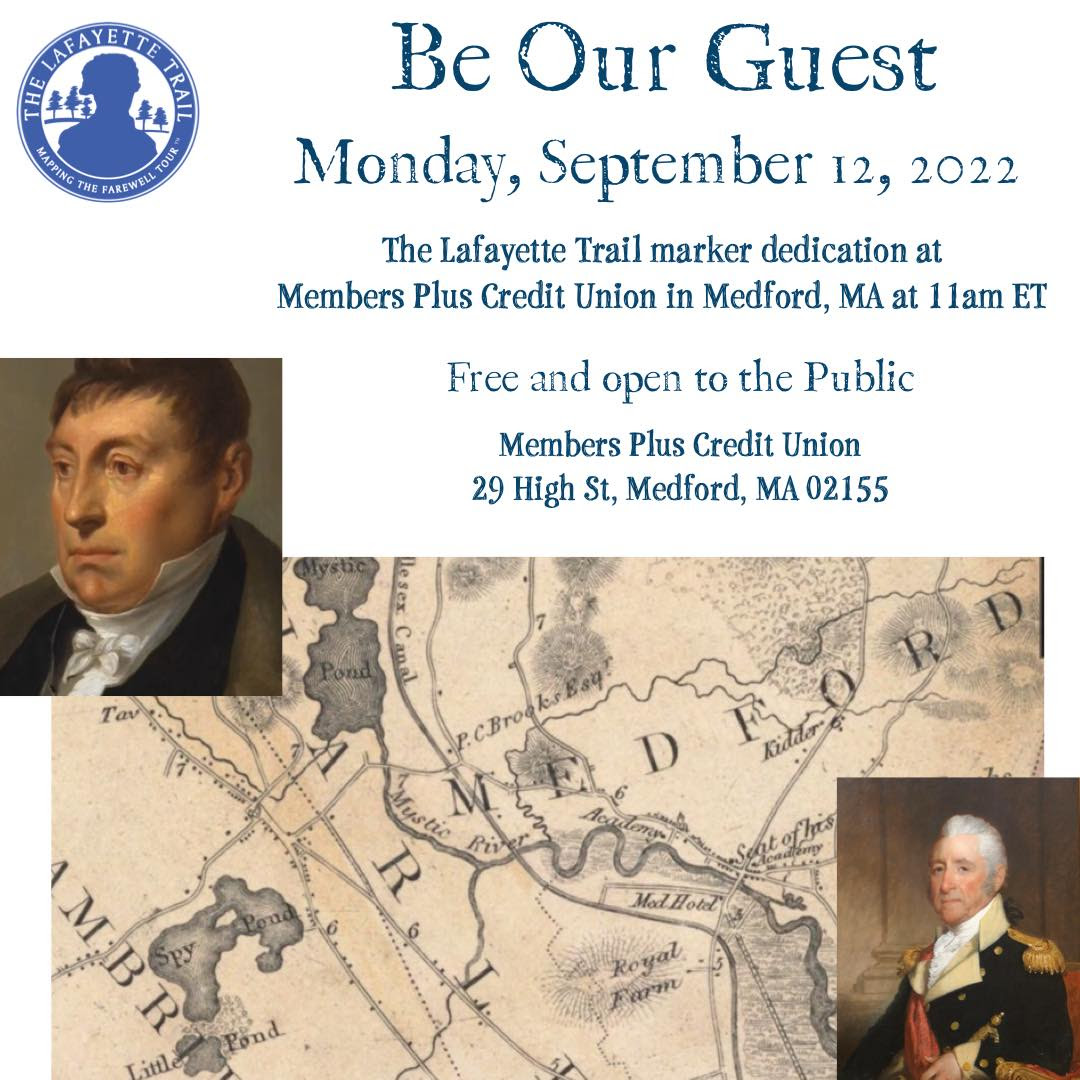
The Lafayette Trail, Inc. is pleased to announce the upcoming dedication of a new Lafayette Trail historic marker in Medford, MA on Monday, September 12 at 11 am ET.
The Medford marker dedication ceremony will take place at the Members Plus Credit Union, located at 29 High Street, Medford, MA 02155.
|
|
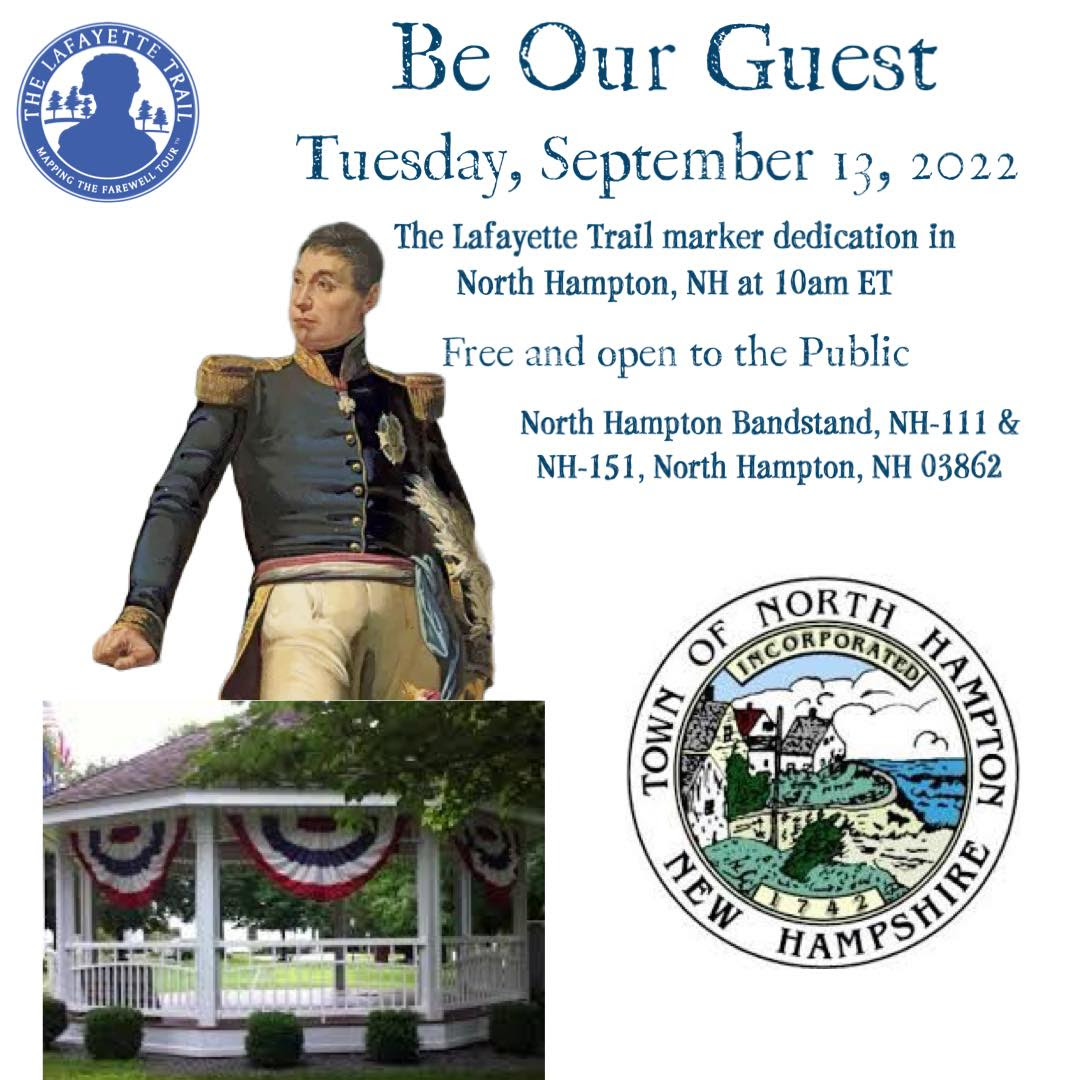
The Lafayette Trail, Inc. is pleased to announce the upcoming dedication of a new Lafayette Trail historic marker in North Hampton, NH on Tuesday, September 13 at 10 am ET.
The North Hampton marker dedication ceremony will take place at the North Hampton Bandstand, located at the corner of NH-111 and NH-151, North Hampton, NH 03862.
|
|
FOLLOW THE FRENCHMEN | EPISODE 16
CLARKSVILLE, TN
Episode 16 of Follow The Frenchmen, the Video Series about the Lafayette Trail, is now available!
Click on the link below to check it out now!
#FollowTheFrenchmen is a Lafayette Trail-related initiative with the goal of shining a national spotlight on Lafayette's Farewell Tour using the format of a place-based narrative.
Julien Icher is out and about following Lafayette's footsteps during his Farewell Tour of the United States from August 16, 1824, to September 7, 1825.
|
|
UPCOMING EVENTS FROM THE
WASHINGTON-ROCHAMBEAU ROUTE ASSOCIATION
W3R
|
|
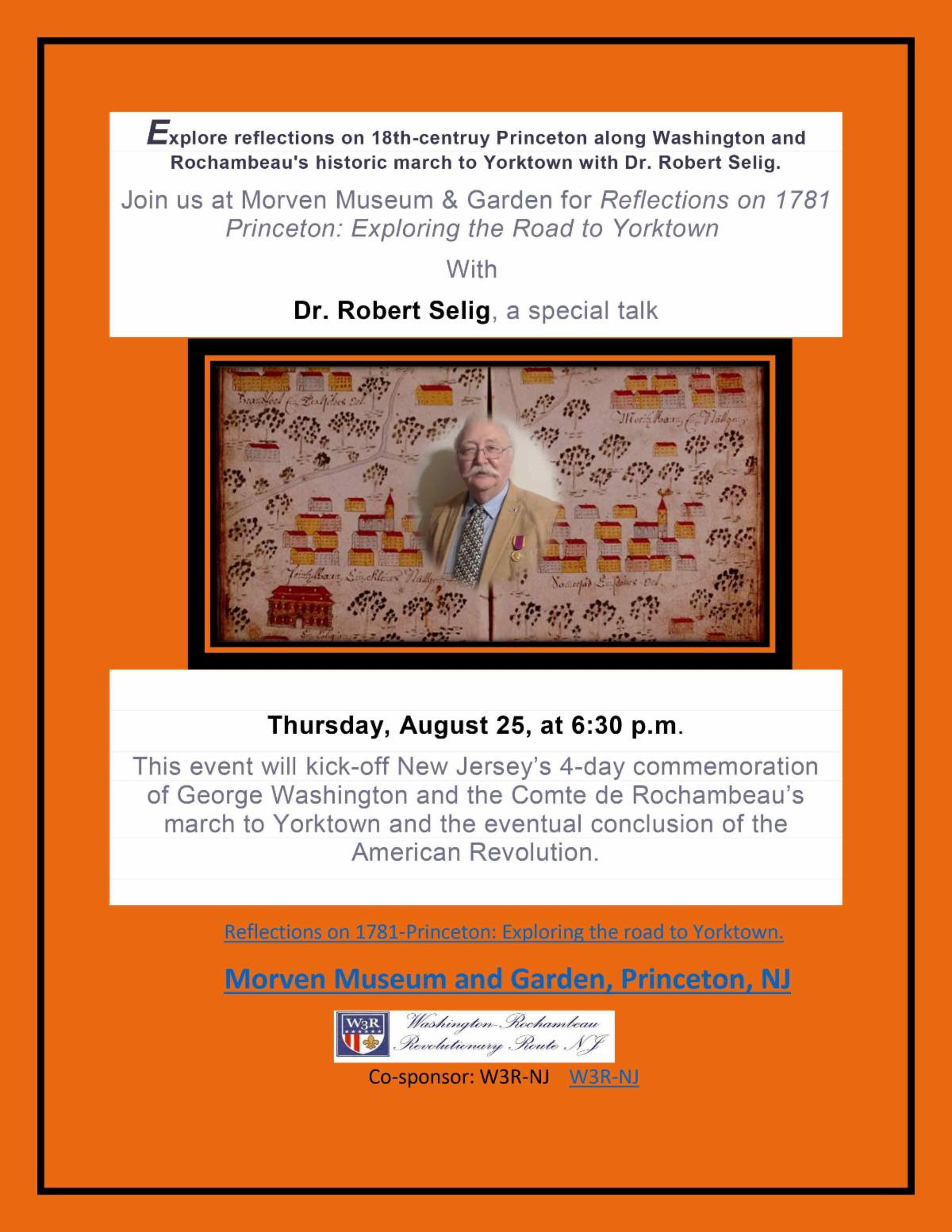
Join the Morven Museum and W3R-New Jersey for this special lecture by Dr. Robert Selig. Doors open at 6:00 pm for in person guests at the Stockton Education Center, and a special zoom link will be shared day-of for virtual ticket holders. A Q & A will follow the event, open to both live and virtual attendees!
|
|
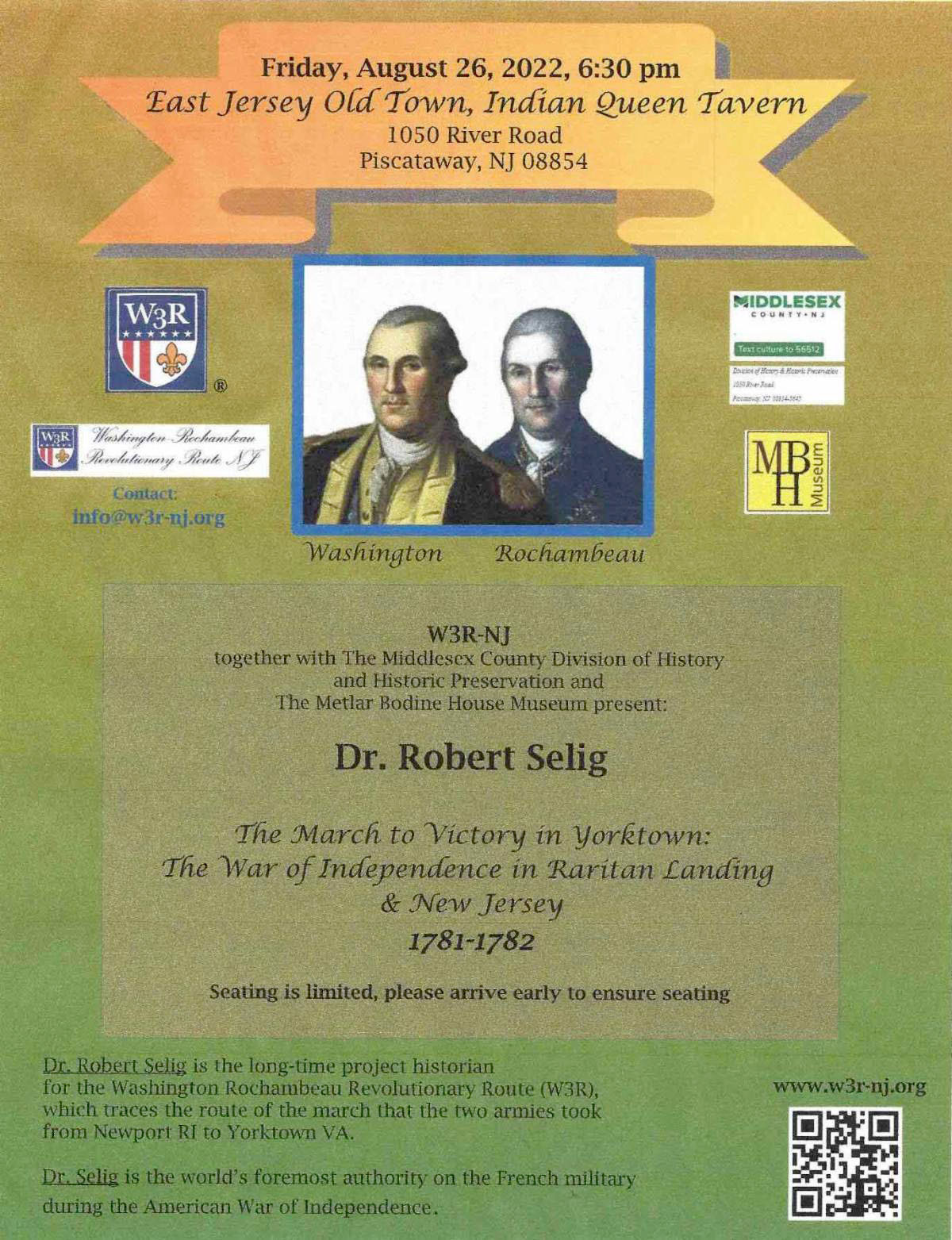
W3R New Jersey together with The Middlesex County Division of History and Historic preservation and The Metlar Bodine House Museum present:
The March to Victory in Yorktown: The War of Independence in Raritan Landing & New Jersey 1781-1782 by Dr. Robert Selig.
Seating is limited! Arrive early to ensure a spot!
|
|
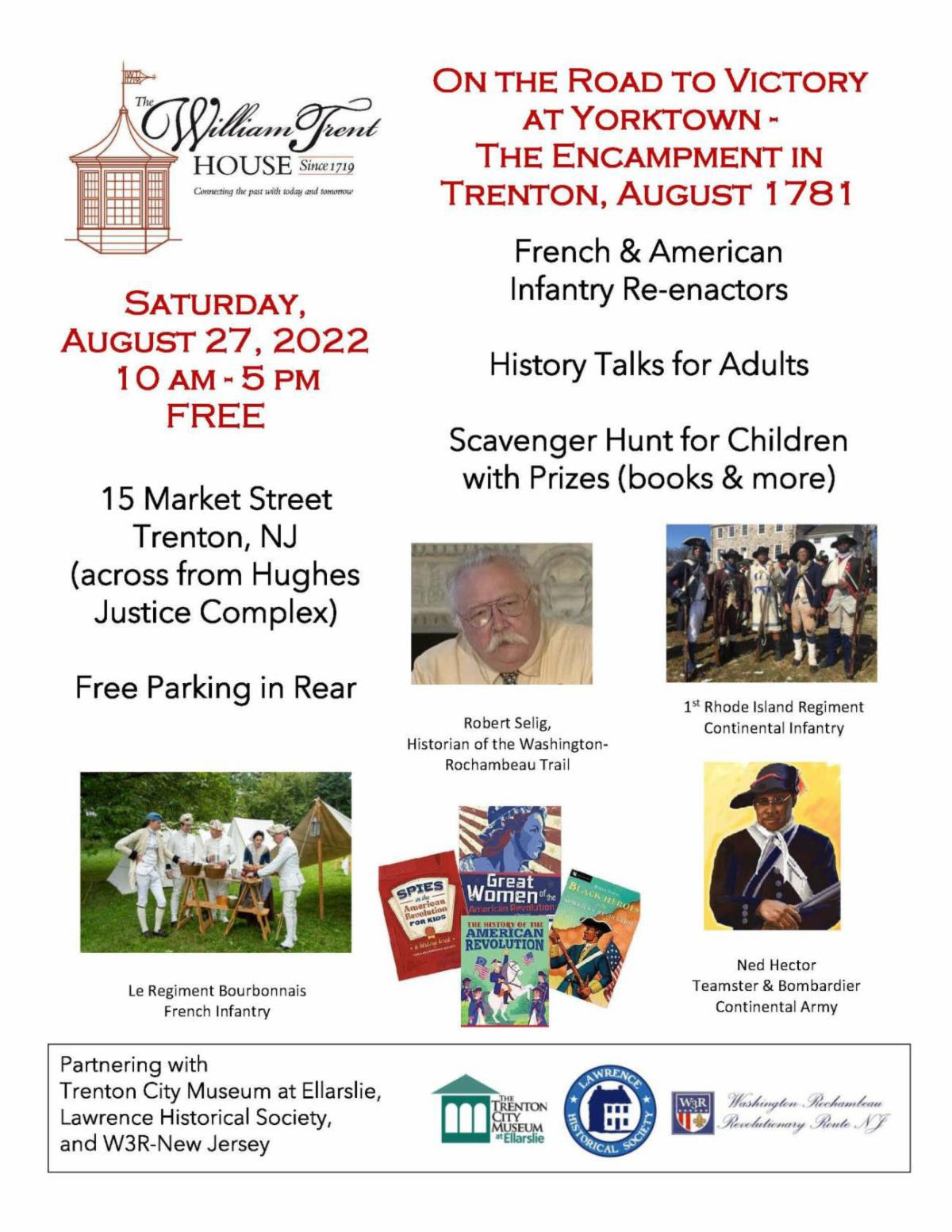
Presented by the Trenton City Museum, The William Trent House, the Lawrence Historical Society and W3R- New Jersey on Saturday August 27th:
On the Road to Victory at Yorktown!
|
|
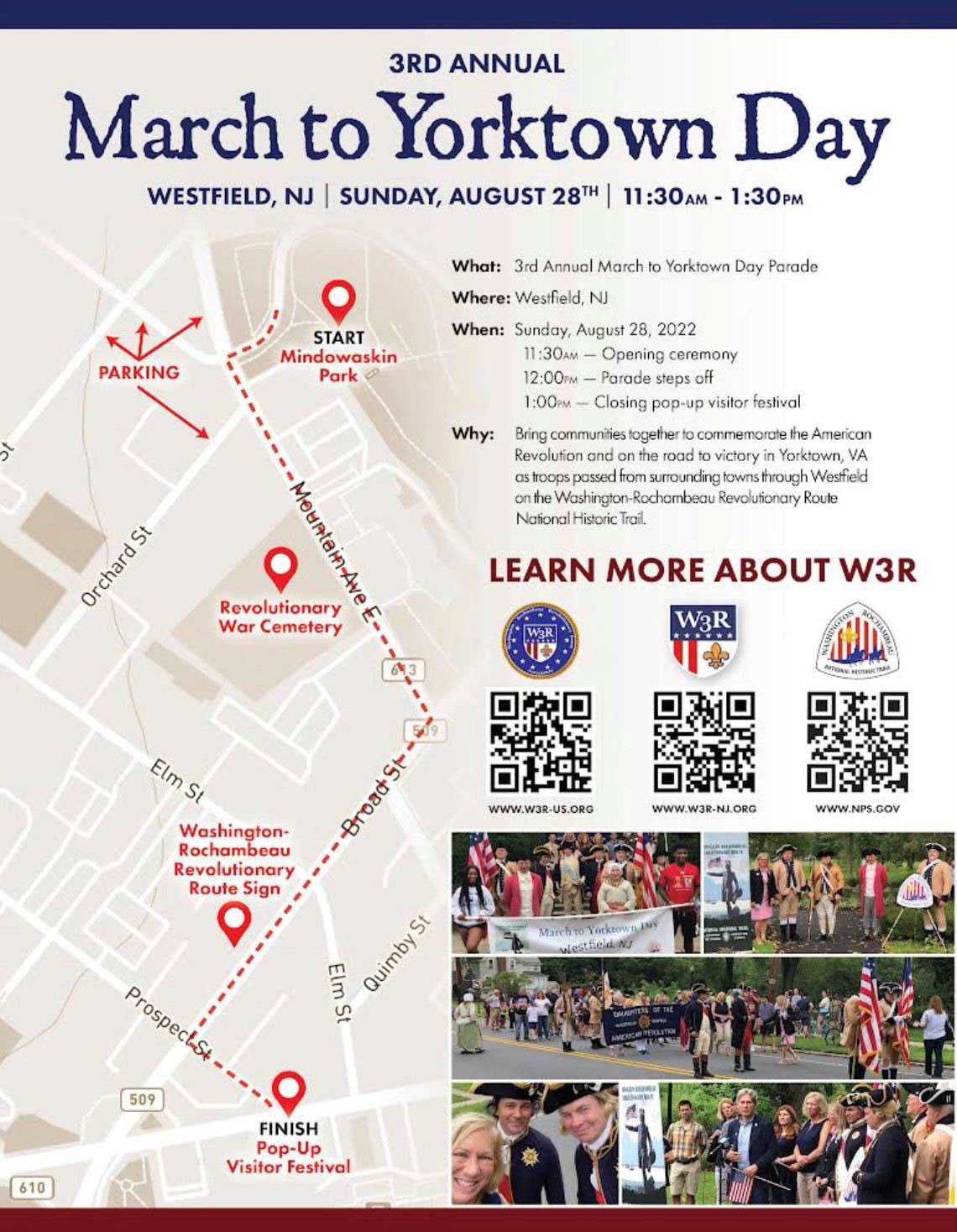
The 3rd Annual March to Yorktown Day is once again upon us- join W3R- New Jersey and Friends for this celebration on Sunday, August 28th!
|
|
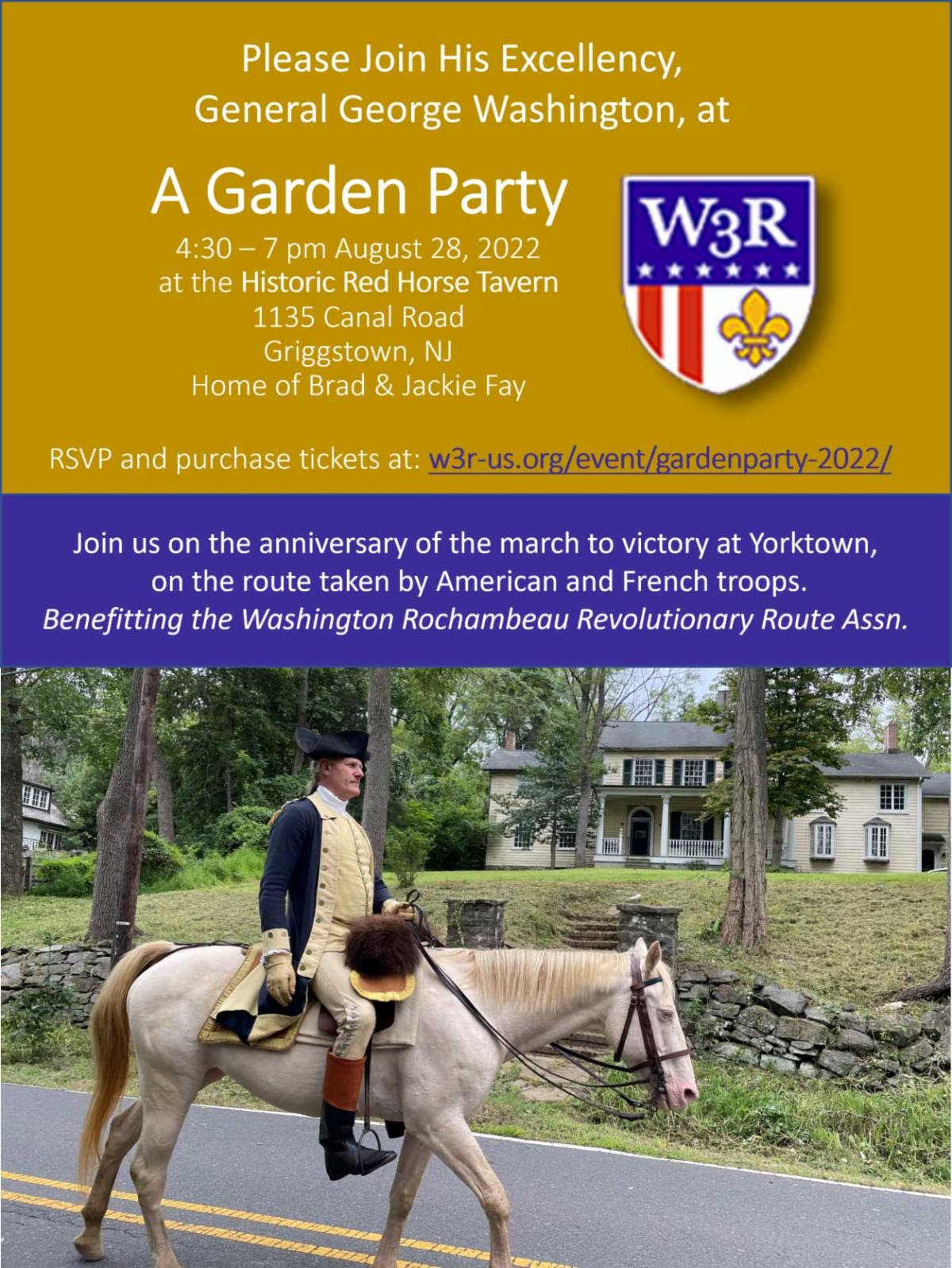
Come join General Washington and W3R August 28th, 2022 from 4:30 pm to 7:00 pm at the Historic Red Horse Tavern in New Jersey!
W3R-US – the managing partner of the Washington Rochambeau National Historic Trail – is a 501(c)3 organization with a Goldstar Platinum rating. We raise funds for Trail projects, work with schoolchildren and teachers, and support long-term planning for the Trail’s development.
W3R-US supports investments in Trail communities, with the goal of enhancing equitable access to local outdoor recreation, and heritage tourism. Our events and interpretation tell a multicultural story of America’s founding and the March to Yorktown, including the key role of the French and other allies from abroad as well as the vital contribution of soldiers and sailors of color, and the role of Native Americans.
|
|
MARK YOUR CALENDAR!
MORE DETAILS WILL BE FORTHCOMING IN OUR NEXT BULLETINS
(Dates are subject to change)
THURSDAY, SEPTEMBER 22, 2022
WEDNESDAY, OCTOBER 12, 2022
Cocktail reception to launch the Sculpture of Le Petit Prince and Antoine de Saint-Exupéry
TUESDAY, OCTOBER 18, 2022
Inauguration of the Interpretive Marker "The Crucial Role of the French Navy in the War of Independence", Yorktown Riverfront, Yorktown, Virginia.
WEDNESDAY OCTOBER 19, 2022
YORKTOWN ANNUAL VICTORY CELEBRATIONS
Laying of wreaths at the French cemetery
Wreath laying at the French Memorial
Ceremony, Victory Monument
SATURDAY NOVEMBER 5, 2022
Annual ceremony to pay tribute to the memory of 25 soldiers from Rochambeau buried in Providence Cemetery, Rhode Island organized by Prof. Norman Desmarais.
SUNDAY NOVEMBER 6, 2022
Ceremony in tribute to Mr. André Joseph Scheinmann, alias Maurice Peulevey, German-born, French naturalized resistance fighter in Brittany, 1940-1942, Member of the réseau Overcloud, parachuted from London, arrested and deported to the concentration camps of Struthoff and Dachau 1942-1945, who emigrated to the United States after the war and is buried in New Bedford, Massachusetts
FRIDAY NOVEMBER 11, 2022 - VETERANS DAY
5th Avenue Parade alongside the Federation of French War Veterans, the Association of French Reserve Officers in the United States (ACREFEU), and TheFrenchWillNeverForget.org
|
|
OUR MISSIONS:
• To preserve the memory of the French soldiers, sailors and airmen who gave their lives for freedom, and who are buried in the United States.
• To honor French Citizens who did great deeds in the United States, or with a strong connection with the United States,
• To promote the appreciation for French culture and heritage in the United States, and the ideals that unite our two nations, in order to pass the torch of memory to younger generations.
• To strengthen the long-standing traditional bonds of friendship between the American and French peoples, and to this end: erect or maintain memorials and monuments and encourage historical research, public presentations and publications in the media.
We are looking to complete our geographic coverage with Regional Delegates for the SouthWest in cities such as Austin, or Houston, and Louisiana, in cities such as New Orleans or Baton Rouge.
The American Society of Le Souvenir Français, Inc. is an independent American corporation, apolitical, established in 1993 in NY, with 501 (c) 3 non-profit status.
|
|
Did you know that a portion of every purchase you make on Amazon can benefit American Society of Le Souvenir Francais Inc, at no cost to you?
Simply go to: smile.amazon.com, designate American Society of Le Souvenir Francais Inc. as your beneficiary, and shop away
|
|
Help us implement several historic commemorative projects celebrating the 244-year-old Franco-American friendship and alliance! |
|
The American Society of Le Souvenir Français, Inc. is a registered NY State non-profit corporation and has full IRS tax exempt 501(c)3 status. All donations are tax deductible.
Copyright © 2022 The American Society of Le Souvenir Français, Inc.
Contact: Thierry Chaunu, President
697 Third Avenue #341 New York, NY 10017
|
|
|
|
|
|
|