|
| |
School Hours
Monday through Thursday
9:30 a.m. to 5:00 p.m.
Friday 9:30 a.m. to 2:00 p.m.
| | |
|
Upcoming Events
October
10/09 Q1 Report Card Day- No School for Students
10/21 PSAT date (TENTATIVE)
10/26-10/30 Spirit Week
10/30 Halloween Lunch (families invited)
November
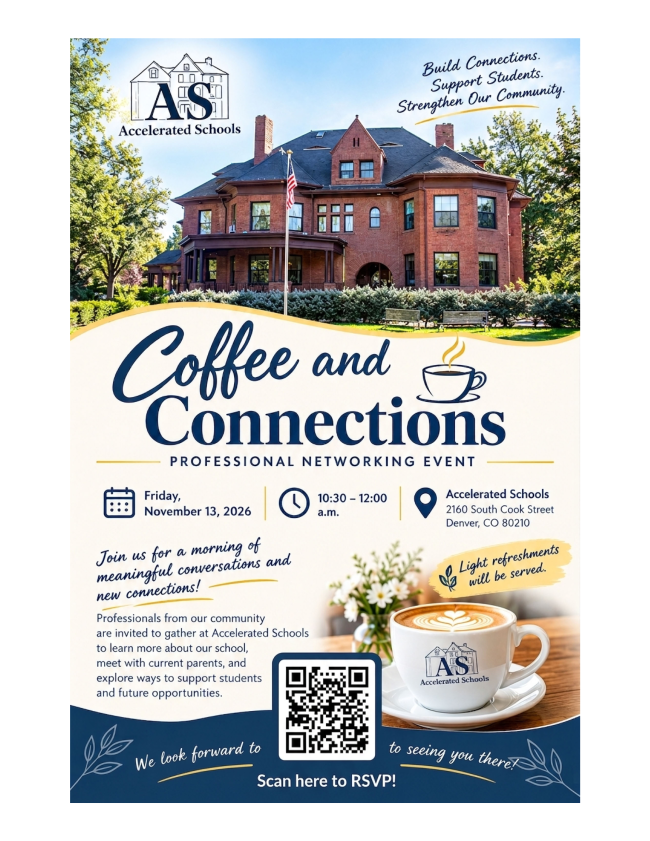
11/13 Coffee and Connections
11/25-11/27 NO SCHOOL- Thanksgiving Break
| | |
A Fresh New Look for Accelerated Schools!
In August, Accelerated Schools has officially launched a fresh, newly redesigned website! If you have not already, check it out at www.acceleratedschools.org
A massive THANK YOU to the brilliant Yorke, who lent her web design expertise to give our online home a sleek, modern upgrade.
While Yorke is an absolute wizard at web design, her true passion lies in her main business, Arcana Heritage Horses. Dedicated to preserving, breeding, and showcasing rare heritage horse breeds, Arcana Heritage Horses combines deep equine passion with exceptional care and promotion of these extraordinary animals.
Ready to discover the magnificent world of heritage horses?
Visit arcanatekes.com to explore Yorke's main passion project. Head over today to learn more and support her incredible work!
| | |
Decluttering?
Accelerated Schools is always looking for gently used items we can use, such as sports equipment, art supplies, books, bikes, ski/snowboard gear, or even fresh ingredients for our cooking class! Please keep us in mind if you are downsizing or clearing out your space.
We also rely on donations for our silent auctions during annual fundraising events such as our event in December!
Email us at info@acceleratedschools.org for more information. We provide receipts for tax purposes for donations.
| |
September 2026 Activities | |
Connection Matters
Josh Warren, Mathematics Instructor and Assistant Principal
Fall is always an exciting time in education. Students are settling into routines, teachers are getting to know their classrooms, and, as a new Assistant Principal, I am learning that some of the most important work we do happens outside the walls of our school.
This fall, Accelerated Schools has had several opportunities to connect with the larger Denver community. The Walk for Autism was a wonderful reminder that events like these are about more than awareness. They are about connection. Families, educators, providers, and advocates all have an opportunity to meet one another, share experiences, and discover resources they may not have known existed.
We also had the opportunity to attend events at Brewability with different providers, consultants, and professionals who work with students and families throughout the Denver area. It reinforced something I have been thinking about quite a bit since stepping into administration: education in Denver is a surprisingly small network.
That means word of mouth matters.
As an Assistant Principal, I want Accelerated Schools to continue being part of that network. I want other educators, providers, and families to know who we are, what we do, and most importantly, that we are willing to work together.
| |
Environmental Literacy takes to the forest
Zach Saipe, Environmental Literacy Instructor
The first major unit in Environmental Literacy is about forest fire ecology and its intersection with human activity. We started off by studying the basics of ecology (For our purposes, we have defined ecology as the study of connections in nature) and progressed on to how forests use fire as a tool to stay healthy. We began considering how human activity has affected forest fires to become larger and more dangerous and have considered fire suppression and climate change as factors exacerbating the situation, leading to more detrimental forest fires each year.
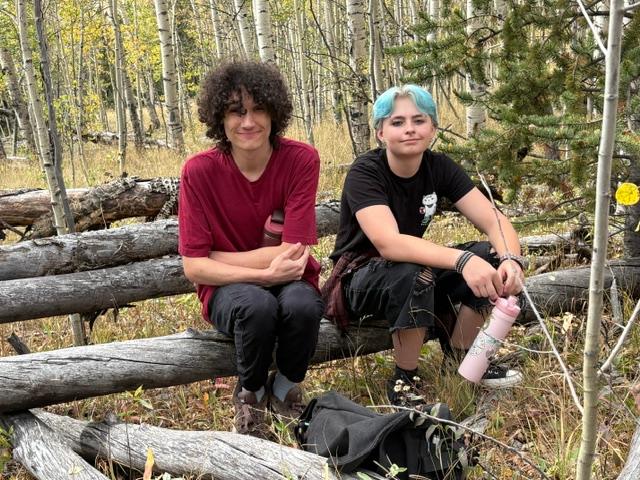
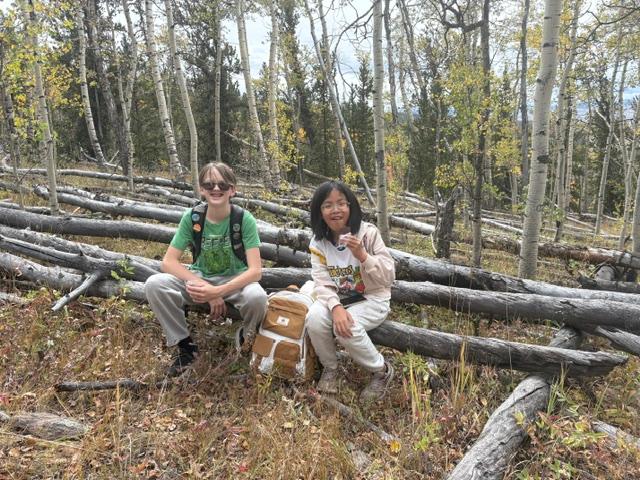
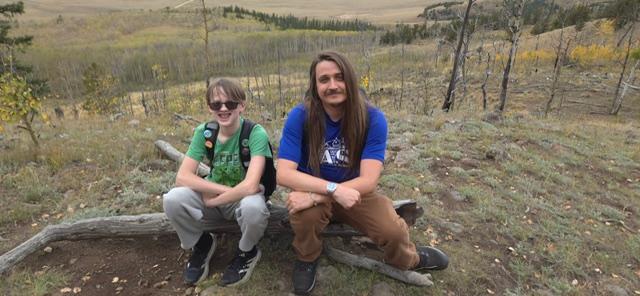
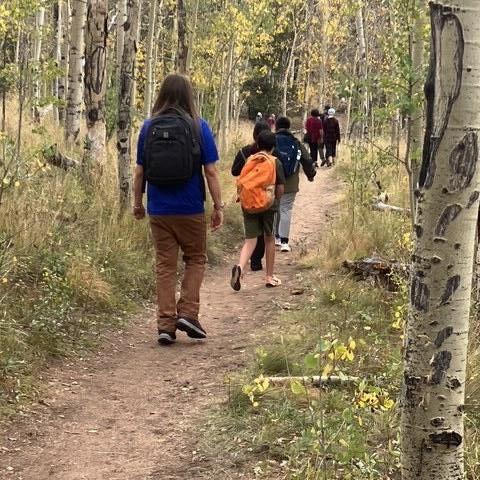
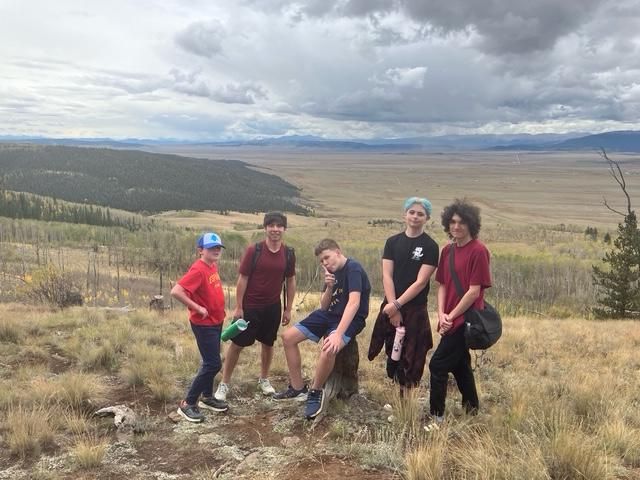
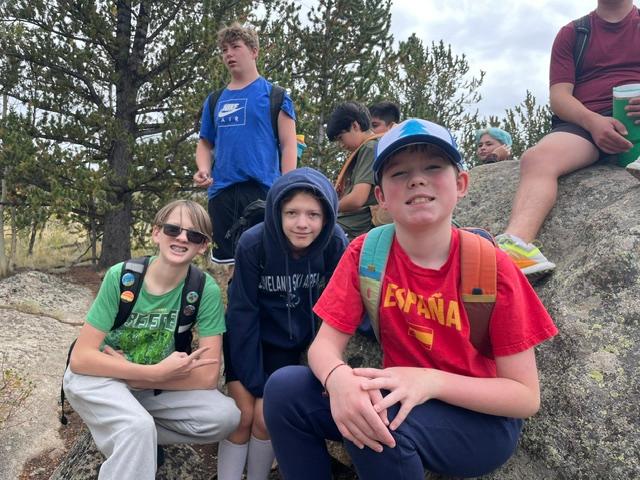
Through a lucky connection I have to the Evergreen fire department, we were able to take a field trip out with their education outreach expert to learn first hand about forest fire ecology. Since this was a valuable learning experience, we ended up bringing most of the school along with us! Out in the field, students got a first hand understanding of the factors that lead to forest fires, the ways in which forest fires keep the ecosystems balanced, and how something solid actually must change into its gaseous form before burning (I had no idea!).
Finishing off the unit, students have been assigned independent projects to study historical fires in Colorado, all only an hour or two drive from campus, with the intention of visiting one of the sights in the spring to see what’s growing. The students will make visual presentations that we will put up in the classroom for your viewing pleasure.
| |
Notes from the Science Lab
Julia Potocnjak-Overn , Science Instructor
The Elastic Realm: Physics Meets Pop Culture
In Physics, we’re cracking the code of how everyday objects fight back against deformation using Hooke’s Law (F = (k)(x). Whether it’s Spider-Man’s webbing stretching to catch a falling bus or the high-tension springs inside a trampoline launching you into the air, the restoring force (F) is directly proportional to how far you stretch or compress an object (x), controlled by its spring constant (k). When Peter Parker pulls that web taut, the spring constant determines how stiff the material is before it snaps back to equilibrium. Master this linear relationship, and you'll understand the exact mechanical limits keeping super-heroic stunts—and your car’s shock absorbers—from crashing!
Microscopic Mysteries: Chemical Compounds & Crime Scenes
Meanwhile, over in Chemistry, we are taking a detective’s approach to molecular formulas by using the periodic table to decode atomic mass units (amu). By summing up the individual atomic masses of every element in a compound—like combining the weight of two Hydrogen atoms and one Oxygen atom to get the molar mass of water—we can calculate precisely how heavy molecules are on a microscopic scale. This molecular accounting directly powers our Forensic Science elective, where we analyze trace evidence left behind at a crime scene. From identifying microscopic ink particles and fibers lifted from clothing, knowing how to break compounds down to their atomic masses lets us piece together unseen physical evidence and solve complex cases.
|
Superb First Quarter!
Aisling O'Brien, Humanities, English and Social Studies Instructor
As we embark upon the second quarter of the academic school year, let’s reflect on some of the achievements accomplished by our students here at Accelerated Schools, so far this year.
Firstly, a big shout out to our English Language Arts highschoolers, as well as some Homeroom students, who submitted impressive compositions centered around persuasive writing. A number of meaningful topics were explored including wildfire prevention, management of the national budget, and maximizing access to education. Additionally, these argumentative essays made for an even more compelling read since many included cited evidence from credible sources. It was wonderful to see students challenge themselves by opting to respond to AP examination prompts.
Similarly, a lot of successful learning has been taking place across the board in the humanities. While geography students have been exploring maps while history learners have been expanding their knowledge on indigenous people but moreover, they are developing life skills that go beyond the classroom walls. They are becoming researchers, problem solvers, critical thinkers, and even leaders. There certainly is so much talent and potential here at Accelerated Schools!
| |
Practice Makes Pitch Perfect
John Jarvinen, Student and Staff Support, Electives
Many of you might remember the Oscar winning film from 1965, The Sound of Music. Julie Andrews teaches children, for whom she’s tasked to nanny, the basics of solfège singing with the lively song “Do-Re-Mi”. This month students in our music class aren’t just learning this silly song, they are diving headfirst into solfège to master the fundamentals of vocal performance, pitch identification, and musical memory.
The solfège system dates back to eleventh-century Italy where a monk named Guido of Arezzo struggled to teach his choir new chants; without written music he needed a way to help them learn. Rote repetition took too long, so Guido invented a system in which he assigned a syllable to each note in the scale to speed up the process. This system was a massive success, eventually evolving into the Do-Re-Mi-Fa-Sol-La-Ti-Do system used worldwide today.
Now at Accelerated Schools, our music class is taking the role of Guido’s choir. Learning solfège will help these students to identify pitches and navigate melodies with ease. This training builds strong musical intellect and sharpens pattern recognition. This is a vital skill musicians use to improve their listening, reading, and performance abilities. Ultimately, solfège will give our students the foundational vocabulary to communicate and reproduce musical patterns confidently.
By transforming these sounds into a structured language, our students are building a foundation for lifelong music literacy. Solfège turns the task of learning music into a puzzle that anyone can solve. We look forward to watching our young musicians apply these new skills as they grow their creative talents this school year.
| | |
Back-to-School Night: Experiencing a Day at Accelerated Schools
Kate Oh, Enrollment and Community Outreach and Instructor
Back-to-School Night is always a special evening for our Accelerated Schools community. It is an opportunity for parents to step into their children’s school day and experience a little bit of what life is like at Accelerated.
Instead of simply hearing about their children’s classes, parents have the opportunity to follow their child’s schedule. They move from classroom to classroom, meet their children’s teachers, learn about the curriculum, and get a better understanding of what their children will be learning throughout the school year.
It is also a wonderful opportunity for parents to meet other parents and become more connected with our school community.
Experiencing School Through Our Students’ Eyes
One of the things I especially enjoyed seeing this year was how much some of our students genuinely enjoy being at school.
One student’s guardian was unable to attend Back-to-School Night, but the student wanted to stay at school anyway. When she said that “it’s more fun being at school than being at home,” I couldn’t help but smile.
As an educator, hearing something like that is incredibly meaningful. We want our students to learn, but we also want them to feel comfortable, supported, connected, and happy to be part of our school community.
That is what makes Accelerated Schools more than just a school.
A Look Inside Korean Class
I also enjoyed having parents visit my Korean class during Back-to-School Night. I shared with them what students can expect to learn throughout the year—not only Korean vocabulary and language skills, but also Korean culture.
Learning a new language gives students an opportunity to challenge themselves in a different way. Korean is particularly interesting for English-speaking students because it introduces them to a different writing system, sentence structure, sounds, and cultural perspective.
During the evening, I promised parents that I would share an article about some of the cognitive skills associated with learning Korean. The article discusses topics such as attention and concentration, learning Hangul, working with different grammar structures, memory, communication skills, and neuroplasticity.
For parents who are interested, you can read the article here:
How Learning Korean Boosts Cognitive Skills and Memory
Learning Beyond the Classroom
Another class that reflects the spirit of Accelerated Schools is Cooking Essentials.
Cooking is much more than preparing food. Students learn practical skills that they can carry with them throughout their lives, including kitchen safety, knife skills, food preparation, cleaning, budgeting, grocery shopping, nutrition, and proper food storage.
Students also learn how to work together, share responsibilities, communicate with one another, and respect the kitchen and the people around them.
These hands-on experiences give students opportunities to practice independence, problem-solving, responsibility, and teamwork in real-life situations. Seeing students take ownership of a task and then share something they have created with others is one of the most rewarding parts of teaching.
Building Our School Community
We are a small school, and that is one of the things that makes our community special. Every student and every family matters, and we have the opportunity to know our students well and support them as individuals.
I also feel very grateful for the people in our community who are willing to support Accelerated Schools and contribute to the continued development of our school. Community support means so much to us. Whether it is sharing our school with a family who may benefit from what we offer, connecting us with helpful resources, volunteering, or supporting school improvements, every contribution makes a difference.
We welcome donations from individuals and community members who would like to help us improve and enhance our school environment for our students. Donations can help us continue developing our classrooms, programs, learning spaces, and other areas that directly benefit our students.
At Accelerated Schools, we are more than a school. We want to create an environment where each student can learn, grow, feel supported, thrive, and be happy being themselves.
Thank you to all of the parents and students who participated in Back-to-School Night. Your participation helped make the evening a meaningful part of our school year. We look forward to building an even stronger community together and welcoming more families to future events!
| |
Restorative Justice
Debby Sharp, Middle and High School Instructor
How many of you feel like you can hold a grudge. I know personally when I feel someone has been mean or unfair towards me, it’s hard to let it go. This is the same with our students. One way to help our students with letting conflicts go and moving forward in a positive way is to engage in restorative justice practices.
Restorative Justice is a set of practices and a philosophy that is built on understanding the harm caused and then identifying the needs of the individuals involved. It also strives to understand the needs of a person before the behavior starts. What did the person need that led to the harmful behavior?
There are five basic principles of restorative justice.
- Relationship: Focuses on repairing the bonds and connections that were broken by the conflict or offense.
- Respect: Requires listening to all perspectives safely, treating everyone with dignity, and honoring each person's worth.
- Responsibility: Expects the person who caused harm to acknowledge their actions, understand the impact, and take active accountability.
- Repair: Aims to actively fix or mend the tangible and emotional damage done to the victim and the community
- Reintegration: Supports welcoming both the harmed person and the person who caused harm back into the community as whole, safe members.
Restorative justice gives the opportunity for thoughtful and positive accountability by taking responsibility and working to fix the harm caused in a way that doesn’t cause more harm. Therefore, this approach creates an environment that is safe and makes the people involved feel heard and understood.
| |
Middle Schoolers Create an Amazing New Math Game!
Mary Christensen, Math Instructor
Have you ever played Telestrations? It’s that party game where each person draws a picture and passes their picture on to the next person, then the second person copies the first person’s picture, the third person copies the second person’s copy, and on and on until everyone has copied the version they think they saw. Now imagine that game…with math!
The middle school math class was working on their order of operations skills, and they got so good at the questions that they could do problems with more than six steps! The big challenge when the questions get longer and more complicated is for them to keep their scratchwork so neat and organized that they don’t lose any of the numbers or signs in the process. To practice that skill, we invented TELEQUATIONS.
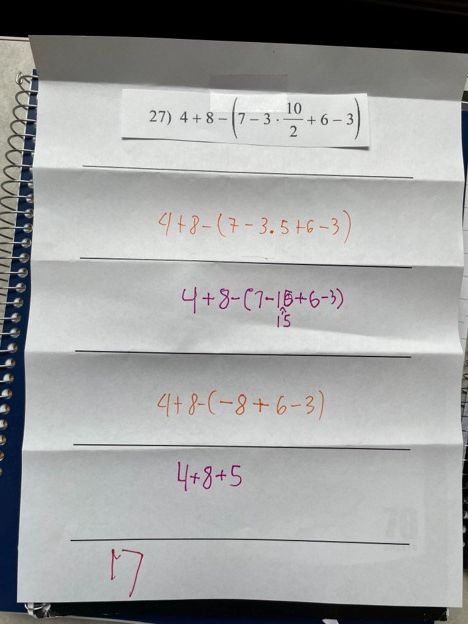
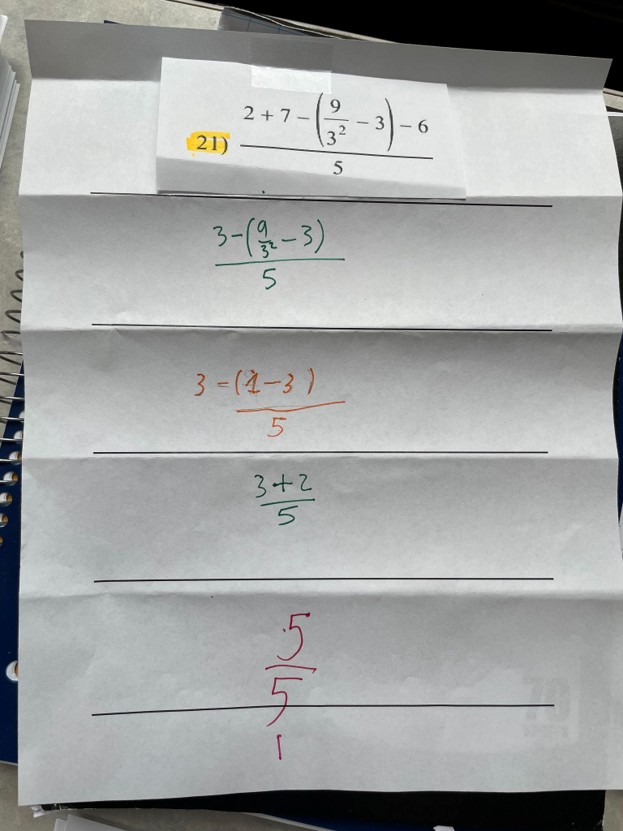
How do you play Telequations? First you need a really hard order of operations question with a lot of steps. You write that at the top of your sheet of paper. Then you draw a line and write the first step of your simplification under the line. Now comes the exciting part: you fold the paper back along the line so that you cannot see the original question anymore. Your work on the first step better have been extra clear and complete! Then draw a line across the page and write out your second step below it, and fold the paper back again so you can only see your second step! Keep going until you have reached a single value at the bottom of the page.
Once we all learned how the game works, each middle schooler picked a different color to write with, and we passed the questions along like a relay race, with each step by a different person in a different color. Could we make it all the way to the end of the question without making a mistake? Check out a couple of our examples and see for yourself!
| |
The Accelerated Way: Universal Social-Emotional Learning Part 1
Evan Simpson, Principal
Below are excerpts from my 2025 Masters Thesis. This will be part of an ongoing series of contextualizing my research within Accelerated Schools.
“Social-Emotional Learning (SEL) is a pedagogical approach that emphasizes students building emotional regulation, prosocial behavior, decision making, and interpersonal skills. The Collaborative for Academic, Social, and Emotional Learning (CASEL) defines SEL as not separate from core content, but rather a framework in which teachers “express care, challenge growth, provide support, share power, and expand possibilities” for students (CASEL, Schwartz, Skoog-Hoffman, Polman, Kelly, Bañales, & Jagers (2023, p.26). By creating a class culture that acknowledges different student identities, facilitates effective communication, and emotional awareness through SEL, students can engage more effectively in collaborative learning and project based assignments. Implementing SEL in academic settings shows improvement in students’ collaboration and goal achievement (Hosokawa, Matsumoto, Nishida, Funato, & Mitani, 2024). Furthermore, SEL can help facilitate lower rates of behavioral disruptions, better academic outcomes, and higher class satisfaction from both teachers and students (Deledda, 2024).
Social-Emotional Learning is most widely practiced in early childhood education settings, but has been shown to have similar positive correlative effects in secondary education settings as well (Bondebjerg et al., 2023). In these secondary settings the most prominent use of targeted SEL strategies is in special education programs. Both explicit SEL goals and general academic goals have notably strong impact on the learning of students with autism, ADHD, and dyslexia, where both the collaborative framework and emotion regulation assist in overcoming frustrations and obstacles to learning (Doikou, 2024).”
Simpson, 2025
This is just an introduction to what SEL is and what its benefits are. I believe many secondary education programs are much more highly focused on academics and are forgetting to teach the whole student. Regardless of a student’s background we make SEL an integral part of Accelerated Schools’s culture since we believe in lifelong learning and development. SEL instruction combined with personalized academics helps to build the skills of all types of learners.
Works Cited
Bondebjerg, A., Dalgaard, N. T., Filges, T., & Viinholt, B. C. A. (2023). The effects of
small class sizes on students' academic achievement, socioemotional development and well-being in special education: A systematic review. Campbell Systematic Reviews, 19(3), e1345. https://doi.org/10.1002/cl2.1345
Collaborative for Academic, Social and Emotional Learning (CASEL), Heather N. Schwartz, Ally Skoog-Hoffman, Joe Polman, Olivia Kelly, Josefina Bañales, & Rob Jagers. (2023). Integrated Learning, Integrated Lives: Highlighting Opportunities for Transformative SEL within Academic Instruction. Social and Emotional Learning Innovations Series. In Collaborative for Academic, Social, and Emotional Learning.
https://doi-org.csuglobal.idm.oclc.org/10.3390/bs14010018
Deledda, G. (2024). The Impact of Social Emotional Learning on High School Students in a Partnered Learning Environment. In Online Submission.
Doikou, M. (2024). Promoting Social and Emotional Learning in Pupils with Disability. Special Teachers’ Perceptions and Practices. International Journal of Emotional Education,
16(1), 154–168.
Hosokawa, R., Matsumoto, Y., Nishida, C., Funato, K., & Mitani, A. (2024). Enhancing
| | Helpful Forms and Links for Accelerated Families | | | |  | |
For more than 40 years, concerned parents have turned to Accelerated Schools for individualized learning programs helping students overcome challenges, and excel academically. The fact is, a traditional school system is not designed to meet the needs of every child. When a student is not being successful, or is not thriving in a traditional environment, parents must often look elsewhere for a solution. This is were Accelerated Schools comes in.
Accelerated Schools begins by creating a learning program designed specifically for a student. Our work points are toward changing the ratio of failure to success and by cultivating an environment of accountability. Our students are given attainable goals and are rewarded by celebrating their accomplishments. Once a student starts experiencing success, their attitude, motivation and effort improve dramatically. This ends the negative cycle and leads to positive academic progress and positive self-esteem.
| | If you have comments and/or suggestions about our newsletter, email Kayla Presnal | | | | |