|
The American Society of Le Souvenir Français Inc.
Monthly Bulletin - Vol. IV. No 9 - September 2024
| |
|
French Missionaries in America
New France in the 17th & 18th century
(Part 2 of a series: from the Great Lakes to the Gulf of Mexico)
| |
|
Cover illustration:
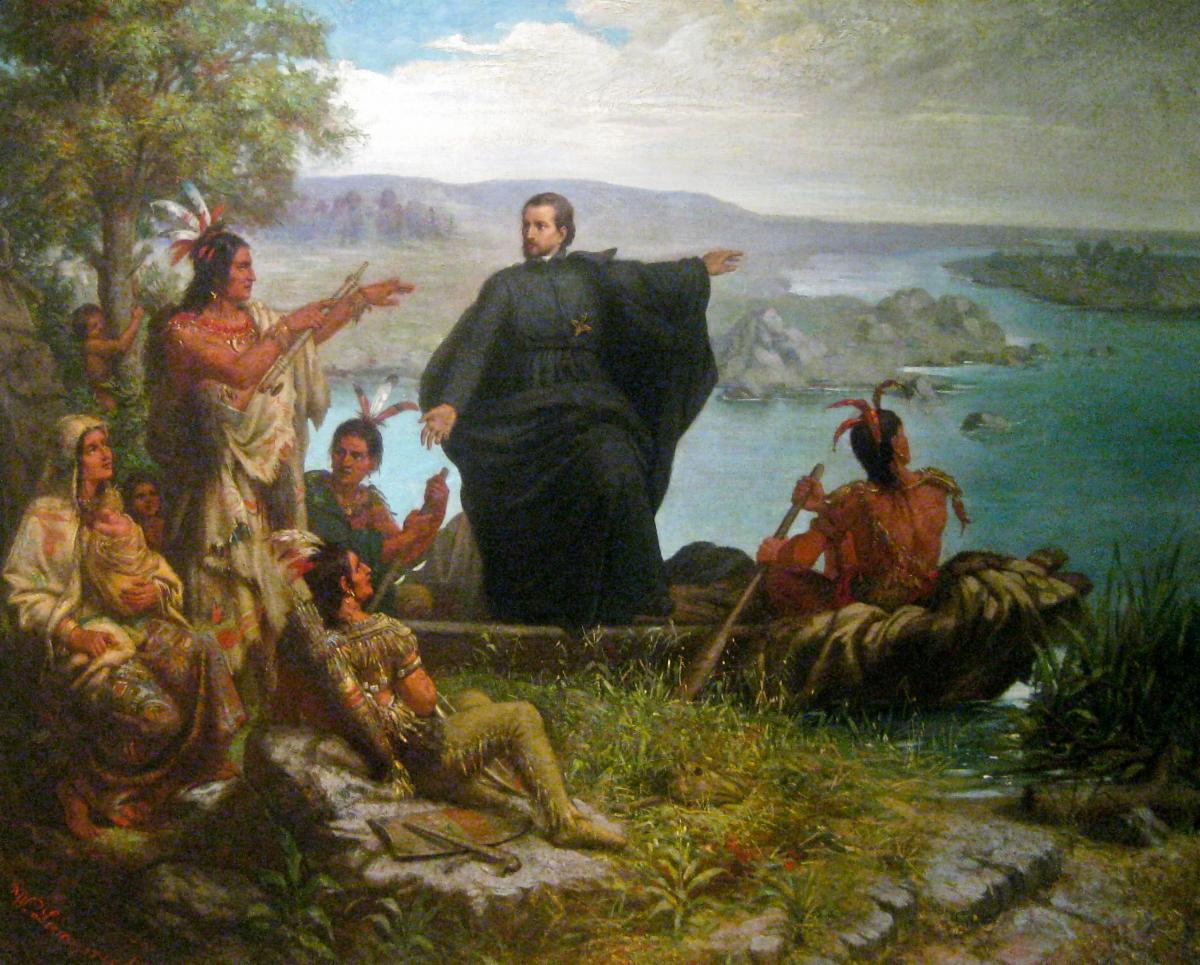
Père Marquette and the Indians [at the Mississippi River], oil painting (1869) by Wilhelm Lamprecht (German, 1838–1906).
The original hangs in the Raynor Memorial Library at Marquette University, Milwaukee, Wisconsin. Public Domain, https://commons.wikimedia.org/w/index.php?curid=8041258
| |
|
EDITORIAL
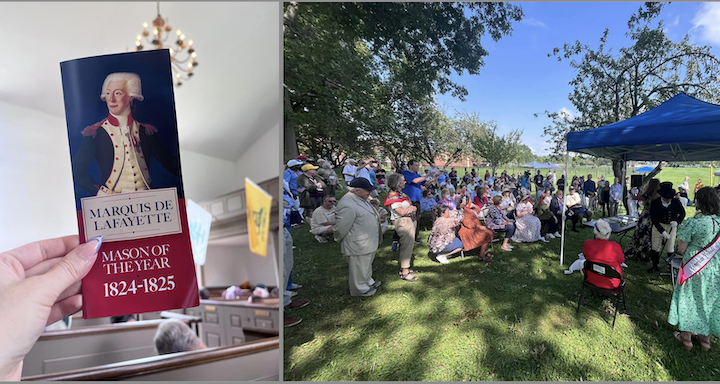
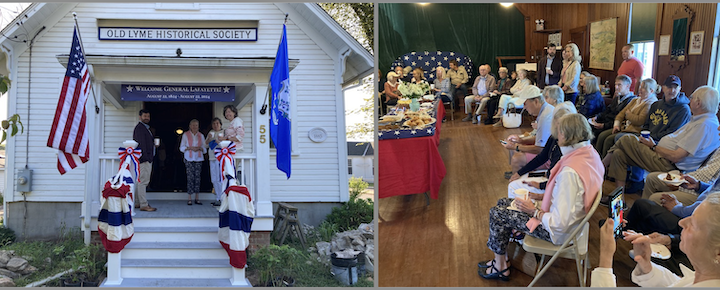
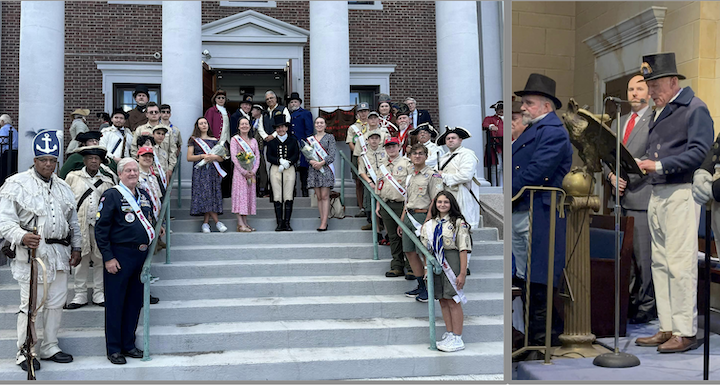
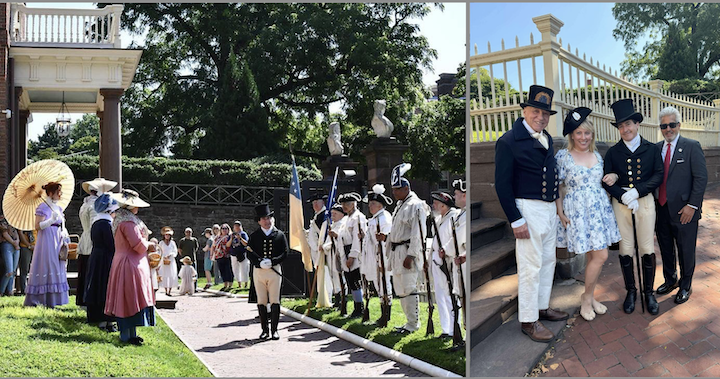
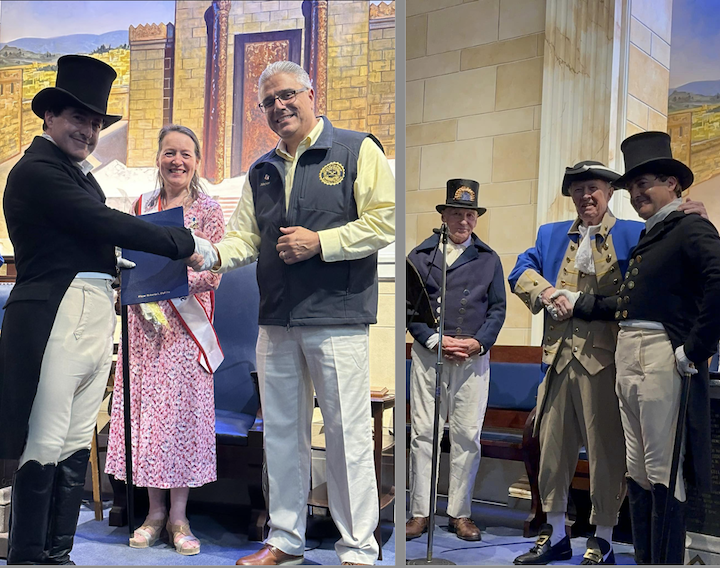
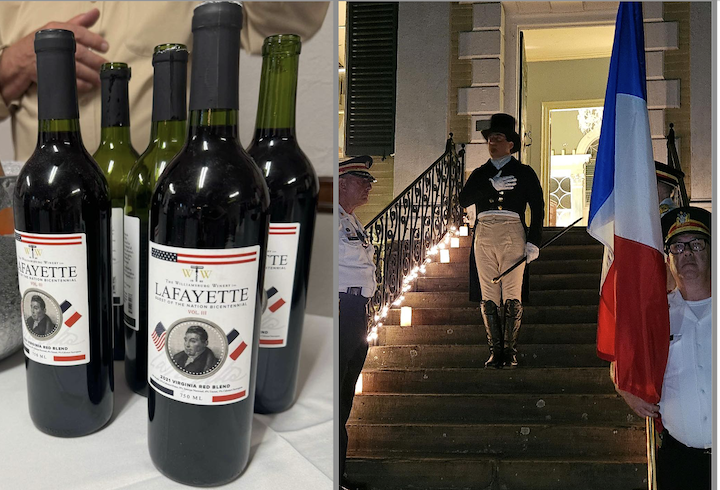
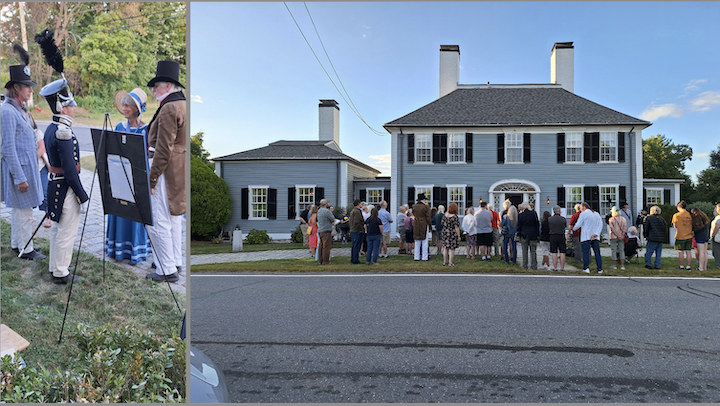
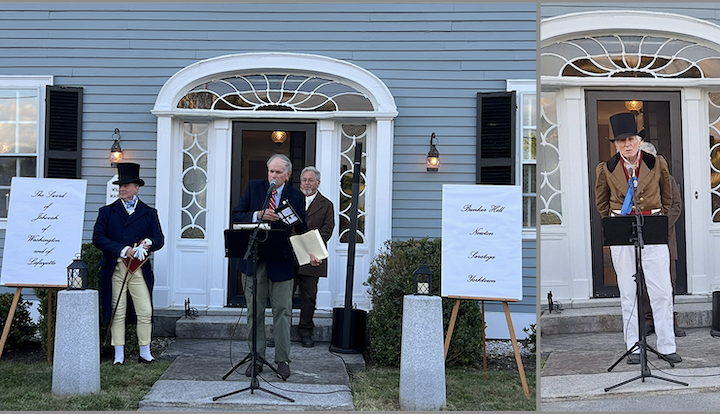
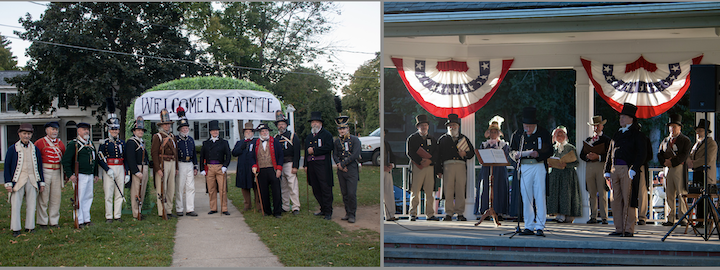
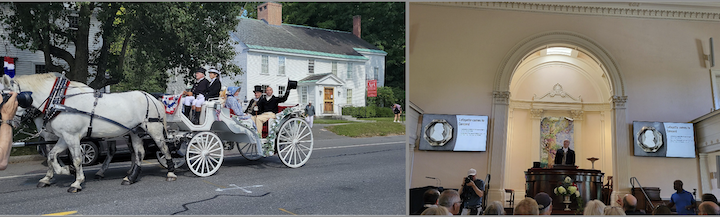
General de Lafayette, "America’s favorite Frenchman", has been in the spotlight recently, even making the front page of the New York Times on August 15.
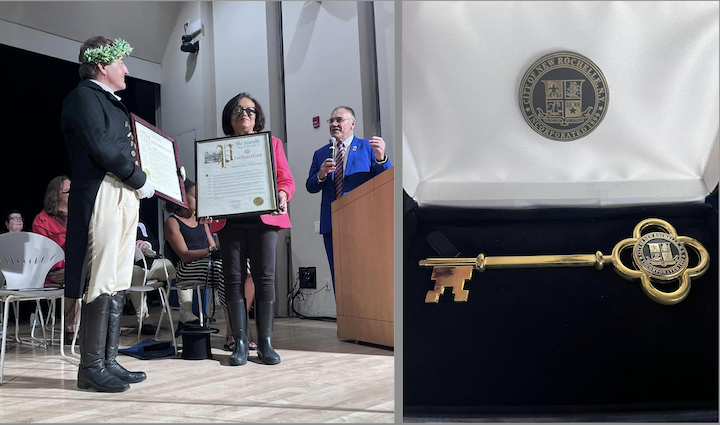
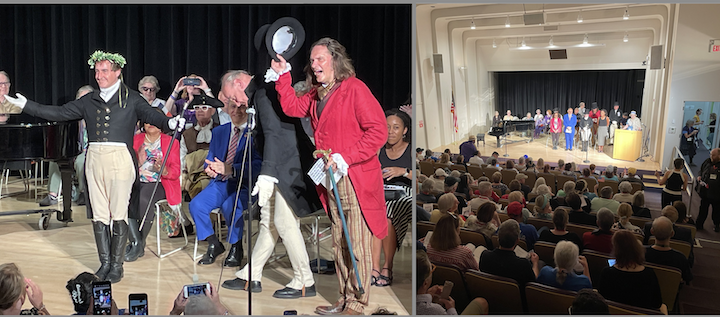
This brings us great pride and joy, especially when we consider all the volunteers dedicating their time to organize Bicentennial celebrations across the country. Thanks to reenactor Mark Schneider’s incredible talent, those who attended the kickoff ceremony felt as if they were meeting the Marquis in person. We will keep sharing updates on these events with photos and highlight upcoming announcements over the next year. Please spread the word to anyone who might be interested to join. It’s essential to honor Lafayette, not just for his past achievements, but because his values and struggles remain highly relevant today.
Our Society covers various historical periods, not just the Revolutionary War. We invite you to join us this month as we explore earlier times and different areas, continuing the series we started last January about French Missionaries in America. In January, we focused on the first Jesuits who came to evangelize Native Americans in the 1600s in the Northeast regions of today's United States. This month, in the second part of our series, we will follow the footsteps of several Missionaries in the years 1650-1750 throughout New France, from the Great Lakes to the Gulf of Mexico.
Like Lafayette, another important French figure in America has a name ending in “ette”: Reverend Father Jacques Marquette. He is honored in many states across the Midwest, from the Great Lakes to the Great Plains and along the Mississippi River. You will find many memorials and statues of Père Jacques Marquette, starting with his statue in the National Statuary Hall of the U.S. Capitol in Washington, D.C.
Although he is the most well-known, there were many more missionaries sharing the same zeal. The heart of America was evangelized by groups of explorers and French missionaries, all of whom deserve our recognition. They have made lasting contributions to many places, but many of their stories are fading from memory. This Bulletin will highlight several of these individuals: Claude Dablon, Gabriel Druillettes, known as “the Apostle of Maine,” Louis Hennepin, Claude Allouez, called “the Francis Xavier of the American Missions,” Pierre Gibaut, Jean Mermet, Francois Vaillant, and Nicolas Delhalle, to name a few. Each played a key role in building the spiritual foundations of the vast lands they explored.
Each month, we pay respect to an American volunteer who made the ultimate sacrifice in France defending democracy and Freedom. This month, we remember Sergeant Vernon (William) Jr. Booth of New York. He succumbed to his injuries on July 10, 1918, at the Royaumont hospital in the Oise region after a tough aerial battle and a crash landing. Even with serious wounds and burns, he managed to crawl from his plane and set it on fire to prevent the enemy from taking it. He then crawled through No Man's Land until French soldiers rescued him.
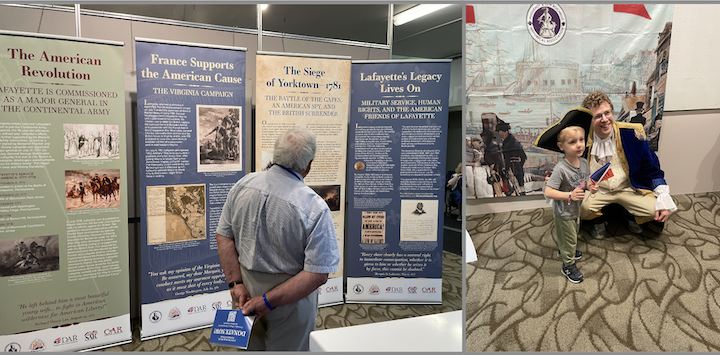
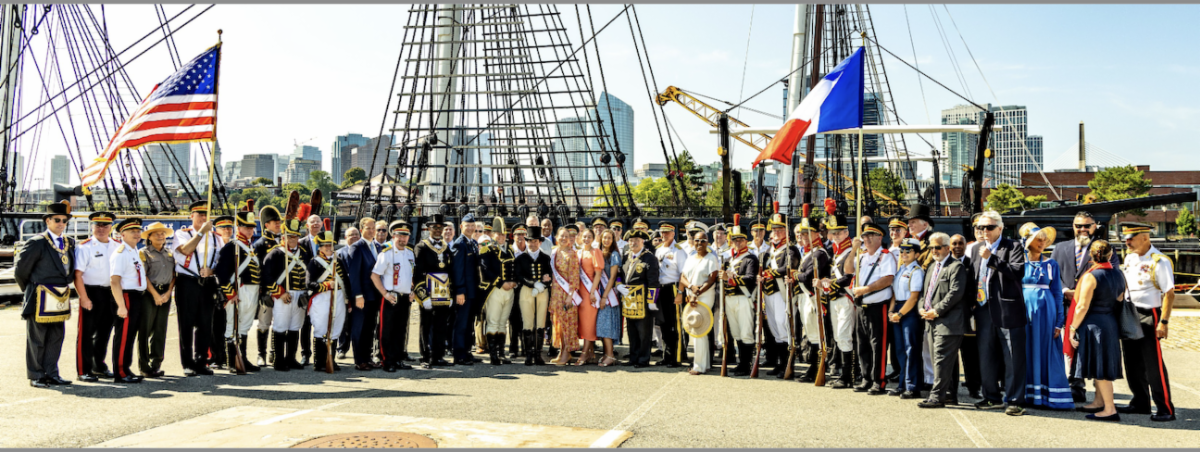
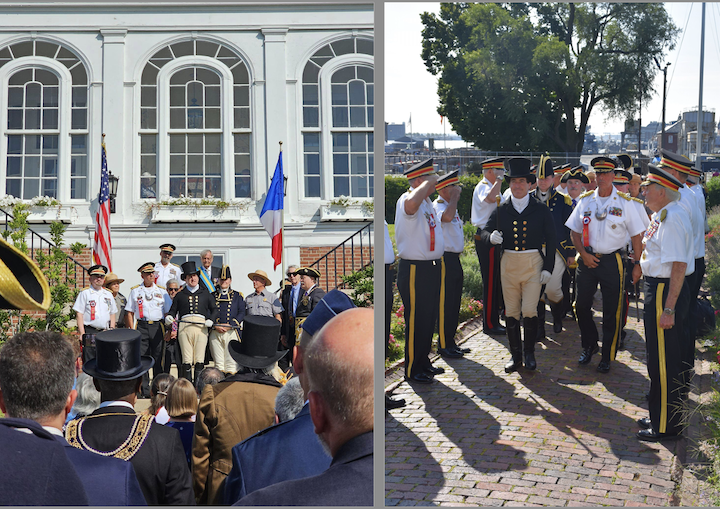
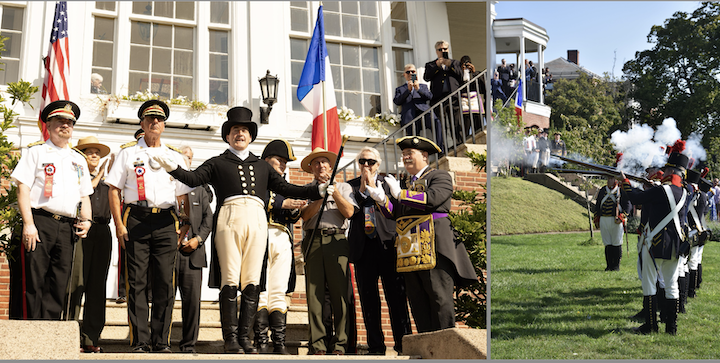
At the end of this Bulletin, you will find a Photo Album showcasing recent celebrations of Lafayette’s Farewell Tour bicentennial, along with announcements for upcoming events. For information on all events organized by the American Friends of Lafayette and other civic and patriotic groups across 24 states over the next 13 months, visit: www.Lafayette200.org.
Thank you for your continued support!
On behalf of the Board of Directors,
Thierry Chaunu
President, American Society of Le Souvenir Français, Inc.
| |
|
France in the Middle West:
There is a marker in Saint Ignace, Michigan, whose title is "France at Mackinac" which gives a global summary.
This marker is located at:
251 South State Street, Saint Ignace MI 49781
GPS: 45.865277, -84.719532
• Inscription:
“French Missions: In the 1640s French missionary priests brought the Christian gospel to the people of the upper Great Lakes. In 1671 Father Jacques Marquette established a mission on Mackinac Island. After a few months Marquette moved the mission to the north side of the Straits and named it St. Ignace in honor of the founder of his Jesuit order St. Ignatius Loyola. Father Marquette was eager to take his message to distant tribes. In 1673 he accompanied Louis Jolliet on an exploratory trip that led to the European discovery of the Mississippi River. “
“French Culture and Indian Ways: French men often married Native women. An Indian wife provided an important connection between the European trader and the Native peoples. Her family ties were essential because Indian people wanted to trade with merchants they could trust. Their children bridged both cultures and were known as metis. Metis were the major population of the Straits of Mackinac into the early 19th century. Today French descendants remain in the Straits area.”
“French Marines at Mackinac: Soldiers of the Compagnies Franches de la Marines (Independent Company of Marines) served at the Straits of Mackinac beginning in the late 1600s. In 1715 French Marines began a 45-year period of service at Fort Michilimackinac. Here they protected the community and supervised the fur trade. French officers also recruited Native American warriors at Michilimackinac to fight against British forces as far away as Ohio and New York.”
This blend of fur traders, farmers, missionaries and the military were certainly the necessary ingredients to colonize new territories. However, it never succeeded due to a lack of immigrants... as we will see further below, the valiant efforts of the missionaries to spread the gospel to the Native Indians, seemingly futile at times, are attested by the inscriptions on numerous memorials and markers throughout Minnesota, Wisconsin, Michigan, Illinois, Indiana, Iowa, Arkansas, Missouri, Alabama, Louisiana.
| |
|
Above:
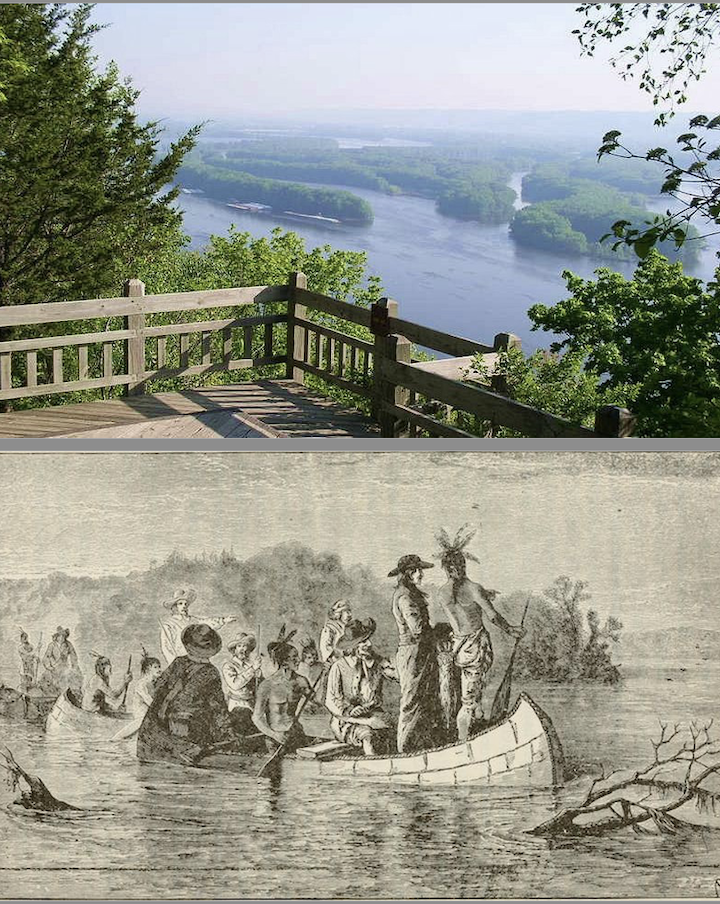
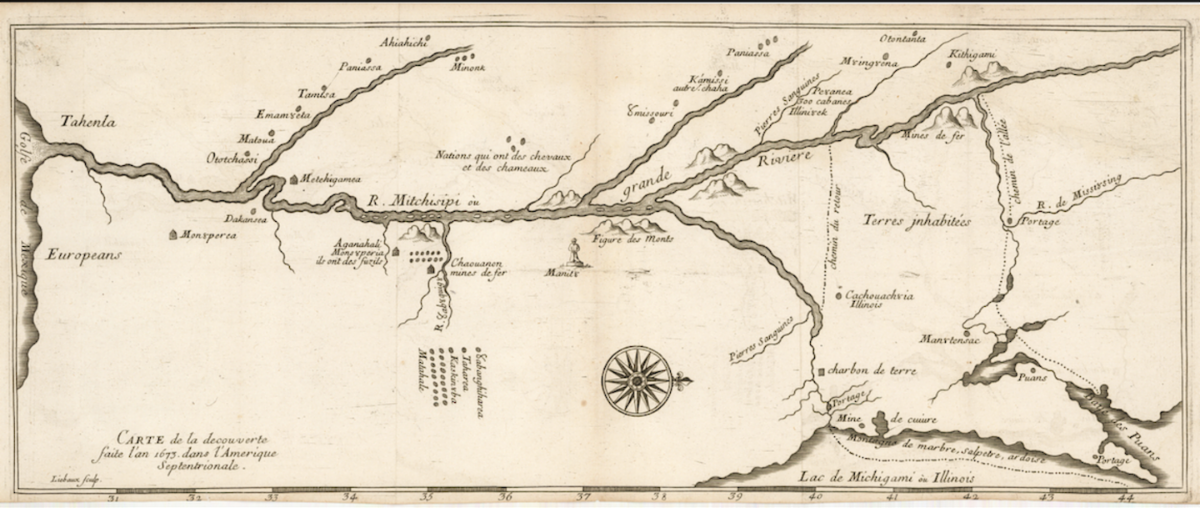
Top: "Carte de la découverte faite l'an 1673 dans l'Amérique Septentrionale" by Liebaux & Marquette, Jacques, 1637-1675. Library of Congress, Public Domain, https://lccn.loc.gov/200662976
Below: "Père Marquette and Louis Joliet being guided by an Indian on their mapping expedition of the Mississippi valley", Painting circa 1900 by De Cost Smith (American, 1864 - 1934), Syracuse University Art Museum, Gift of the American Book Company, https://onlinecollections.syr.edu/objects/
| |
|
The Duet Marquette & Jolliet
We will devote a great portion of this Bulletin to Father Jacques Marquette. However you will see the name of Louis Jolliet (at times spelled Joliet) almost always associated with him in every monument, marker, or tablet.
Father Marquette takes precedence because of his evangelization work, yet Jolliet was an inseparable companion and explorer in his own right.
Before we pursue further with our narrative, it is time that we present these two illustrious men in a few words.
Jacques Marquette, SJ was born in Laon in Northern France on July 1, 1637. He enterered a Jesuit school at the age of 9, was ordained at 17 and came to Quebec in 1666 at the age of 31. After learning Indian languages, he helped start a mission at Sault Ste. Marie (now in Michigan) in 1668 and another at St. Ignace (now in Michigan) in 1671. In mid-May 1673, he left St. Ignace with Jolliet, who was sent by Louis, comte de Frontenac, the governor of New France, to explore the Mississippi River. They traveled west to Green Bay (now in Wisconsin), went up the Fox River, crossed to the Wisconsin River, and reached the Mississippi near Prairie du Chien on June 17. They followed the river to the Arkansas River but found it went through dangerous Spanish territory, so they turned back in mid-July via the Illinois River. Marquette was very tired when he got to Green Bay and stayed there while Jolliet went on to Canada.
In 1674, Marquette aimed to start a mission with the Illinois Indians, but winter caught him and two friends near what is now Chicago, making them the first Europeans to live there. He met the Indians (near present-day Utica, Ill.) in the spring, but sickness made him go back. He died at the mouth of a river now called Père Marquette while heading to St. Ignace.
Louis Jolliet (also spelled Joliet) (September 21, 1645 – after May 1700) was born in Beaupré near Québec City, and was an an orphan at six. His mother remarried and his step father moved to Ile d'Orleans, where local Indians would mix with the French colonists. He became therefore acquainted with their languages and customs, learned Spanish and Englishand after studying briefly in a Jesuit school preferred to embrace the lucrative and adventurous occupation of fur trader. After his exploring association with Father Marquette, he returned to Québec and married. In 1680, Louis XIV rewarded Jolliet with the Island of Anticosti, where he built a fort and stationed soldiers. By 1693, he became the "Royal Hydrographer," and on April 30, 1697, he received a seigneury southwest of Quebec City, which he named Jolliest.
In 1694, he traveled from the Gulf of St. Lawrence up the Labrador coast to Zoar, taking five and a half months. He documented the land, navigation, the Inuit, and their traditions. His journal, "Journal de Louis Jolliet allant à la decouverte de Labrador, 1694," is the first detailed survey of the Labrador coast from the Strait of Belle Isle to Zoar in Newfoundland.
In May 1700, Jolliet set out for Anticosti Island in the Gulf of St. Lawrence, after which he vanishes from history. There are no records of his death or burial, and the only mention of his fate is a mass held for him in Quebec on September 15, 1700.
| |
Exploration and Evangelization | |
|
Above:
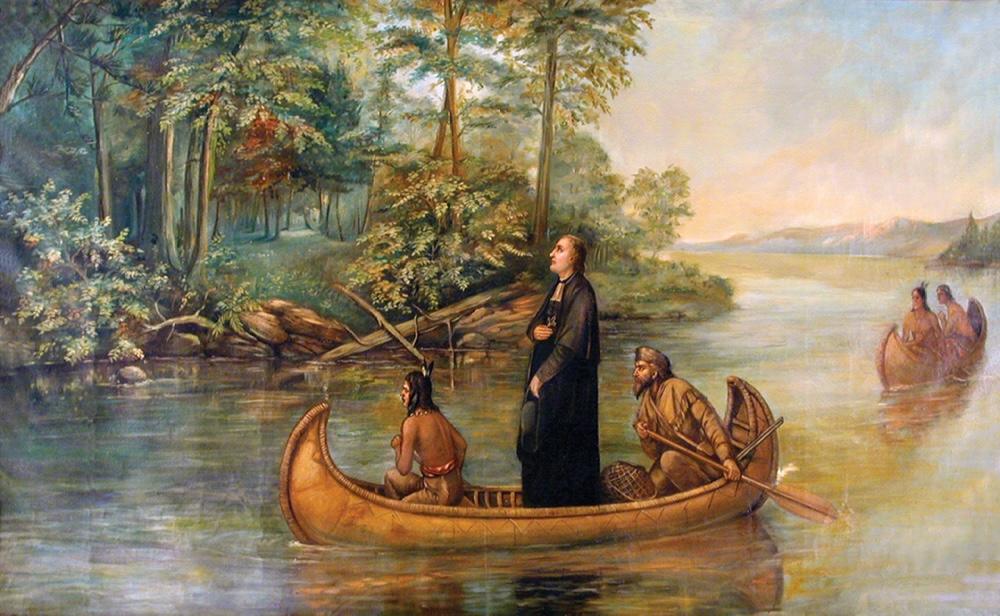
Top: "Marquette and Joliet Exploring the Upper Mississippi River" Oil painting by German-born Frank H. Zeitler (1874-died Wisconsin 1940). "The composition shows Marquette and Jolliet's canoe as it rounds a bend in the Mississippi, illustrating both the forest nearby and the mountains on the horizon. The canoe following them is led by two Amerindians". Source: Wisconsin Historical Museum Online Collections. https://www.wisconsinhistory.org/Records/Article/CS520
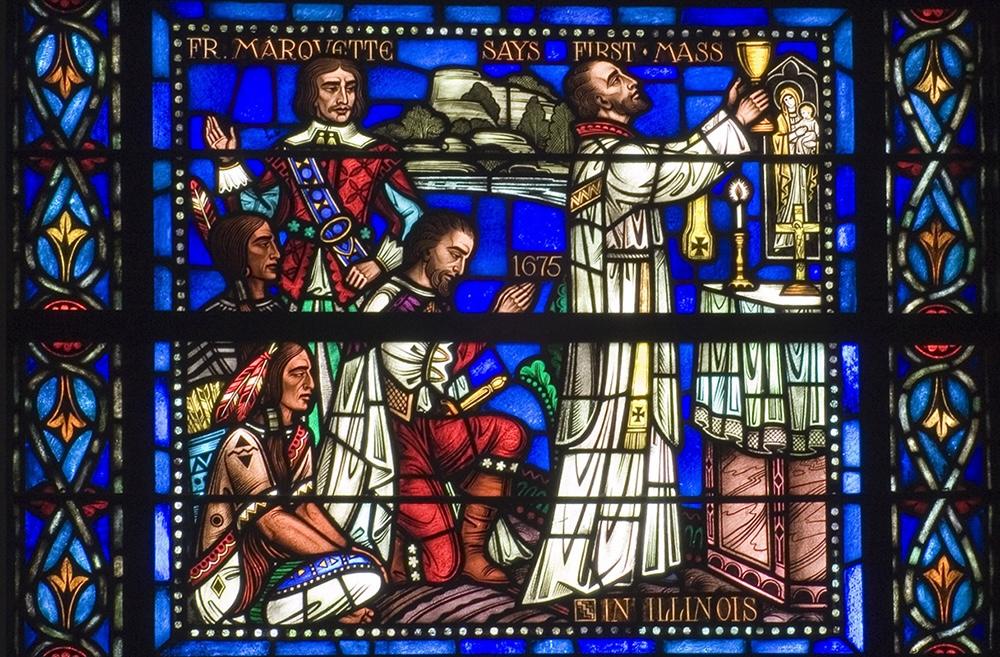
Below: This stained-glass located at the Cathedral of St. Mary in Peoria, IL. depicts Father Marquette saying Mass among the Kaskaskia, near Utica Illinois, during Holy Week of 1674.
The Cathedral of Saint Mary of the Immaculate Conception
607 NE Madison Ave, Peoria, IL 61603
GPS: 40.698398, -89.584797 Photo: https://rd.uqam.ca/Marquette/index.html
| |
|
Colonization and the Natives
• The 19th-century American historian Francis Parkman, author of the monumental seven-volume France and England in North America, wrote: "Spanish civilization crushed the Indian; English civilization scorned and neglected him; French civilization embraced and cherished him."
• As we will see, All the plaques on monuments, interpretive markers, and tablets support this narrative, though some wordings might be questioned due to the sensitive nature of the topic today.
Marker “Two Cultures Meet”
499 North State Street, Saint Ignace MI 49781
GPS: 45.870800, -84.730350
• Inscription:
“French traders established themselves in the Upper Great Lakes region after 1644 and were welcome among the Indians. They sought harmony with the native people, learning their language and respecting their customs.
The French adopted useful Indian products like snowshoes and canoes. At the same time, European trade goods slowly replaced traditional Indian wares. Cotton and wool supplanted buckskin and European glass beads replaced beads made of shell and bone.
Stone arrowheads gave way to iron arrowheads and eventually guns began to replace the bow and arrow altogether. To obtain such European trade goods, Indians traded furs to the French and began to function increasingly as trappers”...
| |
|
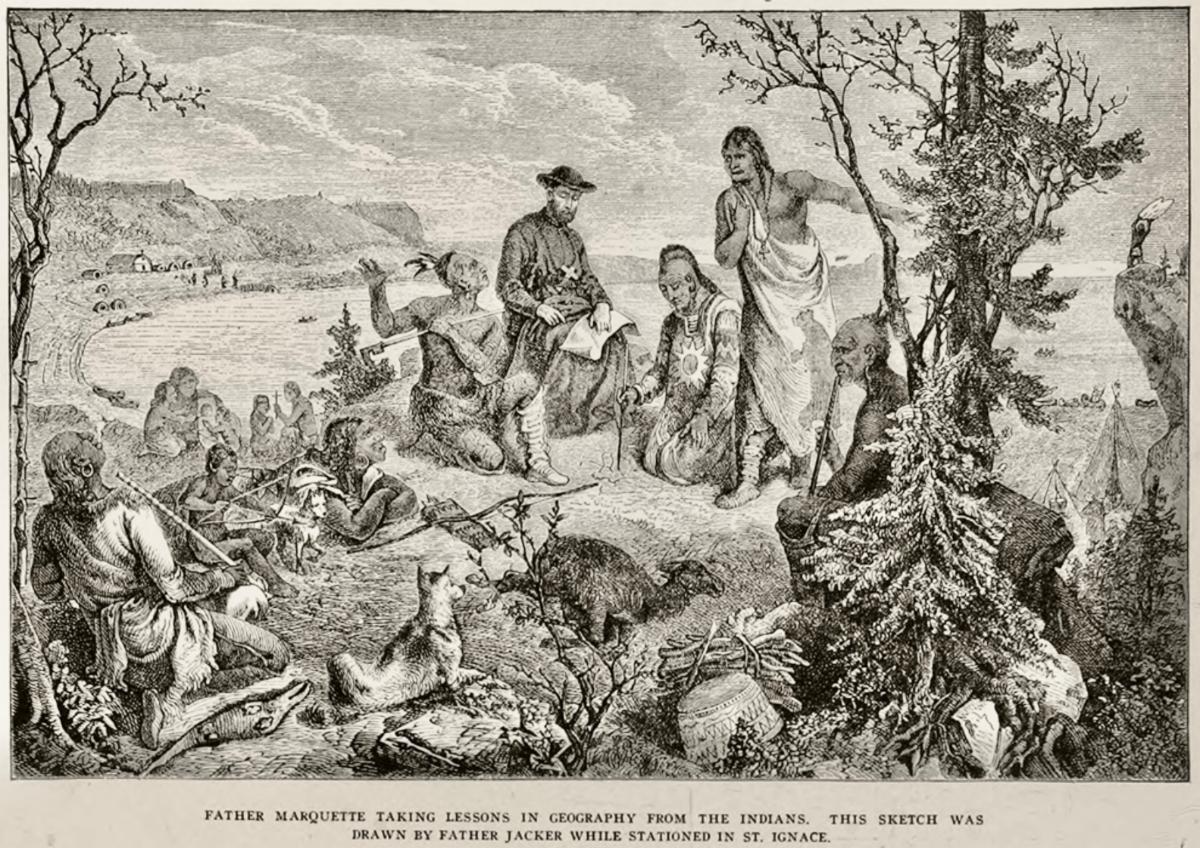
Above:
"Father Marquette taking lessons in Geography from the Indians." This pen-sketch was first published in "Űber Land und Meer" by German-born artist Edward Jacker (1827-1887). It also forms the scene on the main curtain of the Baraga Auditorium, in the St Peter Cathedral school in Marquette, WI. From: https://rd.uqam.ca/Marquette/index.html
| |
|
Continuation of marker:
...“The Mission: A Gathering Place”
“Hundreds of Huron and Odawa (Ottawa) people fled their homeland in Ontario following their defeat at the hands of the Iroquois in 1649. They retreated through the Straits of Mackinac to Green Bay, and later to northern Wisconsin on the shores of Lake Superior. There they met Father Jacques Marquette.
In 1671, hostilities had developed with the neighboring Lakota and the refugees were again forced to move. Deciding to relocate at the Straits of Mackinac, they first settled on Mackinac Island. When the island proved to be unsatisfactory for farming, they moved to this very site. A chapel was built at the head of the protected bay, and the Huron and Odawa each constructed palisaded villages directly to the north.
The village and mission continued here for 30 years, the Huron becoming principal players in the fur trade. In 1701 Commandant Cadillac moved the French fort to Detroit and convinced most of the Huron to go with him. The Jesuits maintained a presence among the Odawa who remained in St. Ignace, probably until Fort Michilimackinac was built across the Straits in 1714.”
"The City: A Bustling 17th Century Town"
“...The Jesuit mission stood here, at the center of the community. To the north of the mission were the villages of the Huron and the Odawa. The Huron lived in huge longhouses, 20 feet wide and 100 feet long. They farmed, fished, traded with the French, and maintained a defensive footing against their Iroquois enemies.
St. Ignace continued to grow when French fur traders and soldiers, in the 1680s, built Fort deBuade to the south of the mission. At its peak, the population here numbered at least 2,000. St. Ignace had established itself as the trade center of the Great Lakes Country.”
| |
|
Monuments to Father Jacques Marquette
The Pre-eminent Missionary
| |
|
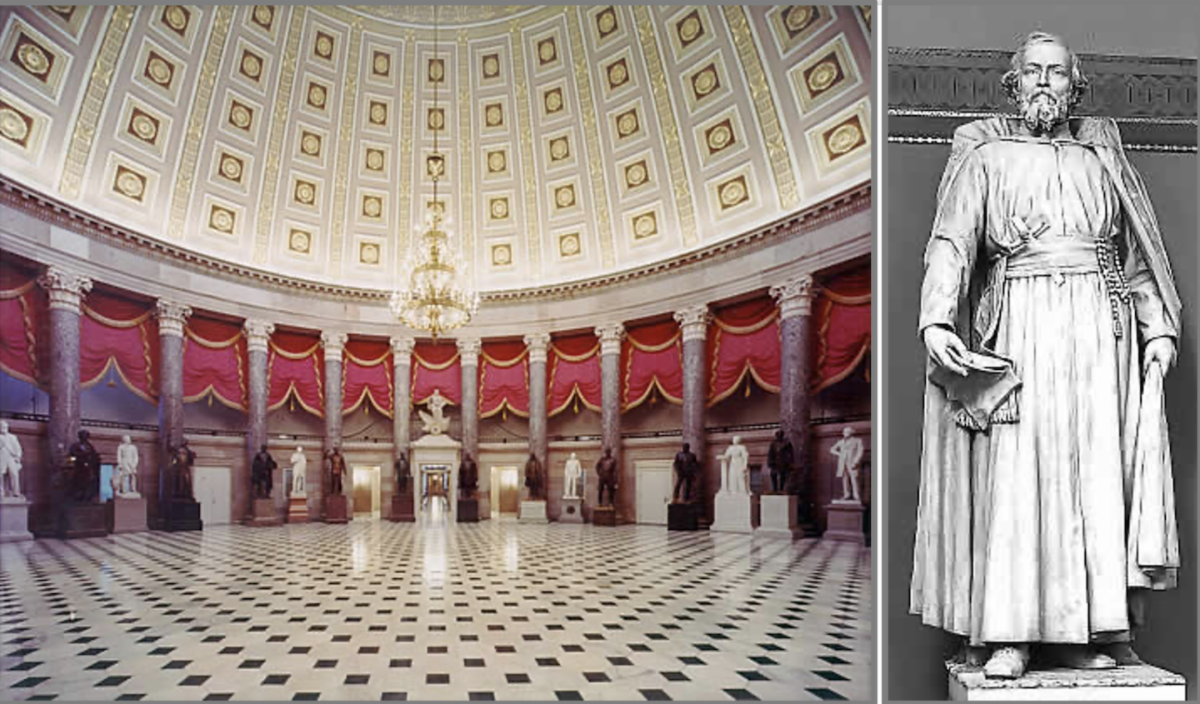
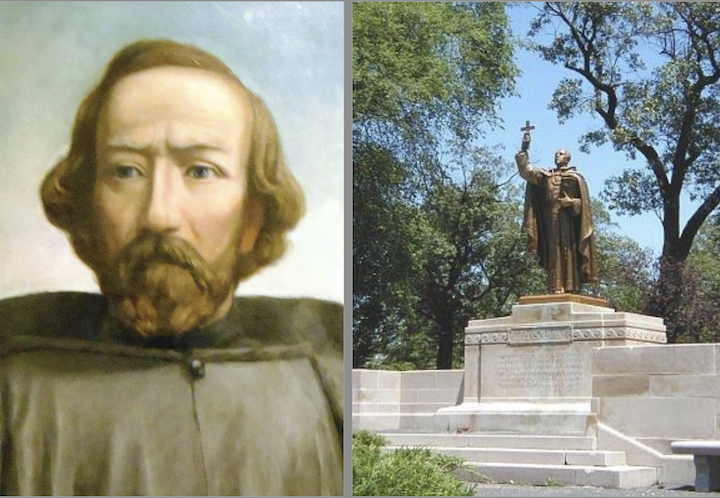
Statue of Father Marquette
U.S. Capitol, Washington, D.C.
| |
|
One of Wisconsin's two statues at the US Congress
• The National Statuary Hall Collection holds statues donated by each State of the Union, portraying notable persons in the histories of the respective states. The two statues offered by the State of Wisconsin are the ones of Father Jacques Marquette and Congressman Robert M. LaFollette, (1885-1891), presidential candidate in 1924 of the Progressive Movement.
• Father Marquette was chosen to represent Wisconsin because he was the first to bring Christianity to the area and the first to explore the upper Mississippi River and much of what is now Wisconsin.
• The statue "Jacques Marquette" is sculpted in marble and the is work of Italian-American sculptor Gaetano Trentanove (1858-1937). The work was accepted into the U.S. Senate in 1896 and was sent to Washington in the winter of that year.
• However, during this time, a group called The American Protective Association spread fears that the Pope might come to America to disrupt democracy. A resolution in the House to reject Wisconsin’s gift because it showed a priest in religious clothing with a crucifix put the gift on hold until 1904, when finally Congress officially accept the Father Marquette statue for the National Statuary Hall Collection.
• The heated debate had two results: it brought national attention to Father Marquette and it helped explain that he deserved the honor from Wisconsin for his lifelong commitment to promoting the core values of charity and goodness in humankind.
| |
Father Marquette monuments in Michigan | |
|
Above:
Left: Statue of Jacques Marquette in Marquette, Michigan
Father Marquette Park, 501 South Front Street, Marquette, MI 49855
GPS: 46.539950, -87.393533
Photo by rossograph - Own work, CC BY-SA 4.0
https://commons.wikimedia.org/w/index.php?curid=80065981
Right: Statue “Marquette1637-1675” at Mackinac Island, Michigan
7200 Huron St Marquette Statue, Mackinac Island, MI 49757
GPS: 45.851126, -84.616617
Photo: https://www.linkedin.com/company/mackinac-state-historic-parks/
| |
|
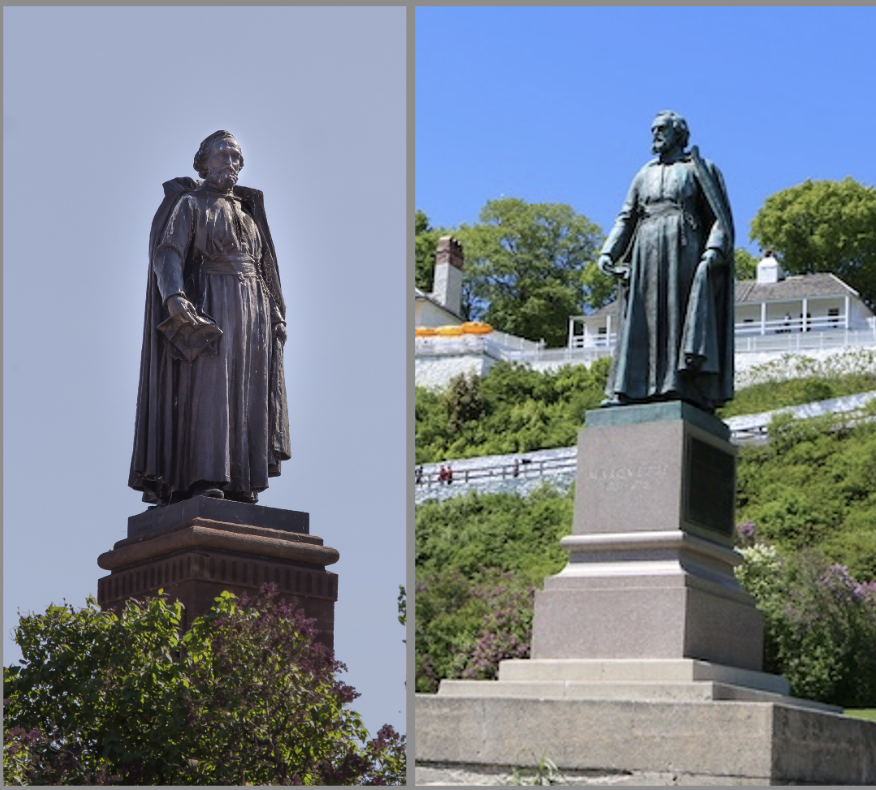
There are three replicas in Michigan:
• In Marquette, MI: The Father Marquette Statue second replica was dedicated on July 15, 1897, gifted to the city of Marquette from Peter White. Weighing 1 1/2 tons, the cast bronze statue cost $6,000 ($225,000 in today's dollars), and was originally situated near the original Waterworks Plant at the southeast end of East Ridge Street. It was moved in 1913 to its current location in the Father Marquette Park on Front & Baraga Street.
• Inscription on pedestal:
[south] : “Presented to the City of Marquette, July 1897"
[north] : "James (sic) Marquette, Intrepid Explorer"
• Inscription of marker:
“During the seventeenth century, dedicated Jesuit missionaries forged into the North American wilderness to live and work among the native peoples of the Great Lakes region. In September 1666, at age twenty-nine, Father Jacques Marquette arrived in Quebec. He then helped establish a mission in Sault Ste. Marie, worked at the Mission of Ste. Esprit in the Chequamegon Bay area, and founded a mission in St. Ignace. In 1673 Marquette and Louis Jolliet explored the Mississippi River as far south as the Arkansas River. Two years later Marquette fulfilled his promise to return to the Illinois people. Illness cut short his ministry and on May 18, 1675, he died while returning to St. Ignace. In 1677 Odawa Indians returned his remains to St. Ignace for burial beneath the floor of his mission.
Erected 2000 by Michigan Historical Center, Michigan Department of State. (Marker Number S585C.)”
• The third replica is in Mackinac Island, MI.: this replica was dedicated in 1909 in Marquette Park on Mackinac Island, Michigan.
• Inscription on pedestal:
“Father Jacques Marquette
with Louis Joliet discoverer of the Mississippi River
Founder of Saint Ignace and Kaskaskia Missions and explorer
Ardent and resourceful
A shepherd who gave his life for the sheep.
To Nicolet - Raymbault and Jogues - Radisson and Groselliers
Menard - Allouez - Saint Lusson and Perrot -
Marquette and Joliet - Andre - LaSalle
Du Lhut - Le Sueur - Cadillac
Honored names in the discovery of the Northwest
This memorial to the pioneers of France in the New World is due to Peter White of Marquette himself a pioneer of Upper Michigan"
• There is also a third replica, in marble, at Marquette University, on the 4th floor of Zilber Hall:
On the fourth floor of Zilber Hall, there is a marble statue of Father Marquette. This statue is also copy of the one that represents the State of Wisconsin in the National Statuary Hall Collection at the U.S. Capitol. In 1903, Mrs. Harriet Cramer donated this replica to Marquette College.
• The original plaster model created by sculptor Trentanove and sent in 1894 to the Commission chosen by Wisconsin governor George Wilbur Peck for selecting a statue to be given to Congress is located at the Wisconsin Historical Society, 816 State St, Madison, WI 53706.
| |
Statue at Saint Ignace Mission, MI | |
|
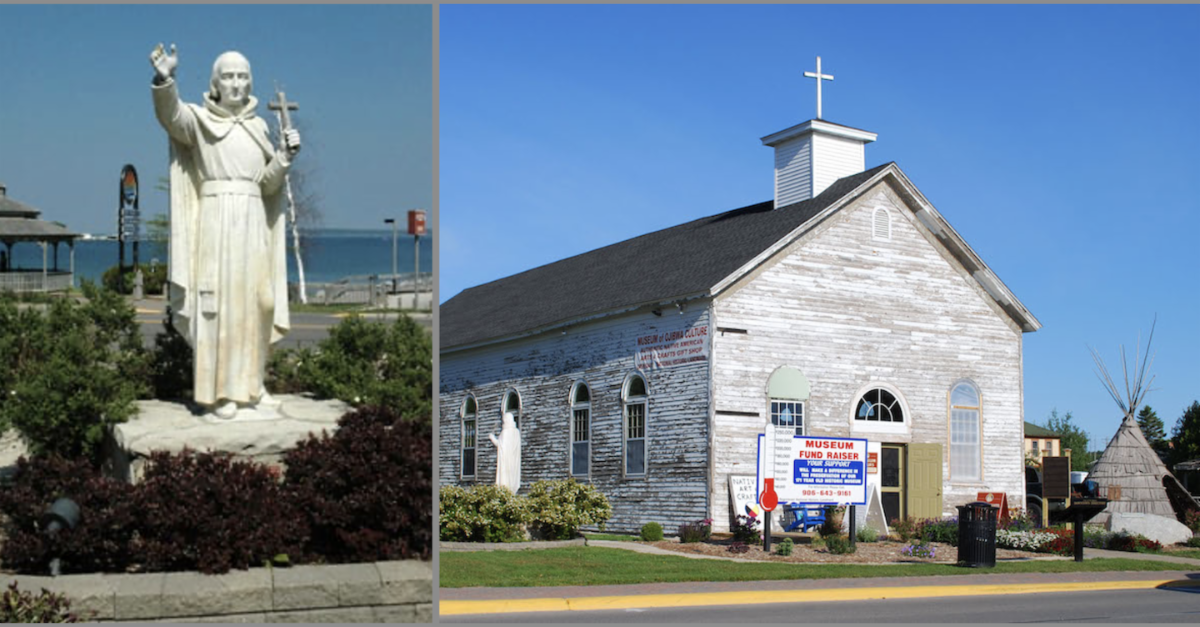
• The Old Mission Church Association- comprised of the Knights of Columbus and the Diocese of Marquette- commissioned a statue of Father Marquette. The life-size figure was sculpted by Aldo Pera, a graduate of the Royal Academy of Art in Florence, Italy.
• The statue was unveiled, dedicated and blessed by the Most Rev. Thomas L. Noa, during the Father Marquette day on August 11, 1957. The likeness of the Jesuit priest was positioned just north of the relocated former Old Mission Catholic Church, after its re-purposing as a museum. Fr. Marquette’s effigy was set facing Moran Bay, with a triangular background of Drummond dolomite, capped by a tilted cross of California redwood.
• Later, the Marquette icon was moved to the south side of the museum building, where is resides today.
• Inscription:
“In 1671 the mission of St. Ignace was established so that the Christian message could be brought to several thousand Indians living on this shore. The founder was Father Jacques Marquette, the Jesuit missionary. In 1673 he left on his great journey to the Mississippi Valley. He never returned to his mission before he died in 1675. Two years later his bones were reburied here beneath the chapel altar. In 1706, after French troops had abandoned the fort, the chapel was destroyed.”
Erected 1957 by Michigan Historical Commission. (Marker Number 92.)”
Marker “Missionaries at Mackinac - Mackinaw City Historical Pathway”
212 N Nicolet St, Mackinaw City MI 49701
GPS: 45.783383, -84.732433
• Inscription:
“Roman Catholicism came to the Straits of Mackinac through the self-sacrificing efforts of seventeenth-century Jesuit Missionaries. In 1670 Father Jacques Marquette established a mission for Huron Indians on Mackinac Island. An agriculturally-based tribe, the Huron found the thin soil of Mackinac Island unsuitable for their crops.
A year after settling on Mackinac Island, Marquette moved his mission to the more fertile land on the north shore of the Straits. Here, Marquette and Father Claude Dablon founded the permanent mission of St. Ignatius Loyola (today, St. Ignace, Michigan,) named in honor of the founder of the Jesuit order. Nearby, the Jesuits also established the mission of St. Francis Borgia to the Ottawa Indians, another agricultural tribe which planted corn fields on the St. Ignace peninsula.
A fur trade community developed adjacent to the missions and by 1690 soldiers constructed Fort Du Buade to protect French commercial interests. When the French military closed Fort Du Buade and later reestablished a Great Lakes presence at Detroit in 1701, the Huron from St. Ignace migrated south and became the Detroit-area Wyandots. Left behind were the Jesuits and their faithful band of Ottawa still tilling the soil at the Straits of Mackinac. After depleting the soil at St. Ignace, the Ottawa and their Jesuit priests moved to the south shore of the Straits of Mackinaw (today Mackinaw City, Michigan,) sometime around 1708. In 1715 they were once again joined by French soldiers who constructed the palisaded community of Michilimackinac. (Marker Number 37.)”
| |
|
Statue of Père Marquette at Detroit, MI
"The Fantastic Four"
Wayne State University
| |
|
Above:
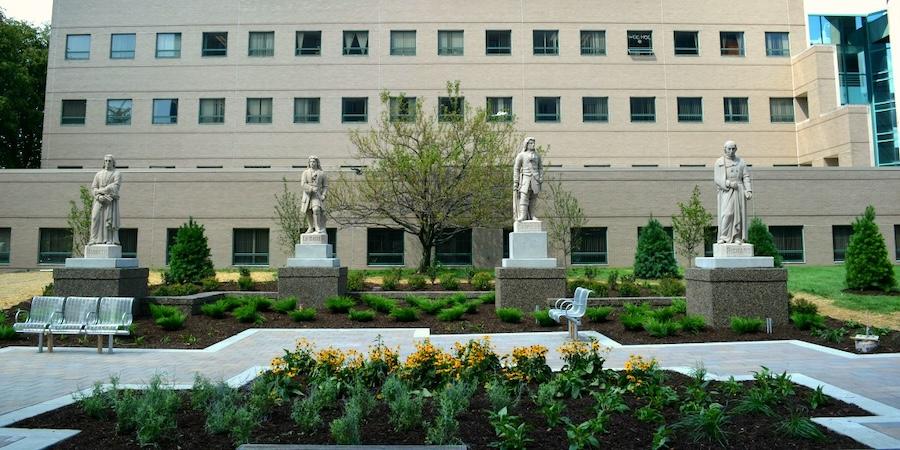
Statues, “The Fantastic Four”
Between Faculty Administration Building and Towers Residential Suites, Wayne State University, 655 Kirby Road, Detroit, MI. 48202
GPS: 42.358332, -83.072521
Photos: Wayne State University
| |
|
Père Marquette, First to the left, Michigan's spiritual father
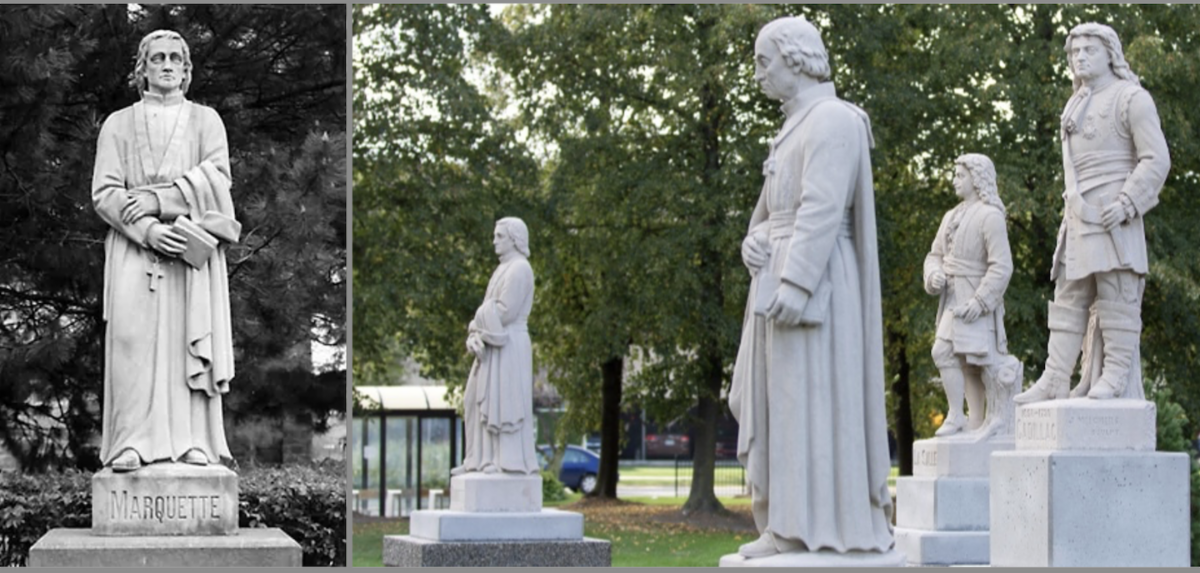
• "The Fantastic Four" consists of four statues representing Michigan’s four French founding fathers: Father Jacques Marquette, Antoine Laumet de la Mothe Cadillac, Robert Cavalier Sieur de La Salle, and Father Gabriel Richard. These 10-foot tall figures are carved in limestone and honor the French pioneers who played a key role in developing Michigan and founding Detroit. Marquette the legendary Jesuit missionary, Cadillac the city's founder, La Salle the ”Prince of explorers”, and Father Richard who co-founded the University of Michigan.
• In 1884, Julius Theodore Melchers, a German-born, Paris Beaux-Arts educated top sculptor in Detroit, was hired by Bela Hubbard, a lumber and real estate entrepreneur and philanthropist, to create large sandstone statues of four pioneers. Architect John M. Donaldson made a model for Marquette, while Melchers sculpted the other three. These statues were displayed at the original Detroit City Hall from 1885 until the building was torn down in 1961. They were given to the university by the Detroit Common Council and, then placed on Ludington Mall near General Lectures/St. Andrew’s Hall in 1973.
• In 2017, they were restored and moved to this prestigious new location.
| |
|
First church in Michigan
Founded by Père Marquette
Sault Ste. Marie, MI.
| |
|
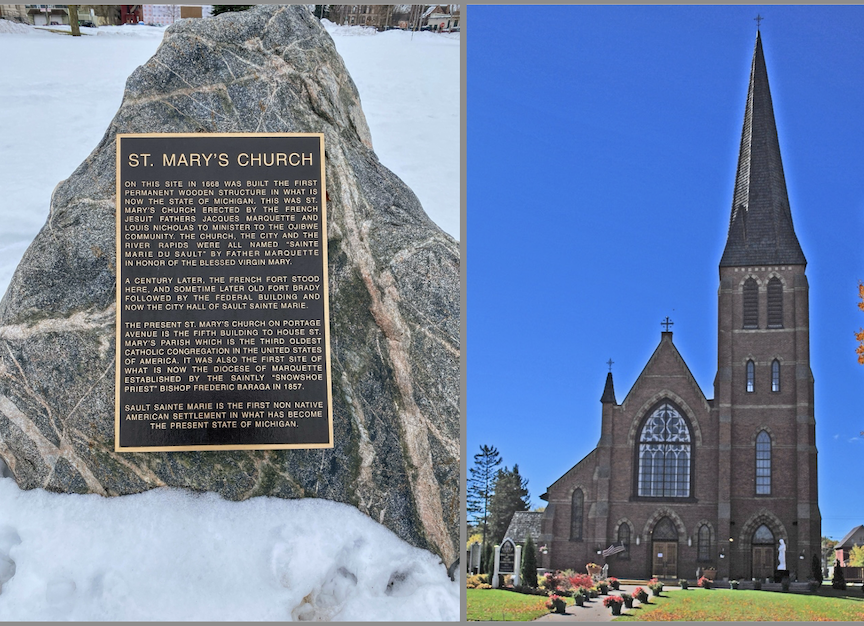
Sault Ste. Marie
• In 1668, French missionaries Jacques Marquette and Claude Dablon (see more on him further below) established a Jesuit mission here. Sault Ste. Marie became one of the earliest European cities in the U.S. west of the Appalachian Mountains and the first lasting European settlement in Michigan.
• Inscription :
"On this site in 1668 was built the first permanent wooden structure in what is now the state of Michigan. This was St. Mary's Church erected by the French Jesuit fathers Jacques Marquette and Louis Nicholas to minister to the Ojibwe community. The church, the city and the river rapids were all named "Sainte Marie du Sault" by Father Marquette in honor of the blessed Virgin Mary.
A century later, the French fort stood here, and sometime later old Fort Brady followed by the federal building and now the city hall of Sault Sainte Marie.
The present St. Mary's Church on Portage Avenue is the fifth building to house St. Mary's parish which is the third oldest Catholic congregation in the United States of America. It was also the first site of what is now the diocese of Marquette established by the saintly "snowshoe priest" bishop Frederic Baraga in 1857. Sault Sainte Marie is the first non native American settlement in what has become the present state of Michigan.”
| |
|
Statues and monuments of Père Marquette
in Wisconsin
Two statues in Milwaukee:
| |
|
Above:
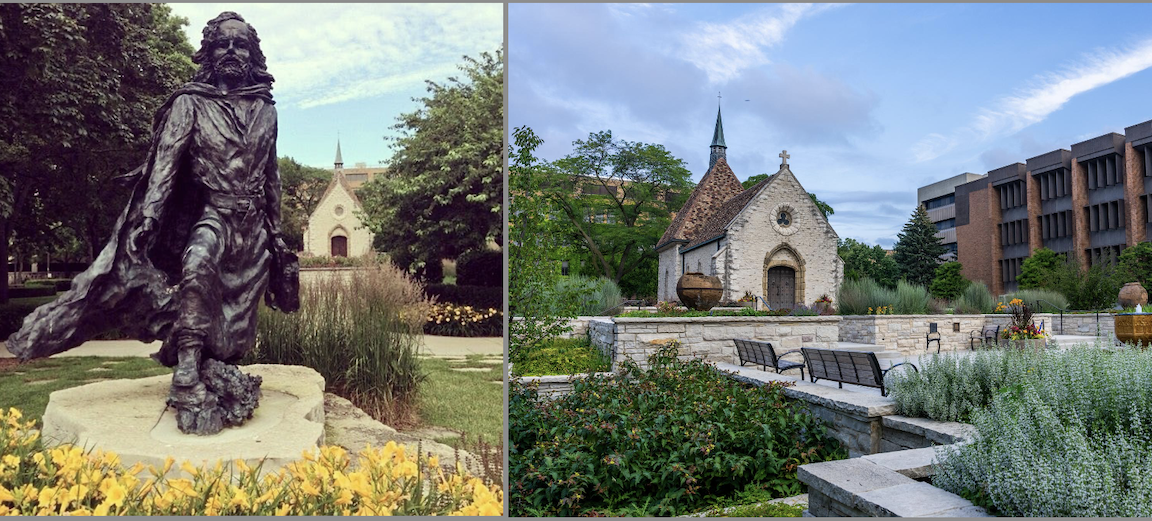
Top Left: Statue, “Father Marquette”, with the Chapel of Joan of Arc in the background
East end of Central Mall, near Coughlin Hall on the Marquette campus, Marquette University,
1250 W Wisconsin Ave, Milwaukee, WI 53233
GPS: 46.539950, -87.393533
Top Right: Chapel of Joan of Arc: read more about it in our May 2023 Bullletin, Joan of Arc in America https://conta.cc/41AMMfZ (original in English) https://conta.cc/3W5rp56 (in French).
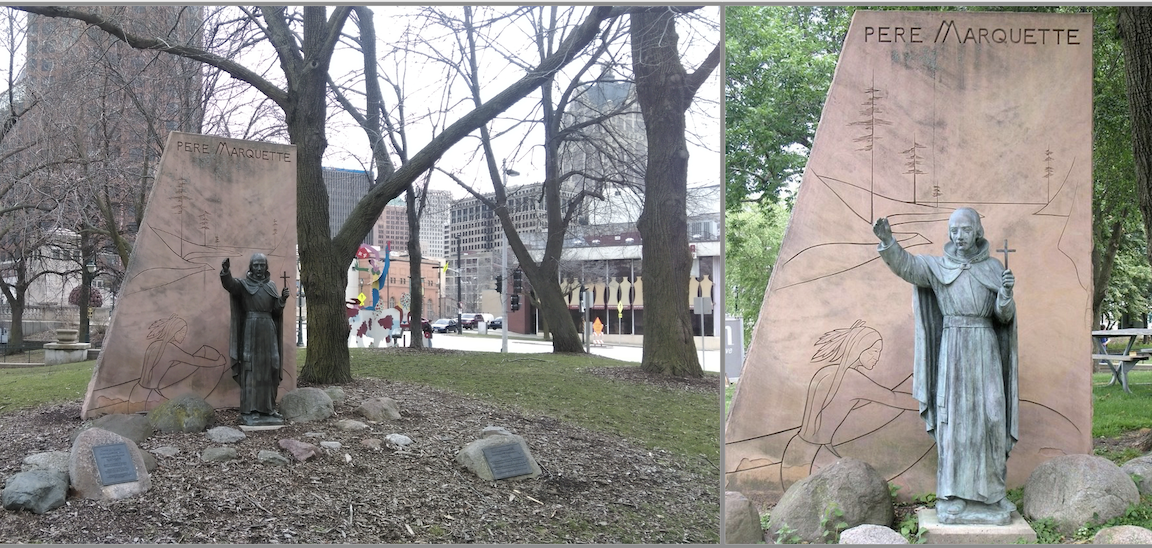
Bottom: two views of the Statue, “Père Jacques Marquette, S.J. - Missionaire et Explorateur — 1637-1675", (so named in French, with bronze plaque in French).
Père Marquette Park, 900 N Plankinton Ave, Milwaukee, WI 53203
GPS: 43.041800, -87.913783
Photo by DevonPolzar, http://www.hmdb.org/marker.asp?marker=93660
| |
|
Statue at Marquette University:
• Father Marquette appears to be stepping away from the water’s edge, a pose that illustrates both his long journey and his evangelizing of Native American tribes that included baptizing 4,400 people in a single day.
• “...In 1956 Alumnus John Madden and his wife Mary offered to fund a sculpture of Marquette. The University commissioned New York-based artist Ron Knepper to create the work, which was dedicated on September 23, 2005. Located immediately west of Coughlin Hall, the bronze statue portrays a mature Father Marquette. It stands eight feet two inches tall and weighs between 2,500 and 3,000 pounds. The sculpture depicts Marquette carrying a map, a nod to his explorations, and wearing a crucifix at his belt. During winter, Marquette students drape a Marquette scarf around the sculpture’s neck; graduating students often have their picture taken near the statue."
Brigid Nannenhorn, and James Marten. "Father Marquette Statue, Clio, Your Guide to History. April 8, 2022.
Statue at Père Marquette Park:
• This sculpture by American sculptor Thomas Queoff (b. 1952) was inaugurated on July 9, 1987. Pere Marquette stands holding a crucifix up in his proper left hand; his proper right hand is extended upward. Behind him, a pink granite marker depicts a river landscape with a Native American in a canoe.
• Inscription:
“350th Anniversary of his birth
Statue dedicated July 9, 1987
Bronze cast donated by the
Milwaukee Sentinel, founded 1837,
in honor of its 150th anniversary.
Original statue donated by
Marquette University High School,
Class of 1957.”
• Plaque in French nearby (translated from French):
“Bronze statue donated by the "Milwaukee Sentinel ” in commemoration of its 150th anniversary. Inaugurated on July 9, 1987 on the occasion of the 350th anniversary of the birth of Father Marquette ”
"Erected by the East Town Association."
| |
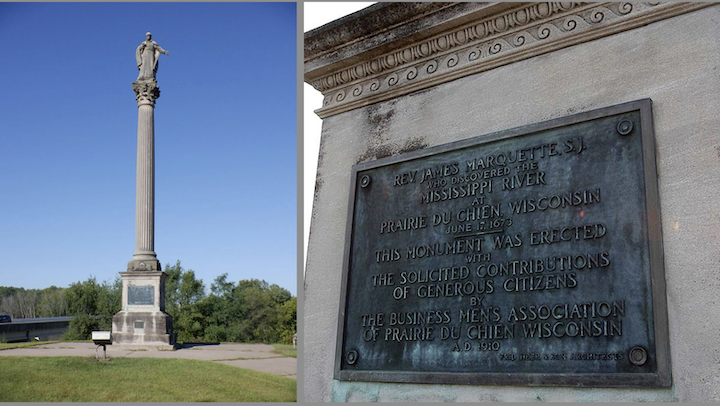
Statue at Prairie du Chien, Wisconsin: | |
|
• The location at which Marquette and Jolliet entered the Mississippi from the Wisconsin River is near the location of this monument. The monument was unveiled on St. Mary's College grounds, June 17, 1910. Later, it was relocated to the Prairie du Chien Chamber of Commerce area, close to highway US-18 and the Mississippi River. Interestingly, Marquette is looking east, which means he is turned away from the river.
Statue, “Pere Marquette”
211 S Main St, Prairie du Chien, WI 53821
GPS: 43.049483, -91.150233
• Inscription:
«Rev. James Marquette, S.J.
Who discovered the
Mississippi River
at
Prairie du Chien Wisconsin
June 17, 1673
This Monument was erected with
The Solicited Contributions of Generous Citizens
by The Business Men’s Association
of Prairie du Chien, Wisconsin A.D. 1910”
| |
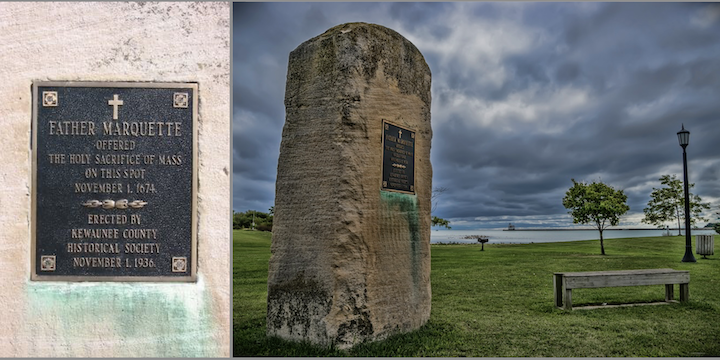
Memorial stele at Kewaunee, Wisconsin | |
|
Stele, “Father Marquette”
Father Marquette Memorial Park, 380 Hathaway Dr, Kewaunee, WI 54216
GPS: 44.465133, -87.496150
• Inscription:
«Father Marquette
offered
the Holy Sacrifice of Mass
on this spot
November 1, 1674.
Erected 1936 by the Kewaunee County Historical Society."
| |
|
Monuments and statues of Père Marquette
in Illinois
| |
|
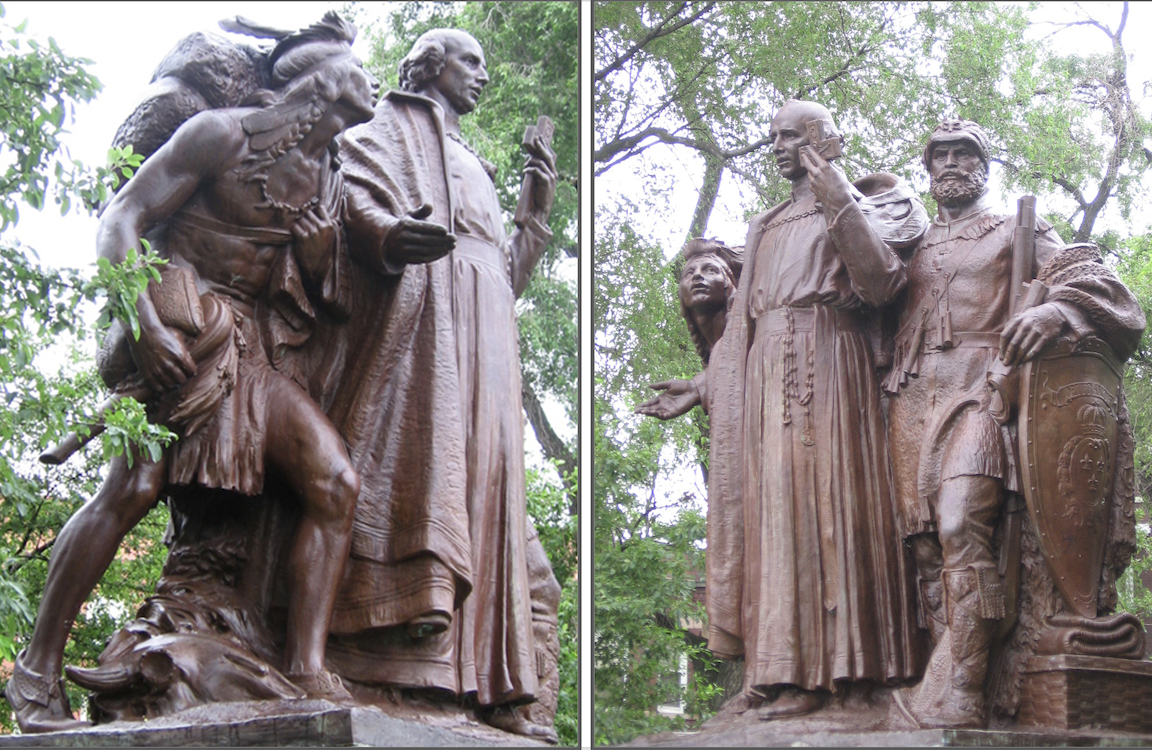
“Jacques Marquette -Louis Jolliet Memorial”
Chicago, IL.
| |
|
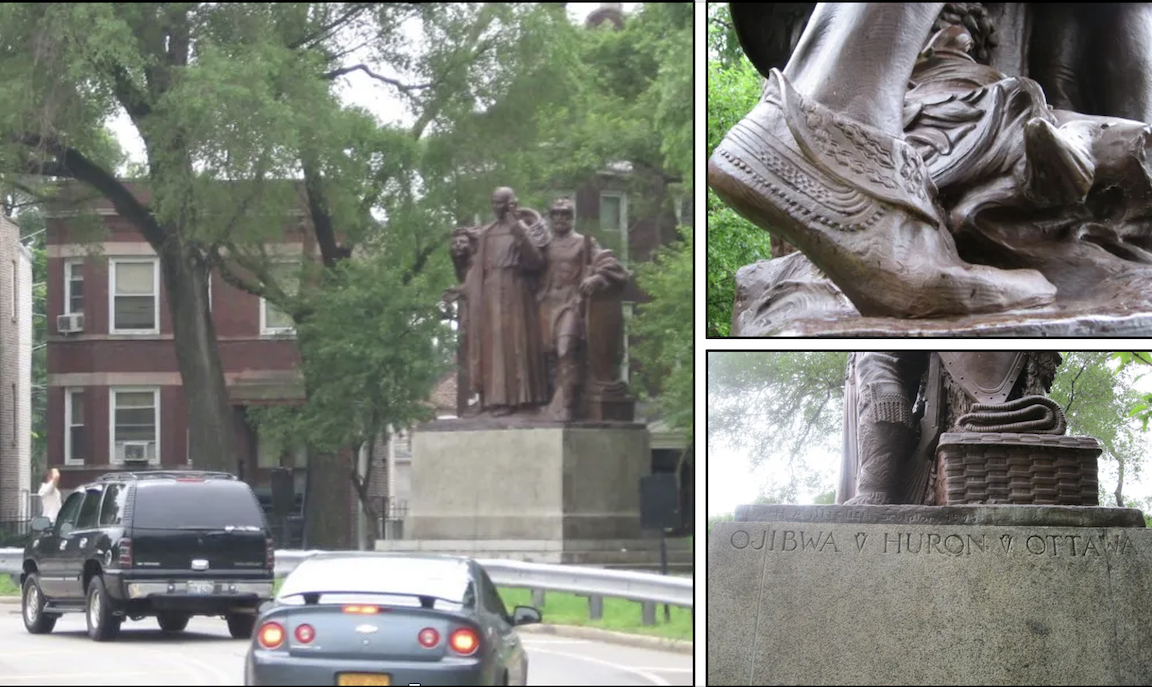
• Commissioned by the B. F. Ferguson Fund in 1925, this monument is intended to memorialize the site where two French explorers, Jesuit missionary Jacques Marquette (1645-1675) and trader Louis Jolliet (1645-c.1700), accompanied by an Algonquin Indian guide, realized that a canal could link the entire Great Lakes system with the Mississippi watershed. Today the Chicago Sanitary and Ship Canal, south of this point, makes that connection. During the summer of 1673, Marquette and Jolliet made their historic voyage to the Indian portage (wetland) between the Des Plaines River and the south branch of the Chicago River.
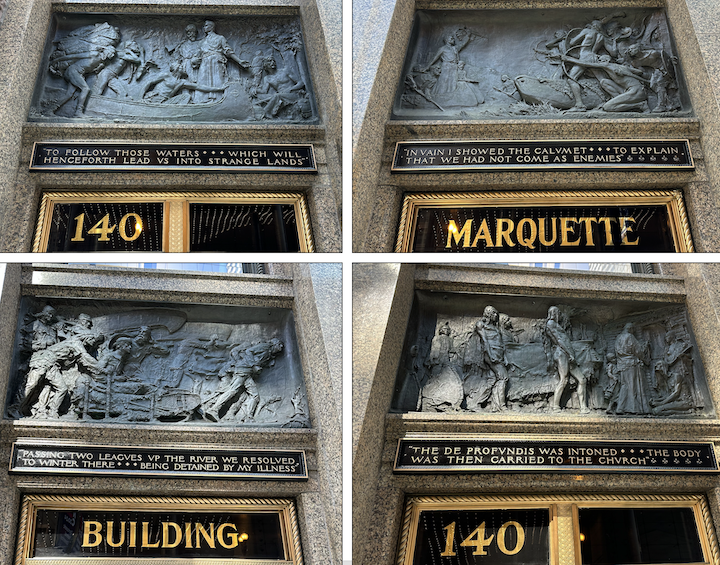
• The Beaux-Arts trained sculptor Hermon A. MacNeil created statues for the Electricity Building at the 1893 World’s Columbian Exposition and, soon after, received a commission to decorate the Marquette Building. His four bronze narrative panels depicting the travels of Marquette and Jolliet may be found above the elaborate bronze doors on the Dearborn Street side.
• This monument is built on a six-foot base and features bronze figures that reach nearly twelve feet tall. People walking towards the Monument from Marshall and 24th Avenue Boulevards see the Jesuit's welcoming hand. Similar to his work at the Marquette Building in the Chicago Loop, the details are remarkable. MacNeil skillfully carved the tribal names on the Marquette Memorial of 1926. The moccasins are finely detailed, appearing very realistic.
• Back then, over 15,000 school children in Chicago had signed a petition asking for a statue of the missionary-explorer.
• Today, there are demands to remove this statue. The Report of the Chicago Monuments Project reads, in part:
“The sculpture reinforces stereotypes about American Indians and glorifies a complicated and painful history of Western expansion.
It features a cowering American Indian, following submissively in the footsteps of Marquette. Recommended Next Steps: The artwork should be placed in storage. The city should initiate a conversation with the Marshall Square community, where the artwork is located, to study options for the development of new public art at the site. Agencies may also consider the long- term loan or donation of this artwork to a private organization.”
| |
|
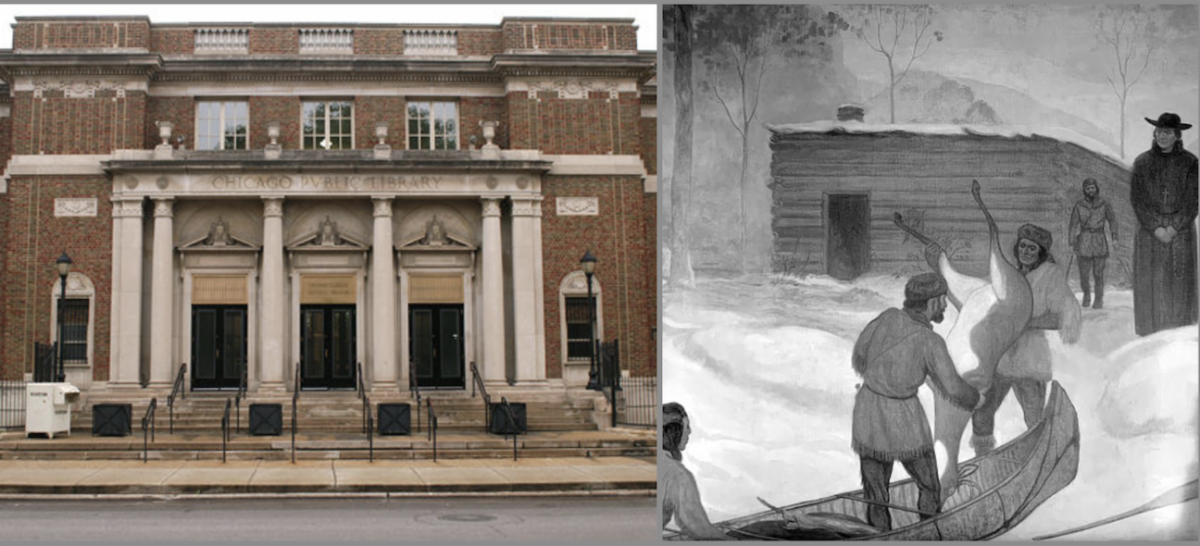
Mural featuring Père Marquette
Chicago Public Library
| |
|
• The Public Works of Art Project (PWAP), which came before the Federal Art Program (1935-1943), commissioned this work for Legler Library. This initiative was part of the New Deal efforts to help artists during the Great Depression. The painting, Wilderness, Winter Scene, was created and put up between 1933 and 1934, coinciding with Chicago's 100th anniversary as a city and the 1833 Treaty of Chicago, which led to the removal of Potawatomi Indians from Illinois.
• The Chicago Monuments Project states on its website: "Babcock’s mural illustrates Father Marquette’s winter quarters near the Chicago River, a scene that represents a watershed moment in the European colonial conquest of the North American continent – which resulted in the forced displacement and genocide of the American Indian population of the region".
| |
|
"The Discoverers"
Bridgehouse relief
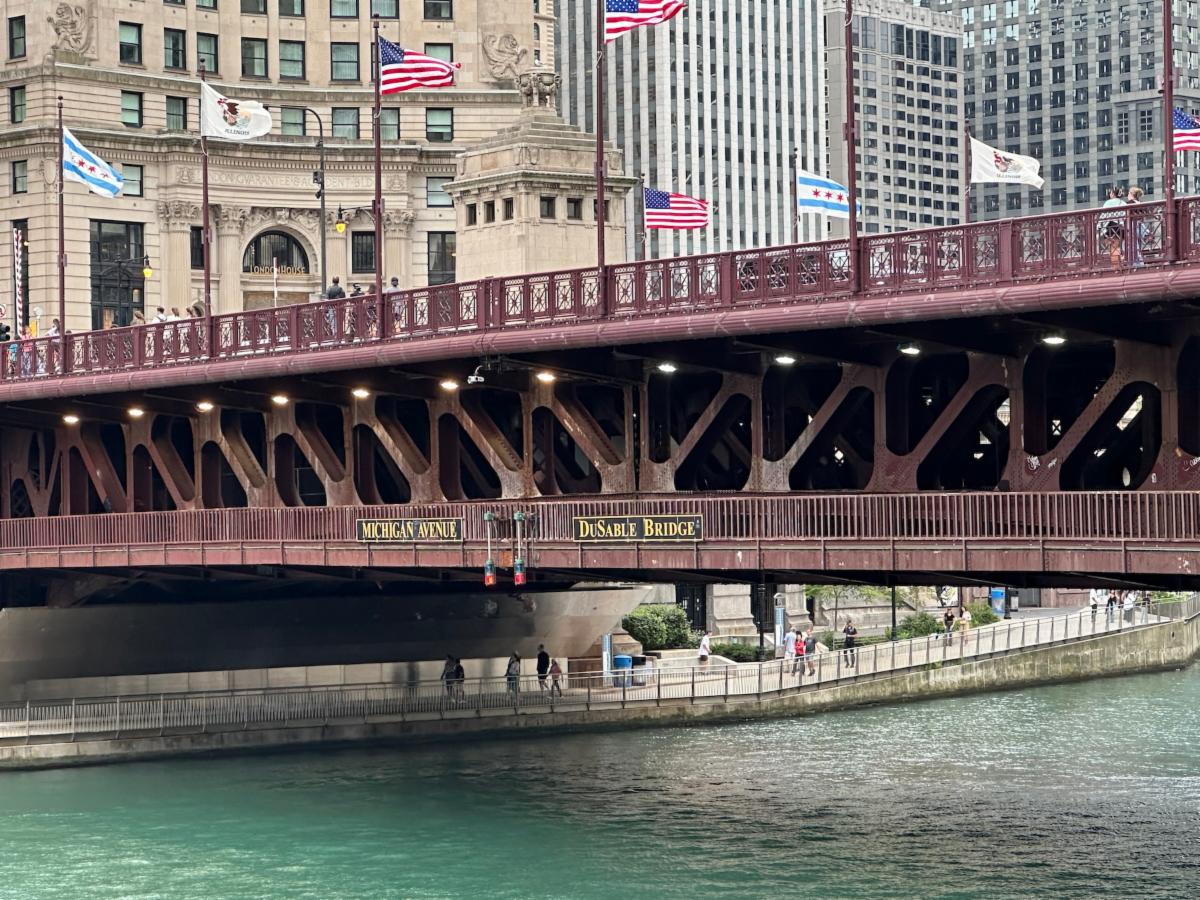
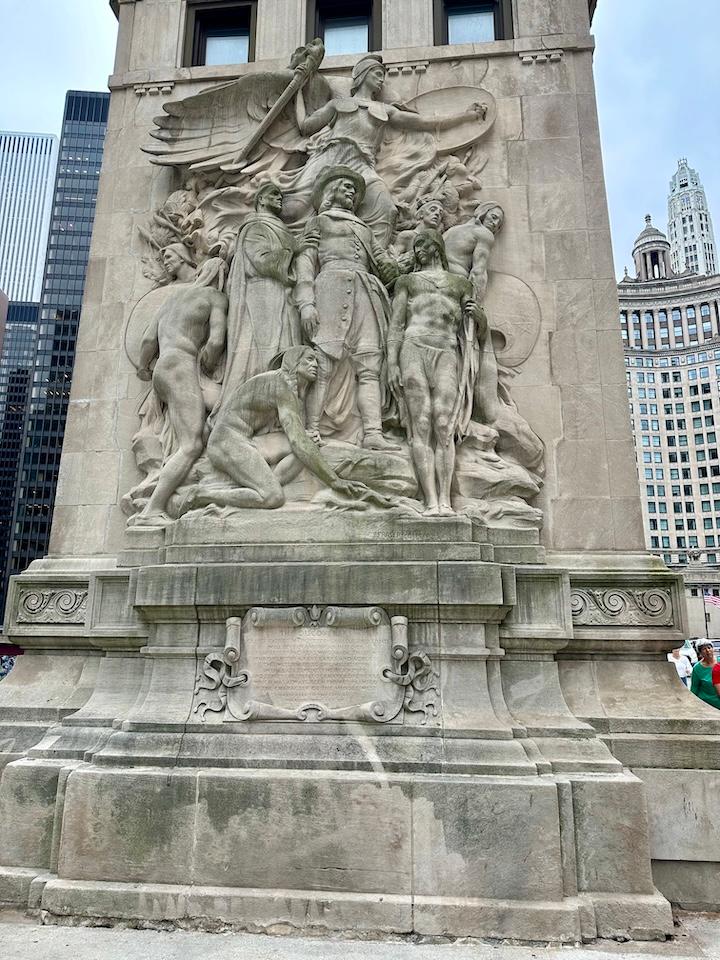
DuSable Bridge, Chicago, IL
| |
|
Above:
Top: DuSable bridge (formerly Michigan Avenue bridge, named after Jean-Baptiste DuSable, founder of Chicago), Chicago IL. 60611
GPS: 41.889233, -87.624050,
Middle top: Bridgehouse relief, The Discoverers by James Earle Fraser, 1928. This sculpture adorns the wall of the northeastern bridge tender's house on DuSable bridge in Chicago, Illinois.
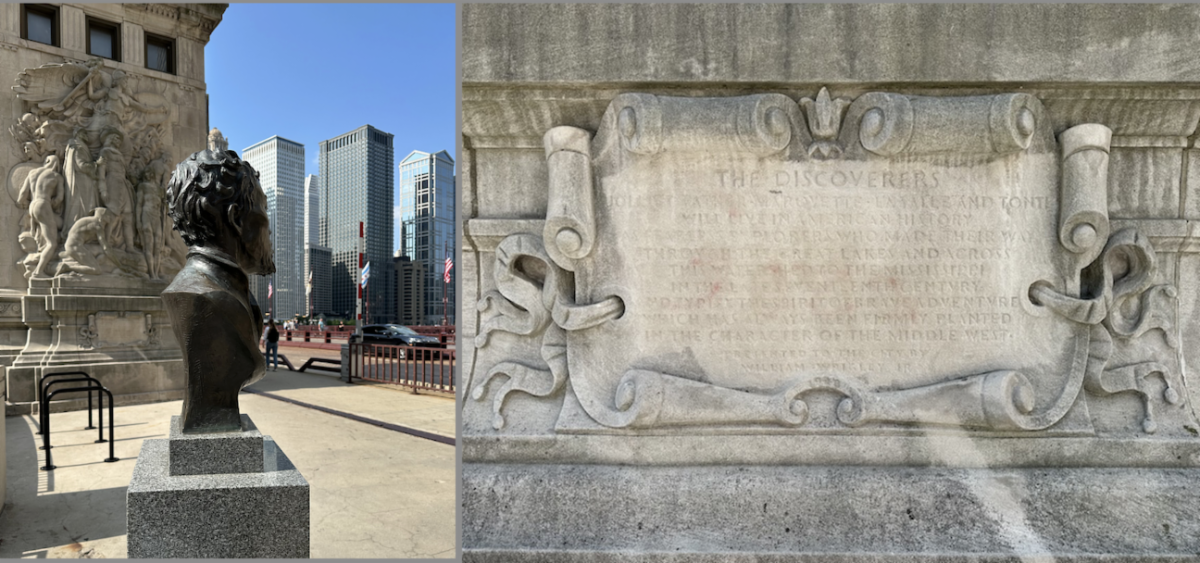
Middle bottom: Bust of Jean-Baptiste DuSable, close-up of engraved inscription bridgehouse relief.
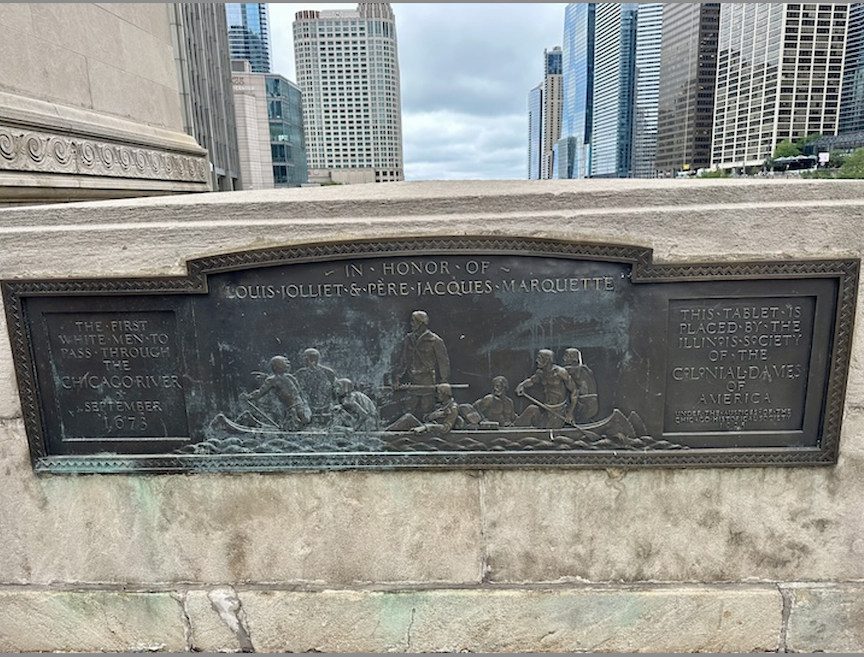
Bottom: Plaque, « Louis Jolliet & Père Jacques Marquette”
On the N.E. corner of the Michigan Avenue Bridge, 407 North Michigan Avenue, Chicago IL 60611
GPS: 41.889167, -87.624117
Photos: TC © ASSFI 2024
| |
|
• The bridge is situated in a historically significant area. The northern end of the bridge covers part of the Jean Baptiste Point Du Sable Homesite, which is commemorated by a National Historic plaque in Pioneer Court. In 1928, sculptures depicting scenes from Chicago's history were added to the outward-facing walls of the four bridge houses.
• “This relief portrays French explorers Louis Joliet and Jacques Marquette, who determined in 1678 that Chicago was the site of the passage between the Great Lakes and the Mississippi River system, and Rene Robert Cavelier - Sieur de La Salle, and his lieutenant, Henri de Tonti, who explored the entire Mississippi River area between 1679 and 1682. Although Marquette was a Jesuit priest, he is depicted in the robes of a Franciscan monk. There is a profile of a kneeling indian in the foreground. An allegorical female figure floats above the more boldly carved, Beaux-Arts figure group” - Smithsonian American Art Museum, Renwick Gallery
• Inscription:
“Jolliet, Father Marquette, La Salle and Tonti will live in American history as fearless explorers who made their way through the Great Lakes and across this watershed to the Mississippi in the late seventeenth century and typify the spirit of brave adventure which has always been firmly planted in the character of the middle west.”
Presented to the city by William Wrigley Jr. 1928
Erected 1928 by William Wrigley Jr.
• Inscription on the plaque:
“In Honor of Louis Jolliet & Père Jacques Marquette
The First White Men to Pass Through the Chicago River
September 1673
This Tablet is placed by the Illinois Society of the Colonial Dames of America
Under the auspices of the Chicago Historical Society 1925”
| |
Artwork, The Marquette Building, Chicago | |
|
Above:
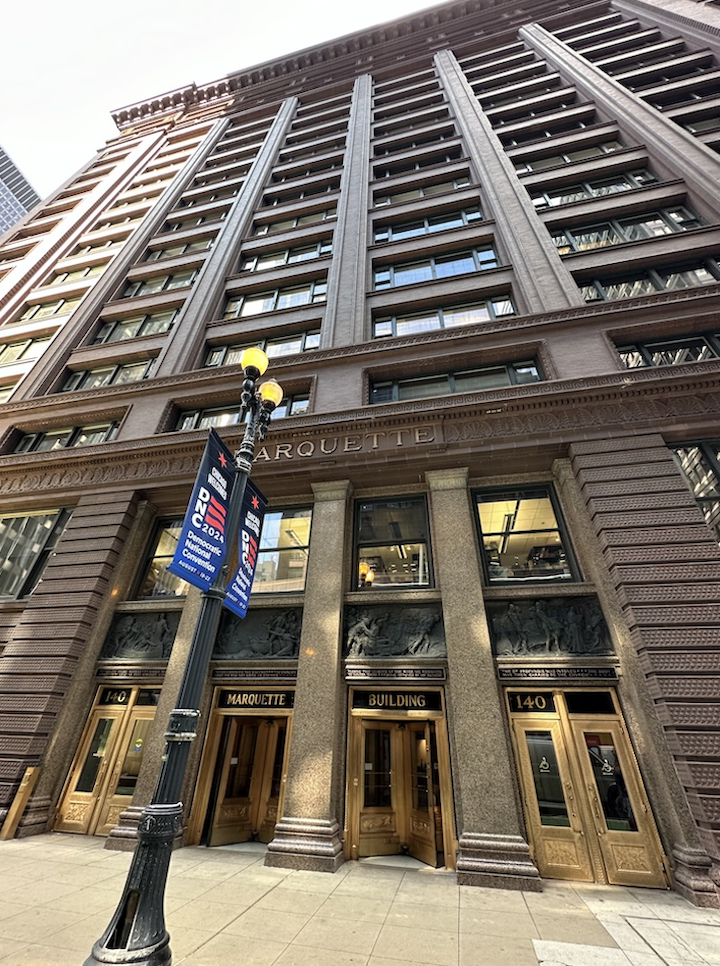
The Marquette Building (1895)
140 S Dearborn St, Chicago, IL 60603
GPS: 41.879802, -87.629568
Photos: TC © ASSFI 2024
| |
|
A gem of a building
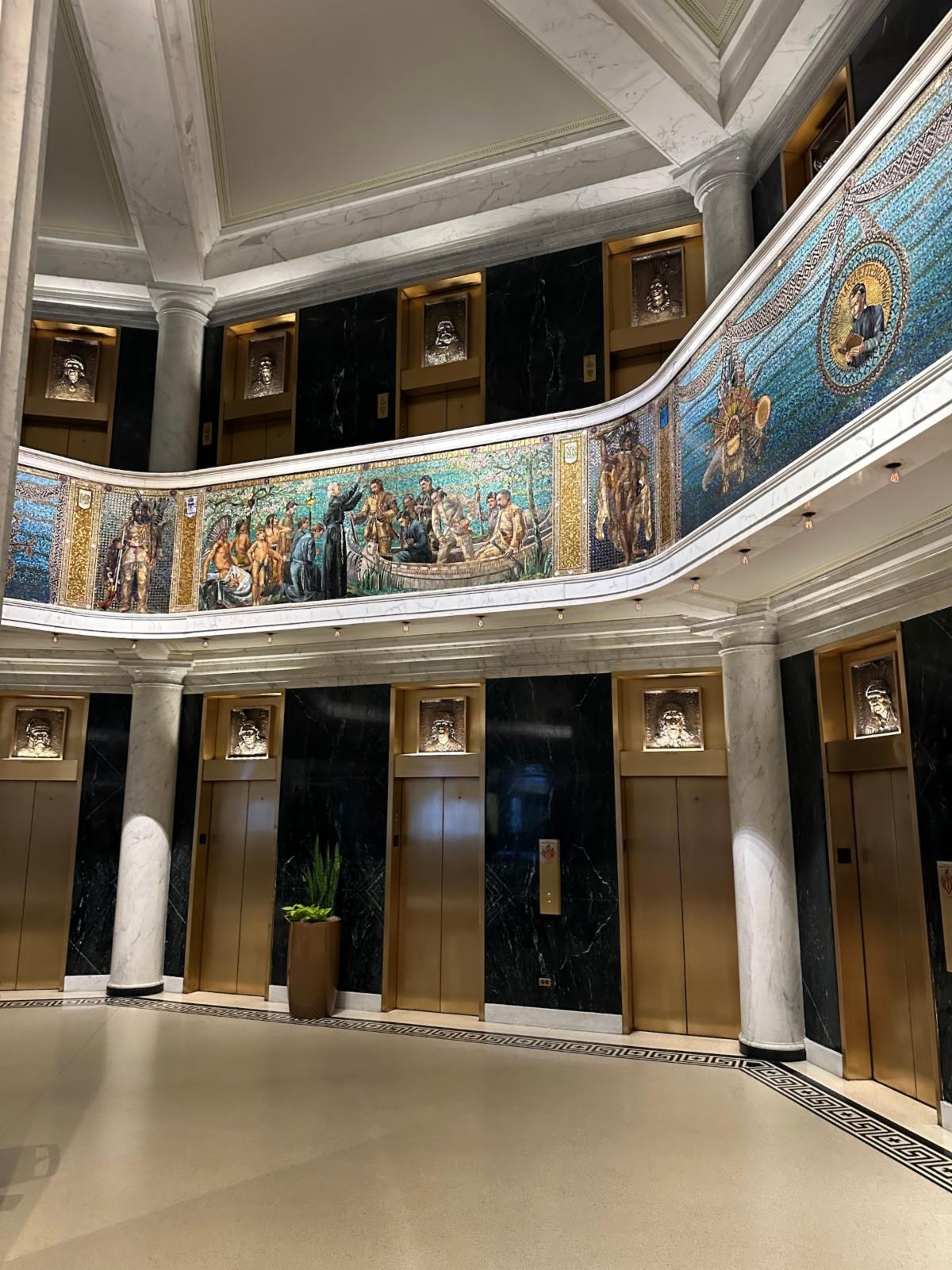
• At the time of its completion in 1895, the Marquette Building was Chicago’s most prestigious commercial site. In 1975, the Marquette Building gained landmark status, and its owners, the John D. and Catherine T. MacArthur Foundation, committed to an extensive restoration. Today, the building is a monument to Chicago’s development and architectural history.
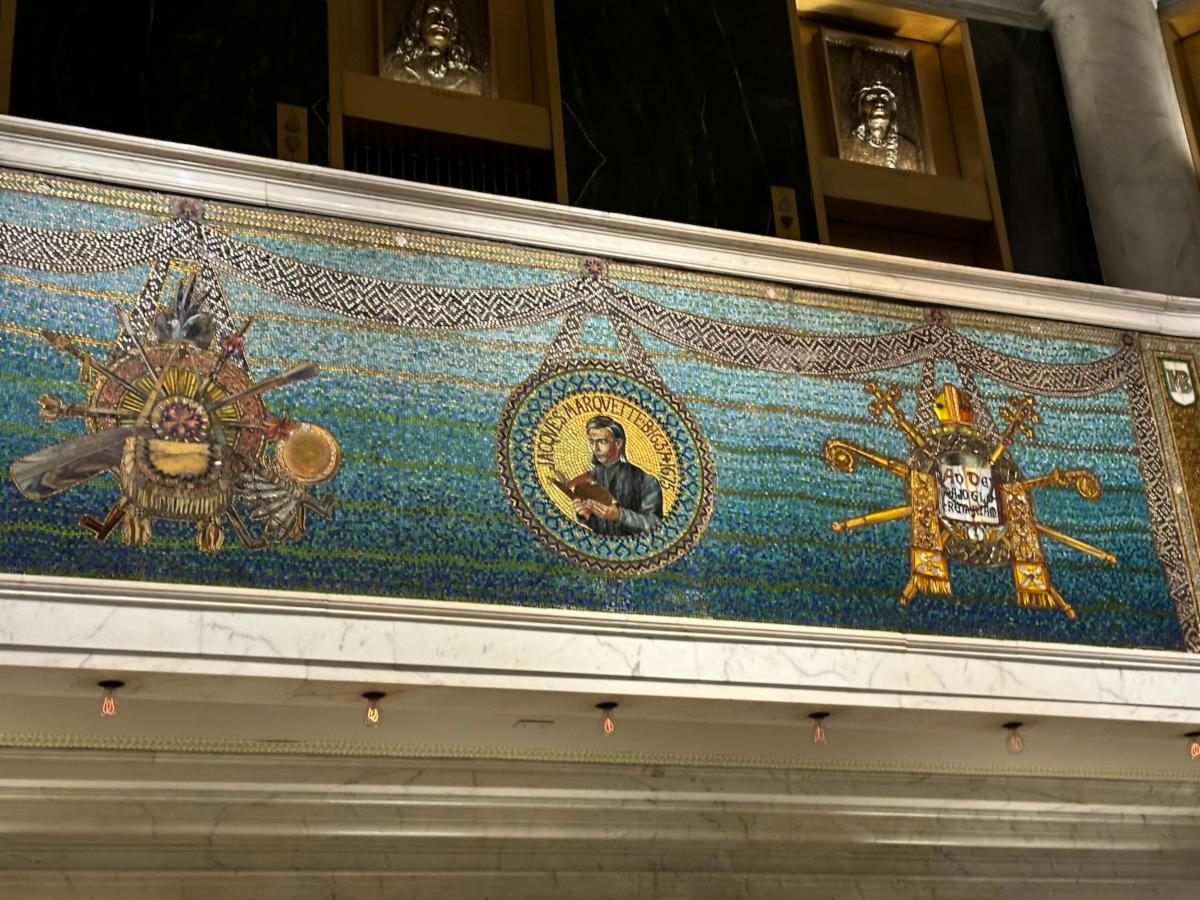
• The Marquette Building was not just as a money maker but also was meant to be a cultural treasure for its great city. The decorative scheme reflected on Chicago’s important history. The mosaics interpret moments in the life and death of Father Marquette. “In this memorial rotunda, which is considered the most artistic and interesting portions of the building, [are]...three pictorial tablets descriptive of the events in the life of Marquette…These glass mosaic panels are certainly works of high artistic value… a glowing series of pictures never before attempted in glass mosaic.” Architectural Reviewer, July 1897
• Four bronze panels were placed over the front doors, welcoming visitors to the Marquette Building. These exterior bronzes were meticulously restored in 2009. “Over the doors of the main entrance are panels of bronze, designed and executed by Mr. Herman A. MacNeil, illustrating incidents in the life of Pere Marquette in his explorations of the Mississippi River and the state of Illinois…The inscriptions below are panels taken from Marquette’s diary.” Architectural Reviewer, July 1897
• Inscriptions:
Door 1: “To follow these waters***which will henceforth lead us into strange lands”
Door 2: “In vain I showed the calumet *** to explain that we didn’t come as ennemies”
Door 3: “Passing two leagues up the river we resolved to winter there *** being detained by my illness”
Door 4: “The De Profundis was intoned *** the body was then carried to the church”
• The mosaics surround the entire lobby, and each elevator door is adorned with a bronze plaque honoring the expedition members and local Indians.
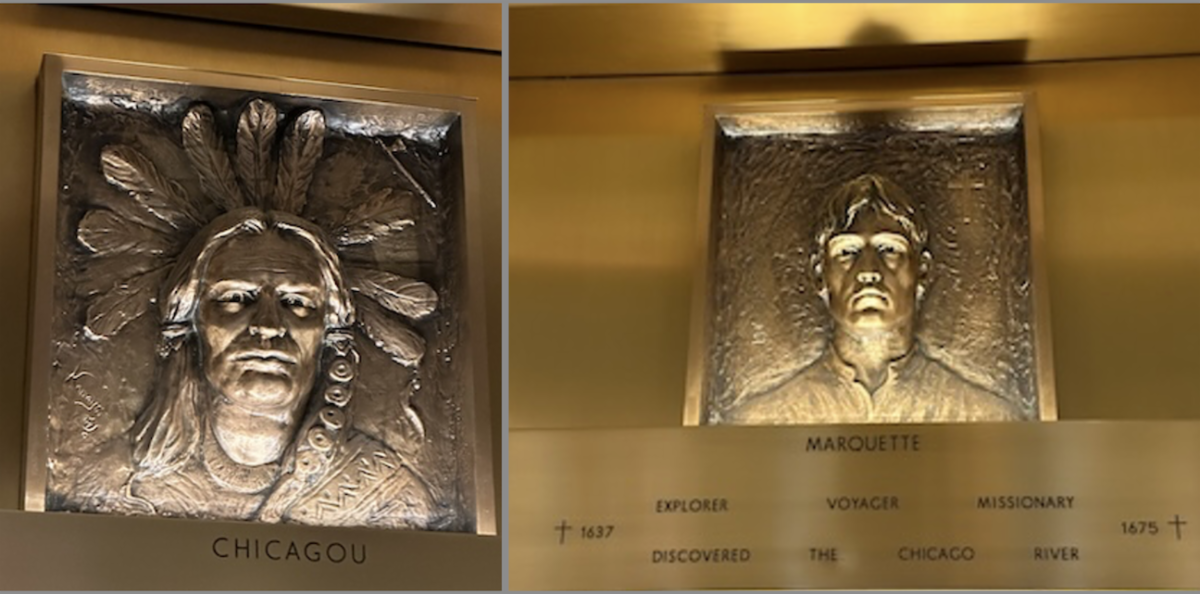
• Each elevator entrance is adorned with portraits of Father Marquette & Jolliet, Tonty, as well as notable figures such as La Taupine, De Menthon, Frontenac, Talon, and several Indian Chiefs, including Chicagou.
• Chief Chicagou, also referred to as Agapit Chicagou, was a leader of the Mitchigamea tribe in the 18th century. He traveled to Paris, as noted in the December 1725 edition of the Mercure de France. The Company of the Indies facilitated his journey along with five other chiefs to France.
• On November 22, the chiefs had an audience with King Louis XV. According to the Mercure de France, Chicagou delivered a speech to the young king, expressing loyalty to the French crown.
The following day, the king invited the chiefs to join him on a rabbit hunt.
• During their stay in Paris, the chiefs performed at the Theatre Italien, which caught the attention of composer Jean-Philippe Rameau. They showcased three types of dances: the Peace, War, and Victory dances. This inspired Rameau to compose a harpsichord piece titled Les Sauvages, which was later included in his Nouvelles Suites de Pieces de Clavecin.
| |
|
Stele & Statue of Marquette & Jolliet
Chicago Portage National Historic Site
| |
|
Above:
Left: Stele, Père Marquette
2618 S Damen Ave, Chicago, IL 60608
GPS: 41.843988, -87.675510
Photo: By Roger Deschner https://commons.wikimedia.org/w/index.php?curid=19016627
Right: Sculpture, Father Marquette,
Chicago Portage National Historic Site, 47th St, Forest View, IL 60402
GPS: 41.803983, -87.803767
Photo: National Park Service, https://www.nps.gov/places/chicago-portage.htm
| |
|
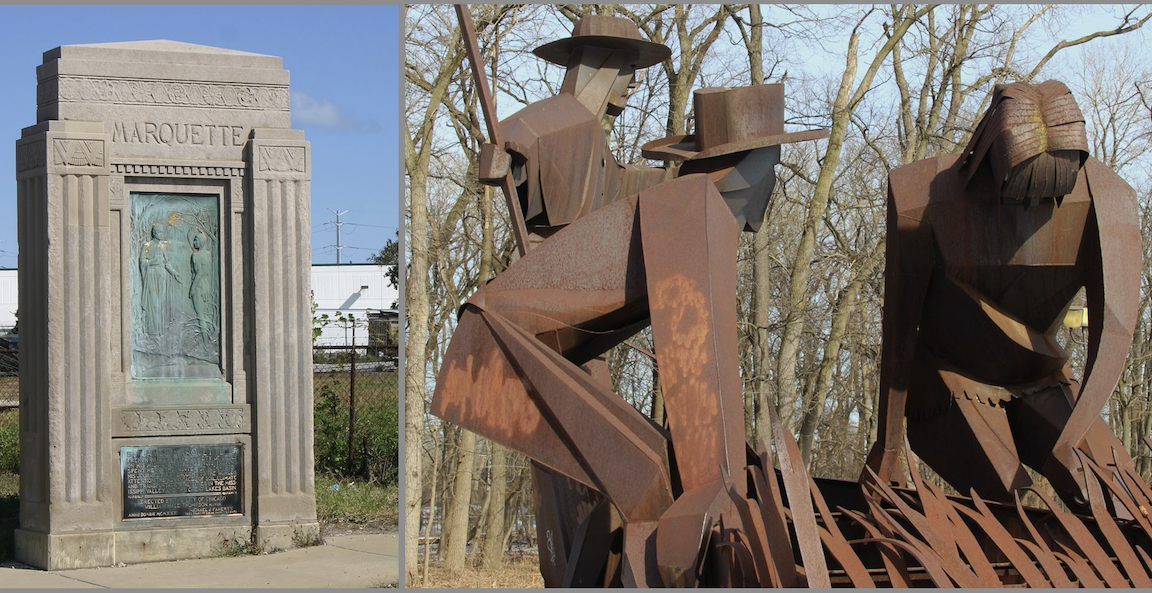
• This stele marks the location where Father Jacques Marquette (named "James Marquette" on this monument) spent the winter of 1674-75. It also marks the eastern end of the Chicago Portage.
• Inscription:
“James Marquette”
“French Priest of the Society of Jesus
On his mission to the Illinois Indians
Spent here the winters of 1674-1675.
His Journal first brought to the world’s
attention the advantages of soil, climate
and transportation facilities in the Mississippi
Valley and the Great Lakes Basin”
“Erected by the City of Chicago
William Hale Thompson Mayor
Anno Domini MCMXXX
Michael J. Faherty Pres. Board of Local Improvements”
And yet another statue! :
• In the summer of 1673 members of the Kaskaskia, a tribe of the Illinois Confederation, led French explorers Louis Jolliet and Father Jacques Marquette, to the western end of the Chicago Portage. This statue depicts that event. It was designed and executed by Ferdinand Rebechini (1923-2003), a Chicago area artist. It is constructed of Cor-10 steel and was erected on April 25-26, 1990.
• Inscription of marker :
“For hundreds of years, early travelers and settlers had to carry their canoes, belongings and trade goods overland through the Chicago Portage between the Des Plaines River and the Chicago River. You are standing where Marquette, Jolliet and countless other explorers and traders once walked.
The length of the portage varied with the seasons. When water was high, canoes could be paddled from here up Portage Creek and through the seasonal Mud Lake to the Chicago River without any overland travel. In semi-dry times the bed of Mud Lake became a huge swamp and travelers were required to drag their canoes through waist-deep mud. In very dry times when there was little or no standing water, travelers had to carry their boats and belongings over the "Long Portage Trail" for up to 95 miles, the entire distance between the South Branch of the Chicago River and the Illinois River near LaSalle/Peru."
| |
|
Memorial monument, « Père Marquette »
Utica, IL.
| |
|
Memorial monument, « Père Marquette »
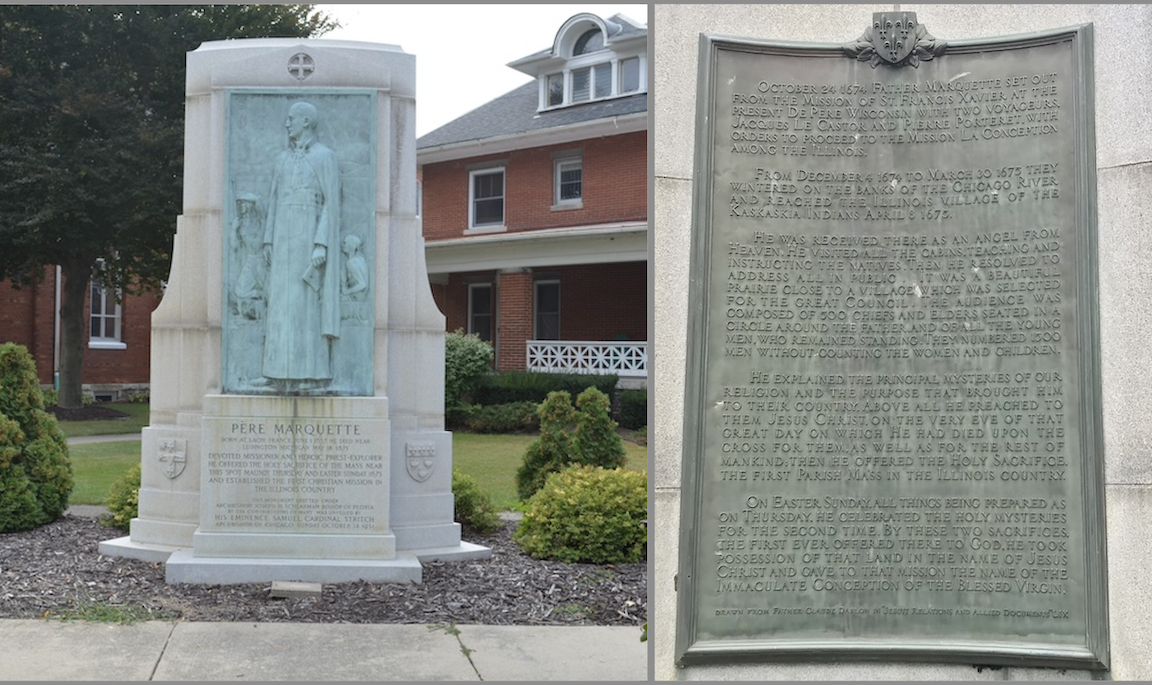
• On Holy Thursday, April 11, 1675, Francis Jacques Marquette offered the first parochial Mass in the Illinois Country at Utica in the presence of 5,000 Native Americans. Father Marquette and his companion Louis Jolliet, took possession of this land in the name Louis XIV and founded the town of Utica.
• The monument in his honor stands in the northeast corner of the Mission of the Immaculate Conception which eventually became the Church of Saint Mary
• Pere Marquette is wearing a priestly garb. He holds a map in his left hand. Behind him is an Indian kneeling in a canoe. On his left is a second Indian seated on an edge of a river, depicted in the background.
• Inscription:
“Pere Marquette/
Born At Laon France June 1, 1637
He Died Near/Ludington Michigan May 18 1675/
Devoted Missioner And Heroic Priest-explorer/
He Offered The Holy Sacrifice Of The Mass Near/
This Spot Maundy Thursday And Easter Sunday 1675/
And Established The First Christian Mission In/
The Illinois Country/
This Monument Erected Under/
Archbishop Joseph H. Schlarman Bishop Of Peoria/
By The Contributions Of Many Was Unveiled By/
His Eminence Samuel Cardinal Stritch/
Archbishop Of Chicago Sunday October 14 1951”
J. Topin 1937 - F. Barbedienne Fondeur Paris (Base Front)
• The plaque on the back of the monument is quite instructive:
• Inscription:
“October 24 1674 Father Marquette set out from the Mission of St. Francis Xavier at the present de Pere Wisconsin with two voyageurs, Jacques le Castor and Pierre Porteret, with orders to proceed to the Mission la Conception among the Illinois. From December 4 1674 to March 30 1675 they wintered on the banks of the Chicago River and reached the Illinois village of the Kaskaskia Indians April 8 1675.
He was received there as an angel from Heaven. He visited all the cabins, teaching and instructing the natives. Then he resolved to address all in public. It was a beautiful prairie close to a village which was selected for the Great Council. The audience was composed of 500 chiefs and elders seated in a circle around the father, and of all the young men, who remained standing, they numbered 1500 men without counting the women and children. He explained the principal mysteries of our religion and the purpose that brought him to their country. Above all he preached to them Jesus Christ, on the very eve of that great day on which he had died upon the cross for them, as well as for the rest of mankind: then he offered the Holy Sacrifice, the first parish Mass in the Illinois country.
On Easter Sunday, all things being prepared as on Thursday, he celebrated the holy mysteries for the second time. By these two sacrifices, the first ever offered there to God, he took possession of that land in the name of Jesus Christ and gave to that mission the name of the Immaculate Conception of the Blessed Virgin.”
| |
|
Père Marquette State Park
Grafton, IL.
| |
|
Père Marquette State Park, Grafton, Illinois
• The preservation of this land as a state park was a goal pursued by local civic groups. Through their efforts, they managed to raise funds and convince the state to contribute an equal amount for the acquisition of the land in 1931. Originally named Piasa Bluffs, the state park underwent a name change to Pere Marquette State Park due to overwhelming public support. This renaming was done as a tribute to the intrepid French missionary.
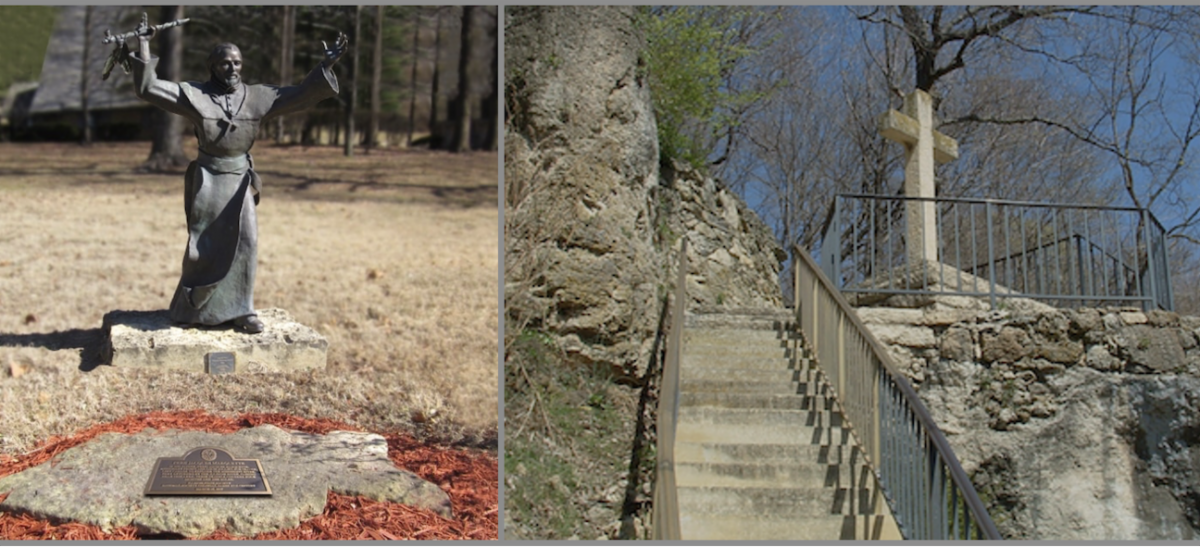
• The statue of Père Marquette holding a calumet is by Kirk St. Maur (American artist, b. 1949) and was placed in 1991.
• Inscription:
“In 1673 Father (Pere) Jacques Marquette, missionary priest, and Louis Jolliet, fur trader, left Canada to explore the Mississippi River. They returned by the Illinois River, passing near this area. Their travels covered four months and 2500 miles.
Erected 2017 by Illinois State Society and National Society Colonial Dames XVII Century.”
Monumental Cross overlooking the Mississippi:
• A significant landmark in the park's vicinity, an imposing stone cross, serves as a commemoration of Marquette and Jolliet's momentous arrival at this site.
• In 1929, John D. McAdams, the business manager of the Alton Telegraph, proposed the idea of constructing a memorial to honor Jacques Marquette, who was recognized as the first European to set foot in Illinois. This proposal was presented to H. H. Ferguson, a local landowner, who took charge of designing the monument. The monument was erected in a location where Ferguson believed the mouth of the Illinois River would have been situated during Marquette's expedition.
• Crafted from a single block of dolomite, the monument stands at a height of seven feet six inches. It is strategically positioned on a bluff ledge, offering a panoramic view of the Illinois River. To access the monument, two sets of dolomite stairs have been constructed, leading from the Sam Vadalabene Bike Trail up to the prominent cross.
• Inscription of plaque:
“At this place in early August 1673, Marquette, Joliet and five companions entered Illinois dawn-heralds of Religion, Civil Government and Consecrated Labor”
Dedicated September 1, 1929 Rt. Rev. James A. Griffin D.D. Bishop of Springfield, Illinois”
| |
Statue of Père Marquette in Indiana | |
|
Marquette Park, Gary, Indiana
"In 1675 Father Marquette noted in one of his last journal entries that this spot was the most beautiful he had ever seen, abundant in animal and plant life and natural beauty..."
Excerpt from Marker, “History of Marquette Park, 100th anniversary 2019”
Marquette Park, Chanute Trail, 7132 Oak Ave, Gary IN 46403
GPS: 41.620483, -87.252983
• Father Marquette passed through Miller Beach while returning from his second exploration of the water passage from Lake Michigan to the Mississippi River. In 1673 he and Louis Jolliet ventured through Wisconsin and down the Mississippi, returning to Sault Ste. Marie via the Illinois and Chicago Rivers. The next year Marquette traveled down Lake Michigan to the Chicago River and the portage to the Illinois, entering the Mississippi in the spring of 1675. Marquette was sick, however, and returning that spring he passed along the shores of Miller Beach close to death. He died only days later at the mouth of the Pere Marquette River in Michigan.
•In 1931 W. P. Gleason, the Superintendent of the Gary Steel Works and Superintendent of the Gary Park Department, commissioned Henry Hering of New York create a bronze statue of Father Pere Marquette to be placed at the gateway to the park, which was re named Marquette Park with the dedication of the statue in July of 1932.
• Inscription:
“Jacques Marquette
Born 1637 Died 1675
A French Jesuit Priest.
One of the earliest Christian teachers of the American Indians
Landed here AD 1673 in company with the French explorer Louis Joliet.
Erected 1931 by Park Commission of Gary, Indiana.”
| |
Statue of Père Marquette in Arkansas | |
|
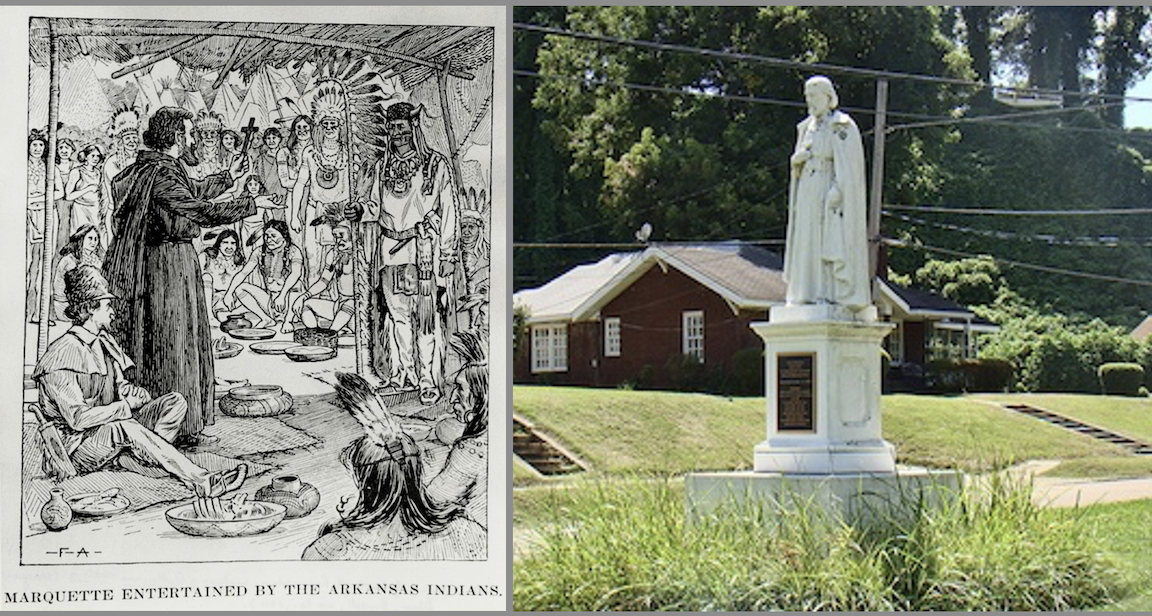
• This statue of Father Jacques Marquette is located in Helena-West Helena (Phillips County) and commemorates the Marquette-Jolliet Expedition; The original anonymous marble sculpture from 1936 was destroyed in a car accident in the 1990's.
• John Repa, a sculptor, and Orlandi Statuary, a fabricator, recreated it in concrete on Oakland Ave in Helena-West, Helena, Arkansas. It was installed in 2000. The design is based on the 1896 Trentanove sculpture.
• Inscription:
“Father Marquette
(1637-1675)
To Commemorate Explorations
Along the Mississsippi River
Rededicated October 12, 2000”
Marker, « Father Jacques Marquette and Louis Joliet's French expedition arrived in Arkansas»
104 Cypress Drive, Marion AR 72364
GPS: 35.215850, -90.194817
• Inscription (excerpts):
"In 1673, another European expedition arrived in Arkansas. Canoeing down the Mississippi River from the Illinois country (the upper Mississippi River Valley), Father Jacques Marquette, Jesuit missionary, and Louis Joliet, a coureur de bois (a trader who lived in Indian country), led a French expedition that was much smaller than de Soto's. The expedition's mission was to explore the Mississippi River Valley and find the mouth of the river. Their hope was that the river flowed west and might be a route to the Pacific. It was the first step to extend French influence into the middle of the continent in order to convert the native peoples and set up a French-Indian trade network. Near the mouth of the Arkansas River, the French men encountered the Quapaw, whom they called the Arkansas, and named the river and the region after the tribe. The expedition stayed several days among the Quapaw and learned that the mouth of the Mississippi River was not far to the South. The Quapaw also warned them that downriver there were strong tribes of Indians who might kill the French. Fearing for their safety, Marquette and Joliet: decided not to continue and returned to Illinois. Marquette reported what his expedition had found to officials in the colony of New France (Canada). His report led to a larger French expedition nine years later."[...]
| |
The Legacy of Père Marquette | |
|
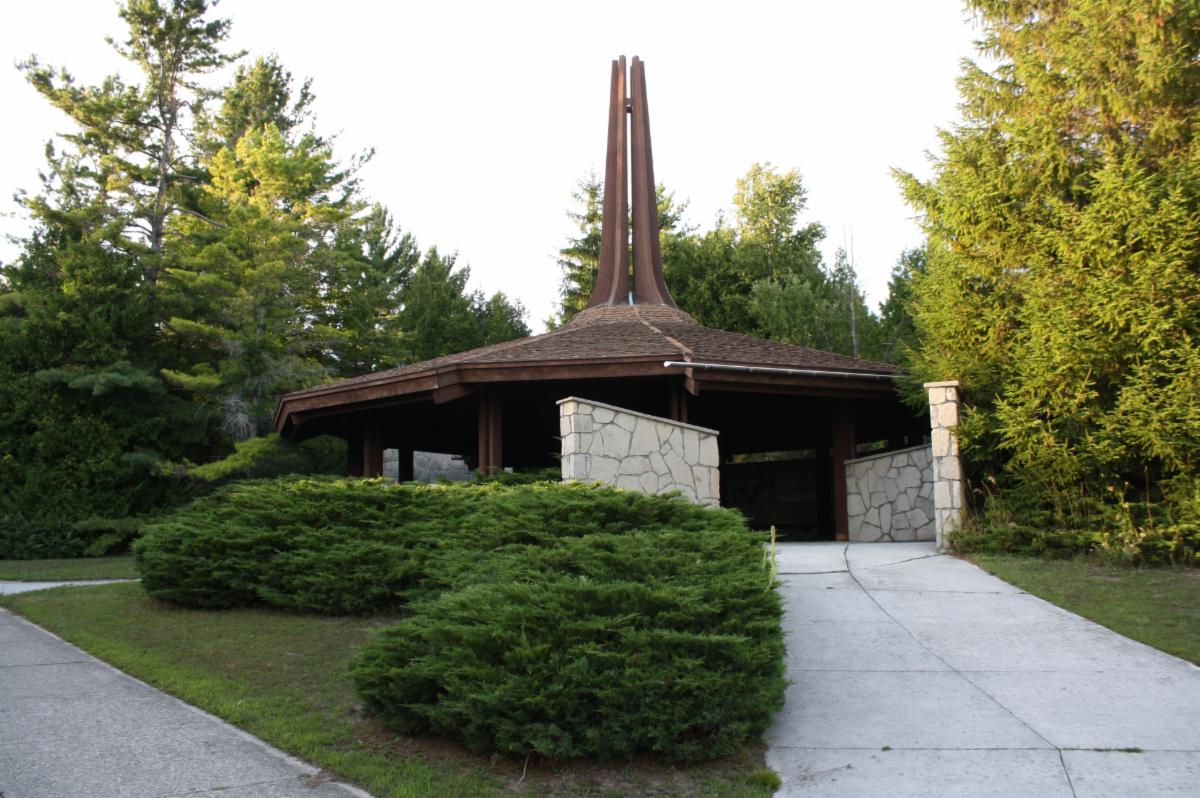
• Father Marquette National Memorial pays tribute to the life and work of Jacques Marquette, French priest and explorer. The memorial is located in Straits State Park near St. Ignace, where he founded a Jesuit mission in 1671 and was buried in 1678. The Father Marquette Museum building was destroyed in a fire on March 9, 2000 and has been replaced with an open structure.
• A marker located at St Ignace, MI, narrates the story of Père Marquette's death and burial:
Père Marquette Park Kiosk
Saint Ignace Mission, Museum of Ojibwa Culture, 500 N State St, St Ignace, MI 49781
GPS: 45.871467, -84.731600
• Inscription:
"After Father Marquette's Mississippi voyage, he was determined to establish a mission among the Illinois Indians he had met, but he was plagued by an unnamed illness. Finally arriving among the Illinois in the spring of 1675, his health worsened. Knowing he was dying, he asked his French companions to return him to S. Ignace. On May 18, fourteen days before his 38th birthday, he died enroute, probably near present-day Ludington. His two companions buried him and brought the sad news to the St. Ignace community. A returning hunting party of Odawa Christians disinterred the bones two years later, placing them in a birch bark box and bringing them to St. Ignace. Marquette was reburied under the chapel floor on June 8, 1677. After Cadillac relocated his fort in Detroit and French life became centered across the Straits at Fort Michilimackinac, the location of Marquette's grave was lost. But stories persisted, especially among the Indians, that a great and brave white leader was buried at the head of this bay."
| |
|
• The Latin text is inscribed on the gravestone. The text on the plaque at the base of the monument is nearly identical to the marker which is located nearby:
• Inscription on monument plaque:
“In memory of Rev. Father James Marquette, S.J.,
who died the eighteenth day of May MDCLXXV,
at the age of thirty eight
and was buried in this grave
A.D. MDCLXXVII. R.I.P.
This monument was raised by the citizens of St. Ignace
A.D. MDCCCLXXXII.”
• Inscription of marker:
“Translation of Latin Text on Monument"
In Memoriam
Erected by the citizens of St. Ignace in 1882, this monument marks the grave of Rev. Father James Marquette, S.J., who died on the eighteenth day of May, 1675, at the age of thirty eight and was buried here, in 1677. R. I. P.”
| |
|
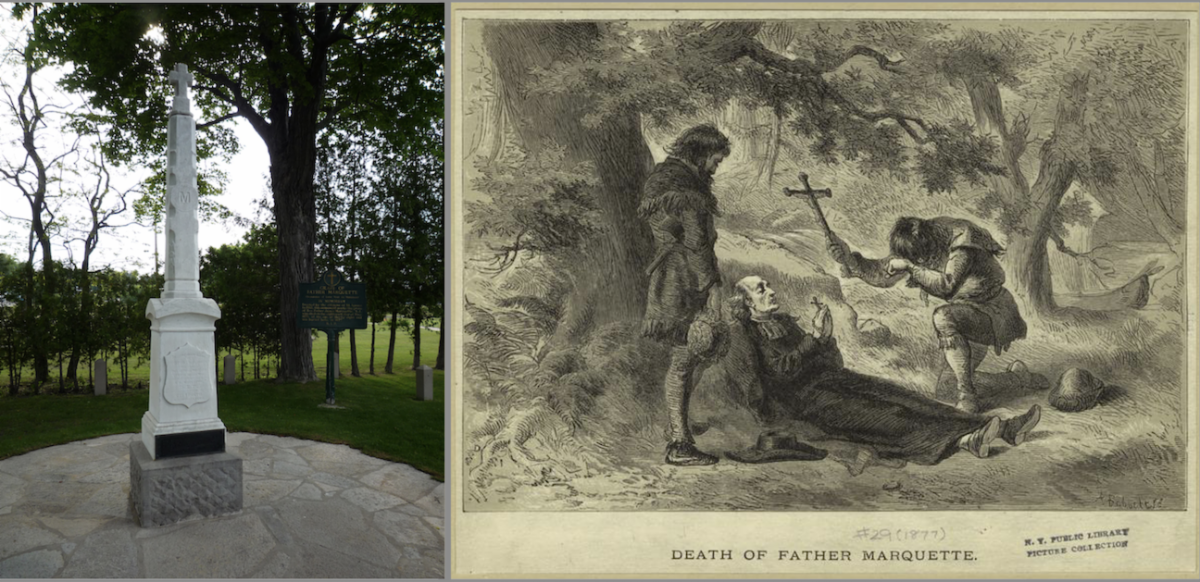
Above:
Left: Memorial Monument & Cross, “Marquette's Death”
Father Marquette Memorial Park, S Lakeshore Dr, Ludington, MI 49431
GPS: 43.941700, -86.453017
Photo: https://www.michiganwatertrails.org/location.asp?ait=av&aid=1120
Right: Marker, “Marquette's Death”
23 S 2nd St, Frankfort, MI 49635
GPS: 44.631017, -86.243833
Photo: hmdb.org by William Fischer, http://www.hmdb.org/marker.asp?marker=97466
| |
|
• Both locations in Frankfort and Ludington pay homage to Pere Marquette, along with the dozens of statues, buildings, roads and monuments around the country.
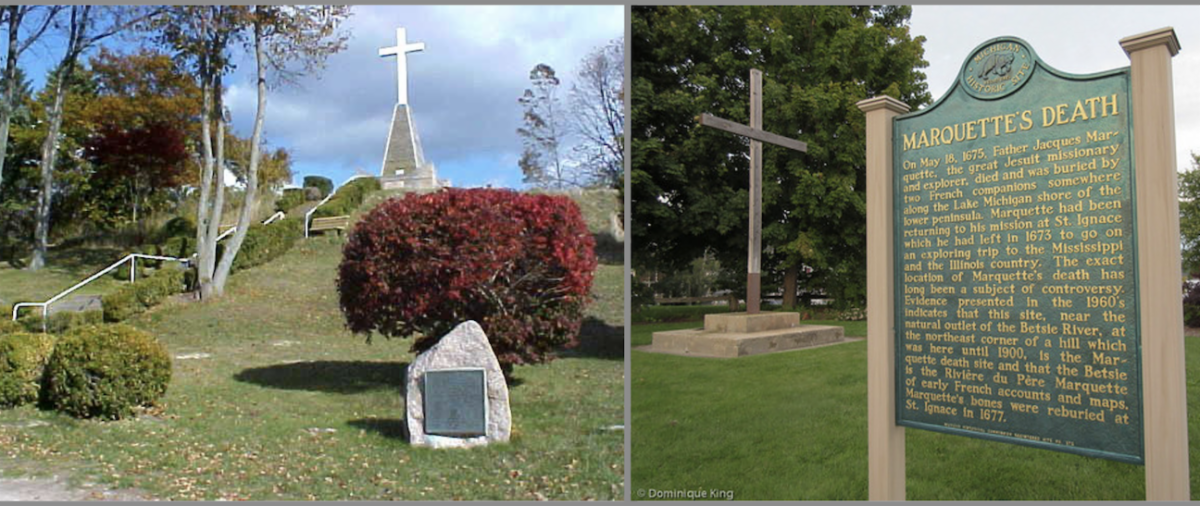
• The two markers were placed by the State of Michigan just one year apart, Ludington was placed in 1966 and Frankfort was there a year earlier in 1965.
https://www.mlive.com/news/muskegon/2018/04/controversial_ludington_cross.html
• Inscription in Ludington, MI.:
“Pere Jacques Marquette
Famous Jesuit Missionary-Explorer
Born at Laon, France June , 1637
Died at this site May 18, 1675
“He came as a missionary to Quebec Sept. 20, 1666, learning the Indian languages and customs. In 1668 he founded the first mission at Sault Ste. Marie. Working among and Christianizing the Indians around the Straits of Mackinac. June 17, 1673, with Louis Joliet, he discovered the upper Mississippi, then the river of mystery. They explored the Mississippi south to the mouth of the Arkansas.
Endeavoring to found a mission among the Illinois Indians, he spent the winter of 1674 & ’75 on the banks of the Chicago River. Due to impaired health, he was returning to St. Ignace via the east shore of Lake Michigan when his condition worsened and he died at this spot. Two years later an Indian cortege came from St. Ignace, taking his remains back for burial.”
Erected 1955 Pere Marquette Memorial Assn.
Dedicated July 23, 1955
• Inscription in Frankfort, MI.:
“On May 18, 1675, Father Jacques Marquette, the great Jesuit missionary and explorer, died and was buried by two French companions somewhere along the Lake Michigan shore of the lower peninsula. Marquette had been returning to his mission at St. Ignace which he had left in 1673 to go on an exploring trip to the Mississippi and the Illinois country. The exact location of Marquette's death has long been a subject of controversy. Evidence presented in the 1960's indicates that this site, near the natural outlet of the Betsie River, at the northeast corner of a hill which was here until 1900, is the Marquette death site and that the Betsie is the Rivière du Père Marquette of early French accounts and maps. Marquette's bones were reburied at St. Ignace in 1677.
Erected 1965 by Michigan Historical Commission. (Marker Number S0272).”
| |
Père Marquette's numerous legacies | |
|
Father Marquette is remembered in many ways:
• Counties:
Marquette County, Michigan; Marquette County, Wisconsin
• Townships and communities:
Marquette, Michigan; Marquette, Wisconsin; Marquette, Iowa; Marquette, Illinois; Marquette Heights, Illinois; Pere Marquette Charter Township, Michigan;
• Streets and avenues:
Marquette Avenue, a large street in Minneapolis, Minnesota…
Numerous Marquette Streets, even in States where he never set foot, such as California (Farmersville, CA 93323, Mooonpark, CA 93021), Texas (Dallas, TX 75225, Houston, TX 77005), Virginia (Vienna, VA 22180), Louisiana (New Iberia, LA 70563), Florida (Niceville, FL 32578), New Jersey (Montclair, NJ 07043) …
• University & High Schools:
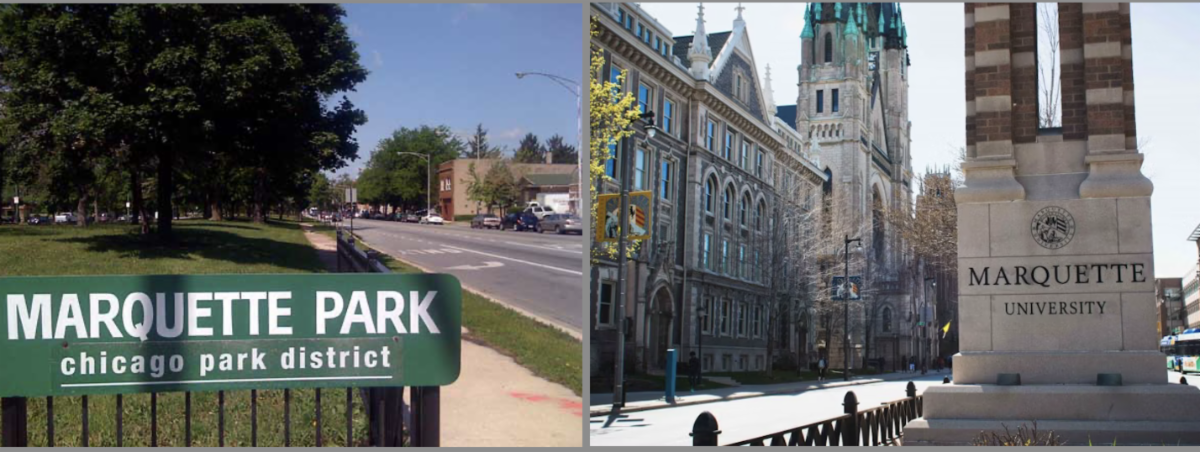
Marquette University and Marquette University; Marquette High School in Milwaukee, Wisconsin; Marquette Catholic High School, Alton, IL.
• Geographical sites:
Marquette Island in Lake Huron; Lake Marquette in Minnesota; Pere Marquette River and Pere Marquette Lake, which drain into Lake Michigan at Ludington, Michigan.
• Parks:
Pere Marquette Park in Milwaukee, WI; Pere Marquette State Park near Grafton, Illinois; Marquette Park, Chicago, Illinois; Marquette Park, Gary, Indiana; Marquette Park, Mackinac Island, Michigan; Marquette Park, St. Louis, Missouri; Pere Marquette Beach, a public beach in Muskegon, Michigan; Pere Marquette State Forest, in Michigan.
• Buildings and business:
The Pere Marquette Railway (Michigan, Indiana, Ohio, Ontario) ; Marquette Savings Bank, Pennsylvania; Marquette Building in Chicago; Marquette Building in Detroit; Marquette Building in Saint Louis, Missouri; Pere Marquette Hotel in Peoria, Illinois...
US Postage Stamps:
| |
|
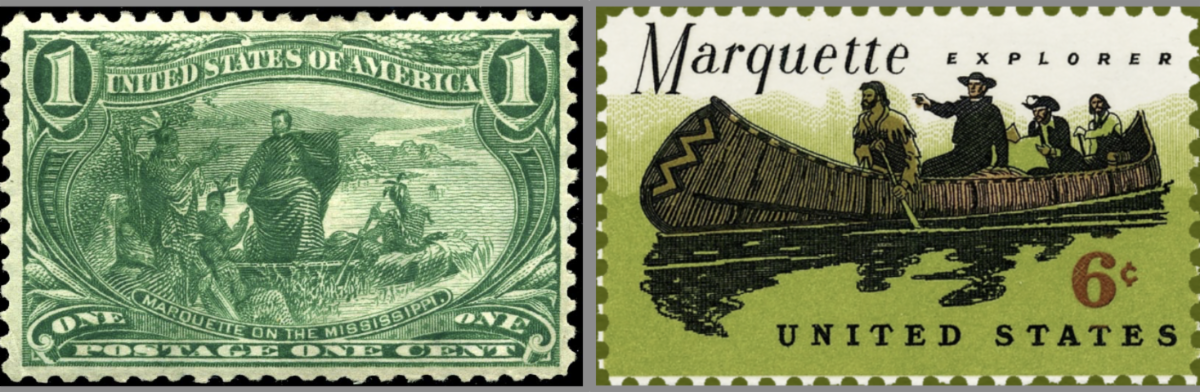
• The US Post office has issued stamps honoring Father Marquette (so did the Canadian mail, however we couldn't find a French post office stamp):
• The 1898 one-cent stamp shows Father Marquette talking to Native Americans from his canoe on the Mississippi River during his 1673 journey. This stamp was part of the "Trans-Mississippi Exposition Issue" to honor the Trans-Mississippi Exposition in Omaha, Nebraska. Named "Marquette on the Mississippi," it was inspired by an 1869 painting by Wilhelm Lamprecht. The painting was created to support the Christian Art Society in Cincinnati. After changing hands several times, it was bought by Rev. Francis X. Weninger and donated to Marquette College in the 1882-1883 school year. The oil painting is now displayed in the Raynor Memorial Libraries, near the Opus North Bridge on the second floor of Raynor Library.
• The 1968 six-cent commemorative stamp was released to celebrate the 300th anniversary of the Sault Ste. Marie mission. It showed Father Marquette and Louis Joliet in a canoe with two paddlers. This stamp kicked off a five-year celebration of the explorer, organized by the Marquette Tercentenary Commission, which was created by Congress to honor him. The design of the stamp was revealed during a ceremony at Marquette University on April 19, 1968, in the Brooks Memorial Union ballroom.
Last remarks :
Jacques Marquette (and his faithful companion and associate Louis Jolliet) left an indelible imprint on a vast central portion of our nation. Reading their Journals shows clearly that their mission and their engagement with the Natives was sincere and peaceful, with the best of intentions, certainly not to achieve their submission or displacement , which belong to a later part of history.
| |
|
Other exceptional Missionaries
Father Claude Allouez
First mass in Green Bay, WI.
10,000 baptisms
| |
|
• Claude Jean Allouez, a Jesuit missionary and French explorer of North America, was born on June 6, 1622 in Saint-Didier-en-Velay, Haute-Loire, and passed away on August 28, 1689.
• Upon his arrival in Quebec in 1658, he immediately commenced a study of the Wyandot and Anishinaabe languages to prepare himself for missionary work among the American Indian tribes. Due to his fluency in native languages and the high regard in which he was held by the Indian nations, he served as a principal speaker at the ceremony in Sault Ste. Marie, Michigan, which formally declared the Great Lakes and the Mississippi River valley as territory of the King of France.
• In 1666, he was the first white man to report seeing copper along the south shore of Lake Superior (which produced a large percentage of the world’s copper by the end of the 19th century).
• In 1669, Father Allouez started a mission with the Potawatomie Tribe near Green Bay. The French also called the bay Baie Verte and the town of La Baye was incorporated in 1754. At the end of the Seven Years' War, it went under British control and was renamed Green Bay, which was incorporated under this name in 1839.
• By 1671, he relocated the mission to what is now De Pere, making it a key place for Jesuit work in Wisconsin. He continued to evangelize the Indians until his passing in 1689, near what is presently Niles, Michigan, where he is buried. He played an important role in fostering peace between the French and the local Native Americans.
As the website of Father Allouez Catholic School reminds us: "He became a Jesuit missionary who established a number of missions in Wisconsin and has been called the founder of Catholicism in the West. It is said that he baptized approximately 10,000 neophytes. He is a symbol of peace between different groups of people. "
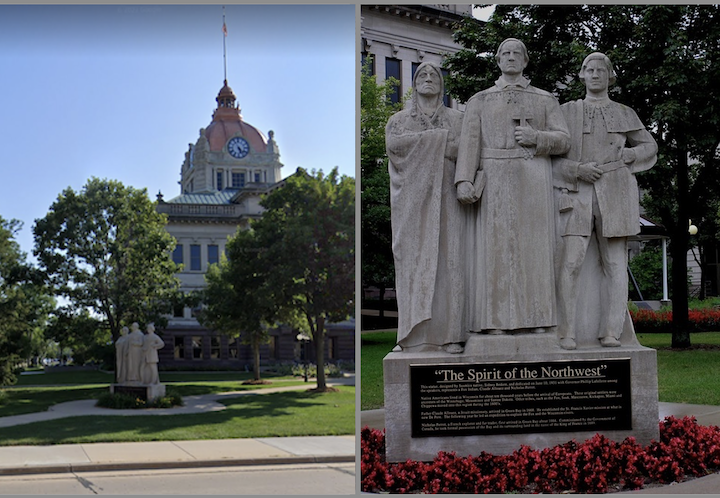
Monument, “The Spirit of the Northwest”
In the park, in front of Brown County Courthouse
100 S Jefferson St, Green Bay, WI 54301
GPS: 44.513283, -88.013683
• Inscription:
“This statue, designed by Suamico native, Sydney Bedore, and dedicated on June 10, 1931 with Governor Phillip Lafollette among the speakers, represents a Fox Indian, Claude Allouez and Nicholas Perrot.
Native Americans lived in Wisconsin for about ten thousand years before the arrival of Europeans. These original settlers were ancestors of the Winnebago, Menominee and Santee Dakota. Other tribes, such as the Fox, Sauk, Mascouten, Kickapoo, Miami, and Chippewa moved into this region during the 1600's. Father Claude Allouez, a Jesuit missionary, arrived in Green Bay in 1668. He established the St Francis Xavier mission at what is now De Pere. The following year he led an expedition to explore the Fox and the Wisconsin rivers. Nicholas Perrot, a French explorer and fur trader, first arrived in green Bay about 1664. Commissioned by the government of Canada, he took formal possession of the Bay and its surrounding land in the name of the King of France in 1689.”
| |
|
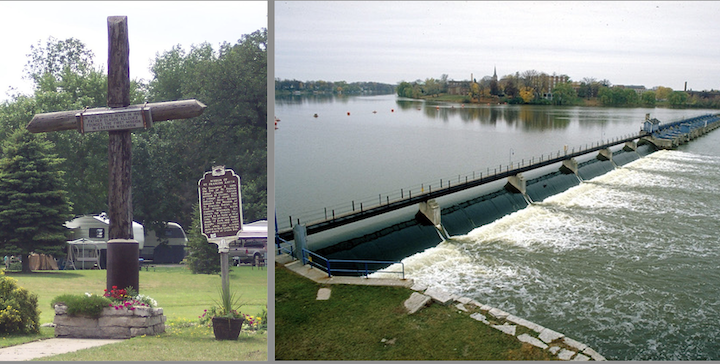
• Father Claude-Jean Allouez said the first Mass a few miles north in Oconto (a few miles north of Green Bay) on December 3, 1669. A cross and a marker memorialize the event.
Cross & Marker “Mission of St. Francois Xavier”
Brazeau Avenue, Oconto WI 54153
GPS: 44.891633, -87.884117
• Inscription:
“On December 2, 1669, the Eve of St. Francis, Father Claude Allouez arrived at Oconto, then a village of about 600 Indians. Here Allouez founded the Mission of St. Francois Xavier, the first mission in north eastern Wisconsin. Six French fur traders happened to be here at that time. The primitive chapel made of bark and cedar boughs remained until 1671 when the mission moved to Red Banks on the East shore of Green Bay.
Erected 1958 by the Wisconsin Historical Society. (Marker Number 78.).”
| |
|
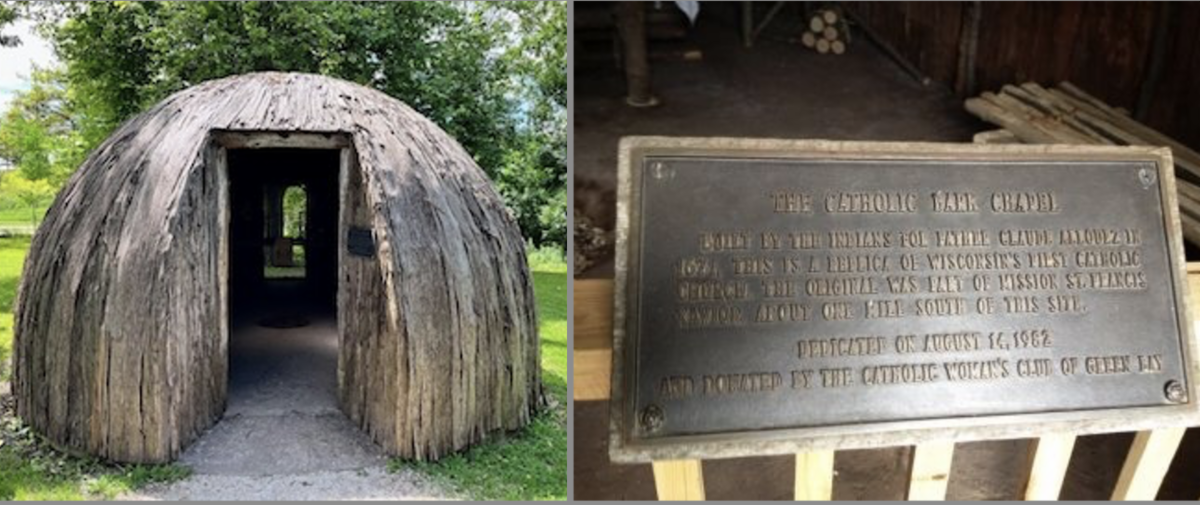
“The Catholic Bark Chapel”
Heritage Hill State Historical Park, 2640 South Webster Avenue, Green Bay, WI 54301.
GPS: 44.474767, -88.038517
• Inscription:
“Built by the Indians for Father Claude Allouez in 1671, this is a replica of Wisconsin's first Catholic Church. The original was part of Mission St. Francis Xavior, about one mile south of this site.
Erected 1982 by Catholic Woman's Club of Green Bay."
• Père Claude-Jean Allouez established the Mission de Saint-Joseph in the 1680s in Niles, Michigan. Allouez ministered to the local Native Americans, who were primarily Odawa and Ojibwe.
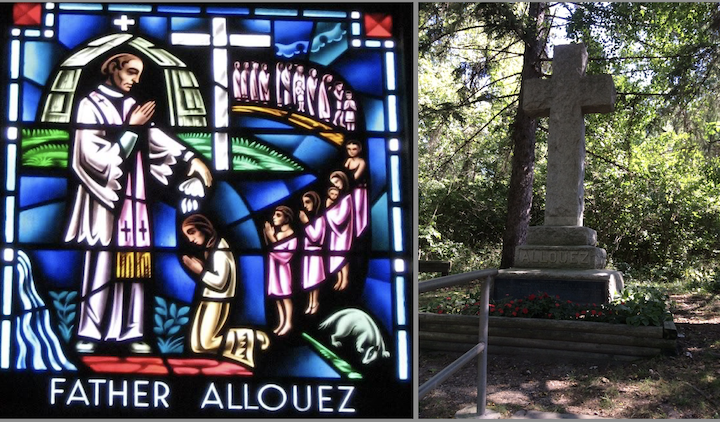
• The Miami Indians held him in such high regard that they buried him on a hill above the St. Joseph River, near the Mission, and put up a large wooden cross to honor his grave. For 322 years, a cross has marked his resting place. The last wooden cross was replaced with a granite one in 1918, and it still stands today:
Cross “Father Claude Jean Allouez S. J.”
Allouez Park, Niles, MI 49120
GPS: 41.814283, -86.259933
• Inscription:
“To the memory of
Father Claude Jean Allouez S. J.
Whose intrepid courage won the admiration of the Indians
and whose apostolic zeal earned for him the title of
the Francis Xavier of the American Missions.
Father Allouez was born at St. Didier, France, 1622
and died near this spot
August 27th 1689.”
“Erected by the Woman's Progressive League of Niles, Michigan, 1918.”
Legacy:
· The village of Allouez, Wisconsin, near Green Bay
· Allouez Trail on Mackinac Island in Northern Michigan
· Claude Allouez Bridge over the Fox River in De Pere, Wisconsin
· Allouez Bay near the mouth of the St. Louis River in Superior, Wisconsin
· Allouez neighborhood of Superior, Wisconsin, situated on Allouez Bay
· Allouez Township in Keweenaw County, Michigan
· The unincorporated community of Allouez in Allouez Township, Michigan
· Father Allouez School in Allouez, WI.
Father William Garraghan wrote:
"If the name of Jacques Marquette stands apart in the fervor of its appeal to sentiment and the historical imagination, the name of Claude Allouez deserves to be remembered as that of the first organizer of Catholicism in what is now the heart of the United States.” (https://www.biographi.ca/en/bio/allouez_claude_1E.html)
| |
|
Father Claude Dablon
Superior of the Jesuit missions in New France
Father Gabriel Druillettes
"The Apostle of Maine"
| |
|
Above:
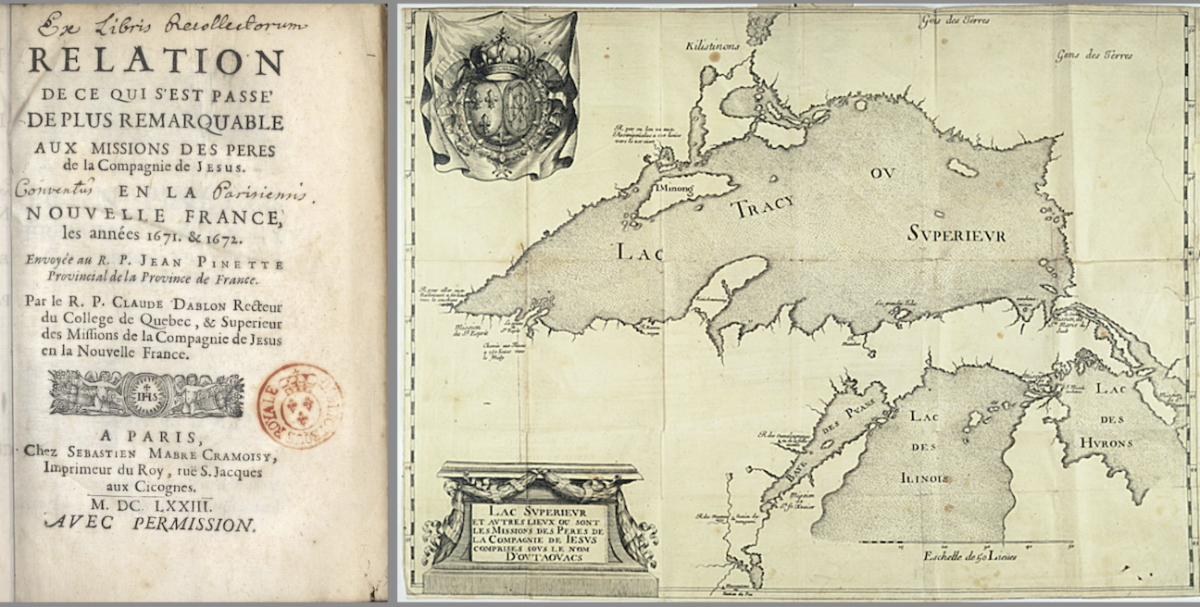
Left: Cover page, "Relation de ce qui s'est passé de plus remarquable aux Missions des Pères de la Compagnie de Jésus, en la Nouvelle-France, les années 1671 et 1672" par le R. P. Claude Dablon" published 1673 by S. Mabre-Cramoisy (Paris), Bibliothèque Natinale de France,
Photo: https://gallica.bnf.fr/ark:/12148/bpt6k8705207#
Right: First map of Lake Superior, drawn by Jesuits ca. 1670; published by Claude Dablon, Paris, 1672. Bibliothèque Nationale de France https://catalogue.bnf.fr/ark:/12148/cb36401756p
| |
|
• Claude Dablon, S.J. (February 1618 – May 3, 1697) was a Jesuit missionary, born in Dieppe, France. In 1661 he accompanied Father Gabriel Druillettes, the "Apostle of Maine", on an expedition overland to Hudson Bay, the purpose of which was to establish missions among the Native Americans in that region and perhaps to discover an outlet through Hudson Bay to China. The expedition was unsuccessful and is only chronicled as another abortive attempt to find the famous Northwest Passage. In 1668 Dablon was on Lake Superior with Claude-Jean Allouez and Jacques Marquette, and he was the first to inform the world of the rich copper mines of that region, which later became so valuable to the Canadian economy. After founding Sault Ste. Marie, Dablon became, in 1671, Superior General of all the Canadian Missions, retaining that office until 1680.
Father Dablon wrote many chapters of the Relations between 1655 and 1672. He published the story of the trip to the northern sea (Hudson Bay) in 1662. The last Relation published in the 17th century was in 1672, along with annual reports from 1673 to 1679 that stayed unpublished for almost 200 years, all of which were also his work.
• Gabriel Druillettes S.J. (September 29, 1610 – April 8, 1681) was a French Jesuit priest in New France known for his work as an explorer, missionary to Indigenous peoples, and diplomat. He earned the title "Apostle of Maine." He became a priest around 1641 or 1642 and arrived in New France in 1643. His mission involved living with Indigenous communities and establishing missions in Quebec and present-day Maine. He also traveled to Boston for diplomatic purposes, where the governor welcomed him. It is believed that Druillettes celebrated Mass privately in Boston in December 1650. In 1651, he went on a second mission to Connecticut, which, while not resulting in a formal treaty, helped foster friendly relations between the French and English Puritans. In 1661, Druillettes joined Father Claude Dablon on an overland expedition to Hudson Bay to set up missions among the Native people and possibly find a route to China. However, their Indigenous guides refused to go further north, leading them to return to Quebec, marking another unsuccessful attempt to discover the Northwest Passage. In 1670, Druillettes was at Sault Sainte Marie and took part in the significant "taking possession" of the land by Simon-François Daumont de Saint-Lusson in May 1671 alongside Claude-Jean Allouez and Jacques Marquette. He was known for his deep spirituality and was credited with miracles. Druillettes was also skilled in Indigenous languages; Joseph Marquette studied Algonquin under his guidance at Three Rivers. His mission work with Indigenous peoples lasted thirty-eight years. He passed away in Quebec on April 8, 1681.
Marker “Saint Anne Church”
6836 Main St, Mackinac Island, MI 49757
GPS: 45.850167, -84.611400
• Inscription of marker:
“In 1670, Jesuit Father Charles Dablon founded a birchbark mission chapel on Mackinac Island. The following year, Father Jacques Marquette relocated the mission at Saint Ignace. Abandoned in 1706 and restablished (sic) at Fort Michilimackinac around 1715, the new church was named Sainte Anne de Michilimackinac. During the winter of 1780-1781, British troops relocated to the island and moved the church building across the ice. The parish is the nation's oldest dedicated to Saint Anne, and maintains baptismal records dating from April 1695. Erected 1992 by Bureau of History, Michigan Department of State. (Marker Number S622.)”
| |
|
Father Louis Hennepin
Intrepid missionary, explorer, and reporter
| |
|
An intrepid explorer and missionary
From Upstate New York to Minnesota
We introduced Father Hennepin in our January 2024 Bulletin: "Early French Missionaries in the United States (Part 1 - New York, Maine, Vermont)"
https://conta.cc/41VLaPE (version in English), https://conta.cc/3NWK407
(version in French) and narrated his voyages and discoveries in the Niagara Falls region. He was the first to preach the gospel on the Niagara frontier. We are now continuing to travel with him farther West, where he pursued his missionary zeal to Minnesota.
• Louis Hennepin was born on May 12, 1626, in Ath, (today's Belgium), and died after 1701, possibly in Rome. Hennepin joined the Récollet Order of Friars Minor in Béthune, France, and went to Canada with La Salle in 1675, becoming his chaplain in 1678. He traveled with him to the Great Lakes in 1679 and wrote the first published account of the area.
• They reached Peoria, Illinois, in January 1680, where they built Fort-Crèvecoeur. La Salle went back to Fort Frontenac for supplies while Hennepin and the others explored the upper Mississippi River. In April, they were captured by Sioux Indians and joined them on hunting trips, during which Hennepin discovered what he called the Falls of St. Anthony, now Minneapolis, Minnesota. He was rescued in July 1680 by the French explorer Daniel Greysolon, Sieur Dulhut.
• After returning to France in 1682, Hennepin published a detailed account of his adventures titled "Description de la Louisiane in 1683", which was a huge success. It had many editions and was translated into Italian, Dutch, and German. The monk became famous quickly, as readers were eager for exciting tales and enjoyed his descriptions of the Mississippi and its fertile valley. It was later updated as "Nouvelle découverte d’un très grand pays situé dans l’Amérique en 1697", claiming to have explored the entire Mississippi River. This claim is mostly contested by historians. Still, he was a very popular author author in his time, famous for his vivid descriptions of the plants and animals in the country. He also wrote insightfully about the Indian tribes, detailing their lifestyles, traditions, and beliefs. His work had no fewer than 46 editions! Hennepin spent his last years in relative obscurity, with his last known whereabouts in a Roman monastery in 1701.
Captured by the Sioux
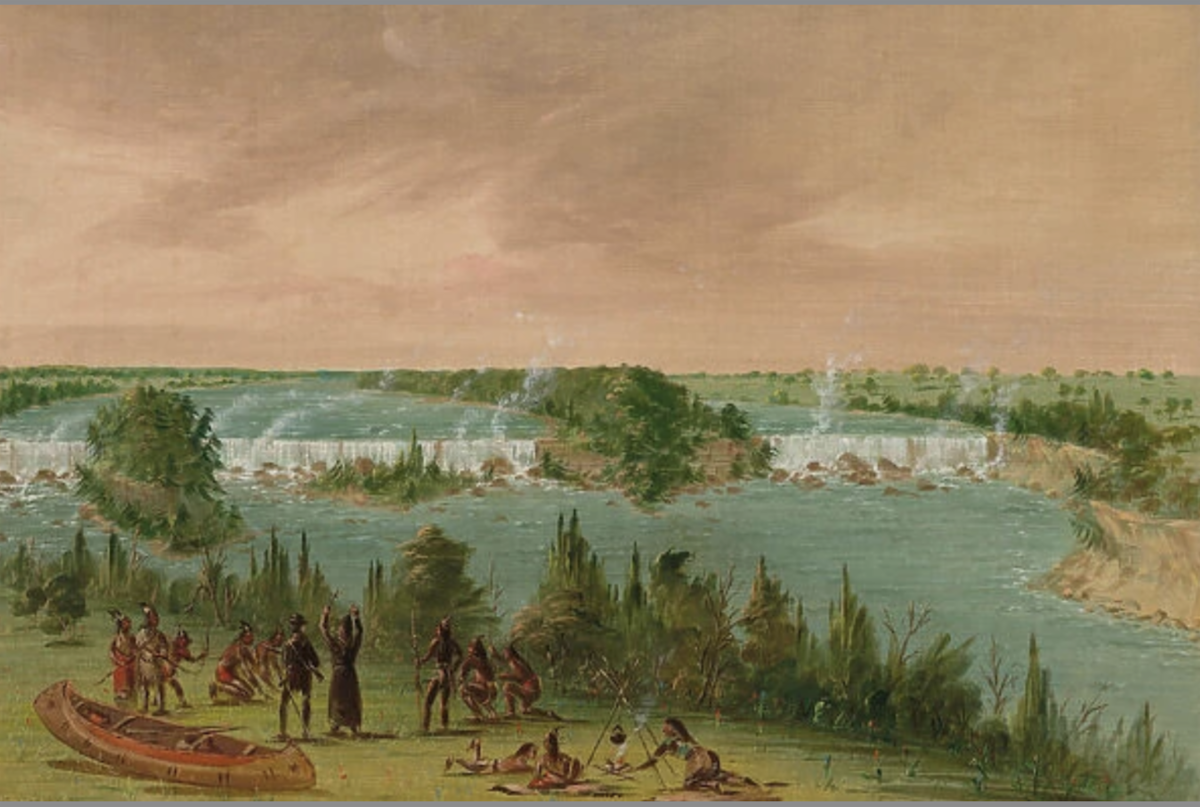
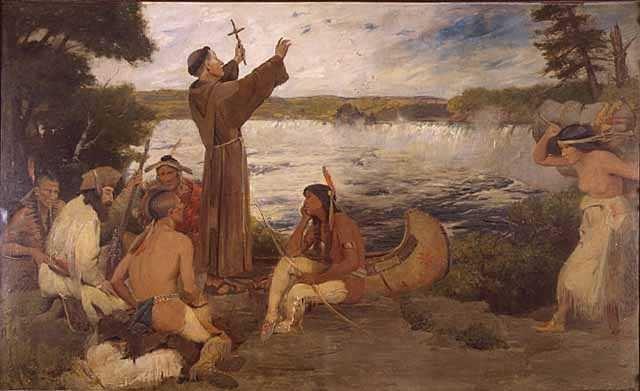
• The famous Récollet Franciscan explorer was captured by a band of Sioux Indians along with his two companions in February 1680. Whenever the Indians moved about from place to place, according to their nomadic inclinations, they carried with them the Franciscan Father and the two other captives. During one of their excursions the wanderers stopped at the great cataract in the Mississippi which is now encircled by the city of Minneapolis
and which still bears the name of St. Anthony Falls, given to it by Hennepin in honor of St. Anthony of Padua.
Marker, “Father Louis Hennepin's Exploration in 1680“
1922 1st Avenue S, Anoka MN 55303
GPS: 45.197917, -93.390800
• Inscription:
" Father Louis Hennepin, Belgian Recollect missionary accompanying Sieur de la Salle's expedition to the Mississippi River region, left Fort Crevecoeur, Illinois, on February 29, 1680, for an exploration of the upper Mississippi River. On April 11, he and his two French companions were captured by a Dakota (Sioux) war party. Leaving the river near present-day St. Paul, the Indians took their captives on a grueling five-day march to their encampment on the shores of Mille Lacs Lake. In early July Father Hennepin accompanied a Dakota hunting party down the St. Francis (Rum) River. On the fourth day the group camped on the west bank of the Mississippi just opposite the mouth of the Rum River in present-day Champlin. A day or so later Father Hennepin viewed the falls to which he gave the name St. Anthony of Padua. On July 25, some miles below Lake Pepin, Father Hennepin and his two companions were rescued by five Frenchmen led by Daniel Greysolon, Sieur Du Luth, who had come from Lake Superior by way of the Brule and St. Croix rivers. The Indians and Frenchmen now returned to Mille Lacs Lake. Late in September Father Hennepin and Sieur Du Luth set out on their homeward voyage. They wintered at Mackinac and reached Quebec in the spring of 1681. Father Hennepin returned to France, where, in 1683, he published his widely-read Description of Louisiana. Erected 1980 by Anoka Senior Citizens Club."
| |
|
Discovery of St. Anthony Falls,
Minneapolis, MN.
Marker, “St. Anthony Falls“
East River Parkway, Champlin MN 55316
GPS: 45.186683, -93.391633
• Inscription:
" On July-1-1680
Louis Hennepin
left this place
to discover the
St Anthony Falls"
———
Marked by the Daughters
of the American Colonists
– 1929 –
• In the 1920s, the Knights of Columbus in Minnesota started planning a monument for Father Louis Hennepin. He named St. Anthony Falls during his exploration and missionary work in North America in the late 1600s.
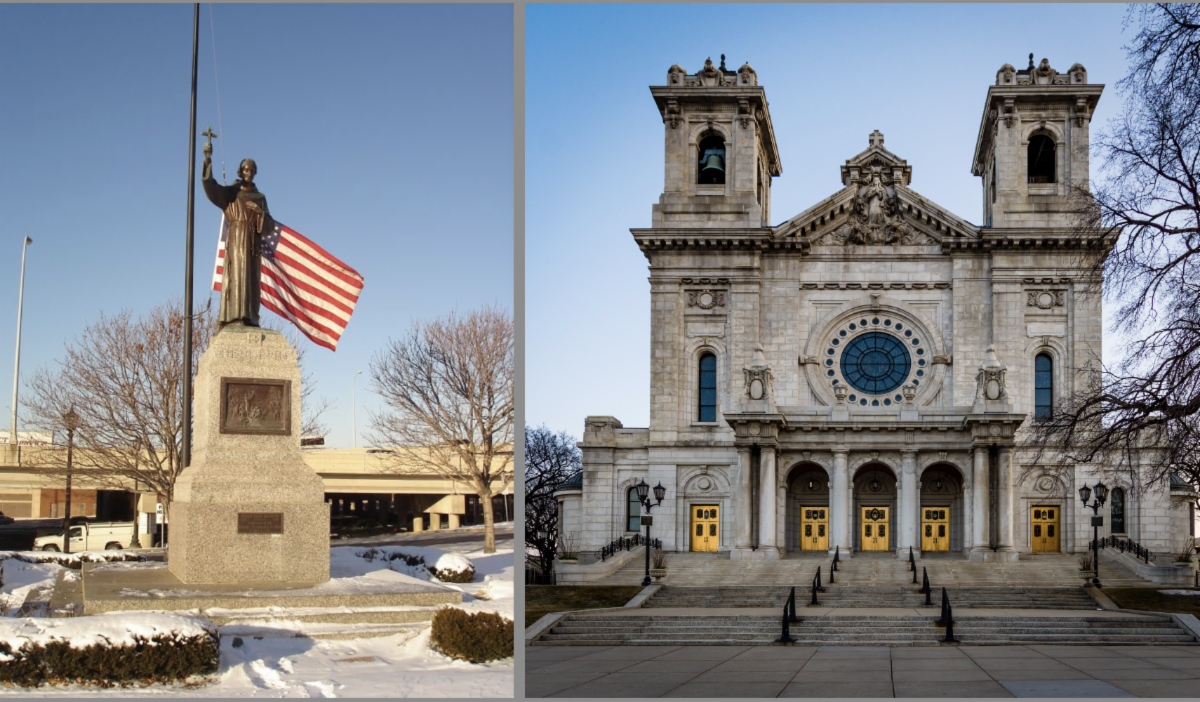
• A statue was made in Geislengen, Germany, and placed facing St. Anthony Falls on a triangular piece of land in front of the Basilica of St. Mary on Sunday, October 12, 1930. This event marked 250 years since Father Hennepin's visit to the falls.
• The dedication ceremony included many important figures from both civic and church backgrounds. Attendees included church leaders, the Governor of Minnesota, the Mayors of Minneapolis and St. Paul, and state and local members of the Knights of Columbus, who funded the statue's creation and its recent restoration.
Statue, “Father Louis Hennepin“
In front of Basilica of St Mary, Hennepin Ave & 17th Street, Minneapolis, MN 55403
GPS: 44.972387, -93.286735
• Inscription:
”Father Louis Hennepin
1640 – 1705
Rededicated by the Knights of Columbus of Minn.
October 12, 1980”
| |
|
Father Pinet
Spiritual anchor of Cahokia, Illinois
| |
|
• Pierre François Pinet was born in Périgueux, France, on November 11, 1660. He joined the Jesuit novitiate in Bordeaux in 1682. In 1694, he traveled to Canada, first reaching Quebec, then moving on to Montreal, Ville-Marie, and Michillimackinac.
• In 1696, Pinet set up the Mission of the Guardian Angel in Chicago (probably around Evanston or Skokie), but Louis de Buade de Frontenac, the Governor General of New France, wished to reassign him to another post. After an appeal to François de Laval, the bishop of New France, the mission was restarted in 1698. After 1700, the Miamis began relocating to the Maumee and Wabash valleys in Indiana, leading to the mission's permanent closure.
• Following this, Pinet worked with the Illiniwek tribes at Cahokia and later joined the Kaskaskia tribe on the north side of the River des Peres, now St. Louis, Missouri.
• A letter from Father Bergier, dated March 1, 1703, mentions that Pinet passed away at River des Peres on August 1, 1702.
• The Cahokia Native Americans of the Illini did not coalesce as a tribe and live in the Illinois area until nearly the time of French contact 300 years ago.
Father Pinet founded a mission in late 1696 to convert the Cahokian and Tamaroa Native Americans to Christianity. Father Pinet and the Seminary of Foreign Missions of Quebec built a log church and dedicated it to the Holy Family.
• During the next 100 years, Cahokia became one of the largest French colonial towns in the Illinois Country.
• The Church (French: Église de la Sainte-Famille) was constructed in the characteristic post-on-sill technique of the French heritage and that church is still standing in Cahokia. The parish was founded in 1699, when two priests from Québec came here to establish a mission (Fathers Davion and Cosme). This continued until 1768. The present church was built in 1786, just after the arrival of Father Paul Saint-Pierre, and consecrated in 1799. It is the longest continuous Roman Catholic community in the United States.
Marker “Welcome To Historic Village of Cahokia”
Eglise de la Sainte Famille
4053 Mississippi Ave, East Saint Louis, IL 62206
GPS: 38.571950, -90.188117
• Inscription:
"The historic town of Cahokia was founded by French-Canadian missionaries in 1699. It was the first European settlement on the Mississippi River and remains the oldest village existing on the river."
Like all missionaries, Father Pinet lived among the Indians. Father Cosme wrote in his Journal in 1699:
“(We) went by land to the house of the Reverend Jesuit Fathers, the Mission of the Guardian Angel, found there the Reverend Father Pinet and the Reverend Father Bineteau, recently arrived from the Illinois country, slightly ill. Their house is built on the bank of a small river, with the lake on one side and a vast prairie on the other. The village of savages contains over a hundred and fifty cabins, and a league up the river is still another village, almost as large. They are all Miamis.”
| |
|
Father François Vaillant de Gueslis
First missionary in Detroit
Father Nicolas Constantine de L'Halle
"Martyr of Detroit"
| |
|
Above:
Left: The Fleur-de-lys is an integral part of the basilica's identity.
Photo: https://www.facebook.com/BasilicaSteAnneDetroit/
Right: Basilica of Sainte Anne de Detroit, Photo: CNS photo/James Silvestri, Detroit Catholic). Its 1886 architecture by Léon Cocquard reflects the French history of the parish and territory.
| |
|
• François Vaillant de Gueslis (July 20, 1646 – September 24, 1718) was a Jesuit missionary from Orléans. He joined the Society of Jesus on November 10, 1665, and traveled to Canada in 1670, where he became a priest in Quebec on December 1, 1675.
• From 1679 to 1684, he worked to convert the Mohawks to Christianity. In early 1688, Canadian leaders selected him as an ambassador to Thomas Dongan, the Governor of New York, to help establish peace between the French and the Iroquois. However, the talks failed because of Dongan's demands and the resistance from Huron chief Kondiaronk.
• He was the first missionary to serve Native Americans in Detroit, but his stay was brief, as he did not align with the plans of Antoine Laumet de La Mothe, sieur de Cadillac. After peace was made between the French and the Iroquois, he tried to convert the Senecas from 1702 to 1707.
• He played a significant role in countering Colonel Schuyler's efforts at Onondaga (in today's upstate New York), who wanted the Five Nations to expel French missionaries. His main missionary work took place in Quebec and Montreal. In Quebec (1685–91; 1697–1702), he held key roles as minister, procurator, and preacher. While in Montreal (1692–96; 1709–15), he was the first leader of the Jesuit residence established in 1693. He returned to France in 1715, where he passed away in Moulins in 1718.
• Father Nicolas Constantin de l'Halle was a Recollet priest (Franciscan) at Fort Ponchartrain du Detroit. He wrote the earliest records of the fort and Ste. Anne's.
• On June 6, 1706, he died when a group of Ottawa Indians attacked Miami Indians near the fort. Father Charlevoix recounts the event in these words: “The Recollet Father Constantin, chaplain of the fort, was walking in his garden, ignorant of all that was going on. Some Ottawas seized and bound him; but Outoutagan, one of their chiefs, who had taken part in the assembly at Montreal, where the general peace was signed, unbound him, and begged him to go and tell the Commandant that they had no designs on the French, and that he besought him to stop firing on them. As that religious was about entering the fort, some flying Miamis overtook him, and a volley of musketry was fired upon them by Ottawas who perceived them. Father Constantin was struck and fell dead on the spot.” Commander Bourgmont faced strong criticism for how he and the garrison handled the incident.
• Father de L'Halle was laid to rest in the cemetery of the mission. The Recollets who followed him at this location and the people in Detroit began to honor his name, believing he performed miracles through their prayers.
Tablet, Sainte Anne's Catholic Church
125 Griswold Street, Detroit MI 48226
GPS: 42.328583, -83.045733
• Inscription:
"This is a replica of an original bronze tablet placed at this historic site by the Catholic Study Club of Detroit on July 26th, 1926.
"This tablet marks the site of
Sainte Anne's Catholic Church
The erection of which was begun July 25, 1701, the day of Le Sieur Antoine De La Mothe Cadillac's Landing. It was completed and named on July 26th, 1701, that being the Feast Day of Sainte Anne. This church was the first building in Fort Ponchartrain, afterward named Detroit. The first pastor, Reverend Nicholas Constantine de L'Halle, was killed June 6th, 1706 by the Indians, the first Christian martyr in Detroit. The original bronze tablet is on display inside the lobby of the Standard Federal Savings Building.
Erected 1980 by The Catholic Study Club of Detroit."
Basilica of Sainte Anne de Détroit
1000 St Anne St, Detroit, MI 48216
GPS: 42.320390, -83.076597
• It was founded July 26, 1701, two days after Antoine de la Mothe Cadillac landed at Detroit and began construction of Fort Ponchartrain. July 26 is the feast day of Saint Anne (sainte Anne) patron of France, mother of Mary and grandmother of Jesus. Nicolas Constantine de l’Halle and François Vaillant (a Jesuit) were the two priests who accompanied the group.
• It is the second-oldest continuously operating Roman Catholic parish in the United States.
• The vicinity of Fort Pontchartrain developed as the city of Detroit. Local native American Indians set fire to the church in 1703. It was rebuilt in 1704, then a larger one was built in 1708, then burnt again in 1714, then enlarged in 1722, and rebuilt again in 1755, and again in 1818, and finally this structure in 1886 by architect Léon Cocquard.
• Father Gabriel Richard was called to Ste. Anne's in 1796. He helped start the school that eventually developed as the University of Michigan, started primary schools for white boys and girls as well as for Indians, and was elected as a territorial representative to the U.S. Congress.
• The last sermon in French was held in 1942.
| |
|
Father Anastase Douay
First mass of record in Louisiana
Father Paul du Ru
First Chapel in Louisiana
| |
|
• Father Paul Du Ru, a Jesuit priest active in the greater Mississippi area, was born in Vernon, France, in the region of Normandy. After entering the novitiate at the age of twenty, he completed his courses and was ordained in 1698. Father Paul du Ru was a member of the Society of Jesus who was brought in by d'Iberville after the first Missionary Anastase Douay refused to stay in Fort Maurepas. He established contact with local indigenous tribes such as the Houma, who resided on the east side of the Mississippi River, twenty miles above the Red River. During his time with them, he encouraged the construction of a church fifty feet in length, positioned in front of a forty-foot-high cross. This initiative paved the way for other missionaries to conduct the first high mass with the Houma, including chanting.
Marker, « Bayou Goula»
State Hwy 1, White Castle LA 70788
GPS: 30.205200, -91.184450
• Inscription:
“Mugulasha Indian village captured by Bayogoulas. In 1699 Bienville here found Tonti's letter of 1686 to La Salle. Father Paul Du Ru built first chapel in Louisiana near village in 1700.
Erected 1962 by Department of Commerce and Industry.”
• On March 3, 1699, Father Anastase Douay, a member of the d'Iberville expedition, conducted the inaugural recognized mass in French Louisiana. The initial mass was held in Venice, within the parish of Plaquemine, which retains the same name to this day. It is worth noting that the first mass may have actually taken place on April 9, 1682, when Robert Cavelier de La Salle claimed the territory on behalf of Louis XIV. During this event, a large cross was erected.
• The cross commemorating this event (it is surmised) was retrieved from the bottom of the river in 1904 and can be seen at Port Lavaca, TX. Robert Cavelier de La Salle conducted a Te Deum on April 9, 1682, suggesting that the liturgical actions associated with a mass may have already been performed on that day. Despite the debate surrounding the 1699 mass, the parish of Plaquemine was granted a French fort in 1722.
• As per the 2000 census, Plaquemine has a population exceeding twenty thousand, with nearly a thousand individuals still conversing in French on a daily basis.
Marker, “Venice”
Highway 23, near 137 Blanchard Ln, Buras, LA 70041
(Disappeared after hurricane Kathrina in 2005
GPS: 29.339480, -89.412319
• Inscription:
“Near this site on April 9, 1682, LaSalle claimed Louisiana for France. Father Zenobius Membre, a member of the expedition, sang the Te Deum. On March 3, 1699, Father Anastase Douay, a member of Iberville’s expedition, celebrated the first mass of record in French Louisiana.”
La Salle Cross
On display at Grace Episcopal Church, 213 E Austin St, Port Lavaca, TX 77979
GPS: 28.613459, -96.622750
• Inscription:
"This cross presented by Deaconess Lucile Bickford.
Found in the vicinity of old Fort St. Louis by W. H. Huffaker (in 1904).
Is surmised to be the old LaSalle Cross."
| |
|
Father Montigny, Father Davion, and Father St. Cosme
Cape Girardeau, Missouri
| |
|
• Father François de Montigny was born in Paris in 1669 and passed away there on December 19, 1742.
In 1692, Montigny came to Canada at the request of the Bishop of Québec. By 1697, he received formal letters appointing him as vicar general for the entire colony. In 1698, the directors of the Quebec seminary sought permission to establish missions among the tribes along the Mississippi River, and Bishop Saint-Vallier agreed, insisting that Montigny lead the efforts.
Montigny, along with two priests chosen by the Quebec seminary, Jean-François Buisson de Saint-Cosme and Albert Davion, departed from Quebec. • They traveled up the west side of Lake Michigan to the Chicago portage, then down the Des Plaines and Illinois rivers to the Mississippi. They reached the territory of the Arkansas Indians, where Davion stayed with the Tunicas and Buisson de Saint-Cosme with the Tamaroas. Montigny settled among the Taensas and the nearby Natchez.
• However, his time there was short-lived. The vast distances, the hostility of the Indians, and their constant movement made it impossible for him to achieve meaningful work. On May 28, 1700, he left on Iberville’s ship and never returned.
• He later went to China but was expelled by Emperor Kangxi. He returned to Paris, where he died in 1742. His final words were: “I die as I always thought it fitting for a priest to die: without debts and without possessions.”
• Father Jean-François Buisson de Saint-Cosme, a priest from the Quebec seminary, founded the Sainte-Famille mission for the Tamaroa tribe in Cahokia, Illinois. He was born on January 30, 1667, in Lauson, Quebec, entered the seminary at age 8, and became a priest at 23 in 1690.
• He briefly served as a chaplain for the Micmac Indians. Chosen as a pioneer for missionary work in the Mississippi Valley, he moved to the Tamaroa area in April 1699 to connect the Taensa mission with Quebec, which was about 2,760 miles away. After his time at Sainte-Famille, he went to the lower Mississippi in July 1700, replacing vicar general François de Montigny among the scattered Natchez people.
• However, his efforts were unsuccessful due to language barriers and distrust. His concerns were justified, as he was killed by Chitimacha arrows while traveling to Mobile at the end of 1706.
• Father Albert Davion was a member of the Quebec seminary community. He was born in Saint-Omer, Artois around 1670 and died in 1726 in his birthplace. He came to Quebec in 1690, and in 1698, Bishop Saint-Vallier and the seminary directors selected him to join Abbé Jean-François Buisson de Saint-Cosme to establish missions in Louisiana. Although he was regarded as a good priest, his poor health made it difficult for him to thrive in the wilderness. • He worked with the Tunicas Indians and often spent extended periods in the French settlements near Mobile Bay, Alabama. Around 1700, he set up a mission on the bluffs of the Mississippi River, close to where Fort Adams is located. This mission aimed to spread Christianity to the local Native Americans and became a key stop for travelers on the river and the trails linking Natchez to New Orleans.
• The Tunicas were known for their love and loyalty to the French, possibly because they did not have close ties with nearby tribes. In 1719, historian La Harpe visited the Tonica village and discovered that Father Davion was still present and highly respected, even though he openly criticized their polygamy and pagan rituals. Davion left the mission by 1720, but the area was still known as Roche Davion (Davion's Rock) for many years (in 1764, it was renamed Loftus Heights by the British).
• In 1722, he returned to New Orleans and later went back to his home parish in France, where he died in 1726.
Plaque & Cross, «Cape La Croix creek”
122 South Main Street, Cape Girardeau, MO 63701
GPS: 37.300367, -89.519200
• Inscription:
“In 1699, Fathers Montigny, Davion and St. Cosme, French missionaries
erected a cross where this stream entered the Mississippi and prayed
that this might be the beginning of Christianity among the Indians.
The stream has ever since been known as
Cape La Croix Creek.”
Originally dedicated October 12, 1947
LaCroix Creek site on N. Kings Highway.
Relocated to this site on Good Friday, April 10, 2009
Rededicated Easter Sunday, April 4, 2010”
| |
Father Henry Roulleaux de la Vente
First Priest in Mobile, Alabama
| |
Above:
Left: East view of Cathedral Basilica of the Immaculate Conception, Mobile, Alabama
Photo: By DXR - Own work, CC BY-SA 4.0, https://commons.wikimedia.org/w/index.php?curid=50262375
Right: one of the two historical markers by the cathedral
Photo by Cosmos Mariner: http://www.hmdb.org/marker.asp?marker=117245
| |
• Henri Roulleaux de La Vente was born around 1655 and passed away on July 9, 1717. He was an experienced missionary priest when he arrived in the Mobile colony at the age of 50 in 1704.
• His early letters highlighted the poor health of the colonists and the urgent need for supplies and more missionaries. He provided a detailed list of items needed many of which were meant for trading with the Native Americans. One letter, titled "General Memoir of Merchandise," asked for glass beads, knives, colorful fabric, and trade muskets, among other things.
• In the New World, religion played a crucial role for the colonists. Being able to perform important rituals like baptisms, marriages, and funerals was crucial. As the parish priest, La Vente was seen as a natural leader for the people in the colony.
• In 1708, commandant Bienville ordered the construction of a church but left it to La Vente to provide the windows, door, and roof. Another major concern for La Vente was the shortage of white women for the colonists to marry. Many men resorted to buying Indian slave women as housekeepers. Initially, La Vente was very troubled by this practice, which the Church deemed immoral, and he frequently wrote to his superiors for support. Eventually he realized he could help by facilitating marriages between Frenchmen and their Indian partners. He anticipated his superiors' reactions when he wrote in 1708 that the intermarriage of French and Indians "would not negatively affect the French bloodline".
• In fact, the spiritual needs of both the French and Indian populations were addressed with equal consideration: the very first entry found in the records of the new parish is that of the baptism of an Apalachee Indian girl (6 September, 1703), by Father Albert Davion.
Marker, “Cathedral-Basilica of the Immaculate Conception”
399-351 Dauphin St, Mobile, AL 36602 (on the north side of the cathedral)
GPS: 30.690417, -88.045917
• Inscription :
"The Cathedral Archives preserve the records of Mobile’s multicultural and diverse origin. The sacramental records began by the first pastor, M. Henri Roulleaux de La Vente date back to 1704, documenting the first baptisms, marriages, and burials of the French, Spanish, British, Native Americans, Africans, and Creole de Color in Mobile. Many documents are the only reference to eighteenth century African Slaves and are among the oldest on the Gulf Coast. Some documents are signed by Mobile’s founders, Pierre Le Moyne, d’Iberville and Jean Baptiste Le Moyne, de Bienville. The ceremonial placement of the Cathedral’s Cornerstone took place in the Catholic Graveyard on July 19, 1835.
The origin of this Cathedral was established on July 20, 1703, by Jean-Baptiste de La Croix de Chevrieres de Saint Vallier, Bishop of Quebec at Fort Louis de la Mobile, the city’s first permanent settlement. The Bishop also appointed Father M. Henri Roulleaux de La Vente as Pastor of the first formal church along the Mississippi Valley which extended from the mouth of the Mississippi to Canada. The missionary zeal of the early Catholic Jesuit priests accompanying Mobile’s founders brothers, Pierre Le Moyne, d’Iberville and Jean Baptiste Le Moyne, de Bienville was intrinsic to the religious development of Mobile, Alabama."
| |
|
Father Pierre Gabriel Marest
Father Jean Mermet
and the 1711 Peoria Settlement, Illinois
| |
|
• Pierre-Gabriel Marest was born in Laval on October 14, 1662, and died on September 15, 1714, in Kaskaskia, Illinois. Marest joined the novitiate in Paris in October 1681. For six years, he taught in Vannes before continuing his studies in Bourges and Paris. In 1694, he was sent to Canada and served as a chaplain on a ship during a raid led led by Pierre le Moyne, Sieur d’Iberville against an English fort in Hudson Bay.
During this expedition, he witnessed the French attack on an English fort and its surrender, marking his first meeting with Native Americans. In September 1695, he was captured by the English and taken to England as a prisoner. After his release, he returned to France and requested to be sent back to America as a missionary.
• He arrived in Quebec in 1698 and was soon sent by Father Jacques Gravier to work with a Native village near what is now Peoria, Illinois. After two years, he traveled with the Kaskaskia tribe as they moved south, possibly due to fears of Iroquois raids, conflicts with other tribes, or in search of better land and trade opportunities in the lower Mississippi River valley.
• The Kaskaskia tribe and two priests, Fathers Marest and Pierre François Pinet, first arrived on the west side of the Mississippi at the River Des Peres, which means River of the Fathers. In 1703, the Kaskaskia chose to move about fifty miles south to the east side of the Mississippi, close to where the Michigamea River flows into it, now called the Kaskaskia River. They established a new village there, and Marest spent the last eleven years of his life serving the Kaskaskia people. He made two trips back to the Peoria mission, and during the second trip, he unexpectedly met his brother, Father Joseph Marest, and spent several weeks with him.
• Some say the first Peoria site started in 1691, but most historians now agree on the date of 1711, when French soldiers, traders, and missionaries came together with thousands of Illinois Indians. Many French traders and soldiers also married Illinois Indians, forming a diverse community.
• Some of these Peoria descendants today can trace their family trees back to the time of La Salle.
• In the summer of 1711, Father Marest, a Jesuit priest from Canada, preached to the Indians at Cahokia, and by the force of his eloquence, a large number of them were converted to Christianity. Among these converts was a chief named Kolet, from Peoria, who at the time was at Cahokia, visiting friends. The chief prevailed on Father Marest to accompany him home to his village at Peoria Lake, and proclaim salvation to his people.
• The Kaskaskia mission thrived, and Marest earned respect from both Native Americans and French settlers. He became an excellent linguist in Native American languages, but none of his writings have been discovered. Marest passed away in Kaskaskia on September 15, 1714, during an outbreak of disease.
• Jean Mermet was a Jesuit missionary in the Illinois area from 1698 to 1716. He was born on September 23, 1664, in Grenoble.
• Mermet began his religious journey as a novice in Avignon in 1683. He studied in Embrun from 1685 to 1686 and then taught in Carpentras, Roanne, and Vesoul. He completed his theology studies in Dole between 1692 and 1696 and spent his last year at Salins before arriving in Canada in 1698.
• Upon arrival, he was sent west to help at the Guardian Angel mission in Chicago and nearby Miami-Illinois villages. Father François Pinet, who led the mission, spent summers there but moved to the Illinois River or joined the Indians for winter hunts. In 1702 Mermet took over the mission since Pinet had moved to the Kaskaskias in 1700.
• Mermet joined the Kaskaskia mission around 1705 or 1706 and served there until his death in 1716.
• In 1706, Mermet helped Father Jacques Gravier, who had been ambushed and injured by Peorias. He treated Gravier’s arm, cared for him, and sent him to Mobile. Gravier noted in 1707 that Mermet was struggling with his health due to his intense dedication. Father Marest also acknowledged Mermet’s commitment, stating that despite his poor health, he was the heart of the mission.
• During his time at Kaskaskia, Mermet was very active. He performed baptisms, marriages, and funerals, served nearby Indian communities, and worked to build friendly relations with the hostile Peorias. In February 1715, Mermet expressed his sorrow over the passing of his dear friend, Pierre-Gabriel Marest, calling him “a missionary of unmatched dedication.”
• Mermet passed away in Kaskaskia on September 15, 1716. In December 1727, Father Jean-Antoine Le Boullenger reburied his remains in the new parish at Kaskaskia. Throughout his career, Mermet faced no major scandals or controversies. He represents the committed missionary who, despite physical challenges, worked on the frontier for many years. The Illinois missions thrived largely because of Gravier and Marest, who both recognized Mermet’s dedication and support. Mermet took pride in being part of a missionary effort that Gravier described as so busy that they “hardly have time to breathe” due to the growing number of eager new converts.
Marker “Peoria Settlement Site”
Peoria Park District Rock Island Greenway, 2 Caroline Street , Peoria, IL 61603
GPS: 40.701300, -89.571200
• Inscription:
“When Father Marquette, the missionary, and Louis Joliet, the trader, first white men to see the site of Peoria, came ashore here in the summer of 1673, there was an Indian village at this location. 100 years later, the French had built a village and fort here.”
Erected 1968 by Peoria Historical Society.”
| |
|
So many other missionaries
deserve to be remembered...
...and the nuns too...
| |
|
We shouldn't not forget the role of the nuns in New France, whether in Québec or in New Orleans. Unfortunately, there are few accounts of their presence in the missions, as they were probably not exposed to the dangers of traveling to the far corners of these vast lands. The vast majority of them remain anonymous for eternity.
• Le Couvent des Ursulines was a series of historic Ursuline convents in New Orleans, Louisiana. In 1727, at the request of Governor Étienne Perier, nuns from the Ursuline Convent of Rouen (Normandy) went to New Orleans to found a convent, run a hospital, and take care of educating young girls.
• It is the oldest and only surviving French colonial building in New Orleans.
Plaque, “Old Ursuline Convent 1749-1753”
1100 Chartres St, New Orleans, LA 70116
GPS: 29.960700, -90.060683
• Inscription (excerpts):
“Next to site of first building erected in 1734
Home of Ursuline nuns who came from France
“to relieve the poor, sick and provide education for young girls”
First girl’s school in Louisiana
Oldest building in Mississippi Valley
Erected 1995 by Louisiana Society,
National Society Colonial Dames XVII Century.”
| |
|
• So many of the Missionaries deserve to be remembered. Only a few of them, and only a few of these monuments, tablets and markers are selected in this Bulletin.
• There is a plaque in the town of Lima, in Upstate New york, that pays homage to several additional missionaries:
Plaque, “1668-1709”
Honeyoye Falls road no. 6, Lima NY 14485
GPS: 42.945700, -77.612133
• Inscription:
“Near this site Catholic missionaries erected houses of worship in the westernmost Seneca villages of the Iroquois Confederacy.
The Chapel of La Conception was built in 1668 at Totiakton (near Rochester Junction) St. Jean Chapel was erected in 1669 at Gandachiragou on the Lima Road.
The resident missionaries were:
Fr. James Fremin, S. J. (1668-1670) / Fr. Julien Garnier, S. J. (1669-1683)
Fr. Peter Raffiex, S. J. (1672-1680)
Notable Visitors were: Fr. Rene Galinee, S. S. (1669) / Le Sieur de la Salle (1669) / Fr. James Bruyas S. J. (1673) / Wentworth Greenhalg (1677) / Fr. Louis Hennepin, Recollet (1679)
After the destruction by Denonville's Army in 1687 a new village was founded on Spring Brook (near by)
The Missionaries were:
Fr. Julien Garnier, S. J. (1701-1703) / Fr. Vaillant de Gueslis, S. J. (1702-1707) / Fr. James D. Heu, S. J. (1707-1709)
When political circumstances compelled the final withdrawal of French missionaries from this region, the ministrations of religion to the Christian Indians were continued through contacts with Canadian missions, where many descendants of the Senecas still persevere in the faith brought to this locality by the above named men of God.
Erected 1933 by Order of the Alhambra.”
| |
|
In turn, all these missionaries prepared the groundwork for the emergence of new generations of local, native priests, and contributed to the spiritual foundations of the United States.
• Hence the advent of Antoine Foucher, "First American Priest of the West" in West Lafayette, Indiana, where there was a mission.
• The site of this mission is noted as the first recorded land grant in the area that now makes up the state, granted in 1686 to the Jesuit Missions with the stipulation that they build a house and chapel within three years. Father Allouez, the founder of the church in Indiana passed away here in 1689, and Father Claude Aveneau succeeded him. Although the mission faced interruptions due to conflicts with the Miamis, it was reestablished in 1706 under Father James Gravier. By 1719, Jesuit missionaries were present at Fort Ouiatenon on the Wabash, near present-day Lafayette, and later at Fort Miami, where Fort Wayne is located, continuing their work until 1733 at Poste au Ouabache, now known as Vincennes.
• On July 22, 1741, a child named Antoine Foucher was born at Fort Ouiatenon, who would become the first native of the state to receive Holy orders. He was ordained on the 30th of October, 1774, for the diocese of Quebec, of which Indiana was a part.
Marker, “Site of the Birth Place of Rev. Anthony Foucher”
The first American Priest of the West.
3129 S River Rd, West Lafayette, IN 47906
GPS: 40.405350, -86.964583
• Inscription:
“Site of the birth place of
Rev. Anthony Foucher
The first American Priest of the West.
July 22, 1741 - June 12, 1812
Erected 1961 by The Catholic Womens Study Club.”
We will end this presentation with a tribute to one of the last French-born Missionaries in New France, and who lived through the change of ownership (and allegiance) from France to the United States.
Fittingly, he became a true American Patriot:
| |
|
Father Pierre Gibault
"The Patriot Priest", Vincennes, Indiana
| |
|
Above:
Left: Statue of Father Gibault, Photo National Park Service, Public Domain
Right: The St. Francis Xavier Cathedral (also known as the Basilica of St. Francis Xavier, or simply "The Old Cathedral"; French: Basilique Saint-François-Xavier de Vincennes) Photo: By hbherman - Own work, CC BY-SA 3.0, https://commons.wikimedia.org/w/index.php?curid=21096664
| |
|
And finally, when New France became American, the local French population pledged allegiance to the United States government.
A marker and a statue pay tribute to Father Pierre Gibault.
• Father Pierre Gibault (1737 – 1802) was a Jesuit priest in the Northwest Territory , and an American Patriot. In 1770 he blessed the little wooden chapel that had been erected at Paincourt, the present site of St. Louis. The territory was still considered dangerous frontier, and Gibault carried a gun and two pistols... Gibault was featured in a collectors’ coin to celebrate the bicentennial of Indiana statehood.
• In 1935, a bronze statue of Father Gibault was created by Albin Polasek and erected on park grounds in front of St. Francis Xavier Cathedral.
Statue, “Pierre Gibault, 1737-1802” – Vincennes, Indiana
On the grounds of the Basilica of St Francis Xavier, 401 S 2nd St, Vincennes, IN 47591
GPS: 38.679183, -87.533767
• Inscription:
“Vicar-General of the Illinois Country
who in 1778 gained the allegiance to the United States
of the French population of Vincennes
Erected 1935.”
Our third and final installment in our series on French Missionaries in the United States will narrate the important role that they played during the Conquest of the American West in the 1800s.
| |
|
Tribute to Sergeant Vernon (William) Booth Jr.
Lafayette F
"Died for France"
July 10, 1918, at Royaumont-Asnieres-sur-Oise, France.
We continue our series started this past October with tributes to members of the Escadrille Lafayette, later part of the Lafayette Flying Corps. For access to our Bulletin dedicated to the Escadrille Lafayette, please click on:
https://conta.cc/3Qz0Xjl (original version in English)
https://conta.cc/3QCRqYM (version en français)
Note*: "Mort pour la France" meaning "died for France," is a legal term in France. It is an honor given to those who lost their lives in conflicts while serving the country. This phrase appears on their death certificates. Both French citizens and foreign volunteers can receive this recognition.
| |
|
Decorations:
Légion d'Honneur, Médaille Militaire, Croix de Guerre with Palm
Service:
• Sgt. Vernon Booth was born in Chicago on October 8, 1889, the son of William Vernon Booth and Nellie (Lester) Booth. He entered Harvard in the class of 1913, and upon graduating went to the New York Law School. After completing the course there he entered the law firm of Platt and Field. On the nineteenth of May he sailed from New York for France, where he joined the Lafayette Flying Corps. He remained in the French service throughout his career, and did not transfer to the American Expeditionary Force, although a commission in it was offered to him.
• On 10 January 1918, 'Rat' Booth was assigned at the Front with Escadrille SPAD 96. He flew continually with that squadron with the exception of a ten-day leave which he was granted for bringing down an enemy aircraft. He used the opportunity to marry Ethel Forgan, the daughter of David R. Forgan, a Chicago financier, on 27 April in Paris. Following a wedding trip to Cannes, Booth returned to the Front on 14 May while Mrs. Booth returned to her work at a Y.M.C.A. canteen.
• Sergent Booth flew with his French SPAD 96 airplane until 25 June 1918, the day he was wounded in aerial combat near Longpont. On that date, Booth was on patrol when he and four comrades engaged in violent combat with 18 Fokkers. Greatly outnumbered, Booth desperately tried to extricate himself from the melee. He and his companions were outnumbered eighteen to five, and a bullet shattered his leg, while another set fire to his machine. He fainted, and his machine started to fall; but the flames were extinguished by the rush of air, and he regained consciousness sufficiently to right his machine. But Booth's engine had stopped, and he made a forced landing near Longpont in the center of No Man's Land.
• Bullets from the German trenches poured into Booth's downed fighter. Despite severe wounds and burns, he crawled from his machine and set it afire to keep it out of enemy hands. He then crawled through No Man's Land until rescued by French troops.
• Booth was evacuated to the Scottish Woman's Hospital at Royaumont where his right leg was amputated in an attempt to save his life. On 4 July he was decorated with France's Medaille Militaire and the Croix de Guerre, with Palm. On 10 July 1918, with his wife at his side, the 29-year-old succumbed to his wounds and was buried at Royaumont-Asnieres-sur-Oise. Sergent Booth was posthumously decorated with the Legion d'Honneur."
-From "The Lafayette Flying Corps: The American Volunteers in the French Air Service in World War One," by Dennis Gordon. Schiffer Military History, Atglen, PA: 2000. Page63.
∼
• Sgt. Vernon Booth is buried inside the crypt at the Lafayette Escadrille Memorial, Marnes-la-Coquette outside of Paris.
| |
ANNOUNCEMENTS AND SAVE THE DATES | |
|
Our Hermione Fund raising appeal continues!
• This past November, our Society helped launch the US Fund raising campaign to help Save the Hermione and have it sail back in time for the United States Semiquicentennial. This is an ongoing campaign and all donations are tax-deductible.
| |
News from the "Merci Train" 75th Anniversary Celebrations | |
|
• Our November 2022 Bulletin narrated the incredible story and ongoing legacy of the "Train de la Reconnaissance Française", affectionately called "The Merci Train" (November 2022: "The Merci Train, 49 boxcars of French gifts"
https://conta.cc/3OLtgJ3 (original version in English)
https://conta.cc/3VpKzRP (version en français)
• 2024 is the 75th anniversary of the "Merci Train", a gesture of friendship and gratitude from the French people to Americans who gave 49 boxcars full of gifts for each State in 1949.
• The Merci Train, the 40&8 National Box Car Association and many other local organizations, custodians of the various "Merci train" boxcars in several States are planning celebrations throughout the year. We express our admiration for the fantastic work they are doing and we are honored to help get the word out.
• The Historic Museum of Holly Hill is planning with our Society, represented by Brigitte van den Hove-Smith, Déléguée Générale Adjointe, South East USA a special commemoration in Holly Hill, Daytona Beach, FL at the Florida boxcar on November 11 at 11:00AM, with the French General Consulate in Miami. Stay tuned for more details!
• Another "Save the Date": February 2, 2025 for the re-dedication of the Hawai'i boxcar, currently being restored thanks to Mr. Jeff Livingston, Historian, 40 & 8 Project Manager, Hawaiian Railway Society, and volunteers, as well as the enthusiastic support of the Aloha Chapter, NSDAR, of the Daughters of the American Revolution, Laura Ingenluyff, State Vice-Regent, Hawai'i NSDAR. See the photos below that we just received, showing the incredible efforts that are being deployed to save this historical artifact.
• David Knutson, of the 40&8 National Box Car Association shared this short video: made in 2011, this is an excellent short video on the Forty and Eight story. Created for an interactive media unit for the Southern Museum of Civil War & Locomotive History (In Association with the Smithsonian) for their new education wing centered on the "Merci Train". Credited to Ava Wilkey of the Southern Museum of Civil War and Locomotive History. https://vimeo.com/18495973
There is a link on the homepage of their website: https://texasboxcar.org/ a
| |
|
Above:
We applaud Mr. Jeff Livingston for his remarkable contribution to the restoration of the Hawai'i Merci Train boxcar. It has been restored to its wondrous glory! Under his guidance and leadership, many volunteers including members of the Hawai'i DAR Aloha Chapter, have joined in the historical preservation work, with highly commendable enthusiasm.
Do not miss this article in the Honolulu Civil Beat:
Denby Fawcett: Restoring A Giant Symbol Of Postwar Generosity And Friendship
Photo: courtesy Laura Ingenluyff, DAR
| |
|
PHOTO ALBUM
Bicentennial of Lafayette's Farewell Tour
Recent selected events in NY, CT, R.I., and MA
| |
|
Above:
Photos Kat Smith courtesy American Friends of Lafayette
Video clip courtesy Consulate General of France
https://fb.watch/u0ML-wmLKv/
"Our estimate is 6 million people saw Lafayette. He was a bigger rock star than even the Beatles. He was the original rock star” - - Chuck Schwam, executive director of The American Friends of Lafayette.
Below is a small selection of the dozens of events that have already taken place since August 16 when we welcomed general Lafayette in lower Manhattan.
For more complete coverage we invite you to visit The American Friends of Lafayette's Facebook page at: https://www.facebook.com/AmericanFriendsofLafayette
Every day, almost every hour, you can find the latest updates on upcoming events, and discover everything that you missed! But you can catch up there are still 12 months to go.
Seventh Regiment, NY National Guard
Park Ave Armory:
| |
|
Above: Books signing at the NY Park Avenue Armory - Seventh Regiment, NYNG, prior to the reception at the Consulate General of France (photos in our August Bulletin).
Westchester County (New Rochelle, Rye):
| |
|
Above: August 18: Westchester County (New Rochelle, Rye). Congratulations to the Huguenot & New Rochelle Historical Association, New Rochelle Public Library, The Rye Historical Society, Rye Free Reading Room, municipal officials and other organizations who organized ceremonies, exhibits, performances and other activities to mark the 200th anniversary of Lafayette’s return to America and journey through Westchester! Lafayette attended the events, accompanied by the The American Friends of Lafayette.
Old Lyme, CT:
| |
|
Above: August 22: Old Lyme Historical Society, CT. Lafayette re-enactor Michael Halbert joined a capacity crowd at 55 Lyme Street for a continental breakfast, exhibit of 1824 artifacts, proclamation by the Board of Selectmen, 1824 music playlist, and a walking tour down Lyme Street to view the Lafayette Trail marker and McCurdy house at 1 Lyme Street, visited by Lafayette in 1778 and 1824.
East Providence, Rhode Island:
| |
|
Above: August 23: Lafayette spent only one day in Rhode Island, but what a day! Prof. Norman Desmarais, Chairman of the Rhode Island Bicentennial Lafayette Committee (who is also Regional Delegate of Le Souvenir Français) worked with many volunteers from diverse associations to make this day a resounding success. Mayor DaSilva read a proclamation from the city of East Providence, followed by a reading of the proclamation from the mayor of Providence. La Capricieuse band played French folk music throughout the cocktail hour and for dancing after dinner. Many thanks to all those who helped make this day a success: Elizabeth Sulock for the John Brown House
Bob DaSilva, Mayor of East Providence, Rhode Island, Music by La Capricieuse.
Photos taken by Kathy Becker, Alan Van Wert, Elizabeth Sulock, Kiley Knott, Chuck Schwam and Lexington 250, East Providence Historical Society, Battle of Rhode Island Association, Lafayette Dinner and Ball in Rhode Island, Rhode Island History, Arts & Culture.
Boston, Massachusetts:
| |
|
Above: August 24 at Charleston Navy yard and Boston. The National Parks of Boston and partners, welcomed the Marquis de Lafayette at the USS Constitution, and a parade from Feneuil Hall to the Boston Common at the Lafayette Memorial. Over the weekend, more than 35 groups took part in various events. Photos courtesy of M A Barker Photography
Marblehead, Massachusetts:
| |
|
Above: August 31 at the Jeremiah Lee mansion, Marblehead, MA. Lauren McCormack and Marblehead Museum organized this event with The American Friends of Lafayette, in the presence of Jenny Armini, State Representative at Massachusetts House of Representatives (photo bottom left), the Select Board and Glover's Marblehead Regiment.
Bolton, Massachusetts:
| |
|
Above: On Monday evening, Sept. 2, the Bolton Historical Society, in partnership with the American Friends of Lafayette, welcomed the arrival of the ‘Marquis de Lafayette’ to the Wilder home on the 200th anniversary of Lafayette’s original visit to the Bolton home of Sampson Vryling Stoddard (S.V.S.) Wilder. Recreating that visit, Bolton Historical Society President Tim Fiehler welcomed the crowd gathered in front of the Wilder Mansion. He introduced “Lafayette” (Re-enactor Michael Halbert) who spoke of his love of the country. Also on hand was William P. Dunham, Jr., Past President of the Mass. Lafayette Society and sixth great grandson of S.V.S. Wilder, to give his remarks on the occasion. Photos: courtesy William Dunham, Cyndy Saari The Bolton Independent
Old Sturbridge, Massachusetts:
| |
|
Above: a commemorative ceremony was held on the Sturbridge Common, the exact grounds where Lafayette stopped in 1824. The event featured an actor portraying Lafayette accompanied by the Sturbridge Militia, performances by the Old Sturbridge Village Singers and Dancers, a cannon firing, speeches, and great fanfare.
Concord, New Hampshire:
| |
|
Above: The Wright Tavern and Racial Justice Group at First Parish in Concord, 20 Lexington Road, in the Sanctuary hosted this celebration. Program speakers include Historian Robert Gross, Executive Director of the Robbins House Jen Turner, and Executive Director of Concord Prison Outreach Sam Williams. A reception followed at The Historic Wright Tavern.
Salem, Massachusetts:
| |
|
Above: a Red, White, and Blue Picnic in the Chestnut Street Park was held with the Guest of the Nation in Salem, MA. Attendees waited for Lafayette’s arrival via horse and carriage, with a picnic in the park, made historic ribbon flair to wear in celebration of the day, played popular 1820s games, and socialized with living history interpreters. Hamilton Hall was open for self-guided tours. Presented in partnership with Salem Athenaeum, Hamilton Hall, Historic New England Phillips House, Pickering House, Creative Collective, and Essex National Heritage.
Photos: Jan O'Sullivan.
New Haven, Connecticut:
| |
|
Above: September 4 at New Haven Museum, CT: Marquis de Lafayette concluded his triumphal tour of CT on this day, September 4, exactly 200 years ago! We loved having Lafayette —as portrayed by reenactor Michael Halbert— at NHM for a welcoming celebration during his journey! Photos: Defining Studios.
Portsmouth, New Hampshire:
| |
|
Above: To celebrate General Lafayette’s historic visit to Portsmouth on September 1st, 1824, several events were planned, including a visit to Govenor Langdon’s Mansion just as Lafayette did on that date 200 years ago. Later in the evening, a dinner was held at Strawbery Banke, sponsored by the American Friends of Lafayette. The General arrived by horse-drawn carriage and traveled along Hancock street to Pleasant St. Photos by Jan O'Sullivan.
Greenland, New Hampshire
| |
|
Above: Lafayette went through North Hampton to Greenland where he was greeted at the Lafayette Trail Marker at the Greenland Parade Common at 12 noon (484 Portsmouth Ave, Greenland, NH). Photos by Jan O'Sullivan.
Hamptons and Hampton Falls, New Hampshire:
| |
|
Above: Top:Hampton, NH, Sept 4: On his whirlwind tour through New Hampshire, he stopped in Hampton at Meetinghouse Green at 10:30 am (Tuck Museum, 40 Park Ave, Hampton, NH), the Marquis was welcomed by the Hampton Historical Society and their “Jubilee of Liberty” program after his carriage rounded Founders Park to flag-waving residents. The SAR Color Guard, French coffee, and pastries were served to celebrate his arrival. Middle and Below: Hampton Falls, NH: Lafayette, played by Ben Goldman, arrived by horse-drawn carriage at the Hampton Falls Town Common, 1 Lincoln Ave, Hampton Falls NH at 9:00 am where he was welcomed and honored during the public dedication of a new Lafayette Trail Marker. The SAR Color Guard provided a military salute on the Common. State Representative Susan Porcelli read a Proclamation announcing Lafayette Day in Hampton Falls. Photos by Jan O'Sullivan.
Arlington, Massachusetts:
| |
|
Above: The event was held at the Arlington Historical Society, 7 Jason Street, Arlington, MA. The museum was open and visitors enjoyed the adjacent Jason Russell House. There was an exhibition of the museum’s Lafayette-related items including gloves and a glass. Informational panels about Lafayette and the Farewell Tour were on display. There was also a splendid “meet and greet” with interpreters, including Lafayette.
Lexington, Massachusetts:
| |
|
Above: As the Semiquincentennial (250th Anniversary) of the Battle of Lexington approaches, the Lexington Historical Society lead community-wide effort to reenact Lafayette’s 1824 visit to Lexington, on its actual 200th Anniversary, and on the original site at the Lexington Battle Green, at 1625 Massachusetts Ave, Lexington, MA. The Battle Green was surrounded by flags; an artillery cannon boomed; the Belfry rang; townspeople assembled to greet Lafayette with a reproduction of the original banner reading, “Welcome, Friend of America to the Birthplace of American Liberty;” schoolchildren celebrated, with girls dressed in white and boys in the Sunday best, clutching bouquets; reenactors representing the survivors of the Battle of April 19, 1775 were seated around a monument; a Major Elias Phinney reenactor stood ready with a welcoming speech; and a Lafayette reenactor walked onto the Green under a triumphal arch. Photos by Jan O'Sullivan.
YouTube: https://youtu.be/E8mRaoKcrlQ?si=rMlDZPyg3vcF8vbB
Lexington Observer: https://lexobserver.org/2024/09/04/lafayette-returns/
Scotch Plains, New Jersey:
| |
|
Above: The Stage House Tavern, which has been operating since the 1700s in Scotch Plains, welcomed back one of its most famous customers, General Marquis de Lafayette, who dined at the establishment two centuries ago. The Stage House donated a portion of the day's profits to The American Friends of Lafayette, the proud official sponsor of the commemoration of the general's farewell tour. Scotch Plains Township officials, including Mayor Josh Losardo, who read a proclamation, were on hand for the celebration of Lafayette.
The Lafayette National Symposium
at Fairfield University:
| |
|
Above: Lafayette and the Enduring Struggle for Human Rights and Democratic Governments Presented with American Friends of Lafayette Symposium, the Fairfield University Office of the President, Department of History, and the College of Arts and Sciences. The American Friends of Lafayette had a day-long symposium on the Marquis de La Fayette, aimed to foster and promote personal connections by way of continual research into the history that began with the American War of Independence, and included documents and discoveries past and present that shed more light on the life of this French visionary leader.The recording of the event has not been released yet for those who were unable to attend or view from home. It will be available here: https://quickcenter.fairfield.edu/thequicklive/index.html
Courtesy: Fairfield University
Albany, New York:
| |
|
Above: The American Friends of Lafayette and the Daughters of the American Revolution celebrated the 200th Anniversary of the Marquis de Lafayette's visit in Albany, in the presence of Assembly member Patricia A. Fahy, New York State Representative, Albany Mayor Kathy Sheehan and Daniel McCoy, Albany County Executive.
Eglise Notre-Dame, Manhattan
| |
|
Above: September 14: Chuck Schwam, executive director of the American Friends of Lafayette and Thierry Chaunu, president of our Society laid a wreath of Le Souvenir Français at the foot of the statue of Lafayette & George Washington at Lafayette Park, West 114th Street and Manhattan Avenue, and we were honored by the presence of the new Consul General of France in New York, Mr. Cédrik Fouriscot. A lecture and musical program ensued at nearby Notre Dame church. Our heartfelt thanks to Rev. Peter A. Heasley, S.Th.D., Pastor, Parish of Corpus Christi and Notre Dame for welcoming us, to Dr. Toivio and Mr. Kouadio for preparing a unique musical program, to Diane Shaw for her presentation of Lafayette's humanist values, and to Mme Françoise Cestac, and Prof. Clément Mbom, respectively Honorary president and Board member of The American Society of Le Souvenir Français Inc.
Photo: courtesy of Anne Mousson-Lestang, Daniel Falgerho, Federation of French War Veterans
Bulletin August 2024 - The legacy of Lafayette in America
https://conta.cc/3X90SWQ (original version in English)
https://conta.cc/3YQTmRG (version en français)
| |
|
80th Anniversary Celebrations of Allied Landing in Provence
Operation Dragoon
3rd Infantry Division "Rock of the Marne"
| |
|
Above: Since 14 August, retired U.S.Army Capt. C. Monika Stoy, president of The Outpost 5845, International Outpost of the Society of the 3rd Infantry Division (3rd ID) has attended more than 70 meaningful ceremonies and events to celebrate 80th anniversary of Operation Dragoon.
Among large and small cities which paid tribute to their American liberators, Aix-en-Provence, Montélimar, and further north Vy-lès-Lure (Haute Saône), Besançon, Vesoul....These commemorations will continue all the way to Strasbourg and munipalities in Alsace later this year.
An Invitation in Washington D.C., Sept 25-27, 2024:
| |
|
UPCOMING EVENTS
Lafayette Farewell Tour Bicentennial
For a complete list, visit: Lafayette200.org
| |
|
You are to register for the virtual conference (in French) on Wednesday, September 25, 2024 (2:00 pm-ET / 8:00 pm Paris time) by Eric Simonis
French Language Instructor & Lecturer. Hosted by The Athenaeum of Philadelphia.
The theme is Le marquis de La Fayette, from childhood to the American War of Independence. Registration is free at this link:
https://philaathenaeum.org/event-detail/?event_id=21702
This is the first in a series of three presentations. In November and December, we will cover the following themes:
- La Fayette under the French Revolution and Empire (1789-1814)
- La Fayette under the Restoration (1815-1834)
| |
|
Lafayette in Bristol, Pennsylvania.
September 27, 2024
| |
|
On September 27, 1824, the “Guest of the Nation”, Marquis de Lafayette, visited Bristol, starting at Adam’s Hollow Creek, under the “Welcome Friend” Arch that still hangs proudly in the Bristol Borough Hall. It continues to greet newcomers as well as locals.
‘Welcome Friend’ has served Bristol as its motto since a wooden sign greeted the Marquis de Lafayette on his ‘Farewell Tour of America’ in 1824.
The Procession will begin a block away from Saint Mark Church, from Adam’s Hollow Bridge that crosses Adam’s Hollow Creek, the northern limit of Bristol Borough. It will continue down the banner lined Radcliffe Street to the corner of Radcliffe and Mill Streets for the festivities and speeches, including a formal dedication of the Lafayette Mural that has been gifted by Bob Marquis, Daniel and Amanda Yaeger of BMP Development, and crafted by freelance artist/ graphic designer/ muralist Jared Bader.
Click HERE for more information.
| |
|
Lafayette Exhibitions At Lafayette College
Monday, September 30th, 2024
| |
|
In September of 1824, citizens of Easton, Pennsylvania traveled to Philadelphia to see the last living Continental General: Lafayette
They were so moved by Lafayette's presence that they returned to Easton and formed a college in his honor: Lafayette College in 1826.
The American Friends of Lafayette started their organization at Lafayette College 106 years later in May of 1932.
To honor these events and the important relationship between Lafayette College and the American Friends of Lafayette, there will be a special day of celebrations at the college on Monday, September 30th.
The day consists of two exhibitions and a very special French lunch.
You can park for free, and everything is within walking distance.
11:00am at the Simon Room in the Skillman Library 710 Sullivan Rd, Easton, PA 18042
A very exclusive exhibit about the history of the American Friends of Lafayette will be available for viewing. Many AFL artifacts will be on hand and Lafayette's sword will be on display (for a few lucky folks to hold).
12:30pm at Phenning Alumni Center, Oechsle Hall, Hamilton St, Easton, PA 18042
There will be a catered French buffet lunch in the lovely Wilson Room...
Classic French Bistro Salad, Sliced Baguettes, Pommes Anna, Ratatouille, Chicken Chasseur, Pear Tarte Tatin with Whipped Cream, Ice Water, Citron Presse (French Lemonade), Coffee & Tea
Our guest speakers at this luncheon will be Lafayette College's Dean of Libraries, Dr. Charlotte Nunes and Ana Ramirez Luhrs, Co-Director of Special Collections & College Archives at Lafayette College's Skillman Library. Ana is an AFL member and the curator of both exhibitions.
2:00pm at the Williams Center for the Arts 317 Hamilton St, Easton, PA 18042
It is here that we will see the extensive exhibition on the Bicentennial of Lafayette's Grand Tour. This will be a "no holds barred" exhibit highlighting Lafayette College's second to none collection of Lafayette-related artifacts and documents.
Tickets for this day are $30 (includes lunch) and can be purchased by clicking: HERE
| |
|
October’s First Wednesday Luncheon:
“The Washington-Rochambeau Trail” with Julie Diddell
October 2, 2024
| |
|
October’s First Wednesday Luncheon:
“The Washington-Rochambeau Trail” with Julie Diddell
October 2, 2024, 11:30 AM - 2:30 PM
Echo Lake Country Club, 515 Springfield Avenue, Westfield, NJ 07090
For the Westfield Historical Society’s First Wednesday Luncheon series in October, guests are welcome to the luncheon at Echo Lake Country Club on Wednesday October 2nd, 2024 beginning with check-in at 11:45am. Westfield’s own, Julie Diddell, the State Chair of W3R in New Jersey will present a program on “The Washington-Rochambeau Trail.”
This presentation is about The Washington-Rochambeau Revolutionary Route National Historic Trail. It is a 680 mile-long land and water corridor that runs through Massachusetts, Rhode Island, Connecticut, New York, New Jersey, Pennsylvania, Delaware, Maryland, Virginia and Washington, DC. Authorized by Congress in 2009, so visitors can understand the national significance of the joint action taken by Washington’s and Rochambeau’s allied armies in the longest march and complex military maneuver of the Revolutionary War. The Trail is a unit of the National Trail System administered by the National Park Service.
The Trail passes through several Union County towns including Chatham, Springfield, Summit, Mountainside, Westfield, Fanwood and Scotch Plains.
W3R-NJ is a 501c3 non-profit organization that is working to identify, research, commemorate and preserve the New Jersey routes and associated historic sites used by allied troops during 1780-1783 for the Yorktown, VA campaign along the Washington-Rochambeau Revolutionary
Route National Historic Trail. www.w3r-nj.org
Julie Diddell is the State Chair for W3R-NJ. She is a resident of Westfield, a town on the Trail. W3R-NJ is assisting Westfield and other New Jersey trail towns to prepare their commemoration for America250 in 2026. Her interest in the Trail began in 2016 after listening to a talk by W3R National Historian, Robert A. Selig, PhD.
She has since grown the W3R-NJ organization by bringing trail related programs and projects to the Trail towns in NJ. Such projects include the Westfield Historical Society’s recent Project Grants from the NJ Historical Commission. Both grants titled, The Inclusive History of the Washington-Rochambeau Revolutionary Route National Historic Trail, Westfield, NJ are researching local, county, state and national archives to uncover lesser-known stories of Westfield during the time period of when the allied troops marched through the town in August 1781.
Those wishing to attend the luncheon may make a reservation by email to westfieldhistoricalsociety@gmail.com; or, by calling 908-654-1794, before Thursday, September 26th. Please advise if there are special dietary needs. The luncheon fee of $40 (WHS members) or $45 (non-members) includes a three-course meal, coffee/tea, and gratuity. The luncheon fee should be paid in advance (check payable to Westfield Historical Society) by mailing to Westfield Historical Society, P.O. Box 613, Westfield, NJ 07091; by Venmo to @Westfield-HistoricalSociety; or, online at https://www.westfieldhistoricalsociety.org/registration. Registration and payments should be received by Thursday prior to the luncheon. Attendees should check the club’s dress code and guest policies at: echolakecc.org/guest-info
Organizer:
Westfield Historical Society
westfieldhistoricalsociety@gmail.com
908-654-1794
| |
|
The Middlebury Historical Society needs your help!
| |
|
The Middlebury Historical Society, based in Middlebury, Connecticut, seeks to memorialize the encampment of General Rochambeau and the French army under his command who encamped at Breakneck Hill on June 27th, 1781 on their way south to New York, and eventually, Yorktown. They also camped here on their return march in 1782.
The location for the memorial will be in Meadowview Park, at 190 Southford Road in Middlebury. Plans for the site include a beautiful park including three flag poles, a rounded brick plaza, trees, shrubbery, benches and a statue of General Rochambeau honoring his commitment to the Revolutionary cause, the French, Middlebury Revolutionary War Veterans and the ideals of our nation.
The Middlebury Historical Society has contacted several professional sculptors to craft the statue, and are excited to erect this monument which will stand in a beautiful public park that sees many annual visitors. The park is ideal for such a plaza, as it has ample parking and room for school classes and other large groups to visit in order to learn about American values, the veterans who sacrificed their lives for our freedom, and the families of Middlebury who fought in the War for Independence.
The Middlebury Historical Society invites all to participate in this once in a lifetime opportunity!
To do so, please contact them at: president@middleburyhistoricalsociety.org and let them know of your interest!
The Rochambeau Memorial Committee meets Fridays at 10 a.m. at the Middlebury Historical Society. The Honorary Chair for our entire project is Larry Janesky. Frank Mirovsky is the chair of the Rochambeau Memorial Monument Project.
For more information, check their official site for the project by clicking here!
https://www.middleburyhistoricalsociety.org/rochambeau-project/
https://w3r-us.org/the-rochambeau-memorial-project-in-middlebury-connecticut-needs-your-help/
Illustration above: Artist’s preliminary conception of the plaza, with a replica of statue in Newport, Rhode Island (not the final design)
| |
|
Lafayette Essay Contest - 4th & 5th grade students
Calling all 4th & 5th grade students who reside in New Rochelle to enter the Lafayette Essay Contest. Win prizes, enter today for free.
| |
|
Calling all 4th & 5th grade students who reside in New Rochelle to enter our Lafayette Essay Contest. Win prizes, enter today for free.
Contest Winners will receive cash awards- 1st Place $400, 2nd Place $275, 3rd Place $175
All contest winners will receive a one-year family membership to the Thomas Paine Cottage Museum that will include a special private tour including grounds, schoolhouse and firing of a musket.
In addition, first place will receive a one-year certificate good for use of the grounds of Paine Cottage. Certain restrictions will be discussed before scheduling.
Additional prizes to be announced at a later date.
Thomas Paine Cottage Museum,Community Contributor
For full details:
https://patch.com/.../lafayette-essay-contest-4th-5th...
Photo above: Thomas Paine cottage museum, By Ɱ - Own work, CC BY-SA 4.0, https://commons.wikimedia.org/w/index.php?curid=41925705
| |
|
Diana Mara Henry, Society member
Announces the publication of her new book:
I Am André: German Jew, French Resistance Fighter, British Spy
| |
|
To be published on October 15th!
I Am André: German Jew, French Resistance Fighter, British Spy,
by Diana Mara Henry from the Life of André Joseph Scheinmann
Who doesn't like a good impostor story? André was a good impostor!
He was a man born with the wrong identity in a dangerous time ...something a lot of people can identify with today.
Born a Jew, in Germany, he was given a new identity fighting as a Frenchman in WW2. Then, from the moment he forged his way out of prisoner of war camp, he was off to the races, in his new career as a translator for the German high command at the French railroads. Right away, he figured his boss to be a British agent, working with Secret Intelligence Service. "Give me a secretary, a nice office, a rug on the floor, a special title, the Germans will be thrilled." He knew how to play them all.
He brought hundreds of French resistors into his MI6 networks, the very earliest operating in Brittany, from the coastline of the English channel with its submarine bases and fuel depots to the airfields where he implanted informers. His memoir, the first part of the book, tells in his own words how he was spirited to London in the darkest days of January 1942, how he was betrayed, how he outwitted the Nazis through 18 months of Gestapo prisons, and upheld many comrades in the concentration camps, including even organizing theatrical performances- strictly forbidden - to lift their spirits.
My part of the book is the rest of the story- everything he did not tell- that came to light after the veil was pulled back, from the archives to his secret stash of letters from his agents- including possibly a lover or two- that his son discovered and turned over to me to complete his story.
Richly illustrated with photographs in disguises created for him by the British Secret Services during his spycraft training in London, styling him as a banker in bowler and pinstripes, a sailor, and a soldier, and his little black book. Anyone who struggles with public versus private identity, or who is fascinated by how one person can resist and fight a mighty power of oppression, will take heart and share secret smiles from the story of Agent André.
The story of an MI6 man is seldom told, not much more the story of the earliest resistance in France before 1943.
"A ripping good yarn," as a former British special ops man calls it. At once a great impostor story, a story of courage, a story of resistance, a story of love and friendship, it is my true pleasure to bring you the story a man that I knew and that you will love. https://www.chiselbury.co.uk/
The Kindle edition is now available for pre-order from
Youtube: https://youtu.be/twsrRr-y3qw?si=_8yDnZeRAt-W00SS
Photos Above: Left: Cover design by Indra Murugiah Right: Tribute ceremony by our Society on November 6, 2022 with Prof. Norman Desmarais, Regional Delegate, Mr. Michel Scheinmann (André Scheinmann's son), the author Diana Mara Henry, and Thierry Chaunu, president of our Society.
| |
|
ANNOUNCEMENT
Gala dinner at Mount Vernon, VA
to honor the Marquis de Lafayette
October 17, 2024
| |
|
SAVE THE DATE!
Friday, October 18, 2024 at 1:30PM
Dedication of our memorial honoring French Soldiers
On the eve of the 243rd anniversary of the joint French American victory at Yorktown, we dedicate this memorial as another enduring symbol of French American alliance and friendship.
| |
|
Memorial Committee Members:
LCL Mathieu BRULAIS, Thierry CHAUNU, Warren DEAL, CPT Jean-René DEGANS
COL Nicolas DURAND, Robert KELLY Jr., RDML Frédéric De RUPILLY,
PJ LAMBERT, Dr. Robert A SELIG, Nicole YANCEY
| |
|
PAST MONTHLY BULLETINS
OUR AIM: To turn the spotlight on a famous, or less famous, episode or historical figure during the long shared history between France and the United States, with illustrations and anecdotes.
You can have access to our past monthly Bulletins
(in English and French) at: www.SouvenirFrancaisUSA.org
Click on the illustrations for further access to sources and references
| |
|
• Tuesday, September 24, 2024, 2:00PM: A Day of Remembrance and Reflection, Gold Star Mother's and Family's Day at ABMC East Coast Memorial, Battery Park, NYC
• Thursday, October 17: Lafayette gala at Mount Vernon, Virginia
• Friday, October 18: dedication of our memorial honoring the French soldiers who died for the cause of American Independence at the Battle of Hook at Abingdon Elementary School park near Yorktown, VA..
• Saturday, October 19: celebration of French-American Victory at Yorktown, with laying of Le Souvenir Français wreaths at the French Cemetery and the French Memorial.
• Saturday, October 26: Annual ceremony on board the USS Olympia, Philadelphia, by the Society of Honor Guard/Tomb of Unknown Soldier, to honor the return of the American Unknown Soldier of WWI, with the participation of several military and patriotic organizations, and representatives of our Society and the Federation of French War Veterans.
• Sunday, November 10: Annual Le Souvenir Français wreath-laying honoring the 463 "Morts Pour la France" at Notre Dame Church in Manhattan
• Monday, November 11: Veterans Day / Armistice Day, 5th Avenue Parade in NYC, Washington DC, Houston, TX.
• Monday, November 11: wreath-laying ceremony at the Merci Train boxcar in Holly Hill , Daytona Beach, Florida.
Our next Bulletin will provide updated information.
Please contact Alain Dupuis or Thierry Chaunu for more details on the above.
| |
OUR MISSIONS:
• To preserve the memory of the French soldiers, sailors and airmen who gave their lives for freedom, and who are buried in the United States.
• To honor French Citizens who did great deeds in the United States, or with a strong connection with the United States,
• To promote the appreciation for French culture and heritage in the United States, and the ideals that unite our two nations, in order to pass the torch of memory to younger generations.
• To strengthen the long-standing traditional bonds of friendship between the American and French peoples, and to this end: erect or maintain memorials and monuments and encourage historical research, public presentations and publications in the media.
The American Society of Le Souvenir Français, Inc. is an independent American corporation, apolitical, established in 1993 in NY, with 501 (c) 3 non-profit status.
| |
Board of Directors
American Society of Le Souvenir Français, Inc.
Members (2024):
Françoise Cestac, Honorary President • Thierry Chaunu, President, and General Delegate, Le Souvenir Français in the United States • Yves de Ternay, Treasurer • Patrick du Tertre, 1st Vice President • Henri Dubarry • Francis Dubois • Alain Dupuis, 2nd Vice President & Deputy General Delegate, Le Souvenir Français in the United States • Daniel Falgerho, General Secretary • Clément Mbom, Education Advisor • Jean-Hugues Monier, Auditor • Harriet Saxon • Nicole Yancey
Regional Delegates:
Jacques Besnainou, Great Lakes and Midwest • Bruno Cateni, South
Prof. Norman Desmarais, New England • Alain Leca, Washington D.C. •
Marc Onetto, West Coast • Brigitte Van den Hove – Smith, Southeast • Nicole Yancey, Yorktown & Virginia, former Honorary Consul of France in Virginia
| |
Help us implement several historic commemorative projects celebrating the 246-year-old Franco-American friendship and alliance! | |
The American Society of Le Souvenir Français, Inc. is a registered NY State non-profit corporation and has full IRS tax exempt 501(c)3 status. All donations are tax deductible.
Copyright © 2024 The American Society of Le Souvenir Français, Inc.
All Rights Reserved
Merci de nous contacter si vous souhaitez recevoir ce bulletin dans sa version traduite en français.
Contact: Thierry Chaunu, President
500 East 77th Street #2017, New York, NY 10162
| | | | |