|
State-Based Planning: Preventing Parental Burnout
By Barry Gelston, Ed.D., and Karen Arnstein, Ed.D.
As educators and researchers who also parent twice-exceptional and gifted learners, we’ve felt the pressure summer brings. For families with neurodivergent children—whether homeschooling year-round or taking a break from school routines—summer can carry a heavy emotional load. There’s the hope of deeper connection, the dream of progress, and the silent pressure to “make it count.” And then, there’s reality.
Parents often find themselves juggling the intensive needs of their children with their own depleted resilience, especially after a long year of caregiving, advocating, and planning. In our work with families through the Spiral Adaptation Lens, we’ve seen how state-based planning can reduce that burnout and make summer feel more human.
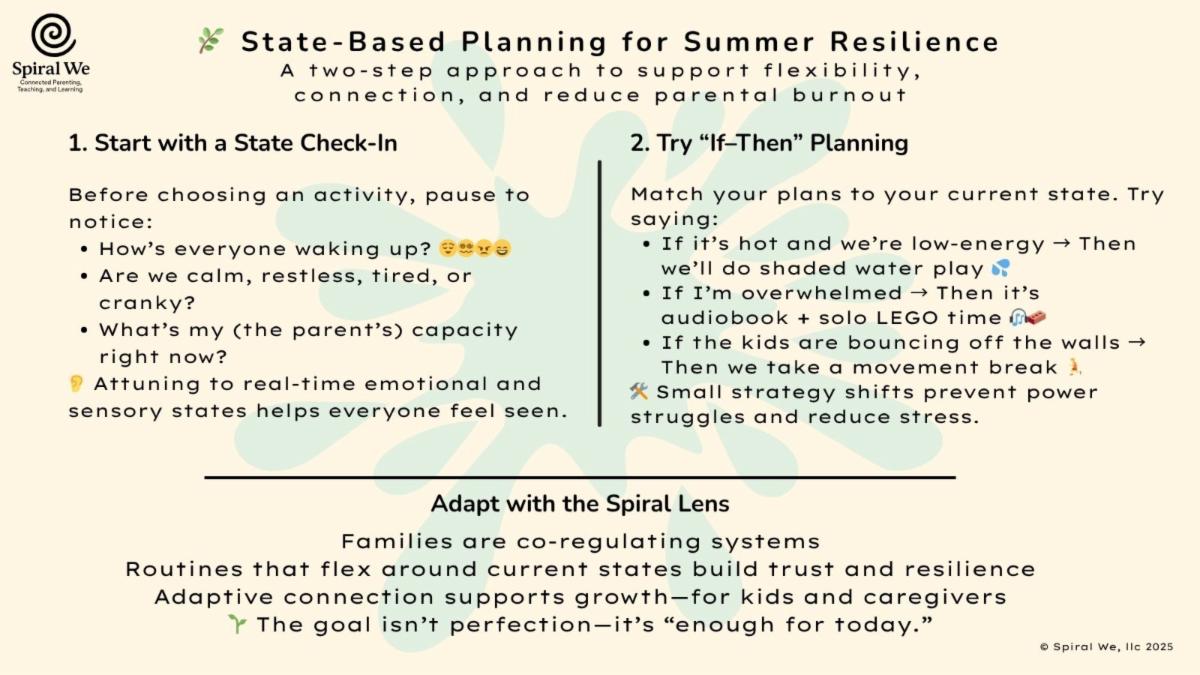
Start With a State Check-In
Before you reach for a summer schedule or Pinterest activity list, try asking: What state are we in today?
This is a gentle pause, not a diagnostic. You might ask:
- Are we starting the day calm, cranky, tired, or silly?
- How’s everyone’s body feeling—antsy, sluggish, regulated?
- As the adult, what’s my capacity right now?
These questions invite adaptive connection. They help you attune to the emotional and sensory states shaping the day, instead of pushing against them.
Try “If-Then” Planning
Once you’ve checked in, you can co-create flexible “if-then” plans with your kids. For example:
-
If the weather is scorching and we’re under-resourced, then we’ll stay cool with water play or indoor fort building.
-
If I (the parent) am on edge, then we’ll do quiet parallel play so I can recharge nearby.
-
If the kids are bouncing off the walls, then we’ll take a spontaneous hike or set up an obstacle course.
These tiny agreements help reduce power struggles and sensory mismatches. They also model self-awareness and collaborative problem-solving—skills that matter more than any enrichment packet.
Why This Matters
The Spiral Adaptation Lens invites us to see families as co-regulating systems. When we shape routines around real-time states—rather than static expectations—we build resilience. Children learn that their needs matter and that safe adults adjust. Parents reclaim space to breathe, notice, and respond with care.
State-based planning isn’t about lowering standards. It’s about right-sizing your day so that everyone’s nervous system can stay in range. Especially for families navigating asynchronous development or intense giftedness, this approach offers dignity, flexibility, and sanity.
You don’t need a perfect summer plan. You just need a way to notice what’s true in the moment—and a toolkit to meet it with enoughness.
We’d love to hear how state-based planning is unfolding in your home this summer—what’s working, what’s messy, and what’s surprising.
🗨️ Join the conversation in the GHF forum and connect with other parents exploring this approach.
To learn more about the Spiral Adaptation Lens and our ongoing work, we invite you to subscribe to our Substack: spiralwe.substack.com
___________________________________________
Our Approach to AI at Spiral We
At Spiral We, we use AI as a collaborative drafting tool—not a substitute for human insight. All content is reviewed and authored by our team, guided by our values of developmental integrity, adaptive connection, and strength-based practice. Ziv, our assistant, supports clarity and accessibility across diverse neurotypes. We welcome transparency about how each piece is created.
|