A note from the road, the clinic, and the heart of our community | |
Welcome to Developmental FX Learning Journeys' Insights newsletter, designed especially for clinicians. We are so happy you are here, and to offer a space where like-minded colleagues can learn from one another’s insights and
collectively elevate our important work. | | MARCH 2026:
FOUNDATIONS OF SENSORY INTEGRATIVE PROCESSING | |
Reflections from Tracy...
This month, we focus on the foundations of Sensory Integrative Processing (SIP). This term emphasizes sensation as a neurobiological process that enables meaningful occupation, consistent with the original work of A. Jean Ayres and supported by contemporary neuroscience.
| | | While the American Occupational Therapy Association (AOTA) recommends the term Sensory Integration and Processing, we intentionally remove the “and” to emphasize the coordinated nature of SIP. Sensation is not merely processed. It is actively used within the dynamic interplay of brain and body systems. This perspective allows us to explore dualities that matter: multiple sensory streams working together to support brain–body function and the balance of differentiation and integration that underlies adaptive capacity. | | Core Ayres Constructs: Modulation and Discrimination | | From an Ayres Sensory Integration® (ASI) perspective, sensory modulation (regulation) and sensory discrimination/perception (skillfulness) are distinct yet interconnected processes. Each supports its own neural networks and adaptive capacities, while together they enable meaningful action. Sensory input encodes meaning, interfaces with affect, and coordinates with motor systems to generate purposeful expression - what we refer to as S-A-M: Sensory-Affective-Motor integration. | | |
Sensory Discrimination/Perception: noticing, distinguishing, and interpreting sensory input; linked to praxis and motor planning, including bilateral integration, body scheme, and visual–motor skills.
Sensory Modulation: regulating intensity, timing, and emotional/arousal responses to sensory input; supports attention, activity level, and emotion regulation, with examples of challenges to this function including tactile defensiveness, gravitational insecurity, and poor registration.
| | |
The Dance of Integration
The brain and body are in constant dialogue, orchestrated by sensation as it integrates. This dance has two essential partners:
- Modulation - the system’s tuner - calibrates arousal, pacing, and regulation.
- Discrimination - the system’s interpreter - extracts meaning, maps detail, and informs skilled action.
| | |
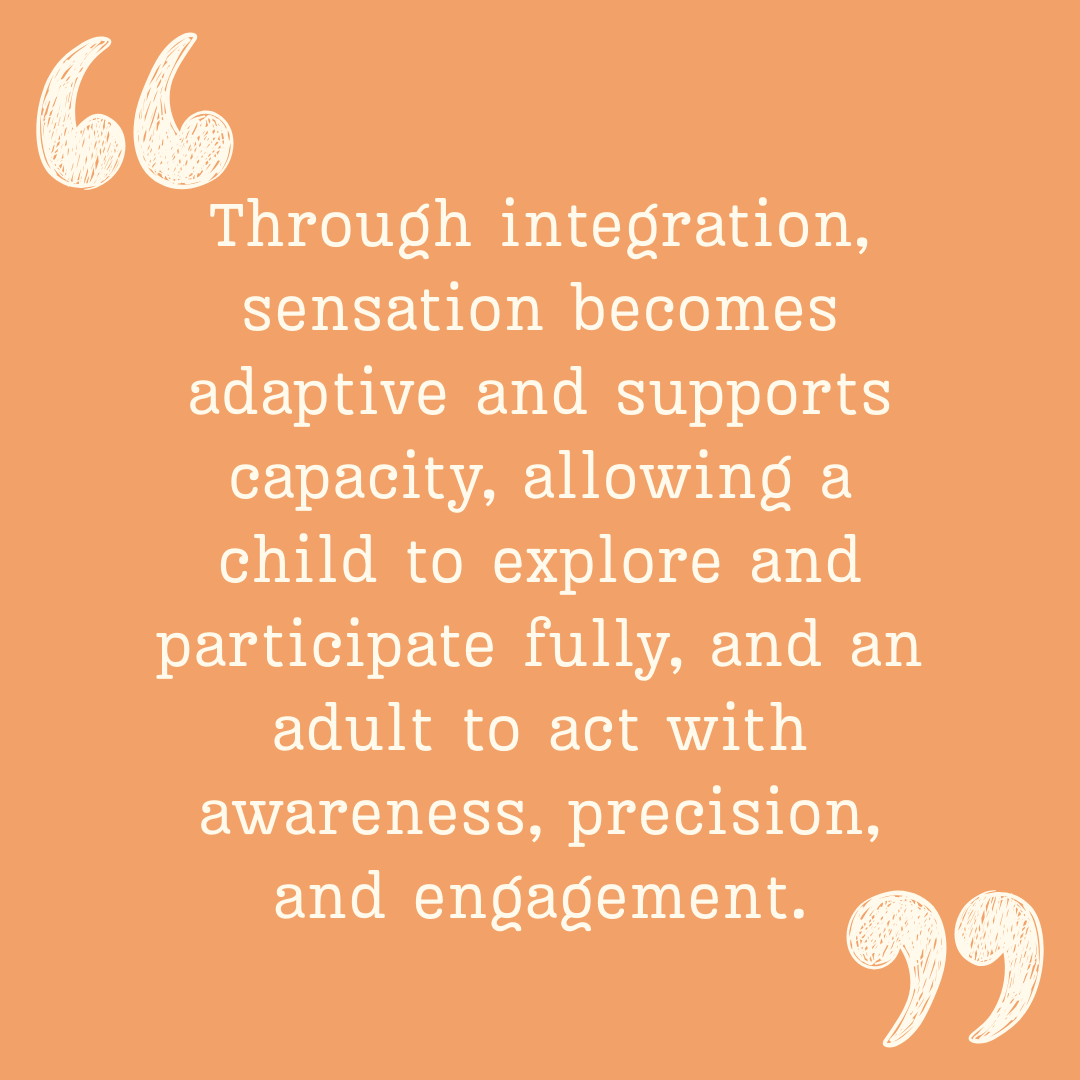
Alone, each is essential; together, they form a dynamic conversation. The nervous system weaves touch, movement, sound, and vision with emotional state, autonomic function, and intention. Through this integration, sensation becomes adaptive and supports capacity, allowing a child to explore and participate fully, and an adult to act with awareness, precision, and engagement.
| | Integration is at the heart of SIP, reflecting the enduring insight of Ayres: sensory processes must be integrated to become meaningful and adaptive. | | |
Warmly, and in reflection,
Tracy
| | This month in the Learning Journeys Community... | | |
Complementing Tracy’s overview, in the LJC this month we’ve been discussing foundations of sensory integrative processing. Tracy shared a mini-lecture on dual processing of sensory information, and we’re exploring a recent systematic review of ASI.
For our live call this month, we are excited to go through our second case processing! Join us live on March 26th at 2pm MT (find your time here), or catch the recording the following week in the community.
| | | |  |
Live LJ Community Events: Winter/Spring 2026
- Thursday, March 26:
SpIRiT Case Processing
- Thursday, April 30:
Occupation-centered sensory integrative processing
LJ Community Forums are
at 2:00pm MT
| | | |
DFX Learning Journeys Opportunities:
-
Our STEPPSI cohort is currently underway - next up will be a SpIRiT cohort launching in Fall 2026.
-
If you have a group that would like to set up a private cohort for either the STEPPSSI or SpIRiT, reach out to us at learningjourneys@developmentalfx.org!
Other Ways to Join Us:
-
DFX will be at the ICDL conference this weekend, March 20-21!
- You can hear Tracy in her keynote address, “The Science of Being Together: Co-Regulation, S-A-M, and the Epigenetics of Flourishing.”
-
DFX team members Sam Mulvey and Juliana Padilla are sharing insights from DFX’s Therapy that fits® approach in their presentation, “Bridging Language and Action: Exploring the Connection Between Gestalt Language Processing and Affordance-Based Development Through the Lens of DIR/Floortime.”
-
In September, you can catch Tracy at the 2026 PVI International Gathering - she will be presenting at the post-conference workshop day for clinicians about “Sensory Integrative Interventions: Portals to Possibility.”
-
In November, CPD Retreats is hosting Tracy for a second time as she leads “A Spirited Retreat” - an immersive learning experience in Bali, Indonesia focused on the SpIRiT© model. Learn more here.
| | | | |