The Journey - Your Newsletter
|
|
|
|
Wow! Such A
Powerful Message.
A Must-Read For All.
|
|
Dear Dr. Neimeyer,
My husband passed away a few years ago when my children were very young. I was fortunate enough to find a wonderful man and remarry. He has embraced "our" children as if they were his own. My problem is that I am very conflicted. I want my children to grow up knowing about their "first" father, but am concerned that by doing so I am undermining their relationship with their new father. One child was old enough to have memories of her first father; the second wasn’t.
All of this is tied up in my own continuing grief over the loss of my first husband and an underlying irrational guilt about remarrying. Therapists I’ve seen haven’t offered any useful guidance. Can you help me? -Nicole
Dear Nicole,
Unfortunately, not all therapists are comfortable with grief, whether because they received very little training in dealing with the uniquely difficult challenges loss presents, or because they mistakenly assume that working on issues of love and loyalty in a relationship can only be done when both partners are living. In fact, as AfterTalk demonstrates, nothing can be further from the truth, as we are quite capable of accessing the voices of those we have loved and lost, as we also negotiate the inevitable changes in our lives.
So how might you do so? One place to begin would be by consulting your first husband in the matter through an AfterTalk letter. How might he advise you handle this, balancing your understandable need to keep his stories alive with your children’s readiness for a second father who loves them in his own way? What special memories would he want you to share, and what new exploits of the children with you and your current husband might he appreciate hearing about, as they grow toward the young people and adults they will one day become?
Fortunately, we have room in our hearts to love more than one person at a time: just as we don’t have to stop loving our parents to marry, or to withdraw affection from one child in order to have another, so too we can continue our bond with a previous partner while also opening our hearts to another.
Embracing both husbands conveys this vital lesson to your children, as you teach them by example that carrying forward a legacy of love can enrich, rather than threaten, the present. –Dr. Neimeyer
Thanks to
AfterTalk
for sharing Dr. Neimeyer with us.
|
|
|
|
Robert A. Neimeyer, Ph.D. is one of the foremost authorities on grief and bereavement. He is a Professor of Psychology at University of Memphis where he also maintains an active clinical practice. He has published 27 books, including Techniques of Grief Therapy: Creative Practices for Counseling the Bereaved and Grief and the Expressive Arts: Practices for Creating Meaning. He also serves as Editor of the journal Death Studies. The author of over 400 articles and book chapters, and a frequent workshop presenter, he is currently working to advance a more adequate theory of grieving as a meaning-making process. Dr. Neimeyer served as President of the Association for Death Education and Counseling (ADEC) and Chair of the International Work Group for Death, Dying & Bereavement.
|
|
Seasons of Grief
by Sandy Goodman
|
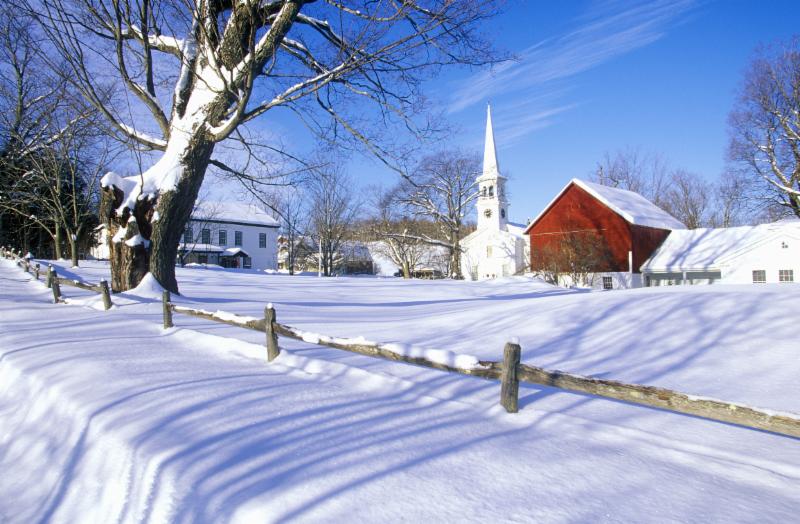
It is winter today. There is no sun, not even a flash of light to focus on. The air has become murky as if it has solidified, losing its clarity. Ice covers everything, smothering any life that might have been.
|
|
|
Staring out my window, my pondering carries me back in time to my son's death. Jason was 18 years old and at the threshold of adulthood when he made a fatal error and grabbed a high-voltage line, dying three hours later.
The death of a child is a catastrophic event. When Jason's life ended on that warm summer morning, so did mine. Like a beautiful rose battered by a sudden hailstorm, I abruptly lost all semblance to what I was before. It is not unusual for me to be sitting here at this window, years later, reflecting on what once was ...
and what is now ...
and what may become. I compare the bite of winter to my grief
:
the coldness, the shadows, and my reluctance to breathe in any more discomfort. Grief, like winter, appears uninvited and unwelcome. We abhor the pain and wonder why we must endure the distress, while all along we feel its imminent arrival.
Winter compels the earth to rest. All forms of life stop struggling and performing, and they sleep. All that was living before now appears lifeless. The leaves disappear from the trees, flowers no longer grace our gardens, and the grass is entombed by snow.
|
|
|
|
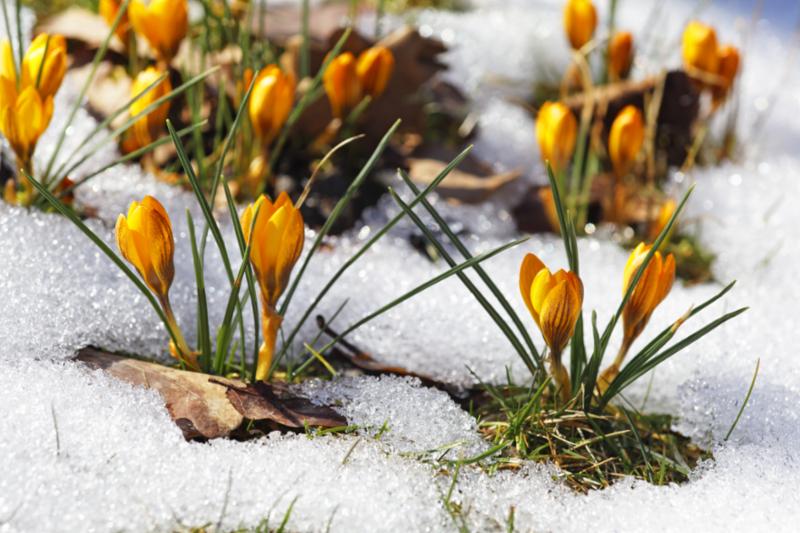
But what transpires beneath that which we can see? Are the flowers really gone, or are they only changing, renewing, transforming?
I wonder how much further I dare pursue this idea. Is grief, like winter, a gift?
|
|
Can I speak about the metamorphosis of grief and contemplate gratitude in its presence? I do not know the answers, but that is where my thoughts are leading me.
My grief necessitates a sabbatical from living. I stop struggling and performing, and I become frozen. My compulsion to "do" dissolves, and simply "being" is all that remains. My life as I once knew it disappears. My dreams are shattered, and my heart is crushed in the blink of an eye. I am lost in my grief. But what is transpiring in my heart? Is everything gone, or is it only changing, renewing, transforming?
Grief is harsher than winter. The tasks of daily living are amplified, and what was once soft and blurred becomes sharp and ragged. The challenges of winter invariably end and spring arrives. Grief makes no such promise. I must wait without assurance.
There are moments when winter is beautiful: a blanket of fresh snow on Christmas morning or the surprise of a warm breeze in February. There are nights when winter is hard and ugly, when temperatures plummet, and the howl of the wind threatens our sanity. Grief is the same. A special memory comes into my heart, and grief becomes bittersweet ... beautiful. Then, a letter addressed to my son arrives in the mail, and I return to the harsh reality that he is gone.
My grief transformed me. It tore out everything within me and said: “There! It is GONE! What are you going to do? You have NOTHING LEFT TO HANG ON TO! You must begin again. You must change.”
As winter alters the earth, my grief changed me. It gave me a period of time to step back from living and to just be. It was a time for reflection, re-prioritizing, and searching. Without this phase, I would have remained as empty as a garden that never rests.
My grief, like winter, freezes my world. Both appear painful, horrifying, and devastating, but it is our perception, anticipation, and reaction that create our discomfort. If we deny that death is possible for those we love, we are stunned and terrified by its occurrence. If we react to the first blizzard of winter with panic and fear, we are too afraid to honor its power. If we perceive a fatal ice storm as an act of God, we will shake our fist and spend more time than we have asking why. And if we distinguish death as the end of a loved one's existence, we are eternally saddened by their absence.
The path to spring, to the end of winter, requires only our patience and perseverance.
|
|
The path to healing requires that and more; it demands that we learn to think differently. If we alter our beliefs, we can then change our perception, anticipation and reaction to death. If we come to know that death is a change in form rather than the end, we do not eliminate the winters of our grieving, we lessen our suffering. My journey has been both desolate and inspiring. There have been moments when I thought the cold and darkness would never end, and moments when tears of joy washed away the pain and light permeated my being.
I invite you to walk the path of grief a little differently: to nurture winter's bleakness and look deep into its purpose. And just as we must think differently to see winter's grace, we must think differently to see the gift of grief. It is there; buried beneath a frozen crust that protects and restores while the winter of our soul
. . .
ensues.
S
andy Goodman
is the mother of three sons, including Jeremy, and twins, Jason and Josh. Jason’s death started Sandy on a path of spiritual exploration through her grief. Sandy, author of
Love Never Dies: A Mother's Journey from Loss to Love
(Jodere Group, 2002), has presented at various national conferences.
"Seasons of Grief" can be found in the anthology,
Mourning Has Broken
.
|
|
and share with your friends.
|
|
SOMEONE YOU LOVE HAS DIED.
WHERE DO YOU GO?
WHAT DO YOU DO?
GRIEFHAVEN
IS HERE FOR YOU
|
|
|
|
WE HAVE SPACE IN
THE FOLLOWING
GROUPS:
CHILD LOSS GROUPS
(Pacific Palisades - New group just starting)
SPOUSAL LOSS GROUPS
(Pacific Palisades - New group just starting)
OTHER GROUPS -
GET ON OUR WAIT LIST
(Call to get on our wait list)
|
|
 |
Remember to order your free Packet of Hope for yourself or someone you love:
|
|
|
|
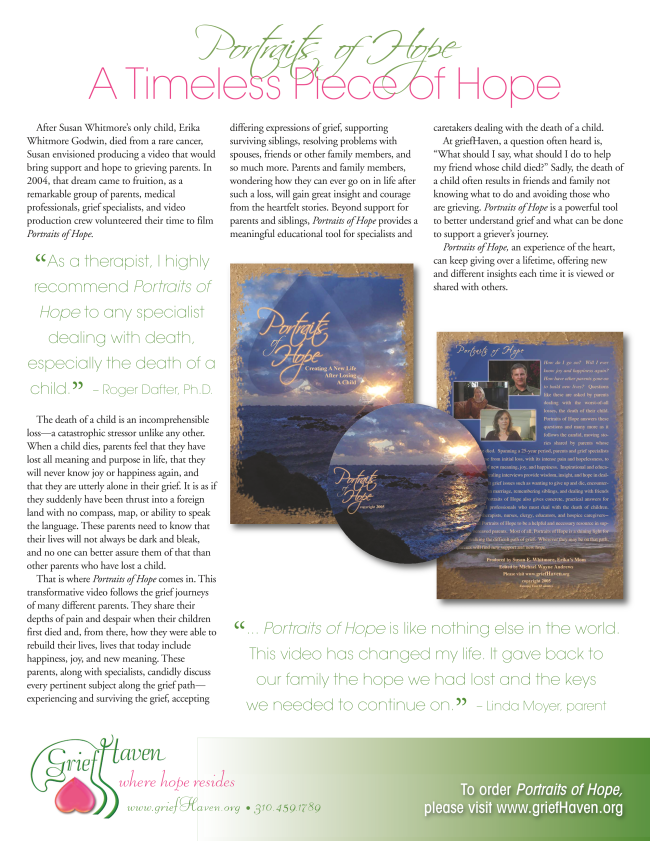
Our beautiful documentary film,
Portraits of Hope: The Parent's Journey
, will help parents who have lost a child, as well as their families, those who want to know how to support them, and those who work in the grief arena.
|
|
|
|
|
|
Would Love to Have
You Visit Us
|
www.griefHaven.org
Questions? Please Call or Email
(310) 459-1789
|
|
griefHaven | 310-459-1789 | hope@griefhaven.org | griefhaven.org
|
|
|
|
|
|
|