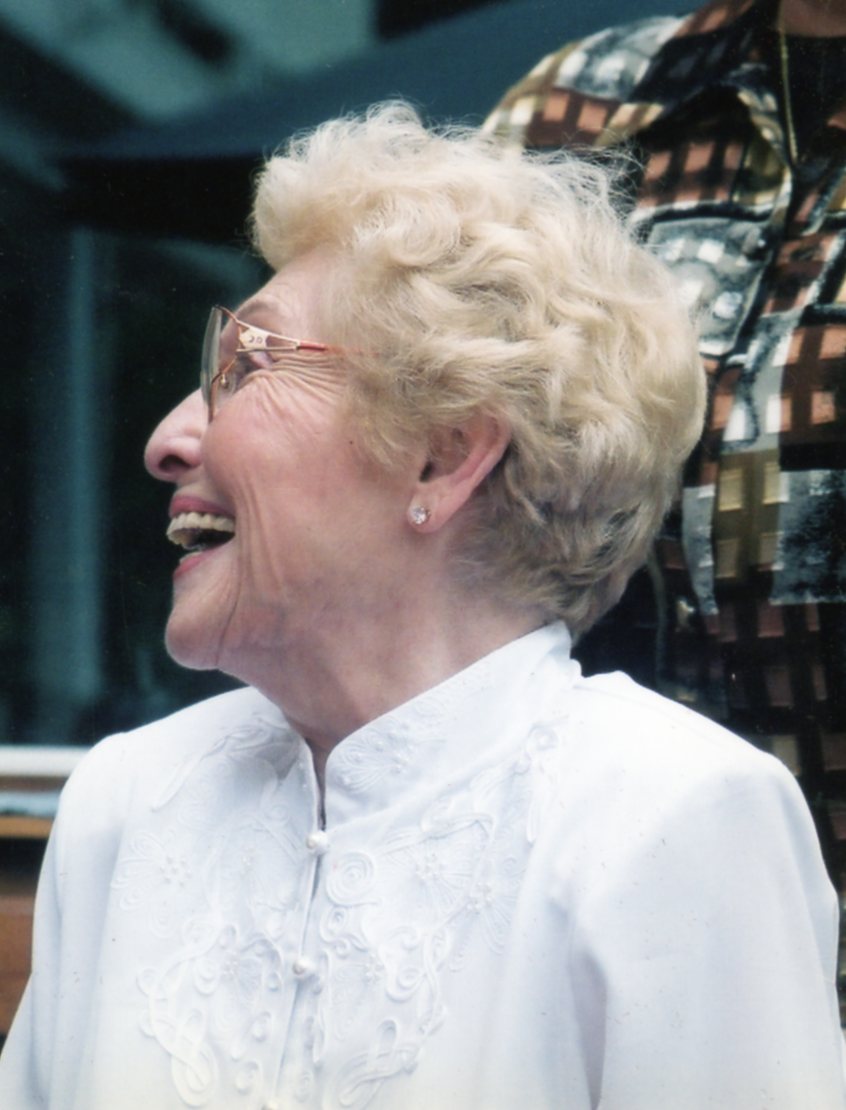
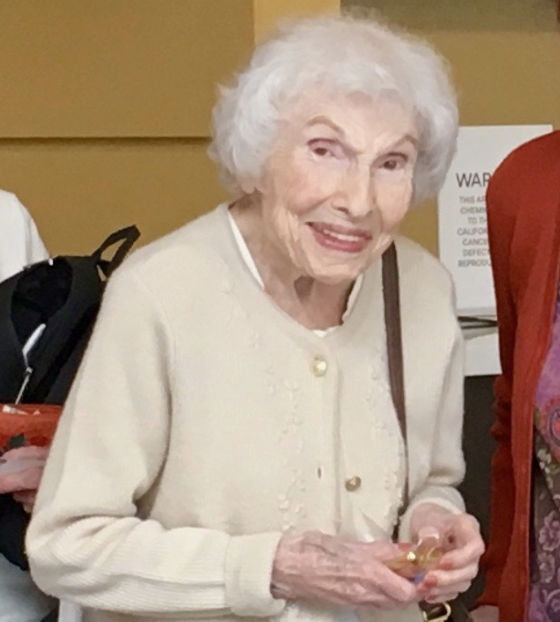
Edith Parti, Edie to everyone, was 101 years old when she died on January 27, and she lived an amazing life during a time that was too interesting to be comfortable. Imagine, she was born just after World War I and the flu pandemic, was raised during the Great Depression, started her working life during WWII, and worked well into her 90s. She never lost her spark, her sense of humor, her gumption to get up and go, or her absolutely irresistible charm.
She was born in 1920 in Chicago, and lived there for more than half a century. She was definitely a big-city kid, but she did spend a few years in a very small town when her parents temporarily moved their business to rural Indiana. She actually remembered seeing the first car drive into town, and she attended a two-room school where the kids in different grades were lined up by row. She said that when her family moved back to the big city, the Chicago schools mostly repeated what she had learned from the upper-grade lessons she overheard in Indiana.
Her parents had emigrated to the U.S. from Europe, ultimately from what we would now call the Ukraine, with almost no financial resources; armed with several European languages, but very little English. They opened a store on the West Side of Chicago and sold cloth and other supplies for sewing. In those days, people often (and in that neighborhood, mostly) made their own clothing. Her father Harry and his cronies would get together in the store every morning to drink coffee and talk about the issues of the day – the great Wall Street crash, the depression, the gathering storm of war. Edie’s family lived in a small apartment in the back of the store; and in the late afternoons her mother Bessie would go there to start dinner, and the store would be filled with the smells of delicious cooking. Before marriage, Bessie had run the kitchen of a small restaurant. Although they didn’t have very much money for extras, there was always food on the table.
College was out of the question for Edie because of the economic situation and she took a commercial course in high school so that she could get a job as a secretary after high school. All during this time, though, she loved music, and wanted to sing professionally: her high school yearbook prediction for her was that she would become a great singer.
But she needed to work, and she became a secretary, and she married. She and her beloved husband Charlie, set up housekeeping in a three-room basement apartment on Chicago’s West Side. They managed to save some money and made a nice life for themselves there for some years with one kid, Michael, and a small dog, Rex.
Edie and Charlie eventually managed to save enough money to buy a house. She kept getting better jobs and she became a crackerjack legal secretary at one of the best law firms in Chicago. The lawyers in that firm had to be in the top 10 of their law class (most of them from the University of Chicago). One of the influential clients of the firm decided that wasn’t enough of a recommendation and he insisted that everyone who worked for him, including all the people who worked on his legal problems, had to take an IQ test. That included Edie, and it turned out that she did better than average, even if you just counted the lawyers’ scores.
After spending quite a few years at the same law firm, she decided to go back to school to become a court reporter. Once she graduated, she opened up her own court reporting firm and ran that for many years until the State of Illinois decided to create a group of Official State of Illinois Court Reporters. She assumed a leadership role there, and designed the initial court reporter staffing management plan for the entire state of Illinois. She also did actual court reporting and had to respond on a 24-hour basis when there were social disruptions such as the 1968 Democratic Convention.
All during this time, the house that she and Charlie bought was full of friends (their own and their kid’s), family, business acquaintances and visiting dignitaries, visitors from abroad – lots of good stories, laughter, good food, and debates about interesting ideas. There were lots of holiday celebrations. Since Edie and Charlie both worked, Saturday was for general housecleaning- she sang over the vacuum cleaner noise, and Charlie was a pretty good whistler.
After many years in that house, Edie and Charlie decided to retire to California where they had a lot of family, and the weather was more forgiving. Visiting their son Michael who was teaching at San Diego State convinced them that the area around Del Mar looked like a pretty good place for a retirement. They moved there in the late 1970s.
At about that time Charlie became quite ill from emphysema, a pulmonary disease that resulted from a lifetime of smoking. He enrolled in a pulmonary rehab program at Scripps Clinic, and most of Edie’s days were spent organizing his diet and exercise and medications. They spent several happy years at their new house, but he died in 1984.
It’s strange to imagine this, but Edie was 63 years old at that time and she still had almost 40 more years of productive life to live. Since her whole life had revolved for several years around her husband, she needed to reevaluate her goals. She had no interest in remarrying: Charlie was her guy and that was that.
Her son Michael had opened a consulting firm, and though he taught economics, he had far less experience running a firm than she did. She took over the bookkeeping for the firm and was usually the main editor of the consulting reports that went out of the firm. She evaluated all the office software that came into the firm, and helped to evaluate the personnel hired by the firm. She did all of the office management tasks, was skilled at evaluating business plans, and charmed all the visitors to the firm’s offices. The firm was audited several times by the IRS and Edie ran the IRS interviews for the firm. Each time, the IRS complimented the firm on the high quality of its books.
At the same time, Edie joined Del Mar Community Connections to maintain contact with the people around her. She also made some further important connections that merged two interests stemming from her childhood: She wanted to make contact with people who spoke the Yiddish language she’d heard and spoken as a child, and she wanted to sing again. She joined several choirs and also became involved with the Yiddish Circle group at the JCC. This group included some very talented, creative people and they wrote and performed, in Yiddish, a funny and beautiful musical version of Snow White. One day, the leader of that JCC group, told Edie’s son Michael, “Your mother is a great artist.” Edie also took piano and voice lessons in her 80s, and continued to act and sing on stage well into her 90s.
She lived independently and organized her own bills and financial affairs until she was 98, and then moved to a retirement home just east of Del Mar. When she was 99 she developed symptoms of Alzheimer’s disease. Although her memory began to be faulty, her welcoming, funny, clever, and affectionate personality was still intact, and she still sometimes made wry puns. She contracted the Covid-19 disease this January and was moved to a skilled nursing facility. The last real words she spoke to her son Michael were in this conversation a few days before she died:
Edie: I don’t know who these people are.
Michael: Mom, you’ve caught a virus and they’re taking care of you in an isolation area. I’ve been worried about you.
Edie: Oh honey, don’t worry about me.
Edie, had many good, valued, friends at Del Mar Community Connections and the JCC and she was much-loved in her various family roles: mom, grandma, and great-grandma. She was the treasured biological and honorary Aunt Edie.
She always wanted to be doing something useful, and she loved to communicate with people. When she worked, everyone wanted to work with her. In her personal life everyone wanted to talk to her.
She had a good life.
Remembrance shared with DMCC by Edie's son Michael and her grandson Charlie.
There will be no in-person memorial due to ongoing pandemic concerns. The family requests that those who wish to share a remembrance gift make a memorial donation to the Alzheimer's Association.