Welcome to the University of Oklahoma Carceral Studies Consortium Newsletter. The Carceral Studies Consortium strives to build a community for intellectual exploration that includes faculty, staff, graduate students, community members, practitioners, and organizers.
Carceral Studies is concerned with the independent function and nexus of the political and social systems that organize, shape, sustain, and entrench practices of punishment, surveillance, incarceration, and harm.
|
|
Carceral Studies Micro-Grants |
|
The Carceral Studies Consortium is pleased to announce recipients of its inaugural micro-grants. Congratulations to the following project leads:
|
|
-
Access to Gardening for the Women of the Mabel Bassett Correctional Center (Project Leads: Bailey Hoffner and Sharee Asberry)
-
Against Carceral Feminism (Project Leads: aurelius francisco and Erin Simpson)
-
Environmental Justice & Incarceration (Project Leads: Olivia Robson, Emma Colven, and Anthony Levenda)
-
Poetic Justice Distance Learning (Project Leads: Ellen Stackable and Nancy LaGreca)
-
Writers Guild: Giant Steps (Project Leads: Catherine Mintler, Nick LoLordo and Timothy Bradford)
|
|
|
|
Students in Wake County, NC, have been organizing to eliminate the discriminatory school resource officer program from their schools. Removing these SROs, student organizers argue, “is as much about shifting the culture that allows armed officers in the halls with children as it is about getting the cops off campus.” The Wake County Black Students Coalition organized to keep SROs out of high school as school security in North Carolina has become a significant expense in district budgets and students recognized the history of abuse and discrimination within the program. Parents whose families had experienced racism in the school organized together and “realized that their experiences were not exceptions, but the rule for Black and Brown families.” These parents and students, along with researchers, have come to understand “Increasing investment in school resource officers does not lead to safer schools.”
|
|
|
|
After Austin’s City Council voted in August to take funds from the police department’s budget to provide social services, the City Council voted to purchase one hotel to turn into sixty units of permanent housing for people experiencing homelessness. Council Member Gregorio Casar, who led the efforts to cut police housing, argues: “That’s [cutting the police budget] how we’re paying for this. That’s the only reason we’re able to do this.” The city’s Homeless Services Division will work with nonprofit service providers to cover operating costs and services for residents.
|
|
|
|
Scholars at UCLA won a $3.65 million grant funded by the Andrew W. Mellon Foundation to preserve and dissect the history of mass incarceration in Los Angeles. This archive will preserve 177 boxes of LAPD records as well as oral histories and other ephemera from community members. The materials from people impacted by incarceration and policing will complement the LAPD’s institutional records. Kelly Lytle Hernández, who leads this and UCLA’s Million Dollar Hoods project, notes: “This is an example of community control over policing. We are taking control over the archive of what happened, and we will be curating what gets released and how, and we will be describing it, filling it with meaning. It’s reparative work.”
|
|
|
|
A Harvard University professor faced backlash for his course that asks students to analyze the efficacy of C3 on residents of Springfield, Mass. C3 is “a domestic policing technique modeled after counterinsurgency tactics used in the Iraq and Afghanistan wars.” Students at Harvard “felt outraged that the school would offer a course that they say perpetuates overly aggressive policing of marginalized communities and treats them ‘as laboratories for experimentation.’” Students noted that the data-driven nature of C3 might “naturalize policies and practices that have had disparate impacts on Black and Brown communities.” Due to student protest, the course was canceled for the spring semester.
|
|
|
|
In Cool Spring, SC, Black residents farm, forage, and raise livestock as “a preemptive strike against food insecurity.” Racism, racist violence, and harmful laws cause “disease in the Black community and compel them to continue the struggle for self-protection,” and one way this self-protection is achieved in Cool Springs is through food security and sovereignty in the Black community. Richards-Greaves concludes: “Producing their own foods allows Black Cool Spring residents to maintain Black foodways by reducing or eliminating the scarcity that results from seasonal crops or insufficient finances and ensuring some degree of authenticity.”
|
|
|
|
In its first six months the Support Team Assisted Response Program (STAR) has responded to 748 incidents like trespassing and mental health episodes. Instead of police officers responding to these incidents, STAR sends a civilian mental health clinician and paramedic. None of the incidents to which STAR responded led to arrests or police involvement. Sachs argues: “STAR represents a more empathetic approach to policing that keeps people out of an often-cyclical criminal justice system by connecting people with services like shelter, food aid, counseling, and medication. The program also deliberately cuts down on encounters between uniformed officers and civilians.” This alternative to policing empowers behavioral health experts.
|
|
|
|
In cities across the U.S., activists and organizers are working to end contracts between local police forces and public libraries to provide cop-free libraries. Libraries are among the few public spaces that provide access to basic resources. Public library budgets, such as Los Angeles’, disproportionately invests in security and policing. Fassler and Ventura argue: “Though the public library, in the popular imagination, is upheld as a place of equal opportunity and freedom, the LAPL budget reveals that it is also a site of increasing policing and surveillance.” They continue: “Angelenos like [Theo] Henderson believe library policing is just another way to criminalize the unhoused for simply existing.” Some libraries, like those in Denver and Dallas, employ social workers to connect patrons with services and handle crises.
|
|
|
|
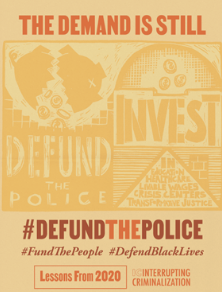
Andrea Ritchie, organizer and author with the group Interrupting Criminalization, discusses the group’s new report The Demand is Still #DefundPolice: Lessons From 2020. Ritchie argues that organizers have much to learn from both the successes of the past year, such as the divestment of over $840 million dollars from police departments and the solidarity budgets created in cities like Seattle, as well as the roadblocks, such as the “funny math” of cutting $300 million from the NYPD budget but moving that money to the Department of Education budget to continue funding school resource officers. Ritchie delves into how communities ought to care for themselves and how the call to divest is paired with a demand to invest in people and communities. Ritchie argues that abolishing police requires imagination, and asks: “What is the role of the state? Do we really need someone to call for every problem? Or is there not some responsibility that we all have to each other, for each other’s safety?”
|
|
|
|
More than 100 inmates at the St. Louis City Justice Center took over two units of the jail and held control of these units for over six hours. This protest comes in the wake of two other protests in December and January over the jail’s conditions and COVID-19 protocols. Murphy reports: “The mood during the uprising, both on the fourth floor and in the crowd of supporters cheering from the street, was celebratory. But the incident followed weeks of unanswered complaints from inmates and crackdowns by jailers, advocates say.” Nonprofit law firm ArchCity Defenders, which has a jail hotline for inmates and their families, notes that inmates have been airing grievances for weeks; they are concerned about COVID-19 spread, freezing temperatures, harsh treatment by officers, and inadequate access to medical care. After officers regained control, they relocated 55 inmates to a segregated unit on another floor and 65 inmates to the Workhouse.
|
|
Announcements & Opportunities |
|
"The Truth About Tulsa and the 1921 Race Massacre: Histories and Legacies in Context"
An Online Lecture by Dr. Scott Ellsworth
Feb. 23, 2021 | 6:00 pm CT
Dr. Scott Ellsworth, author of the seminal history Death in a Promised Land and one of the lead scholars for the 2001 Tulsa Race Riot Commission Report, offers perspectives on the Tulsa Race Massacre from historical and contemporary perspectives, with particular recognition of the ways in which the massacre continues to reverberate today.
|
|
|
"Abolitionist Pedagogy Workshop"
An Online Workshop Led by Dr. Sabina Vaught
March 26, 2021 | 1:30-2:30 pm CT
Dr. Sabina Vaught, founding chair of the Carceral Studies Consortium and Professor and Inaugural Chair of the new Department of Teaching, Learning, and Leading at the University of Pittsburgh will offer an Abolitionist Pedagogy Workshop on March 26, 2021.
|
|
|
Carceral Studies Student Work Prize
Submissions Due May 1st, 2021
The Consortium is pleased to announce a Carceral Studies Student Work Prize. OU students may submit an original essay or creative work produced as part of any course in any discipline during the 2020-2021 academic year that deals with the topic of Carceral Studies, broadly conceived. Submissions are due May 1st, 2021.
|
|
|
About
The Consortium Newsletter offers a roundup of selected articles that reflect today’s news, organizing, and thinking related to the carceral state. We understand that freedom work is built on education and engagement. Education requires an understanding of contemporary issues informed by their historical context. We hope that these curated articles will help you analyze the issues that we face and understand the community that we strive to construct.
|
|
Join the conversation!
We encourage feedback, suggestions, and article recommendations. Please reach out to carceralstudies@ou.edu with any ideas, thoughts, or recommendations.
If anyone you know is interested in receiving this newsletter and other information from the Carceral Studies Consortium, please forward them this email and they may click this link to subscribe.
|
|
Land Acknowledgment
The University of Oklahoma is on the traditional lands of the Caddo Nation and the Wichita & Affiliated Tribes. This land was also once part of the Muscogee Creek and Seminole nations. It also served as a hunting ground, trade exchange point, and migration route for the Apache, Cheyenne, Comanche, Kiowa, and Osage nations. Today, 39 federally-recognized Tribal nations dwell in what is now the State of Oklahoma as a result of settler colonial policies designed to confine and forcefully assimilate Indigenous peoples.
|
|
The University of Oklahoma is an equal opportunity institution. ou.edu/eoo |
|
|
|
|
|
|