|
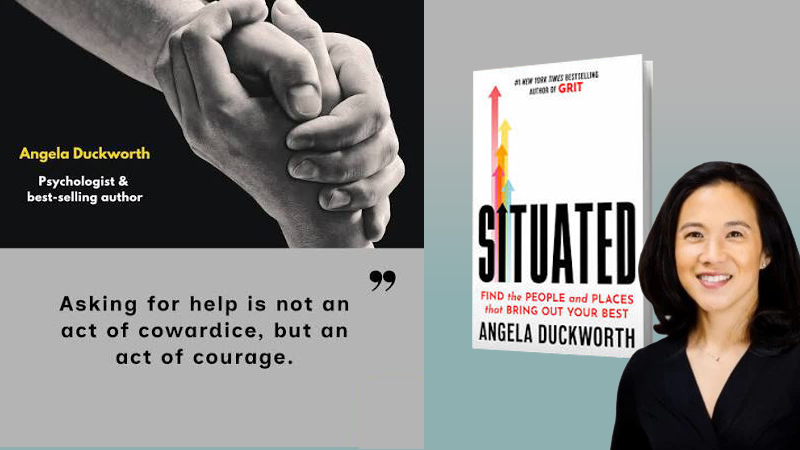
Recently, on the heels of the publication of her new book Situated: Find the People and Places That Bring Out Your Best, professor of psychology Dr. Angela Duckworth wrote an op-ed in the New York Times that identified asking for help as an essential skill for success. She backs up this assertion with references to studies looking at successful persistence and performance in both college and career contexts:
"College students who proactively seek assistance from others typically outperform those who avoid doing so...Research also shows that entrepreneurs are more successful when brought together to learn from one another."
Not surprisingly, the old mode of learning in American schools fostered the “individual contributor” mindset, building people who competed to be their best for themselves, not for others. If students struggle with team projects in K-12 and do not learn in college to value collaboration and how to accomplish goals through and with others, they are likely to stall as learners and more so as earners. The world of work requires that grads be strong at working with peers, managers, and those who follow in their footsteps. This requires vulnerability, self-awareness, and humility to ask for help and to be helpful.
In my academic coaching work over the last eight years, I have seen an astounding number of students who resist asking for help. One can posit any number of causes in addition to the “factory method” of learning — a COVID-induced tendency toward isolation, the lure of easy screen use over more effortful human interaction, messaging that asking for help is a sign of failure or weakness, or maybe a combination. Whatever the cause, the instinct to go it alone is often problematic. With students for whom isolation exacerbates academic struggle, the tendency toward self-blame can create even more difficulty. Working alone can make it hard to find causes for failure outside the self. Even if a student can succeed academically while flying solo, they aren't likely to build the teamwork skills that are so essential in the modern workplace. Colleges have to address this pattern, if grads are going to succeed outside of the Ivory Tower.
When a student comes to coaching, whether mandated or by their own initiative, the coaching conversation itself is an experience of connection driving success. Within that conversation, coaches can advocate for further interdependence by:
-
Encouraging students to discuss their habits about, and viewpoints of, asking for help: "When do you ask for academic help?" "What does asking for help mean to you?" "If you haven't gone to office hours, what is the reason?"
-
Inviting students to explore possibilities for help: "Who might answer your question?" "Which professors or teaching assistance might support your learning?" "Where else on campus can you find learning assistance that can help you up your game?"
-
Normalizing help—perhaps with a quick personal story, perhaps with a question about their own lives: "When has help from someone allowed you to reach an important achievement in your life?"
-
Asking about the value of multiple perspectives and the benefit of others who can see what you cannot—who can fill in the gaps that each of us has and has to manage to succeed.
Join other educators at a LifeBound training and grow your own skills of interdependence so that you can help others you coach master this themselves. All of us need this basic skill to succeed in an increasingly complex world—we all need each other.
To learn more or explore which option is right for you, visit www.lifebound.com.
|