JANUARY 26, 2026

Facebook  X  Instagram  Email  Web

AZGOP Annual Meeting: Unity Tested Before It Began — and Ended After Eleven Hours


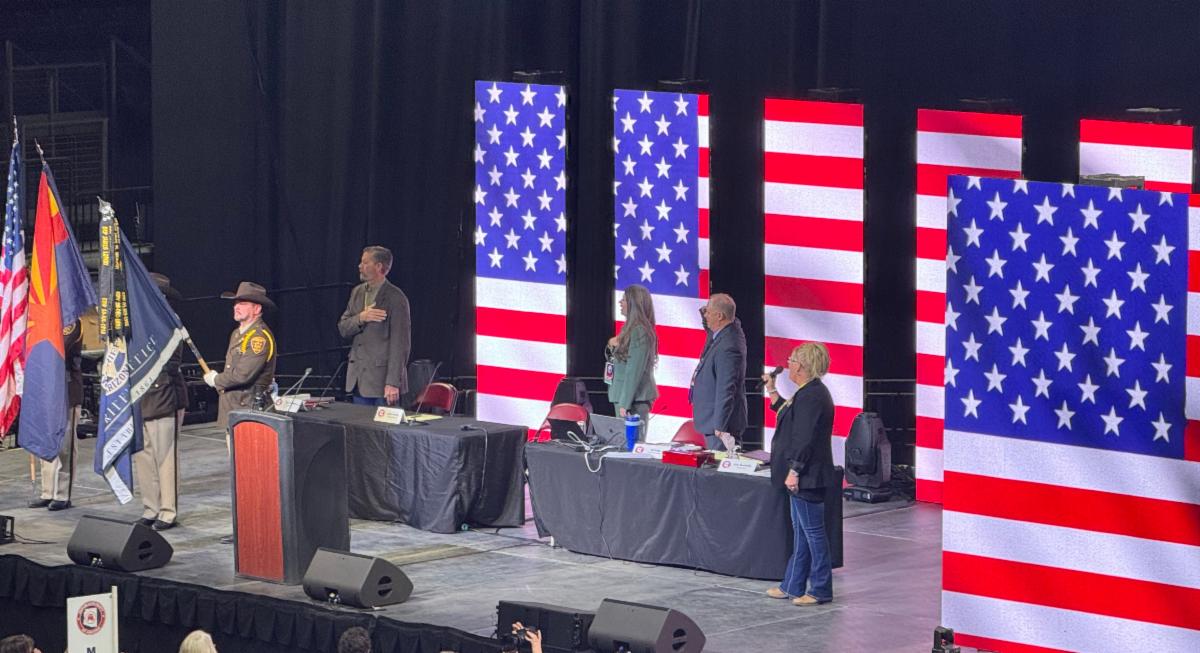
On January 24, the Arizona Republican Party held its annual meeting in Prescott Valley—and the drama started well before the gavel dropped.


Maricopa County State Committeemen were vocal about having to drive north. For years, however, rural counties have asked that the meeting be held outside what’s often referred to as the “State of Maricopa.” The challenge has always been logistics—finding a venue large enough to accommodate such a large event. Last summer, the AZGOP Board unanimously voted to hold the meeting in Prescott Valley, acknowledging those long-standing rural concerns.


Leadership Rumors and a Party at Odds with Itself

Location wasn’t the only controversy. Rumors swirled about then-Chair Gina Swoboda, who was scheduled to officially resign as she prepares to run for Congress in CD1, replacing David Schweikert, who is running for governor. In a party that too often turns its fire inward instead of focusing on defeating Democrats, there were some who felt Swoboda couldn’t leave fast enough. But other State Committeemen hoped Swoboda would remain as chair—despite four candidates already lined up to replace her. Motions were made from the floor urging her to stay.


I support the decision Swoboda made to leave but I would have stood by her if she chose to stay. Swoboda has time and time again put party over personal gain and that matters to me.


It is worth noting, Gina Swoboda, herself asked for the motion for her to remain as chair be withdrawn.


Lawfare, Irony, and Internal Combat

And of course, it wouldn’t be a party meeting without lawsuits—three of them, in fact, with more likely to follow. The irony is hard to miss. The MCRC rails against lawfare year after year, yet our own internal disputes increasingly rely on it.


Attorney Tim La Sota, representing Lawrence Hudson, filed suit contesting the appointment of fractional State Committeemen—a practice that has existed for over a decade. This time, however, one of those appointed fractional members was Sergio Arellano, a candidate for chair.


Rumor has it the suit was funded by Jake Hoffman and Tyler Bowyer, who were backing their preferred candidate, Pam Kirby. Many believe the broader objective—particularly from Turning Point Action—is access to AZGOP data, bringing the organization one step closer to rivaling the RNC itself.


In reality, Arellano was the only serious competitor to Kirby, though Kathleen Winn and Bob Branch were also on the ballot.


Delays, Discipline, and a Lesson in Leadership

The first three hours were plagued by predictable delays. It was clear early on who wanted Swoboda out immediately, but she maintained composure and control of the room—as she so elegantly does. Eventually, the gamesmanship shifted elsewhere.


There’s a lesson here for every Republican leader: stick to the statutes and bylaws, listen to your parliamentarian, and never let them see you sweat.


In her remarks, Swoboda reflected on a brief moment when the party was united—before fracturing once again. She urged members to work together and find common ground. Those were once core Republican values, before purity tests took over our party.


The Numbers That Should Wake Us Up

Because of the lawsuits, the 16 fractional State Committeemen were initially denied credentials. A motion was made and after extensive debate, the motion passed and credentialing was able to seat them. Their inclusion brought total attendance to 1,709.


Let that number sink in.


Out of millions of Republicans in Arizona, and thousands of State Committeemen, fewer than two thousand of the elected state committeemen showed up to directly influence the direction of their party and their government. Taking that 1,709 figure and projecting it across all 50 states, fewer than 100,000 people nationwide effectively determine the direction of the Republican Party. That reality alone should give every Republican pause.


Accuracy Over Speed

With lawsuits looming, every step of the process was checked—and rechecked—anticipating court challenges. The credentialing report alone took more than two hours, and counting the first round of ballots stretched past four hours. Accuracy, not speed, ruled the day.


As expected, the vote resulted in a runoff between Pam Kirby and Sergio Arellano. In the end, Sergio Arellano prevailed, securing the chairmanship and closing one of the longest days Arizona Republicans have endured in recent memory.


A motion was then made to suspend debate and forgo even the reading of proposed bylaw changes. It passed with overwhelming support. Due to the hour, the results will be counted off site at a later date. My prediction, none will pass just like at the Maricopa County Republican Committee Mandatory Meeting two weeks ago.


The meeting lasted over eleven hours.


The New AZGOP Leadership Team

The newly elected AZGOP Board is:


  • Chairman: Sergio Arellano
  • First Vice Chair: Shiry Sapir
  • Second Vice Chair: Kevin Maldonado
  • Third Vice Chair: Nickie Kelley
  • Secretary: Sherra Kissee
  • Assistant Secretary: Shirley Dye
  • Sgt at Arms - Carie Hughs
  • Asst Sgt at Arms - Frank Antenori
  • Assistant Treasurer: Young Mayberry


One final moment stood out. When Kathleen Winn did not advance to the runoff, she immediately texted her support for Sergio Arellano. In a day defined by division, that gesture of unity mattered—and may be a small but meaningful sign of how the party can begin to move forward together.

Thank you Gina Swoboda for all you have done and are doing for our party. 

Honored to Serve: Appointment to the Surprise Planning & Zoning Commission


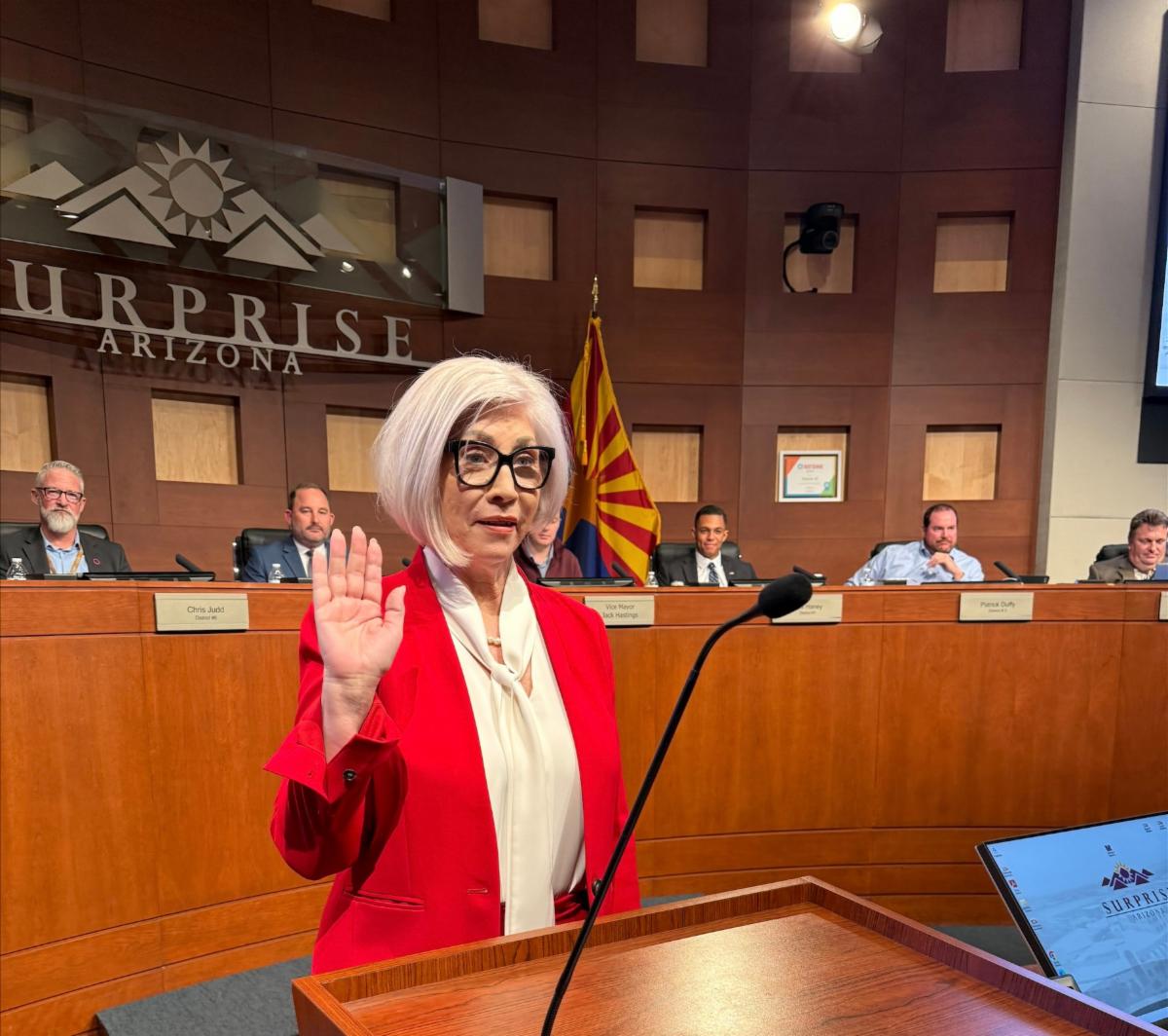
On January 20th, I was honored to be appointed to the Surprise Planning and Zoning Commission. Many of you who have followed my newsletters over the years know that zoning and land-use issues are near and dear to my heart. They are not abstract policy discussions—they directly affect families, neighborhoods, traffic, water resources, schools, and the overall character of our community.


Zoning is always a delicate balance. It requires respecting the property rights of landowners while also recognizing the rights of neighboring property owners and the broader community. Growth can be positive and necessary, but it must be thoughtful, transparent, and responsible. Poorly planned development decisions can have long-lasting consequences, while well-planned projects can strengthen our city for generations.


I am committed to approaching each case with an open mind, careful analysis, and a deep respect for the people who live and work in Surprise. I look forward to working collaboratively with my fellow commissioners, city staff, and residents to make sound, responsible recommendations to the Surprise City Council.


Thank you to everyone who has supported and trusted me to serve in this role. I take that responsibility seriously and will continue to earn your trust as we work through important zoning and planning decisions that shape the furute of Surprise.


Experience Matters at the Arizona Corporation Commission


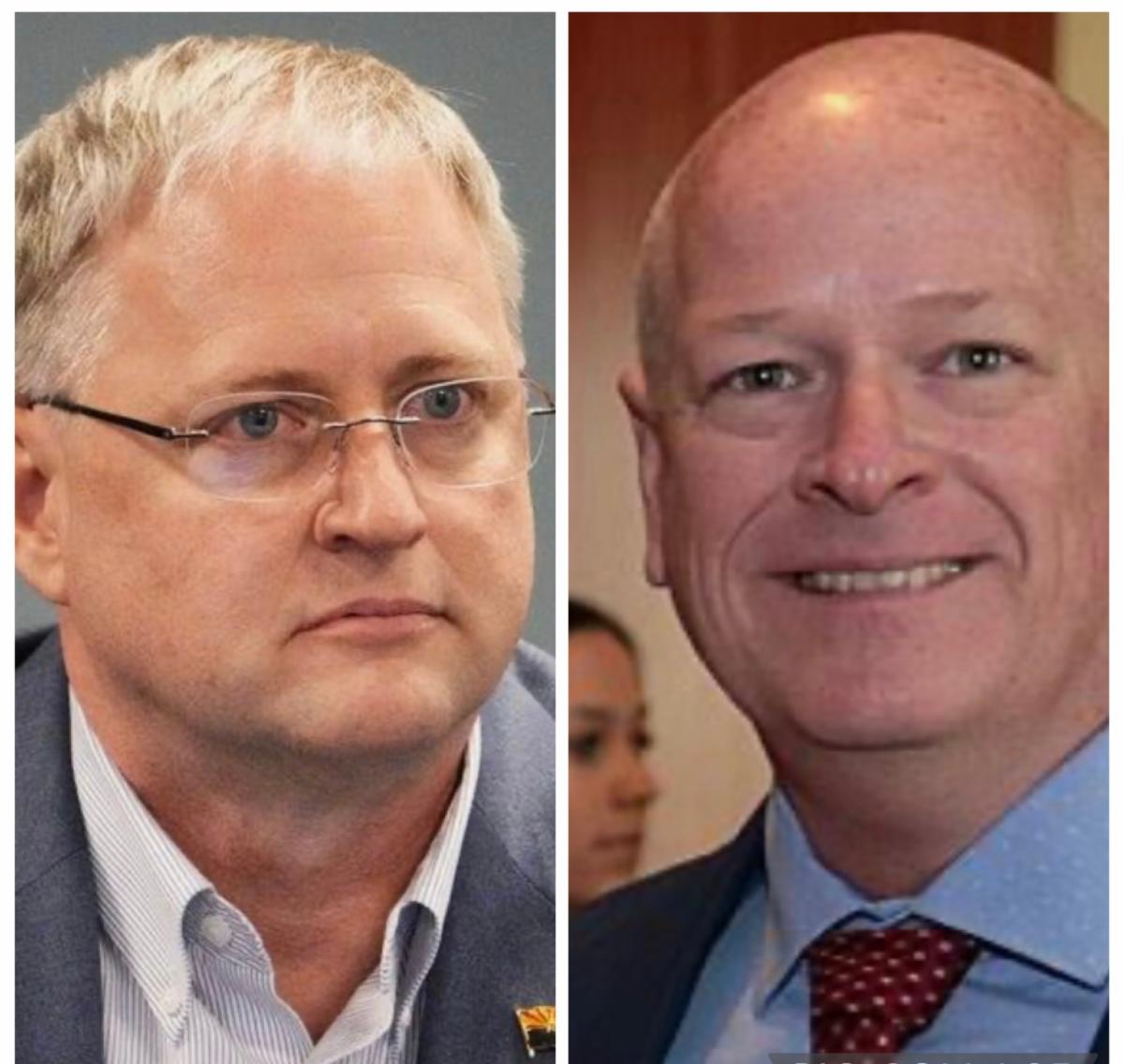
Nick Myers and Kevin Thompson are running for re-election to the Arizona Corporation Commission, and their continued service is critical at a time when Arizona’s growth, energy demand, and infrastructure challenges are colliding.


The Arizona Corporation Commission (ACC) is not a symbolic office. It is a powerful state agency that regulates investor-owned utilities—electric, gas, water, and telecommunications—oversees railroad and pipeline safety, incorporates businesses, and enforces securities laws. The Commission operates as a quasi-executive body, balancing consumer protection with the realities of keeping essential services reliable, affordable, and secure. This work requires deep technical knowledge, regulatory experience, and a clear understanding of long-term consequences—not sound bites.


Proven Leadership with National Credibility

Nick Myers brings that depth of experience to the Commission. He serves on the Federal-State Current Issues Collaborative alongside the Federal Energy Regulatory Commission (FERC) and the National Association of Regulatory Utility Commissioners (NARUC), representing western states on complex energy policy issues. His work places Arizona at the table where national and regional grid decisions are being shaped—decisions that directly affect reliability, cost, and future capacity.


Kevin Thompson also brings extensive leadership and recognition. He currently serves on the Western Energy Imbalance Market (WEIM) Body of State Regulators, advising on western grid coordination and stability. He is a member of NARUC’s Board of Directors, serves on the Electricity Committee, and on the Critical Consumer Issues Forum Advisory Council. He has worked with the White House and the National Energy Dominance Council on many issues impacting Arizona. He most recently served as the Chair of the ACC from January 2025 to January 2026. Previously, he chaired the National League of Cities Economic Development Committee, giving him a strong understanding of how utility policy directly impacts economic growth and local communities.


In addition, Myers serves on NARUC’s Committee on Gas and the Committee on Critical Infrastructure, is a past Co-Vice Chair of the Subcommittee on Nuclear Energy, and has met directly with federal energy leaders in Washington, D.C., alongside the Chair of FERC. In January 2025, he was unanimously selected as the first-ever Vice Chairman of the Arizona Corporation Commission—an unprecedented vote of confidence from his peers.


Why This Election Matters

Both Myers and Thompson have decades of experience in public utilities and regulatory policy. Their challengers do not. These challengers did not independently study utility systems, energy markets, or regulatory frameworks before deciding to run. They did not “wake up one day” with a passion for utility policy. Instead, they are campaigning on rehearsed talking points—buzzwords that may sound appealing on the trail but reveal a dangerous lack of understanding once applied to real-world decisions.


It is easy to campaign across Arizona repeating slogans. It is far harder to grasp the implications of grid reliability, base-load generation, infrastructure investment, cybersecurity, and long-term planning for a rapidly growing state.


Setting the Record Straight on Utility Rates

Since Myers and Thompson were elected, they have focused on rooting out waste and protecting ratepayers. One reality the public often misunderstands is utility rate increases. When companies like Arizona Public Service (APS) request rate adjustments, those increases are not designed to pad investor profits. They are intended to reimburse the utility for the cost they incurred for poles, wires, abor, tools, and equipment to ensure the grid remains reliable for customers across their service territory.


Without experienced commissioners who understand these systems, Arizona risks short-term political decisions that lead to long-term instability, higher costs, and unreliable service.


The Bottom Line

The Arizona Corporation Commission is not a training ground. It is a highly technical, high-stakes regulatory body that directly affects every household and business in our state. Nick Myers and Kevin Thompson have earned re-election through experience, national respect, and a demonstrated commitment to responsible oversight. At a time when Arizona cannot afford mistakes, experience matters-and voters should choose proven leadership over empty rhetoric.


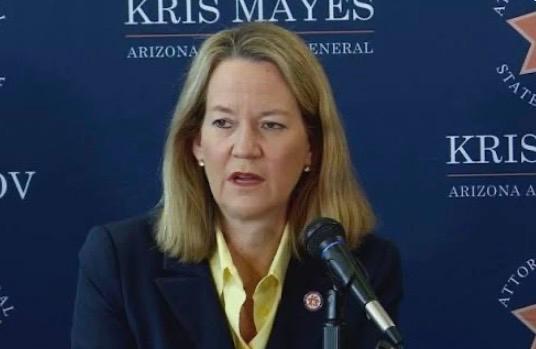
Arizona AG Kris Mayes Sparks Outrage with Comments on “Stand Your Ground” and ICE Agents


On January 23, 2026, Arizona Attorney General Kris Mayes ignited a political firestorm after remarks about the state’s “Stand Your Ground” self-defense laws during a televised interview suggested that under certain circumstances, residents could legally use deadly force against masked federal Immigration and Customs Enforcement (ICE) agents if they believed their lives were in danger.


In the interview, Mayes — a Democrat and the state’s top legal officer — expressed concern about how Arizona’s broad self-defense statutes could collide with federal enforcement actions. She noted that Arizona law permits individuals to use lethal force if they “reasonably believe their life is in danger” while in their home, car, or on their property. Mayes described a scenario in which federal agents operating in plain clothes with masks and limited identification could be mistaken for a threat, saying it was “kind of a recipe for disaster.”


When pressed by the interviewer about whether that interpretation meant residents could shoot federal agents, Mayes said she wasn’t encouraging violence. Instead, she framed the comments as a stark illustration of how the law might be applied if someone genuinely couldn’t identify intruders as law enforcement.


Law Enforcement Groups Push Back

Mayes’ remarks were met with swift criticism from law enforcement organizations and elected officials who called the comments dangerous and irresponsible.


The Arizona Police Association (APA) issued a statement sharply condemning the suggestion that residents might be justified in using deadly force against federal officers. The APA stressed that public speculation about such scenarios could jeopardize the safety of law enforcement professionals — including those who may at times operate in plain clothes or protective face coverings. The association called the comments “reckless, irresponsible, and dangerous to the safety of all law enforcement professionals in this state.”


National and local political figures also weighed in. Some criticized Mayes for potentially providing a misguided interpretation of self-defense law that could be misread as a green light for violence against federal officers, particularly at a time of heightened tensions related to immigration enforcement.


Legal Context and Broader Debate

Arizona’s Stand Your Ground law generally allows individuals to use deadly force without a duty to retreat when they reasonably believe it’s necessary to prevent imminent death or great bodily harm. However, this legal protection does not explicitly grant citizens authority to target law enforcement officers acting within the scope of their duties — even if the officer’s identity isn’t immediately clear.


Legal experts and civil liberties advocates note that attacking a federal agent — such as an ICE officer — is itself a serious crime under federal law, and self-defense claims typically must be supported by clear evidence that the defendant genuinely and reasonably believed their life was in immediate danger. Critics argue that Mayes’ comments blurred this distinction and risked inflaming an already volatile national debate on immigration enforcement tactics and public safety.


What’s Next?

As controversy continues, Mayes’ statements have become a flashpoint in discussions about public safety, immigration enforcement, and the responsibilities of elected officials to clarify — rather than complicate — the application of self-defense laws. Both supporters and critics agree that clear communication about legal rights and obligations is essential, especially when it involves life-and-death situations and the rule of law.

When Two Issues Collide: BNSF, Traffic, and the Future of Rural Arizona


Two topics I have been covering for quite some time are now colliding.


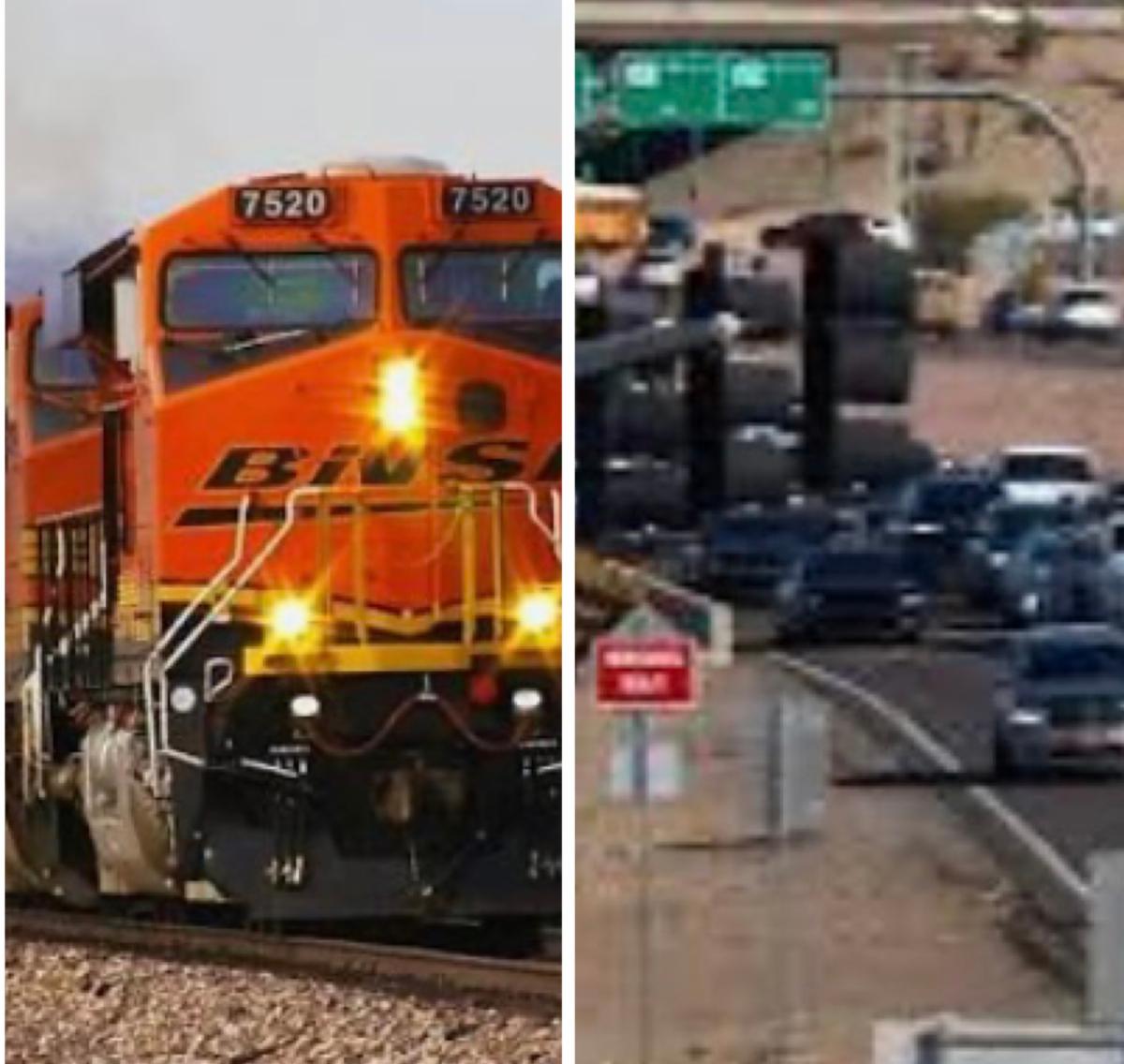
It appears the Arizona State Legislature is holding out hope that BNSF Railway will ride in with a big fat check to help resolve the traffic disaster at Loop 303, Highway 60, and 163rd Avenue. Friends, this is where we need to make our voices heard—clearly and loudly—to our elected officials.


I do not expect BNSF to acquiesce. Their track record shows they do not help communities—they take from them. But just in case anyone in leadership still believes otherwise, we must make it very clear: sacrificing rural Arizona to fix a problem everyone saw coming for over a decade is unacceptable.


Some state legislators have suggested that BNSF could somehow become the savior of the West Valley. That narrative is dangerous and deeply flawed. The traffic crisis at Loop 303 and Highway 60 did not appear overnight. Anyone with eyes could see this coming years ago, yet meaningful planning and timely solutions were delayed. Now, instead of accountability, there is talk of placing the burden on rural communities.


That brings us to Wittmann.


Wittmann has been zoned RU-43 for a very long time, by design. The residents there value open space, desert views, dark skies, and room for their horses and cattle. They chose that lifestyle intentionally—and it deserves respect. I used to be a country girl myself, and I deeply respect that way of life. Our nation was built by people who lived this way. It is not just our history; it is still very much our present.


Rural Arizona is not a blank space on a map to be traded away for urban planning failures elsewhere.


What is being suggested—implicitly or explicitly—is that Wittmann should be sacrificed to solve a transportation problem that planners, agencies, and leaders ignored for years. That is not fair, and it is not right. Rural communities should not be punished because others failed to act when they had the chance.


I am asking you to take action.


Contact your state and federal officials. Tell them plainly that you are not willing to sacrifice Wittmann—or rural Arizona—to resolve a problem everyone knew was coming and no one adequately planned for. Tell them that hoping for a miracle check from BNSF is not a strategy. Protecting rural communities must be a priority, not an afterthought.


We can fix traffic. We can demand smarter infrastructure planning. But we cannot do that by destroying the very communities that make Arizona what it is.


Now is the time to speak up—before decisions are made for us.

Political Tensions Escalate at Scottsdale City Hall: Mayor Borowsky Demands Answers Over Chief of Staff Suspension


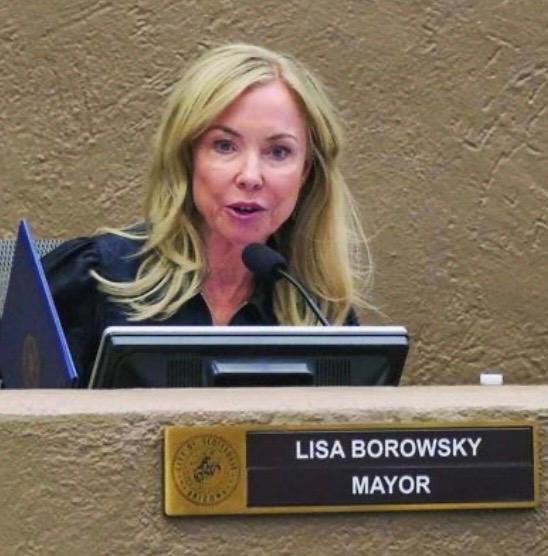
Scottsdale, AZ — January 2026 — Scottsdale Mayor Lisa Borowsky has publicly clashed with city leadership and council members amid growing political discord at City Hall, focusing attention on the recent suspension of her chief of staff, R. Lamar Whitmer, and broader governance questions that have shaken local politics.


The controversy intensified on January 22, when Borowsky held a press conference calling out Scottsdale City Manager Greg Caton for the suspension of Whitmer, describing the action as lacking transparency and fueling concerns about internal political motives. Whitmer was placed on paid, non-disciplinary suspension on January 14, but city officials have not publicly disclosed the specific reasons behind the move.


Mayor Borowsky’s Accusations and Calls for Transparency

Mayor Borowsky has demanded that the City Manager provide a clearer explanation of why her chief of staff was suspended, insisting that Whitmer — who answers directly to her office — deserves to know the underlying allegations against him. She described the situation as “mysterious and therefore suspicious,” suggesting political dynamics are at play rather than objective administrative concerns.


Borowsky and Whitmer’s legal counsel have both criticized the lack of disclosure, with the chief of staff’s attorney calling the absence of reasons for suspension “absurd” and potentially unjustified.


City Management Pushback

City spokesperson Holly Peralta has insisted that there are no political motives behind Whitmer’s suspension, suggesting the action was taken for legitimate internal reasons and not as part of any broader effort to undermine the mayor’s administration. This response highlights a sharp divide in how city leadership is interpreting the incident.


Borowsky has also publicly disputed claims by city management that her chief of staff reports to them, maintaining that he is accountable directly to the elected mayor’s office — a disagreement that underscores ongoing structural and political frictions.


Council and City Hall Infighting

This dispute is the latest chapter in a year of intense political tension between Mayor Borowsky and members of the Scottsdale City Council. Borowsky — who won the 2024 mayoral election — has frequently clashed with a majority faction of the council on policy priorities, leadership decisions, and administrative oversight.


Local coverage has highlighted growing concerns among residents and political observers that internal divisions are hampering City Hall’s effectiveness and contributing to a lack of clear governance. The mayor herself has acknowledged that these disputes have impacted city operations and public confidence, noting that infighting could undermine Scottsdale’s ability to function efficiently.


What’s Next

Mayor Borowsky is expected to address these issues further during her upcoming State of the City speech, where she is likely to call for greater transparency and clarity about this and other organizational matters — and to push back against what she characterizes as attempts to undermine her leadership.


As political tensions remain high, residents and local stakeholders will be watching to see if city leaders can bridge their differences or if the discord will continue to affect Scottsdale’s governance in the months ahead.

Primary Election Season Is Here — Small Actions Make a Big Difference


Arizona is officially in primary election season, and that means candidates across the state are working hard to qualify for the ballot. One of the most important steps in this process is gathering petition signatures. While not every race requires petitions—such as school governing board races—most local, legislative, and statewide candidates must meet this requirement to move forward.


The Easiest Way to Help a Candidate

If you’re looking for a simple, meaningful way to support your favorite candidate, sign their petition. It takes just a minute, costs nothing, and can make the difference between a candidate earning a place on the ballot or being shut out before voters ever get a choice. Petitions are not an endorsement of how you will vote in the primary or general election—they simply allow the candidate to compete.


$5 That Goes a Long Way

Another powerful way to help is by making a $5 Clean Elections donation through the Arizona Citizens Clean Elections Commission program. That small contribution can unlock hundreds of dollars in public matching funds for qualifying candidates. For grassroots campaigns, especially those without big donors, these funds can be game-changing—helping with mailers, signs, voter outreach, and basic campaign operations.


Leadership Starts With Participation

Arizona’s future depends on the quality of its leadership, and leadership begins long before Election Day. It starts with citizens taking small but intentional steps to support candidates who share their values and are willing to serve.


Sign petitions. Donate $5 when you can. Encourage others to do the same. Together, these simple actions help ensure strong candidates make it to the ballot and that Arizona remains guided by informed, committed leadership.

PATRIOT HAPPY HOUR WITH FELLOW REPUBLICANS!


Join Us for Another Great Evening!


Due to overwhelming demand, we’re bringing back our Patriot Happy Hour at State 48 in Surprise! Last month’s gathering was a fantastic success, with great food, drinks, and, most importantly, meaningful conversations with fellow conservatives. Let’s do it again!


 Where: State 48 Brewery - 13823 West Bell Road, Surprise, AZ 85374

 When: Wednesday, January 28, 2026

 Time: 4:00 PM – 7:00 PM


This is the perfect opportunity to connect with like-minded individuals, get to know fellow PATRIOTS, and strengthen our local Republican community. Whether you're new to politics or simply want to make new friends everyone is welcome!


Bring a friend and join us for an evening of camaraderie, networking, and fun. Let’s keep the momentum going!


Patriot Happy Hour is always the last Wednesday of the month.

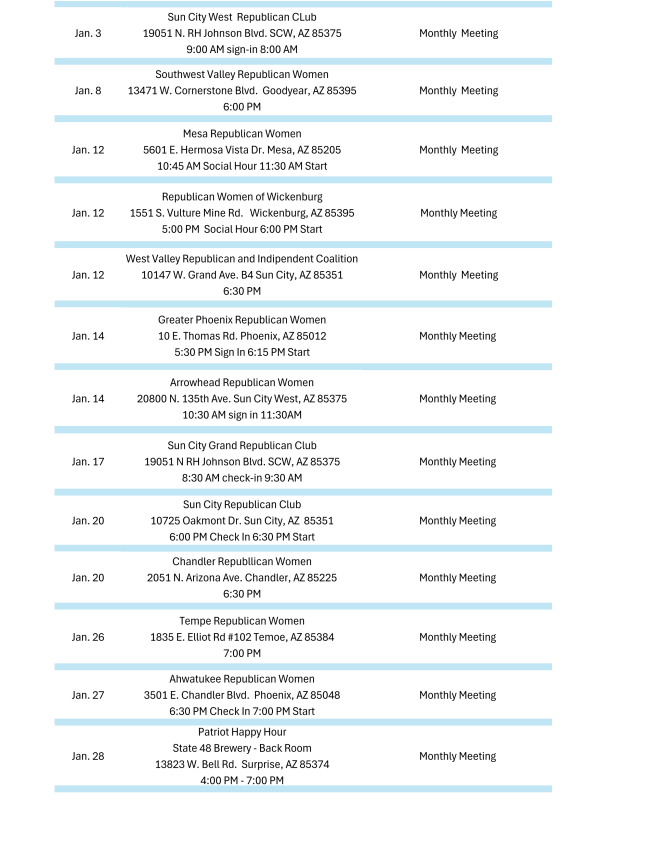
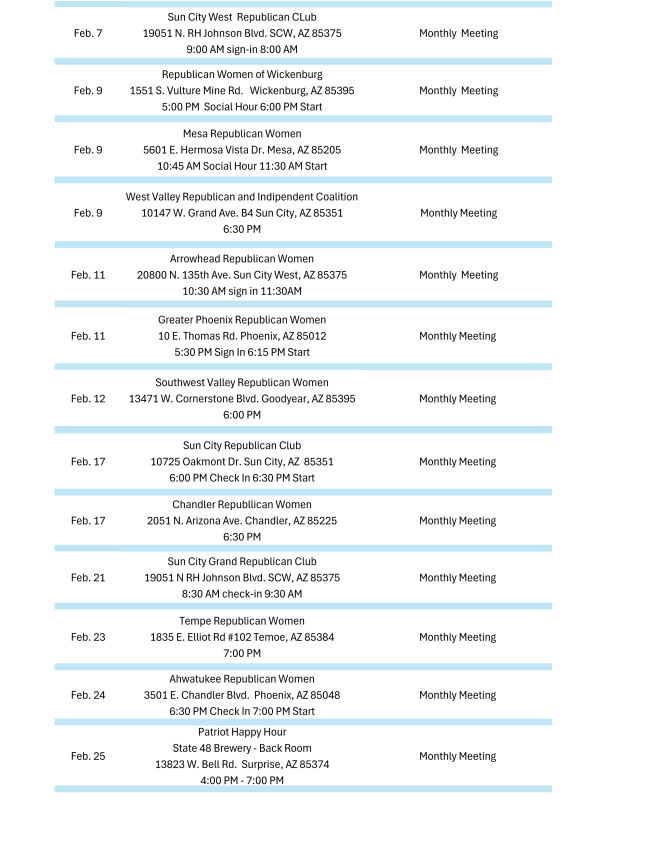
IF YOU WOULD LIKE YOUR CLUB LISTED PLEASE CONTACT ME

FEBRUARY 2026

Thank you,

Lisa Everett


www.patriotnheels.com


Follow me on:

X - @patriotnheels

Facebook - @patriotnheels

Instagram - @patriotnheels