Weekly update from the National Housing Conference | |
NOTE: This Member Brief is being delivered to you regardless of your NHC membership status for the next eight weeks. If you’re not a member and would like to continue receiving our Member Brief as well as other NHC member benefits, please click here to join today. | |
News from Washington | By Brittany Webb
| |
|
Agencies clarify civil rights protections
Eight federal offices jointly issued clarifications regarding the Civil Rights Act’s Title VI to include antisemitism, Islamophobia, and related forms of discrimination. The Departments of Agriculture, Health and Human Services, Homeland Security, HUD, Interior, Labor, Treasury, and Transportation each issued fact sheets clarifying how Title VI covers discrimination based on shared ancestry or ethnic characteristics. The government is translating the fact sheets into Yiddish, Hebrew, Arabic, Punjabi, and other languages to ensure equitable access to the information. The Biden Administration’s move is part of a broader comprehensive effort to counter antisemitism, including a National Strategy to Counter Antisemitism published in May.
HUD’s Fact Sheet includes examples of incidents that could be considered discriminatory and what a person can do if they experience such discrimination.
“The fact sheet we are releasing today sends a strong message that discrimination on the basis of shared ancestry or ethnic characteristics is illegal under the Civil Rights Act,” said Demetria McCain, HUD’s Principal Deputy Assistant Secretary for Fair Housing and Equal Opportunity. “This announcement is in line with HUD’s continued commitment to combat housing discrimination in all forms. It informs those who call America home of their right to be treated equally regardless of their shared ancestry or ethnic characteristics–putting us one step closer to building a housing system that prioritizes fairness and equality.”
| | |
|
CFPB report shows 2022 mortgage lending downturn
The Consumer Financial Protection Bureau (CFPB) reported that mortgage applications and originations declined notably in 2022 as rates, fees, and other costs increased. CFPB said average monthly mortgage payments increased more than 46% in 2022 from $1,400 to $2,045. The findings come from CFPB’s analysis of Home Mortgage Disclosure Act data in its annual report on mortgage lending, Data Point: 2022 Mortgage Market Activity and Trends. Other key findings from the report show that costs and fees associated with borrower’s taking out a mortgage rose 22% from 2021, refinance originations were largely cash-out refinance loans originated by independent lenders, home-equity lines of credit rose, and lenders increasingly denied applicants for insufficient income. Additionally, CFPB found that Hispanic and Black borrowers experienced higher rates of loan denials and were charged higher interest rates and fees.
"The higher interest rate environment had profound effects on the mortgage market in 2022, with borrowers paying much more in monthly payments,” said CFPB Director Rohit Chopra. “These trends are likely to continue given further increases in interest rates in 2023.”
The report notes that a significant downturn in mortgage lending activities marks 2022. The total number of applications decreased by 38.6%, and originations decreased by 44.1%. Due to rising interest rates, the average debt-to-income ratio (DTI) increased across all groups, and DTI became a more likely reason for application denial.
| | |
|
CDFI Fund announces $5 billion in NMTC awards
The Community Development Financial Institutions (CDFI) Fund announced $5 billion in 2022 New Markets Tax Credits (NMTC) awards. Nearly 200 community development entities submitted applications for the awards, totaling $14.8 billion requested, but just over 100 received funding. Novogradac analysis shows that of the awards, $2.35 billion is planned for major urban investment, $1.24 billion for minor urban investment, and a record $1.32 billion is allocated toward rural investment.
“The New Markets Tax Credit plays a critical role in financing many vital businesses and community projects in our nation’s low-income communities,” said Assistant Secretary Graham Steele. “The investments that will result from today’s announcement will help preserve and create hundreds of thousands of jobs and spur economic growth in these urban, rural, and Tribal communities across our country. It is important that Congress sustains these investments by making the New Markets Tax Credit permanent.”
The CDFI Fund also announced three guarantees totaling $300 million under the CDFI Bond Guarantee Program to finance projects in low-income and distressed communities. The program enables CDFIs to develop commercial real estate, affordable rental housing, schools, daycares, and health centers.
| |  |
|
Ginnie Mae seeks to address liquidity pressures
Ginnie Mae announced new revisions to its Home Equity Conversion Mortgage (HECM) Mortgage-Backed Securities (HMBS) requirements to reduce liquidity pressures on HMBS Issuers. The HMBS program allows secondary mortgage market access for HECM loans, also called reverse mortgages. The program enables Issuers to securitize portions of the HECM over time as issuers fund borrower line of credit draws and program fees, called “participations.” The change, which goes into effect Oct. 1, will allow securitization of multiple participations related to a HECM in any single issuance month. The previous policy only allowed for one securitization per loan in a monthly period. According to Ginnie Mae President Alanna McCargo, this will enable Issuers continuous access to capital market funding sources throughout the month, rather than issuers relying on finance vehicles of their own.
| | |
|
Bill reintroduced to expand, improve Opportunity Zones
A bipartisan group of Congressional members, including Mike Kelly (R-Pa.), Dan Kildee (D-Mich.), Carol Miller (R-W.Va.), and Terri Sewell (D-Ala.), reintroduced the Opportunity Zones Transparency Extension and Improvement Act. The bill is similar to the legislation’s 2022 iteration, which would extend the deferral date for Opportunity Zone investment to 2028, expand on reporting requirements, and allow for the investment of funds in other qualified opportunity funds.
| | |
|
Fannie Mae expands resources to address Latino homeownership gap
Fannie Mae announced new resources to expand Latino homeownership, including increasing access to its existing special purpose credit program (SPCP). The Enterprise launched HomeView en Español, a Spanish-language consumer education platform that provides information on homeownership and financial literacy for Latino consumers.
Fannie Mae is also expanding its SPCP to provide downpayment assistance to eligible first-time homebuyers living in majority-Latino communities in Atlanta, Baltimore, Chicago, Detroit, Memphis, and Philadelphia. Fannie Mae is planning further expansion to other cities next year.
"We want to help people get into and stay in their homes for a long time. Downpayment assistance and homeownership education can help the Latino community and achieve both goals. We will continue to work closely with the Latino community to craft solutions to the barriers Latinos face on their housing journey. We're committed to a future where everyone has fair access to sustainable housing," said Fannie Mae CEO Priscilla Almodovar.
| | |
|
HUD grants $3 million in research awards
HUD announced nearly $3 million in research awards to organizations studying two issues: closing the racial homeownership gap and addressing homelessness. HUD allocated almost $1 million to research addressing the racial homeownership gap and $2 million to tackle homelessness.
Recipients for the racial homeownership gap grants include the New America Foundation, in partnership with the Winston-Salem State University, which is researching the disproportionate impacts of the decrease in small-dollar mortgage loans, and the University of Michigan, which is analyzing two Detroit neighborhoods to better understand the effect of limited mortgage financing resources on borrowers of color. Additionally, Abt Associates will produce a three-part project to develop policy insights to assist Black and Latino renter households achieve homeownership and address racial and ethnic homeownership gaps.
"Homeownership is often the most direct path to generational wealth building. That is why HUD is committed to providing resources to help low-income renters access opportunities to purchase a home, if that is their choice,” said HUD Secretary Marcia Fudge.
Addressing homeless awardees include Northern Arizona University, which will conduct a three-year project documenting known encampment resolution strategies and their effectiveness in three populous Arizona counties, as well as the impact of these strategies on people experiencing homelessness. New York University (NYU) Grossman School of Medicine will identify services and resources that are needed to facilitate rapid transitions from homelessness to housing for older adults in New York City and NYU Furman Center will estimate the impact of providing $1,000 monthly unconditional cash transfers to families who previously experienced homelessness and are exiting a rapid-rehousing program.
“These research projects will help fill crucial knowledge gaps about solutions to end homelessness and help HUD, other federal agencies, and our state and local partners better understand the effectiveness of programs and interventions designed to address homelessness in communities,” said Soloman Greene, HUD Principal Deputy Assistant Secretary for Policy Development and Research.
| | |
|
Low-Income Communities Bonus Credit Program application period opens soon
Treasury, the U.S. Department of Energy, and the IRS announced they will soon begin accepting Low-Income Communities Bonus Credit Program applications. The program, authorized under the Inflation Reduction Act, provides a 10-20% boost to investment tax credit percentages for solar or wind facilities built in low-income communities or on Indian land, are part of affordable housing developments, or benefit low-income households.
The application period opens at 9 AM ET on Oct. 19.
| | |
|
Rent growth decelerates in September
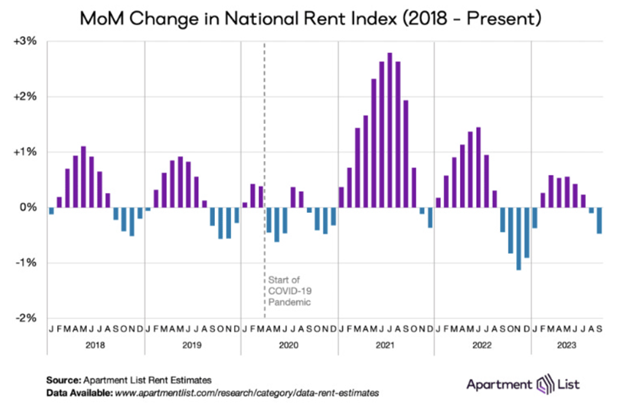
Apartment List’s National Rent Report for October 2023 shows the rental market continues to slow down, with nationwide rent falling 0.5% to $1,364. This is the index’s steepest September drop on record. Typically, rents fall in September by 0.1-0.3%. Month-over-month, rents fell in 85 of the 100 largest cities, marking a major deceleration from recent years that saw 18% rent growth.
| |
|
Enterprise Community Partners President and CEO Shaun Donovan gave the keynote address at the National Building Museum’s Future Cities: Housing Affordability Summit. Donovan expressed the urgency of addressing nationwide housing cost challenges. “I was asked today if I thought we're at a historic moment when it comes to affordability and the future of our cities,” he said. “Yes, this is a historic moment. The question is, will we live up to it?”
Realtor.com published an article on how a government shutdown would further disrupt the housing market. It highlights how mortgage rates could rise further, home sales could be delayed, rural homebuyers could struggle to secure USDA loans, and renters and homeowners could grapple with monthly payments.
The Government Accountability Office released a new report on the Self-Help Homeownership Opportunity Program (SHOP). This competitive grant awards nonprofits funding to develop affordable housing units that low-income families can purchase. The report highlights that market increases in land and construction costs have reduced SHOP’s purchasing power and, as a result, lessened the program’s impact.
| |
|
Monday, October 2
NH&RA Fall Developers Forum (NH&RA), in person in Boston, MA
School of Loan Origination (Mortgage Bankers Association), 2 – 4 PM ET
Tuesday, October 3
NH&RA Fall Developers Forum (NH&RA), in person in Boston, MA
FHFA Fall 2023 Econ Summit (FHFA), 9 AM – 5:30 PM ET, in person in Washington, DC
Preservation Next Colorado Academy: Property and Asset Management (Enterprise Community Partners), 1 – 2:30 PM ET
Wednesday, October 4
WHF Fireside With Chase Bank: The Relationship Between Housing Affordability and Wealth Building (Women in Housing and Finance), 8 – 9 AM ET, in person in Washington, DC
New Jersey Citizen Action’s Financial Justice Summit: Panel On Fair & Affordable Housing and CRA IN 2023 (NCRC), 10 AM – 3 PM ET, in person in Newark, NJ
Change is Coming: Climate Risk Disclosures and Real Estate Investment (US/Europe) (ULI Americas), 11 AM – 12 PM ET
Closing the Gap: Barriers and Solutions for Equitable Homeownership (Urban Institute), 2 – 5 PM ET
DHRC’s Disaster Recovery Working Group (NLIHC), 2 PM ET
School of Loan Origination (Mortgage Bankers Association), 2 – 4 PM ET
Unlocking Potential: Harnessing Loan Participations for Optimal Balance Sheet Management (NAFCU), 2 PM ET
Change is Coming: Climate Risk Disclosures and Real Estate Investment (US/APAC) (ULI Americas), 9 PM – 10 PM ET
Thursday, October 5
Homelessness in Higher Ed: Creative Housing Solutions (Housing Matters), 1 – 2 PM ET
Using New Markets Tax Credits for Your Business Webinar (Novogradac), 1 – 3 PM ET
Building Equitable Ecosystems: Capitals, Markets, And Technical Assistance (NCRC), 2 PM ET
From Policy to Practice – Fannie and Freddie’s New Radon Sampling Requirements (Mortgage Bankers Association), 2 – 3 PM ET
School of Loan Origination (Mortgage Bankers Association), 2 – 4 PM ET
NMHC Emerging Leaders Speaker Series – Los Angeles (NMHC), 9 – 11:30 PM ET, in person in Los Angeles, CA
Friday, October 6
NAHRO 2023 National Conference (NAHRO), in person in New Orleans, LA
Older Adults’ Pathways Into – And Out Of – Housing Insecurity and Homelessness (Harvard JCHS), 1 PM ET
|  | |
The National Housing Conference is a diverse continuum of affordable housing stakeholders that convene and collaborate through dialogue, advocacy, research, and education, to develop equitable solutions that serve our common interest. | |
Defending Our American Home since 1931 | |
Copyright © 2023. All Rights Reserved. | | | | |