|
Regulation E is Still a Top Compliance Challenge. Is Your Credit Union Prepared?
Regulation E has been around for decades, yet it continues to present compliance challenges for financial institutions.
Sometimes we pay more attention to new and changing regulations than we do to requirements that have been around for years. After all, if the regulation hasn’t changed, our processes should already be compliant, right? Recent examination findings suggest it may not be that simple.
The Federal Reserve’s Consumer Compliance Outlook recently highlighted the top consumer compliance violations identified among its state member banks in 2025. While HMDA reporting topped the list, Regulation E appeared multiple times among the most frequently cited violations.
-
Error-resolution investigations: 35 violations, ranked No. 3 for failing to perform an investigation to determine whether an error occurred within 10 business days of receiving notice.
-
Written explanations following certain determinations: 13 violations, ranked No. 5 for failing to respond to a consumer’s notice of error in writing if it determines that no error occurred or that an error occurred in a manner or amount different from what the consumer described.
-
Periodic statements: 9 violations, tied for No. 8 for failing to send a periodic statement to the consumer for each monthly cycle in which an electronic fund transfer occurs.
Although these findings involve Federal Reserve-supervised state bank members, the underlying Regulation E requirements also apply to credit unions. The results offer a useful reminder of the operational areas where established procedures, staff training, documentation, and quality-control reviews may need renewed attention.
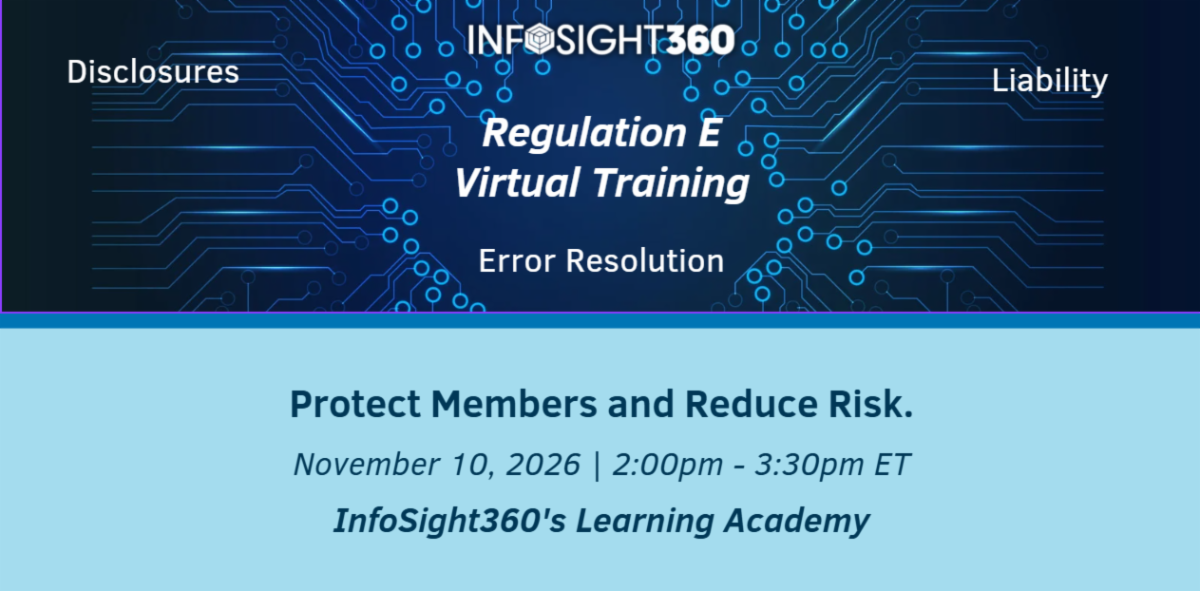
Join Michael Christians, Director of Regulatory Compliance Counsel for InfoSight360, on November 10, 2026, from 2:00 to 3:30 p.m. ET for a practical review of the Electronic Fund Transfer Act and Regulation E. The session will help participants better understand the regulation’s requirements, recognize common compliance trouble spots, and translate complex regulatory language into more effective day-to-day procedures.
Register today to refresh your Regulation E knowledge and identify areas where your credit union’s procedures may need additional attention.
|