RETIREMENT SECURITY MATTERS

A forum for retirement innovation information sharing

focused on states, supporters, and service providers.

Vol 75 | March 24, 2023


Greetings!  Lisa, welcome to Retirement Security Matters – where we talk about retirement readiness innovation by states, supporters, and service providers. 

Friends – Spring is finally here with all the hope and promise of renewal that this season always brings. Is all about warmer temperatures, spring cleaning, skinny cocktails, flowers, Easter eggs and new beginnings.


While we both think about that, here’s what’s on deck in the world of retirement savings innovation:


  • The inimitable Mark Iwry parses SECURE 2.0 - and takes a future focus
  • Numbers from the states
  • Key updates from Maine, Massachusetts, and Puerto Rico
  • Hot Sauce and Cool Stuff
  • … and Pix of the week! 

Comments or content suggestions? We welcome both. Have something about your program you’d like to share? We are all ears.

 
Your Logo 2.jpg

RSM wants your support! Be seen.

Click to grab this space for your brand.


Parsing SECURE 2.0: Good News/Bad News and Future Focus

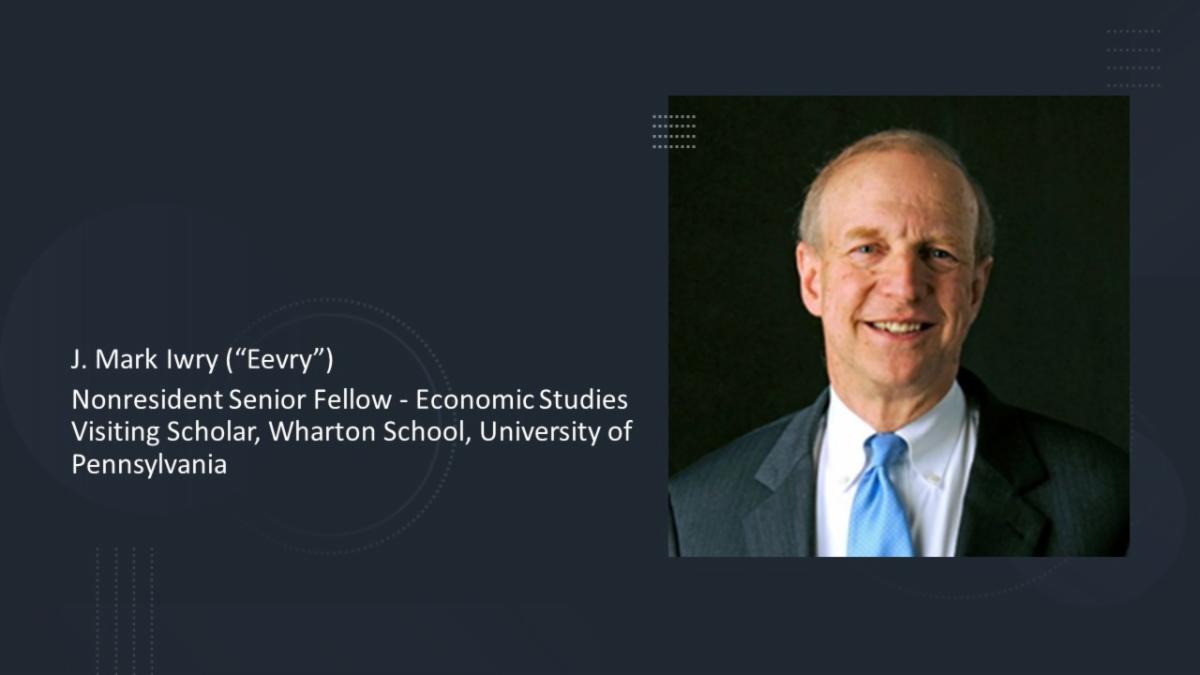
This week we have the pleasure of chatting with Mark Iwry. We talk about fresh thinking in 2023, and get Mark’s take on SECURE 2.0 – good and bad .


This is our summary. Join our full conversation here and a closer look at a few provisions to discuss what’s truly useful, and what’s still missing here. 

Mark Iwry, it's such a pleasure to talk with you again today. What's exciting for you right now?


Always great to talk with you, Lisa. 


I’m not sure I’d use the word “exciting”, but I am glad the SECURE 2.0 legislation is done - which was largely a fallback bill – plan B. It followed the latest unsuccessful effort at major reform of our private pension system by trying once again to enact the federal Auto IRA legislation. That would accomplish on a uniform, nationwide basis the expansion of coverage through automatic IRAs that states have begun to demonstrate. When I first started encouraging state legislators and treasurers, 20 years ago, to help expand private-sector retirement coverage, I hoped pilot projects in one or two states might be enough to spur action in Congress on a uniform, nationwide solution. 


However, among many other provisions, SECURE 2.0 expands the saver’s credit significantly to give lower- and moderate-income workers a little more incentive to save, and expands automatic enrollment and auto-escalation to make saving easier and cover more people, begins an important effort to encourage emergency saving without detracting from retirement saving, and does a bit more to help part-time employees save.


Also, it does feel a bit personal for me, as a fair number of the SECURE 2.0 provisions expand on or otherwise affect initiatives I developed, co-authored, or pushed forward over the years: automatic enrollment and other auto features in 401(k)s; the saver’s credit; the SIMPLE-IRA plan; the QLAC; the startup tax credit for small business retirement plans; EPCRS self-correction including safe harbor for correcting auto-enrollment/auto-escalation errors; facilitating user-friendly rollovers between retirement plans; the state-facilitated retirement saving/auto IRA programs, etc. I can’t help but relate to these a bit like my “children” (albeit in some cases, step children, god children, or wayward children).


For a walk through a few specific Secure 2.0 provisions – its good, bad, and backstory read here.


You’re currently working with some folks on technical corrections in SECURE 2.0 and related legislation. Please share what you can.


A technical correction will be needed, for example, to undo the inadvertent elimination of the ability to make most catchup contributions for 2024 – both the age 50+ and the new types of catchup contributions added by 2.0. Its main effect is to expand assets under management for the benefit of the investment industry, diverting revenues that could have been used for those who most need the help saving the first dollar in a plan or IRA, such as by beefing up the saver’s credit and enacting nationwide auto IRAs. This was one of the disappointing though unsurprising aspects of SECURE 1.0 and 2.0.


Other technical corrections include fixing the inadvertent preclusive impact of allowing SEP and SIMPLE Roth accounts on Roth IRA contributions and fixing the error in RMD drafting, so people born in 1959 have two different required beginning ages (73 and 75). But the thing to focus on here is not the technical corrections but the major missed opportunity relating to required minimum distributions policy.


Net of everything you've seen happening over the last few years legislatively, Mark, are there some things that still worry you?


Well, most of what should concern us has not been solved by the work we've done so far. The problem is not “access” but actual coverage: the 57 million workers, largely Black, Hispanic, women, and lower-income workers, who lack workplace retirement savings. The state auto IRAs are obviously very much a part of the good news, and are a fine demonstration of what can be done. But getting that to scale on a uniform, nationwide basis has yet to be accomplished.


One of the real benefits of having the A team working on this has been … [keep reading HERE]


What else should we be focusing on?


There's so much in the system that needs improving, in addition to the need to cover the 57 million uncovered workers (who disproportionately consist of Blacks, Hispanics, women, and lower-income households). There’s also too much leakage. There are portability problems. We need more retirement income that is reliable, regular, reasonably priced, and otherwise consumer-protective, preferably for life. There’s some progress following SECURE, but it’s more conversation and less action. We also continue to need more effective consumer protections. And conflicts of interest continue to be a real concern.

We haven't been able to do very far-reaching things in Congress. We know the roots of this problem. Among other concerns, much of our area (retirement) is wired through the tax code. And given the dominance of effective private-sector lobbying, it’s fair to say that our tax code is the most eloquent brief ever written in favor of campaign finance reform.


Mark, you have a way of keeping us looking at things that matter. Thank you for sharing your perspective today. 


Mark ❤ Iwry’s bio runs long and deep. He served as Senior Advisor to the Secretary of the Treasury from 2009 to January 2017, and served concurrently as the Treasury Department’s Deputy Assistant Secretary for Retirement and Health Policy. His portfolio included pensions/retirement (DB and DC/401(k) plans, IRAs, etc.) and national savings policy; related tax policy and other tax and legal aspects; legislative and regulatory implementation of the Affordable Care Act, and other health policy; other employee benefits and compensation, and related legislative, policymaking, and rulemaking responsibilities.


Currently a Nonresident Senior Fellow at the Brookings Institution and a Visiting Scholar at the Wharton School at the University of Pennsylvania, Mark is the originator or co-author of the Saver’s Credit, the SIMPLE IRA, the startup tax credit for small business, the QLAC, auto rollovers, direct deposit and splitting of tax refunds in IRAs and savings bonds, the automatic IRA proposal (with David John), and various other reforms and innovations, including the nationwide movement to involve the states in promoting retirement savings through auto-enrollment of uncovered citizens in private-sector IRAs. 


While in government, Mark also spearheaded the initiative to define, approve, and promote the practice of automatic enrollment in 401(k)s and similar plans, which laid the groundwork for automatic escalation, default investment in QDIAs, default rollovers and retirement income, and, in later years, the federal and state auto IRAs. You can connect directly with Mark here. You can follow Mark’s work at the Brookings Institution here. You can also connect with Mark on LinkedIn.

 
*Fresh!* State Auto IRA Program Metrics

What’s up! February figures are rolling in.


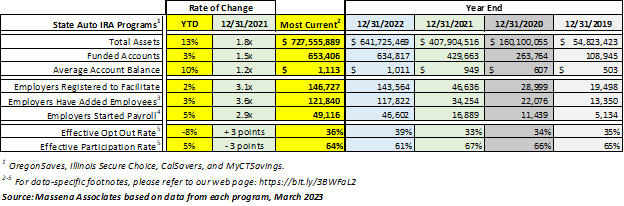
Saver assets are up 13% year-to-date and 1.8x since December 2021 to $727 million. Average account balances remain just over $1,000. Longer term balances are higher.


The four programs shown here now aggregate to over 653,000 funded accounts. For comparison, funded accounts are up 1.5x since December 2021, up about 2.5x since December 2020 and up about 6x since December 2019 – and up in 2023.


Over 146,000 employers are now registered to facilitate a state Auto IRA. Of that number, more than 49,000 have begun forwarding payroll contributions for savers. 

 
State Facilitated Retirement Programs - Fresh Highlights
I M P L E M E N T I N G

Maine (workforce 674,000) – The Maine Retirement Savings Board met on March 15, 2023. Key items on the agenda included a summary report from Executive Director Beth Bordowitz, Board discussion and approval of program logo and mission statement. Following other business, the Board briefly entered into executive session to review draft of the Sustainability Study. 

Massachusetts (workforce 3.6 million) – The Massachusetts CORE Plan Statutory Committee met on March 14, 2023. As a refresher, this program is a multiple employer plan targeted specifically to non-profits with 20 employees or fewer. The agenda included a Q4 2022 CORE investment review from Aon Investments, and a broader program update from Empower Retirement that included social media marketing and outreach strategy development. 

A C T I V E


Puerto Rico (workforce 3.6 million) - Gov. Pedro R. Pierluisi has signed legislation that moves Puerto Rico a step closer to making it easier for private-sector workers to save for retirement.


The new law sets up a working group to design a publicly facilitated retirement savings option. It will also establish financial literacy training for public and private employees. The AARP calls it “a crucial step to tackle the crisis of financial insecurity”. For more information check out AARP’s recent post.


See also the states we highlighted in both RSM74 and RSM73 for a complete current view. 

C O M I N G  U P


  • Maryland (workforce 3.2 million) – The next meeting of the Maryland$aves Board is scheduled for May 1, 2023.


  • Oregon (workforce 2.2 million) – The next meeting of the OregonSaves Board is tentatively scheduled for May 16, 2023.


  • Virginia (workforce 4.3 million) – The next meeting is tentatively scheduled for May 24, 2022.
 
 
Hot Sauce! Cool Stuff

A no-miss read - The Center for Retirement Initiatives at Georgetown University just released their Monthly Performance Trend Report in State-Facilitated Retirement Savings Programs. This first report focused on performance between December 2022 and January 2023.


Two key insights on emergency savings - Over the last years, the retirement industry has made significant progress on developing and implementing emergency savings solutions, with recordkeeping firms leading the way. Main takeaway: adequate emergency savings is an important part of financial wellness and retirement security.


To explore examples of solutions in the market and learnings from the field check out this recent brief by Commonwealth and the Defined Contribution Institutional Investment Association (DCIIA) Retirement Research Center.


Closing Women’s History Month with some amazing women in a myriad of careers - check out this playlist “How She Works”


TikTok and Money. So real. Banking below the poverty line. and what TikTok says about our savings. Don’t be watching these from your government device, now.


So much reading, give us some PIX!

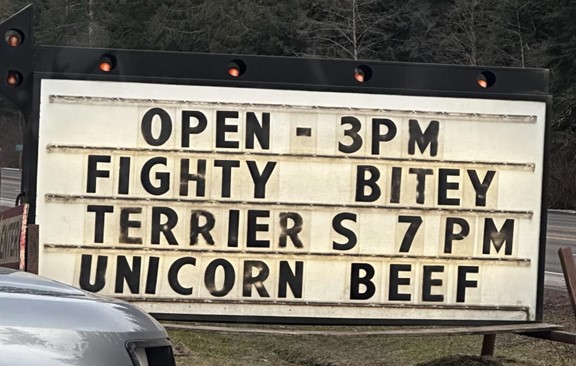
You don’t see this every day. We missed the Fighty Bitey Terriers, but we did have some Unicorn 🍀Beef at the Skyway Bar and Grill in Rhododendron, Oregon. Yes. Rhododendron. We like our functional names here.

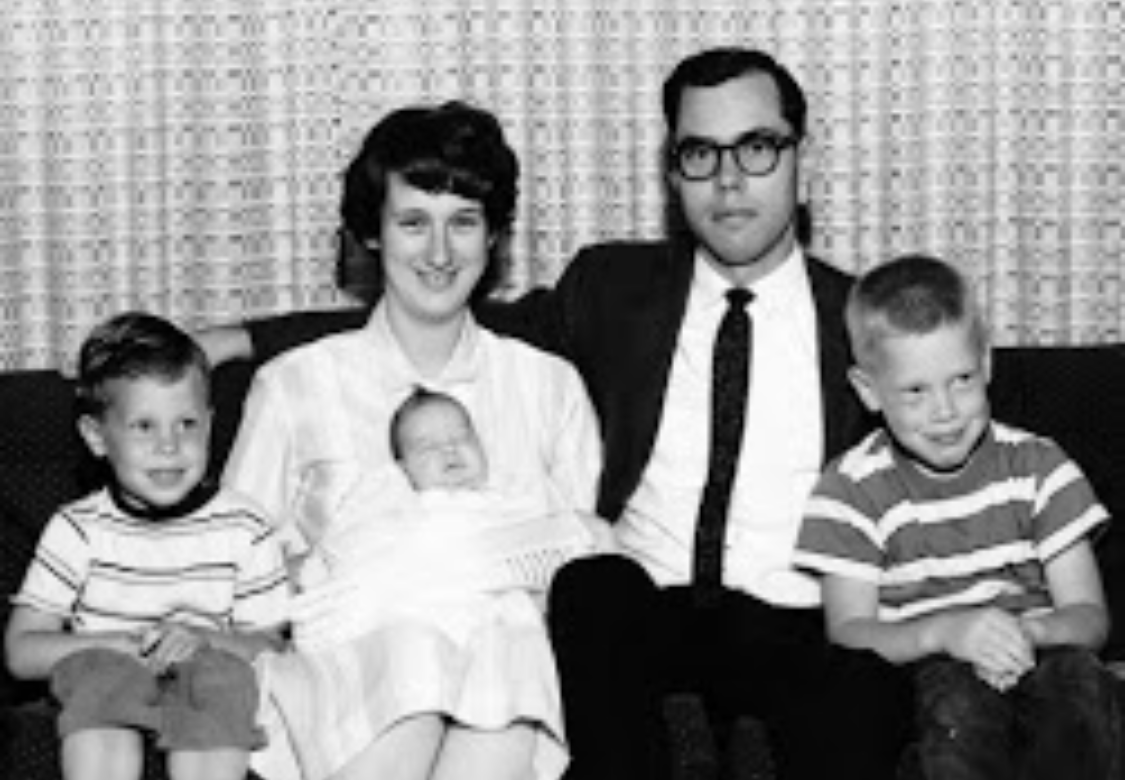
In Memoriam. David Lee Massena Jasper, December 1958 to March 2023.


We dedicate Edition 75 to our brother and friend David, pictured left-most when he was four. ♥️ You are loved and you are missed, Brother. Fly well. ♥

That’s it for this edition. ❤️ Hug your people and change the world.


If you like this piece, please stick with us. We’ll be back in about two weeks. If you don’t like it, please unsubscribe below. Comments for us? Please let us know. Want your own subscription? Request one here. All information shared is from public sources or used with express permission.

Massena Associates provides process, policy, and implementation consulting on retirement savings programs and products.

Our clientele includes public entities, policy organizations, and private sector providers. Our specialty – efficient, targeted results. We are an active speaker on retirement security topics, including state-facilitated programs, MEPs and more.

If you’d like to explore working together, we welcome the conversation. Connect with us here, and at 339-236-0684.
RESOURCES you can use:

Looking for a great retirement savings innovation resource? Led by Dr. Alicia Munnell, the Center for Retirement Research at Boston College develops and hosts terrific content and proprietary research related to states, financial security, social security, and more.


The Defined Contribution Institutional Investment Association (DCIIA) is dedicated to enhancing the retirement security of America’s workers. To do this, DCIIA fosters a dialogue among the leaders of the defined contribution community who are passionate about improving defined contribution outcomes. DCIIA's site provides a range of public and member-specific resources.


The Georgetown Center for Retirement Initiatives, Exec Angela Antonelli, provides excellent information on state-based and other retirement security innovation and policy.


Pew’s Retirement Savings Project studies the challenges and opportunities for increasing retirement savings and is another great resource - check out the work of John Scott and his terrific team.


If you want a great source of broad-based, consumer-focused retirement news, Jeffrey H. Snyder’s The Morning Pulse is your ticket. You can subscribe here.

 
Subscribe
Linkedin  Twitter