POLICY & ADVOCACY UPDATE

Issue #18, 3 April 2024

  • AA Member input requested on two important workforce issues
  • Recruitment difficulty rates drop as labour market weakens
  • International Visitor data shows recovery still some way off
  • New Business Events data

AA Member input requested on two important workforce issues

There are two significant national inquiries and consultation processes currently occurring to which Accommodation Australia will be making important submissions on your behalf to ensure our sector has the skills and labour we need both now and in the future. We need your help to ensure these submissions reflect your experiences and concerns.  


The first inquiry is into apprenticeships and traineeships and specifically the incentives needed for apprentices and employers to encourage commencement and retention of apprentices and trainees.  AA has major concerns that traineeship employer incentives for our industry will be discontinued on 1 July 2024. Already the number of trainees and apprentices in our sector has been dropping dramatically, and the pipeline of apprentice chefs was also impacted during the COVID period.  


The second inquiry relates to a migration draft Core Skills List recently released by Jobs & Skills Australia. This List is critically important to the sponsorship of temporary and permanent skilled migrants when the new migration system commences at the end of the year. JSA has classified our key occupations into either a category that requires further consultation (including cooks, chefs, hotel & motel managers, finance managers), or a category that indicates that JSA is confident that the job roles will not be included on the final list (such as cafe & restaurant manager). Occupations not on the final core skills list will not be eligible for migration sponsorship.  In our submission we will need to present further evidence that these occupations are in shortage so that we can sponsor migrants for those job roles. This is why your input is vital.  


To facilitate member input for both of these related submissions, the following on-line Zoom sessions are proposed:


  • Thursday, 18th April at 2.30 to 4 pm for general managers, HR managers, training managers and others involved in workforce issues to cover occupations in shortage as well as a discussion about apprenticeships and traineeships – their value, the importance of incentives etc.  
  • Monday, 22nd April 2.30 pm to 3.30 pm for senior chefs or managers who want to provide input into the specific issues around apprentice chefs and the difficulty in recruiting chefs and cooks which will feed into both submissions.    


In addition to members, other interested stakeholders including migration specialists and vocational trainers working with our industry are also welcome to attend either or both sessions. To register and receive more information including the agenda for the meetings and the Zoom link please contact either Jenny at policy@accommodationaustralia.org or Lorelle at mail@accommodationaustralia.org.  

Recruitment difficulty rates drop

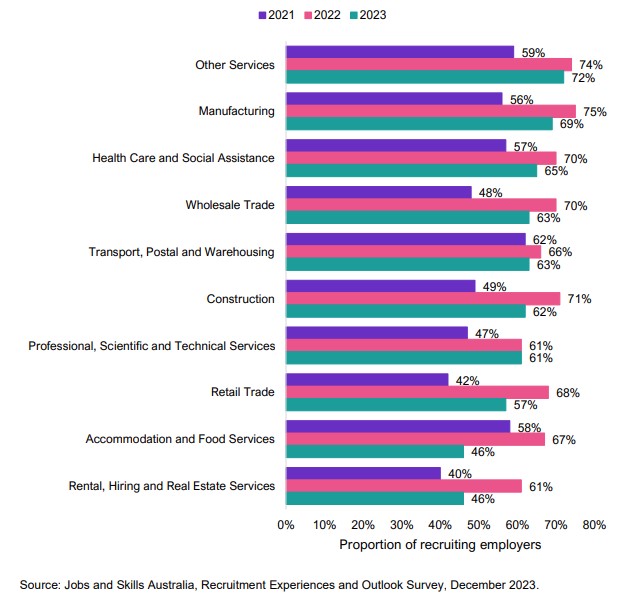
In what may be some explanation for Jobs & Skills Australia questioning the skills shortages in our industry, their latest recruitment survey results indicate that, with the labour market softening, recruitment difficulty rates were lower in 2023 across almost all reported industries relative to 2022 but still higher compared with 2021. Recruitment difficulty increased in the first half of 2023, rising by 11 percentage points to reach its highest level of 67% in May 2023. Recruitment difficulty then fell by 16 percentage points to December 2023 and ended the year with an average of 51% of recruiting employers reporting difficulty filling their vacancies. As the figure below shows, the recruitment difficulty rate in accommodation and food services is below that average at 46%.


Recruitment difficulty rates, by selected industries (2021 to 2023)

International Visitor data shows recovery still some way off

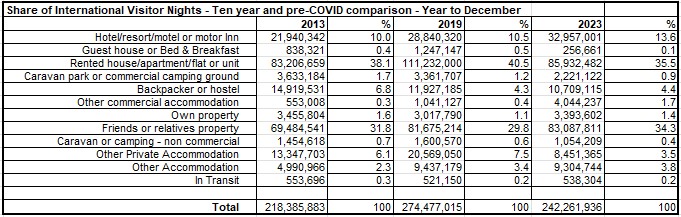
The latest International Visitor Data from Tourism Research Australia indicates that we are still some way off obtaining the full benefit from international tourism. In calendar year 2023, there were a total of 6.6 million visitor trips, compared with 8.7 million trips in pre-COVID 2019. The last time that Australia had less than 6.5 million trips was 2014 - almost 10 years ago. As the table below shows, in terms of nights, the picture is similar, with the only bright spot for our sector being that the number of nights spent in hotels and motels is at a record high at almost 33 million nights. The big fall in visitor nights is in rented houses and other private accommodation which can only be assumed to reflect a drop in student nights, which is somewhat contradictory of the number of student visas issued in the last 12 months, which are at an all time high.

New Business Events data

Tourism Research Australia has commenced publishing data on business events derived from new questions inserted into both national and international visitor surveys. Over calendar 2023 visitors travelling for business events spent $20.9 billion in Australia during their trip. Of this total, $2.6 billion was spent in Australia by international visitors. The remaining $18.3 billion of spend included $16.9 billion from domestic overnight travel and $1.4 billion through domestic daytrips to attend business events. International visitation for business events was in a recovery phase during 2023. International visitor numbers for 2023 (742,000) were at 71% of pre-COVID figures (compared to 2019) and stayed for 13.7 million nights in Australia.


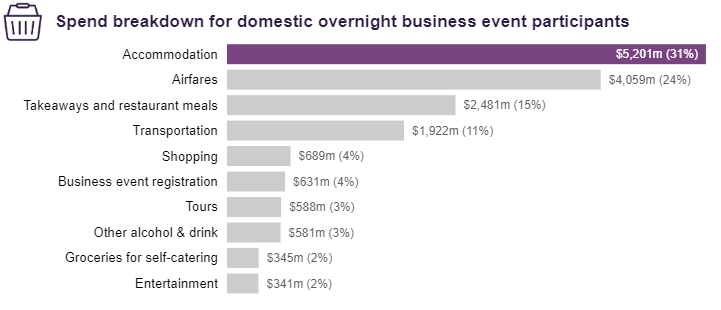
The spend breakdown of domestic overnight business event visitors (see graph below) showed that the spend on accommodation was the largest spend, at $5.2 billion or 31% of total spend, with the next largest on airfares (24%) followed by meals (15%), other transport (11%), shopping (4%), registration (4%) and tours (3%). For international business events visitors, of the total spend (defined to include money spent overseas on the trip), $1.7 billion or 38% was spent on airfares, followed by $1.5 billion or 33% on food, drink and accommodation and 7% on shopping.

Source TRA: Business Events Data

Drop me an email at policy@accommodationaustralia.org or give me a call on 0418 277 919 if you have any national policy issue that you think AA should be following up.  If you know an AA member who is not receiving this advocacy report but wants to, then encourage them to email me and we can add them to the distribution list.


Kind Regards


Jenny Lambert OAM

National Policy & Research Advisor

Accommodation Australia

Facebook  Linkedin