Welcome to the University of Oklahoma Carceral Studies Consortium Newsletter. The Carceral Studies Consortium strives to build a community for intellectual exploration that includes faculty, staff, graduate students, community members, practitioners, and organizers.
Carceral Studies is concerned with the independent function and nexus of the political and social systems that organize, shape, sustain, and entrench practices of punishment, surveillance, incarceration, and harm.
|
|
Carceral Studies Conversations Podcast |
|
"Trauma, brave educational spaces, and mass incarceration," with Dr. Jae James |
|
|
|
In the second episode of the University of Oklahoma Carceral Studies Conversations podcast, Dr. Jae James discusses trauma, the global and historical development of mass incarceration, and the creation of brave spaces for awareness and liberation. Dr. James is a formerly incarcerated person and professor of social work at New York University. He utilizes his firsthand knowledge and research to educate, train, and work with governments, community-based organizations, social workers, and advocates with social justice agendas throughout America, the Caribbean, and Africa.
|
|
|
|
This StoryMap covers Mary Heinen McPherson’s life story. McPherson is an activist and formerly incarcerated woman. She was the lead plaintiff in Glover v. Johnson, which established gender equity in educational and vocational prison programming, and co-founded the Prison Creative Arts Project. While her incarceration revealed to her the inhumane and corrupt carceral system, she simultaneously made “revolutionary changes” within women’s facilities, obtained college degrees, and made connections.
|
|
|
|
Since the protests over the killing of George Floyd in May, Chicago’s bridges crossing the Chicago River have been raised to prevent pedestrians and traffic from crossing. “For apparently the first time since 1855, the bridges became weapons in Mayor Lori Lightfoot’s aggressive crowd-control arsenal, which also included strategic public transportation shutdowns and highway exit closures.” While the pretext of these actions was public safety, these measures have been decried as a “kettling tactic that makes it easier for police officers to make arrests indiscriminately.”
|
|
|
|
In June, Oakland’s school board abolished its school police department. Despite constituting 26 percent of students enrolled in Oakland schools, Black students account for nearly three out of four arrests. Rio argues that “Officers installed in schools didn’t police crime so much as produce criminality.” This victory of Black activists in Oakland came after nearly a half century of activism: “For as long as cops have been in the city’s school system, Black Oaklanders have protested their presence.”
|
|
|
|
Segrue introduces a collection of essays that explore how the COVID-19 virus’ destruction of urban areas has been devastating because of preexisting social conditions. Segrue defines these preexisting social conditions as: “the precarity of work; the unaffordability of housing; the depth of racial, ethnic, and class divides; a profoundly unequal global economy; and the failure of many governments worldwide to rise to the challenges.” The trajectory of the virus has been a result of human-made systems, and “the ravages of COVID are but one manifestation of a global economy that maldistributes disease, environmental harm, and poverty, all in service of corporate gain.” These essays, linked at the bottom of Segrue’s introduction, underscore the interconnected systems of economic, environmental, and racial injustice, while simultaneously offering paths forward by imagining the alternatives that need to be realized.
|
|
|
|
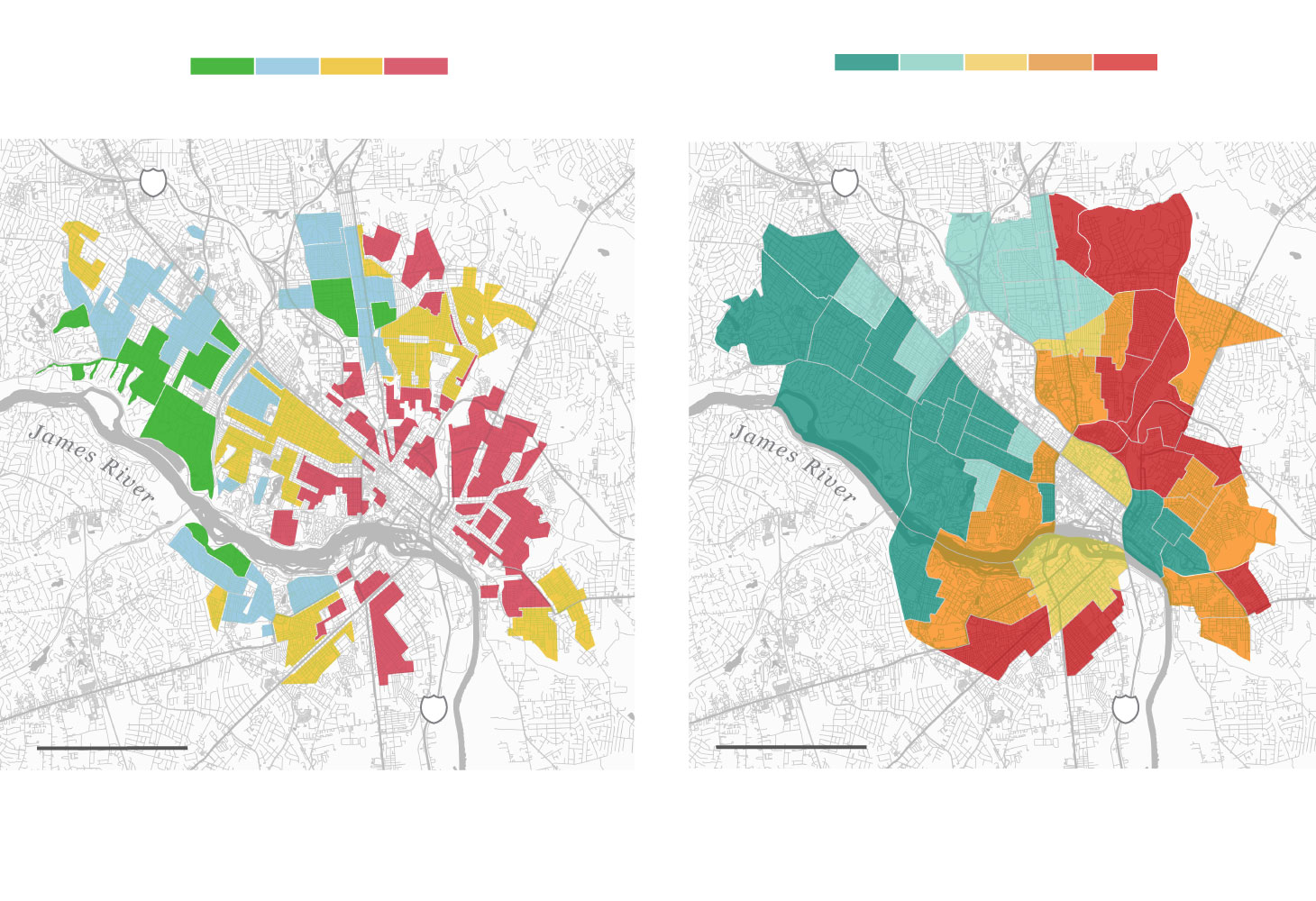
Redlining, the federally-sanctioned racist discriminatory practice of limiting Black and minority housing opportunities by grading the mortgage security of these neighborhoods as hazardous, has many long-lasting consequences on intergenerational wealth and education. Tracing redlining over history reveals one important way structural racism and systemic inequality persist. This essay reports that researchers have found that “People who live in neighborhoods that were once subjected to a discriminatory lending practice called redlining are today more likely to experience shorter life spans – sometimes, as much as 20 or 30 years shorter than other neighborhoods in the same city.” These neighborhoods are also more likely to have “greater social vulnerability,” which affects their ability to withstand natural and human disasters.
|
|
|
|
This article explores how a private prison company’s arrival in Evanston, Wyo., promised an economic revival but unleashed a bitter debate around morality and the economy. Since Sept. 11, 2001, the U.S. constructed many new immigration detention facilities, many of them in rural areas and privately operated. Local organizers launched a campaign against the proposed facility based on their skepticism of the lasting economic benefits, the location near Bear River State Park, the secrecy of the proposal, and the principle that detaining immigrants on non-criminal charges is wrong. In response to the opponents, supporters of the facility organized their own campaign. Despite the county commissioners voting unanimously to support the project, CoreCivic, the owner and operator of private detention facilities and the company interested in the Evanston contract, walked away. The tensions within the community remained: “the detention center had crystallized the hidden differences among people in a generally tight-knit community – over immigration, over politics, over the future of their town.”
|
|
|
|
Since early October, Nigerians across the country have been protesting police brutality. Rather than responding to demands of protesters, the Nigerian government has suppressed dissent with military force. Gbadamosi argues that the police brutality and suppression of dissent depended on foreign arms and training. Between 2015 and 2019, the U.S. “made nearly $19 million worth of military sales of defense education and technical training to the Nigerian Army and police... These trainings ranged from military civilian control, adherence to human rights, and military professionalization.” In much of this training, police were trained alongside members of the Nigerian army.
|
|
Join the Consortium Board! Faculty, staff, graduate students, and community members can apply to become Core Affiliate or Affiliate Board Members. Applications are accepted on a rolling basis.
|
|
|
ABOUT
The Consortium Newsletter will offer a roundup of a few selected articles that reflect today’s news, organizing, and thinking related to the carceral state. We understand that freedom work is built on education and engagement. Education requires an understanding of contemporary issues informed by their historical context. We hope that these curated articles will help you analyze the issues that we face and understand the community that we strive to construct.
Join the conversation!
We encourage feedback, suggestions, and article suggestions. Please reach out to carceralstudies@ou.edu with any ideas, thoughts, or recommendations.
If anyone you know is interested in receiving this newsletter and other information from the Carceral Studies Consortium, please forward them this email and they may click this link to subscribe.
|
|
Land Acknowledgment
The University of Oklahoma is on the traditional lands of the Caddo Nation and the Wichita & Affiliated Tribes. This land was also once part of the Muscogee Creek and Seminole nations. It also served as a hunting ground, trade exchange point, and migration route for the Apache, Cheyenne, Comanche, Kiowa, and Osage nations. Today, 39 federally-recognized Tribal nations dwell in what is now the State of Oklahoma as a result of settler colonial policies designed to confine and forcefully assimilate Indigenous peoples.
|
|
The University of Oklahoma is an equal opportunity institution. ou.edu/eoo |
|
|
|
|
|
|