NOVEMBER 2026

Your Peek Into Sacramento’s Coordinated Access System


Stories, updates, and data from Sacramento’s front door to homelessness services.


October Data & Analysis


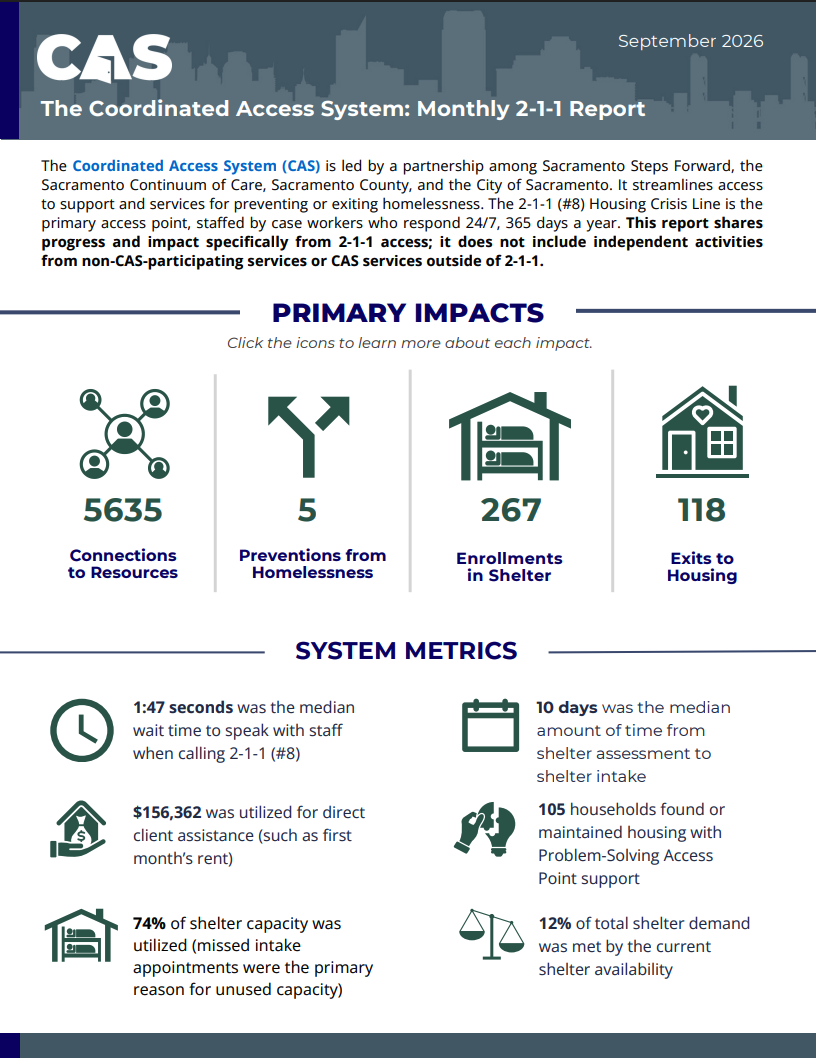
As housing costs continue to challenge households across the community, access to financial assistance and alternative, affordable housing options remains an important part of the response to homelessness. In October, $230,240 in direct client assistance was utilized, helping households address financial barriers associated with securing or maintaining housing.


The system also supported 136 exits to housing and connected 5,502 households to resources. At the same time, available shelter capacity met only 10% of total shelter demand, reinforcing the need for housing solutions that extend beyond traditional shelter placements.


These outcomes highlight the importance of combining direct financial assistance, resource connections, and alternative housing opportunities to help households overcome barriers and move toward housing stability.


READ THE FULL REPORT & ANALYSIS ➜

SCAS: How the System Supports Survivors  


Highlight by Shaitra Ken, Lead CAS Program Analyst, SSF 


The Survivor Coordinated Access System (S-CAS) is a dedicated part of Sacramento's Coordinated Access System (CAS), designed to help individuals fleeing domestic violence and human trafficking connect with housing and services safely. It provides an alternative way for survivors to access support while prioritizing their safety, privacy, and individual circumstances. 


While the Homeless Management Information System (HMIS) helps providers coordinate housing services across Sacramento, survivors often face additional safety risks when sharing personal information. The S-CAS addresses these concerns through a separate process that protects sensitive information while helping survivors access the support they need. . . .


READ THE FULL ARTICLE ➜

Updates & Reminders


Clarification: Current Living Situation and Homelessness Verification 


Completing the Current Living Situation (CLS) Assessment does not automatically update the HMIS Homeless Status Timeline used for homelessness verification. However, completing the CLS Assessment monthly is still important because it helps verify homeless status on the back end for program eligibility and keeps the client's Coordinated Access System (CAS) program enrollment active. 


Please continue completing the CLS Assessment monthly. 


Verifying Chronic Homelessness 


To verify chronic homelessness, a client must demonstrate either: 


  • 12 months of continuous homelessness, or 
  • At least four separate occasions of homelessness within the past three years that total at least 12 months. 


The CAS team will review a combination of the following documentation to determine eligibility: 


  • HMIS Homeless Status Timeline 
  • Third-Party Verifications documented in the HMIS 
  • Self-Certifications (up to three months) 


Invitation: Get Involved in the 2027 Point-in-Time Count


Registration is now open for the 2027 Sacramento Point-in-Time (PIT) Count, happening January 27 and 28! Each year, volunteers from across Sacramento County come together to better understand who is experiencing homelessness in our community. The findings help identify local needs, guide planning, and support funding for homelessness response efforts.


We'd love to see our Coordinated Access System (CAS) partners and service providers take part! Consider inviting your colleagues and volunteering together as a team from your organization. Volunteers will gather at the Scottish Rite Masonic Center between 5:00 and 11:00 p.m. each evening. Training is provided, and you can participate on one or both nights and indicate time preference for your team's deployment. Signing up with a team? Just make sure each person completes their own registration and identifies their team when registering.


REGISTER NOW ➜

The People Behind the Progress


Behind every referral and placement are people working together to make it possible.


This Month’s Spotlight: Moneshia Davis, Case Conferencing Specialist, Sacramento Steps Forward


"One thing I’ve learned through my work at Sacramento Steps Forward is that housing stability takes more than just finding someone a place to live. It’s about addressing the challenges that may prevent them from obtaining or maintaining housing, whether that’s income, healthcare, mental health, or simply having the right support system in place. The CAS allows us to work together so that individuals and families have a better opportunity to achieve long-term stability."


READ THE FULL SPOTLIGHT ➜

The Q&A Corner


This month’s most-asked questions.


Q: What is the prioritization order for the CAS priority lists? 


A: Program eligibility and prioritization are determined by the client's responses to the Crisis and Housing Conversation Tool Assessment (HCT). 


The prioritization criteria are applied in the following order: 


  • Program Eligibility: Whether the client meets the eligibility requirements for the specific program. 


  • Vulnerability Score: The client's assessed level of vulnerability. 


  • Barrier Score: The client's identified barriers to obtaining or maintaining housing. 


  • Length of Time Homeless: Used as a tiebreaker when clients have otherwise comparable prioritization. 


Q: If a client experienced homelessness in another state, and that experience would qualify them as chronically homeless, can I use third-party verification to document that period? 


A: Yes. You may use third-party verification to document the period of homelessness. The third party must have firsthand knowledge of the client’s experience of homelessness and complete the required verification form. Once completed, the form must be uploaded to the HMIS to document the client’s homelessness history.

🏠︎ Housing Highlights


Melania Trump Foster Youth to Independence (FYI) Initiative: Expanding Housing Opportunities for Transition-Age Youth 


Earlier this year, the Sacramento Housing and Redevelopment Agency (SHRA) requested 100 additional Foster Youth to Independence (FYI) vouchers, following guidance shared during a webinar hosted by the National Center for Housing and Child Welfare (NCHCW). The webinar clarified that public housing authorities may request additional vouchers based on demonstrated need and their ability to utilize them. 


Previously, SHRA was generally limited to requesting 25 vouchers annually. This expansion creates an exciting opportunity for SHRA and the CAS to work toward exhausting the Foster Youth Priority List and connecting more young adults to stable housing. 


The FYI program provides eligible young adults who experienced foster care at age 16 or older with 3–5 years of tenant-based rental assistance, paired with ongoing case management and supportive services. The goal is to prevent or end homelessness while giving participants the stability and support needed to develop independent living skills and successfully transition into adulthood. 


This opportunity is particularly meaningful for youth who may not score high enough on the Housing Conversation Tool (HCT) assessment to qualify for other permanent housing programs. 


All FYI referrals will follow established CAS referral processes. Through continued partnership, we can help more transition-age youth access housing, build independence, and create a foundation for long-term stability. 


Thank you for being part of this work.


Questions about the Coordinated Access System?

Contact: CAS@sacstepsforward.org