|
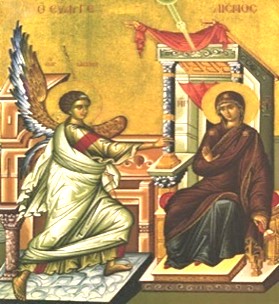
MARCH 25 - ANNUNCIATION OF OUR MOST HOLY THEOTOKOS
Six months after John the Forerunner's conception, the Archangel Gabriel was sent by God to Nazareth, a town of Galilee, unto Mary the Virgin, who had come forth from the Temple a mature maiden (see Nov. 21). According to the tradition handed down by the Fathers, she had been betrothed to Joseph four months. On coming to Joseph's house, the Archangel declared: "Rejoice, thou Full of Grace, the Lord is with thee: blessed art thou among women." After some consideration, and turmoil of soul, and fear because of this greeting, the Virgin, when she had finally obtained full assurance concerning God's unsearchable condescension and the ineffable dispensation that was to take place through her, and believing that all things are possible to the Most High, answered in humility: "Behold the handmaid of the Lord; be it unto me according to thy word." And at this, the Holy Spirit came upon her, and the power of the Most High overshadowed her all-blameless womb, and the Son and Word of God, Who existed before the ages, was conceived past speech and understanding, and became flesh in her immaculate body (Luke 1:26-38). Bearing in her womb the Uncontainable One, the blessed Virgin went with haste from Nazareth to the hill country of Judea, where Zacharias had his dwelling; for she desired to find Elizabeth her kinswoman and rejoice together with her, because, as she had learned from the Archangel, Elizabeth had conceived in her old age. Furthermore, she wished to tell her of the great things that the Mighty One had been well-pleased to bring to pass in her, and she greeted Elizabeth and drew nigh to her. When Elizabeth heard Mary's greeting, she felt her six-month-old babe, Saint John the Baptist, prophesied of the dawning of the spiritual Sun. Immediately, the aged Elizabeth was filled with the Holy Spirit and recognized her as the Mother of her Lord, and with a great voice blessed her and the Fruit that she held within herself. The Virgin also, moved by a supernatural rejoicing in the spirit, glorified her God and Savior, saying: "My soul doth magnify the Lord, and my spirit hath rejoiced in God my Saviour," and the rest, as the divine Luke hath recorded (1:39-55).
Epistle Reading for the Day
St. Paul's Letter to the Hebrews 4:14-16; 5:1-6
BRETHREN, since we have a high priest who has passed through the heavens, Jesus, the Son of God, let us hold fast our confession. For we have not a high priest who is unable to sympathize with our weaknesses, but one who in every respect has been tempted as we are, yet without sin. Let us then with confidence draw near to the throne of grace, that we may receive mercy and find grace to help in time of need. For every high priest chosen from among men is appointed to act on behalf of men in relation to God, to offer gifts and sacrifices for sins. He can deal gently with the ignorant and wayward, since he himself is beset with weakness. Because of this he is bound to offer sacrifice for his own sins as well as for those of the people. And one does not take the honor upon himself, but he is called by God, just as Aaron was. So also Christ did not exalt himself to be made a high priest, but was appointed by him who said to him, "Thou art my Son, today I have begotten thee"; as he says also in another place, "Thou art a priest for ever, after the order of Melchizedek."
Gospel Reading of the Day
The Gospel of Mark 8:34-38; 9:1
The Lord said: "If anyone wishes to come after me, let him deny himself and take up his cross and follow me. For whoever would save his life will lose it; and whoever loses his life for my sake and the gospel's will save it. For what does it profit a man, to gain the whole world and forfeit his life? For what can a man give in return for his life? For whoever is ashamed of me and my words in this adulterous and sinful generation, of him will the Son of man also be ashamed, when he comes in the glory of his Father with the holy angels." And he said to them, "Truly, I say to you, there are some standing here who will not taste death before they see the kingdom of God come with power."
Απόστολος της Ημέρας
Πρὸς Ἑβραίους 4:14-16; 5:1-6
Ἀδελφοί, ἔχοντες οὖν ἀρχιερέα μέγαν, διεληλυθότα τοὺς οὐρανούς, Ἰησοῦν τὸν υἱὸν τοῦ θεοῦ, κρατῶμεν τῆς ὁμολογίας. Οὐ γὰρ ἔχομεν ἀρχιερέα μὴ δυνάμενον συμπαθῆσαι ταῖς ἀσθενείαις ἡμῶν, πεπειραμένον δὲ κατὰ πάντα καθʼ ὁμοιότητα, χωρὶς ἁμαρτίας. Προσερχώμεθα οὖν μετὰ παρρησίας τῷ θρόνῳ τῆς χάριτος, ἵνα λάβωμεν ἔλεον, καὶ χάριν εὕρωμεν εἰς εὔκαιρον βοήθειαν. Πᾶς γὰρ ἀρχιερεύς, ἐξ ἀνθρώπων λαμβανόμενος, ὑπὲρ ἀνθρώπων καθίσταται τὰ πρὸς τὸν θεόν, ἵνα προσφέρῃ δῶρά τε καὶ θυσίας ὑπὲρ ἁμαρτιῶν· μετριοπαθεῖν δυνάμενος τοῖς ἀγνοοῦσιν καὶ πλανωμένοις, ἐπεὶ καὶ αὐτὸς περίκειται ἀσθένειαν· καὶ διὰ ταύτην ὀφείλει, καθὼς περὶ τοῦ λαοῦ, οὕτως καὶ περὶ ἑαυτοῦ, προσφέρειν ὑπὲρ ἁμαρτιῶν. Καὶ οὐχ ἑαυτῷ τις λαμβάνει τὴν τιμήν, ἀλλὰ καλούμενος ὑπὸ τοῦ θεοῦ, καθάπερ καὶ Ἀαρών. Οὕτως καὶ ὁ Χριστὸς οὐχ ἑαυτὸν ἐδόξασεν γενηθῆναι ἀρχιερέα, ἀλλʼ ὁ λαλήσας πρὸς αὐτόν, Υἱός μου εἶ σύ, ἐγὼ σήμερον γεγέννηκά σε. Καθὼς καὶ ἐν ἑτέρῳ λέγει, Σὺ ἱερεὺς εἰς τὸν αἰῶνα κατὰ τὴν τάξιν Μελχισεδέκ.
Ευαγγέλιον της Ήμέρας
Κατὰ Μᾶρκον 8.34-38; 9.1
Εἶπεν ὁ Κύριος· Εἴ τις θέλει ὀπίσω μου ἐλθεῖν, ἀπαρνησάσθω ἑαυτὸν καὶ ἀράτω τὸν σταυρὸν αὐτοῦ, καὶ ἀκολουθείτω μοι. ὃς γὰρ ἂν θέλῃ τὴν ψυχὴν αὐτοῦ σῶσαι, ἀπολέσει αὐτήν· ὃς δ᾿ ἂν ἀπολέσῃ τὴν ἑαυτοῦ ψυχὴν ἕνεκεν ἐμοῦ καὶ τοῦ εὐαγγελίου, οὗτος σώσει αὐτήν. τί γὰρ ὠφελήσει ἄνθρωπον ἐὰν κερδήσῃ τὸν κόσμον ὅλον, καὶ ζημιωθῇ τὴν ψυχὴν αὐτοῦ; ἢ τί δώσει ἄνθρωπος ἀντάλλαγμα τῆς ψυχῆς αὐτοῦ; ὃς γὰρ ἐὰν ἐπαισχυνθῇ με καὶ τοὺς ἐμοὺς λόγους ἐν τῇ γενεᾷ ταύτῃ τῇ μοιχαλίδι καὶ ἁμαρτωλῷ, καὶ ὁ υἱὸς τοῦ ἀνθρώπου ἐπαισχυνθήσεται αὐτὸν ὅταν ἔλθῃ ἐν τῇ δόξῃ τοῦ πατρὸς αὐτοῦ μετὰ τῶν ἀγγέλων τῶν ἁγίων. Καὶ ἔλεγεν αὐτοῖς· ἀμὴν λέγω ὑμῖν ὅτι εἰσί τινες τῶν ὧδε ἑστηκότων, οἵτινες οὐ μὴ γεύσωνται θανάτου ἕως ἂν ἴδωσι τὴν βασιλείαν τοῦ Θεοῦ ἐληλυθυῖαν ἐν δυνάμει.
READINGS OF OUR HOLY ORTHODOX SAINTS
+Saints Chrysanthos & Daria the Martyrs – March 19
Saint Chrysanthos, who was from Alexandria, had been instructed in the Faith of Christ by a certain bishop. His father, who was a senator by rank and a pagan, had him shut up in prison for many days; then, seeing the unchanging disposition of his mind, he commanded that a certain young woman named Daria be brought from Athens. She was a very beautiful and learned maiden, and also an idolater, and Chrysanthos' father wedded him to her so that he might be drawn away from the Faith of Christ because of his love for her. Instead of this however, Chrysanthus drew Daria unto piety, and both of them boldly proclaimed Christ and received the crown of martyrdom in 283, during the reign of Numerian, when they were buried alive in a pit of mire.
"Glory, O Lord, to the power of Thy Cross, which never fails! When the enemy oppresses me with a sinful thought or feeling, and I, lacking freedom in my heart, make the sign of the Cross several times with faith, suddenly my sin falls away from me, the compulsion vanishes, and I find myself free… For the faithful the Cross is a mighty power which delivers from all evils, from the malice of the invisible foe." +Saint John of Kronstadt
"Many indeed are the wondrous happenings of that time: God hanging from a Cross, the sun made dark, and again flaming out; for it was fitting that creation should mourn with its Creator. The Temple veil rent, blood and water flowing from His side: the one as from a man, the other as from What was above man; the earth was shaken, the rocks shattered because of the Rock; the dead risen to bear witness of the final and universal resurrection of the dead. The happenings at the Sepulchre, and after the Sepulchre, who can fittingly recount them? Yet not one of them can be compared to the miracle of my salvation. A few drops of Blood renew the whole world, and do for all men what the rennet does for milk: joining us and binding us together." +Saint Gregory the Theologian
ΜΙΚΡΟΣ ΣΥΝΑΞΑΡΙΣΤΗΣ
ΤΡΙΤΗ ΚΥΡΙΑΚΗ ΤΩΝ ΝΗΣΤΕΙΩΝ - ΤΗΣ ΣΤΑΥΡΟΠΡΟΣΚΥΝΗΣΕΩΣ
Η Κυριακή αυτή λεγεται και «Κυριακή της Σταυροπροσκυνήσεως» γιατί η Εκκλησία μας παρουσιάζει σε προσκύνηση τον Τίμιο και Πανάγιο Σταυρό. Ο Σταυρός μεταφέρεται σε μιά σεμνή πομπή στο κέντρο του Ναού και παραμένει εκεί όλη την υπόλοιπη εβδομάδα, οπότε στο τέλος κάθε ακολουθίας γίνεται ευλαβική προσκύνηση του Σταυρού. Αξίζει να σημειωθεί ότι το θέμα του Σταυρού, που κυριαρχεί στην υμνολογία αυτής της Κυριακής, παρουσιάζεται όχι μέσα στα πλαίσια του πόνου, αλλά της νίκης και της χαράς. Βρισκόμαστε στη μέση της Μεγάλης Σαρακοστής. Από την μιά πλευρά η φυσική και πνευματική προσπάθεια, άν είναι συστηματική και συνεχής αρχίζει να μας γίνεται αισθητή, το φόρτωμα να γίνεται πιό βαρύ, η κόπωση πιό φανερή. Έχουμε ανάγκη από βοήθεια και ενθάρρυνση. Από την άλλη πλευρά η φυσική, αφού αντέξουμε αυτή τη κόπωση και έχουμε αναρριχηθεί στο βουνό μέχρι αυτό το σημείο αρχίζουμε να βλέπουμε το τέλος της πορείας μας και η ακτινοβολία του Πάσχα γίνεται πιό έντονη. Ο Σταυρός που είναι η δύναμη των πιστών και το στήριγμα των αμαρτωλών, μας εμψυχώνει τώρα στις νηστείες μας και μας ενθαρρύνει. Η Σαρακοστή είναι η σταύρωση του εαυτού μας, είναι η εμπειρία ποπυ αποκομίζουμε από την εντολή του Χριστού που ακούγεται στο Ευαγγελικό Ανάγνωσμα αυτής της Κυριακής «όποιος θέλει να με ακολουθεί, άς απαρνηθεί τον εαυτόν του, άς σηκώσει το Σταυρό του, και άς με ακολουθεί». Το ιερώτερο σύμβολο του χριστιανισμού είναι ο Τίμιος Σταυρός. Η Σημαία και το Λάβαρο της Εκκλησίας. Μιά φορά ήταν όργανο θανατικής εκτελέσεως, των κακούργων και των ατίμων, ξύλο καταισχύνης και κατάρας. Από τότε όμως που επάνω σ’ αυτό πέθανε ο αναμάρτητος Σωτήρας του κόσμου, ο Σταυρός έγινε «τίμιον ξύλον». Από τότε το σχήμα του χαράσσεται πάνω στους τάφους των χριστιανών, στις κατακόμβες και μετά τους διωγμούς στολίζει τα στέμματα των χριστιανών βασιλέων, υψώνεται επάνω στις Εκκλησίες και παντού είναι το φυλακτό και το στολίδι των χριστιανών. «Σταυρός ο φύλαξ πάσης της Οικουμένης»
Ο ΕΥΑΓΓΕΛΙΣΜΟΣ ΤΗΣ ΘΕΟΤΟΚΟΥ - 25η ΜΑΡΤΙΟΥ – Εθνική εορτή (ιχθύος κατάλυσις)
Ημέρα ορόσημο για τους απανταχού χριστιανούς είναι η 25η Μαρτίου και απαρχή του δρόμου για την πραγματοποίηση της Σωτηρίας τους. Είναι το χαρμόσυνο μήνυμα της θείας ενσάρκωσης, που με τόσο σαφή τρόπο μας το παρουσιάζει ο ευαγγελιστής Λουκάς στο Ευαγγέλιό του. Την ημέρα αυτή, ο θεόσταλτος αρχάγγελος Γαβριήλ παρουσιάζεται και λέε στην Παρθένο Μαρία ότι θα γεννήσει υιό, που θα είναι ο Σωτήρ του κόσμου. Αξίζει όμως να δούμε πώς οι εμπνευσμένοι υμνωδοί της Εκκλησίας μας έψαλαν το κοσμοσωτήριο άγγελμα«Σήμερα πραγματοποιείται η ολοκλήρωση της Σωτηρίας μας και η φανέρωση του μυστηρίου που προαιωνίως υπήρχε.Ο Υιός του Θεού γίνεται Υιός της Παρθένου κα ο αρχάγγελος Γαβριήλ φέρνει την ευχάριστη αγγελία της Θείας Χάρης Χαίρε εσύ που σε έχει επισκιάσει η χάρη του Θεού, ο Κύριος είναι μαζί σου».
Η ΑΝΕΚΤΙΜΗΤΗ ΠΡΟΣΦΟΡΑ - ΔΥΟ ΕΛΕΥΘΕΡΙΕΣ -Το έπος του 1821, το οποίο είναι στενά συνδεδεμένο με τον εορτασμό του Ευαγγελισμού της σωτηρίας μας, οφείλεται στη σφυρηλάτηση της εθνικής συνειδήσεως από την ελληνορθόδοξη παράδοση, την οποία πρόβαλε η Εκκλησία μας καθ’ όλη τη διάρκεια της μακραίωνης δουλείας μας. ΄Αν η σημερινή Εθνική Γιορτή θυμίζει τους αγώνες για ελευθερία, ανεξαρτησία και πατριωτισμού, η σημερινή Εκκλησιαστική Γιορτή δίνει μιά άλλη βαθύτερη έννοια ελευθερίας, την ελευθερία της αποδοχής του Χριστού στη ζωή μας.
|