The American Society of Le Souvenir Français Inc.
Monthly Bulletin - Vol. II. No 10 - October 2022
|
|
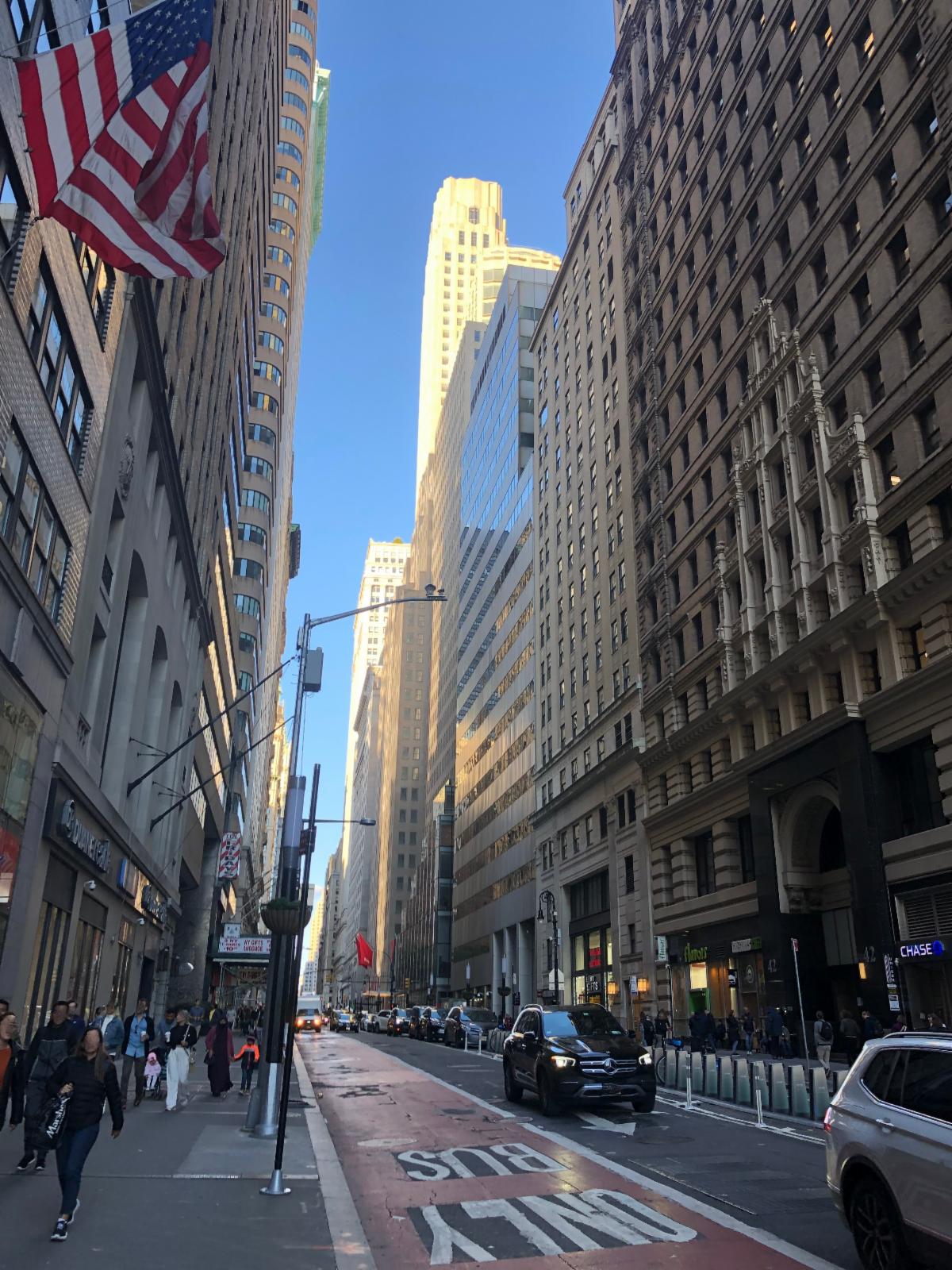
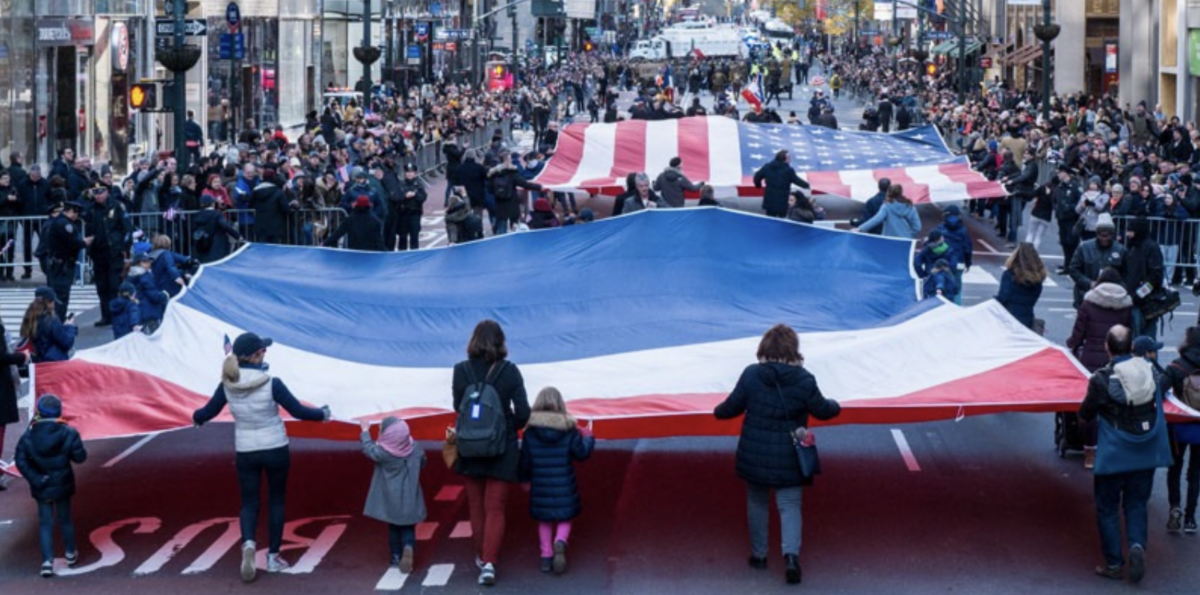
"The Canyon of Heroes" on Broadway, starting at Battery Park and ending at City Hall.
New York NY 10004
Photo © American Society of Le Souvenir Français, Inc 2022
|
|
EDITORIAL
In last month's Bulletin, we narrated several events, some well known, some almost forgotten, which all took place in September, throughout several States.
In this month's Bulletin, we will focus on one specific, narrowly defined geographic area: "The Canyon of Heroes".
To our readers in France, I hasten to mention, this title does not refer to a John Wayne or Gary Cooper movie...
It refers to a portion of Broadway, in the heart of Wall Street, dotted with a relatively little known series of granite markers imbedded on both sidewalks.
This is the street where the famous "Ticker Tape parades", as they are known, take place. It is New York's unique way to welcome famous visitors.
Out of a total of 206 ticker tape parades since 1886, 14 of them honored visiting Frenchmen (If we include Lafayette in 1824, who, as we will see below, can be considered the precursor of this New York tradition, the total is 15).
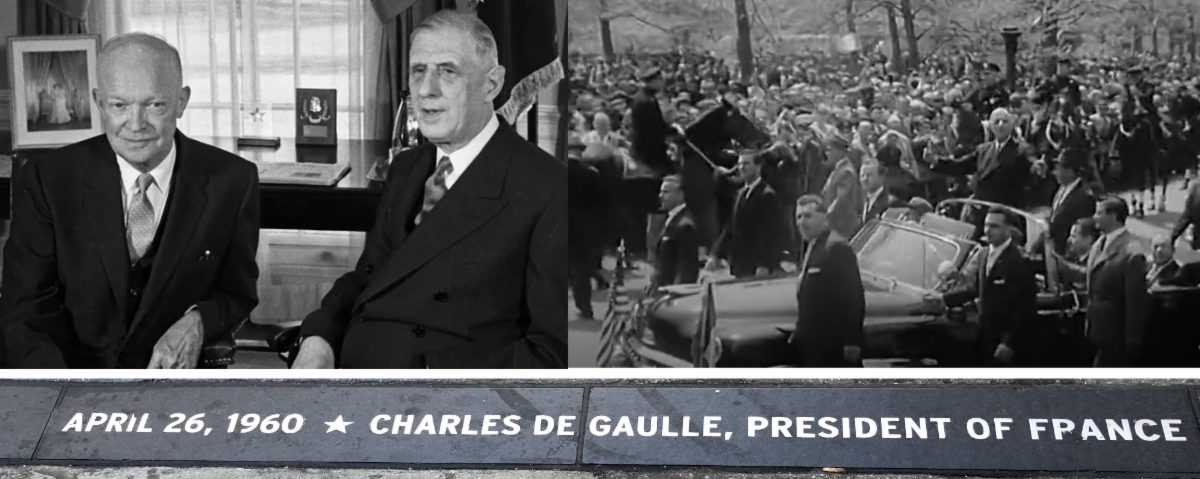
Some of these illustrious French visitors do not need much introduction. General de Gaulle was one of a total of 11 who had the privilege to be so honored twice (in 1947 and 1960).
A few, alas, fell into relative, or total, oblivion: who remembers, for instance, Geneviève de Galard-Terraube?
Two of them fell into dishonor. True to our mission, we will content ourselves with historical facts, the faithful transcription of markers, and press reports from their time.
This portion of Broadway is bustling with heavy foot traffic from tourists. They all line up to take a photo next to the sculpture of the Wall Street bull. Souvenir shops sell T-shirts, caps, snow globes, all sorts of trinkets; food vendors' trucks are parked, at times directly on top of these granite markers. It is interesting to observe how very few of these tourists coming from all over the world pay scant attention, if any, to these granite strips. All too many are busy watching their smart phone while they walk.
We hope that this Bulletin will serve as a "tourist guide" not only for our readers throughout the USA and in France, but also to our those of us who live in the Big Apple and may find it to be a nice walk on a Fall weekend.
The Souvenir Français, as it name indicates, is all about remembering, and it is part of our mission here at the American Society of Le Souvenir Français to celebrate events that have tied together France and the United States over the past two centuries.
In this Bulletin, we will continue to report of the Marquis de Lafayette's tour of his own, back in October 2024, as well as the progress of the march of the French Army in October 1782, throughout the State of Connecticut, on its way back to Boston after the victorious siege of Yorktown in October 1781.
And, as always, you will also find the activities in which your association participated in since last month's bulletin, as well as other upcoming worthy patriotic events and historical commemorations uniting French and Americans.
Thank you also for all your kind words or encouragements and valuable suggestions.
We wish you "Bonne Lecture" (and watch your steps when walking on Broadway!)
On behalf of the Board of Directors.
Thierry Chaunu, President,
American Society of Le Souvenir Français, Inc.
Poor is the nation that has no heroes, but poorer still is the nation that having heroes, fails to remember and honor them. Marcus Tullius Cicero 106-43 BC
|
|
"TICKER TAPE" PARADES:
IT ALL STARTED IN NEW YORK
|
|
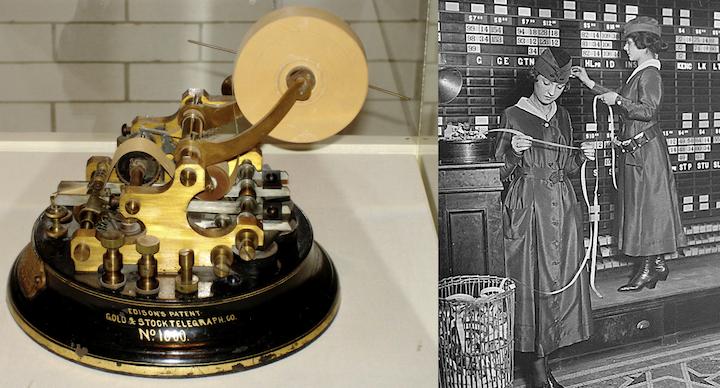
Photos: Left: By H. Zimmer - Own work, CC BY 3.0, https://commons.wikimedia.org/w/index.php?curid=3961718
Right: By Underwood & Underwood, Photographer - Public Domain, https://commons.wikimedia.org/w/index.php?curid=6705944
|
|
FROM TICKER TAPES TO CONFETTIS
• The term "ticker tape" comes from the use of the paper output of ticker-tape machines, which were devices used in brokerages to provide updated stock market quotes. These machines made a "ticker" sound when printing the tape, hence the name.
• A ticker-tape parade is a parade with crowds lining up the sidewalks, where large amounts of shredded paper (originally ticker tape, but now mostly confetti or shredded paper) are thrown from windows of office buildings onto the parade route. The effect is that of a snowstorm of swirling papers, with a memorable celebratory effect.
• These parades had their heydays from the 1890's until the 1990's. Today they are much less frequent, mainly limited to championship sports teams, or celebrations of the return of astronauts and military troops. As ticker tape technology became obsolete with the advent of computers in brokerage offices.
• The cost of clean up is considerable: more than 50 tons of papers are collected after a typical parade, at a cost to the City of $2 million.
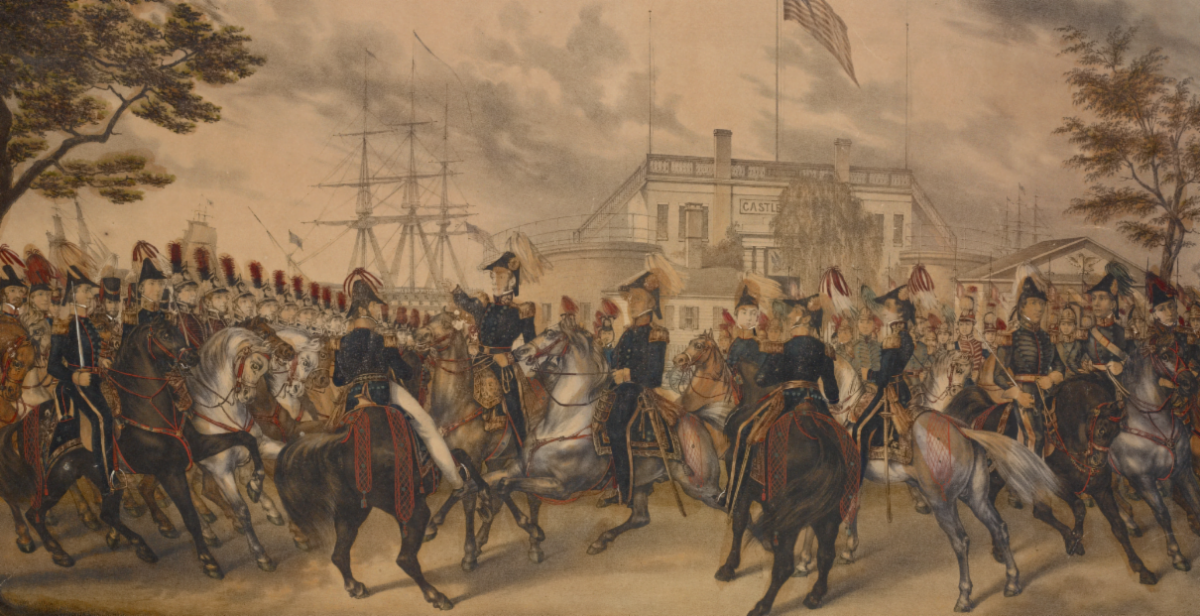
• The origins of the ticker tapes parade date back to that most famous day of August 16, 1824, when General Marquis de Lafayette started his triumphal visit of the United States, which we related in our previous August 2022 Bulletin, with a parade in the same section of town, from Clinton Castle on Battery Park to City Hall.
|
|
THE OFFICIAL FIRST TICKER TAPE PARADE:
DEDICATION OF THE STATUE OF LIBERTY
OCTOBER 28, 1886
|
|
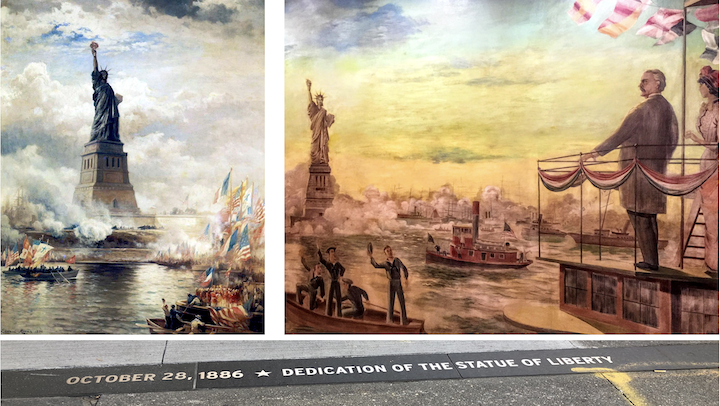
Right: President Grover Cleveland inaugurating the Statue of Liberty, unknown artist
|
|
• On Oct. 28, 1886, President Grover Cleveland dedicated the Statue of Liberty as a gift from the people of France on what is now known as Liberty Island in New York Harbor. In addition to the officials surrounding the piedestal of the statue, and hundreds of ships gathering around the island. The ceremony included speeches by the president and French engineer Ferdinand de Lesseps (of Suez canal fame), Edouard de Laboulaye who first had the idea of the Statue, Chauncy Depew, president of the Union League Club, among many others. The statue’s designer, Frederic-Auguste Bartholdi, who was perched in the statue’s torch, pulled a rope removing a large French flag from the front of the statue, revealing Lady Liberty’s face to the crowd. He was quite impatient however, and in doing so interrupted New York Senator WIlliam Evarts' speech.
• Only dignitaries were invited to attend the statue’s official dedication ceremony, but an estimated one million people took part in a parade and festivities around New York to mark the occasion. A celebration was held in Lower Manhattan, starting at City Hall and ending at Battery Park, with a view of the statue, on a cold and rainy day. Hundreds of thousands lined the sidewalks, waving French and American flags. A huge fireworks had to be cancelled and postponed until November 1st.
• Back then, the building hosting the New York Stock Exchange wasn't built. Office workers at different brokerage firms along Broadway couldn't join the crowd on the sidewalks, and started throwing discarded tapes laying on the floor by the windows. Everyone was in awe with the overall festive effect, effectively starting the tradition. Once everyone on the streets realized how festive and fun it was to throw the ticker tape, it started to become a regular tradition. City officials began to schedule parades for every special or triumphal occasion.
• In that day’s edition, The New York Times described the building excitement for the ceremony: “All day yesterday people came to the city in droves to participate in to-day’s celebration. Extra heavily loaded trains, much behind schedule time, were the rule on every railroad entering the city. Every hotel was crowded to its utmost capacity last night, and there was hardly one of the better known hotels which did not have to turn away hundreds of would be guests.”
|
|
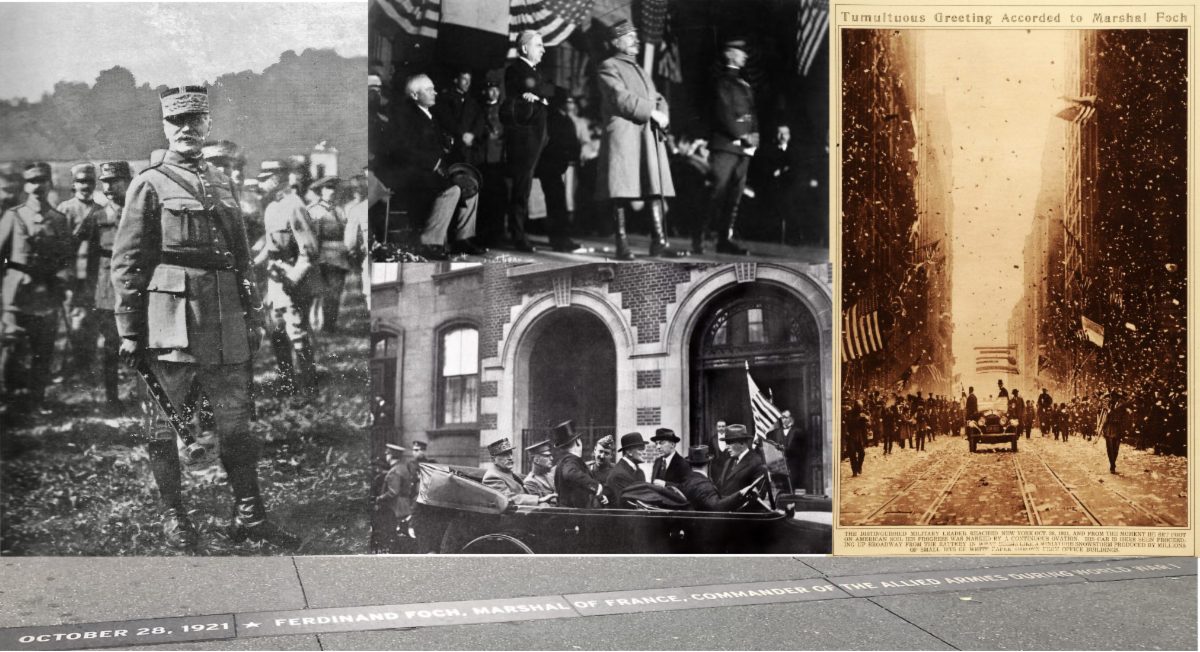
OCTOBER 28, 1921
FERDINAND FOCH, MARSHAL OF FRANCE
|
|
Middle top:
" Ferdinand Foch, Marshal of France, Victorious Commander-In-Chief of the Armies of the Allied and Associated Nations in the World War, Who Comes as the Honored Guest of the American People”
Right: rotogravure, 1922, Top caption: “Tumultuous Greeting Accorded to Marshal Foch" - Bottom caption: "Distinguished Military Leader reached New York Oct. 28, 1921, and from the moment he set foot on American soil his progress was marked by a continuous ovation. His car is here seen proceeding up Broadway from the Battery in what seems like a miniature snowstorm produced by millions of small bits of white paper thrown from office buildings."
|
|
• Ferdinand Foch (2 October 1851 - 20 March 1929) served as the Supreme Allied Commander during the First World War. He successfully coordinated the French, British and American efforts into a coherent whole, deftly handling his strategic reserves. He stopped the German offensive and launched a war-winning counterattack. In November 1918, Marshal Foch accepted the German cessation of hostilities and was present at the Armistice of 11 November 1918 signed in a railcar at Rethondes, north of Paris. Foch died on 20 March 1929. He was buried in Les Invalides, next to Napoleon and other famous French soldiers and officers
• Foch was insistent to impose very harsh terms on Germany, so that it never poses a threat to France ever again. He thought that the Treaty of Versailles was much too lenient on Germany. Upon the signing of the Treaty, he famously declared: "This is not peace. It is an armistice for twenty years." His words proved prophetic: the Second World War started twenty years later.
• During his triumphal tour of the United States, Foch made a 3000-mile circuit through the American Midwest and industrial cities such as Pittsburgh and then on to Washington, D.C., which included ceremonies at Arlington National Cemetery for what was then called Armistice Day. During the tour, he received numerous honorary degrees from American Universities. In addition to be a Marshal of Poland, he is the only Frenchman ever to be made an honorary field-marshal by the British.
• Dozens of places around the world, from Paris to Shanghai, Beirut to Singapore, streets, avenues, plazas, bear his name. The city of Fochville in South Africa is named in his honor, as well as a mountain in Alberta, Canada.
US Tour of 1922:
"...On Friday afternoon a press conference was held at the Kountz home, the Marshal then greeted the Salvation Army headed by Commander Booth. Then a meeting with the Jewish delegation, headed by Rabbi Silverman. Luncheon with the Union Interallie, at Sherry’s on 48th Street. Visit’s the 7th Regt. Armory to greet New York City school children. Lays wreaths at the Jeanne Arc statue and Grants Tomb. On to New York University where he receives a degree. Attends the Iron and Steel Institute Dinner at the Hotel Commodore.
On Saturday, November 19th, he receives representatives of Federated Council of Churches of Christ and La Bienvenue Francaise at the Kountz home. Visit’s the Theodore Roosevelt birth place at E. 20th Street. Lunch with the Pennsylvania Society at Waldorf Astoria. Visits Columbia University. Lays cornerstone for permanent home for the Arts and Letters home at Riverside Drive. Dinner by the France American Society at the Waldorf Astoria, Meeting with Miss Anne Morgan head of the Devastated France Association at the Capitol Theater.
On Sunday the 20th, the day started with Mass at St. Patrick’s Church. Then visits to Fordham University and the Academy of the Sacred Heart. Lunch at the Kuntz home. Address the Army and Navy Club. Meets with delegation of French Societies at the Plaza Hotel. French Societies Dinner at the Plaza Hotel. Attends the formal Reception of the American Legion for the Marshall at the Hippodrome, The meeting was presided over by the Chairman, Sydney G. Gumpertz, Bishop Brent offered the invocation and in addition to Marshal Foch the Honorable Martin W. Littleton addressed the meeting. The Peoples Liberty Chores of over 400 voices and the New York Symphony Orchestra furnished the music. 230 wounded soldiers from Fox Hills Polyclinic and Marine Hospitals were the guests of the Legion while many patriotic societies were represented. The Marshal leaves the Hippodrome for Penn Station at 10:00 pm.
By all accounts, the Marshal Foch visit to New York City was an unqualified success..."
• During his stay in the United States, on November 1st, 1921 he helped Vice President Calvin Coolidge break ground on the Liberty Memorial in Kansas City. The memorial honors the fallen soldiers of World War I from Kansas and Missouri, and now houses the National World War I Museum. Interesting piece of trivia, the local veteran chosen to present a flag to Marshal Foch was a Kansas City haberdasher, Harry S. Truman, who would later serve as 33rd President of the United States from 1945 to 1953. In 1935, a bas-reliefs of Foch by sculptor Walker Hancock was added to the memorial.
"While visiting Bismarck, North Dakota, Marshal Foch spoke of the similarities between France and the United States, and of their shared sacrifice in the Great War. “Even far in the west,” he said, “the people of North Dakota were united with all America and America united with France in the war…Therefore, I wish to come out to this state of North Dakota to bring the deep gratitude of the French nation and to tell you in person all this great state has done in the war.”
• Several other organizations showed gratitude to Foch as well, and among them was the Dakota Sioux nation. The Bismarck Tribune of Nov. 28, 1921 relates:
"Close to the end of the ceremony, Chief Red Tomahawk presented Marshal Foch with a peace pipe. Together, the Chief and Foch smoked the pipe, which was given to Foch, along with a beaded tobacco pouch as a gift from the Sioux nation. Foch was then given the name “Charging Thunder,” or "Watakte Wakiya". The representatives of the French and Sioux nations then exchanged words of gratitude. “I know the record of the North American Indian in the war,” said Foch, “and I have come here in part particularly to thank this nation for the splendid men they sent—and the mothers of the Indian soldiers.” Foch also made a promise to Red Tomahawk that the graves of the Indians who died in Europe would never be disturbed.
Foch exited the city with as many cheers as when he arrived, and was particularly delighted when the Sioux Indians danced around him..."
|
|
APRIL 24, 1922
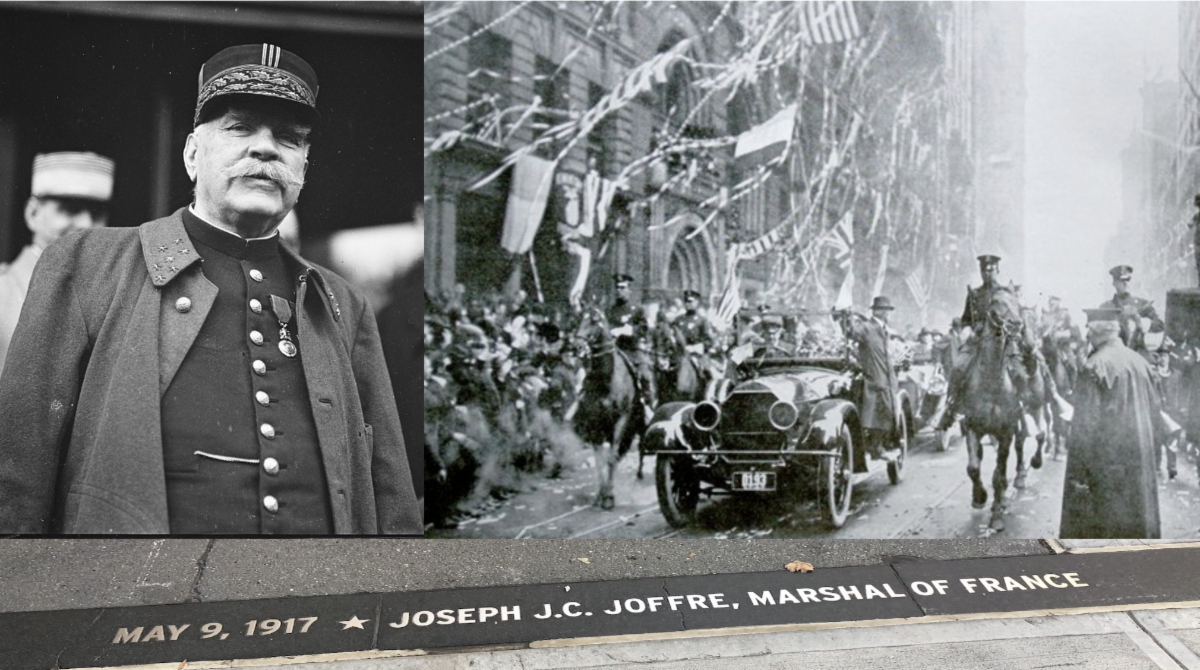
JOSEPH JOFFRE, MARSHAL OF FRANCE
|
|
Photos: Left: Library of Congress Prints and Photographs Division Washington, D.C. 20540 http://hdl.loc.gov/loc.pnp/hec.42122 Public Domain
Right: Marshal Joffre and Viviani arrive in New York, First World War, 9 May 1917. Joffre, Commander-in-Chief of the French army, and Rene Viviani, Prime Minister of France when war broke out in 1914.
New York Public Library, https://twitter.com/nypl/status/1148960671637352448/photo/1
Note: The date on the granite strip refers to the first visit of Joffre (and Viviani) in 1917. Although they received a warm New York welcome on May 19, 1917, the ticker tape parade dedicated to Marshal Joffre took place a few months after that of Marshal Ferdinand Foch, in 1922.
|
|
• Joseph Jacques Césaire Joffre (12 January 1852 - 3 January 1931) was a French general who served as Commander-in-Chief of French forces on the Western Front from the start of World War I until the end of 1916. He is best known for regrouping the retreating allied armies to defeat the Germans at the strategically decisive First Battle of the Marne in September 1914.
• When the United States Congress declared war on Germany on April 6, 1917, finally breaking with neutrality and coming to the aid of the French and British armies, the immediate problem was how to equip and train the US Army.
• The French government sent Joffre and Viviani, a former Prime Minister, on a mission to the United States in order to fix the main lines of cooperation between American and Allied forces. It was a difficult mission, competing with the simultaneous British mission led by Foreign Minister and former Prime Minister Lord Balfour, arguing that help should be directed their way since the language was the same.
• However Joffre proved very popular with the Americans. He stayed in Washington for ten days, addressed both Houses of Congress individually, and on a tour to the Midwest made headlines when he waited in line for his turn at a local barbershop in Saint Louis, Missouri. He visited the tomb monument of Abraham Lincoln in Springfield, Illinois, the tomb of Ulysses Grant, laid wreaths at the statues of Joan of Arc and Lafayette in New York, and visited West Point (His medallion adorns the pedestal of a sculpture offered by the Elèves de Polytechnique in a courtyard of WestPoint, as well as a depiction of his campaign tent on the mural of the Cadets' refectory).
• Joffre became leader of the Supreme War Council in 1918. When he retired in 1919, he was made a member of the Académie Française.
• In 1922 he was welcomed in Broadway, New York with a ticker-tape parade, a few months after Ferdinand Foch, the Supreme Allied Commander during World War I.
• Dozens of places in France and around the world are named after Marshal Joffre. In the United States, there are:
|
|
SEPTEMBER 4, 1930
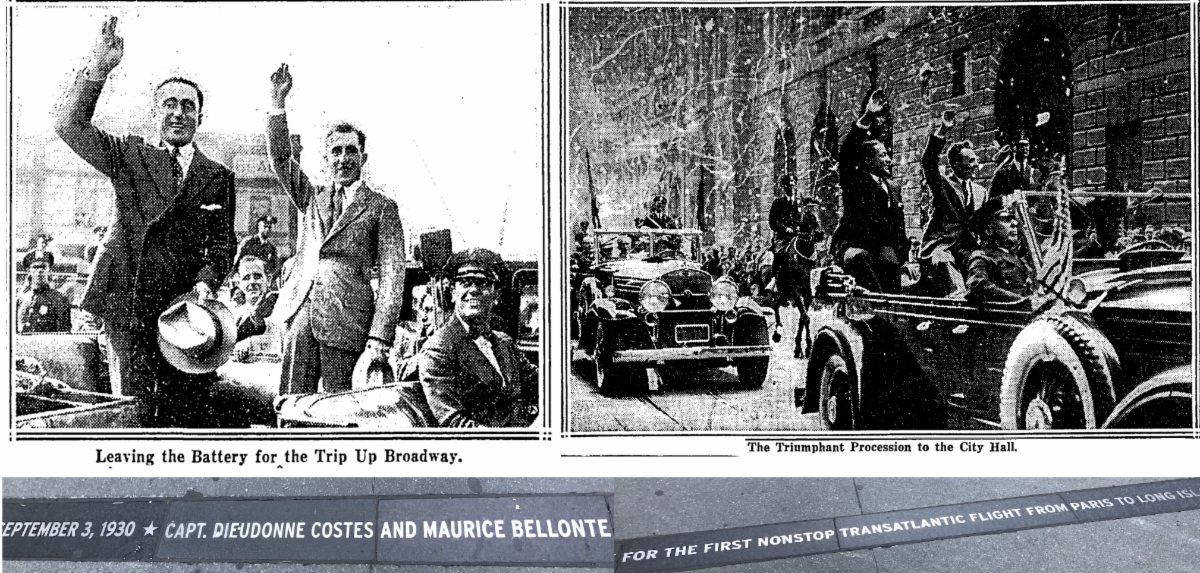
CAPTAIN DIEUDONNÉ COSTE AND MAURICE BELLONTE
|
|
Times Wide World Photos, Sept 5, 1930
New York, New York: September, 1930 - French aviators Dieudonné Costes and Maurice Bellonte in the parade given them up Broadway after being the first to fly nonstop from Paris to New York.
Click on the images above to witness the scene of their arrival on Youtube.
|
|
• French aviators Dieudonné Costes and Maurice Bellonte broke the world record on September 1, 1930, for a first non-stop flight by crossing the Atlantic Ocean against the trade winds, a very challenging feat. Only 3 years before Charles Lindberg had made the first transatlantic crossing, from New York to Paris in a thirty-three hours solo flight.
• At the time in 1927, the French aeronautics industry was in mourning, as pilots Nungesser and François Coli had disappeared during their own attempt to fly from Paris to New York.
• Costes and Bellonte did so in a modified Breguet XIX bomber, called "Point d'Interrogation" (Question Mark), because they were not sure whether they would succeed or not.
• When they reached the shores of Long Island on September 3, 1930, American radio reporters were waiting at Curtiss Field, microphones in hand, to capture the fliers’ reactions for listeners in France and North America. This was the first successful short-wave retransmission by a French broadcasting company of an American radio program.
• A complete bulletin in 2023 will be devoted to these French aviation pioneers and their triumphal tour throughout the United States from September 15 to October 10. They were welcomed by enthusiastic crowds everywhere, from Boston to Chicago to Seattle, San Francisco, Los Angeles, St Louis, New Orleans, Atlanta, to name a few cities.
|
|
MAY 26, 1930
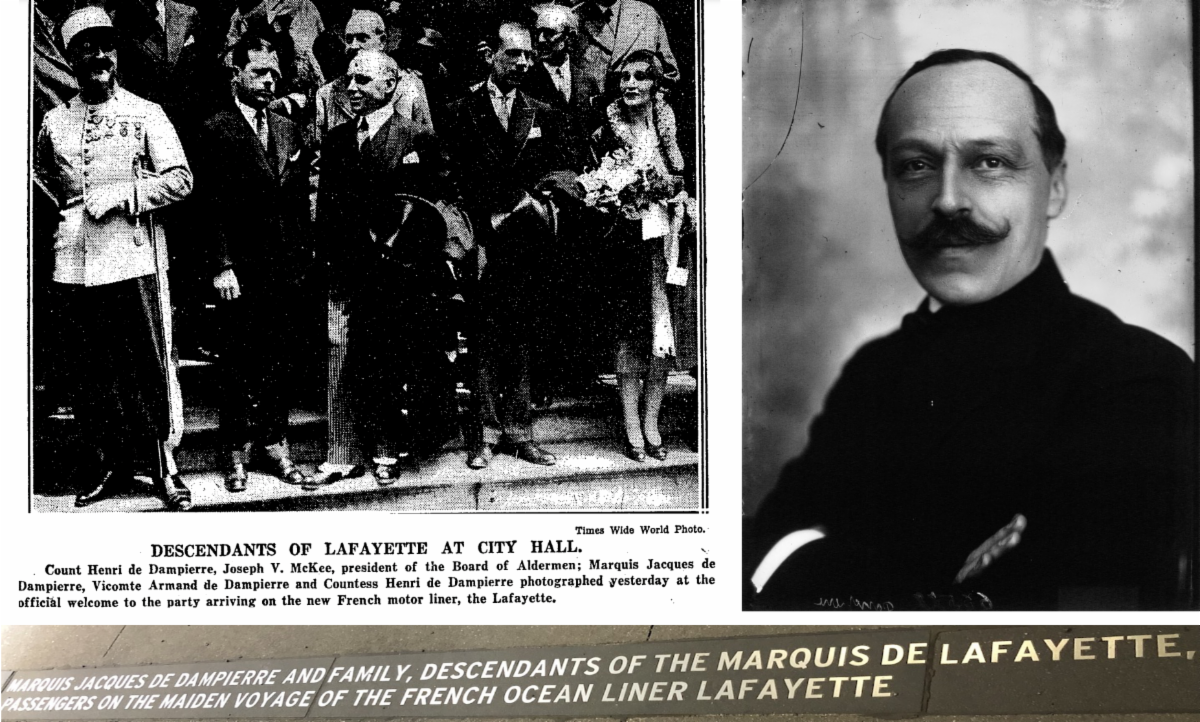
MARQUIS JACQUES DE DAMPIERRE
& DESCENDANTS OF LAFAYETTE
|
|
Photos: New York Times, May 27, 1930 |
|
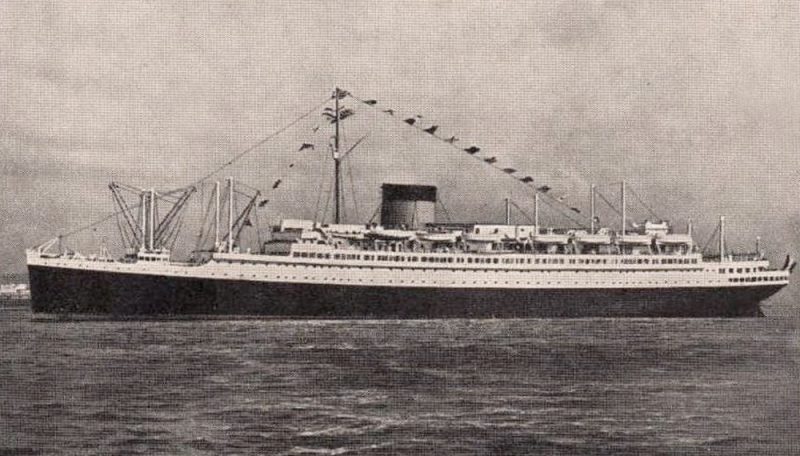
The French Line, or Compagnie Générale Transatlantique (CGT) was Cunard's main rival up until the late Sixties. The Lafayette, ordered in 1928, was 610 feet (186.3 m) long, 83 feet (25.4 m) wide, 25,178 gross tons, with four diesel engines powering four propellers, reaching an average of 18 knot service speed. Passenger capacity: 1,077.
|
|
• The French Line thought it advantageous from a public relations viewpoint to invite (distant) descendants of the Marquis de Lafayette to come to New York on board its latest ocean liner "Lafayette".
• During their stay in the country, the family, consisting of the Marquis Jacques de Dampierre, his wife, their sons the Comte Henri de Dampierre (in his uniform of Lieutenant of Algerian Tirailleurs) and the younger Vicomte Armand de Dampierre.
• As the New York Times reporter writes with a hint of amusement, "Henri.. taking care of a monocle which the wind occasionally skewed sidewise...he also had a sword, which he carried under his arm with no other visible means of attachment".
• The New York Times further reported on the parade, noting that "ashore a parade was waiting, consisting of a detachment of National Guardsmen in dress uniform, a platoon of mounted policemen who rode ahead in line and another platoon which trotted as flank escorts at each side, enclosing the city's guests and the reception committee, in a column of twenty automobiles each bearing a large American flag at the right and a large French tricolor at hte left. Noonday spectators stood four deep along the sidewalks, with patrolmen on foot stationed every two years along Broadway to City Hall."
|
|
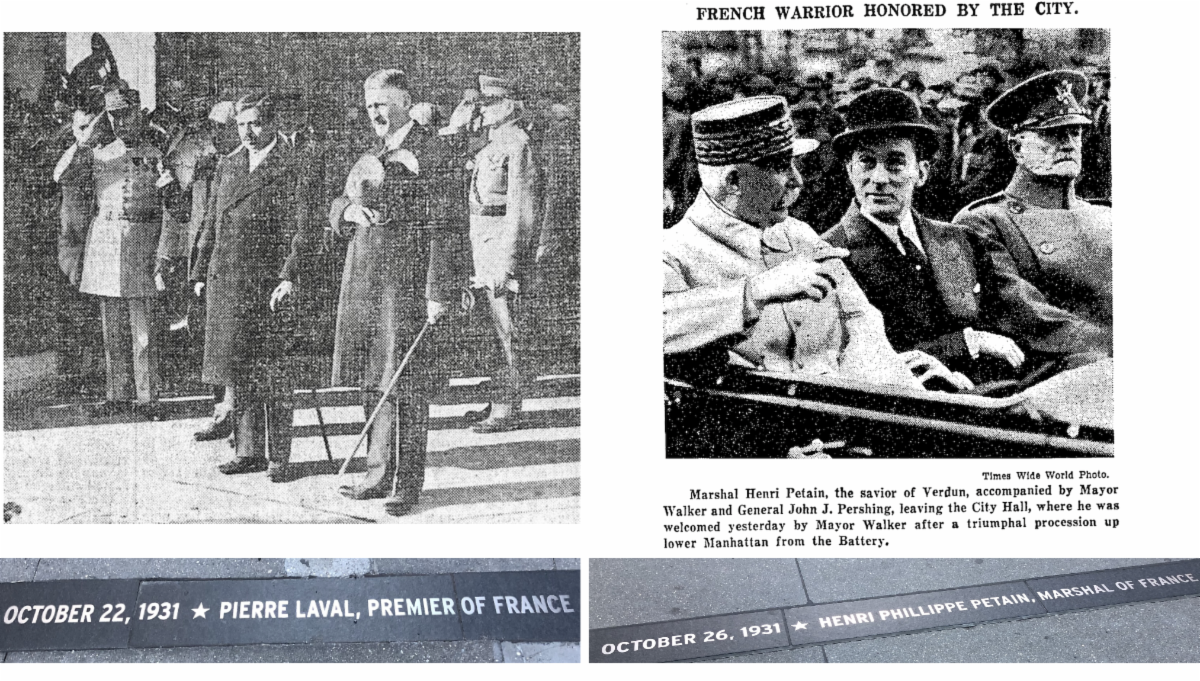
OCTOBER 22, 1931
PIERRE LAVAL, PRIME MINISTER OF FRANCE
OCTOBER 26, 1931
PHILIPPE PÉTAIN, MARSHAL OF FRANCE
|
|
At the time, they were honored because they were honorable.
Marshall Pétain was the hero of World War I, the savior of Verdun, the epic battle when more than 355,000 French soldiers gave their lives or were wounded for the cause of freedom.
Pierre Laval was honored in his quality as Prime Minister of France... Laval had just led a triumphant tour of the United States, during which he met President Hoover and the isolationists. He will be named "Man of the Year" by Time Magazine, thus becoming the only Frenchman to date, with General De Gaulle, to have received this title.
This was 10 years before the Vichy regime, when the pair collaborated with the Nazis. Pierre Laval was sentenced to death as a traitor, and executed by a firing squad in 1945. Marshal Pétain was also sentenced to death. His death sentence was commuted to life imprisonment in reason of his old age (89) by General de Gaulle.
There have been calls to remove the two granite strips on the Broadway sidewalls, especially since France itself renamed streets and places named after these two figures long ago.
|
|
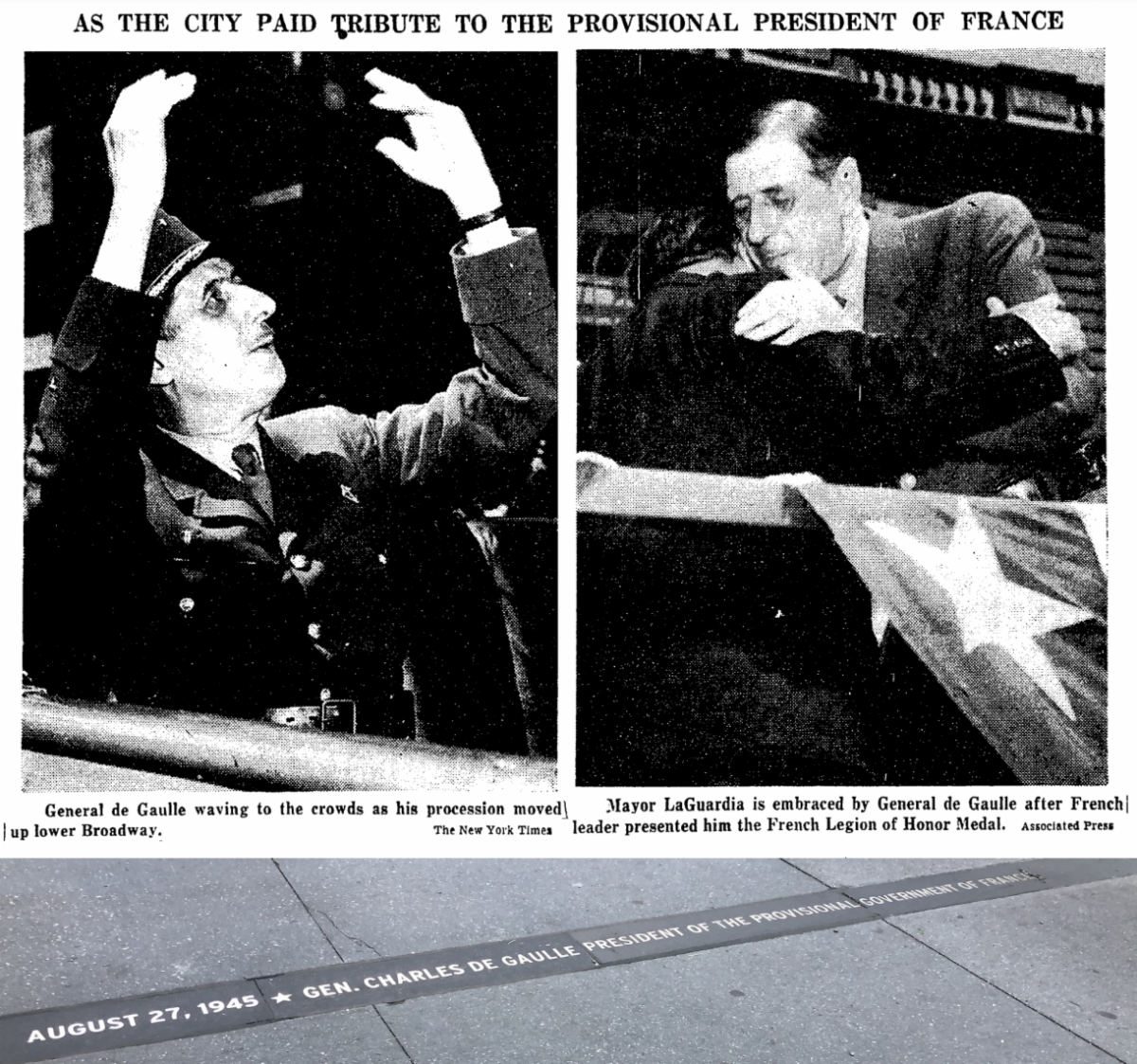
AUGUST 27, 1945
GENERAL CHARLES DE GAULLE
PRESIDENT OF THE PROVISIONAL GOV’T OF FRANCE
|
|
Photos: The New York Times
Click on the photo to watch a rare newsreel of his visit on Youtube.
|
|
• After the fall of France in June 1940 and its partition in two zones, the Nazi-occupied north and the "Vichy government" in the south, President Franklin D.Roosevelt recognized the Vichy regime headed by Marshal Pétain and appointed Admiral Leahy as the United States ambassador to Vichy. Winston Churchill, on the other hand, refused and backed de Gaulle as leader of the "Free French". The personal animosity between Roosevelt and de Gaulle never abated, the former thinking that de Gaulle was a potential dictator not to be trusted, and that France would never ever regain its status as a world power. On the other side, De Gaulle, profoundly proud and humiliated, never forgave what he saw as an opportunistic trampling from an ally all too eager to take advantage of France's geopolitical misfortune, and strip if of its vast empire.
• It is in this heavy historical context Gen. De Gaulle arrived in Washington for a three-day state visit with President Truman. In this official visit to Washington in 1945, French President Charles de Gaulle thanked the United States for its help liberating France from German occupation during World War II. After stepping from the transport plane in which he made the journey, Gen. De Gaulle said: "In the great task of organizing the world for peace, the U.S. will have to play a leading part". The French leader added: "It is the earnest desire of France to unite her efforts with yours in a spirit of confidence and friendship." These were diplomatic niceties. De Gaulle needed the all powerful United States to rebuild a war-ravaged nation and to help contain the communists.
• During the visit, Truman told de Gaulle that the U.S. would not oppose a return of French authority in Indochina. And when France went to war to recolonize Vietnam in 1945, the U.S. government needed its ally’s cooperation to contain the spread of communism in Europe.
• Throughout World War II, the American public and the American press were rooting for the Free French, and Roosevelt was increasingly criticized for his obstination to counter de Gaulle - some would say his personal obsession against him. In particular, New Yorkers, led by Mayor La Guardia, were overwhelmingly in favor of the valiant lonely fight of the French general.
• During his visit to New York, the New York Times headline read:
"2,000,000 Cheer de Gaulle on 62-mile Tour of the City". In a two-page article, the newspaper continued:..."New York's millions discovered that a taciturn, unsmiling Frenchman whose aim of freedom for his country, a traditional ally, paralleled their own, could unbend in victory after national tragedy"[...] "Preceded by a police band with fife and bugle corps, the procession made its way slowly through Whitehall Street and up lower Broadway. Office workers, leaning out of the windows, tossed a shower of multi-colored paper, confetti and streamers that drifted lazily down and sparkled in the sunlight slanting across the Customs House. Noonday strollers, forgoing their lunch, set up shouts of "Hooray for de Gaulle!" and "Vive la France!", while others simply called out "Hello, Charlie." Almost on the dot of noon, as the general's car passed the historic church the chimes of old Trinity pealed the hour. "
• Three months later after this visit, on 13th November, 1945, the first Constituent Assembly unanimously elected de Gaulle as head of the French government. He held the post until resigning on 20th January, 1946 into a twelve-year retirement, and his return to active statesmanship in 1958 prompted by the Algerian tragedy.
|
|
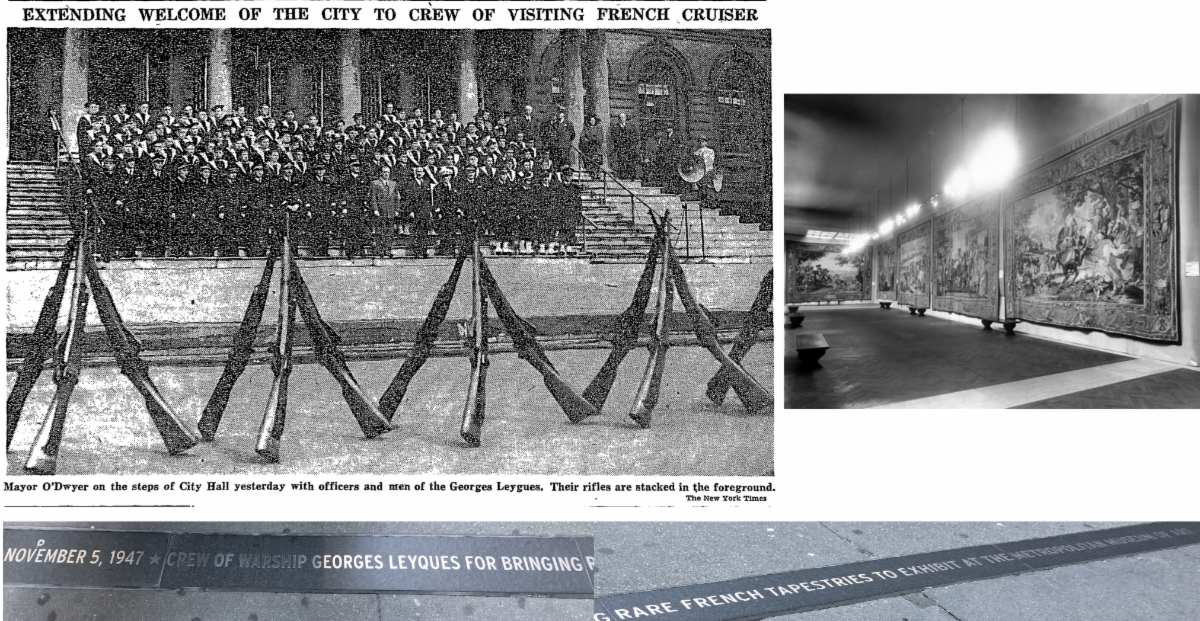
NOVEMBER 5, 1947
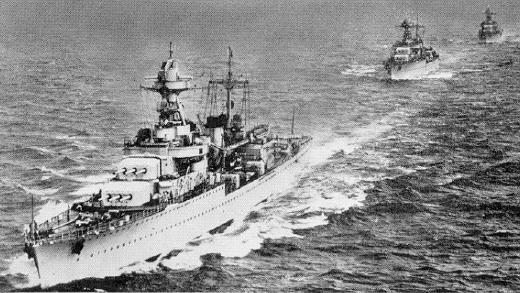
CREW OF FRENCH WARSHIP GEORGES LEYGUES
|
|
Photos: Top: The New York Times, Installation view, French Tapestries, on view November 22, 1947–February 29, 1948
Bottom: Cruiser Georges Leygues, ONI203 booklet for identification of ships of the French Navy, published by the Division of Naval Inteligence of the Navy Department of the United States (9 November 1942). Public Domain, https://commons.wikimedia.org/w/index.php?curid=1209208
|
|
• In late 1946, a correspondence took place between the Metropolitan Museum of Art and the French Embassy to the United States regarding the possible loan of a collection of rare tapestries for an upcoming exhibit. Claude Levy-Strauss, the future world renowned anthropologist, was at the time living in New York and teaching at the New School for Social Research, and also assisting the French General Consulate in New York. In April 1947, Claude Levy Strauss informed the Metropolitan Museum "of the formal acceptance by the French Government of your invitation to hold an exhibition of French tapestries . . ."
• Eager to restart after the war a policy of cultural exchanges with America, and to seek economic help to rebuild the country after 5 years of brutal occupation and pillage, the French government designated the cruiser Georges Leygues to carry the precious cargo to New York.
• The Georges Leygues, named after a French politician in the 1920's, had played an active role during the war, including support for the June 1944 Allied landing at Normandy. In addition to carry tapestries, the cruiser also delivered French gold bullions worth some 80 millions dollars (out of 2,500 tons of gold previously saved from invasion of Metropolitan France to various locations in the US, Halifax in Canada, Martinique, Dakar in Senegal) to buy equipment. More can be found on this fascinating story at: https://www.gold-eagle.com/article/french-gold-world-war-ii
• At the disembarkation ceremony, New York Mayor William O'Dwyer noted: "While the countries of the world are thinking in terms of war, France is thinking in terms of culture."
• Each of the six hundred crew members of Georges Leygues received as a welcome gift one pound of chocolate - - a prized commodity after years of wartime rationing. On November 6, a contingent of the ship's sailors and officers, led by their captain, Jacques Willaume, marched up Broadway from the Battery to City Hall for a memorable ticker tape parade.
• The New York Times headline read: "Tapestries Show France Remains Bastion of Culture, O'Dwyer Says". The article went on "A detachment of ninety-six officers and blue-uniformed sailors from teh French cruiser Georges Leygues stepped briskly up Broadway [...] to the stirring music of a French drum and bugle corps that played the "Sambre et Meuse", the "Lorraine" and the "Foreign Legion" marches." [...] "the crew stacked their carbines and marched up to the Board of Estimate room for a brief ceremony"..[...] " their peaceful mission of bringing priceless treasures of French tapestries for exhibition at the Metropolitan Museum of Art " will contribute immensely to the realiation that France remains the great bastion of Western European culture that she has always been" [...] Captain Willaume, speaking in French, said "You can be sure that all of us, side by side with the American Navy, are ready to cooperate for the peace of the world, with the same spirit of freedom, liberty and happiness".
|
|
FEBRUARY 3, 1949
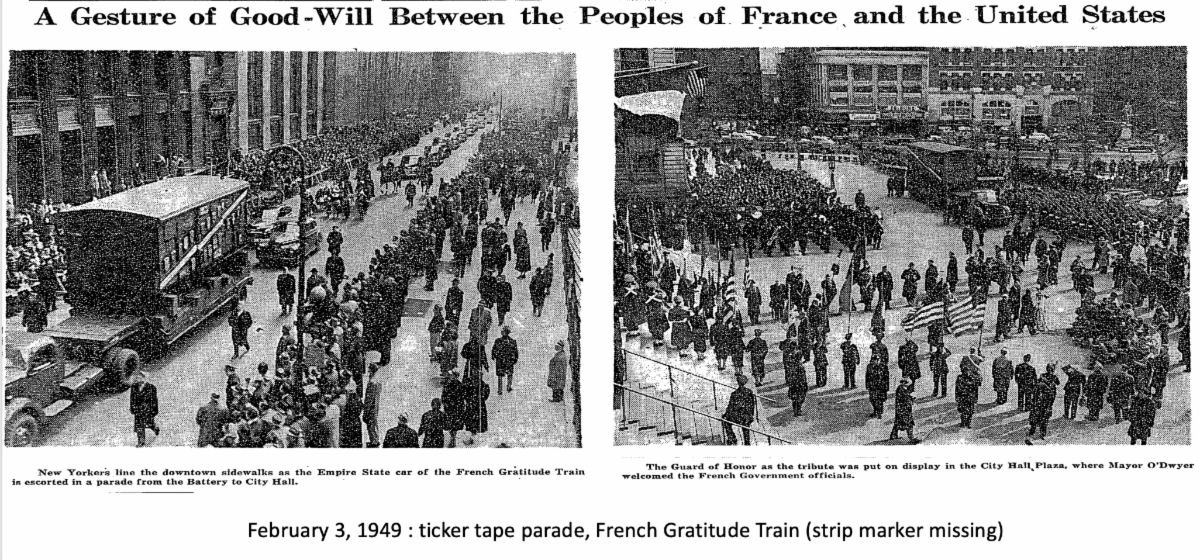
FRENCH GRATITUDE TRAIN
(strip marker not found)
|
|
Photos: The New York Times
The missing strip marker is probably due to construction on a building and its portion of adjacent sidewalk.
It read: "French gratitude train ("Merci Train") bearing gift from France to the United States in appreciation of the friendship train (February 3, 1949)"
|
|
• The headline of The New York Times read: " City Roars Thanks to France fro Car of Gratitude Train" - "First of 49 Freight Carriers Paraded from the Battery to City Hall as 200,000 Cheer"
The article went on: "The city put out its traditional welcome mat for the first of forty-nine gift-laden boxcars being sent by the French people in appreciation for the $40,000,000 Friendship Train that America sent to France in the bleak winter of 1947" [...] "Each car contains approximately 10,000 cultural, historical, personal and communal gifts..."[...] "the American Legion accepted a torch lighted in January at the tomb of the Unknown Soldier in Paris"[...]"eventually the torch will be taken to Arlington to beunited with teh Eternal Flame at the tomb of the Unknown Soldier there, and then turned over to teh American Legion"[...] "Massed thousands, swelled by the noon-hour crowds in the financial district and by 15,0000 public and parochial school children with French and American flags, packed the parade route along Broadway. An avalanche of confetti and ticker tape danced in the sunlight as it fell in the wind".
• We will devote our Bulletin next month to the almost forgotten wonderful story of the "Train de la Reconnaissance Française", or "Merci Train" as it is known in English, and the whereabouts of the 49 railroad boxcars and their contents, dispersed throughout the 49 States of United States of 1949, plus Hawaii and the District of Columbia.
|
|
APRIL 3, 1950
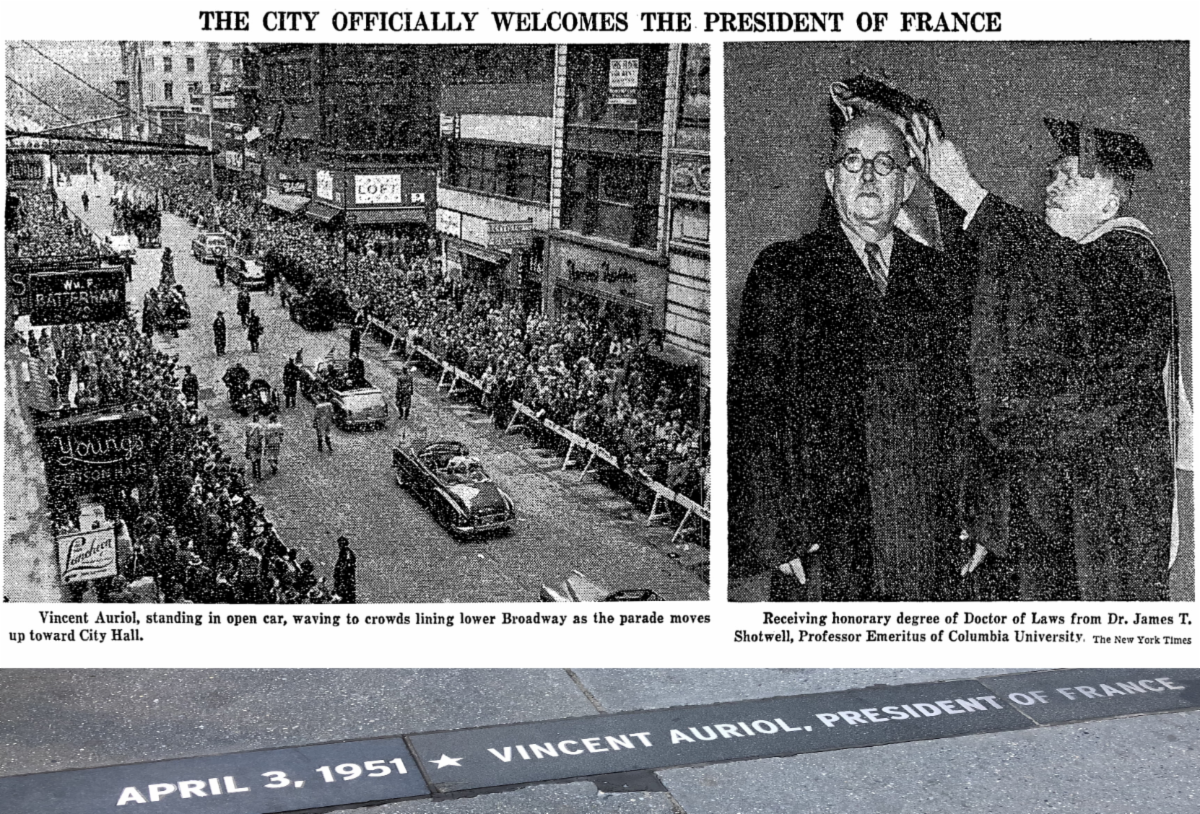
VINCENT AURIOL, PRESIDENT OF THE FRANCE
|
|
Photos: The New York Times |
|
• Vincent Jules Auriol (27 August 1884 – 1 January 1966) was a French politician from the Socialist Party who served as President of France from 1947 to 1954. He was one of the 80 deputies who voted against the extraordinary powers given to Prime Minister Marshal Philippe Pétain on 10 July 1940 that brought about the Nazi-backed Vichy government. As a result, he was placed under house arrest until he escaped to the French Resistance in October 1942, and fought with the Resistance for a year. Auriol was exfiltrated to London in October 1943. He represented the Socialists at the Free French Consultative Assembly (organized by Charles de Gaulle in Algiers later that year). In July 1944, he represented France at the United Nations Monetary and Financial Conference at Bretton Woods, United States. He was France's first representative on the United Nations Security Council in 1946
• In an article dated April 4, 1951, the New York Times reports:" New York bestowed high honors and a warm welcome yesterday upon President Vincent Auriol of France. Seventy-five thousands persons, according to the police estimate, applauded and cheered him as he drove up Broadway from Bowling Green to City Hall in the traditional parade for visiting celebrities. Thens of thousands more turned out to see him as he drove up and down and across Manhattan" [...] "President Auriol, who is paying an official visit to this country to strengthen Franco-American friendship against Communist agression, was suffering from a slight cold as he left his quarters at the Waldorf-Astoria Hotel"... [...] "France, whose history is linked with all the great revolutions for freedom, has always been the first to rise against aggression, even at the risk of endangering her own existence", Mr. Auriol said. "We have remained faithful to the ideal that has always been ours".
|
|
JULY 26, 1954
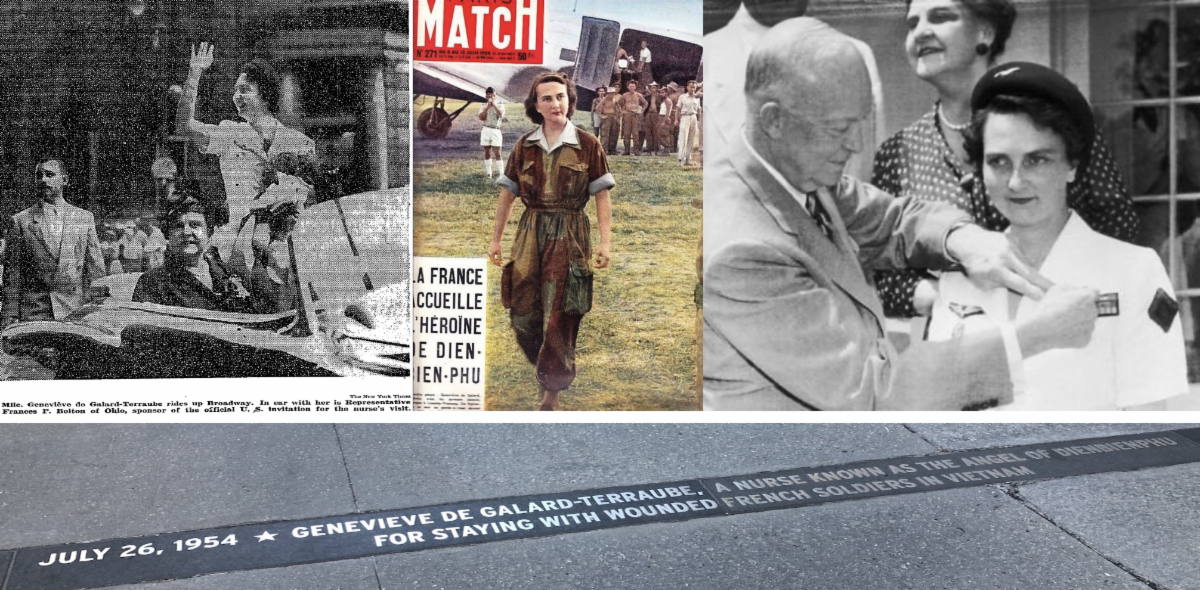
LIEUTENANT GENEVIÈVE DE GALARD-TERRAUBE,
THE "ANGEL OF DIEN BIEN PHU”
|
|
Photos:
Left: The New York Times -
Middle: front cover of Paris Match magazine, May 24 1954
Right: https://www.presidency.ucsb.edu/documents/citation-accompanying-the-medal-freedom-presented-genevieve-de-galard-terraube
|
|
"I do not deserve this honor. I have only done what any nurse would do."
• Geneviève de Galard (born 13 April 1925) is a French nurse who was dubbed l'ange de Dien Bien Phu ("the Angel of Dien Bien Phu") during the French war in Indochina by the press in Hanoi, although in the camp she was known simply as Geneviève.
• She became a nurse and volunteered to serve in the French Air Force as a "convoyeuse" (in-flight nurse). After January 1954, she was on the flights that evacuated casualties from the battlefield of Dien Bien Phu, a French stronghold encircled, besieged and overrun by dozens of thousands of Vietminh soldiers. On March 8, 1954, her C-47 plane landed in fog and got stranded on a tarmac destroyed by incessant artillery barrages. She volunteered to work in a field hospital and was the only female nurse.
• After the garrison was overrun and she was captured by the Vietminh, and while still a prisoner of war, US Secretary of State John Foster Dulles invited her to the USA. After her eventual release she arrived in New York in July and was feted as a "symbol of heroic femininity in the free world" by Congresswoman Frances P Bolton.
• 250,000 spectators lined her ticker tape parade on Broadway. In Washington, she was recognized by the House of Representatives, and was awarded with the Medal of Freedom in the White House Rose Garden by President Eisenhower.
• Geneviève de Galard, 97, lives in Paris with her husband, Colonel Jean de Heaulme de Boutsocq.
MEDAL OF FREEDOM (WITH BRONZE PALM)
• THE PRESIDENT of the United States of America, authorized by Executive Order, July 6, 1945, has awarded the Medal of Freedom with Bronze Palm, to Mademoiselle Genevieve de Galard-Terraube, French Airborne Nurse, for meritorious service.
"Mademoiselle Genevieve de Galard-Terraube, French Airborne Nurse, by her ministrations to the sick and wounded at Dien Bien Phu, inspired and heartened the entire free world. Her service to her comrades, marked by the courage of a woman in battle and by the devotion of a nurse to her sworn duty, has been unsurpassed in this century. Her supreme fortitude in hours of peril, her unfaltering dedication to her mission reflected the greatness of spirit manifested on many fields, in many centuries, by the soldiers of France.
The Republic she serves so nobly has been an ally of the United States for 178 years. The continuing friendship between the peoples of the two Republics is symbolized today in their joined salute to Mademoiselle de Galard-Terraube. Her service at Dien Bien Phu reflects great credit upon herself and her country and the cause of freedom around the world."
DWIGHT D. EISENHOWER,
(Citation Accompanying the Medal of Freedom Presented to Genevieve de Galard- Terraube)
• "Mademoiselle Genevieve de Galard-Terraube, French Airborne Nurse, by her ministrations to the sick and wounded at Dien Bien Phu, inspired and heartened the entire free world. Her service to her comrades, marked by the courage of a woman in battle and by the devotion of a nurse to her sworn duty, has been unsurpassed in this century. Her supreme fortitude in hours of peril, her unfaltering dedication to her mission reflected the greatness of spirit manifested on many fields, in many centuries, by the soldiers of France." - Dwight D. Eisenhower
• The New York Times dated July 27, 1954 reported: "Mlle Geneviève de Galard-Terraube, a young Parisienne with dimples in her smile, a fleeting shyness about showing them, and the emphatically low heels of a nurse, came to America yesterday. Everything about the visitor except her welcome - by an estimated total of 250,000 New Yorkers - belied the fact that she had been the only woman in the beleagured (sic) Indochinese strongpoint of Dienbienphu [....] "I do not deserve this honor", she read, with an appealing accent, "for I have only done my duty. This honor is intended, through me, for all those whose life I was proud to share in Dien-Bien-Phu, and for the nurses, for all the nurses who devote themselves to the best of their abilities, to alleviating the sufferings of the wounded" [...] "Mademoiselle", said the Mayor, "you are not only the heroine of Dienbienphu. You are not only the heroine of France. You are the heroine of the entire free world".
|
|
Photos: The New York Times
Click on the photos above to watch a newsreel of the visit on Youtube
|
|
“Hundreds of thousands New Yorkers are expected”
• “It is impossible for a New Yorker to think of the visit of a great French general to our city without thinking of those memorable days in August, 1824, when General Lafayette came ashore in New York on his last visit to the United States. “ […] But Lafayette started it long ago when the guns boomed, the West Point band played “See the Conquering Hero Comes”, and New York put out its flags and threw flowers while the delirious crowd cheered. Old soldiers wept for joy and for the memories of “battles long ago”. The General wept, too. All this was like a chord whose sound was so true that we will always hear it, as we do now while General de Gaulle is in our City.”
[...]
“…General de Gaulle said he was “profoundly moved”. So was Foch in his time. So was Lafayette. So were we and our parents and our grandparents all the way back to the day when President John Quincy Adams said farewell to the Marquis of Lafayette in words that were prophetic: “We shall look up upon you always”, he said, “as belonging to us, during the whole of our ife, and as belonging to our children after us”.
The New York Times, published April 27, 1960
• On April 23, 1960, De Gaulle held a press conference, which can be heard by clicking at:
• On April 25, 1960, De Gaulle addressed a joint session of Congress. A newsreel of his speech (in French) can be seen at:
• A newsreel of the parade on Broadway of April 26, 1960 can be viewed by clicking:
|
|
PART THREE OF THE SERIES
"LAFAYETTE, GUEST OF THE NATION"
If you missed the episodes from our past Bulletins...
• President James Monroe invited Lafayette, the last surviving major general of the American Revolutionary War, to tour the United States, officially to celebrate the nation's 50th anniversary but also to instill the "spirit of 1776" in the next generation of Americans at a time of great political divide. His tour drew large crowds and sparked a renewal of patriotism.
• From July 1824 to September 1825, Lafayette made a tour of all 24 States in the United States. He was received with a hero's welcome everywhere he stopped. Immense crowds, children, old veterans would come from miles away and wait hours to have a chance to see him, approach him, touch him. Many honors and monuments were presented to commemorate and memorialize the visit.
• The 24 states visited were: Alabama, Connecticut, Delaware, Georgia, Illinois, Indiana, Kentucky, Louisiana, Maine (ex-Massachusetts / North part), Maryland, Massachusetts, Mississippi, Missouri, New Hampshire, New Jersey, New York, North Carolina, Ohio, Pennsylvania, Rhode Island, South Carolina, Tennessee, Vermont, Virginia, Washington D.C.
• The main means of transportation were stagecoach, horseback, canal barge, and steamboat.
• Throughout the years 2024 and 2025 each city will celebrate this most illustrious Frenchman, ranked alongside the Founding Fathers, practically on a par with George Washington. If anyone harbors any doubt about it, one only needs to read the some of the hundreds of local newspapers articles and the accounts or memoirs of contemporary witnesses accounts.
|
|
• Several of his stops are memorialized with markers and plaques, some decades-old, and an increasing number of brand new ones, thanks to the energy and enthusiasm deployed by Julien Icher, president of the LafayetteTrail.org, whose goal is to dedicate all 175 markers by 2024.
• These new markers from the LafayetteTrail.org are all made in the same distinctive blue and red cast metal and signed by the William C. Pomeroy Foundation which is generously funding this gigantic project.
• The American Society of Le Souvenir Français Inc. is honored to partner with these two like-minded organizations, all well as all other American patriotic associations and volunteers who are participating in these celebrations.
|
|
As we started with August 2022 Bulletin, we will narrate every month some of the most salient episodes of this remarkable journey of the corresponding month 198 years ago, while keeping you abreast of the many celebrations planned by the local committees of the American Friends of Lafayette in 2024 and in 2025.
For this series we will also borrow from the testimonies of a privileged close witness, Auguste Levasseur, Lafayette’s personal secretary, who traveled along with the Marquis and his son, George Washington Lafayette, and who published his extensive daily journal: “Lafayette en Amérique 1824-1825, ou Journal d'un voyage au Etats-Unis" (Published by the Librairie Baudoin, Paris, in 1829), as well as other well-documented sources, such as Samuel Lorenzo Knapp. “Memoirs of General Lafayette : with an Account of His Visit to America and His Reception By the People of the United States; From His Arrival, August 15th, to the Celebration at Yorktown, October 19th, 1824”(Published in November, 1824)
|
|
October 6 – Escorted to Wilmington, Delaware, by the Grand Lodge of Delaware Masons
October 8 to October 11– Toured Baltimore and met with surviving officers and soldiers of the Revolution
October 12 – Arrives in Washington, D.C., paraded into town, welcomed by the mayor in the U.S. Capitol rotunda, and celebrated with illuminations throughout the city and with a rocket show.
October 15 – Spends the entire evening at Arlington House, although he returns to his hotel in Washington, D.C., at night
October 17 – Visits Mount Vernon and George Washington's tomb in Virginia
October 18–19 – Arrives by steamer in Petersburg, Virginia, for visit to Yorktown and festivities marking the 43rd anniversary of the battle; spent eight days in the Tidewater of Virginia (Norfolk and Portsmouth) area.
October 22 – Arrives in Norfolk, Virginia via steamer from Petersburg and spends four days there and in Portsmouth
October 23 – Arrives in Richmond, Virginia, on a steamer from Norfolk. Edgar Allan Poe is in the youth honor guard in Richmond that welcomed him when he arrived.
|
|
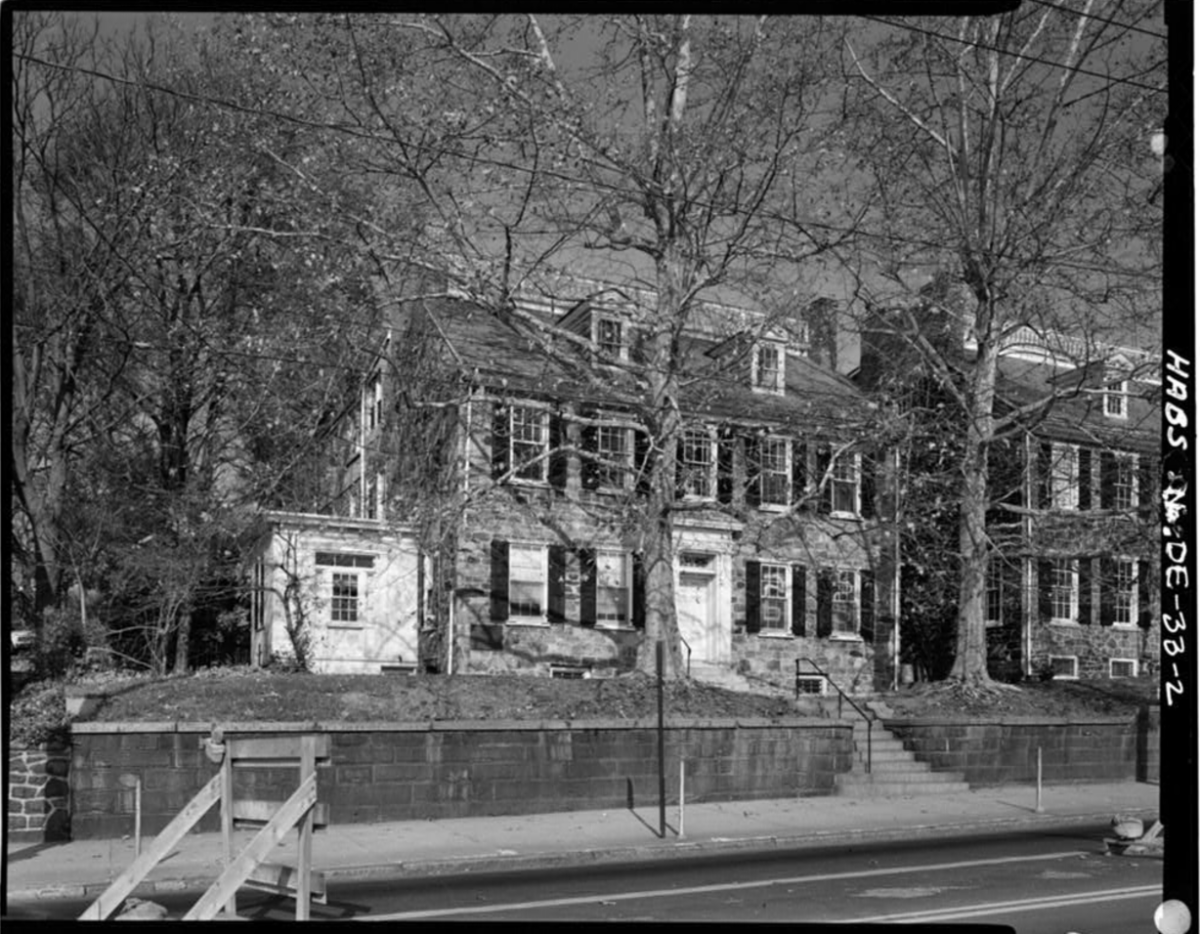
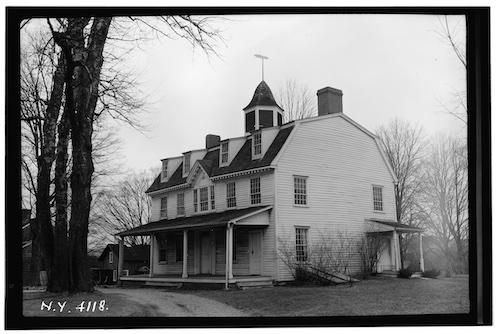
LAFAYETTE AT WILMINGTON, DELAWARE
October 6, 1824
|
|
1800 North Market Street, Wilmington, DE 19802
Photo: Library of Congress Prints and Photographs Division Washington, D.C. , Public Domain https://www.loc.gov/rr/print/res/114_habs.html
|
|
•The house is listed on the National Register of Historic Homes since July 14, 1993.
• Inscription of marker:
"Built about 1760. Anthony Wayne's Headquarters 1777. Generals Washington, Lafayette, Wayne, and other officers met here to hold council and hear reports prior to the Battle of Brandywine. Later occupied by British. Joseph Tatnall owned and operated original flour mills on the Brandywine and supplied flour to Continental Army
Erected 1932 by Historic Markers Commission. (Marker Number NC-A2.)"
• Inscription of Lafayette's’ tour marker:
“On October 6, 1824, general
Lafayette entered Brandywine
village and was escorted to
Joseph Tatnall's house where
he addressed family members.”
William G. Pomeroy foundation 2022
|
|
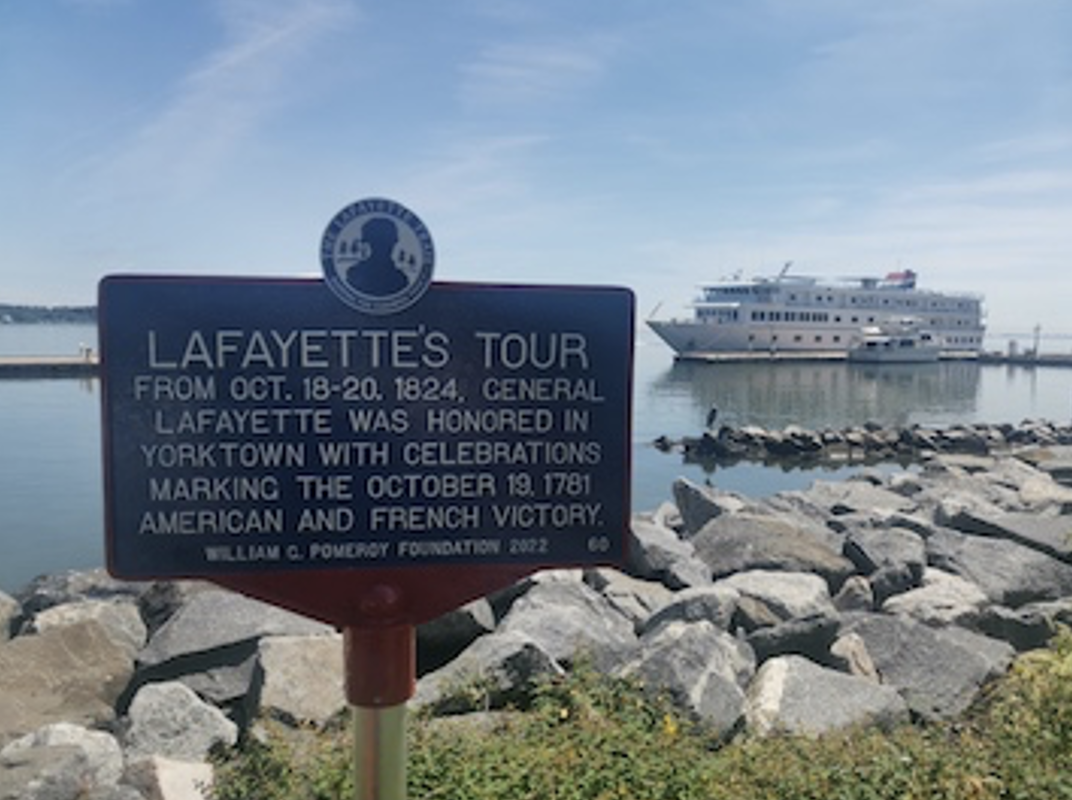
LAFAYETTE IN YORKTOWN
October 18-20, 1824
|
|
Riverwalk, 329 Water St, Yorktown, VA 23690
Photo: Nicole Yancey
|
|
• Lafayette arrived in Yorktown on October 18 on a ship and disembarked on a specially constructed wharf, where he was greeted by a crowd of 15,000 people.
• During the visit, the party visited temporary monuments, including a 45-foot tall arch at the site of his courageous assault at Redoubt #10 and a 76-foot tall obelisk at the site of the British surrender. A mass assembly greeted him at Surrender Field.
• Inscription of marker by Riverwalk, Yorktown:
Lafayette Tour
“From October 18-20, 1824, General
Lafayette was honored in
Yorktown with celebrations
Marking the October 19, 1781
American and French victory”
William Pomeroy Foundation, 2022”
• From October 19–22 he visited Williamsburg, Virginia and the College of William & Mary and stayed in the Peyton Randolph House in Williamsburg. He attended an honorary banquet at Raleigh Tavern with Chief Justice John Marshall and Secretary of War John Calhoun.
His party rode to Jamestown, Virginia and traveled to Portsmouth to see Norfolk Naval Shipyard. While in Hampton Roads, he visited the unfinished Fort Monroe, and then Colonel Abraham Eustis escorted him to inspect the Old Point Comfort stronghold, which had been designed by French-born engineer Simon Bernard.
On October 25, he left on a ship bound for Richmond, VA.
|
|
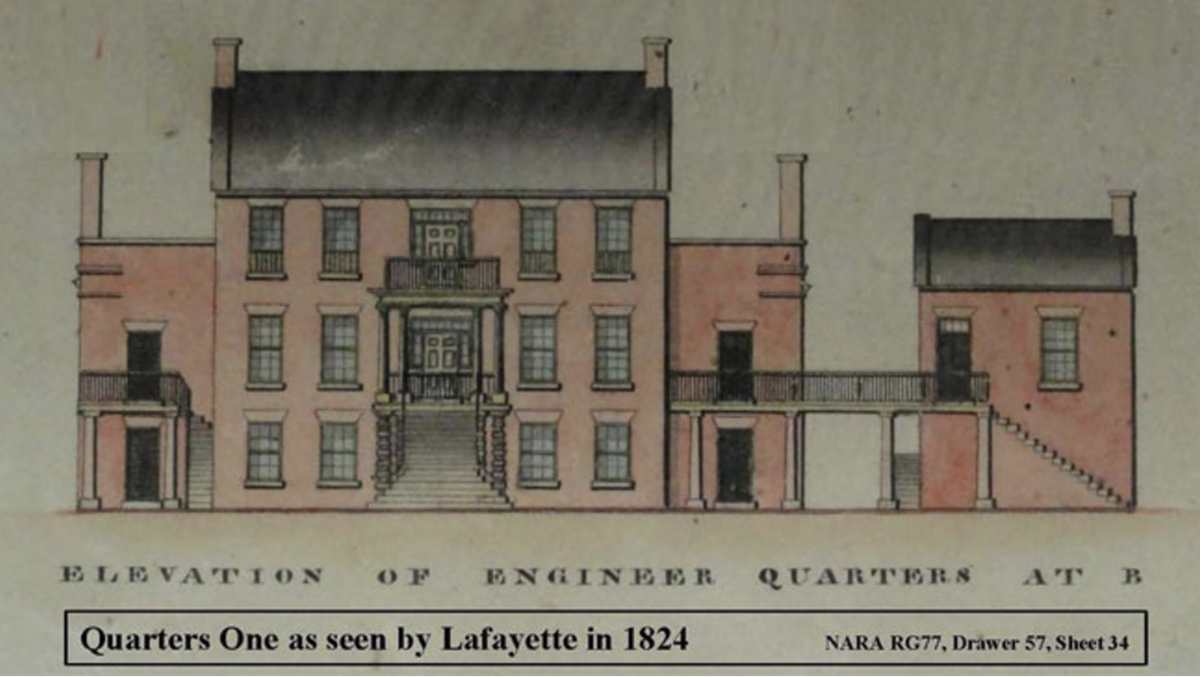
VISIT OF FORT MONROE, VA
October 22, 1824
|
|
41 Bernard Road, Fort Monroe, VA 23651
|
|
• General Lafayette arrived at Fort Monroe on Sunday October 24, 1824. The Norfolk and Portsmouth Herald {October 27, 1824}, which covered his visit extensively stated, “…the general left here { } on Sunday afternoon for a visit to Fortress Monroe where he was received with highest military honors.”
• Today, on the main floor of Quarters No. 1 adjacent to the “Lincoln Bedroom” is the “Lafayette Room” where Lafayette presumably spent the Sunday night of October 24, 1824. The building is owned by the National Park Service and operated by Fort Monroe National Monument.
(Excerpts of “Lafayette’s visit to Fort Monroe in 1824 as Guest of the Nation" by Robert Kelly, Casemate Museum Historian, and VP of the American Friends of Lafayette)
|
|
VISIT OF PORTSMOUTH, VA
October 24, 1824
|
|
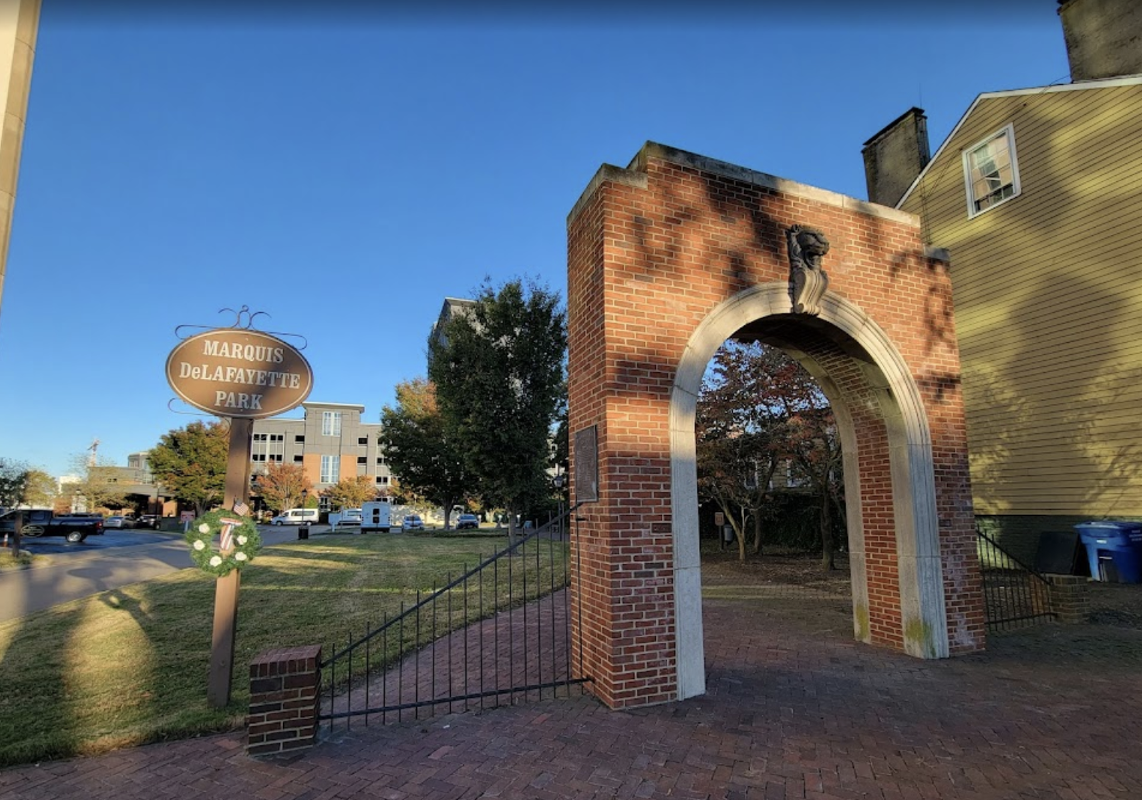
Marquis De Lafayette Park, 407 Crawford St, Portsmouth, VA 23704
Photo: USS Carolina - By US Navy - Naval Historical Center, Public Domain, https://commons.wikimedia.org/w/index.php?curid=10114573
|
|
• “General: Appointed by my associates, the boys of the town of Portsmouth, who are now assembled before you, to express to you our feelings on this joyous occasion, I congratulate you that you have arrived in our country, and in our town. We have heard, General, of your philanthropy, of your magnanimity, of your distinguished services in our Country’s cause; and we have been taught from the cradle, by our fathers, to lisp your praise. The history of our Country has recorded and associated your name with that of our beloved Washington, and, General, although we are young, yet, it is recorded in our memories, never to be effaced. Our hearts swell with the purest gratitude and respect, which we beg you, General, to accept...” Address of Master Winchester Watts, reported by The Norfolk and Portsmouth Herald, Oct 27, 1824
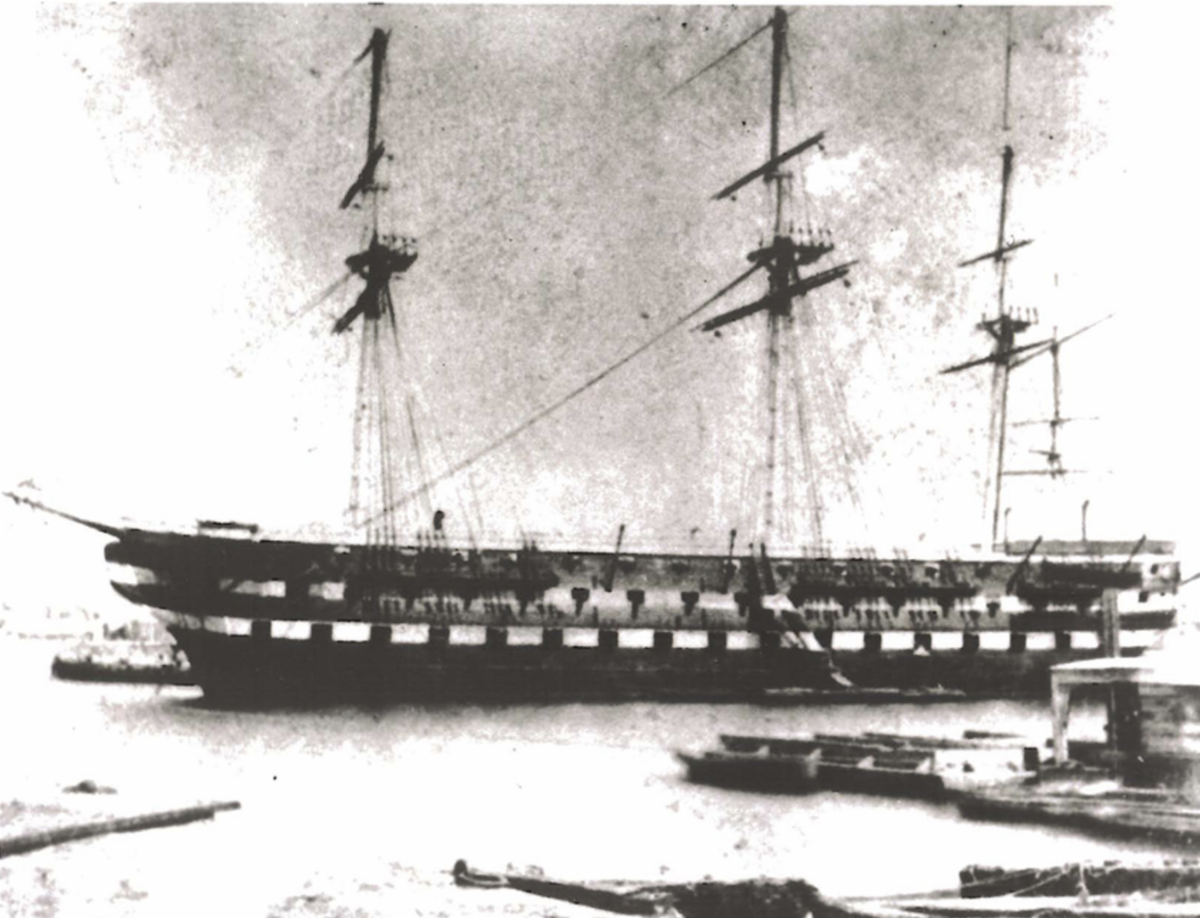
• Inscription of marker:
“On oct. 25, 1824, general
Lafayette was greeted by
artillery salute near here
and proceeded to Navy yard
to view USS North Carolina.”
William G. Pomeroy foundation 2020
|
|
Arch, “General Lafayette”, Park Lafayette |
|
Marquis de Lafayette Park, 407 Crawford St, Portsmouth, VA 23704
Photo: Image capture Nov 2021 (c) Google 2022
|
|
• “The Lafayette Arch was unveiled in 1976 as a part of the bicentennial celebration. It marks the entrance to Lafayette Park, a small pocket park dedicated to the memory and contributions of the Marquis de Lafayette, friend of the Patriots, hero of the American Revolution, and early abolitionist. Designed by local architect Mary Ramsay Brown Channel, it is and inspired by an arch erected in Portsmouth in 1824 to honor the Marquis de Lafayette’s visit to the city and dedicated to “all who lived and died for freedom.”
• The lion’s head came from the demolished American National Bank Building on High Street.
(Excerpt from the book "French Memories in the United States" by Thierry Chaunu, page 193)
|
|
TO BE CONTINUED NEXT MONTH!... |
|
SEASON 2, EPISODE 3, OCTOBER 1782:
THE FRENCH ARMY FROM CROMPOND, NY TO BOSTON
|
|
MISSION ACCOMPLISHED
Last year we narrated in 5 episodes, from June to October, the long march of the French Army under general comte de Rochambeau from Newport, R.I. to Yorktown, VA, through the States of CT, NJ, NY, PA, DE, MD
We are resuming the series, which will extend from this month until December: "Season 2, Episode 3: October 1782, New York & Connecticut"
After the victory in Yorktown, the war was not officially over. It would take several more months before England would recognize the independence of the United States and sign the Treaty of Paris on September 3, 1783.
During that time, British forces were still in control of cities such as New York.
The French army spent the most part of the winter of 1781-1782 stationed in Williamsburg, VA, and starting marching north in July 1st, 1782 to reach Boston in December and sail home.
Some units stayed behind, such as the famous Lauzun Legion of hussards, who kept watch during the winter of 1782-1783.
The return march route was in a much lighter mood, understandably so. It is not as well documented than the south-bound march we narrated last year. Still, there are several markers along the way which we will select, as well as a few nice anecdotes which we will tell in future bulletins until December.
Below are a few markers pertaining to the month of OCTOBER 1782, while crossing the States of New York and Connecticut.
|
|
A FEW SELECTED MARKERS ALONG THE WAY...
October 1782
|
|
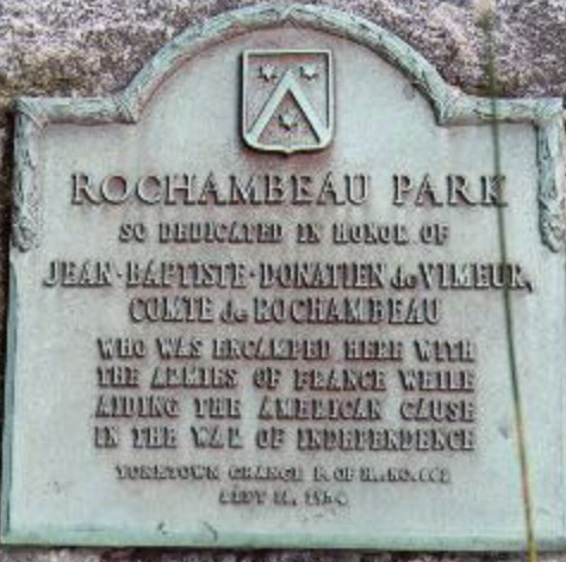
Rochambeau Park, Yorktown Heights, NY
Photo: by Ralph Nelson Kirkwood Chapter, Delaware Society SAR
|
|
• Rochambeau’s "arrest": General Rochambeau lodged at the house of a poor miller by the name of Samuel Delavan on Hallock’s Mill Road in Yorktown Heights. At breakfast, the local sheriff came with Delavan to tell him that the troops did quite a bit of damage and that Mr. Delavan wanted to be reimbursed. The sheriff said that he was sorry, that he recognized the important services the general had rendered. Mr. Delavan then put his hand on General Rochambeau’s neck. The sheriff took him by the shoulder and grabbed him by the other side. Rochambeau advised the sheriff to leave if he did not wish to become a prisoner himself! (All damages were fully paid).
• INSCRIPTION
ROCHAMBEAU PARK
SO DEDICATED IN HONOR OF
JEAN-BAPTISTE-DONATIEN de VILMEUR
COMTE DE ROCHAMBEAU
WHO WAS ENCAMPED HERE WITH
THE ARMIES OF FRANCE WHILE
AIDING THE AMERICAN CAUSE
IN THE WAR OF INDEPENDENCE
Yorktown (?) R.OF H. (?)
???
|
|
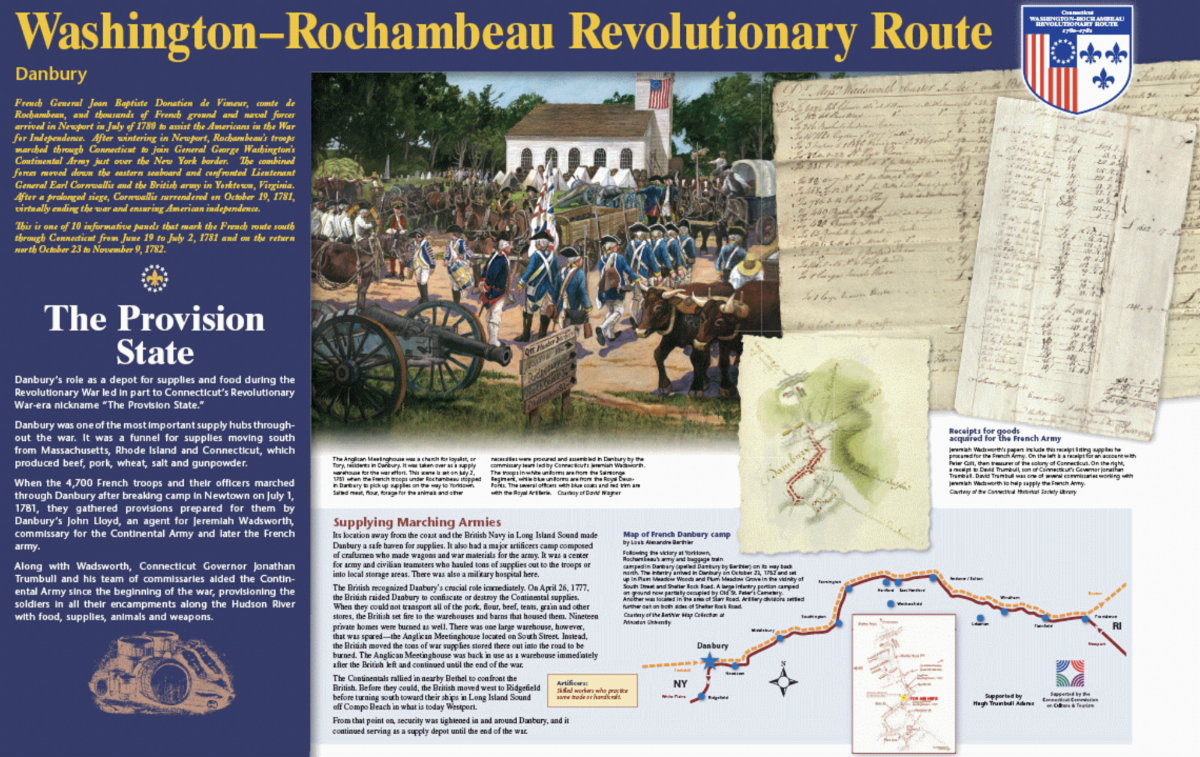
Marker, “The Provision State” , Danbury CT |
|
Next to Rider House (part of the Danbury Museum and Historical Society),
43 Main Street, Danbury, CT 06810
|
|
• Danbury, CT was one of the most important supply hubs in the Revolutionary War, giving rise to Connecticut’s nickname “The Provision State”. The town was burned by British soldiers in April 1777. On the return trip from Yorktown, Rochambeau’s army camped in several locations in Danbury in October 1782, Camp 40.
• The marker is in front of the Rider House, built c. 1785.
• Excerpts from the marker:
“Rochambeau’s army and baggage train camped in Danbury (spelled Dambury by Berthier) on its way back north. The infantry arrived in Danbury on October 23, 1782 and set up in Plum Meadow Woods and Plum Meadow Grove in the vicinity of South Street and Shelter Rock Road. A large infantry portion camped on ground now partially occupied by Old St. Peter’s Cemetery. Another was located in the area of Starr Road. Artillery divisions settled further out on both sides of Shelter Rock Road.”
|
|
39th Encampment of the French Army. North Salem, NY
22 – 23 October, 1782
|
|
North Salem Town Hall, where Rochambeau and his staff stayed.
266 Titicus Rd, North Salem, NY 10560
Photo: By https://www.loc.gov/pictures/item/ny0866.photos.124670p, Public Domain,
|
|
• Following their month-long stay in Crompond/Yorktown Heights, NY, the First Brigade, consisting of the Bourbonnois and Royal Deux-Ponts, broke camp on 22 October 1782, and began the march to Connecticut.
• It set up its 39th encampment near the home of loyalist General De Lancey in North Salem, which serves today as the North Salem Town Hall.
• Rochambeau “stopped to lunch with the minister” of Ridgebury, presumably a Dr. Atwater, “his host of the previous year.” Atwater “gave us the best that he had in the house.”
|
|
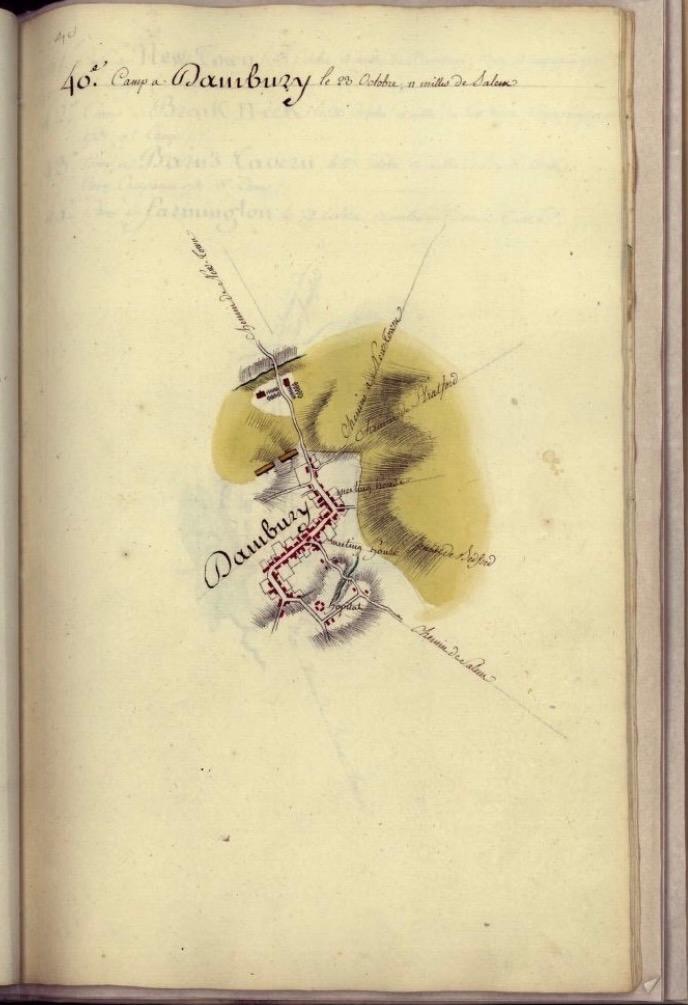
40th Encampment of the French Army, Danbury, CT
23-24 October, 1782
|
|
Dambury, (sic), CT
Manuscript, pen-and-ink and watercolor.
Most of the plans are oriented with north to the top.
They are bound under the title “Amérique campagne 1782: plans des differents camps occupés par l'armée aux ordres de Mr. le Comte de Rochambeau”. This volume belonged to Rochambeau himself.
Photo credit: Library of Congress Geography and Map Division Washington, D.C. 20540-4650 USA dcu, location: https://lccn.loc.gov/00552208 retrieved July 17, 2021
|
|
• The movements of the troops had been carefully prepared in advance by a dedicated and talented staff of cartographers, who traveled throughout Connecticut to identify the best routes and the best places for the encampments. No rough sketch has been kept apparently, however Berthier (who years later became Napoléon's trusted Chief of Staff at the Grande Armée) brought back to France his beautiful colored maps. They were among the first detailed maps of these areas, and their accuracy, even by today’s GPS standards, is impressive. One can still identify today churches, taverns, and even if stretches of roads have been widened and replaced by modern roads, there are still parts of the road that have not changed much.
• The 40th encampment (North) is located in Danbury. Private George Daniel Flohr of the Royal Deux-Ponts regiment wrote that “On the 23rd of October we broke camp again and marched 15 miles to Danbury, a little town in the mountains in an agreeable area. We set up camp quite close to it. This is where the Province of New England begins.”
• Concurrently the Duc de Lauzun’s Legion retraced its steps to Peekskill, crossed the Hudson once again and began its march via Suffern to Wilmington, Delaware, where it would enter quarters for the winter of 1782/83.
• Following their encampment in Danbury the troops marched on to Newtown, (24-26 October, 1782) where they occupied the same campsite as the previous year.
• Jean Baptiste Antoine de Verger, a Swiss officer of the Royal Deux-Ponts regiment noted that at Newtown “we repaired the army wagons, which were by then in very bad condition.”
• Friendships forged the year before were rekindled with force, especially as the French army had helped America and won victory at Yorktown over the British: Colonel Jean Nicolas Desandrouins who commanded Rochambeau’s engineers, lodged with a man named John “Trobrige, a very good man but poor.” At Newtown he too staid with a family he had lodged with the previous year. The family insisted on providing lodging and showed him gratitude and “toutes sortes d’amitiés,” (all sorts of gestures of friendship and good-will”).
• On 26 October 1782 the troops reached the camp at Middlebury, CT “in frightful weather; it rained in torrents ... Never have the troops suffered so much during three campaigns as they did that day”, wrote Baron Closen, one of Rochambeau’s aides-de-camp.
• According to Jean Baptiste Antoine de Verger: “We left very early in the morning and had scarcely begun our march when it began to rain in torrents. This was the worst thing that could have happened to us, for during our whole journey we had never found so bad a road. ... The continual rain, added to the cold, caused us inexpressible suffering.”
•“On the 27th,” wrote Baron Closen in Southington, CT, “we re-crossed the same Stratford River on a wooden bridge, like Carleton’s, 7 miles from Breakneck. You next enter the village of Waterbury, which is very long and contains several pretty houses.”
|
|
PAST MONTHLY BULLETINS
OUR GOAL: turn the spotlight on a famous, or less famous, episode or historical figure during the long shared history between France and the United States, with illustrations and anecdotes.
You can have access to all our past Monthly Bulletin
since February 2021 by visiting our website:
You can click on the photos in our bulletins and on the links indicated in blue for more information and direct access to the references.
|
|
In our next Bulletin in November we will continue to follow the steps of the Marquis during his tour in November 1824 through Monticello, Charlottesville, and Fredericksburg in Virginia, as well as the long march of the French Army back to Boston in 1782 following the victory in Yorktown. |
|
A MEMORABLE RECEPTION ON OCTOBER 13
AT THE SERVICES CULTURELS - VILLA ALBERTINE, NEW YORK
|
|
Antoine de Saint-Exupéry, Rockefeller Center, NY, July 13, 1939
Original photo and collage courtesy of Fondation Saint-Exupéry Pour la Jeunesse
|
|
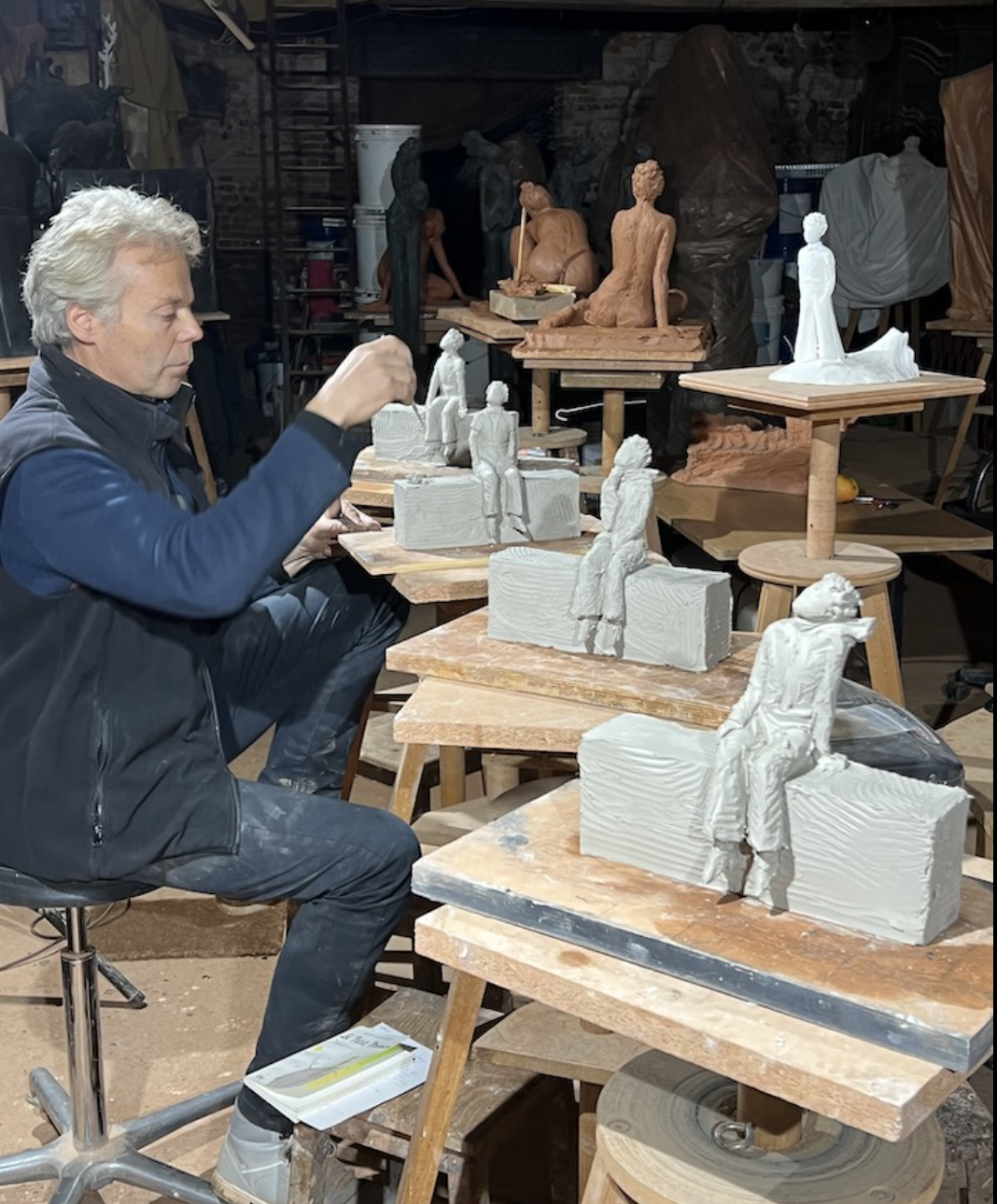
• On October 13, upon the occasion of the insignia award of the Chevalier of the Ordre des Arts & Lettres to Stacy Schiff by Mr. Gaëtan Bruel, Cultural Counselor of the French Embassy and Director of Villa Albertine, we announced the sculpture of The Little Prince which will be inaugurated next year at the Services Culturels - Villa Albertine in New York, by renowned French sculptor Jean-Marc de Pas.
• Since its 1943 publication, generations of children—and with them generations of adults—have fallen under the spell of Antoine de Saint-Exupery’s The Little Prince. Translated into more than 500 languages and dialects, the book is second only to the Bible in its foreign editions.
• Though this whimsical traveler is widely known and loved, few know that Saint-Exupery conjured him into existence in New York City and in Northport, Long Island. Dozens of plaques and statues around the world commemorate the novelist, including a plaque affixed to the facade of 3 East 52nd Street dedicated by our organization in the year 2000. However there is no sculpture in Manhattan, where Saint-Exupery lived in 1941 and 1942. From New York he sailed to North Africa in 1943 with one advance copy of the fable/story in his bag; fifteen months later, he disappeared at the controls of a Lockheed P-38 Lightning, while on a reconnaissance mission for the US Air Force.
• Fittingly, at the initiative of the American Society of Le Souvenir Français, who spearheaded the project, the sculpture of the Little Prince will be installed near the front entrance of Villa Albertine’s headquarters, accessible to passers-by of all ages and backgrounds. Patrons of Albertine, the French and English bookstore inside Villa Albertine, will greet the statue on their way in, and may be inspired to find the treasured book once inside.
• This sculpture project has received the official support of H.E. Denise Campbell Bauer, Ambassador of the United States in Paris, and H.E. Philippe Etienne, Ambassador of France in Washington, DC. The Comité d’Honneur is co-presided by Stacy Schiff and Olivier d’Agay, great-nephew Antoine de Saint-Exupéry, Lionel de Saint-Exupéry, Vice-President of the Saint-Exupéry Youth Foundation. The Steering Committee is headed by Nicolas Delsalle-Mun, General Delegate of the The Antoine de Saint-Exupéry Youth Foundation, Thierry Chaunu, President of the American Society of Le Souvenir Français, Inc. and Board Members Jean-Hugues Monier & Francis Dubois.
|
|
Photos of reception: Daniel Falgerho - Photo above: courtesy Jean-Marc de Pas |
|
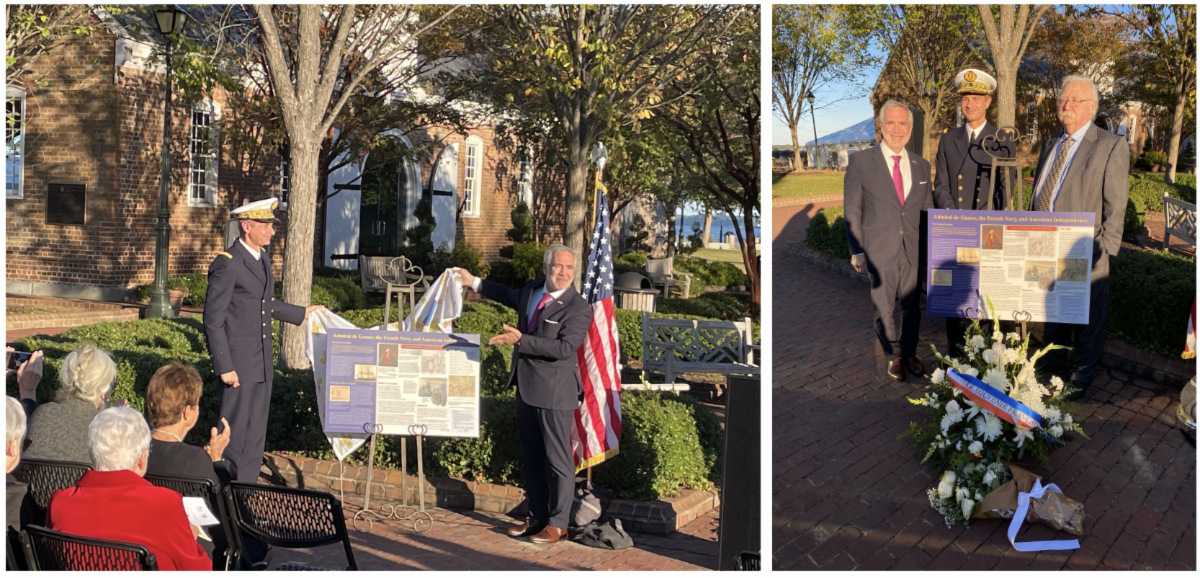
Tuesday, October 18, 2022: Dedication ceremony of the Marker
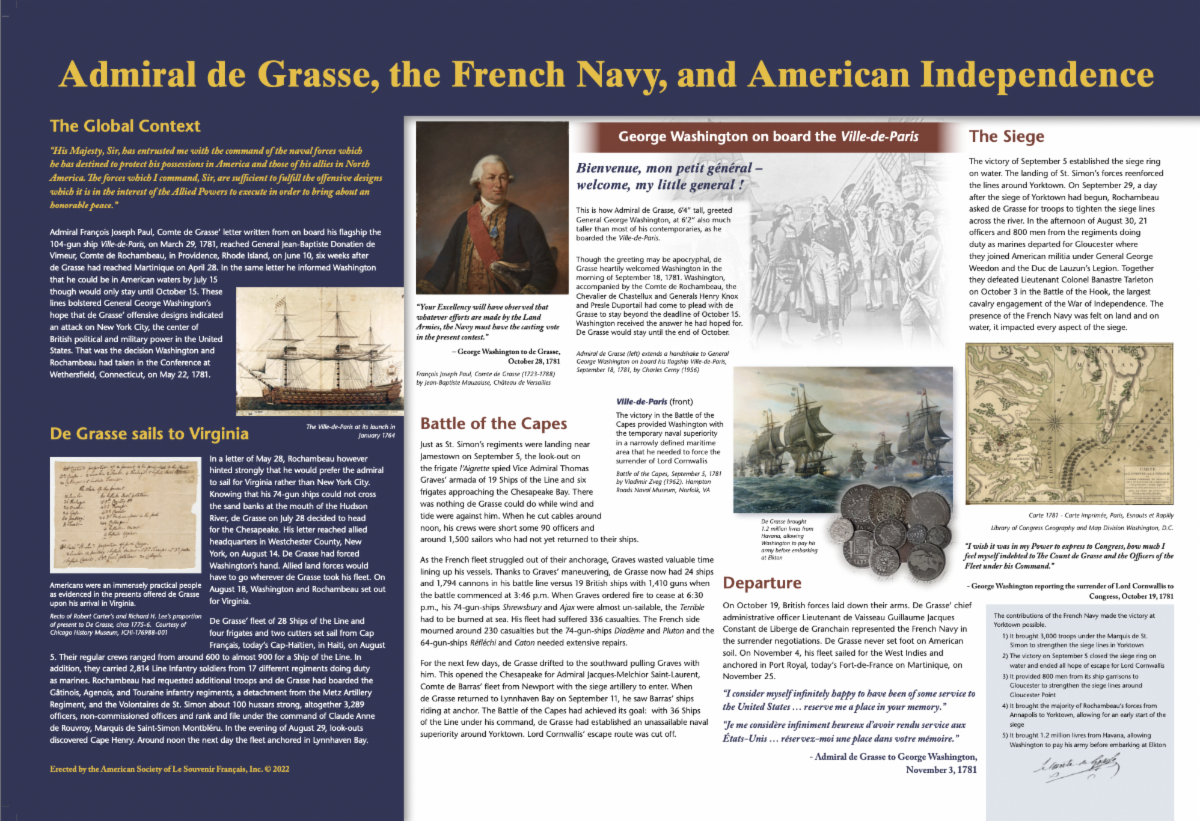
"Admiral de Grasse, the French navy and the American Independence"
|
|
We proudly inaugurated this new addition to the beautiful Riverwalk area of Yorktown with Rear Admiral Frédéric de Rupilly, French Navy, who came from the NATO headquarters in Norfolk and honored us by his presence and his remarks, in front of dozens of distinguished guests. The text and illustrations of this marker, a project from the American Society of Le Souvenir Français, was made possible by Dr. Robert A. Selig, Ph. D.
Photo and Video courtesy of Kathleen Graytok.
We are grateful to the Members of the "Comité de la plaque de Yorktown":
Nicole Yancey • Admiral Hilaire Ducellier • Admiral Frédéric de Rupilly
Colonel Aymeric Tardieu de Maleissye • Lt Colonel Alain Abad • Lt Colonel Mathieu Brulais Johnny Carawan • Dr. Robert A. Selig, Ph.D. • Thierry Chaunu
|
|
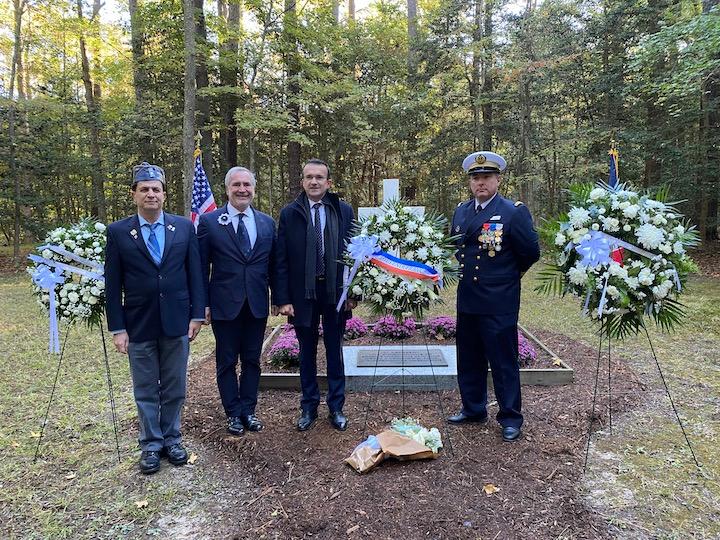
Wednesday, October 19, wreath laying at the French Cemetery |
|
Photo (from Left to Right) by Kathleen Graytok: Mr. Alain Leca, president of the French War Veterans in Washington DC, Thierry Chaunu, François Penguilly, Consul Général of France in Washington DC, Captain Jean-René Degans, French Navy, after laying the wreaths. Note the "Never Forget" Bouquet of white roses laid on this sacred ground by Richard Azzaro, co-Founder, Society of Honor Guard Tomb of Unknown Soldier, who has "adopted" the 50 Unknown French Soldiers and Sailors buried in the French Cemetery's mass grave. |
|
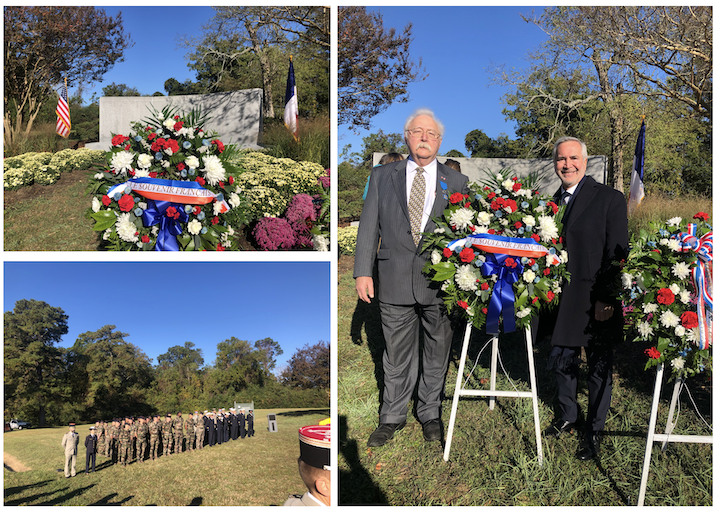
Wednesday, October 19, wreath laying at the French Memorial |
|
French Army, Navy and Air Force officers, soldiers, sailors and aviators stationed at NATO Headquarters in Norfolk paid homage to their valiant forebears who died for the cause of American Independence and Freedom, and whose names are inscribed on the French Monument. The ceremony was conducted by Captain Jean-René Degans, French Navy, and Lt. Col. Mathieu Brulais, French Army. A wreath from the American Society of Le Souvenir Français was laid by Dr. Robert A. Selig, Ph.D and Thierry Chaunu.
Photos courtesy Kathleen Graytok and Mrs. Selig.
|
|
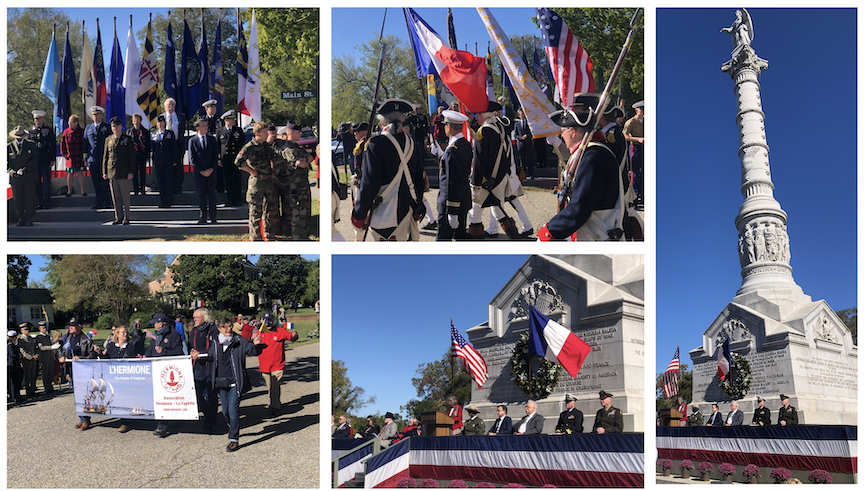
Wednesday, October 19, ceremony at the Victory Monument |
|
At the ensuing Annual Parade, a delegation from the French frigate Hermione was warmly welcomed. The famous replica of the 18th Century ship is currently undergoing costly repairs in dry dock in Bayonne, France, and for which we will soon announce a major fund raising campaign along with several like-minded patriotic organizations this side of the Atlantic. Stay tuned for announcements in our future Bulletins. The patriotic exercise at the foot of the Victory column started soon after the end of the parade. After opening remarks from François Penguilly, Consul General of France in Washington, Dr. Robert A. Selig, Ph.D was the keynote speaker with an unforgettable and detailed account of the crucial role of the French Army and Navy in this combined French-American Victory, which enabled American Independence.
Photos: Thierry Chaunu
|
|
WE WILL REPORT ON THE OTHER CEREMONIES IN
WASHINGTON DC (OCTOBER 21) AND IN PHILADELPHIA (OCTOBER 25)
IN NEXT MONTH'S BULLETIN.
|
|
EXCITING NEWS AND NEW VIDEO
FROM ODELL HOUSE - ROCHAMBEAU'S HEADQUARTERS
|
|
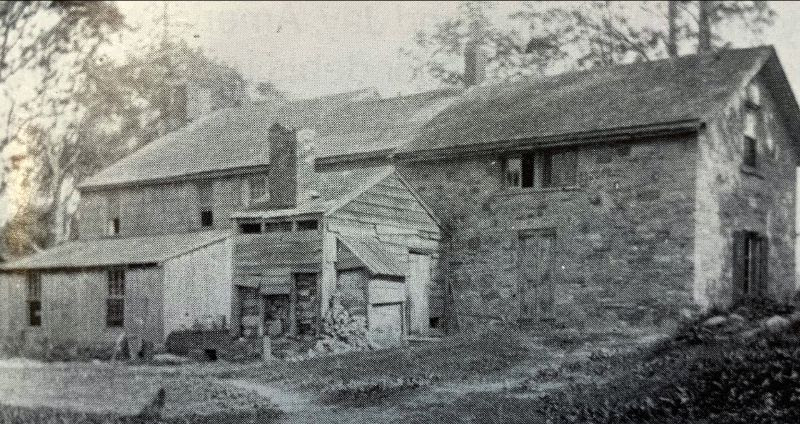
A 19th-century photo of the rear of the house showing the kitchen in the middle.
|
|
The Launch of Westchester’s Philipsburg Encampment of 1781
We are excited to announce the launch on YouTube of our newest video, Westchester’s Philipsburg Encampment of 1781. Written, produced, and directed by OHRH board member Chris Rubeo, it has been designed for use by Westchester students studying American History in grades four and seven. But it’s also an introduction for anyone interested in Westchester’s role in the Revolutionary War. The Hudson River Valley National Heritage Area provided matching funds to create both this video and Thank You, France, which premiered earlier this year.
When Odell House Rochambeau Headquarters is open for tours, these videos will play on screens in the welcome center and prepare visitors to see the exhibits. Thank you to Chris, former board member Andrew Bordwin, Board Vice President Tom Hay (who appears in the film as General Rochambeau), and all who helped bring this project to completion.
The Completion of the Archeology Study at OHRH
Hartgen Associates has completed the written report of all their findings from the “big dig” in May. It is a very comprehensive report describing the history of the site within the context of New York State history and relating that to their findings. They dug 39 trenches or holes and carefully labelled each bag of material they found. These bags are now in the possession of the Friends and are waiting to be shown at the museum. Among the most intriguing items are pottery shards that correspond to intact pottery pieces we have rescued from the house. Further areas for exploration were identified, including the possible outdoor kitchen now seen as a partially collapsed chimney at the rear of the 1855 section. In our research for the Slavery and Odell Farm study we are reaching a conclusion that the enslaved people on the farm most likely lived inside the house, as no evidence of a detached slave quarters was found in this study. This was the usual space allotted to the enslaved in the Lower Hudson Valley and New York City and we would like to investigate the basement and attic of the house in another archeology study. Thanks to our generous private donors we fully funded the archeology study and we hope to go further in the future with the same support. You can read the Hartgen report here.
Contract Signed for Cultural Landscape Plan
Aspect 120 has been chosen to write the Cultural Landscape Plan for OHRH. Headed by licensed Landscape Architect, Susan Jainchill, the firm will begin work next week. The plan will be completed no later than April, 2023 and will have design spaces for handicap accessible walk ways, a designated outdoor classroom, a meeting space for large groups, the location of a monument to the four French soldiers who died while camped in Hartsdale in 1781 and much more. Souvenir Francais USA, a division of the national French association maintaining war memorials and memories of those who died for France, have generously donated funds towards the monument. The Friends have an active committee working with Aspect 120 and expect to work with local garden clubs to create native gardens and a replica of the kitchen garden used by the Odell family.
Construction Update
On October 24, the firm of Abbott and Price will begin the work of replacing the old roof with permanent, historically accurate wood roofing. This will be a four-month process that will start with the 1855 stone section and move into the 1732 and then 1760 sections. By completing the winterization of the 1855 second floor, it should allow work to then begin on making the first floor usable soon for some temporary displays. We will give you more information about this in our November newsletter.
New Board Members and the 2021 Annual Report
At our Annual Meeting on September 10, we were happy to vote four new members into office. Donald and Christine O’Dell (yes, he is a descendant of both Jonathan Odell and of Margaret Dyckman’s family) of Newburgh, N.Y. and Rob Pellegrino and Peter Marcus of Ardsley. Rob and Peter are the Ardsley Town historian and the head of the Ardsley Historical society respectively, and longtime supporters of our project. Marc Cheshire, our wonderful webmaster and communications director and Kathy Evers, assistant treasurer, were voted to be members of the Executive Committee. We were sad to say goodbye to Fred Charles, Andrew Bordwin and Bill Morrissey and we thank them for all their many contributions to OHRH.
At the meeting we also approved the release of our first Annual Report covering the period of 2020 to the end of 2021. The Friends have grown enormously since our founding in January 2020, and we could not have accomplished half of our progress without the very generous donations of our many supporters listed in the report. Current projects underway include the completion of the guide to Odell documents stored at the Westchester County Historical Society (where they will soon be available to all scholars), completion of the Slavery and the Odell Farm report, a report on Native Americans in the Hartsdale area and many more. Look for a display of Victorian holiday cards from the Odell family papers at the Greenburgh Library in December.
We Need Your Support
These projects will need funding to be completed and published. We cannot thank you enough for your donations and urge you to continue as we launch the 2022 campaign. You can donate through our website or by check, mailed to Friends of Odell House Rochambeau Headquarters, c/o Seal, 14 Rochambeau Dr., Hartsdale, N.Y. 10530.
|
|
HELP VOLUNTEERS OF THE FRENCH MILITARY AT NATO IN NORFOLK
TO ACQUIRE PERIOD UNIFORMS FOR RE-ENACTMENTS
|
|
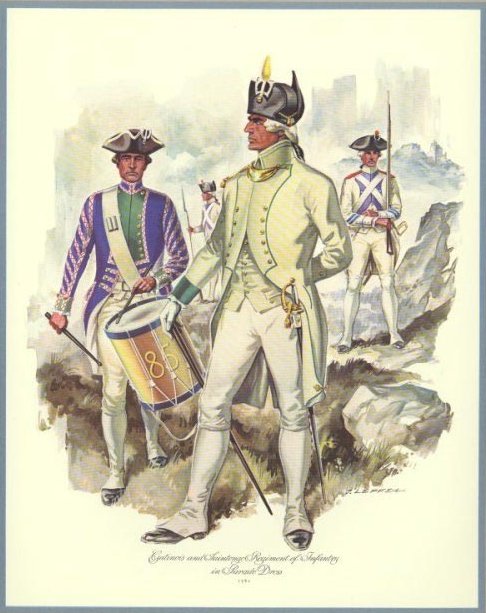
Pictured above: Gâtinois and Saintonge Regiment of Infantry in Parade Dress 1781 - SOURCE: The American Revolution, 1775-1783. Paintings by Jean Leffel, based upon illustrations of H. A. Ogden and Lt. Charles M. Lefferts. Photolithos printed Zurich, Switzerland. Historical descriptions by Harry W. Barker, Jr.
|
|
• We started a fund raising campaign for the purpose of providing volunteers from the French military contingent stationed at NATO headquarters in Virginia with period uniforms, to participate alongside American volunteers in joint patriotic ceremonies. These sets of period military uniforms are made in the USA by very skilled specialized tailors and will be exact reproductions, down to the last button.
We gratefully acknowledge a generous contribution from the Association des Cadres de Réserve Français aux Etats-Unis (ACREFEU) however we are still short $1,000 from our goal.
Please help! Your donation is tax deductible! Suggested donations: $50 - $100 – A recognition medal from Le Souvenir Français will be offered for donations over $500.
Please send your donation via PayPal: https://souvenirfrancaisusa.org/donate/ or by check, payable to "American Society of Le Souvenir Français, Inc"
Please indicate: "Rochambeau Historical Uniforms"
|
|
AN ANNOUNCEMENT FROM
The BATTLE OF RHODE ISLAND ASSOCIATION
|
|
Archaeological Assessment of Butts Hill Fort, Portsmouth, RI
The Battle of RI Association (BoRIA) is pleased to announce that an archaeological assessment of Butts Hill Fort has been completed. This work was done by Joseph (Jay) Waller, an archaeologist with the Public Archaeology Laboratory (PAL), one of the leading firms in New England. BoRIA expresses thanks to Mr. Waller and PAL who did this work pro bono.
In “Technical Memorandum, Butts Hill Fort Restoration Master Plan, Portsmouth, Rhode Island - Archaeological Reconnaissance and Assessment August 2022”, Mr. Waller reviews the history of the Fort and all previous archeological surveys in the vicinity. Butts Hill Fort is a significant historical feature associated with the American Revolution. The site is listed in the National Register of Historic Places, is a National Historic Landmark, and is a contributing site to the National Park Service’s Washington-Rochambeau (WARO) Trail.
Any potential ground-disturbing work at the Fort, including archaeological investigations, may require compliance with relevant federal and state historic preservation regulations
and laws and is subject to review by the Rhode Island Historical Preservation and Heritage Commission (RIHPHC).
If future work uses federal monies or require federal permits or permissions, the National Historic Preservation Act “requires that Federal agencies exercise a higher standard of care when considering undertakings that may directly and adversely affect” National Historic Landmarks and “to the maximum extent possible, undertake such planning and actions as may be necessary to minimize harm to such landmark”. Future work at this National Historic Landmark may require consultation with the National Park Service.
PAL recommends that the committee avoid or minimize future ground disturbing activities within and around the fort to the best extent possible. Future walkways and paths should be raised above existing grade to cap and protect the historical and archaeological features below as opposed to impacting them.
Much of the fort is vegetated. Large trees and secondary vegetative growth to be removed should be cut flush to the ground to prevent inadvertent disturbances to and compromise the underlying integrity of the fort. Signage, flagpoles, or other features should be replaced in-kind or in disturbed areas of the site if at all possible, to avoid further impacting the site.
As the Fort is a National Historic Trust property under the direction of the RIHPHC, the report was sent to Ms. Charlotte Taylor, the Commission’s archeologist, for comment. Ms. Taylor wrote “It’s a thorough overview of the site and should be a very valuable aid to ongoing planning. Jay’s recommendations are on point, and we concur with them all.” and “RIHPHC continues to commend your committee for your stewardship of this important site…”
The Waller report and RIHPHC letter are available at www.battleofrhodeisland.org under the “News” tab. This report will be part of an informational “Concept Master Plan” for the Fort to be released in early 2023. BoRIA has gained the support of 29 partner organizations as noted on the website.
The BUTTS HILL FORT RESTORATION COMMITTEE is a committee of the BATTLE OF RHODE ISLAND ASSOCIATION. The mission of the Committee is to restore and maintain the Revolutionary War fort to provide a safe and accessible educational and recreational site that raises public interest in this National Historic Landmark and its role in the Battle of Rhode Island. The Association is a registered 501(c)(3) non-profit committed to raising awareness of Rhode Island’s role in the War for Independence. Donations may be made payable to “BoRIA” at PO Box 626, Portsmouth, RI 02871.
|
|
NEWS FROM THE LAFAYETTETRAIL.ORG |
|
We are pleased to announce the release of episode 17 of Follow The Frenchmen, our Video Series about the Lafayette Trail! The episode takes place in Yorktown, VA. Click on the video player at the top of this email to check it out now!
#followthefrenchmen EPISODE 17 | Yorktown, VA. In this episode, follow Julien to the birthplace of American Independence: Yorktown, VA. Find out how Lafayette's October 18-20, 1824, visit confirmed the narrative of 1781 while enriching the story of Yorktown. Discover the famed Yorktown Battlefield and stroll along the scenic Historic Yorktown Riverfront. Forty-three years after American Independence was achieved at Yorktown, what was the effect of Lafayette's return visit on the scenes of his early successes? What did it mean for the small town and the country? Who is caretaking this history today on behalf of all Americans? Follow The Frenchmen and find out now!
The video includes Closed Captioning. To enable this feature, click on the CC icon on the right side of the navigation bar at the bottom of the screen.
|
|
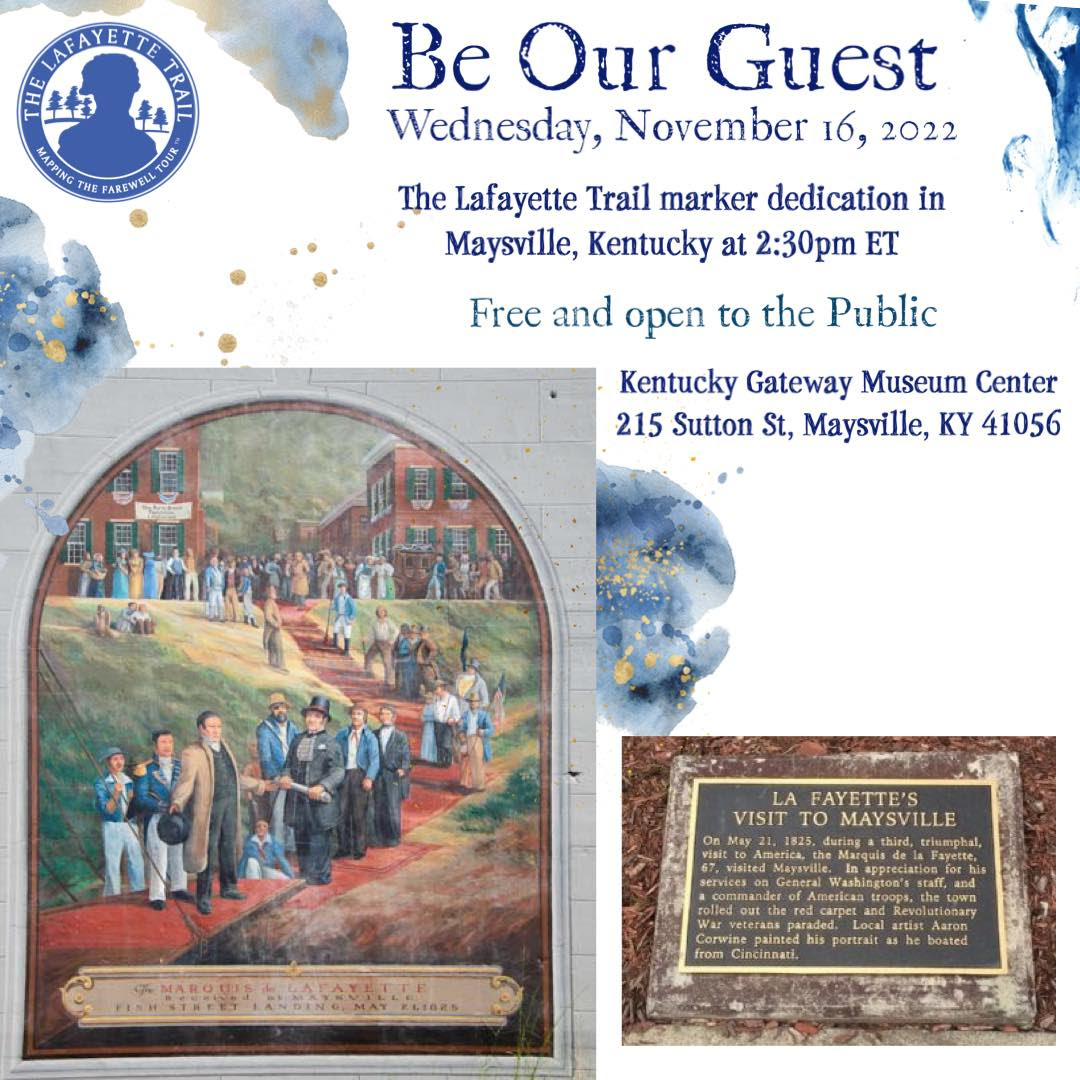
The Lafayette Trail, Inc. is pleased to announce the upcoming dedication of a new Lafayette Trail historic marker in Maysville, KY on Wednesday, November 16 at 2:30 pm ET.
The marker dedication ceremony will take place near the Kentucky Gateway Museum Center located at 215 Sutton Street, Maysville, KY 41056.
|
|
UPCOMING LECTURE AT THE FRENCH EMBASSY
by Dr. Iris de Rode
|
|
The Role of France in the American War of Independence
Thursday, October 27, 2022
Doors Open: 1:30 p.m.
Conference: 2:30 p.m. - 4:30 p.m.
La Maison Française - Embassy of France
4101 Reservoir Road NW
Washington, DC 20007
La Maison Française of the Embassy of France, and Douglas Bradburn, Ph.D., President & CEO of George Washington’s Mount Vernon, cordially invite you to a presentation of Dr. Iris de Rode's new book, François-Jean de Chastellux, un soldat-philosophe dans le monde atlantique à l'époque des Lumières (Honoré de Champion, 2022). The presentation will be followed by an insightful Q&A.
Based on the excavation of the largely unexplored private archives of the Chastellux family, this book covers Chastellux's life, looking to his family and social origins as the driving force behind his role as a soldier-philosopher in the Atlantic world during the Enlightenment.
- Welcome: Ambassador of France to the United States, Philippe Etienne
- Introductory Remarks: Dr. Douglas Bradburn, President and CEO, George Washington’s Mount Vernon
- Moderator: Dr. Vincent Michelot, Attaché for Higher Education at the Embassy of France
- Featuring: Dr. Iris de Rode
Click on the button below to RSVP!
Mount Vernon is owned and maintained by the Mount Vernon Ladies' Association of the Union, a private, non-profit organization. We don't accept government funding and rely upon private contributions to help preserve George Washington's home and legacy.
|
|
ANNUAL TRIBUTES TO FRENCH SOLDIERS, SAILORS AND AVIATORS
ALL ARE WELCOME TO JOIN
|
|
SATURDAY NOVEMBER 5, 2022 at 9:00AM
Annual ceremony to pay tribute to the memory of 25 soldiers from General Comte de Rochambeau's Army buried in Providence Cemetery, Rhode Island organized by Prof. Norman Desmarais. Tribute will be also paid to Colonel Israel Angel, the highest ranking Rhode Island officer who served in the Continental Army, who is buried next to the monument to the French, and Stephen Hopkins, signatory of the Declaration of Independence, who is buried at the top of the hill.
There is also a cenotaph in the same cemetery in honor of Alfred “Nattie” Duffié, General in the Union Army, who was born in France, and who started his military career as lieutenant in a Dragoon regiment of Emperor Napoleon III and fought in Crimea. We will write an article about him in an upcoming Bulletin.
North Burial Ground, 5 Branch Ave.Providence, R.I. 02904
|
|
FEDERATION OF FRENCH WAR VETERANS
FRENCH RESERVE OFFICERS IN THE UNITED STATES
SATURDAY NOVEMBER 5, 2022 at 9:30AM
9:30AM – Flushing Cemetery – "Carré des Anciens Combattants Français" (French War Veterans plot) where a wreath will be laid to honor their memory as well as that of Eugene Bullard, the first African-American pilot in history (see our Bulletin of February 2021 dedicated to his extraordinary story), who is buried among his brothers-in-arms.
163-6 46th Ave, Queens, NY 11358
Entrance at 46th Avenue and 162nd Street.
By car from Manhattan: Take Northern Boulevard, turn right on 162nd Street and left on 46th Avenue.
|
|
FEDERATION OF FRENCH WAR VETERANS
FRENCH RESERVE OFFICERS IN THE UNITED STATES
SATURDAY NOVEMBER 5, 2022 at 9:30AM
11:00AM – Cypress Hills National Cemetery where 25 sailors who "Died for France" in 1918 were buried. Three of them were repatriated to France to their families. Federation flag bearers will be present at the Flushing and Cypress Hills Cemeteries.
French Sailors Plot
Cypress Hills National Cemetery
625 Jamaica Ave, Brooklyn, NY 11208
|
|
FRIDAY NOVEMBER 11, 2022 AT 12:30PM - VETERANS DAY: |
|
Pictured above: last year's parade on Fifth Avenue with giant French and American flags, and copy of Certificate made available last year to the Scouts of Troop #1, their leaders and volunteers. |
|
To continue our well-established tradition, we will join the Federation of French War Veterans, the Association of French Reserve Officers in the United States (ACREFEU), and TheFrenchWillNeverForget.org in the Veterans' Day parade on 5th Avenue. Last year we started the tradition to give a Certificate of Appreciation (sample above).
Please join us and the 60 scouts of Troop 1, their parents and volunteers who will be carrying the two giant American and French flags on Fifth Avenue! (weather and wind permitting)
-
Map of Parade Area: https://parade.uwvc.org/map
-
Date: Friday, November 11, 2022
- Time:
- Parade: 12:30pm – 3:30pm (approx)
- TV Broadcast: 12:30pm – 3:00pm
-
Parade Route: North on Fifth Avenue, between 26th St & 50th St (approx), New York (Manhattan), NY (Map)
-
Broadcast information: The Parade will be broadcast live on WABC in the New York area, and will also be streamed online. Further details will be provided closer to the event.
-
Formation (Assembly) Area: Groups and vehicles will assemble on 24th Street – 29th Street, between Fifth & Sixth Avenues (west and northwest of Madison Square Park). Selected groups and vehicles will assemble on Fifth Avenue itself, or on other temporary holding streets as directed. (Map)
-
Arrival Time: Marching groups will arrive between 9:30am – 1:30pm, depending on their place in the Line of March. Vehicles will arrive between 8:00am – 1:30pm (i.e. some vehicles will be asked to arrive earlier)
-
Opening ceremony/ Wreath laying: There will be a traditional wreath-laying at the Eternal Light Monument in Madison Square Park at 11:00 – 11:45am (approx). Attendance will be limited during the ceremony itself. NOTE: Due to the large number of wreaths presented, most will be pre-placed.
-
Reviewing stand / TV compound: The Reviewing Stand (and TV broadcast compound) will be located on the west side of Fifth Avenue, just south of 26th Street (to marchers’ left as they proceed up the Parade route)
-
Dispersal / End of Route: The Parade will end at approximately 50th St (to be finalized). Marchers and vehicles will disperse as directed, toward Sixth Avenue or Madison Avenue.
- On the Route:
- Participants in marching formation must line up in minimum four abreast (across) formation.
- Participants may not throw items into the crowd
- Marchers may interact with spectators along the route, so long as they do not slow down the Parade and that such interactions are positive and respectful.
- All participants must adhere to the Parade Code of Conduct
- The New York City Veterans Day is a non-partisan, non-political event. No political messaging, other than general expressions of support for veterans, is permitted on the Parade Route or in the Formation areas.
For participation registration and questions, contact:
|
|
ANNUAL MEMORIAL SERVICE HONORING NEW YORKERS
WHO DIED FOR FRANCE DURING BOTH WORLD WARS
|
|
FEDERATION OF FRENCH WAR VETERANS
FRENCH RESERVE OFFICERS IN THE UNITED STATES
Sunday November 13, 2022 at 9:30AM:
Mass of the Armistice at the Parish of Notre Dame. Father Michael Holloran will officiate and the standard bearers of the Federation of French War Veterans will be present. After the Mass, a wreath in memory of the dead of the Two World Wars will be laid, to honor the memory of the members of the Federation as well as the 463 Conscripts and Volunteers from New York City who "Died For France".
After the traditional photo, lunch will take place at Restaurant Le Monde (2885 Broadway between 111th and 112th Street - New York) for the annual Fall Banquet. Participation is $ 100.00 per person, by check made out to the Federation of Veterans Affairs before Friday, November 7, 2022 to the address of the Treasurer: Henri Dubarry, 62-17 37eme Avenue, Woodside, N.Y.11377
Church of Notre Dame
405 West 114th Street, New York, NY 10025
|
|
SPECIAL TRIBUTE TO MR. JOSEPH ANDRÉ SCHEINMANN
MEMBER OF THE FRENCH RESISTANCE
|
|
Sunday November 6, 2022 at 12:00PM noon to 12:30PM
Tifereth Israel Cemetery,1400 Old Plainville Rd, New Bedford, MA 02745
Ceremony in tribute to Mr. André Joseph Scheinmann, alias Maurice Peulevey, Jewish born in Germany in 1915, fled to France with his family in 1933. At the outbreak of hostilities, he enlisted in the French Army, and adopted the surname Peulevey, in order to avoid persecutions in case of capture by the enemy. In the fall of 1940, he entered the French Resistance.
In 1942, he left clandestinely for England, where he was trained for several weeks in spy techniques. Back in France, he eventually got arrested by the Gestapo. He was deported to Dachau on July 9, 1943 as a "Nacht und Nebel"/ (Night and Fog) prisoner.
On February 13, 1946, General De Gaulle awarded him the 1939 War Cross with Gold Star.
He survived the camps, and went to live in the United States in 1952, where he married a radio operator he had met during his stays in London. He published a book in Boston: "Call me Andre".
He died in Boston in 2001, and is buried in New Bedford, MA.
The tribute will be conducted in presence of Joseph André Scheinmann's son, Mr. Michel Scheinmann, and descendants, relatives, as well as friends who knew him well. Prof. Norman Desmarais, Regional Delegate of Le Souvenir Français in New England, will be present.
This ceremony is part of the yearly tribute held by Le Souvenir Français in Paris, 80 years after, honoring 100 patriots who fought for France and the cause of Freedom. In 2022, we honor those who did great deeds in 1942, one of these 100 being buried in the United States.
Ceremony will take place at 12:00PM noon, Sunday November 6 at Tifereth Israel Cemetery,1400 Old Plainville Rd, New Bedford, MA 02745.
From Boston: take Route 24 South to Exit 12 (New Bedford/Route 140 South). Bear right off exit onto Route 140. South to Exit 4 (Mt. Pleasant Streeet/Airport Road). Bear right off exit to stop sign. Take right at stop sign onto Mt. Pleasant right. Mt. Pleasant Street becomes New Plainville Road. Follow New Plainville Road and take left onto Shawmut Avenue stop sign. Now becomes Old Plainville Road. Cemetery is on Old Plainville Road on the left.
From Route 495: Take Exit 7, Route 24 South and follow directions from this point, as above.
From the Providence/Fall River area: Take Route 195 East (toward New Bedford). Take Route 140 North to Kings Highway Exit. Bear right off exit to stop sign. Take right at stop sign onto Mt. Pleasant Street. Follow above.
|
|
Photos above courtesy of Mrs. Diana Henry. For more information on Mr. Scheinmann's extraordinary exploits and hardships during WWII, visit:
|
|
OUR MISSIONS:
• To preserve the memory of the French soldiers, sailors and airmen who gave their lives for freedom, and who are buried in the United States.
• To honor French Citizens who did great deeds in the United States, or with a strong connection with the United States,
• To promote the appreciation for French culture and heritage in the United States, and the ideals that unite our two nations, in order to pass the torch of memory to younger generations.
• To strengthen the long-standing traditional bonds of friendship between the American and French peoples, and to this end: erect or maintain memorials and monuments and encourage historical research, public presentations and publications in the media.
We are looking to complete our geographic coverage with Regional Delegates for the SouthWest in cities such as Austin, or Houston, and Louisiana, in cities such as New Orleans or Baton Rouge.
The American Society of Le Souvenir Français, Inc. is an independent American corporation, apolitical, established in 1993 in NY, with 501 (c) 3 non-profit status.
|
|
Did you know that a portion of every purchase you make on Amazon can benefit American Society of Le Souvenir Francais Inc, at no cost to you?
Simply go to: smile.amazon.com, designate American Society of Le Souvenir Francais Inc. as your beneficiary, and shop away
|
|
Help us implement several historic commemorative projects celebrating the 244-year-old Franco-American friendship and alliance! |
|
The American Society of Le Souvenir Français, Inc. is a registered NY State non-profit corporation and has full IRS tax exempt 501(c)3 status. All donations are tax deductible.
Copyright © 2022 The American Society of Le Souvenir Français, Inc.
Merci de nous contacter si vous souhaitez recevoir ce bulletin dans sa version traduite en français.
Contact: Thierry Chaunu, President
697 Third Avenue #341 New York, NY 10017
|
|
|
|
|
|
|