|
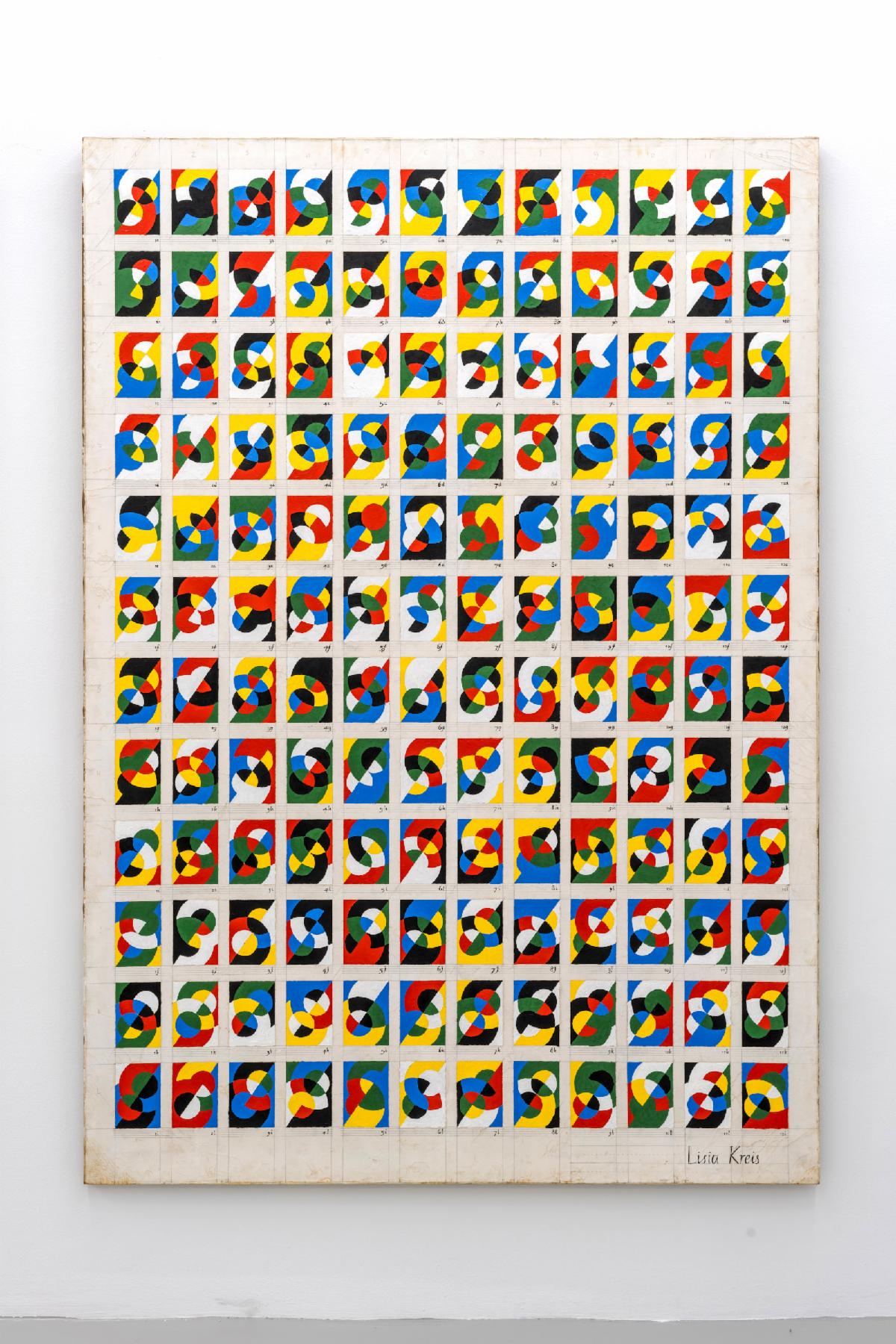
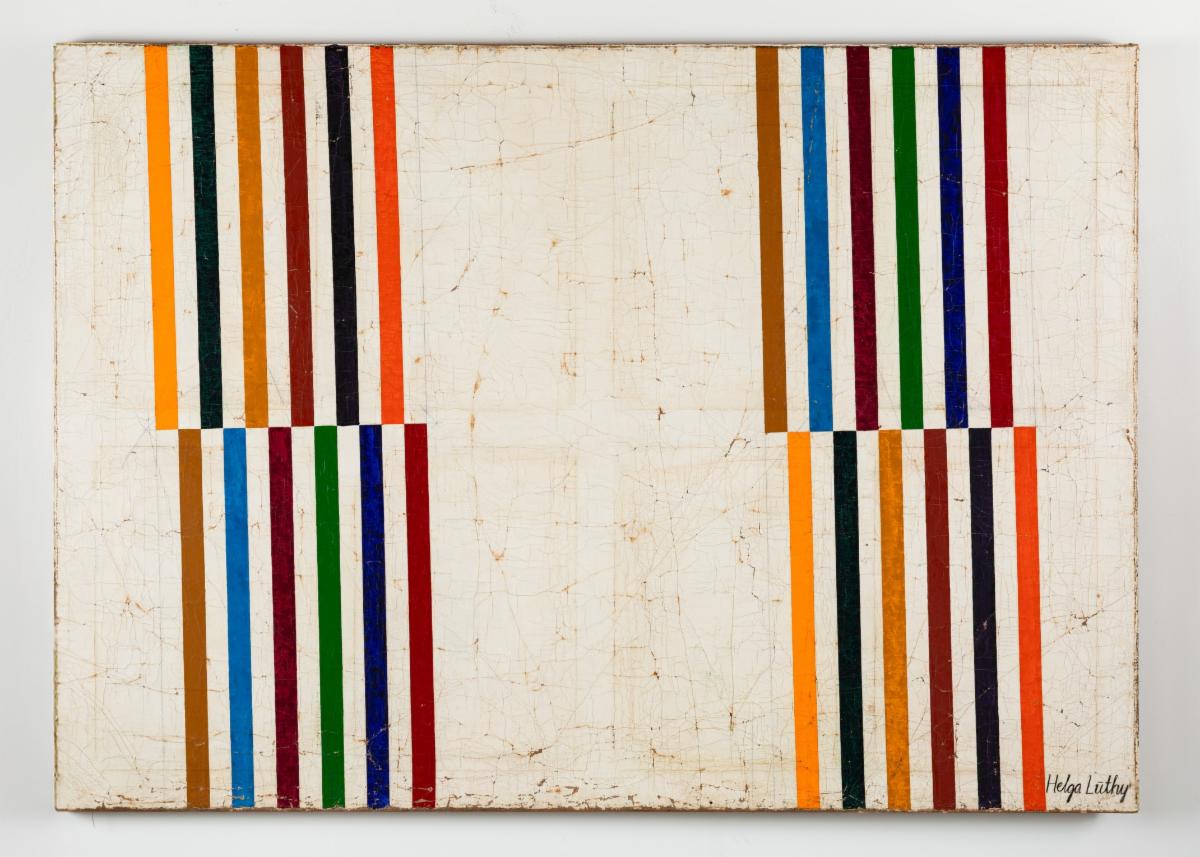
Each composition is constructed by dividing the rectangle with straightedge and compass, using methods developed in Ancient Greece. Color is determined separately, by chance. In the SKZ’s teaching, taking color out of the student’s hands bypasses learned preferences and admits relationships that deliberate choice would exclude.
Light connects the two procedures. It is the physical basis of color, and in quantum mechanics the behavior of individual particles of light is described in terms of probability rather than certainty, a conclusion that grew out of Einstein’s own work but that he resisted for the rest of his life. The SKZ curriculum holds both conditions together: proportion fixed by a constant, color left to chance.
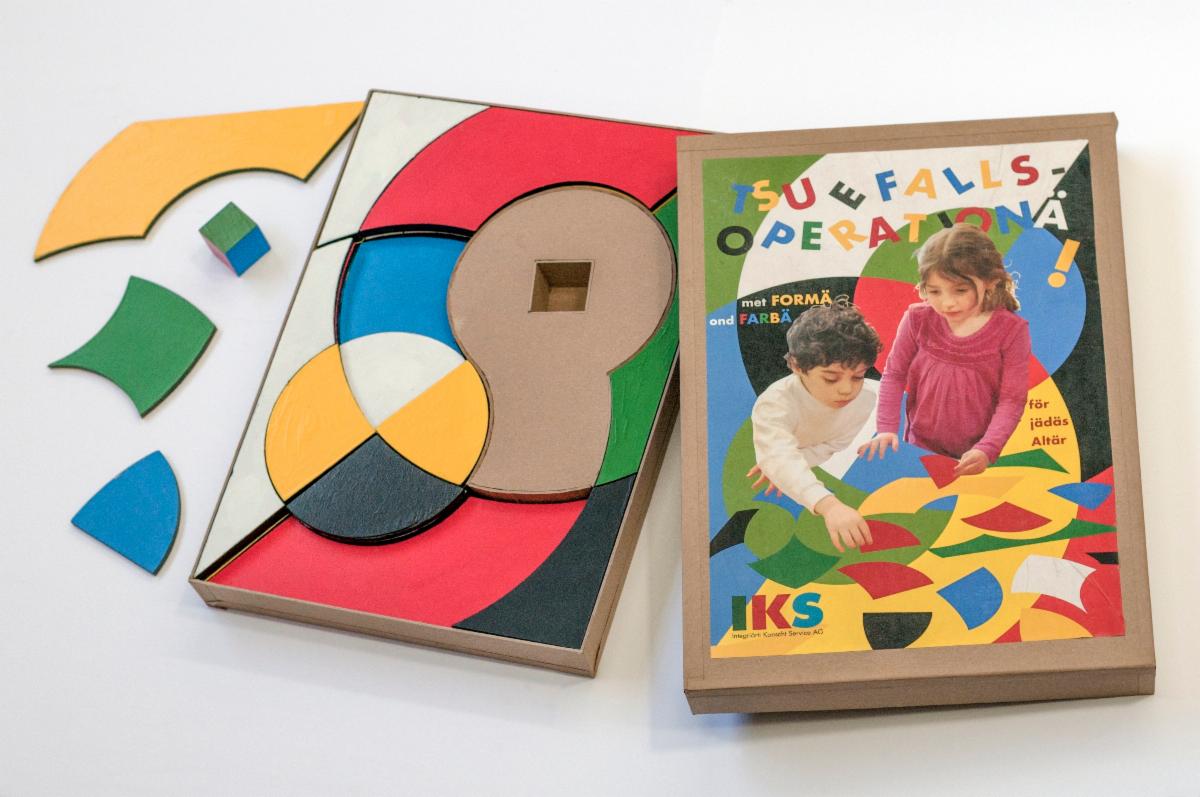
At the center of the exhibition is a maquette of the SKZ “Chance Operations” classroom as it stood at the Academy, shown with the educational board game of the same name that students used to generate color relationships. The game consists of a sixteen-space board, an eight-sided color die, and wooden tiles painted a different color on each face. Many of the paintings were created using games of chance involving cards and dice, recalling an avant-garde legacy that includes Arp, Duchamp, Cage and others.
The ultimate lesson of the SKZ may be that although creative freedom occurs within limits set by necessity, there are always unexplored possibilities within those constraints. Allowing ourselves to roll the dice is one way to discover new ways of arranging familiar colors.
Dan Levenson is an artist based in Los Angeles whose practice spans painting, objects, and installation. He has exhibited at the Hammer Museum, Los Angeles; the Philadelphia Art Alliance; James Fuentes, New York; Vielmetter Los Angeles; Municipal Bonds, San Francisco; Oolong Gallery, New York and Rancho Santa Fe; Honor Fraser, Los Angeles; Praz-Delavallade, Paris and Los Angeles; de boer Gallery, Los Angeles; BozoMag, Los Angeles; Blue Door, Los Angeles and Brooklyn; Eric Firestone Gallery, East Hampton; PARTICIPANT INC, New York; LAXART, Los Angeles; White Columns, New York; and Vox Populi, Philadelphia. He has received a Pollock-Krasner Foundation grant and fellowships from Skowhegan, Yaddo and MacDowell, among other awards. He has taught performative drawing lessons at the Hammer Museum, American Jewish University, USC’s Roski School of Art, and the Saas-Fee Summer Institute in Berlin. He received a BA from Oberlin College and an MA from the Royal College of Art, London (1997).
|