Tiers Being Proposed Within Part 141 Modernization Project | |
The 141 Modernization workgroups continue to work on proposals and content that will eventually be formulated into a report that will be finalized before the end of 2025 and presented to the FAA for consideration for NPRM development. FSANA representatives continue to be a part of some of the work on behalf of member flight training providers.
Some key points of the recent discussions include proposals that there would end up being multiple tiers of 141 certificate holders. For example, tier levels as defined on July 7, 2025 were proposed that might look as follows:
- Tier One - Air Agency Certificate
A basic level with low bar to entry such as small pilot club, fractional ownership or
“two people and a plane" demonstrates intent of permanency;
First level school with permanent staff, small school instructing recreational GA pilots,
multiple aircraft, and examining authority in 24 months;
-
Tier Three - Flight Training Center
Larger fleet, full-time staff with higher education association, professional pilot vector,
director versus chief instructor option;
-
Tier Four - Flight Training Academy
Professional pilot training pipeline, accredited, direct commercial certification, required to
give professional development/mentoring.
Future Considerations included final integrations with other working groups, how to integrate current 141 and larger 61 schools, bed down privileges, and responsibilities for each tier.
It was noted in the proposed structure that Part 61 schools were thought of as
“One on One Mentors”.
A key factor in the discussions is the establishment of a national office for 141 certificate management. It is anticipated that this would:
- Reduce workload on local FAA offices;
- Expedite approval processes for 141 applications and updates;
- Provide a focused and specialized work team at the FAA that would be a knowledgeable resource for 141 operations
In a presentation on the FAA’s Rulemaking, Jim Croddy with the FAA, noted that they have a staff of 40 people with approximately 33 current projects. He explained there are two processes to rulemaking, the first is a minimum of 20 months of research, the second is minimum of 16 months for comments, etc. 36 months is optimal, however it can take much longer depending on how well the new rules are written. Jim said the earliest for new rulemaking would be spring of 2027.
This process remains a dynamic one and FSANA will continue to provide updates as the project proceeds forward. Debbie Sparks, FSANA Vice President is the FSANA leader on the 141 Modernization project. She can be reached at debbie@fsana.com
| | Room Reservations For 2026 Conference Are Now Open | |
FSANA's 17th Annual Flight School Operators Conference & Trade Show will be in San Diego at the Loews Hotel in Coronado Bay, February 25-27, 2026. The conference will again bring together flight training providers, industry professionals, government officials, and product providers for the flight training industry.
We will have more information as the date approaches. In the meantime, set the data in your calendar and plan to join us for this important event.
Room reservations are now open.
Click here to make your room reservation now.
| | Delta Hawk Engines Now Available on Piper Seminoles | |
DeltaHawk Engines Inc. recently announced that it is offering its engine as an option on the Piper Seminole DX, a diesel-powered PA-44 Seminole featuring DeltaHawk’s FAA-certified, DHK4A180 180-horsepower, heavy fuel, compression ignition engine.
The liquid-cooled, 180HP turbo-charged DeltaHawk engine produces turbine performance at 40% better fuel efficiency versus reciprocating avgas engines, while also achieving a significant reduction in cost of ownership due to fewer moving parts. The engine is approved for JET A and JET A-1 fuels, with Sustainable Aviation Fuel (SAF) approval pending. Piper will use a DeltaHawk-led STC to integrate DeltaHawk’s firewall-forward kits into the Seminole production line. The kit includes counter-rotating DeltaHawk engines and three-blade, full-feather propellers. Additionally, the aircraft will have an advanced cabin temperature control system utilizing the engines liquid cooling to ensure a comfortable flight experience in diverse conditions.
Learn more at:
https://www.deltahawk.com/2025/07/22/deltahawk-partners-with-piper-on-new-seminole-dx/
| | Invitation For Speaker Presentations at FSANA 2026 Conference | |
Have a topic that you think is important to aviation flight training training? To Safety in aviation training? Present it at the 2026 FSANA Flight School Operators Conference!
The aviation world continues to evolve and this includes Ab Initio flight training. To further enhance presentations at the next Flight School Operators Conference & Trade Show being held in San Diego in February 2026, FSANA invites interested presenters to express their interest by providing the following information.
- Full contact information with name, company, title, email and phone.
- Title of session where you are proposing to participate.
- Brief description of the topic in 1-2 paragraphs.
- Do you plan to include power point slides?
A majority of the sessions are panel style, 60 minutes in duration and have between 2-3 panelists. Each panelist is provided between 10-15 minutes and there is a Q&A at the end of each session.
Please email your expression of interest by August 15, 2025 to:
Scott Sykes at ssykes@usaviation.aero and
Stormy Sykes at stormysykes@usaviation.aero
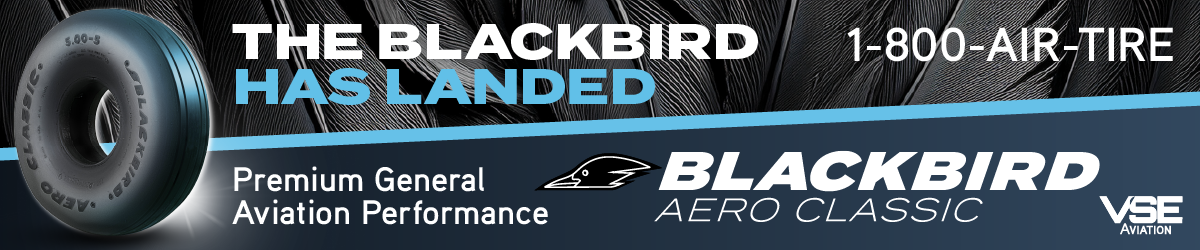
| | The Blackbird Has Landed: VSE Aviation’s New Tire Raises the Bar for General Aviation | |
VSE Aviation’s new Aero Classic Blackbird tire—building on the legacy of Desser Aerospace—is poised to set a new benchmark for value and durability.
A Next-Generation Tire for Demanding Operators
The Blackbird utilizes the latest, state-of-the-art materials and process engineering technology to deliver the best results at a great price point. The Blackbird is a fully belted, lightweight bias general aviation tire. Its high strength and lightweight tire carcass is designed for enhanced stability during taxiing, takeoff and landings, and the long wearing tread compound adds longevity to the wear characteristics built into the tire.
Blackbird tires have a generous tread depth—up to 24% deeper than competing designs—this tire offers more usable rubber, meaning operators can log more landings before replacement. The wide four-rib tread pattern gives a large contact patch for confident braking on both dry and wet runways.
Lower Cost Per Landing, Higher Value Over Time
While many tires claim longevity, the Blackbird backs it up with a design explicitly engineered for retreading. The robust belted carcass can be cycled through multiple retread processes without compromising integrity, a feature that significantly lowers cost per landing over the life of the tire.
VSE Aviation’s engineers also focused on the environmental and operational realities of flight schools—constant takeoffs, heavy crosswind landings, and high volumes of touch-and-go operations. The Blackbird’s multi-layer rubber compounds resist abrasion, UV degradation, and ozone cracking, giving it more of an edge in year-round, high-cycle use.
A Premium Tire, Without the Premium Price
For an industry that thrives on balancing performance with operating costs, the Aero Classic Blackbird arrives at exactly the right time. By combining next-generation construction with retreadable value, VSE Aviation has created a tire ready to meet the evolving needs of general aviation—one landing at a time.
Tailored for the Most Popular General Aviation Platforms
The Aero Classic Blackbird is available in two of the most popular sizes for general aviation aircraft, including:
- 5.00-5 6 PR
- 6.00-6-6 PR
- 6.00-6-8 PR
These sizes cover a wide range of general aviation aircraft from Cessna 120s to 210s, Piper PA20 to 46 series,Grumman Mooney and Beech trainers to a host of other single and light twin aircraft.
Operators interested in maximizing their tire investment can explore purchase and retreading options directly through shop.vseaviation.com or by calling 1-800-AIR-TIRE.
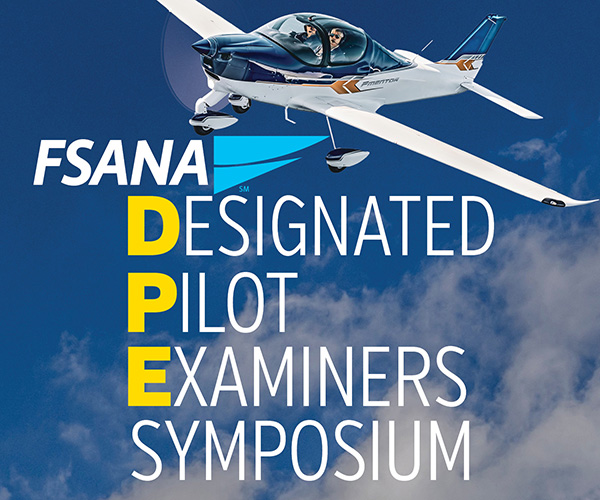
| | DPE Symposium to Be Held in Dallas, November 12, 13, and 14, 2025 | |
Bringing DPEs together for the fourth time, FSANA will again be hosting a DPE conference. This year's DPE Symposium will be held in Dallas on Wednesday through Friday, November 12, 13, and 14.
The goal of the conference has been and continues to be an effort to bring DPEs together to help standardization, help individuals who might be interested in becoming DPEs learn more about the process and potential, and bring FAA staff together with attendees to share information about FAA efforts, DPE practices, and currency.
A change to this year's conference: the last day of the conference is being crafted with the help of the FAA to be an event that will meet 24-month DPE currency requirements that are otherwise completed in an online training session. A goal of the FSANA DPE conference each year is to make each event, an in-person opportunity to share information and at the same time allow attendees to meet their every-other-year training requirements from the FAA for examiner currency.
FSANA looks forward to providing more information as the schedule is finalized and the hotel details become available. For now, if you are a DPE, keep November 12-15, 2025, open in your calendar and plan on joining FSANA and your fellow DPEs from around the country in Dallas.
| | Bryan Bedford Confirmed as Next FAA Administrator | |
Congress has recently confirmed Bryan Bedford as the next Federal Aviation Administration (FAA) Administrator. He will lead a workforce of more than 40,000 employees dedicated to ensuring the safe and efficient operation of the most complex national airspace system in the world.
“I’m grateful for the opportunity to join the FAA team. I have a deep respect for the important work FAA employees do to protect the safety and efficiency of our national airspace,” said new FAA Administrator Bryan Bedford.
Bedford brings more than 35 years of aviation experience to the FAA, including 26 years as CEO of Republic Airways. He will work closely with Transportation Secretary Sean P. Duffy to build a new, state-of-the-art air traffic control system.
“I look forward to working with Secretary Duffy and admire his leadership and commitment to delivering this new system within the next three to four years,” Bedford said. “We’re building a modern, resilient FAA—one that embraces innovation and is ready for the future demands of aviation.”
FSANA looks forward to working with Administrator Bedford and his team. "We are hopeful Administrator Bedford recognizes the vital role that the flight training sector plays in airman development and safety," said FSANA president & CEO Bob Rockmaker. "The United States Ab Initio flight training industry is critical to the continued development of safe airman for what we believe is the world's safest and best aviation system."
| | FAA Handbook and Knowledge Test Updates Coming Soon [for MOSAIC Effects] | |
Upcoming effective change dates for regulatory allowances from the recently published MOSAIC final rule will begin to effect pilot training information in the near future. As a result, the FAA will be updating testing and training documents to reflect these changes. When these documents become available, FSANA will provide links in future correspondence.
In the meantime, be aware that the FAA is intending to update some handbooks, specifically, with addendums developed to harmonize with the upcoming Modernization of Special Airworthiness Certificate (MOSAIC) Rule. They indicated that they will published these to the FAA website on October 22, 2025. The following handbooks are expected to have addendums:
• Airplane Flying Handbook (FAA-H-8083-3C)
• Pilot’s Handbook of Aeronautical Knowledge (FAA-H-8083-25C)
• Weight-Shift-Control Aircraft Flying Handbook (FAA-H-8083-5)
• Powered-Parachute Flying Handbook (FAA-H-8083-29)
• Weight and Balance Handbook (FAA-H-8083-1)
Training providers should also note that FAA Knowledge Test content will begin to reflect changes to match MOSAIC updates also in the near future.
Additionally, In December, 2024, the FAA implemented rule changes for Title 14 CFR Section 61.197 Recent Experience Requirements for Flight Instructor Certification and Title 14 CFR Section 61.199 Reinstatement of Flight Instructor Privileges. As a result, the affected Flight Instructor Airman Knowledge Test Questions (AKTQs) were revised to align with the content of the rule changes. These updates took effect on June 18, 2025.
| | ATP AMEL Certificate Production Year-to-Date in 2025 | |
by Jason Blair
The airline industry has seen reduced hiring in 2025, which has also led to a reduction in the production of ATP certifications. The largest numbers of ATP certifications typically happen concurrently with initial airline training, through the ATP-CTP course, and then the ATP certification that occurs with an initial type rating, most frequently at regional airlines.
Many regional airlines have reduced or fully stopped “new hire classes” in 2025, and we can see the effect of this in the current ATP certification trends year-to-date.
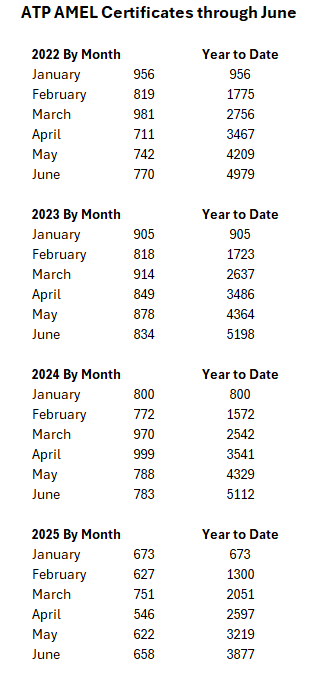
The table here shows a comparison of ATP certificate issuance month-by-month, looking back to 2022 when we saw some of the highest rates of hiring and certification coming out of the COVID pause.
When we compare the half-year point in 2025 to 2024, we see a nearly 25% drop in year-to-date ATP AMEL certifications this year comparatively.
When hiring does again ramp up, we will see those numbers likely correlate with increases of ATP certification as larger, Major airlines, hire pilots from the regional airlines and then the regional airlines are required to back fill those vacated positions with new hire classes again, resulting in new pilots being pushed through larger classes of initial ATP certification processes than we are currently seeing in 2025.
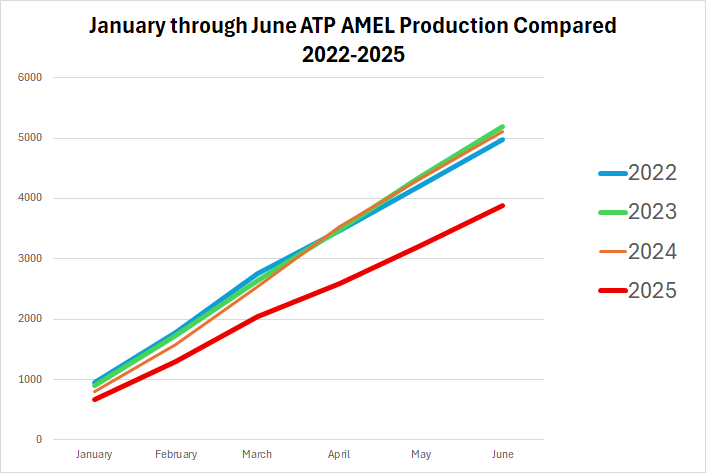
The graph below shows a visible trend of ATP AMEL production in 2022, 2023, and 2024, potentially showing a maximum production level. We can see that we have a differential from previous production in 2025 with a much lower trend line (the red one) that shows the gap in production so far this year.
| | FSANA Editor Releases New Book on Career Pilot Training Options | | |
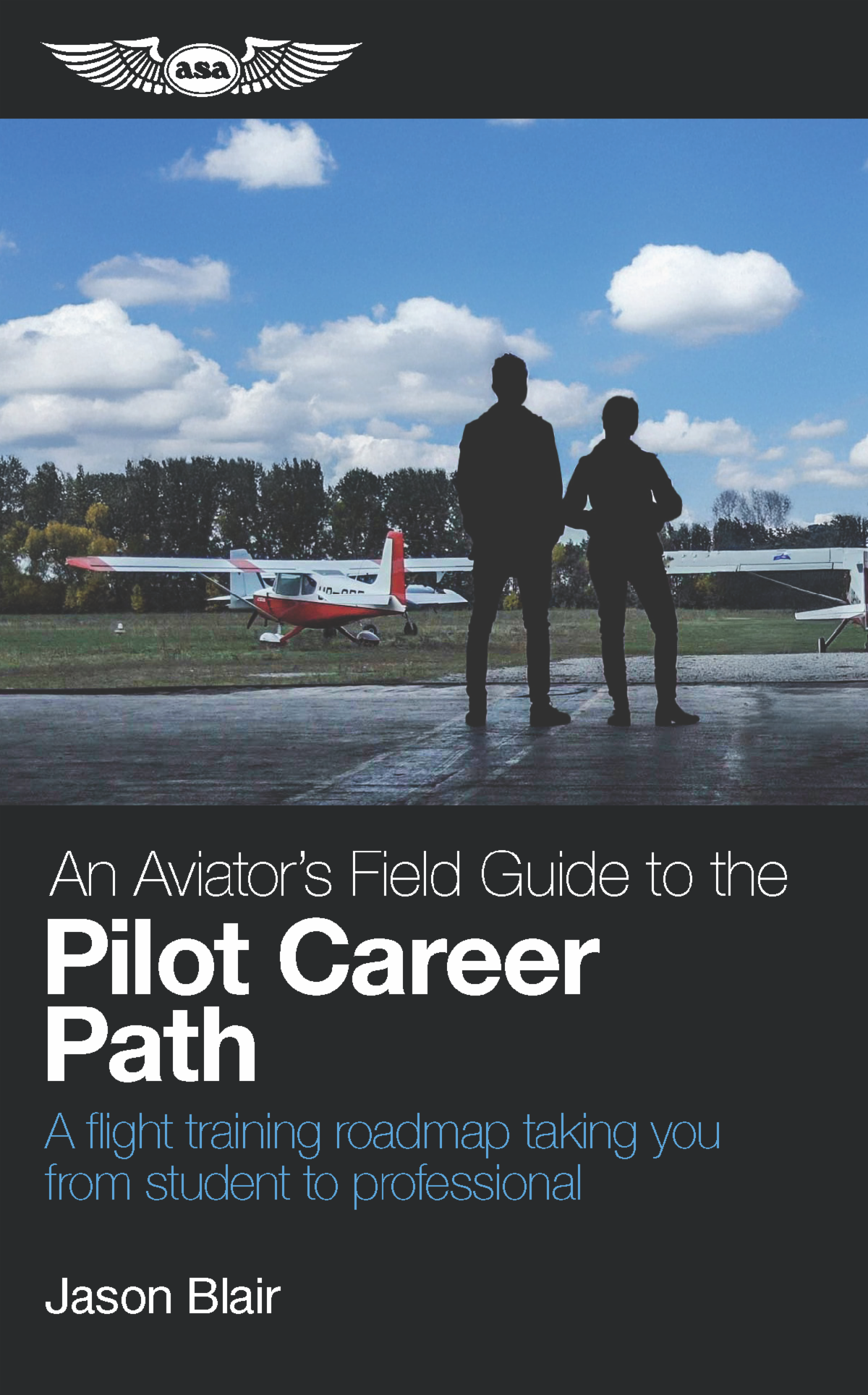
FSANA's own editor, Jason Blair, recently released a new book published by ASA, An Aviator's Field Guide to the Pilot Career Path, a book for anyone who is trying to navigate the path of pilot training with the end goal of becoming a career professional pilot.
Jason's experience as an instructor, DPE, and training industry professional is leveraged to give advice on how to navigate FAA medical processes, how to pick the best training provider for your own situation and needs, and much more.
Readers will learn about financing, training, medical concerns and questions, how parents can best help their children pursue the path, how to choose the best training provider, and how to be most efficient in training efforts. Pilot Career Path is a roadmap for pilots (and parents of pilots) seeking to understand the path from starting pilot training to being eligible to be a professional pilot in an airline, charter or corporate operator, and more. Ideal for STEM programs, young readers, and career guidance counselors.
Learn more about the book and how to get a copy for yourself, or to give to potential customers you work with as a flight training provider, to help answer many of their questions at:
www.thePilotCareerPath.com
This site also includes many other resources in addition to the book that flight training providers may find useful to share with their students, or parents of their students, who are trying to navigate the pilot training path.
| | ARTICLES OF INTEREST FROM THE INDUSTRY | |
|
FSANA has been collecting DPE names who have expressed a willingness to travel to help flight training providers secure practical tests.
The latest List of Travel-Willing DPEs with contact information is available on the FSANA website. If you are a flight training provider who is finding a challenge of scheduling DPEs in your local area, feel free to reach out to these individuals. They may be able to serve some of your local testing needs.
If you are a DPE who is not on this list but would like to be, please let us know. Write us at info@fsana.com with your name, city, state, email and phone number and we will add you.
| |
Email Feedback Concerns about FAA Practical Tests to:
| | |
Tell us what is important to you as a school owner, manager or chief flight instructor. We will share comments in an upcoming edition of Flight Training News. Send your thoughts to info@fsana.com.
| | | FSANA LEGISLATIVE ADVOCATES | | Legislative Advocates are flight schools, businesses and individuals who support FSANA’s efforts to advocate for public policy that benefits the flight training industry. | | FSANA SUPPORTING PARTNERS | | Annual Partners are flight schools, businesses and individuals who support FSANA’s ongoing efforts to strengthen the flight training industry. | |
V I S I O N A R Y •• P A R T N E R S
| |
D E V E L O P E R •• P A R T N E R S
| |
B U I L D E R •• P A R T N E R S
| | L E A D E R •• P A R T N E R S | |
Established in 2009, the Flight School Association of North America (FSANA) is the first and only association of its kind dedicated solely to the flight training industry. FSANA represents flight schools, firms that provide products and services to the flight training or aviation industry, and other supporting partners.
The Mission of the Flight School Association is to support, promote and advocate for the business of flight training; to provide knowledge, programs and services that help its members thrive and better serve their customers and communities; to foster best business practices; to educate and inspire youth; to increase the global pilot population; to improve general aviation safety; and to work in alliance with the aviation and aerospace industry.
| | | | |