Arizona’s 2026 Ballot Propositions: A Conservative-Principles Guide
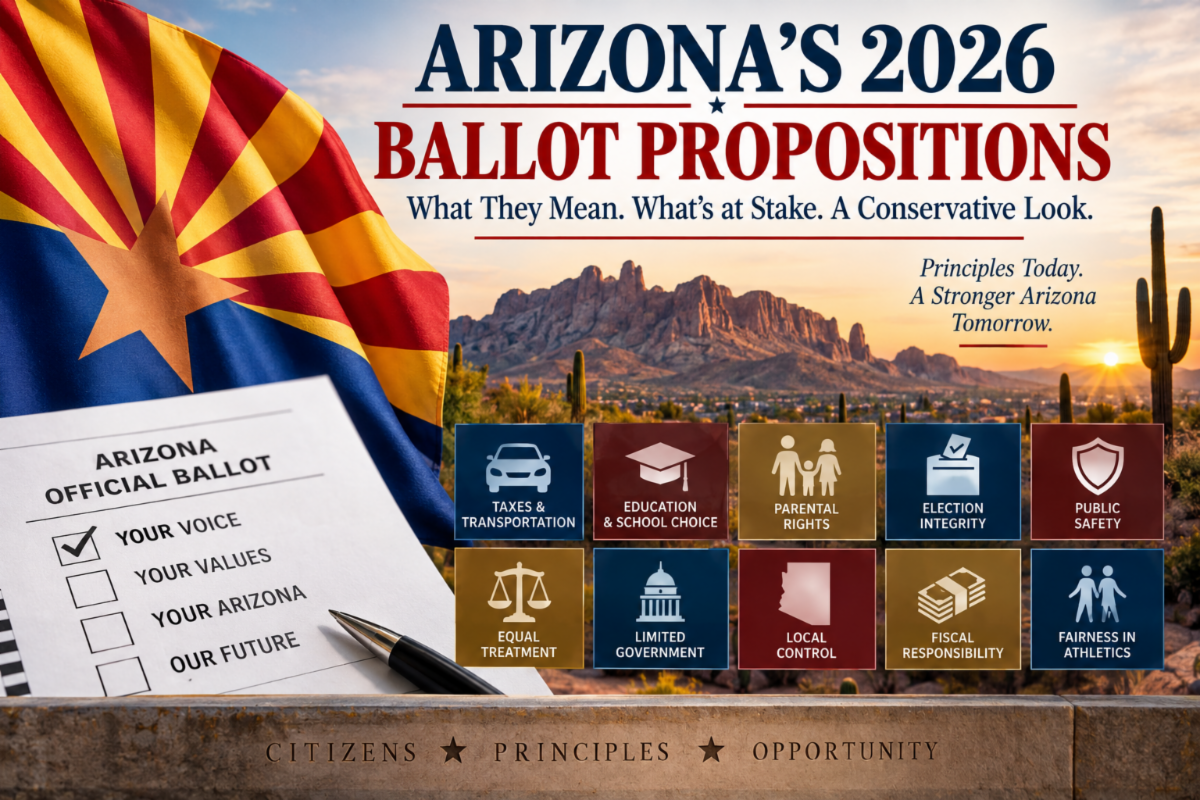
Arizona voters will have much more to decide on November 3 than who occupies elected office. The statewide propositions address taxes, government surveillance, elections, education, school choice, public safety, student athletics, photo radar and school spending.
Ballot propositions can be complicated, and sometimes the title tells only a fraction of the story. Rather than looking at them simply through a Republican-versus-Democrat lens, voters can examine them through traditional conservative principles: limited government, individual liberty, equal treatment under the law, fiscal responsibility, public safety, election integrity, parental authority, school choice, accountability and local control.
Those principles do not always point in exactly the same direction. A proposal limiting government power, for example, may also limit the authority of local voters or elected officials.
Here is what the propositions would do and some of the conservative principles involved
.
Proposition 141 — Vehicle Mileage Taxes and Government Monitoring - YES
Proposition 141 would amend the Arizona Constitution to prohibit state and local governments from imposing a tax or fee based on the number of miles someone travels in a motor vehicle.
It would also prohibit government from monitoring or limiting a person's vehicle mileage without that person's voluntary consent, with exceptions for certain interstate commercial vehicles and government-owned vehicles.
From a conservative perspective, two familiar principles are involved: taxation and privacy.
Conservatives have traditionally been skeptical of creating new forms of taxation and government monitoring of citizens' everyday activities. A vehicle-miles-traveled tax could potentially be considered in the future as electric and fuel-efficient vehicles reduce gasoline-tax collections. Proposition 141 would constitutionally prevent Arizona state and local governments from adopting such a tax.
There is also a privacy component. The proposition would restrict government from monitoring how many miles Arizonans drive without their voluntary consent.
The competing consideration is fiscal and local control. Roads still have to be built and maintained, and prohibiting this revenue mechanism would reduce the options available to future state and local governments.
Questions to consider: How much authority should government have to tax driving? Should government be able to monitor how many miles citizens drive without their consent?
Proposition 142 — Preferential Treatment, Discrimination and DEI - YES
Proposition 142 would amend the Arizona Constitution to prohibit the state, cities, towns, counties, public universities, community colleges, school districts and other political subdivisions from granting preferential treatment or discriminating based on race, sex, color, ethnicity or national origin in public employment, education and contracting.
It would also restrict government requirements involving specified race-based diversity, equity and inclusion concepts and prohibit certain expenditures of public money.
The conservative principles at the center of this proposition include equal treatment under the law, individual merit and limits on compelled speech.
Supporters of this approach argue government should judge people as individuals rather than granting preferences based on race or ethnicity. Critics question whether the language could restrict programs intended to address discrimination or limit the ability of universities and other public institutions to establish their own policies.
Questions to consider: Should government ever treat citizens differently because of race or ethnicity? How far should state government go in regulating what public institutions may require or fund?
Proposition 144 — Election Requirements - YES
Proposition 144 would amend the Arizona Constitution in several significant ways.
It would reaffirm that only U.S. citizens may register and vote in Arizona elections and require voters to present valid government-issued proof of identity before casting a ballot, as prescribed by law.
It would require voters to have the option of having their ballots tabulated at their voting location on Election Day and prohibit foreign nationals from contributing or spending money or anything of value to influence Arizona elections.
The amendment would also expressly allow Arizona voters and the Legislature to enact laws governing elections, including early and mail voting, when those laws are rationally connected to legitimate state interests such as accurate and timely results, efficient administration, election security and public confidence. The provisions would apply beginning with elections held on or after January 1, 2028.
The conservative principles involved include citizenship, election integrity, identification requirements, state authority and confidence in elections.
There is also an individual-access consideration. Identification requirements can be examined both for their security objectives and for how eligible citizens satisfy those requirements, particularly when voting by mail.
Questions to consider: What safeguards should Arizona require before a ballot is counted? What evidence should voters provide to establish identity? What balance should Arizona strike between accessibility and verification?
Proposition 316 — Taxes on Groceries - YES
Proposition 316 deals with municipal taxes on food intended for home consumption.
Municipalities that already imposed such taxes as of January 1, 2025 would face restrictions on increasing them, including voter-approval requirements. Jurisdictions that had not already approved such a tax would need voter approval before imposing one. The measure also establishes rate limitations and timing restrictions.
This creates an interesting conservative-policy tension.
One principle is lower taxes, particularly taxes on necessities such as groceries. Another is local control—whether state government should determine what individual Arizona communities may tax or whether local voters and elected officials should make those decisions.
Questions to consider: Should essential groceries be protected from increased taxation? Should statewide law restrict the taxing authority of local communities?
Proposition 317 — Drug Cartels as Terrorist Organizations - YES
Proposition 317 would declare drug cartels to be terrorist organizations under Arizona law and require the Arizona Department of Homeland Security to use all lawful means within its authority to address threats posed by cartels.
It also states that the measure does not support an alien's claim for asylum under federal law.
The conservative principles involved include border security, public safety, law enforcement and the proper division of state and federal authority.
A practical question is what additional effect the designation would have beyond existing state and federal criminal laws and what actions the Arizona Department of Homeland Security could take under its existing authority.
Questions to consider: What additional tools, if any, would this designation give Arizona? Which actions properly belong to state government and which belong to the federal government?
Proposition 318 — Student Athletics and Biological Sex - YES
Proposition 318 would require school athletic teams to be designated based on biological sex as recorded at birth on an athlete's original birth certificate. It would prohibit males, under the proposition's definition, from participating on teams designated for females.
The measure also applies biological-sex designations to private athletic spaces associated with sports, including restrooms, locker rooms and showers. Coeducational and mixed sports would remain permitted.
Conservative arguments surrounding this issue generally emphasize fairness in women's athletics, privacy and maintaining sex-based distinctions.
Opponents raise questions involving transgender students, equal access and whether state government should establish a single statewide rule for schools and athletic organizations.
Questions to consider: What does fairness require when athletic competition is divided by sex? How should schools protect privacy in locker rooms and similar facilities? Who should establish those rules?
Proposition 319 — Photo-Radar Enforcement - YES
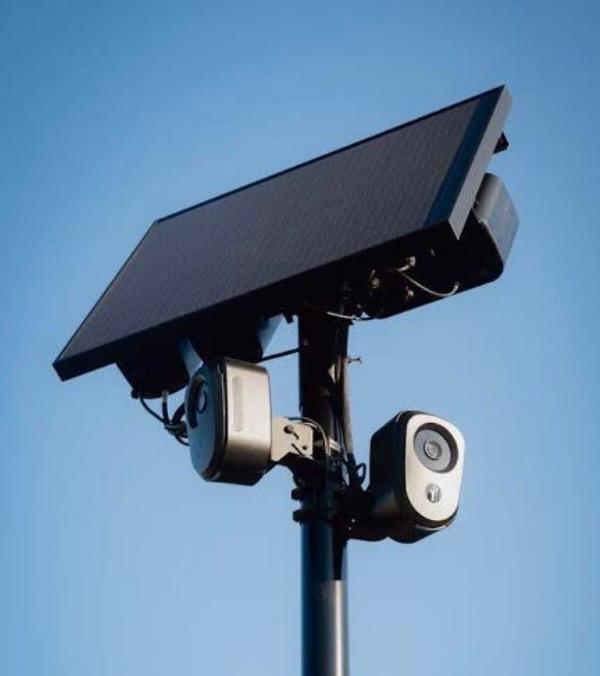
Proposition 319 addresses automated photo-enforcement systems used for speeding and traffic-control violations.
Jurisdictions without a qualifying contract by December 31, 2026 could not begin using such systems. Local governments with existing qualifying contracts would have to ask their voters whether the systems should continue.
If voters approve them, authorization would last ten years, after which voters would have to approve them again. If voters reject them, operation would have to cease within 90 days.
Several conservative principles intersect here.
There is limited government and privacy: should government cameras routinely photograph vehicles to enforce traffic laws?
There is due process and traditional law enforcement: should citations result from automated technology rather than direct observation by law enforcement?
But there is also local control. The proposition establishes statewide restrictions while giving voters in qualifying jurisdictions the ability to authorize continued use.
There is also a public-safety consideration because communities using automated enforcement may argue that the technology discourages dangerous driving without requiring an officer to be physically present.
Questions to consider: Should government use automated cameras for traffic enforcement? If so, should elected officials make that decision, or should voters periodically have the final say?
Proposition 320 — School District Spending - see article below
Proposition 413 — Maricopa County Public Safety and Jail Tax - YES
Proposition 413 asks Maricopa County voters whether to continue a dedicated sales tax used to fund the county's jail and criminal justice system.
The measure would extend the one-fifth-of-one-cent (0.2%) Jail Facilities Excise Tax for another 20 years. The existing tax is scheduled to expire in March 2027. Proposition 413 will appear on the November 3, 2026 General Election ballot.
The tax is a significant source of public-safety funding. Maricopa County budgeted approximately $288 million in jail-tax revenue for FY 2026, with collections projected to increase in future years.
The money supports services and infrastructure associated with the county's criminal justice system, including operating and maintaining adult and juvenile detention facilities, correctional health services, construction and renovation of detention facilities, probation programs and programs intended to reduce recidivism.
The need for long-term funding was examined by Maricopa County's Public Safety Funding Committee, which reviewed adult and juvenile detention facilities, the Jail Master Plan, capital needs, probation and other public-safety programs. The committee held public meetings and ultimately recommended a long-term funding approach that led to legislation allowing voters to consider extending the tax.
For conservatives, Proposition 413 brings two important principles into the same conversation: fiscal restraint and public safety.
Conservatives generally have good reason to scrutinize any tax. Government should be able to explain why the money is necessary, where it will go and whether taxpayers are receiving an essential service in return.
But maintaining jails and operating a functioning criminal justice system are core responsibilities of county government. The debate therefore is not simply about whether taxes should be lower. It is also about how Maricopa County should pay for responsibilities it is required to perform.
There is another fiscal consideration. A sales tax spreads the cost among purchases made throughout Maricopa County, including purchases by visitors, rather than placing the entire burden on property owners or requiring the county to find hundreds of millions of dollars elsewhere in its budget.
The current jail tax has also financed facilities that now require continued maintenance and, in some cases, substantial renovation or replacement. County officials have identified aging facilities including Towers Jail, Lower Buckeye Jail, Fourth Avenue Jail and Estrella Jail as having significant capital or maintenance needs.
That makes accountability particularly important. A 20-year tax represents a substantial commitment by taxpayers. Voters can reasonably expect transparent budgets, careful oversight, competitive contracting and evidence that the money remains focused on the public-safety purposes voters authorized.
Questions to consider: Are jails, detention facilities, probation and correctional services essential functions of county government? Is continuing a dedicated 0.2% sales tax an appropriate way to pay for those responsibilities? What would Maricopa County have to cut, delay or fund through other revenues if the existing tax expires? And what accountability should accompany a 20-year extension?
Public safety costs money. The important question for voters is not simply whether Proposition 413 involves a tax—it does—but whether this dedicated funding mechanism is the appropriate way to finance the jail and justice-system responsibilities Maricopa County must continue providing.
Read Beyond the Ballot Titles
Conservatives frequently talk about smaller government, lower taxes, individual freedom, secure elections, parental authority, school choice, equal treatment and local control. Arizona's 2026 propositions demonstrate why applying those principles can be more complicated than reading a campaign slogan.
A measure can limit government power while simultaneously limiting local control. A measure can impose statewide accountability while reducing discretion for locally elected officials. A proposal intended to strengthen public safety can also raise questions about privacy and government surveillance.
The Arizona Legislative Council has prepared impartial analyses of the ballot proposals. Those analyses are worth reading before filling out your ballot.
The question shouldn't simply be, "Who supports this proposition?"
Instead, ask:
What exactly does the proposition change? What authority does it give government? What authority does it take away? Who makes the decisions? What are the fiscal consequences? And how does it fit with the principles you believe government should follow?
Arizona voters will make those decisions on November 3.
|