|
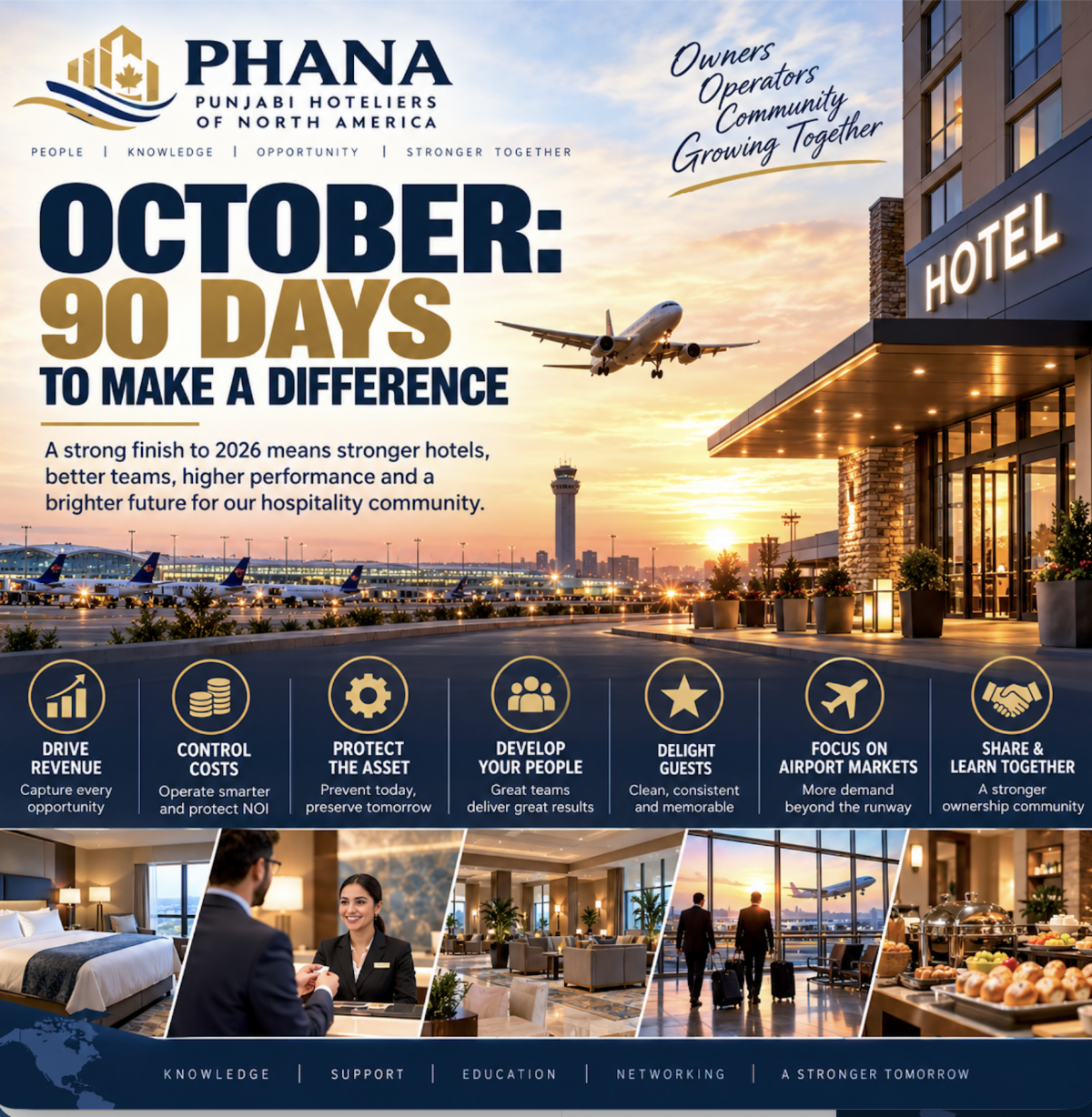
OCTOBER: 90 DAYS TO MAKE A DIFFERENCE
A Message to Hotel Owners & Operators from Punjabi Hoteliers of North America (PHANA)
As we enter October and the final quarter of 2026, there is plenty to be optimistic about in the hospitality industry.
The U.S. hotel industry sold a record number of room nights during the first half of 2026, and STR/Tourism Economics now forecasts approximately 4.4% RevPAR growth for the full year.
But every hotel owner knows something important:
Revenue growth doesn't automatically mean profit growth.
Insurance is expensive.
Labor is expensive.
Utilities are expensive.
Property taxes are increasing in many markets.
Franchise fees, technology, supplies, renovations and financing all continue to put pressure on hotel profitability.
AHLA reports that hotel operating costs have been rising significantly, with cost of goods, labor, utilities and insurance among the biggest concerns reported by hotel owners.
That means the final 90 days of 2026 should not simply be about filling rooms.
They should be about operating smarter.
1. Protect Every Dollar of Revenue
Owners should be asking their teams:
Are we capturing every available room night?
Are we pricing correctly for compression dates?
Are we actively calling local corporate accounts?
Are we watching our competitors?
Are we maximizing weekends?
Are we following up with groups?
Are we collecting cancellation and no-show revenue properly?
Are we reviewing discounts that may no longer be necessary?
A hotel can lose thousands of dollars without ever realizing where the leakage occurred.
Sometimes the biggest revenue opportunity isn't finding another customer.
It's capturing the revenue already sitting in front of us.
2. Stop Managing Hotels Only Through the P&L
The P&L tells us what already happened.
Great operators spend just as much time looking forward.
Every week, ownership and management should understand:
Next 7 days.
Next 30 days.
Next 60 days.
Next 90 days.
Look at occupancy on the books, ADR, pace, pickup, group blocks, local events, airline activity, corporate production and competitive pricing.
The earlier we identify a soft period, the more options we have.
Revenue management works best before the problem arrives.
3. Protect the Asset
When business is good, maintenance can easily get pushed to tomorrow.
Tomorrow eventually becomes a much larger capital expense.
Walk the property.
Look at the roof.
Check HVAC and PTAC performance.
Inspect plumbing.
Test emergency lighting.
Look at parking lots, exterior lighting and signage.
Inspect guestroom bathrooms, vents, caulking and water intrusion.
Review elevators and life-safety systems.
Look at your hotel through the eyes of someone considering buying it.
Preventive maintenance is not an expense. It is asset protection.
4. Don't Let Technology Replace Hospitality
Technology is transforming our industry.
AI can answer phones.
Revenue systems can change rates.
Digital check-in can speed up arrival.
Automation can improve productivity.
But none of these replaces genuine hospitality.
A guest still remembers being welcomed by name.
They remember someone solving their problem quickly.
They remember a clean room.
They remember a friendly breakfast attendant.
They remember the employee who went beyond what was expected.
Use technology to make your people more effective — not to make your hotel less human.
5. Cleanliness Still Wins
Owners sometimes search for complicated solutions to improve guest satisfaction.
Often the fundamentals create the biggest results.
A spotless bathroom.
Fresh bedding.
A clean breakfast area.
Working equipment.
A well-maintained exterior.
A lobby that smells fresh.
And a room inspected before the guest receives the key.
Before spending thousands of dollars trying to improve reputation scores, make sure the fundamentals are being executed every single day.
6. Develop Your People
Hospitality remains a people business.
The strongest hotels aren't necessarily those with the newest building.
They are often the hotels with the strongest culture.
Train your front desk.
Develop your housekeeping supervisors.
Teach your GM how to understand revenue.
Teach your maintenance team preventive maintenance.
Help employees understand why standards matter instead of simply telling them what to do.
And recognize people when they perform well.
Good employees are an expense on the P&L. Great employees are an investment in the asset.
7. Owners Must Become Students of Their Markets
Knowing your hotel is no longer enough.
Know your market.
What companies are expanding?
What companies are leaving?
What construction projects are starting?
What airlines are adding service?
What happens at the local airport?
What new hotels are being developed?
Which hotels are changing brands?
Where is population growing?
Where are employers hiring?
Where is infrastructure money being invested?
The hotel that understands tomorrow's demand generators has an advantage over the hotel waiting for yesterday's customers to return.
8. Airport Markets Show Why We Must Think Beyond the Hotel
Airport hotels are a perfect example.
An airport isn't just airplanes and passengers.
Around an airport can be airlines, logistics companies, rental-car operations, construction projects, training programs, manufacturers, government contractors, flight crews and corporate offices.
The opportunity for an airport hotel may therefore extend well beyond transient travelers.
Follow the economic activity around your hotel, not just the cars entering your parking lot.
9. Owners Need to Work Together
One of the greatest strengths of the hotel ownership community is knowledge.
Someone has already dealt with the problem you are facing today.
A renovation issue.
A lender.
A franchise negotiation.
A difficult vendor.
Insurance.
Property taxes.
Revenue management.
Technology.
Construction.
Labor.
The question is whether we are willing to share what we have learned.
That is one of the reasons organizations like Punjabi Hoteliers of North America (PHANA) matter.
When owners communicate, exchange ideas and learn from each other's experiences, the entire community becomes stronger.
Knowledge shouldn't stop at the front door of our own hotel.
Let's Finish 2026 Strong
We have approximately 90 days remaining in this year.
That's 90 days to improve guest satisfaction.
90 days to grow revenue.
90 days to control expenses.
90 days to develop our teams.
90 days to complete preventive maintenance.
90 days to strengthen relationships with our brands.
90 days to build new corporate accounts.
90 days to prepare our hotels for 2027.
And 90 days to help another hotelier avoid a mistake we have already learned from.
The hospitality industry has always rewarded resilient entrepreneurs.
Our parents and grandparents taught many of us the value of hard work.
Our responsibility today is to combine that work ethic with data, technology, education, collaboration and disciplined execution.
Let's use October as a reset.
Better hotels.
Stronger operators.
Smarter ownership.
A stronger hospitality community.
Here's to a successful October and a strong finish to 2026.
Punjabi Hoteliers of North America (PHANA)
Owners helping owners. Operators learning from operators. A community growing together.
#PHANA #PunjabiHoteliers #HotelOwners #Hospitality #HotelIndustry #HotelOperations #HospitalityLeadership #HotelManagement #HotelInvestment #RevenueManagement #AssetManagement #GuestExperience #AirportHotels #HotelLeadership #HospitalityCommunity
|