Request for Public Comment: Interagency Arctic Research Policy Committee Draft Arctic Research Plan. | |
The Interagency Arctic Research Policy Committee (IARPC) has released a draft of the Arctic Research Plan 2022-2026 for public review in the Federal Register. The comment period will close on June 11, 2021. The draft plan addresses the most pressing Arctic research needs that require a collaborative approach and that can advance understanding of the Arctic, inform policy and planning decisions, and promote the well-being of Arctic and global communities. Download the plan and learn how to comment at iarpccollaborations.org/draft-plan.html
The Federal Register
| |
|
|
In support of U.S. Northern Command's Arctic mission, please consider joining Lt General David Krumm, USAF, Commander Alaska Command, Alaska NORAD Region and 11th Air Force and a host of Defense and Security Leaders for Arctic Senior Leader Summit 2021 (ASLS 21) 10-11 March 2021. This event is oriented to addressing senior leader strategic views on the developing range of security and defense matters affecting the Arctic region. Due to the on-going complications of in-person meetings as a result of COVID 19, Arctic Senior Summit 2021 will be conducted via video conference. Day 1 of ASLS 2021 is focused on plenary presentations and follow-on strategic discussions. Day 2 ASLS 2021 is a planned tabletop exercise. Further details and registration to be provided soon via ASLS 21 planning team at the Arctic Domain Awareness Center.
Arctic Senior Leader Summit 2021
| |
|
|
What localized temperature control measures might mitigate permafrost thaw, supplementing global decarbonization efforts?
Event Link
| |
Nano-engineered Sponge Could Soak Up Oil Spills in Cold Arctic Waters | |
A sponge coated with a paraffin-like material can suck up 99 percent of oil from water at low temperatures, offering a solution to crude oil spills in Arctic environments. Such spills happen with worrying frequency, but in the cold, oil can be more difficult to clean up. At low temperatures, crude oil’s heavier compounds, including the roughly 2.44 percent of the oil that is natural paraffin wax, begin to crystallize. The paraffin crystals then try to link together, which creates larger, stickier masses. Pre-existing clean-up technologies struggle to pick up this thicker, stickier oil
New Scientist
| |
Russian Scientists Developed Composite-Based Floating Modules for Arctic Infrastructure Projects | |
The modules can be used for establishing different bases without capital construction. Russian scientists have developed floating modules based on composite substructure for infrastructure projects in the Arctic, Oleg Timofeyev, Dean, Faculty of Shipbuilding and Ocean Engineering, St. Petersburg State Marine Technical University, said at the 4th International Congress “Hydraulic Engineering Structures and Dredging” being held by PortNews Media Group in Moscow.
Port News
| |
|
The Heavy-Duty Ship the US Needs to Protect Its Thawing Border with Russia ‘Is Just Falling Apart,’ Captain Says | |
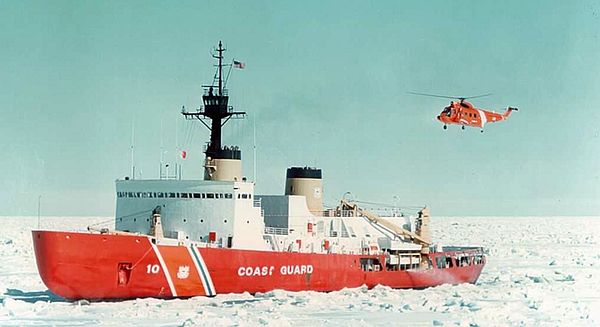
The months-long Arctic operation that Coast Guard icebreaker Polar Star finished last month was a rare mission for the US's sole heavy icebreaker. It was the first time a US icebreaker had been in the Arctic in winter since 1982. The crew overcame "treacherous" conditions, but they also grappled with a problem aboard the ship that may hinder the US's Arctic ambitions.
Business Insider
| |
|
|
Climate change is rapidly changing the Arctic at the same time that security tensions are heightened across the region. How will future climate impacts affect the security environment, operations, and infrastructure of the region? How do Arctic nations understand the changing risk landscape? How can Arctic nations move forward on a "low tension, high effort" agenda in the climate era? Join the Polar Institute of the Wilson Center for a high-level discussion on the intersection of climate change and security in the Arctic, and dialogue on opportunities to manage future security risks in the region. Panelists will build on the findings and recommendations of two new reports: Climate Change and Security in the Arctic; and a Climate Security Plan for Canada.
Event Link
| |
|
Come celebrate our colleague and friend Simon Stephenson as he retires from federal service. As Section Head for Arctic Sciences at NSF, Simon led international and inter-agency engagement in support of the broad research goals of the Arctic Sciences Section. He provided the vision and has been the engine behind IARPC Collaborations for the past decade. We welcome an opportunity to honor these and his many other contributions to Arctic research. Old friends near and far are invited to share stories, raise a toast, and join in the celebration of Simon who has positively impacted so many.
Event Link
| |
|
|
Data from animal-borne sensors offer a growing source of global remote sensing monitoring data. Combining these data allows ecologists to answer questions about biodiversity and long-term, large-scale patterns in animal behavior in relation to changing environments... As climate change and human disturbance increasingly alter the Arctic, the AAMA offers a 30-year data record that can serve as a baseline for documenting whether and how animals respond, and to recognize early signals of local or large-scale Arctic ecosystem changes.
Event Link
| |
|
The Arctic Domain Awareness Center's (ADAC) Arctic Challenges, Innovations, and Commerce Expo (Arctic CICE) seeks to explore the networks, resources, and infrastructure needed to enable the commercial entrance of Arctic-related products and technologies into the Arctic domain. This expo will use an interdisciplinary and collaborative approach to foster conversations around Arctic-centered business pressure points, state-of-the-Arctic-focused R&D, gap analysis of investment and innovation, and the future of business in the region. Participants will be exposed to the latest hardware, software, and people-ware emerging to advance domain awareness, risk mitigation, exploration, Arctic operations, and overall, Arctic security.
Event Link
| |
|
This meeting is part of the ASM3 webinar series and will focus on Theme 3: Respond: sustainable development; evaluation of vulnerability and resilience; application of knowledge.
Event Link
| |
|
|
Are there that measures to complement global decarbonization efforts that might reduce emissions from permafrost thaw? What is currently available or under investigation, and what actions or research might reveal or advance emission interventions?
Event Link
| |
|
The Norwegian Ministers of Foreign Affairs and Defense join the Atlantic Council, alongside two conversations on trends driving the future of Arctic security and on bridging perspectives between Europe and North America on key security issues. This half-day conference will feature conversations with the Norwegian Minister of Foreign Affairs Ine Eriksen Søreide and Minister of Defense Frank Bakke-Jensen, as well as two discussion sessions featuring experts on Arctic and transatlantic security, as well as national perspectives from other Arctic nations.
Event Link
| |
** New this week ** Looking North: Conference on Security in the Arctic, 9:00 am EST on March 19, 2021 (virtual) | |
The Norwegian Ministers of Foreign Affairs and Defense join the Atlantic Council, alongside two conversations on trends driving the future of Arctic security and on bridging perspectives between Europe and North America on key security issues. This half-day conference will feature conversations with the Norwegian Minister of Foreign Affairs Ine Eriksen Søreide and Minister of Defense Frank Bakke-Jensen, as well as two discussion sessions featuring experts on Arctic and transatlantic security, as well as national perspectives from other Arctic nations.
Event Link
| |
|
On behalf of the Portuguese Minister of Science, Technology and Higher Education, the Portuguese Foundation for Science and Technology (FCT) and the Local Organizing Committee we are pleased to invite you to take part in the Arctic Science Summit Week 2021. Framed by the overarching theme for the Science Conference "The Arctic: Regional Changes, Global Impacts", Lisbon invites International experts on the Arctic and Indigenous Peoples to discuss the "New Arctic" and also its impacts and interactions to and with the lower latitudes.
Event Link
| |
|
|
SOFWERX, in collaboration with Dr. Lilian Alessa, the USSOCOM J5 Donovan Strategy and Innovation Group, will host a Disruptive Speaker Series, led by Dr. Lilian "Doc" Alessa, entitled, "A Turmoil of Shadows: The Hidden Facets of Arctic Threats and the Role of USSOCOM in Ensuring Stability." The presentation will address the roles that the SOF Enterprise, as a force multiplier, could be responsible for in the emerging Arctic operational environment. While SOF maintains a standard of being able to operate in any conditions anywhere in the world, the Arctic is emerging as a more nuanced and complex theater.
Event Link
| |
|
|
When considering the Permafrost Carbon Feedback, is there REALLY time to wait for action? Considering PCF and the current goal of global decarbonization by 2050, this last dialogue discusses requirements in research and policy, and what stakeholders can do to ensure that governments around the world address this critical topic with urgency.
Event Link
| |
|
The Arctic Domain Awareness Center (ADAC) and the North American and Arctic Defense and Security Network (NAADSN) will host this event as a follow up meeting on the Advancing Collaboration in Canada-U.S. Arctic Regional Security (ACCUSARS) conference in September 2020. The purpose of ACCUSARS II is to create a subset Strategic Foresight Assessment (SFA) for the North American Arctic, by specifically focusing on Alaska and Western Canada.
Event Link
| |
|
This is expected to be the largest circumpolar One Health conference held in the United States in 2021, with participation anticipated from across the Arctic region. The event is part of the United States contribution to One Arctic, One Health, an Arctic Council project now in its sixth year of operation. The project aims to develop a circumpolar network of One Health experts that can share knowledge, conduct exercises, and spur collaborative investigations of One Health phenomena.
Event Link
| |
|
|
This meeting is part of the ASM3 webinar series and will focus on Theme 4: Strengthen: capacity building; education; networking; resilience-prepare the next generation.
Event Link
| |
|
Organizers announce, that due to the coronavirus outbreak, the 2nd Symposium on Polar Microbes and Viruses has been postponed to 2021. This symposium will bring together molecular microbial ecologists specializing in different organism groups to share our latest results and discuss methodological problems, as well as future prospects in the field, including practical international collaborations. The environmental focus will be on cryospheric environments including sea ice, glaciers, ice sheets, and permafrost, but excellent research in other polar environments is also invited. The methods to be discussed will focus on 'omics' techniques, ranging from single cells to metagenomes, but research using additional methods is encouraged as well.
Event Link
| |
|
This event is hosted by the Arctic Domain Awareness Center. This workshop will be an assessment of the future maritime transportation system of the Bering, Chukchi and Beaufort sea regions.
Event Link
| |
|
The Japanese and Icelandic organizers of this ministerial continue to plan for an in-person ministerial, in Tokyo, but have moved the dates from November 21-22, 2020 to May 8-9, 2021 because of Covid-19. Since the last Arctic Science Ministerial in 2018, changes in the Arctic ecosystem and the resulting impacts locally and globally have been severely felt. Considering the need for climate change mitigation, adaptation, and repair measures, the relevance of an international Arctic Science Ministerial has never been greater. It is necessary to strengthen scientific cooperation and collaboration among both Arctic and non-Arctic States in order to develop our understanding of the rapid changes impacting the Arctic. The First Arctic Science Ministerial (ASM1) was hosted by the United States in 2016, and two years later, the Second Arctic Science Ministerial (ASM2) was co-hosted by Germany, Finland, and the European Commission. ASM3 will be co-hosted by Iceland and Japan.
Event Link
| |
|
Department of Homeland Security S&T OUP Centers of Excellence Summit, May 18-21, 2021 (virtual) | |
DHS S&T's Centers of Excellence (COE) Summit is set and focused on Homeland Security Challenges: Evolving Threats & Dynamic Solutions. This event is a special opportunity for COE researchers to connect and network with DHS components, federal, state, and local stakeholders, as well as industry partners to present current and emerging solutions to threats and challenges faced by DHS. Attendees can visit the Innovation Showcase, where COE and vendor partners showcase research breakthroughs, new products and tools to assist operational decision-makers and dynamic solutions to secure our Homeland.
No event link
| |
|
ADAC will conduct the Center's Program Year 7 Annual meeting to focus on U.S. Coast Guard Project Champions, key stakeholders and the community of Arctic science and technology researchers. Included in the Program Year 7 Annual meeting are planned guest speakers from HQ U.S. Coast Guard, DHS S&T and senior Arctic Research leadership in Washington D.C.
Event Link
| |
|
This meeting is part of the ASM3 webinar series and will focus on the post-ministerial review: joint statement actions.
Event Link
| |
|
For the first time, a Regional Conference on Permafrost will be combined with the bi-annual 19th International Conference on Cold Regions Engineering. This conference is hosted by the US Permafrost Association, the American Society of Civil Engineers, the International Permafrost Association, the Permafrost Young Researchers Network, and the University of Colorado Boulder. A complete list of planned sessions is available here.
Event Link
| |
|
External links in this publication, and on the USARC's World Wide Web site (www.arctic.gov) do not constitute an endorsement by the US Arctic Research Commission of external Web sites or the information, products, or services contained therein. For other than authorized activities, the USARC does not exercise any editorial control over the information you may find at these locations. These links are provided consistent with the stated purpose of this newsletter and the USARC website. | | | | |