Quick, Timely Reads
On the Waterfront
|
|
Gridley Park:
Bay Rat Retreat with Dose of Naval History
|
|
Dr. David Frew, a prolific writer, author, and speaker grew up on Erie's lower west side as a proud "Bay Rat," joining neighborhood kids playing and marauding along the west bayfront. He has written for years about his beloved Presque Isle and his adventures on the Great Lakes. In this series, the JES Scholar-in-Residence takes note of life in and around the water.
|
|
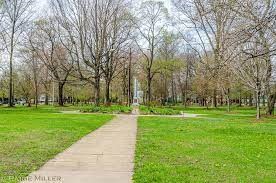
Gridley Park at West Sixth and Liberty streets |
|
Just a few blocks south of the bayfront there was a groomed park with benches, trees, manicured lawns and more. It was Gridley Park, a combination getaway, baseball diamond and football field during the 1950s, a place where we often interacted with the “normal” people from the neighborhood. Home plate was near North Park Avenue and Plum so that we hit balls to the east and along the north side of the paved sidewalk that connected to the park’s center garden. Balls hit to the south of the walkway were “automatic outs.” We played football on the opposite side of the west park, near Liberty Street where there was a flat area unobstructed by trees. We also rode bikes around the paved pathways. Several of us had learned to ride two-wheelers (before training wheels there was road rash) at the park. |
|
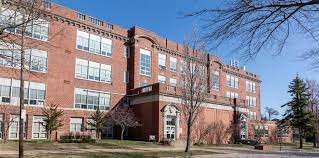
Gridley, built in 1914, was a massive and sprawling four-story middle school during the 1950s. |
|
During an era when there were more kids every year (post World War II baby boom), the northeast side of Gridley Park housed Gridley, a large neighborhood middle school that seemed to have bigger crowds of kids every year.
Gridley School offered two important activity centers for us. The west side of the school had a wooden bicycle shelter that beckoned to us since it had a roof that we climbed. There was nothing quite as exciting for a Bay Rat as scaling the side of a neighborhood outbuilding with a roof – an early form of summit fever. Once positioned on the roof of the Gridley bike shelter, we could see almost forever in any direction, or so we imagined. The more interesting area was on the east side of the school where we played “PG ball” with broomsticks for bats and small plastic, practice golf balls. The east side of the school was an ideal plastic ballfield since it was sheltered from prevailing southwesterly winds and squared off and lined into a traditional looking area that served as a baseball diamond. Hundreds of exciting games were played there over the years and dozens of kids participated.
Gridley Park was one of three green spaces proposed on the original town map by the surveyor who first laid out the new town of Erie in 1795. Andrew Ellicott (Ellicottville, N.Y.) imagined a narrow city that stretched from the Bayfront to 12th Street. Thinking that there should be communal green spaces within the narrow boundaries he identified a park in the center of the city, today’s Perry Square, and two additional green areas on the east and west edges of the city. The western park was named “Cascade Park” in the early plans and retained that name from the founding of Erie until 1913.
|
|
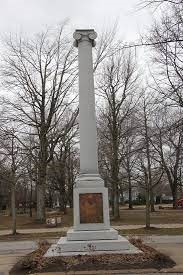
The 1913 statue, memorializing Charles V. Gridley, stands between the east and west parks on Liberty Street at West Sixth Street |
|
The year 1913 was an important turning point for the city of Erie. That was the year that the 100th anniversary of the Battle of Lake Erie was celebrated both here and at Put-In-Bay, Ohio. Huge patriotic local celebrations that year included the raising of the Brig Niagara from the mud of Misery Bay and the reconstruction of the famous War of 1812 ship that became the fleet flagship during the battle when Commodore Oliver Hazard Perry had to leave the Brig Lawrence. The experience of 1913 raised the awareness of Erie’s historic role as a military Mecca and in addition to celebrating Perry and the War of 1812 a citizens’ group proposed the celebration of another (almost) local naval hero, Charles V. Gridley. With a new school scheduled to open at the park the next year (1914), it was determined that both the school and the park would be named for Erie’s Spanish American War hero. |
|
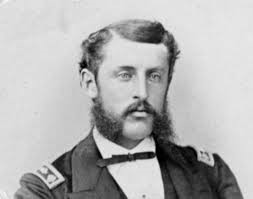
Charles V. Gridley, dashing young naval officer and local hero |
|
Charles Gridley was born in Indiana in 1844 and grew up in Michigan. After graduating from the Naval Academy, he served in the United States Navy for several years before he was assigned to Erie to be in charge of the U.S.S. Michigan (later changed to Wolverine). He took over as Captain of the Michigan in 1871 and found that winters, when the lakes were iced in and the ship was “stuck” in port, were his best times. The dashing young naval officer began to mix in Erie’s social scene, where he met and fell in love with Ellie Vincent, daughter of a local judge and relative of Erie’s celebrated Civil War hero, General Strong Vincent. Gridley and his fiancée were married in 1872 after which they settled into a downtown home and eventually had three children. From that time forward, Gridley considered Erie to be home and spent much of the rest of his career seeking assignments that would keep him close to his family. From 1871 to 1891, for example, he was assigned to Lighthouse District #10, which included Lake Erie, Lake Ontario, and the St. Lawrence River. Being stationed on the eastern Great Lakes (and the St. Lawrence River) allowed him to spend time with his family between sailings.
Gridley’s fame came as a result of the 1898 Battle of Manila Bay in the Philippines. The late 1800s were a time of increasing tension between Spain and the United States, and American citizens who lived on the West Coast were concerned of an imminent attack at one of their newly developing and vulnerable Pacific Coast cities. The United States Navy did not have a naval presence in California since development there was so new. That was why it was deemed that a naval fleet should cross the Pacific and engage the Spanish, preemptively. Even though the epicenter of the Spanish American War was in Cuba, off America’s Atlantic Coast, when Admiral Dewey learned that the Spanish feet was in the Philippines allegedly arming and supplying itself for some purpose he decided to act. An attack on the American West Coast could have been a part of a Spanish plan.
|
|
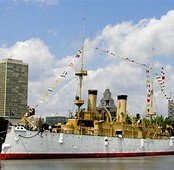
The Olympia, looking almost like a modern warship, is now a museum ship
berthed in Philadelphia, Pennsylvania
|
|
Armed with intelligence suggesting that the Spanish fleet was anchored in Manila Bay, Dewey sent his fleet to engage them, and the captain of the fleet’s largest and most powerful ship was Erie’s Charles Gridley. Aboard the 344-foot, modern steel warship, Olympia, which was rated at an astonishing 5,800 tons (a massive ship for its time). Gridley led a fleet of nine ships into Manila Bay and began firing at the anchored and almost helpless Spanish fleet. While it was later reported that the Spanish fleet had the upper hand since there were 13 ships to Gridley’s nine, the majority of the Spanish ships were old, dated, and wooden. Two of them were unable to move under their own power. It was at this battle that the famous command, “You may fire when ready, Gridley,” was uttered. Admiral George Dewey telegraphed the message to Gridley, who was the commander of the fleet’s lead ship just before the shooting commenced.
Gridley led his nine-ship fleet into Manila Bay and made a preliminary run past the anchored Spanish ships and just out of range of their antiquated guns. The American ships then pummeled the anchored Spanish fleet with shells. After a few runs, however, there was a mid-battle miscommunication within the American fleet followed by a withdrawal. Somehow Dewey thought that his ships had run out of ammunition, which was not the case. The ships departed Manila Bay, sailed offshore and re-organized a few miles away. With the ammunition prepared, Dewey decided to reinitiate the attack but first he ordered a stop for breakfast. Meanwhile, the Spanish, which had been lulled into thinking that the battle was over, turned their attention to tending to the wounded and dead. Unfortunately for them, however, the battle had barely begun. A few hours later, after their breakfast break, the American fleet led by Gridley aboard Olympia retuned with a vengeance, making several runs past the disabled Spanish fleet, and essentially annihilating it. Spanish ships were left burning and sinking with 77 dead and 271 wounded sailors. The American fleet suffered only nine wounded. One sailor died during the battle but of a heart attack rather than battle injuries.
|
|
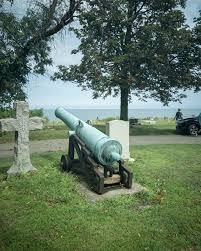
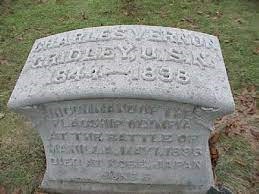
Lakeside Cemetery on East Lake Road in Erie |
|
To the world it looked as though the United States Navy had suddenly emerged as the most powerful military force on the planet. Not only had it defeated the powerful British Navy in Lake Erie in 1813 (even if it was just the Lake Erie squadron), but it also had crushed the Spanish on the other side of an ocean. Sadly, Charles Gridley fell ill almost immediately after the battle. He had been suffering and looked ill at Manila Bay but refused to leave his post. When the fighting was over, he was taken to sick bay, where he was treated for exhaustion. Dewey wanted to have him sent to a naval hospital to be treated but Gridley, who was despondent, chose to resign and return to his family in Erie. Gridley’s condition worsened rapidly, and he died in Kobe, Japan on his way to the United States. He was cremated and returned to Erie, where he was buried on Lake Erie at the recently opened Lakeside Cemetery in east Erie.
Gridley was widely celebrated as a naval hero, especially in Erie. Subsequent analysis of the battle, however, questioned the second wave of the attack as having taken advantage of a mortally wounded enemy instead of reaching out in traditional naval style to offer assistance. Dewey’s defenders argued that he could not have realized the sad state of the bedraggled Spanish fleet and performed precisely as he should have, meeting an enemy fleet with maximum.
|
|
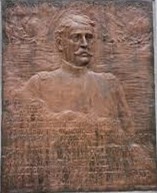
Smitten as the Bay Rats were with recreational opportunities at Gridley Park, we did not fully appreciate the historical significance of its namesake and naval hero. We walked past his image on the mid-park statue and sometimes stopped to read the inscription on the monument but the history surrounding the Spanish American war mostly escaped us. Until now. |
|
The plaque on the Gridley Monument was crafted of metal salvaged from a naval ship. |
|
Accidental Paradise Available at TRECF!
Accidental Paradise
by Dr. David Frew and Jerry Skrypzak
|
|
The beautiful book on Presque Isle published by authors David Frew and Jerry Skrypzak – “Accidental Paradise: 13,000-Year History of Presque Isle” – is on sale at the Tom Ridge Environmental Center’s gift shop and through a special website, AccidentalParadise.com.
The book, priced at $35 plus tax and shipping, can be ordered now through the website sponsored by the TREC Foundation, AccidentalParadise.com.
Presque Isle Gallery and Gifts on the main floor of TREC, located at 301 Peninsula Drive, Suite #2, Erie, PA 16505 will also handle sales daily from 10 a.m. to 4 p.m.
For more information, send an email to aperino@TRECF.org.
To watch "Accidental Paradise: Stories Behind The Stories" click here.
|
|
ABOUT THE AUTHOR
Historian and author David Frew, Ph.D., is a Scholar-in-Residence at the JES. An emeritus professor at Gannon University, he held a variety of administrative positions during a 33-year career. He is also emeritus director of the Erie County Historical Society/Hagen History Center and is president of his own management consulting business. Frew has written or co-written 35 books and more than 100 articles, cases, and papers.
|
|
|
|
|
|
|